


Mobile advertising has shifted from an emerging channel to an essential component of brand strategy. In the U.S., companies are increasingly allocating budgets to reach consumers on smartphones and tablets, while globally the shift toward mobile-first behaviours is clear. For example, a retail brand uses mobile‑only campaigns to drive in‑store footfall, and a media company deploys app‑based video ads to capture younger audiences. This article explores key data and trends shaping mobile advertising, and invites you into a deeper dive into the full landscape.
Editor’s Choice
- The global mobile advertising market is projected to reach approximately $447 billion in 2025, representing over half of total digital ad spending.
- In the U.S., mobile ad spend is expected to top $228 billion in 2025, up from around $202.6 billion in 2024.
- Mobile devices generate roughly 72% of global internet traffic, highlighting the scale of mobile reach.
- Digital channels now account for 72.7% of worldwide ad investment in 2024, with mobile as a major driver.
- Mobile search ads in the U.S. alone were projected at $81.5 billion in 2024, representing the largest mobile format spend.
- Programmatic display advertising worldwide will account for nearly 90% of digital display ad dollars by 2025.
- The average eCPM (effective cost per mille) for banner ads in mobile apps is forecast to reach approx $2.80 by the end of 2024.
Recent Developments
- In Q1 2025, nearly 50,000 mobile games launched advertising campaigns, up about 30.6% versus the same period in 2024.
- Also in Q1 2025, non‑gaming mobile apps launched roughly 109,000 advertised products, representing a 43.7% year‑on‑year increase.
- The U.S. report notes that while mobile ad spend will grow in 2025, heavy tariffs may reduce growth by an estimated $14 billion.
- The emphasis on short‑form video and video‑sharing apps is increasingly driving mobile ad budgets, as indicated by rising market size projections.
- Advertisers are shifting tactics from desktop-first to mobile‑first creative, as mobile becomes the default channel for audience engagement.
- With the rise of 5G and faster mobile connections, advertisers are leveraging richer formats such as interactive and augmented reality on mobile.
- There is a noticeable slowdown in growth rate compared to earlier years, while 2024 saw ~14.4% growth in U.S. mobile ad spend, 2025 is projected at ~12.6%.
- The global mobile advertising market continues to attract investment from emerging regions, altering regional dynamics and competition.
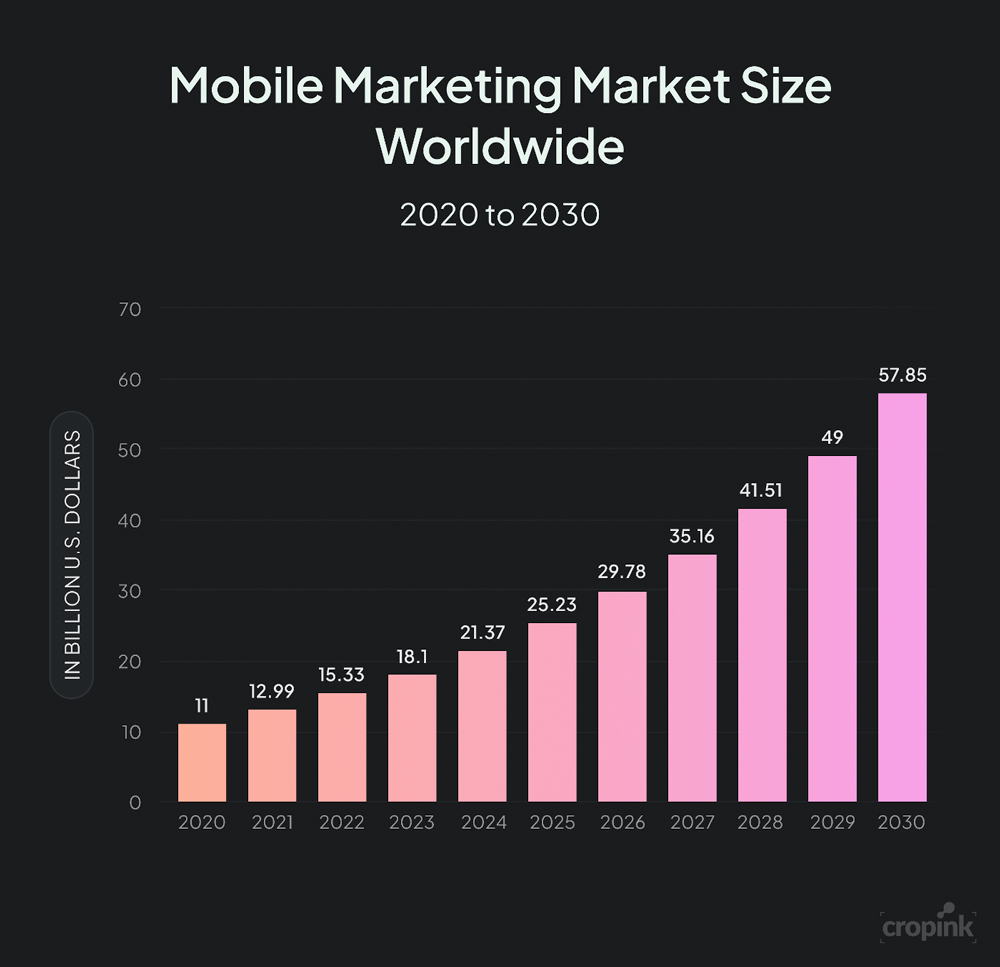
Mobile Marketing Market Size
- The global mobile marketing market shows a strong upward trend from 2020 to 2030.
- Market size grows from $11 billion in 2020 to $57.85 billion by 2030, indicating sustained expansion.
- The period reflects consistent year-over-year growth, with no dips or stagnation.
- Early growth:
- 2020–2023: increases from $11B → $18.1B, showing accelerating adoption of mobile-first strategies.
- Mid-decade shift:
- 2024–2027: a significant rise from $21.37B → $35.16B, reflecting deeper integration of mobile ads, apps, and personalized campaigns.
- Late-decade surge:
- 2028–2030: sharp climb from $41.51B → $57.85B, showing increasing investment, AI-driven mobile experiences, and mature global markets.
- The market nearly quintuples over the decade.
- Average annual growth is strong, pointing to a high-potential, high-scalability sector.
- The data suggests that businesses leveraging mobile marketing will likely benefit from massive audience reach, AI-enhanced personalization, and increased consumer mobile usage.
- The steady growth demonstrates how critical mobile channels have become in digital marketing ecosystems worldwide.
Mobile Advertising Growth Trends
- U.S. mobile ad spend grew at 11.5% in 2022, 9.4% in 2023, and is projected to grow 14.4% in 2024, followed by ~12.6% in 2025.
- Globally, mobile ad spend grew about 8% from 2022 to 2023, from ~$333 billion to ~$362 billion.
- Forecasts indicate a CAGR of more than ~14% for the mobile advertising market between 2025 and 2029.
- The shift of ad budget to mobile means that mobile’s share of digital ad spend continues to expand, rather than plateauing.
- Short‑form video mobile ads, such as in streaming apps and social platforms, are growing faster than traditional banner or display mobile ads.
- The cost efficiencies offered by mobile targeting, location data, and device‑specific ad formats drive growth in mobile ad spend.
- Mobile ad growth in mature markets such as the U.S. and Europe is slower than in emerging markets, where growth rates remain higher due to a lower base and infrastructure investment.
- Advertiser budgets are increasingly shifting from desktop and traditional formats to mobile, reinforcing growth trends.
US Mobile Advertising Spend
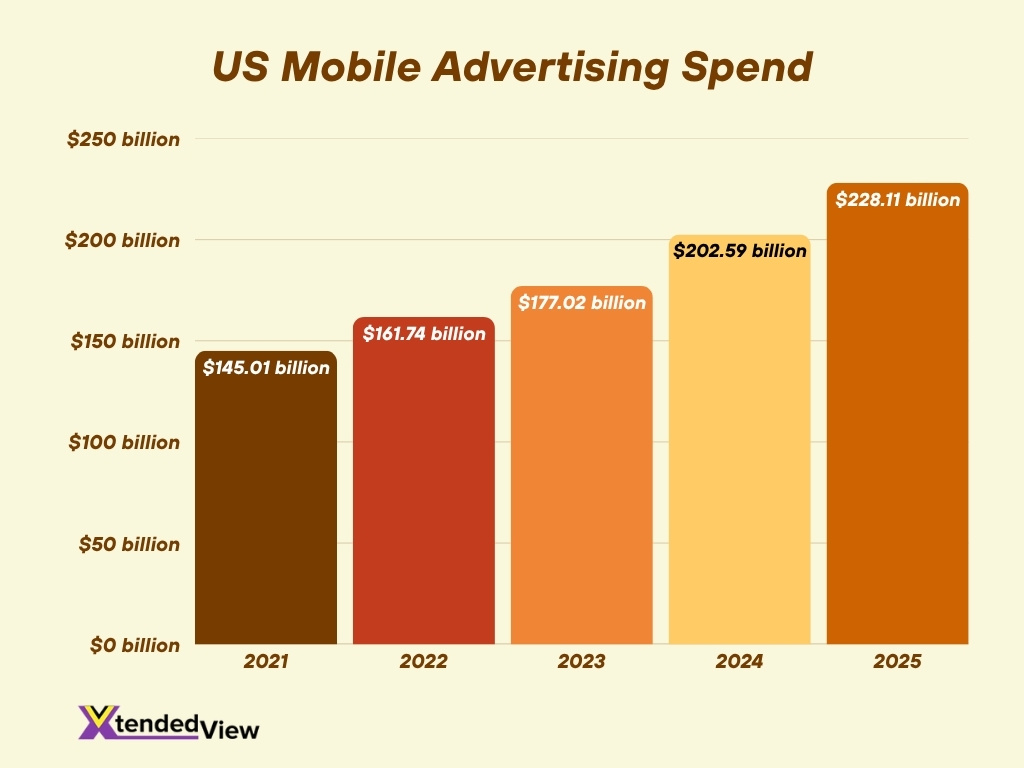
- The US mobile ad market shows strong year-over-year growth throughout the 2021–2025 period.
- Spending rises from $145.01 billion in 2021 to $228.11 billion in 2025, reflecting a sharp upward trajectory.
- 2022 sees an increase to $161.74 billion, indicating continued expansion in mobile-focused marketing strategies.
- By 2023, spending reaches $177.02 billion, demonstrating brands’ growing reliance on mobile devices for ad delivery.
- The jump to $202.59 billion in 2024 showcases accelerating digital transformation and increased consumer mobile engagement.
- The projected $228.11 billion in 2025 highlights the dominance of mobile as a central advertising channel in the U.S.
- Overall, the market grows by more than $83 billion over five years, showing strong investment confidence.
- Data suggests mobile advertising is becoming an essential pillar for businesses aiming to reach always-connected audiences.
Share of Mobile in Digital Advertising
- In the U.S., mobile advertising made up about 65.7% of total digital ad spend in 2021, 65.6% in 2022, 65.5% in 2023, and is projected at 66.4% in 2025.
- Globally, mobile is expected to represent more than 50% of digital ad budgets by 2025.
- Digital ad spending globally is projected to hit ~ $790 billion in 2024, with mobile being a major component.
- Mobile’s increasing share is driven by users’ preference for mobile browsing, app usage, and mobile‑first access in many regions.
- As mobile ad formats become more sophisticated, such as video, interactive, and location‑based, their share relative to fixed or digital legacy formats continues rising.
- Mobile search advertising alone in the U.S. reached $81.5 billion in 2024, serving as a large part of mobile’s digital share.
- Programmatic mobile ads are accelerating faster than traditional desktop display ads, thus reinforcing mobile’s share growth.
- Some sources claim mobile devices will generate about 70% of total digital ad revenue by 2025.
Mobile Advertising by Region
- The Asia‑Pacific region now commands the fastest growth rate in mobile advertising, while the U.S. remains the largest single market.
- In 2024, unique mobile subscribers worldwide grew by 112 million, representing ~2.0% YoY growth, signalling saturation in some mature markets.
- In the U.S., mobile ad spend was projected to exceed $216 billion in 2025.
- North America held approximately 33.7% of the global mobile advertising market in 2024.
- India’s digital ad market was expected to reach ~₹62,045 crore or ~$25 billion by 2025, with digital’s share around 44‑45%, trailing the global average.
- China and the U.S. together accounted for over 80% of worldwide retail‑media ad spending in 2025.
- Emerging markets such as Africa, Latin America, and Southeast Asia are showing double‑digit growth in mobile ad spend year‑on‑year, though from smaller bases.
- In Asia’s app economy, in 2024, user‑acquisition spend neared $70 billion, underscoring performance ad growth there.
Number of Global Mobile Users
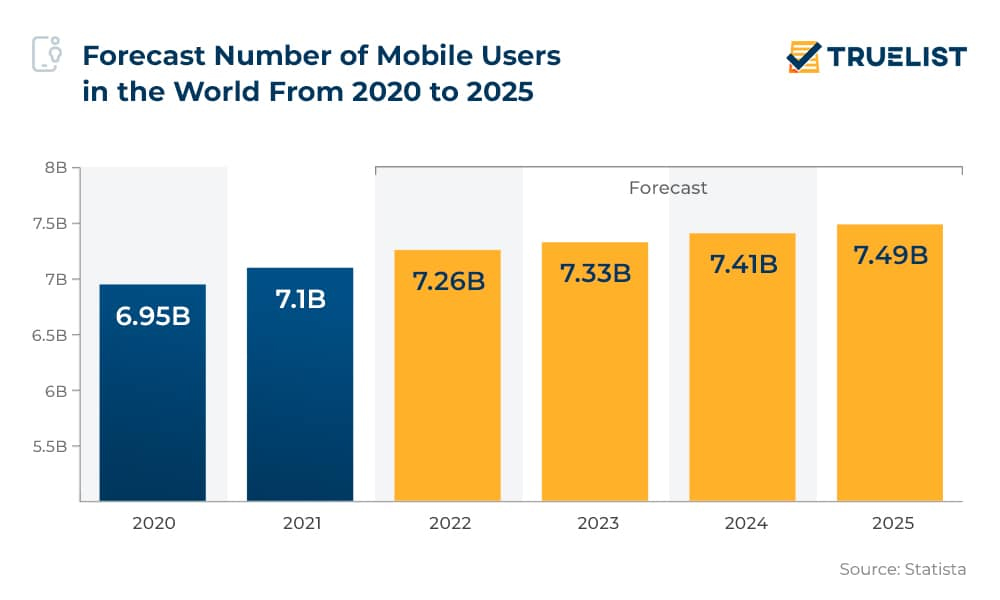
- The number of mobile users worldwide shows consistent growth from 2020 onward.
- In 2020, there were 6.95 billion mobile users globally.
- By 2021, this figure rose to 7.1 billion, crossing the 7-billion mark.
- The upward trend continues with 7.26 billion users in 2022.
- 2023 sees further expansion, reaching 7.33 billion mobile users.
- In 2024, the projected number increases to 7.41 billion.
- The forecast for 2025 estimates 7.49 billion mobile users worldwide.
- Overall, from 2020 to 2025, the global mobile user base is expected to grow by over 540 million users.
- The steady rise highlights the increasing dependence on mobile connectivity, expanding digital access, and widening global penetration.
Mobile Advertising by Platform (In‑App, Mobile Web)
- In the U.S. in 2025, mobile ad spend is projected at $228.12 billion, of which ~$187.78 billion is expected to go to in‑app ads and ~$40.34 billion to mobile‑web ads.
- In‑app advertising globally is growing rapidly, with mobile advertising expected to expand from $262.84 billion in 2025 toward $1,005.96 billion by 2032.
- Approximately 60% of mobile ad impressions are expected to come from in‑app environments in 2025.
- Mobile web traffic in Q3 2025 reached 62.73% globally, indicating that while in‑app dominates ad impressions, mobile web remains a key channel.
- In‑app ads benefit from richer targeting, such as user behaviour, location, and time of day, compared with mobile‑web banners.
- Programmatic advertising tends to favour in‑app inventory because of better measurement and dynamic optimization.
- Mobile web still plays a strong role in reach and discovery, especially in markets where app penetration is lower, or browser is the point of entry.
- Advertisers increasingly allocate budgets based on “app‑first” strategies, especially in gaming, finance, and lifestyle apps.
Mobile User Demographics and Reach
- As of early 2025, about 5.78 billion people use a mobile phone globally, roughly 70.5% of the world’s population.
- Smartphones account for around 87% of mobile handsets in use globally.
- In the U.S., approximately 52% of the general population primarily uses mobile search. For Gen Z, the figure is around 80%.
- Globally, 65.7% of the population were active social‑media users in 2025, with the average user engaging across ~6.84 different platforms per month.
- In 2025, mobile users were about 63% more likely to shop from a company that has a mobile site or app with tailored product recommendations.
- Roughly 49% of mobile users use their device to compare prices, check reviews, or redeem mobile coupons.
- Among smartphone users, about 40% are more likely to make impulse purchases than desktop users because of convenience and mobile‑tailored experiences.
- While mature markets show high saturation, many emerging‑market mobile users still use feature phones or lower‑end smartphones, affecting ad reach strategies.
Mobile Ad Formats (Video, Banner, Native, etc.)
- Video advertising on mobile continues to expand, with U.S. mobile video ad spend reaching approximately $58.92 billion in recent data for mobile formats.
- Banner ads remain significant, with U.S. mobile banner ad spend at about $50.96 billion in the latest data.
- In‑app ad formats often achieve higher eCPMs than mobile‑web banners, with interactive and rewarded video formats commanding premium rates.
- Native ads that match the app or site content are increasingly used on mobile, as users shift away from intrusive formats.
- Short‑form vertical video formats, especially on social platforms, are growing faster than traditional mobile display banners.
- Rich formats such as augmented reality and playable ads are gaining traction in mobile gaming apps, especially in in‑app inventory.
- The share of banner ads is gradually declining in favor of video and native mobile formats, as advertisers prioritize engagement over reach.
Mobile Social Media Advertising Statistics
- As of 2025, over 5.07 billion people use social media worldwide, with more than 98% accessing it via mobile devices.
- Mobile social ad spend in the U.S. is projected at $95.9 billion in 2025.
- Short‑form video platforms like TikTok and Instagram Reels now capture over 40% of total mobile social ad views.
- Facebook mobile advertising accounted for more than 94% of its total ad revenue in 2024.
- Snapchat and TikTok saw a 24% increase in mobile ad engagement year over year, particularly among Gen Z audiences.
- Mobile click‑through rates for social ads average 1.3% on Instagram, 1.6% on Facebook, and over 2.5% on TikTok.
- Interactive ad formats such as polls, stories, and swipeable content perform better in mobile environments compared to static ads.
- U.S. users spend an average of 2 hours and 30 minutes per day on social media apps, driving mobile-first advertising demand.
- Ad spending on influencer campaigns viewed via mobile is expected to surpass $7.14 billion in 2025.
Mobile Search Advertising Statistics
- Mobile search ad spending in the U.S. reached $81.5 billion in 2024, making it the largest mobile ad format.
- By 2025, mobile is expected to drive 75% or more of all paid search clicks in the U.S.
- Mobile search click-through rates (CTR) average 4.1% across industries, slightly higher than desktop CTR.
- Mobile users are 50% more likely to click on a search ad when looking for local information or immediate needs.
- Voice search on mobile now contributes to 27% of total mobile queries, creating new opportunities for ad placement.
- Paid search ads on mobile have a lower average cost-per-click (CPC) than desktop, with many industries averaging $1.16.
- Mobile search conversions are most common in retail, travel, and services, especially when paired with responsive landing pages.
- Search ad extensions, such as location, call, or app install links, increase engagement by 15% to 20% on mobile.
- Retailers with mobile-optimized ad experiences report 2.3x higher ROAS compared to non-optimized campaigns.
Mobile Programmatic Advertising
- Programmatic mobile ad spend is projected to reach $170 billion globally in 2025.
- Nearly 90% of all display advertising in the U.S. is now purchased programmatically, with mobile comprising a major share.
- In-app programmatic spending has grown 31% YoY, outpacing desktop and mobile-web formats.
- Real-time bidding (RTB) dominates programmatic mobile advertising, accounting for 65% of mobile transactions.
- Header bidding adoption on mobile rose to 56% of publishers using it in 2025, improving monetization across apps.
- Mobile programmatic ads using contextual targeting have improved campaign ROI by 23% post-cookie decline.
- Cross-device programmatic campaigns are gaining adoption, particularly for retargeting across mobile apps and the web.
- Private marketplaces (PMPs) account for 32% of programmatic mobile inventory purchases, offering better quality control.
- Programmatic audio and video formats are emerging strongly in mobile DSPs, supported by in-app integrations.
Effectiveness and ROI of Mobile Ads
- Mobile ads can deliver up to 89% better engagement rates than desktop ads.
- The average ROI across all advertising channels in 2025 is estimated at $3.42 earned for every $1spent.
- Every $100 spent on mobile app advertising correlates with ~37 paid installs plus ~3 organic installs, suggesting 7.5% higher effectiveness when spillover is included.
- Mobile campaigns now often outperform traditional formats when optimized for mobile-first creative and targeting.
- Many campaigns underperform due to poor mobile experience, weak targeting, or audience mismatch.
- Cross-device and cross-channel behavior complicate attribution for mobile ad effectiveness.
- Marketers expect a 5:1 profit ratio as a benchmark for performance-focused mobile campaigns.
- Measurement frameworks now include mobile viewability, session length, and incremental lift alongside clicks.
Mobile Ad Engagement Rates
- The average click-through rate (CTR) for mobile ads is around 0.59% in 2025.
- In-app ads on iOS games report a CTR of 4.27%, and 3.34% on Android.
- Non-gaming mobile app CTRs are around 3.01% on iOS and 2.43% on Android.
- In the retail industry, the average in-app interaction rate is 22%.
- Media & entertainment apps achieve the highest interaction rates at 29%.
- Around 72% of users launch retail apps five times or fewer per month, while 13% use them ten or more times.
- Apps consistently outperform mobile web in user engagement metrics such as session depth and tap-throughs.
- Marketers are shifting away from CTR and toward behavioral indicators like time-in-app and tap sequences.
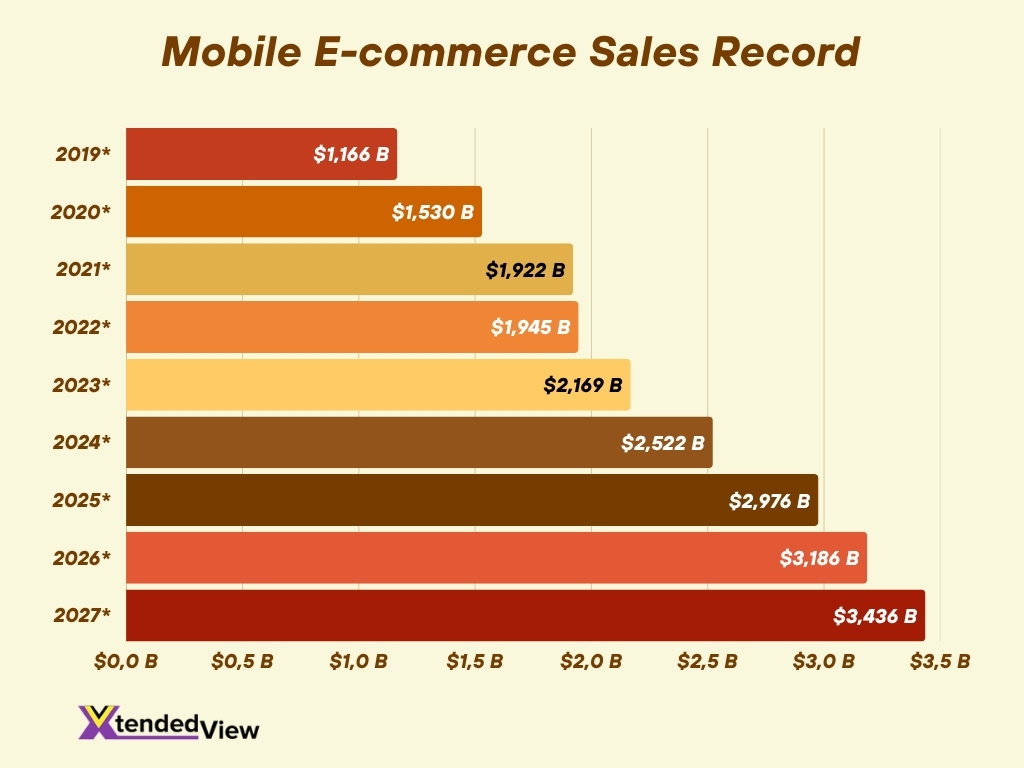
Mobile E-commerce Sales Recorded Worldwide
- Mobile e-commerce continues to show strong year-over-year growth, with sales increasing steadily across the last decade.
- In 2018, global mobile e-commerce sales stood at $982 billion.
- The market crossed the $1 trillion threshold in 2019, reaching $1,166 billion.
- By 2020, sales rose to $1,530 billion, accelerating alongside increased digital adoption.
- In 2021, mobile e-commerce reached $1,922 billion, reflecting continued expansion in online shopping behaviors.
- 2022 saw another boost, hitting $1,945 billion globally.
- In 2023, sales climbed further to $2,169 billion, marking the beginning of the $2 trillion+ era.
- Forecasts suggest that by 2024, mobile e-commerce sales will reach $2,522 billion.
- Projections for 2025 estimate a rise to $2,976 billion, nearing the $3 trillion mark.
- By 2026, predicted sales will be $3,186 billion, surpassing the threshold.
- The upward trajectory is expected to peak at $3,436 billion by 2027, highlighting the global dominance of mobile commerce.
- Overall, from 2018 to 2027, mobile e-commerce is set to more than triple, demonstrating the sector’s explosive and sustained growth.
Mobile Ad Conversion Rates
- Average mobile conversion rates for retail stand at ~2.8%, slightly below desktop at ~3.2%.
- Mobile apps deliver conversion rates 157% higher than mobile websites.
- Average order value on mobile apps is ~15% higher than on mobile websites.
- Cross-device behavior is common, with mobile used for research and desktop used for purchase.
- Checkout design and user flow play critical roles in lifting mobile conversion performance.
- Conversion rates vary widely across verticals, with travel, finance, and fashion performing best.
- App install campaigns show better retention and purchase rates when timed with promotions.
Location-Based Mobile Advertising
- Location-based mobile advertising uses GPS, beacons, and Wi-Fi to trigger ads based on proximity.
- Brands report that location targeting lifts conversion rates by 20% or more.
- Mobile users receiving location-triggered offers are more likely to visit stores within a few hours.
- Around 74% of U.S. shoppers use their phones for product research while inside stores.
- Location-based ads bridge online-to-offline experiences and drive measurable foot traffic.
- 5G and improved mobile sensors are increasing the accuracy and effectiveness of location triggers.
- Opt-in and privacy compliance are essential for location-based ad success.
- Combining location with contextual signals boosts campaign relevance and user experience.
Mobile Ad Fraud Statistics
- Around 22% of all digital ad spend is estimated to be lost to fraud, totaling $84 billion.
- The projected global cost of mobile ad fraud in 2025 is $41.4 billion.
- Paid search click fraud rates reach 14% to 22%, with mobile particularly exposed.
- Up to 15% of global mobile media spend is wasted on fraudulent traffic and invalid clicks.
- Without user tracking, publisher ad prices drop 18% to 23%, affecting revenue.
- Ad fraud distorts attribution and undermines trust in mobile ad performance.
- Mobile-specific fraud methods include click injection, ad stacking, and device farms.
- Anti-fraud investments are increasing in tools, verification platforms, and third-party audits.
Future Predictions for Mobile Advertising
- Mobile advertising is expected to grow by $430.9 billion from 2025 to 2029.
- Mobile ad formats like short-form video and interactive ads will dominate future spend.
- Mobile commerce growth will continue to fuel ad innovation and targeting advancements.
- The global share of mobile in digital advertising is forecast to exceed 56% by 2025.
- Privacy regulation will reshape measurement and tracking in mobile environments.
- Expect more consolidation of ad tech tools focused on mobile-first strategies.
- Fraud prevention and transparency will become strategic requirements for mobile campaigns.
- Mobile-first creative and audience-first strategies will dominate media planning.
Frequently Asked Questions (FAQs)
Approximately US $447 billion.
Around 56%.
US $202.59 billion, with about 14.4% growth.
Around 14.3%.
About $390 billion, making up roughly 82.3 % of mobile ad spending.
Conclusion
Mobile advertising is no longer a side channel; it stands at the core of digital marketing and commerce strategies. With mobile ad spend surpassing $200 billion in the U.S. and global mobile ad markets crossing $400 billion, the scale and reach are clear. The strongest returns and engagement come from mobile-optimized formats, apps, and devices designed with mobile behavior in mind. Yet challenges remain: conversion rate gaps, ad fraud, and evolving measurement models mean advertisers must stay vigilant.
As mobile commerce continues booming and mobile ad growth remains robust, brands that embrace mobile-first execution, performance measurement, and user-friendly experiences will be best positioned for success.
