



The global picture of wealth is shifting as the number of individuals with a net worth of at least $1 million continues its rise. Financial‑service firms and wealth‑management groups report that this upward trend reflects both recovering markets and expanding investment access. In corporate settings, for example, financial advisors are tailoring services to a growing base of affluent clients, while real‑estate developers are increasingly targeting luxury housing in emerging markets where millionaire populations are climbing. Explore the breakdown of these trends and what they mean for wealth‑creation at scale.
Editor’s Choice
- The global millionaire population reached approximately 60 million adults in 2025.
- Over 379,000 new millionaires were created in the U.S. in 2024 alone, more than one per minute, on average.
- The U.S. continued to hold about 35 % of global personal wealth by early 2025.
- One country, the United Arab Emirates (UAE), is projected to attract 9,800 new millionaires in 2025, with an estimated wealth inflow of ~$63 billion.
- The number of millionaires worldwide is expected to grow by approximately 5 million over the next five years.
- In 2025, the top three countries (the U.S., China, and France) combined account for more than half of the global millionaire total.
- Globally, millionaires represent roughly 1.5 % of the adult population.
Recent Developments
- In 2024, more than 684,000 people worldwide became new millionaires.
- The U.S. added more than 379,000 new millionaires in 2024, over 1,000 new millionaires each day.
- Wealth migration is increasing; 142,000 millionaires are projected to relocate globally in 2025.
- The UAE is the fastest‑growing destination, with a projected net inflow of 9,800 millionaires in 2025.
- The U.S. expects a net inflow of 7,500 millionaires in 2025, representing approximately $43.7 billion in wealth.
- China is showing signs of stabilization in millionaire outflows, with an estimated 7,800 millionaires leaving in 2025, its lowest outflow in years.
- The proportion of global adult wealth tied to millionaires continues to increase despite macroeconomic headwinds.
- Emerging markets are contributing more to millionaire growth as high‑net‑worth individuals (HNWIs) roots expand beyond traditional centres.
Global Millionaire Population Statistics
- The global number of millionaires reached approximately 60 million adults in 2025.
- Another source reports over 80 million millionaires globally as of early 2025 (though definitions vary).
- Millionaires represent roughly 1.5 % of the world’s adult population.
- Since the year 2000, the number of dollar‑millionaires in major countries has more than quadrupled.
- In selected major economies, in 2024, the U.S. hosted ~23.8 million millionaires, China ~6.3 million.
- Global personal wealth rose by about 4.6 % in 2024.
- The U.S. region saw wealth growth of over 11 % in 2024, contributing significantly to the rise in millionaires.
- Forecasts indicate the millionaire population will increase by ~5 million over the next five years.
- Wealth accumulation among millionaires remains unevenly distributed; the U.S. holds a disproportionate share of wealth compared to the share of people.
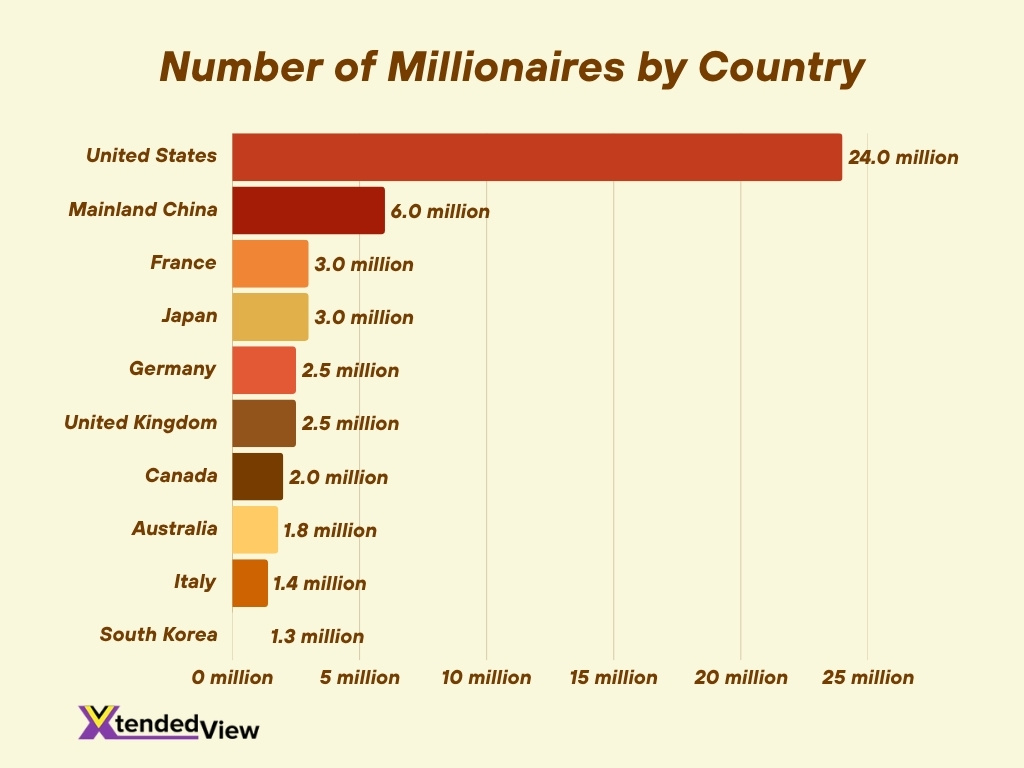
Number of Millionaires by Country
- The United States has by far the highest number of millionaires, with about 24 million individuals.
- Mainland China follows as the second-largest group, with approximately 6 million millionaires.
- European countries show notable representation:
- France: around 3 million
- Germany: about 2.5 million
- United Kingdom: roughly 2.5 million
- Asian economies also appear prominently:
- Japan: nearly 3 million
- South Korea: about 1 million
- Other developed nations included:
- Canada: around 2 million
- Australia: close to 1.8 million
- Italy: about 1.4 million
- The chart highlights a significant global wealth concentration, with the US alone accounting for over one-third of global millionaires.
Distribution of Millionaires by Continent/Region
- North America (primarily the U.S.) dominates in terms of millionaire numbers and total wealth held.
- Europe holds a significant share, but its growth rate for millionaires is slower compared to the Asia‑Pacific.
- Asia‑Pacific is emerging rapidly, and while starting from a lower base, it shows faster percentage growth in millionaires.
- Latin America, Africa, and the Middle East currently account for smaller shares of global millionaires, but growth potential exists as regional economies expand.
- The wealth‑migration “Safe‑Haven 8” countries (Switzerland, Singapore, UAE, Malta, Monaco, New Zealand, Australia, Mauritius) have seen foreign‑born millionaires represent over 50 % of local centi‑millionaire stocks.
- Emerging‑market regions show increasing numbers of millionaires but still lag developed regions in per‑adult density.
- Investor‑friendly regions and cities are becoming hubs for wealth creation and residence, affecting regional millionaire patterns.
- Global wealth concentration means that a small number of regions host a disproportionate share of millionaire wealth relative to their population.
Richest Cities by Millionaire Concentration
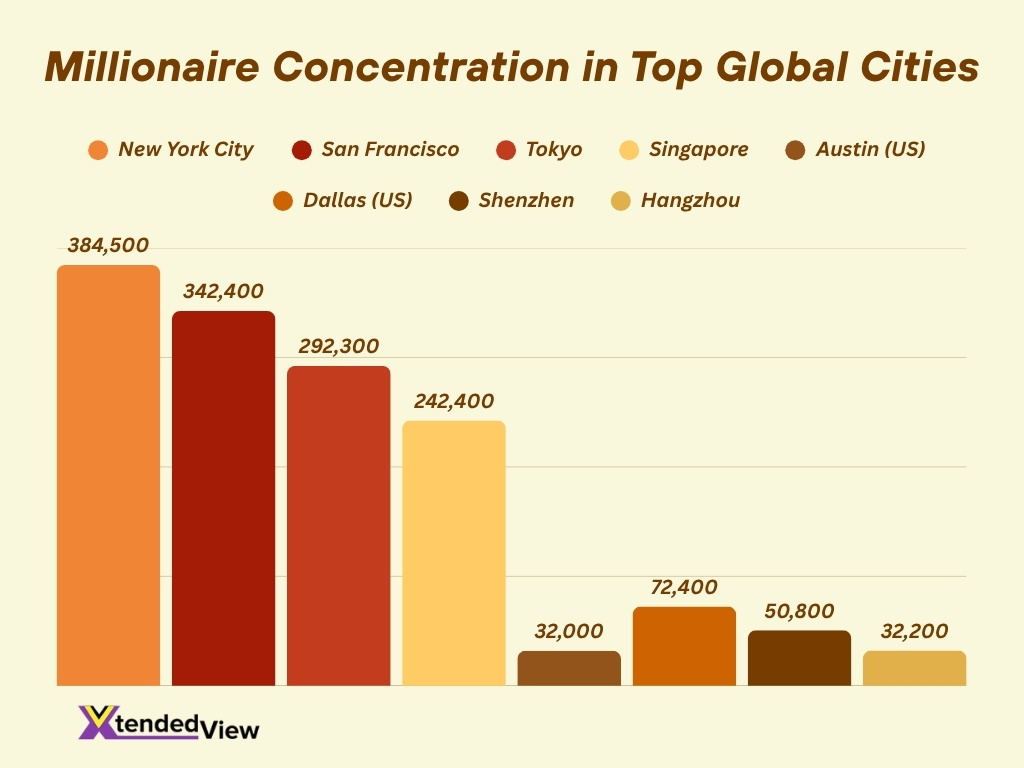
- New York City remains the global leader with around 384,500 resident millionaires in 2025.
- The San Francisco Bay Area (including Silicon Valley) holds approximately 342,400 millionaires and registered a near 98 % increase over the past decade.
- Tokyo ranked third with about 292,300 millionaires in residence in 2025.
- Singapore held fourth place with roughly 242,400 millionaires.
- Among U.S. cities, notable growth was seen in cities like Austin (≈ 32,000 millionaires) and Dallas (≈ 72,400 millionaires), both included in the global Top 50.
- Cities in Asia‑Pacific, such as Shenzhen (≈ 50,800 millionaires) and Hangzhou (≈ 32,200), posted double‑digit growth rates (142 % and 108 % respectively) from 2014 to 2024.
- The common characteristics among top millionaire‑cities include robust financial infrastructure, favourable tax regimes, high quality of life, and strong global connectivity.
- Some traditional financial hubs are plateauing or seeing declines; for instance, London experienced a drop in millionaire population in recent years.
Millionaire Demographics (Age, Gender, Education)
- In the U.S., the average age of a millionaire is approximately 61 years old.
- Americans in their 50s have an average net worth of around $1.3 million as of June 2025.
- Retirement‑millionaires in the U.S. averaged about $2.4 million in savings by December 2024.
- Individuals with a bachelor’s degree had an estimated 18 % chance of becoming a millionaire, while those with a high school diploma had only around 5 %.
- Millionaires tend to be older‑skewing; a large share falls in the 60‑79 age bracket.
- Gender representation remains skewed; in broader high‑net‑worth cohorts, women remain a minority among millionaire‑level wealth.
- Millionaires under age 40 remain a small proportion of all millionaire households; younger cohorts are growing slowly.
- Education, age, and inherited wealth form common vectors; individuals with advanced degrees and longer career spans have better odds of reaching millionaire status.
Women Millionaire Statistics
- By 2025, women are projected to account for around 18 % of the global millionaire population.
- Among ultra‑high‑net‑worth individuals, women make up a still smaller share, pointing to a persistent gender wealth gap.
- Among female billionaires, roughly 75 % have inherited at least part of their fortunes.
- In 2024, women with a net worth ≥ $5 million owned about 15.2 % of high‑priced U.S. homes.
- In luxury home purchases, 94.5 % of married women share or lead decision‑making.
- Women still lag in high‑net‑worth creation; among U.S. millionaires, men continue to dominate both numbers and average net worth multiples.
- The growth rate of women becoming millionaires is accelerating in many markets, though starting from a lower base.
- Projections suggest women may gain stronger representation among millionaires in the coming years.
Sources of Millionaire Wealth
- Investment in stocks and liquid assets remains a primary driver of millionaire status.
- Real estate remains a common path; a large fraction of millionaires describe real estate investment as part of their wealth‑building strategy.
- Entrepreneurship and business ownership continue to contribute heavily.
- Higher education and advanced degrees correlate strongly with millionaire status.
- Inheritance and family wealth transfer remain significant; true self‑made millionaires are fewer than mixed‑inheritance millionaires.
- Globalization and cross‑border investment allow wealthy individuals to diversify sources of income.
- The prevalence of retirement savings vehicles illustrates how long‑term, disciplined saving paired with compounding returns helps accumulate millionaire‐level wealth.
Millionaire Occupations & Income Streams
- Professionals in sectors such as finance, technology, law, and corporate management appear disproportionately in millionaire populations.
- Business owners and entrepreneurs continue to dominate self‑made millionaire statistics.
- Income streams are diversified, including primary business income, investment income, real estate rental yields, and alternative assets.
- Millions of U.S. millionaires rely significantly on retirement savings growth combined with other income streams.
- Older millionaires often derive more income from assets rather than salary.
- High‑net‑worth individuals often have multiple asset classes.
- Some new‑generation millionaires emerge via e‑commerce/technology models rather than traditional corporate careers.
- Passive income streams are increasingly cited by millionaires as key to maintaining status and wealth‐growth.
Self‑Made vs Inherited Millionaires
- A significant share of millionaires achieved their status through self‑made paths.
- Among female millionaires/billionaires, inheritance plays a disproportionately larger role compared to their male peers.
- Self‑made millionaires often begin accumulating earlier.
- Inherited millionaires may have access to capital, networks, and resources that accelerate wealth growth.
- The odds of becoming a millionaire are higher for individuals with higher education, long career spans, and business ownership.
- Younger cohorts show increasing representation of self‑made millionaires.
- Wealth transfer trends suggest that inheritance‑driven millionaire growth will rise.
- The billion-dollar-plus growth of new millionaires is more frequently rooted in entrepreneurial and investment activity.
Millionaire Migration to the UAE (Year After Year)
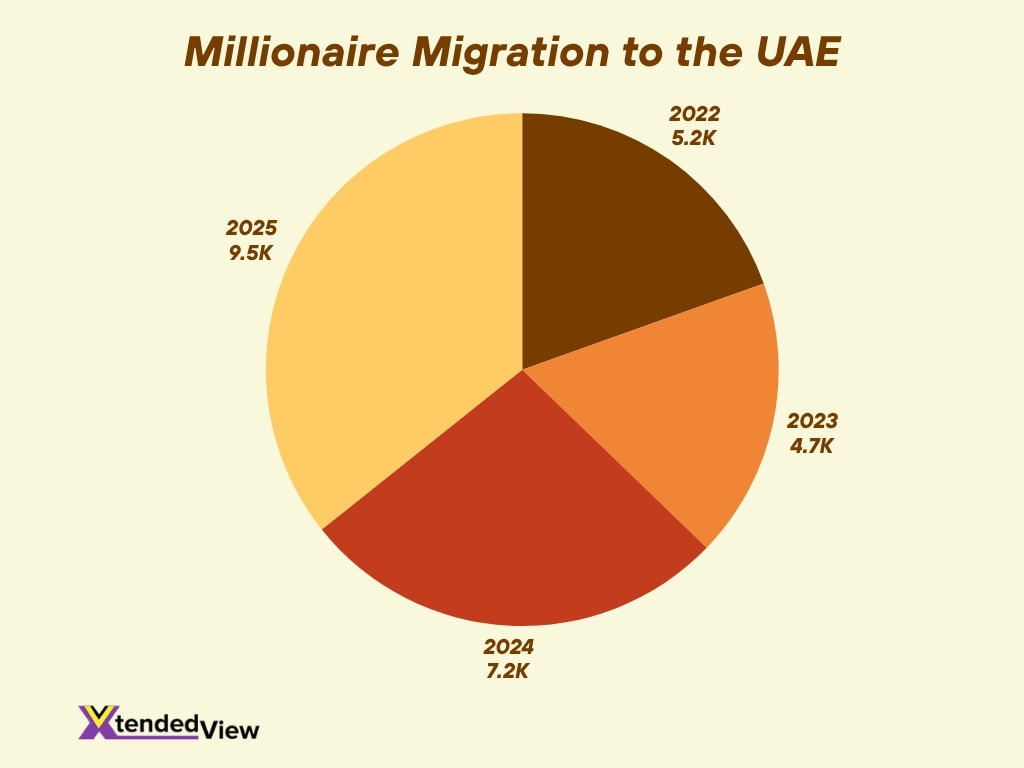
- The UAE has seen consistent growth in millionaire migration over the past five years.
- In 2021, around 800 millionaires relocated to the UAE.
- In 2022, the number rose to 5.2K, marking a significant surge.
- 2023 saw a continued increase, reaching 4.7K, slightly lower than 2022 but still high.
- In 2024, the inflow peaked again at 7.2K, showing renewed strong interest.
- Projections for 2025 estimate 9.5K millionaire migrants, the highest figure so far.
- Overall trend: a strong upward trajectory, reflecting the UAE’s growing appeal for wealthy individuals through taxation advantages, business opportunities, and lifestyle factors.
Millionaire Habits and Lifestyle
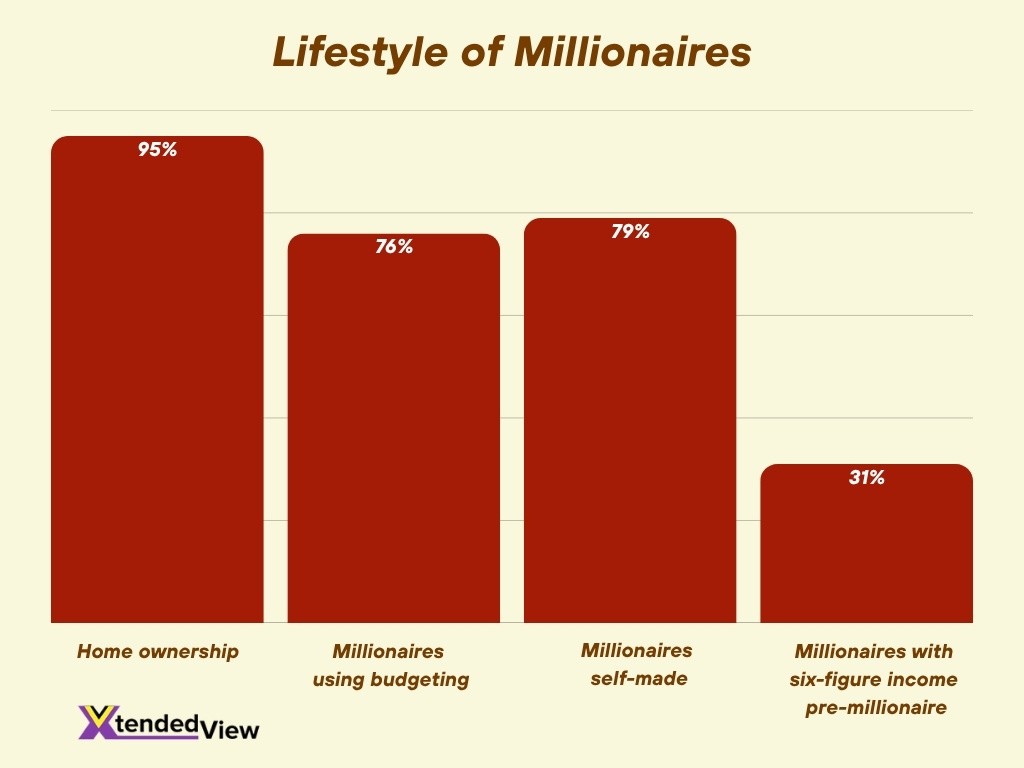
- Around 95% of millionaires own their homes, with an average home value of about $982,938.
- 76% of millionaires use some form of budgeting to track expenses and direct excess toward investment.
- 79% of millionaires received no inheritance, stressing self‑effort over legacy.
- Self‑made millionaires maintain an average of seven different income streams before hitting millionaire‑net‑worth.
- 88% of wealthy individuals spend at least 30 minutes daily on self‑education.
- Only 31% of the wealthy reported ever earning six‑figure incomes before achieving millionaire status.
- Millionaire households reported an average income of about $330,132 and an average home value of just over a million dollars.
- Many avoid lifestyle inflation and invest rather than spend windfalls.
- Fitness and wellness habits are common; high‑net‑worth individuals prioritize physical health.
Money Habits of Self‑Made Millionaires
- Self‑made millionaires often view failure as a learning opportunity, not a defeat.
- The average “401(k) millionaire” has invested for 26 years and contributes about 17% of income annually.
- They live below their means, focusing on net‑worth growth rather than status.
- They diversify income, cultivating side businesses, rental real estate, stock portfolios, and more.
- 88% of wealthy individuals dedicate time each day to reading.
- They start saving when young, maximizing compounding.
- 76% use formal budgeting tools.
- They maintain structured team support, including financial advisors and tax planners.
Common Investment Strategies
- Top strategies include tax‑loss harvesting, thematic investing, dividend growth, and international diversification.
- The average 401(k) millionaire contributes 17% their income annually and invests over decades.
- Self‑made millionaires favour long‑term investing over quick profits.
- Among investors, 49% manage actively and 42% passively during various phases.
- USD $83.5 trillion is expected to be transferred to next‑gen HNWIs by 2048.
- Millionaires invest in alternative assets, including luxury real estate, vineyards, and ESG.
- They are more than twice as likely to hold a travel credit card compared to non‑millionaires.
- They use systematic contributions and reinvestment to harness compounding.
Charitable Giving and Philanthropy Among Millionaires
- 81% of affluent U.S. households donated to charity, with an average donation of $33,219.
- Giving among ultra‑high‑net‑worth individuals reached $190 billion in 2022.
- Total U.S. charitable giving hit $557.16 billion in 2023.
- Donation rates by wealth‑tier remain flat, between 1.44% and 2.01% of income.
- 43% of affluent donors volunteered in 2024, averaging 120 hours per year.
- Households with net worth over $500 million gave just 1.2% to 1.3% of assets.
- Donor‑advised funds have grown more than 400% in a decade.
- The top 3,200 billionaires globally contributed about 8% of all individual giving.
Trends in Millionaire Wealth Creation
- In 2024, global wealth rose by about 4.2% in the high‑net‑worth population.
- About 70% of global millionaires have net assets between $1 million and $5 million.
- An estimated $83.5 trillion is set to be passed on to the next generation by 2048.
- Millionaires increasingly seek thematic investments in ESG, AI, and luxury assets.
- Emerging‑market growth is gaining pace in millionaire formation.
- Next‑gen millionaires favour digital, low‑cost, and global assets.
- Wealth‑migration alters national wealth profiles.
- Long‑term investing via capital markets remains key.
Projections for Millionaires (Next 5–10 Years)
- The millionaire population globally is projected to grow by 5 million or more over the next five years.
- The share of millionaires aged < 50 will rise steadily.
- Asia‑Pacific and Latin America will accelerate millionaire growth.
- Digital assets, AI/green sectors, and alternatives will dominate investment strategy.
- Impact investing will replace traditional philanthropy among younger millionaires.
- Wealth‑migration competition will intensify among nations.
- The ultra-wealthy will grow faster than everyday millionaires, widening gaps.
- Fintech and AI will lower wealth‑building barriers for younger and more diverse groups.
Frequently Asked Questions (FAQs)
Over 80 million people globally had assets exceeding US$1 million by early 2025.
Roughly 1.5% of the global adult population is millionaires as of 2025.
Approximately 684,000 new millionaires were created globally during 2024.
An estimated 142,000 millionaires are expected to migrate to a new country in 2025.
The UAE is expected to attract about 9,800 millionaires in 2025, representing around $63 billion in investable wealth.
Conclusion
The data paints a clear picture: becoming a millionaire is increasingly linked to disciplined habits, diversified income, strategic investment, and long‑term thinking. The populations of millionaires are growing, shifting by age, region, and source of wealth. For businesses, advisors, and aspirants alike, these trends matter; they say where wealth is going and how it is being built.
