


The Google Play Store remains a dominant force in global mobile distribution, particularly in Android ecosystems. In enterprise scenarios, marketers use it to target billions of users across devices, while developers leverage it to scale freemium apps with in‑app purchases. In both consumer and B2B contexts, the platform’s size and dynamics directly influence launch strategies, revenue forecasts, and competitive positioning.
Editor’s Choice
- 2.06 million apps were listed on Google Play in early 2025.
- 97 % of Play Store apps were free to download as of Jan 2025.
- Projected consumer spending on Google Play: $60‑65 billion by the end of 2025.
- The average of 1,619 new apps per day was added in recent measurements.
- In 2024, more than 110 billion downloads occurred via Google Play.
- Paid apps make up only 3 % of listings on the platform.
- In 2024, global app downloads across mobile hit 218 billion, with growth continuing into 2025.
Recent Developments
- In early 2025, reports indicated a significant drop in listed apps on Google Play, from 3.4 million at the start of 2024 to 1.8 million mid‑2025, a 47 % decline.
- This decline is largely attributed to stricter enforcement, with 2.36 million apps blocked in 2024 for policy violations.
- The scale of the cleanup suggests Google’s push for higher‑quality listings and better store hygiene.
- Despite the drop in total app count, new app submissions and releases reportedly remain strong, with average monthly launches in the tens of thousands.
- Increased attention to app‑quality metrics (ratings, reviews, update frequency) is a rising theme in developer forums.
- Some sources report mixed counts of total apps due to removals and clean‑ups, making exact comparison year‑on‑year tricky.
- For developers and marketers, the takeaway is “less noise, more visibility” if your app meets quality thresholds.
Total Number of Apps on Google Play Store
- One commonly cited figure is 2.06 million apps available on Google Play as of early 2025.
- Another source quotes over 3.9 million apps available in 2025, though this may reflect different measurement methods.
- According to one dataset, the store listed 2,074,270 apps in a snapshot, with 605,918 unique publishers.
- Of those 2.07 million apps, 1,824,478 were non‑gaming, and 249,792 were games.
- The variance in total counts suggests ongoing removals, store curation, and differing definitions (active vs listed apps).
- In 2024, 3.95 million apps were available, representing 6.23 % growth from 2023 (3.718 million).
- For Android app developers, targeting the Play Store means navigating an ecosystem of multi‑million listings, meaning discoverability competition remains intense.
Number of Apps Released Daily, Weekly, and Monthly
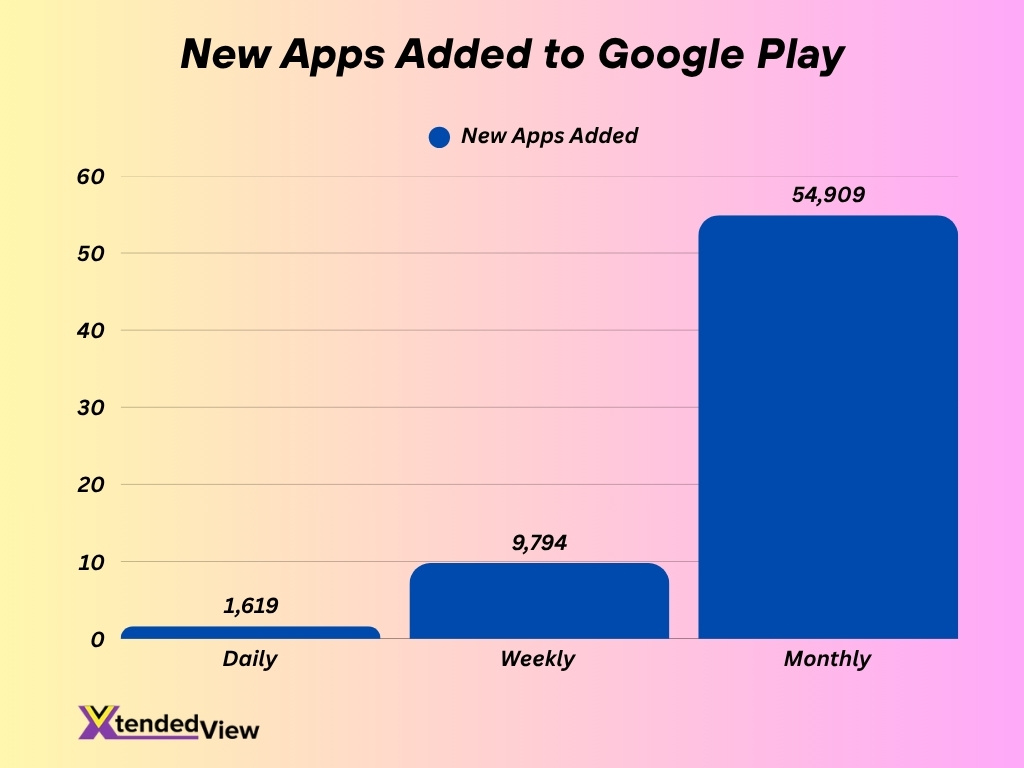
- 1,619 new apps per day have been added recently to Google Play.
- That translates into 9,794 new apps per week on average.
- On a monthly scale, 54,909 new apps are addedper month.
- 41,000 new apps were added in December 2024 alone.
- Weekly rate in one report, over 6,420 new apps per week noted.
- Monthly launch activity indicates a vibrant developer ecosystem despite recent store purges.
- Net growth must consider unpublished or removed apps too; in September 2025, 43.8k new apps and 27.2k removals.
- Frequent release volume means that staying current with ASO and update cadence remains critical.
Annual Google Play Store App Downloads
- Global app downloads continue to climb, reaching an estimated 167 billion in 2024 and projected to hit 181 billion in 2026.
- Google Play dominates the market, accounting for 129 billion downloads in 2024, rising to 143 billion by 2026.
- Apple App Store downloads show steady growth, from 33 billion in 2021 to a projected 38 billion in 2026.
- Year-over-year increases highlight consistent user demand across both platforms:
- 2021: 33B (App Store), 111B (Google Play)
- 2022: 34B | 114B
- 2023: 35B | 121B
- 2024: 36B | 129B
- 2025: 37B | 136B
- 2026: 38B | 143B
- Google Play leads by a wide margin, contributing roughly 78–80% of total downloads throughout the period.
- Steady year-over-year growth suggests increasing smartphone usage, app reliance, and expansion in emerging markets.
- Overall CAGR trend: App downloads are projected to rise about 6.2% from 2021 to 2026.

Estimated User Spending on Google Play Store
- Spending on Google Play was forecast to reach $55.5 billion in 2024.
- Projected growth suggests $60‑65 billion in consumer spending by the end of 2025.
- In Q2 2024, combined global spending (Google Play + Apple App Store) hit $36.2 billion.
- Spending includes in‑app purchases, subscriptions, and premium app purchases.
- For app developers, the upward spending trend signals monetization potential, especially in freemium and subscription models.
- Spending growth reinforces that Android is not only about installs but meaningful revenue generation.
Total App Revenue Generated on Google Play Store
- In 2023, consumer spending on the Google Play Store reached about US $46.7 billion.
- A forecast for 2025 suggests Play Store revenue may climb toward $60 billion+ +.
- The Play Store generated $42.32 billion in 2022 and $45.63 billion in 2023 (estimated).
- In Q2 2024, the combined revenue for Play Store + App Store hit $36.2 billion.
- One projection estimates Play Store revenue at $58.1 billion in 2024.
- The upward revenue trajectory suggests monetization on Android is maturing.
- The competitive advantage lies not just in downloads, but in unlocking meaningful revenue streams on the Play Store.
- Growth is stronger in emerging markets, where lower ARPU means volume plays a role, but premium models are emerging.
Price Distribution of Play Store Apps
- A large number of paid apps are priced at under $1.
- Over 20,000 paid apps fall in the “under $1” category.
- 17,000 are in the $1–$2 price range.
- 1,263 apps are priced at around $9–$10.
- 97 % of apps are free to download.
- Paid apps are a small fraction of listings.
- The average upfront cost of a paid app remains low.
- Monetization for Android largely depends on in‑app purchases or subscriptions.
Free vs Paid Android Apps Statistics
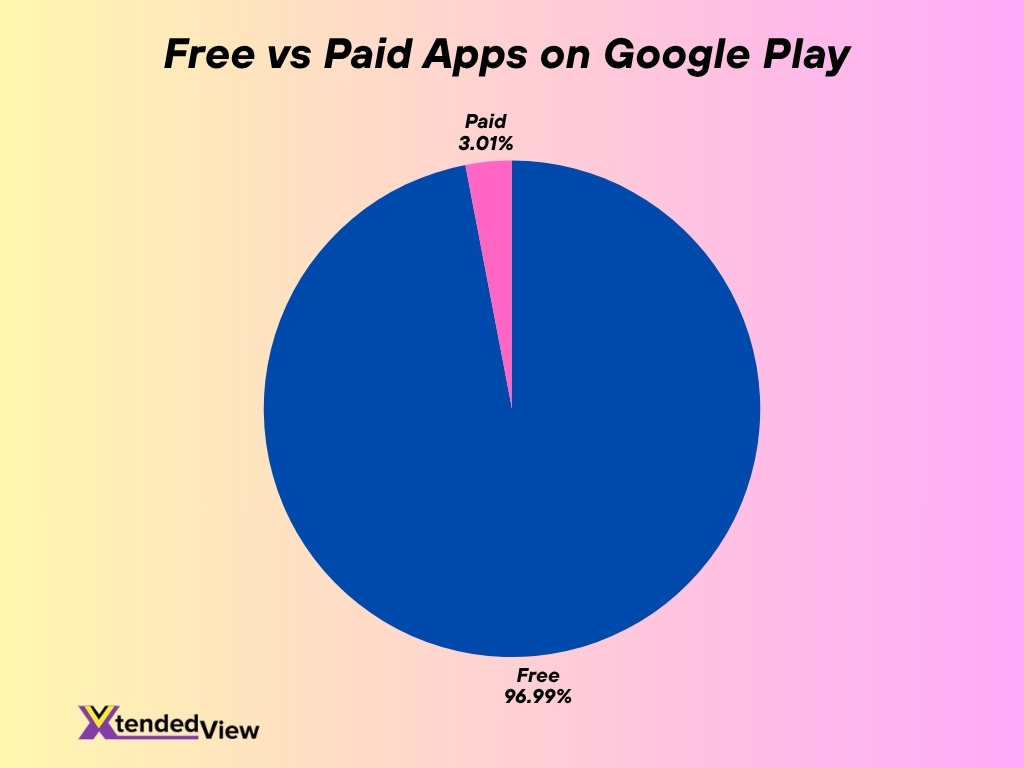
- 2,011,196 (96.99 %) apps are free, and 62,466 (3.01 %) are paid.
- The paid apps segment contributes a disproportionately small share of listings.
- Free apps dominate download volume.
- The freemium model is the dominant approach.
- Success typically means free download plus IAP or ads rather than paid upfront.
- Paid apps face high barriers to success.
- Discovery and trust are challenges for paid-only apps.
- The Play Store ecosystem strongly favors freemium models.
Global Users of Play Store Apps
- Over 2.5 billion active users globally use the Play Store.
- Android dominates in India, Indonesia, Brazil, and Mexico.
- In many regions, over 90 % of smartphone users are Android users.
- Launching on the Play Store offers access to a global user base.
- Growth in user numbers is more significant in lower‑ARPU markets.
- Discoverability is a challenge due to app saturation.
- Localization matters for app adoption in different regions.
- The Play Store remains one of the highest‑volume channels globally.
Country‑Wise Play Store Usage Statistics
- Android has a90 % share in many countries.
- Download growth is higher in Asia‑Pacific, Latin America, and Africa.
- U.S. remains a high‑ARPU but slower growth market.
- Payment preferences and app behaviors vary regionally.
- Local app stores compete with Google Play in some countries.
- Device fragmentation and connectivity vary across markets.
- Regional strategy is vital for global app success.
- Emerging markets require customized deployment strategies.
Category‑Wise and Gaming App Popularity
- 249,792 (12.04 %) apps are games, and 1,824,478 (87.96 %) are non‑gaming.
- Top game categories include Action, Casual, Simulation, Puzzle, and Arcade.
- Gaming 11.86 %, Business 10.35 %, Education 9.8 % of total apps.
- Gaming revenue for the Play Store is projected to reach $40.10 billion by 2025.
- Non‑gaming categories grow through subscriptions and ads.
- Category popularity varies by region.
- Casual games lead in emerging markets.
- Monetization strategy varies between games and non‑games.
Most Popular Android Apps on Google Play Store
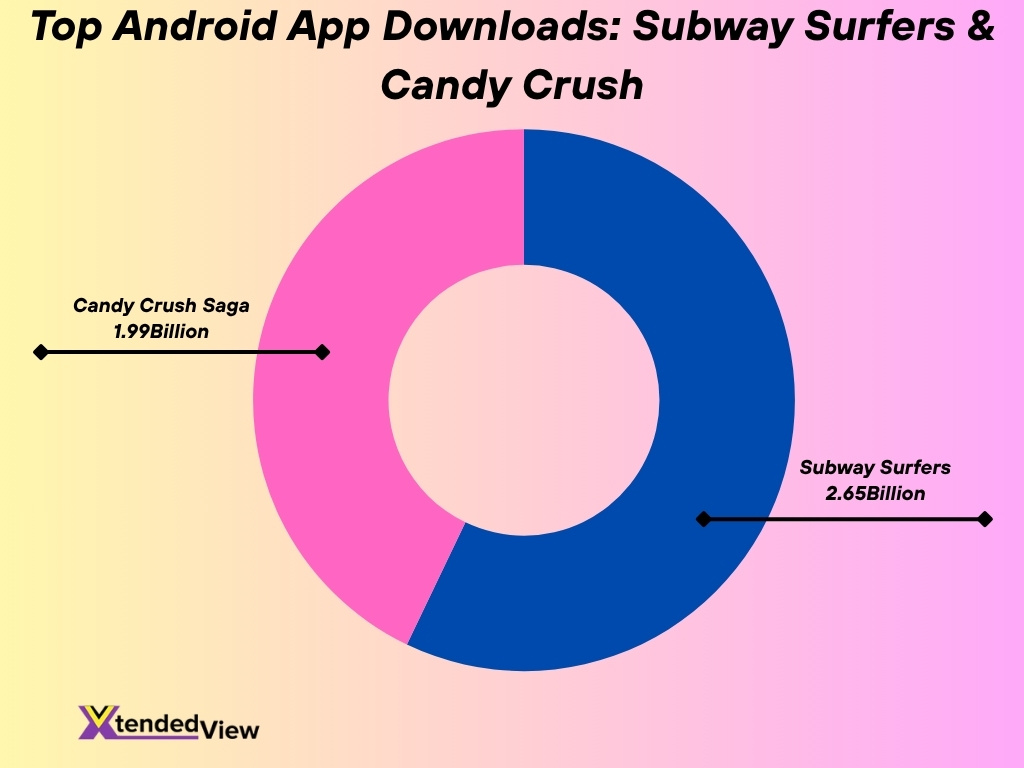
- Subway Surfers: 18.48 million downloads in July 2025, 2.65 billion total.
- Candy Crush Saga: 15.9 million in July, 1.99 billion total.
- TikTok continues to lead non‑game app downloads.
- Mega‑apps dominate visibility.
- Smaller apps succeed in niches.
- Quality + marketing = high app visibility.
- Monetization and retention matter more than download count.
- Download trends identify market demand patterns.
App Ratings: 4‑Star and Above Applications
- 1,027,752 apps (49.55 %) have at least one user rating.
- 109,473 apps earned above 4.5 stars.
- 79 % of users check an app’s rating before downloading.
- Displayed rating is weighted toward recent reviews.
- 50 % of Play Store apps have no user rating.
- High-rated apps are more likely to be recommended.A
- 4+ star average helps user trust.
- Ratings are tied closely to app visibility.
Leading App Publishers on Google Play Store
- 619,629 unique publishers exist.
- A small number of publishers dominate revenue.
- 33 % of apps are self‑developed.
- Multinationals publish most top-revenue apps.
- Publishers are judged on retention and updates.
- 28 % of apps update weekly, 72 % monthly.
- Top publishers support localization and scale.
Google Play Store vs Apple App Store Statistics
- Play Store: US $46.7 billion, App Store: US $103.4 billion in 2023.
- Play Store: 113 billion downloads, more than Apple.
- Android holds 72 % global OS share.
- Apple monetizes at 3× the Android subscription rate.
- iOS dominates ARPU, Android dominates scale.
- Mature markets favor Apple, and emerging markets favor Android.
- Developers need dual-platform strategies.
Subscription and Monetization Strategies
- Global consumer app spending to reach $233 billion by 2026.
- Annual subscriptions retain 28 % of users after 12 months.
- 97 % of apps are free, but generate 98 % of revenue.
- Freemium + IAP + subscription dominates monetization.
- Dynamic pricing and hybrid models are emerging.
- Developers must optimize for recurring revenue.
- Monetization must be planned pre-launch.
Key Metrics: User Retention, Engagement & Health
- Key metrics include Day 1, Day 7, and Day 30 retention.
- Retained users are more valuable than new installs.
- Engagement fuels monetization.
- Frequent updates improve retention.
- Ratings impact retention and monetization.
- Crash rate and stability affect ranking.
- Developers must measure retention velocity and conversion.
Google Play Store Trends and Future Insights
- Downloads projected to reach 143 billion by 2026.
- Revenue to rise to US $63.4 billion in 2025.
- Policy enforcement is removing low-quality apps.
- Trends include AI personalization and 5G app experiences.
- Subscriptions and retention are key.
- Emerging markets will drive growth.
- Mature markets will drive premium monetization.
- Developers must align with the algorithm and quality shifts.
Frequently Asked Questions (FAQs)
Approximately 2.06 million apps are listed on the Google Play Store.
About 97 % are free, and 3 % are paid apps on the Google Play Store.
Consumers spent approximately $46.7 billion on the Google Play Store in 2023.
On average, about 1,619 new apps per day are published on the Google Play Store.
App downloads on the Google Play Store are projected to reach about 143 billion by 2026.
Conclusion
The Google Play Store remains a cornerstone of the global mobile app ecosystem, rich in scale, evolving in monetization, and increasingly quality‑focused in execution. From user ratings and leading publishers to platform comparisons, subscription strategies, and forward‑looking trends, the data paints a clear picture: success on Play and beyond demands more than a launch; it demands continuous user engagement, strategic monetization, and global awareness. If you are planning to build or scale an Android app, these statistics offer actionable direction.
