


Google Analytics (GA) continues to shape how businesses monitor web performance and user behavior. From e‑commerce platforms optimizing conversions to content publishers tracking real‑time traffic, the tool serves as a critical decision‑making engine. In one scenario, a retail company uses GA to refine its marketing funnel and boost revenue; in another, a media firm monitors live visitor flow to adjust editorial rollout in real time. Read on to dive into the latest numbers and emerging trends.
Editor’s Choice
Here are seven standout statistics for 2025:
- 37.9 million websites worldwide use Google Analytics.
- GA holds an approximate 43 % market share in the web analytics space.
- In the U.S., 3.25 million websites use GA4.
- Among the top 10,000 websites globally, 43.35 % use Google Analytics.
- GA4 is implemented on 33.65 % of the top 1 million websites by traffic.
- GA4 now supports AI‑powered “Generated Insights” to flag trends automatically.
- In 2025, GA rolled out “Property Syncing” for custom dimensions/metrics in GA 360.
Recent Developments
- In 2025, GA4 introduced the ability to copy reports and explorations between properties.
- GA4 added AI‑driven insights, which proactively surface anomalies and patterns in data.
- The introduction of Property Syncing in GA 360 allows users to sync custom dimensions/metrics across properties.
- Enhanced identity settings in GA4 now help reconcile users across devices for cleaner journeys.
- GA4’s conversion modelling and attribution tools were upgraded in August 2025 for more accurate multi‑channel tracking.
- Privacy and compliance updates were rolled out to support evolving regulations, particularly in the EU context.
- GA4 expanded report dimensions and metrics, facilitating deeper segmentation and analysis.
- The move away from the old Universal Analytics (UA) accelerated as GA4 became the standard for new setups.
What is Google Analytics?
- Google Analytics is a web and app analytics platform developed by Google LLC that tracks and reports on user activity.
- GA4 is the latest version, built around an event‑and‑parameter model rather than UA’s session‑based model.
- It allows businesses to measure sessions, users, events, conversions, and engagement across platforms (web + app).
- GA integrates with other Google services (Ads, Tag Manager, BigQuery) to enhance tracking, attribution, and data export.
- For real‑time analysis, GA provides live user reports, event stream reports, and audience overviews.
- GA4 emphasizes user‑centric measurement, enabling more refined audience building and cross‑device tracking.
- As of mid‑2025, UA is deprecated for new data, and Google recommends migrating entirely to GA4.
- Because of regulatory pressure, GA4 also enhances privacy controls, data retention options, and consent settings.
Key Google Analytics Statistics
- About 55.49 % of all websites globally use Google Analytics.
- An estimated 37.9 million websites use GA worldwide.
- Among the top 10,000 websites, 43.35 % use GA.
- For the top 100,000 websites, 42.23 % use GA.
- GA4 is implemented on approximately 33.65 % of the top 1 million sites by traffic.
- In the U.S., around 3,255,362 websites use GA4 (22.9 % of global GA4 users).
- The U.S. share of websites using GA4 is approximately. 2.44 % of all U.S. websites (3.25 M of 133.36 M).
- GA holds a market share of 43 % in the web analytics domain.
- Nearly 83.5 % of all websites use either GA or a similar analytics tool.
- Among companies adopting GA, small businesses (1‑10 employees) make up about 72 % of its user base.
Google Analytics Usage Statistics
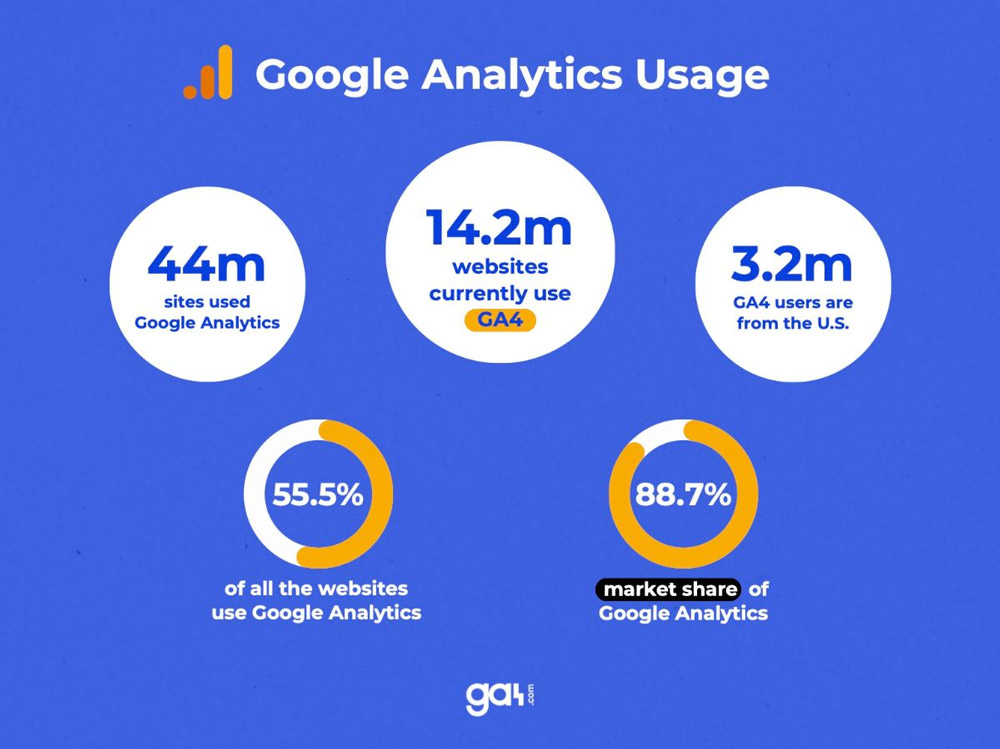
- 44 million websites have used Google Analytics, showcasing its long-standing dominance in web tracking.
- 14.2 million websites currently run GA4, the latest Google Analytics version, signaling strong adoption after the Universal Analytics sunset.
- The United States leads GA4 adoption with 3.2 million users, emphasizing GA4’s popularity among U.S. businesses and marketers.
- 55.5% of all websites rely on Google Analytics, making it one of the most widely used digital analytics platforms worldwide.
- Google Analytics commands an impressive 88.7% market share, reinforcing its position as the top analytics tool globally.
Google Analytics Market Share
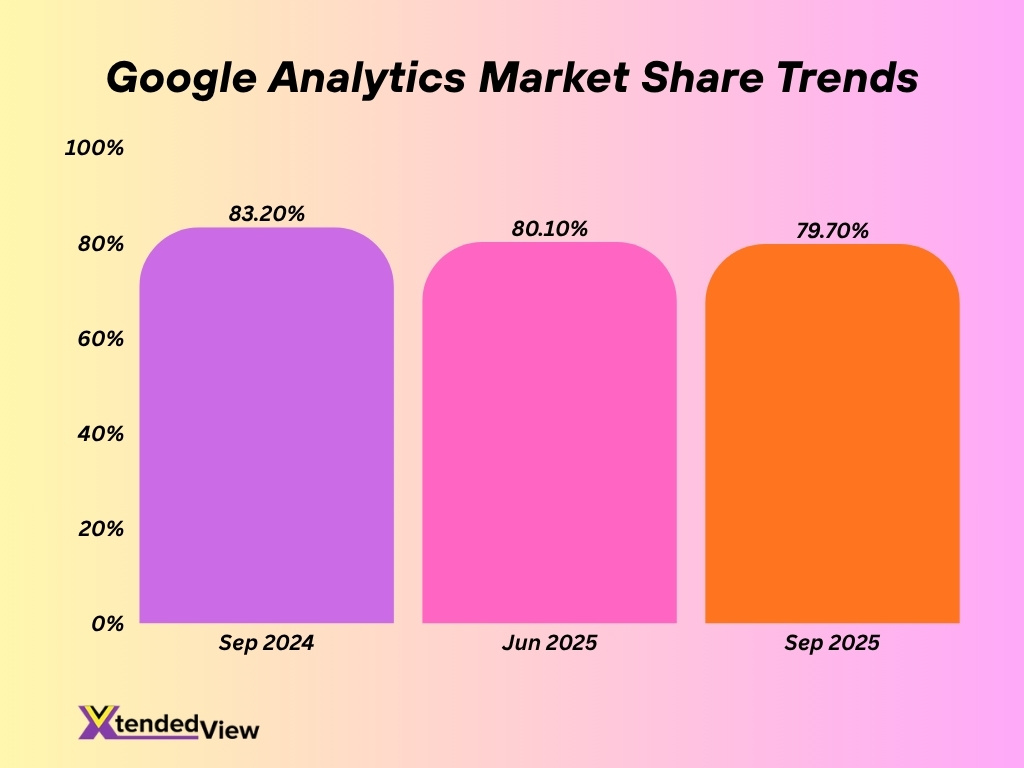
- As of June 2025, Google Analytics (GA) holds approximately 80.1% share among websites whose traffic‑analysis tool is known, which equates to 46.1% of all websites.
- In the same time frame, GA’s share among traffic‑analysis tools dropped from 83.2% in September 2024 to 79.7% in September 2025.
- One report projects GA’s market share in 2025 to reach 90.95% of analytics tool usage.
- Among competitors, GA’s share dwarfs others, e.g., Tableau Software, Mixpanel, and other platforms, each account for under 1% in the same category.
- In the top 10,000 websites by traffic, GA is used by 43.35% of sites.
- GA4 (the latest version) is implemented on 33.65% of the top 1 million websites by traffic.
- Regionally, in the United States, there were 3.26 million live websites using GA in January 2025, representing 11.57% of total live websites using GA globally.
- Small businesses (< $50 M revenue) make up 74% of GA users, while large enterprises (>$1 B revenue) account for 6%.
- Among websites using GA, those with annual revenues between $1 M‑$10 M represent a significant portion (majority) of adopters.
Demographic Insights from Google Analytics
- In Google Analytics 4 (GA4), demographic reports allow tracking of visitor age, gender, interests, language, and location.
- To enable full demographic tracking, users must activate Google Signals; otherwise, large portions of “unknown” demographics may appear.
- In typical GA4 set‑ups, even after enabling Signals, a substantial fraction of data may still be classified as “unknown gender/age” due to non-logged-in users and privacy settings.
- Among websites with demographic data, one example found that the highest converting group was male, aged 25‑34.
- GA4 supports over 39 languages, facilitating multinational demographic capture.
- Usage of demographics in GA4 is becoming increasingly important for tailoring marketing campaigns, especially as first‑party data becomes central.
- For businesses, enabling demographic data often correlates with deeper segmentation and improved user‑targeting outcomes in GA4.
- However, the accuracy of demographic data varies, and many smaller websites may not have sufficient volume to report reliable age/gender breakdowns.
Traffic Acquisition Statistics
- For GA4 sites in 2024, direct traffic drove 86.24% of desktop visits for one sampled dataset.
- As of January 2025, the United States accounted for 11.57% of live websites using GA (3.26 million sites).
- Among Shopify stores, GA4 adoption is over 450,000 stores.
- WordPress-based websites using GA4 number over 2 million.
- A 2025 guide on device usage shows mobile devices driving 59.7% of global website traffic in April.
- Another source places mobile traffic at 64.35% of total web traffic in May 2025.
- The shift from search engine referrals to other acquisition channels (like social, direct, and referral) is increasingly flagged in analytics commentary.
- GA4’s improved attribution modelling (rolled out in August 2025) aims to provide more accurate acquisition insights across channels.
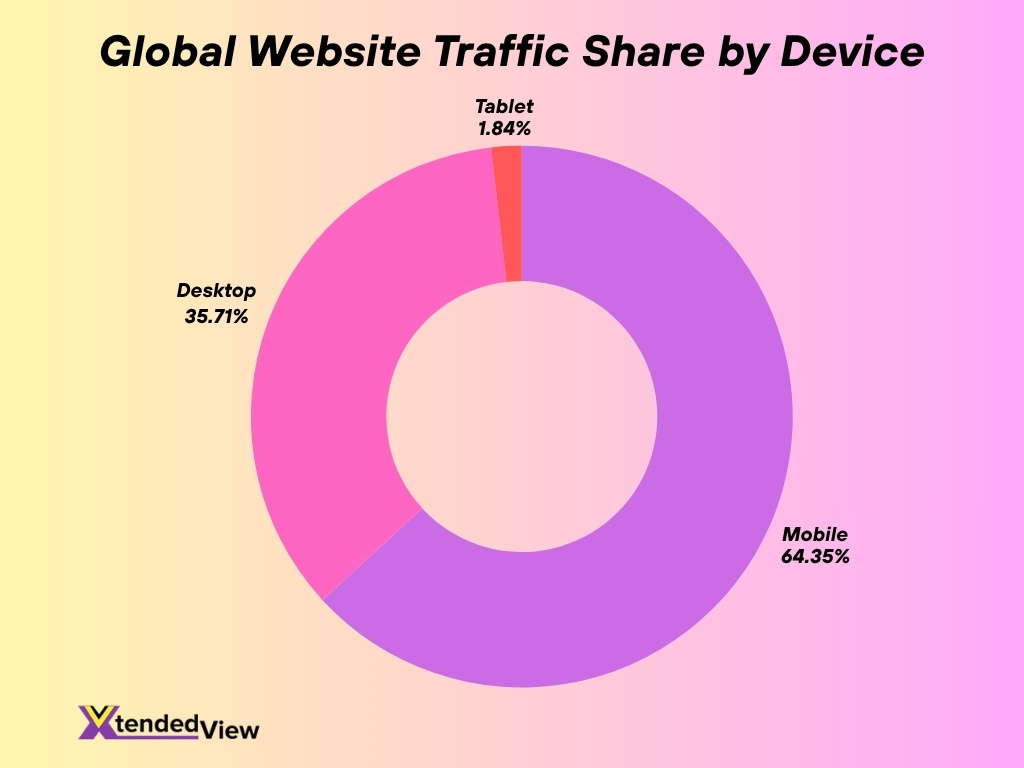
- For global internet traffic, mobile holds 62.45% share while desktop holds 35.71%.
- Regions vary considerably, e.g., Asia sees 72.3% mobile web traffic, Africa 69.8%.
Device and Technology Statistics
- Global mobile device traffic share as of April 2025 is 59.7%.
- In May 2025, mobile devices accounted for 62.45% of internet traffic, desktops 35.71%, tablets 1.84%.
- As of Sept 2025, one source showed mobile traffic at 67.82% of all traffic across platforms.
- A Nov 2024 snapshot shows 64.04% of internet traffic was mobile, desktop 35.96%.
- In the U.S., traffic share from mobile devices was 56.75% vs desktops 43.25% in late 2024.
- Android dominates the mobile OS space, with 72% global mobile traffic share in 2025, and iOS 28%.
- Implementing cross‑device measurement via user ID remains a key challenge for GA4 users.
- The shift toward mobile‑first websites remains critical; industries like e‑commerce report 71.8% of their traffic via mobile devices.
- Desktop still carries significance in certain markets, e.g., Japan and Canada, where desktop traffic may exceed mobile.
- GA4’s technology architecture supports web + app tracking via an event‑based model vs the older session‑based model, enabling device‑agnostic measurement.
Google Analytics Conversion Statistics
- The session conversion rate is calculated by dividing the number of sessions with a conversion event by the total number of sessions.
- The user conversion rate shows the percentage of users who triggered at least one conversion event divided by the total number of users.
- Many sites observe a user conversion rate higher than the session conversion rate because repeat sessions without conversion don’t reduce the user rate.
- With GA4, setting up “key events” replaces the previous “conversion” label in many reports for more flexible tracking of user actions.
- Predefined key events in GA4 include purchase, first_open, and in_app_purchase, which can be flagged as conversions.
- For e‑commerce tracking in GA4, conversion actions like add_to_cart, begin_checkout, and purchase form the backbone of the macro‑conversion funnel.
- Analysts report that conversion setups with properly tagged key events result in 10‑30% higher accuracy in attributing revenue and goal achievements compared to older models.
- Businesses that clean up duplicate event‑tracking and align key event names see up to 20% better match between reported conversions and actual CRM data.
- Effective conversion tracking requires using both session and user conversion metrics, since each offers a different view of visitor behavior.
- Conversion‑rate calculations differ: sessions with conversions divided by all sessions vs users with conversions divided by all users, meaning you should always choose the right denominator for your purpose.
Real‑time Data and Live Visitor Stats
- Real‑time reports in GA allow monitoring events and user activity for up to 30 minutes (or up to 60 for some properties).
- You can see where visitors come from, which pages they land on, and what conversions they trigger almost instantly.
- Real‑time analytics enables you to detect issues such as a broken checkout flow within minutes instead of discovering it in next week’s report.
- Tools report that live visitor session recordings, instant funnel analysis, and real‑time A/B test monitoring are now common in advanced tracking setups.
- In GA4, you’ll find metrics like active users right now, events in the last 30 minutes, and top pages open now, which help teams react fast.
- For live campaigns (such as email blasts or product launches), real‑time dashboards show uplift in traffic and conversions as they happen.
- Real‑time data supports immediate traffic source performance data, so you can shift budget or creative halfway through a campaign if needed.
- Analysts caution that real‑time stats are useful for operational monitoring but still require historical context for strategic decision‑making.
- Large websites track spikes in live visitors and correlate them to incoming referrals, social posts, or press mentions in real‑time.
- Real‑time data can also reveal geographical surges, e.g., an unexpected international traffic influx that prompts localization or variant testing.
Top Landing Pages & Popular Content
- The average conversion rate for landing pages across industries is 9.7% in 2025.
- A benchmark bounce rate for landing pages sits between 60%–90%.
- Businesses with 10‑15 landing pages see about a 55% increase in conversions compared to those with fewer than 10.
- Having 40 or more landing pages can drive up to a 500% increase in conversions.
- Some 48% of visitors leave a landing page without further interaction on that page.
- About 77% of pages labeled as landing pages are actually home pages.
- Mobile‑driven landing pages convert better, e.g., 11.7% vs 10.7% for desktop‑only pages.
- Email‑driven traffic to landing pages achieved a conversion rate of 19.3%.
- Embedding video on a landing page can lead to up to an 86% boost in conversions.
- Businesses using optimization tools for their landing pages report an average lift in conversions of 30%.
User Engagement Metrics
- For Google Analytics 4 (GA4), the average bounce rate is 32.53%.
- On GA4, the average pages per visit is approximately 5.53.
- The average visit duration recorded by GA4 is about 6 minutes and 25 seconds.
- Among landing pages, the median conversion rate across industries is 6.6% in 2025.
- Mobile users respond 25.2% better on dynamic landing pages vs static ones.
- Personalized call‑to‑action (CTA) elements boost conversion rates by around 202% compared with generic CTAs.
- Shorter landing pages with clear CTAs outperform longer ones by 13.5% in conversion rate.
- Around 34% of visitors on high‑performing landing pages arrive via video‑enabled pages.
- About 48% of marketers build a new landing page for each campaign, while 52% reuse existing pages.
Audience Behavior Statistics
- On GA4, the most active age segment for many sites is 25‑34 years.
- Among GA4 users, male visitors account for 61.56% in one dataset.
- Around 43.6% of marketers say lead generation is the primary goal of their landing pages.
- For e‑commerce sites in 2025, 21% of retail purchases are expected to take place online.
- Global online shoppers numbered roughly 2.77 billion in 2025.
- In e‑commerce, 34% of shoppers report going online at least once a week.
- Approximately 52% of online shoppers look for products internationally.
- 73% of GA users are companies with fewer than 50 employees.
- Retail is the single largest industry segment using analytics tools.
Sources of Website Traffic
- On GA4 properties, direct traffic comprised 86.24% of desktop visits in one dataset.
- Mobile devices accounted for 62.45% of global internet traffic in May 2025.
- 45% of social referrals to GA4 sites originate from YouTube in one study.
- Approximately 30% of brands plan to use AI for landing‑page A/B testing by 2025.
- Among landing pages, 51.5% of marketers say social media promotion drives traffic.
- Email traffic to landing pages converts at 19.3%, outperforming paid social in one analysis.
- Businesses with 31‑40 landing pages generate 7× more leads than those with 1‑5 pages.
Google Analytics for E‑commerce Statistics
- Global e‑commerce sales are forecast to surpass $6.86 trillion in 2025.
- E‑commerce share of retail purchases is projected at 21% in 2025.
- Over 28 million e‑commerce stores operate globally as of 2025.
- Integrating analytics platforms like GA4 is now standard for e‑commerce measurement.
- In e‑commerce analytics, mobile traffic frequently exceeds 70% of total visits.
- AI‑driven personalization in e‑commerce was used by 92% of businesses heading into 2025.
- Social commerce and voice commerce are rising as acquisition channels influencing analytics.
- Analytics tools now link to supply‑chain data and return processes for deeper commerce insight.
Google Analytics Adoption by Industry
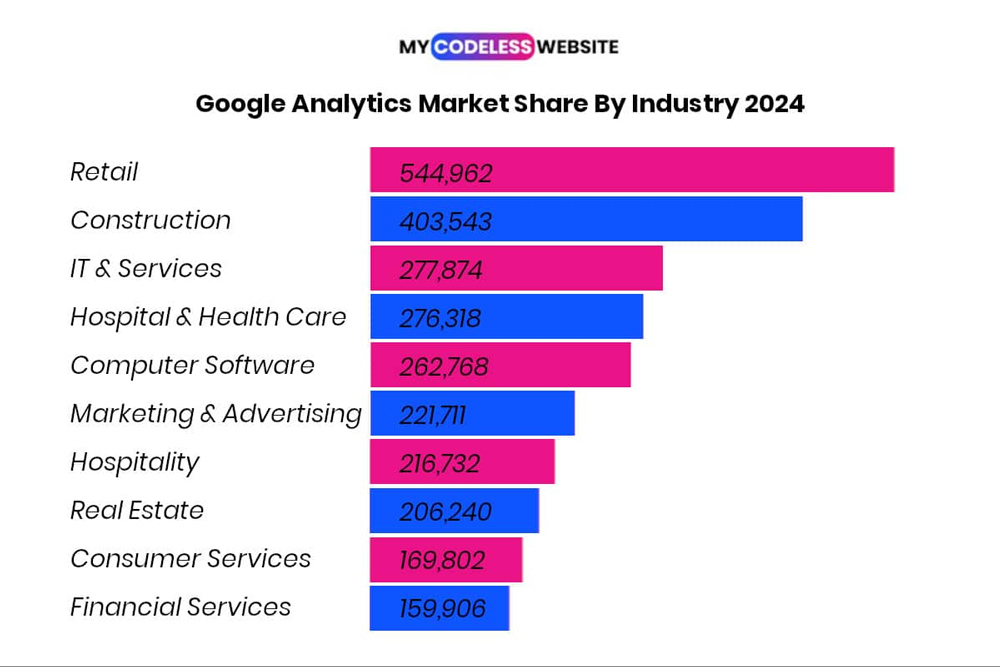
- Retail leads all industries with a massive 544,962 users adopting Google Analytics, showing the sector’s strong reliance on digital tracking for consumer behavior and e-commerce performance.
- Construction follows as the second-largest industry user, with 403,543 businesses utilizing analytics tools for project planning, client acquisition, and operational efficiency.
- IT & Services stands at 277,874 users, highlighting the importance of analytics for tech-driven business growth and data-based service optimization.
- Hospital & Health Care closely aligns with IT, recording 276,318 users, showing rising digital transformation in patient care and health service management.
- The computer software industry records 262,768 users, leveraging analytics for product improvement and user experience tracking.
- Marketing & Advertising agencies have 221,711 users, reflecting the crucial role of data in campaign planning, performance measurement, and ROI optimization.
- The hospitality sector stands at 216,732 users, using analytics for guest experience enhancement and digital booking strategies.
- Real Estate adoption reaches 206,240, driven by tracking buyer behavior, digital leads, and market trends.
- Consumer Services industry sees 169,802 users, showing growing interest in customer journey analytics and service personalization.
- Financial Services ranks last with 159,906 users, still significant, indicating a strong focus on secure, data-driven decision-making.
Geo‑location Statistics
- As of 2025, approximately 14.2 million websites globally use GA4.
- In the U.S., more than 3.2 million websites have adopted GA4.
- In the United Kingdom, 400,000 websites are using GA4.
- Mobile web traffic share by region includes Asia 72.3% and Africa, 69.8%.
- The U.S. portion of global websites using GA (all versions) is estimated at 22%.
Privacy & Compliance Statistics in Google Analytics
- The anonymize_ip setting in GA4 truncates visitor IP addresses to reduce identifiability.
- Businesses must enable consent‑mode and data‑retention controls in GA4 for compliance.
- By 2025, 44% of consumers say transparency about data use is the top driver of brand trust.
- Several EU regulators continue to scrutinize GA4 due to cross‑border data transfer concerns.
- GA’s native data‑sharing settings allow toggling advertising features to support compliance.
- Website owners face regulatory pressure from frameworks like the Digital Markets Act.
- Non‑compliance risks remain high, with penalties up to 4% of annual global revenue or €20 million.
Frequently Asked Questions (FAQs)
43.35% use Google Analytics.
Approximately 37.9 million websites worldwide.
About 32.53%.
Around 43% market share.
Over 2 million WordPress websites are integrated with GA4.
Conclusion
Analytics powered by Google Analytics, particularly GA4, remains central to digital measurement across landing pages, engagement metrics, traffic sources, e‑commerce, and compliance. The stats show clearly that landing page optimization, mobile‑led traffic, industry‑specific adoption, and privacy compliance are fundamental. Organizations that pair strong analytics execution with transparent data governance will be better positioned to extract meaningful value while mitigating risk.
