


Data privacy has rapidly evolved from a regulatory checkbox to a cornerstone of organizational trust. With the acceleration of AI, cloud adoption, and mobile connectivity, companies are handling larger volumes of personal data than ever before. Industries ranging from healthcare to finance and retail now face increasing scrutiny, especially as global regulations tighten. From generative AI risks to record-breaking data breach costs, shaping up to be a defining year for privacy. This article breaks down the most current data privacy statistics across multiple dimensions to help you stay informed and ahead of the curve.
Editor’s Choice
- 144 countries now have data privacy laws, covering nearly 79% of the global population.
- The average global cost of a data breach in 2025 is $4.44 million, but it jumps to $10.22 million in the U.S.
- 63% of businesses report that AI introduces significant new privacy risks.
- 86% of consumers say data privacy is a growing concern.
- 68% of breaches involve a human element like error or social engineering.
- 71% of consumers say they would stop doing business with a company that mishandles their data.
- Only 21% of U.S. adults trust companies to handle their personal data responsibly.
Recent Developments
- In 2025, the average cost of a data breach globally dropped to $4.44 million, a 9% decrease from 2024.
- However, U.S. organizations saw record breach costs at $10.22 million, the highest worldwide.
- AI and machine learning tools were linked to faster breach containment, saving firms up to $1.8 million.
- 68% of global consumers are more concerned about their online privacy than they were a year ago.
- Google and Meta faced new data privacy lawsuits in 2025 for allegedly tracking users without consent.
- The EU Digital Services Act (DSA) began enforcement in early 2025, increasing oversight on major platforms.
- 21 U.S. states now have their own comprehensive data privacy laws, up from 14 in 2024.
- The California Privacy Protection Agency (CPPA) launched enforcement of CPRA, expanding consumer rights.
- Corporate privacy budgets increased by 13% on average year-over-year in response to stricter laws.
- Employee privacy training programs are now adopted by over 78% of Fortune 1000 companies.
Key Findings
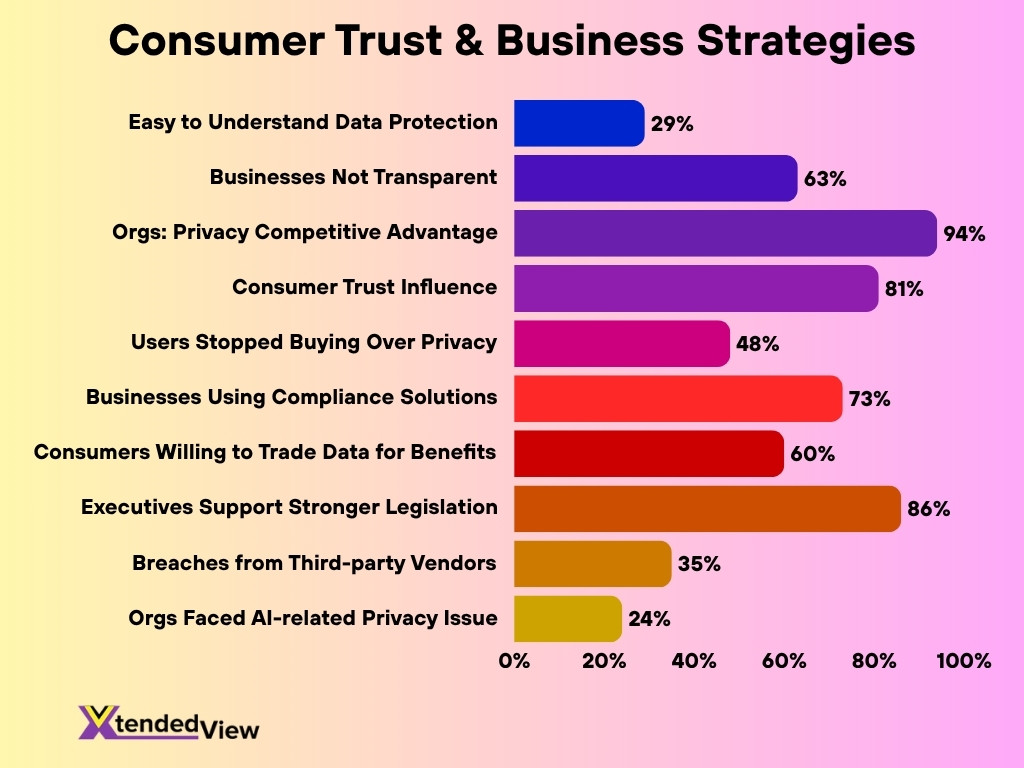
- Only 29% of consumers say it’s easy to understand how companies protect their data.
- 63% of users believe most businesses are not transparent about data usage.
- 94% of organizations believe strong privacy practices give them a competitive edge.
- 81% of consumers say a company’s data practices influence their trust and buying decisions.
- 48% of users have stopped buying from a company over privacy concerns.
- 72.9% of businesses use software or third-party solutions for compliance.
- 60% of consumers are willing to share personal data if they get clear benefits.
- 86% of executives support stronger national privacy legislation.
- 35% of data breaches are caused by third-party vendors.
- 24% of organizations have experienced an AI-related data privacy issue.
Data Privacy Trends
- Privacy-enhancing technologies (PETs) are being adopted by 55% of large enterprises.
- Zero-trust architecture adoption grew 22% year-over-year.
- Cookie-less tracking methods, such as device fingerprinting, are now used by over 47% of advertisers.
- Automated privacy risk assessments have doubled since 2023 in enterprise environments.
- Synthetic data usage for privacy-compliant analytics rose 31% in 2025.
- Dark patterns in consent design are under increasing scrutiny, with 5 EU regulators launching investigations.
- Blockchain-based data auditing tools are deployed by 18% of financial firms.
- Voice assistant data policies are becoming stricter, with Apple, Amazon, and Google updating terms in early 2025.
- Consumer-facing privacy dashboards are now offered by 42% of major tech firms.
- Cross-border data transfer frameworks have become a compliance priority post-Schrems II ruling.
Data Privacy and Consumer Behavior
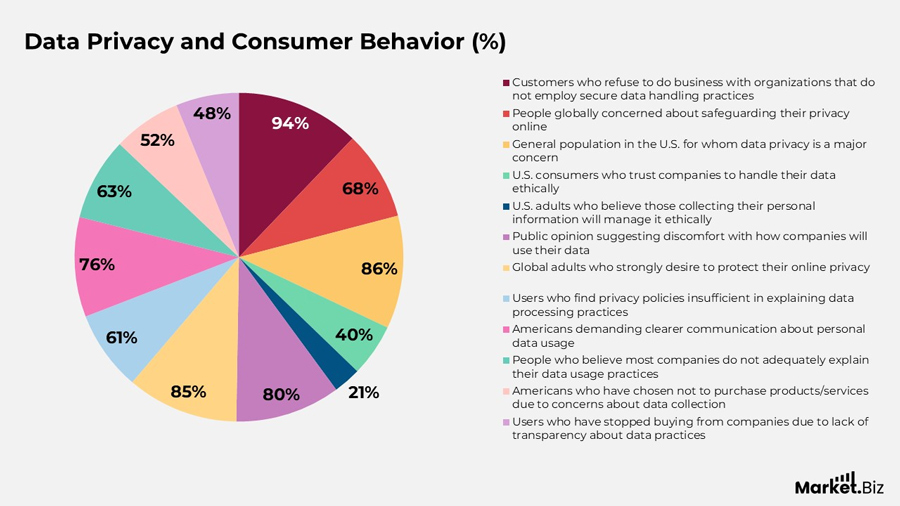
- 94% of customers refuse to do business with organizations that lack secure data handling practices, showing the critical importance of data security in customer trust.
- 86% of the U.S. population considers data privacy a major concern, highlighting how central privacy has become in public discourse.
- 85% of people express discomfort about how companies use their data, revealing a widespread mistrust toward corporate data practices.
- 80% of global adults show a strong desire to protect their online privacy, reinforcing the global demand for stricter digital safeguards.
- 76% of Americans are demanding clearer communication from companies regarding how their personal data is used.
- 68% of people globally are concerned about safeguarding their privacy online, proving this issue extends beyond borders.
- Only 40% of U.S. consumers trust companies to handle their data ethically, and an even smaller 21% believe those collecting personal information will manage it ethically.
- 61% of users find privacy policies insufficient in explaining how data is processed, suggesting companies need more transparency and simplicity in their communication.
- 63% believe that most companies fail to adequately explain their data usage practices, emphasizing a need for better accountability.
- 52% of Americans have avoided purchasing products or services due to data collection concerns, showing that privacy directly affects buying behavior.
- 48% of users have stopped buying from companies because of a lack of transparency about their data practices, underlining the financial impact of poor privacy communication.
Data Privacy and Artificial Intelligence
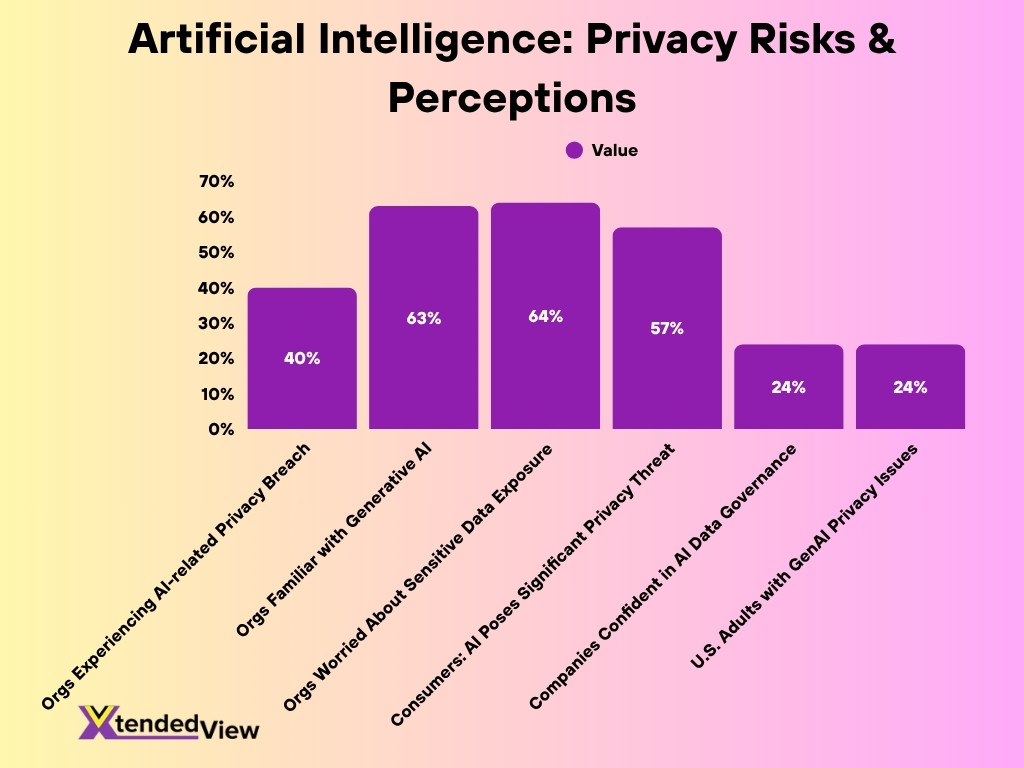
- 40% of organizations reported experiencing an AI‑related privacy breach, signaling that AI systems are already a material source of privacy risk.
- 63% of organizations say they are very familiar with generative AI (GenAI), yet 64% also worry about inadvertently exposing sensitive data when using GenAI tools.
- 57% of global consumers agree that AI poses a significant threat to their privacy, reflecting rising public concern about how personal data is processed by AI systems.
- Only 24% of companies feel confident in how they manage AI data privacy risks and governance frameworks.
- Among U.S. adults, 24% report having had data privacy issues when using generative AI tools.
- Analysts estimate that shadow‑AI (unauthorised or unmanaged AI usage within organizations) is contributing substantially to privacy exposure, though exact figures vary.
- AI systems that use large volumes of personal or sensitive data face unique challenges around transparency, consent, and data minimization.
- Businesses deploying AI must now consider not only cybersecurity risks but also how personal data is processed, inferre,d and repurposed, thus combining data‑privacy and AI‑governance considerations.
Data Privacy Legislation and Compliance
- As of early 2025, 144 countries have enacted consumer privacy or personal‑data legislation.
- In the United States, 21 states (about 42% of 50) had passed comprehensive state privacy laws by the start of 2025.
- By January 2025, data‑protection laws will cover an estimated 6.3 billion people, or 79% of the global population.
- 72.9% of businesses report using compliance solutions (software or services) to help manage data‑privacy obligations.
- 94.1% of businesses believe they can balance data collection for marketing with respecting customer privacy.
- A patchwork of laws (US states, EU, global) is cited as a major compliance challenge by 86% of organisations.
- A double‑blind survey found 90% of organisations believe data would be inherently safer if stored within their region or country.
- The evolving global regulatory landscape means many businesses are shifting from “compliance only” to “privacy strategy” frameworks.
Data Privacy Breaches
- In 2025, 68% of data breach incidents involved the human element (e.g., phishing, misconfiguration, credential theft).
- Phishing accounted for 16% of breaches and had an average cost of $4.8 million.
- Supply‑chain compromise (third‑party or vendor breaches) is the second most common initial breach vector at 15%.
- In 2025, 37% of breaches involved exposure of personal data such as names, SSNs or other personally identifiable information (PII).
- The average cost per breached record was approximately $160 in 2025.
- Organizations with a significant security‑skills shortage incurred an average breach cost of $5.22 million, compared to $3.65 million for those without a shortage.
- Breaches identified and contained in fewer than 200 days cost on average $3.87 million, while those taking more than 200 days cost $5.01 million on average.
- The U.S. remains the highest‑cost region for breaches, with costs about 40% higher than the next highest region (Middle East) in 2025.
Cost of Data Breach Statistics
- For small businesses (under 500 employees), the cost to respond and resolve a breach in 2025 is estimated at $120,000 to $1.24 million.
- In the financial sector, the average cost of a breach is around $6.08 million.
- Ransomware attacks (excluding ransom payments) averaged about $5.13 million in cost.
- The per‑record cost of a breach is about $160 globally in 2024‑25.
- Public‑sector breaches averaged $2.86 million, and are rising (up 12% over the past 12 months).
- Organizations that detected and contained the breach within fewer than 200 days saved an average of $1 million+ compared to longer response cycles.
- The global cost of cybercrime is projected to reach $10.5 trillion in 2025, growing at about 15% annually.
- Multi‑environment breaches (cloud + on‑premises) cost more and last longer, with an average lifecycle of 276 days vs 217 days for on‑premises only.
Consumer Data Privacy Statistics
- 68% of people worldwide say they are somewhat or very concerned about their online privacy.
- In the U.S., about 86% of adults say data privacy is a growing concern.
- Only 21% of U.S. adults feel confident that organizations with access to their personal information will do the right thing with it.
- 71% of consumers say they would stop doing business with a company if it mishandled their sensitive data.
- Only 29% of consumers find it easy to understand how well a company protects their personal data.
- 48% of users have stopped purchasing from a company because of privacy concerns.
- Among global consumers, 40% say they would voluntarily share personal data if they knew exactly how it would be used and by whom, but only 53% of companies say they take active steps to show this.
- 63% of consumers believe most companies aren’t transparent about how their data is used.
Mobile Data Privacy Statistics
- In 2025, global mobile users are projected to reach around 7.49 billion.
- 82.78% of iOS apps track private user data.
- 31.73% of iOS apps (594,000) reportedly use data linked to individual users.
- 18.44% of iOS apps (345,000) have access to users’ background location.
- 15.31% of iOS apps (287,000) use data to actively track users.
- Free mobile apps are about 4× more likely to collect user data than paid apps.
- In a mobile‑permission study, 15 of 20 popular apps requested precise location, 15 asked for file access, and 14 asked for microphone permission.
- Among young adult “digital natives,” 54% underestimated how many apps they had granted data access to, and 47% said they intended to revoke permissions after seeing what data could be inferred from location data.
Online Privacy Statistics
- As of 2025, the number of active social media identities is roughly 5.24 billion, up 4.1% year‑over‑year.
- 94% of adults say their online privacy is important.
- 63% of internet users believe they don’t know enough about how companies use their personal data.
- 62% of Americans believe it is impossible to go through daily life without companies collecting their data.
- Only about 64% of internet users say they use tools to help protect their online privacy, and 56% feel in control of their data.
- Among U.S. adults, 52% chose not to use a product or service because of worries about how much personal data would be collected.
- 81% of users believe the risks of companies collecting their data now outweigh the benefits.
- 69% of users say they view privacy policies as something to get past rather than read fully.
Social Media and Data Privacy Statistics
- 47% of adults across 12 countries have ended relationships with companies over data privacy concerns, including 33% leaving social media platforms.
- Less than 20% of U.S. social media users feel that a major platform protects their data and privacy.
- On average, social media users engage with about 6.83 platforms per month worldwide.
- Daily time spent on social media is 2 h 21 min, a decrease of 10 minutes compared with two years ago.
- Among mobile apps examined, the majority sought extensive permissions like location, file access, and startup‑activation.
- Social media tracking and data sharing with third parties remains under regulatory scrutiny, including recent fines.
- 4 in 5 companies store sensitive user data in the cloud, and for social media firms, this trend magnifies potential exposure.
- Younger users (16–24) spend about 3 h per day on social platforms, with women leading usage by ~12 minutes.
Business-Related Data Privacy Statistics
- 94% of organizations believe they can balance data collection for marketing with respecting customer privacy.
- 78% of businesses felt no negative impact from privacy‑regulation requirements.
- 91.1% of businesses say they would prioritize data privacy if they knew it could increase customer trust and loyalty.
- 48% of consumers have stopped buying from a company over its data‑privacy practices.
- About 94% of organizations admit that their customers would not buy from them if data were not protected properly.
- The average cost for a company to manually process a single data‑subject request is about $1,524.
- The annual budget for privacy in large organizations is projected to exceed $2.5 million by end of 2024–25.
- 63% of internet users believe most companies are not transparent about how their data is used.
Privacy Policies and Consent
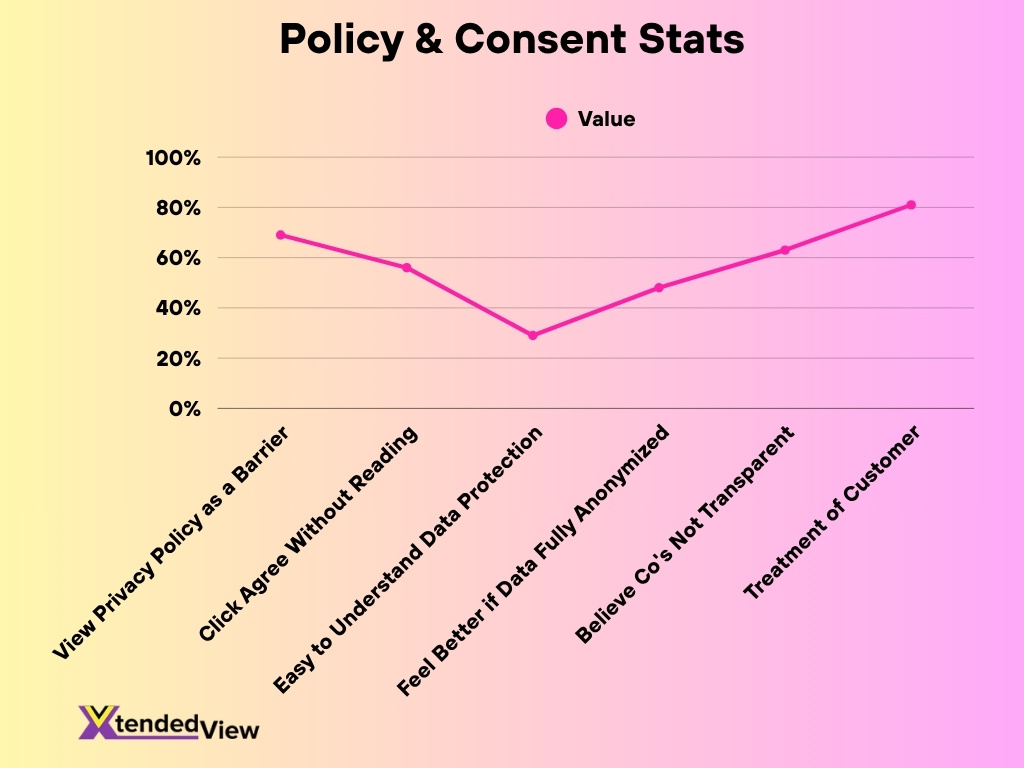
- 69% of users say they view privacy policies as something to get past, rather than read fully.
- 56% of Americans say they always, almost always, or often click “Agree” without reading privacy policies.
- Only 29% of consumers say it is easy to understand how well a company protects their personal data.
- 48% of consumers say they would feel more comfortable if companies anonymized their personal data fully.
- 63% of users believe that most companies are not transparent about how their data is used.
- 81% of users believe a company’s treatment of their personal data indicates how the company views them as a customer.
- Research shows that many digital‑native users underestimate how many apps have permission to access their data.
- Free apps are 4× more likely to collect user data than paid apps.
Data Privacy Software and Technologies
- Adoption of privacy‑enhancing technologies (PETs) is growing as organizations seek to manage risk and comply with laws.
- Organizations with extensive automation or defensive tools reported shorter breach life‑cycles and lower costs.
- Approximate ROI: 95% of organizations say the benefits of investing in data privacy exceed the costs, with an average ROI of ~1.6×.
- The average annual privacy budget for large organizations is projected to exceed $2.5 million.
- Companies increasingly deploy data‑subject‑request (DSR) automation tools to handle rising volumes of consumer requests under privacy laws.
- Lacking proper controls for AI or cloud systems can increase breach costs by up to $670,000.
- 72.9% of businesses use compliance solutions to manage privacy‑law obligations.
- Organizations are shifting from reactive compliance to proactively embedding privacy into software development and operations (privacy by design).
Data Privacy Risk Management
- The average breach lifecycle in 2025 is 241 days from identification to containment, a key risk metric.
- Organizations with security‑skills shortages pay tens of % more for breach resolution than those with adequate staffing.
- Breaches spanning multiple environments cost more and last longer, with an average of 276 days.
- Shadow IT and unmanaged AI tools represent major emerging risk vectors.
- Multi‑environment and cloud‑hybrid incidents show that risk management must span legacy, cloud, and vendor landscapes.
- Identification and containment within 200 days correlates with significantly lower breach cost.
- Data‑subject‑request volumes and regulatory‑investigation demands are increasing the operational risk burden.
- Effective risk‑management frameworks now integrate privacy, security, governance and operational resilience as one ecosystem.
Global Data Privacy Laws
- As noted earlier, 144 countries have data privacy laws in place as of early 2025.
- The General Data Protection Regulation (GDPR) model has inspired laws worldwide, and by end‑2024, privacy laws will cover ~79% of the global population.
- The U.S. has a growing patchwork of state laws (e.g., CCPA, CPRA), and as of February 2025, 19 state statutes were enacted.
- The EU now has multiple major digital‑privacy or tech laws, including the DMA, DSA, and CRA.
- Data transfer and localization rules are increasingly strict, with many countries requiring data residency or imposing significant cross‑border controls.
- Non‑compliance fines are rising, and across Europe alone, fines under GDPR have exceeded €2.1 billion in recent years.
- Organizations operating internationally cite regulatory complexity across jurisdictions as a major challenge in 2025.
- Privacy law frameworks are moving from “check‑the‑box” compliance into requirements for operational governance, documentation, and accountability.
Frequently Asked Questions (FAQs)
94%.
From USD $5.37 billion to USD $45.13 billion.
86%.
42%
59%.
Conclusion
In 2025, the data‑privacy landscape reveals a complex but critical story, while the global average cost of a breach has finally eased to about $4.44 million, the U.S. continues to face record levels of financial impact. Advances in AI, multi‑environment systems, and mobile‑app data collection have introduced fresh risk vectors that demand both operational vigilance and strategic investment. Meanwhile, consumer expectations around data transparency, consent, and control remain higher than ever and influence everything from purchase decisions to brand loyalty. Organizations that embed privacy into their core operations, manage risk across environments, and comply with a global patchwork of legislation are far better placed to win trust and reduce cost exposure.
