



Smart switches have become a core part of connected homes and commercial buildings, giving users remote control over lighting, appliances, and energy usage. They support practical applications such as home automation, energy management, and building control, while also helping property owners improve convenience and reduce electricity waste. As Wi-Fi, Matter, AI, and voice assistants continue to evolve, demand for smart switches keeps rising across the US and global markets. Explore the statistics below to understand the latest market trends, adoption patterns, and growth opportunities shaping the industry.
Editor’s Choice
- Global smart home revenue is projected to reach $159.5 billion in 2026, reflecting continued demand for connected home devices, including smart switches.
- The global smart home market is expected to increase from $147.5 billion in 2025 to $180.1 billion in 2026, representing strong year-over-year expansion.
- North America accounted for 31.7% of the global smart home market in 2025, making it the largest regional market for connected devices.
- The worldwide smart home market is forecast to grow at a 21.4% CAGR through 2034, supported by connected lighting, automation, and energy management solutions.
- Grand View Research estimates the smart home market will reach $207 billion in 2026, up from $162.8 billion in 2025.
- Asia Pacific generated 38.2% of global smart home revenue in 2025, highlighting strong manufacturing capacity and rising consumer adoption.
- Smart switches continue to benefit from broader adoption of AI-powered automation, Matter compatibility, and intelligent energy management across residential and commercial properties.
- Industry forecasts indicate the smart home technologies market could exceed $812 billion by 2033, creating additional opportunities for smart switch vendors.
Recent Developments
- CES 2025 introduced a new generation of Matter-compatible smart switches designed to improve interoperability across leading smart home ecosystems.
- Several manufacturers now allow smart switches to operate in existing three-way wiring configurations without replacing every wall switch, reducing installation costs.
- AI-powered assistants now support more contextual automation, enabling smart switches to respond to occupancy, schedules, and user routines.
- Matter adoption continues to simplify cross-platform compatibility between Apple, Google, Amazon, Samsung, and other ecosystems.
- New premium smart switches now integrate touchscreen displays, environmental sensors, and energy monitoring within a single wall-mounted device.
- Modern smart switches increasingly support Thread and Matter, reducing dependency on proprietary ecosystems.
- Open-source development and Matter bridge support are expanding the future role of Z-Wave smart switch ecosystems.
- Smart switch innovation increasingly focuses on predictive automation powered by AI instead of simple scheduled on/off control.
Global Smart Switch Market Overview
- Smart switches represent one of the fastest-growing categories within the broader smart home industry due to increasing home automation investments.
- Rising electricity prices continue to encourage consumers to install connected lighting controls and automated switches.
- Residential construction projects increasingly include smart wiring infrastructure during new home development.
- Commercial buildings continue adopting smart switches to improve lighting efficiency and centralized facility management.
- The expansion of IoT ecosystems has made smart switches an entry-level automation product for many households.
- Cloud-connected mobile applications remain the primary interface for controlling smart switches remotely.
- Growth in broadband coverage and home Wi-Fi availability continues to increase smart switch adoption globally.
- Vendors increasingly emphasize interoperability instead of proprietary ecosystems, improving consumer confidence.
Home Smart Switches Market Size Statistics
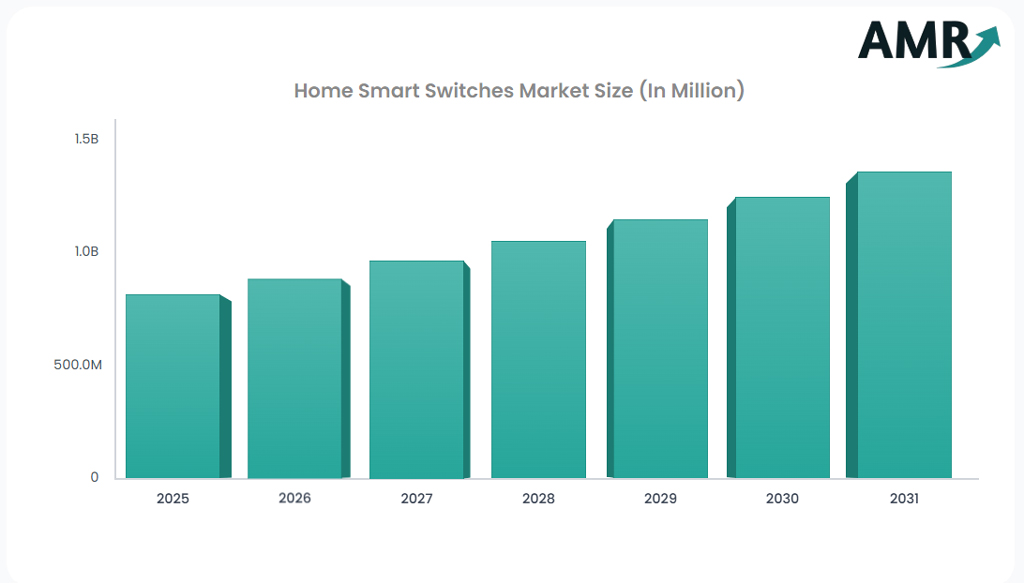
- The home smart switches market is projected to grow from 815.0 million in 2025 to 1.359 billion by 2031, highlighting strong long-term market expansion.
- The market is expected to reach approximately 887.0 million in 2026, reflecting steady year-over-year growth.
- By 2027, the global market size is forecast to increase to 966.0 million, moving closer to the 1 billion milestone.
- The industry is projected to surpass the 1 billion mark in 2028, reaching 1.052 billion.
- Market value is expected to climb further to 1.146 billion in 2029, indicating continued demand for smart home technologies.
- The home smart switches market is forecast to reach 1.248 billion in 2030, maintaining a consistent upward growth trajectory.
- By 2031, the market is anticipated to achieve 1.359 billion, representing an increase of approximately 66.7% compared to 2025.
Smart Switch Revenue and Sales Statistics
- Smart home revenue worldwide is forecast to reach $159.5 billion in 2026.
- Smart home technologies generated an estimated $162.8 billion in global revenue during 2025.
- Market revenue is projected to increase to approximately $207 billion in 2026, reflecting strong annual growth.
- North America remained the largest revenue contributor among regional smart home markets in 2025.
- Asia Pacific generated the highest regional revenue share at 38.2% according to one industry estimate.
- Connected lighting and smart electrical controls continue to represent one of the largest device categories within home automation spending.
- Growth in smart switch sales increasingly comes from retrofit installations rather than only new construction projects.
- Demand for premium smart switches with AI, Matter support, and energy monitoring features continues to increase average selling prices across the market.
Smart Switch Adoption and Penetration Rates
- Over 80% of US homes now feature at least one smart technology device.
- 64% of surveyed homeowners prioritize energy efficiency when adopting smart switches.
- The global single-pole smart switch market is projected to reach $3.32 billion in 2026.
- Residential applications accounted for 54% of global smart switch panel shipments in 2025.
- Over 70% of newly installed smart switches leverage Wi-Fi or Bluetooth connectivity.
- Commercial buildings using smart switches report energy savings of 15% to 30% on lighting.
- Modular electrical switches dominated the global market with a massive 79.6% share in 2025.
- Voice-controlled integrations are now implemented in 29% of all new smart panel deployments.
- The overarching smart home market is forecast to hit a valuation of $180.12 billion in 2026.
Regional Smart Switch Market Breakdown
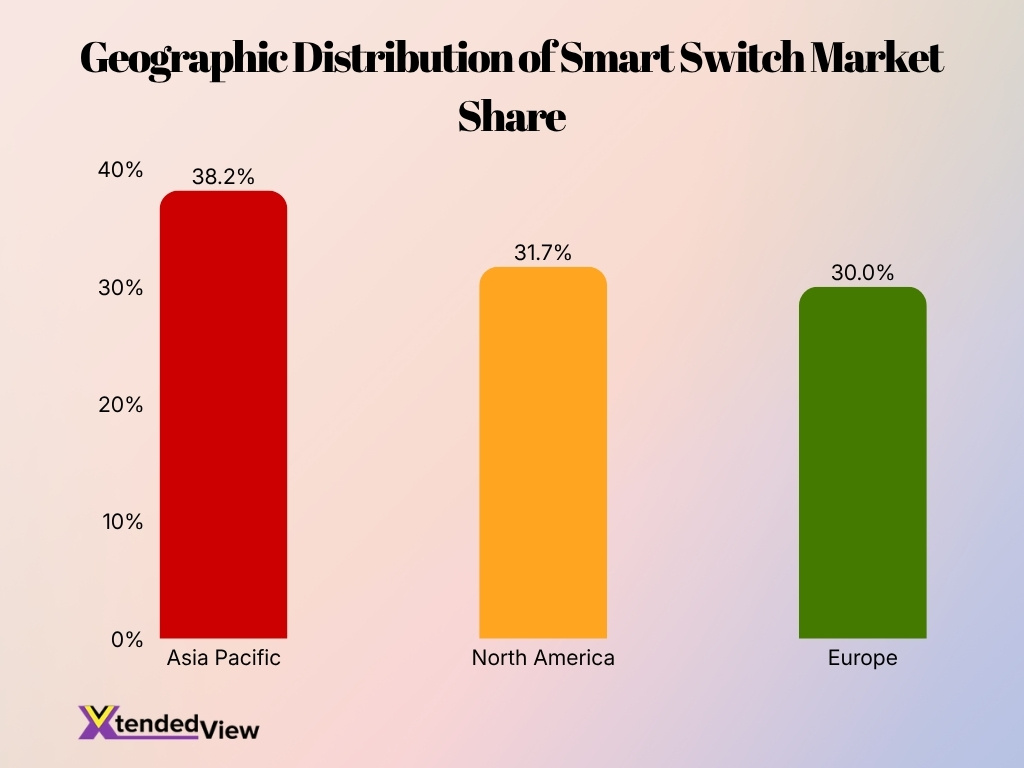
- North America accounted for 31.7% of global smart home revenue in 2025.
- The US leads regional adoption with over 50% of users integrating switch automation.
- Asia Pacific generated 38.2% of total market revenue due to rapid urbanization.
- China and India are seeing double-digit growth of over 10% in mid-income households.
- Europe holds a 30% share of the global smart switch market, driven by sustainability goals.
- Germany accounts for 12.3% of the global market, fueled by strict energy efficiency regulations.
- The Middle East and Africa markets are growing steadily at a 5.8% CAGR due to smart city initiatives.
- Latin America shows gradual growth with Brazil holding a 42.3% regional share in smart installations.
- Global internet penetration of over 60% remains a key factor for smart switch adoption.
Residential vs Commercial Smart Switch Usage
- Residential users account for over 65% of global smart switch installations, driven by DIY kits.
- Commercial buildings represent approximately 32% of total smart switch market demand.
- Smart switches reduce commercial building lighting energy consumption by up to 30%.
- Over 70% of modern residential switches utilize Wi-Fi or Bluetooth for remote control.
- Commercial users achieve operational efficiency with overall energy savings of up to 50%.
- Multi-family housing smart ecosystems are driving a projected $848.47 billion market by 2034.
- Occupancy-based lighting in hotels and offices slashes electricity waste by 60% to 80%.
- Retrofitting buildings is expanding the global smart switch market at a 9.3% CAGR through 2034.
- Commercial smart switch adoption contributes to a potential $10.4 billion in annual energy savings.
Leading Smart Switch Manufacturers and Market Share
- The global smart switch market is projected to reach $14 billion by 2030, expanding at a 17.2% CAGR.
- Legrand currently dominates the global smart switch industry by holding a significant 27.8% market share.
- Lutron controls an impressive 41% market share specifically within the high-end residential smart switch segment.
- North America leads the global industry by capturing a 35% regional market share driven by residential automation.
- The residential application segment accounts for a dominant 45.6% of the overall market share.
- Wi-Fi connected smart switches hold the largest product category share by capturing 38.2% of the market.
- Hotel intelligent solutions offered by Schneider and Siemens generate a lucrative gross profit margin of 58%.
- Honeywell explosion-proof smart switches command a 39% market share within the specialized oil and gas sector.
- Touch-type smart switches currently dominate product forms by occupying 45% of the total market share.
- The Asia-Pacific region is experiencing rapid adoption and currently holds a 38.4% global market share.
Smart Switch Market by Product Type Statistics
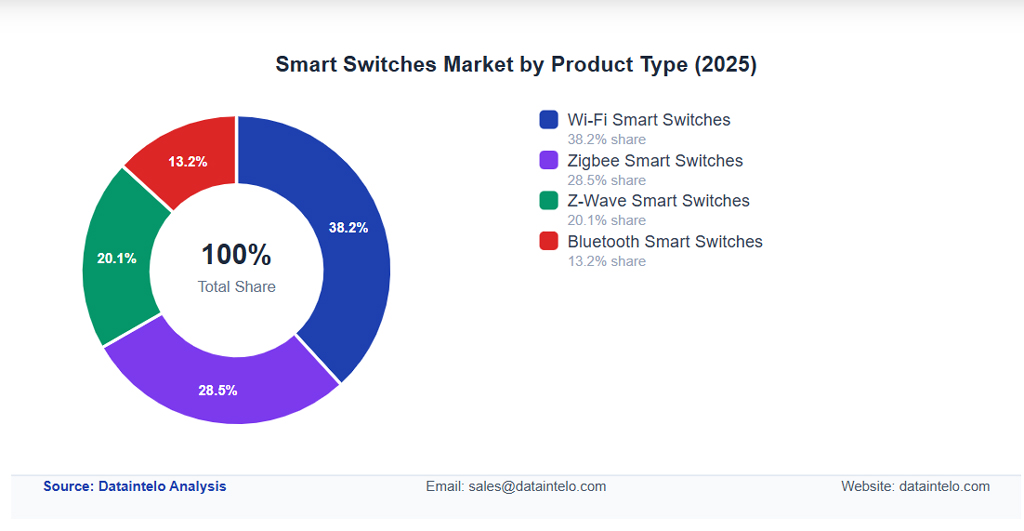
- Wi-Fi smart switches dominate the market with a 38.2% share, making them the largest product segment.
- Zigbee smart switches account for 28.5% of the market, ranking as the second most popular product type.
- Z-Wave smart switches hold a 20.1% market share, reflecting their strong adoption in connected home ecosystems.
- Bluetooth smart switches represent 13.2% of the market, making them the smallest segment among the major product types.
- Wi-Fi smart switches lead Zigbee smart switches by 9.7 percentage points in overall market share.
- The combined share of Wi-Fi and Zigbee smart switches reaches 66.7%, representing over two-thirds of the total market.
- Z-Wave and Bluetooth smart switches together contribute 33.3% of the global smart switch market.
- The top three product types, Wi-Fi, Zigbee, and Z-Wave, collectively account for 86.8% of the total market share.
- Wireless communication technologies dominate the smart switch market, with all four product categories accounting for 100% of the analyzed market.
- The market distribution highlights Wi-Fi as the preferred connectivity technology, while Bluetooth maintains a smaller but notable 13.2% presence.
Smart Switch Product Segmentation by Type
- Toggle switches hold an 18% market share within the global smart switch panel industry.
- Smart dimmer switches now account for 60% of total market demand in the dimming sector.
- Touch-operated smart devices have experienced a notable 39% growth due to premium adoption.
- Multi-gang smart switch panels frequently range from 4-gang to 12-gang configurations globally.
- Wireless smart dimmer switches are gaining significant traction by capturing 35% of the market.
- Retrofit smart switch applications continue to lead the segment with a 51.18% market share.
- Modular commercial building installations currently account for 32% of the total market.
- Smart switches integrated with automated sensors globally hold a 15% market share.
- Hybrid Wi-Fi-enabled smart switch panels dominate global setups by commanding 48% of installations.
Smart Switch Compatibility with Voice Assistants
- Over 75% of smart switch products in 2026 feature voice assistant integration.
- Amazon Alexa leads the sector with a 23% global share in the smart home market.
- Google Assistant actively supports over 400 million devices, including Matter-certified smart switches.
- Over 50% of global households now utilize at least one voice-compatible smart device.
- Approximately 70% of industry experts anticipate extensive voice control adoption among elderly users.
- The global smart home market reached $95.83 billion in 2026, driven directly by voice assistants.
- Over 8.4 billion active voice-enabled devices are currently being used worldwide.
- More than 157.1 million U.S. consumers actively use voice assistants for daily automation routines.
- Advanced AI integration has led to a 40% increase in user satisfaction for smart controls.
Smart Switch Compatibility with Major Smart Home Platforms
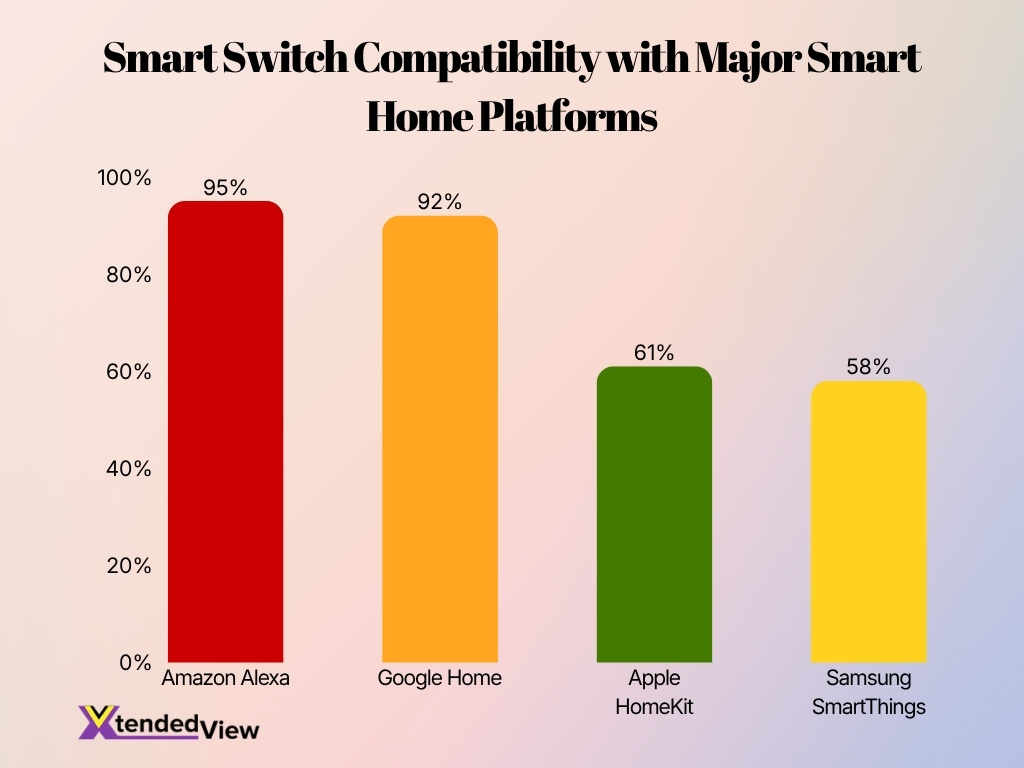
- Amazon Alexa offers the highest compatibility at 95%, making it the most widely supported smart home platform for smart switches.
- Google Home follows closely with 92% compatibility, highlighting its broad integration across leading smart switch brands.
- Apple HomeKit supports 61% of smart switches, indicating a more selective but still significant ecosystem presence.
- Samsung SmartThings records 58% compatibility, providing support for more than half of the smart switch products available.
- The compatibility gap between Amazon Alexa (95%) and Google Home (92%) is only 3 percentage points, showing both platforms dominate the market.
- Amazon Alexa exceeds Apple HomeKit compatibility by 34 percentage points, demonstrating its much broader device support.
- Both Apple HomeKit (61%) and Samsung SmartThings (58%) have compatibility rates below 65%, suggesting narrower smart switch integration than Alexa and Google Home.
- The data indicates that voice assistant ecosystems, particularly Amazon Alexa and Google Home, remain the preferred platforms for smart switch compatibility.
Smart Switch Security and Privacy Statistics
- Around 72% of smart home owners express great concerns about personal data privacy.
- Approximately 98% of all IoT device traffic is transmitted unencrypted, exposing user credentials.
- Over 820,000 malicious IoT hacking attempts occur every single day globally.
- Nearly 83% of IoT devices run on unsupported operating systems, increasing security vulnerabilities.
- IoT cyberattacks have surged by 400% year-over-year, heavily impacting smart home ecosystems.
- About 55% of smart home device owners do not understand how their devices collect data.
- Almost 46% of consumers have experienced at least one privacy or security issue in the past year.
- Around 33% of potential buyers refuse to adopt smart devices due to data privacy fears.
- Roughly 10% of smart home apps collect user data specifically for third-party tracking purposes.
Impact of IoT Growth on Smart Switch Demand
- The global smart switches market is projected to grow from $18.5 billion in 2025 to $47.2 billion by 2033 at a 12.8% CAGR.
- The worldwide IoT device base exceeded 15 billion units by early 2026, expanding the infrastructure for smart switch networks.
- Wi-Fi smart switches dominated the market in 2025 with a 38.2% share due to the widespread availability of wireless internet.
- Commercial buildings adopting smart switches have reported documented energy savings of 15% to 30% on lighting costs.
- Over 70% of newly installed smart switches leverage Wi-Fi or Bluetooth for seamless integration without requiring dedicated hubs.
- The residential sector accounted for 45.6% of the global smart switches market share in 2025 due to rising home automation.
- Voice-controlled smart panel deployments have experienced a rapid 29% growth rate globally as user interfaces become more accessible.
- The global number of smart home users is projected to surge to 576.22 million by 2026, widening the consumer base for intelligent lighting.
- Approximately 39% of newly installed smart switch panels are now specifically engineered for energy efficiency and smart load management.
- The overarching smart home market is forecast to jump from $180.12 billion in 2026 to $848.47 billion by 2034.
Smart Switch Energy Savings Statistics
- Smart lighting controls and switches can reduce residential energy consumption by up to 20%–30%.
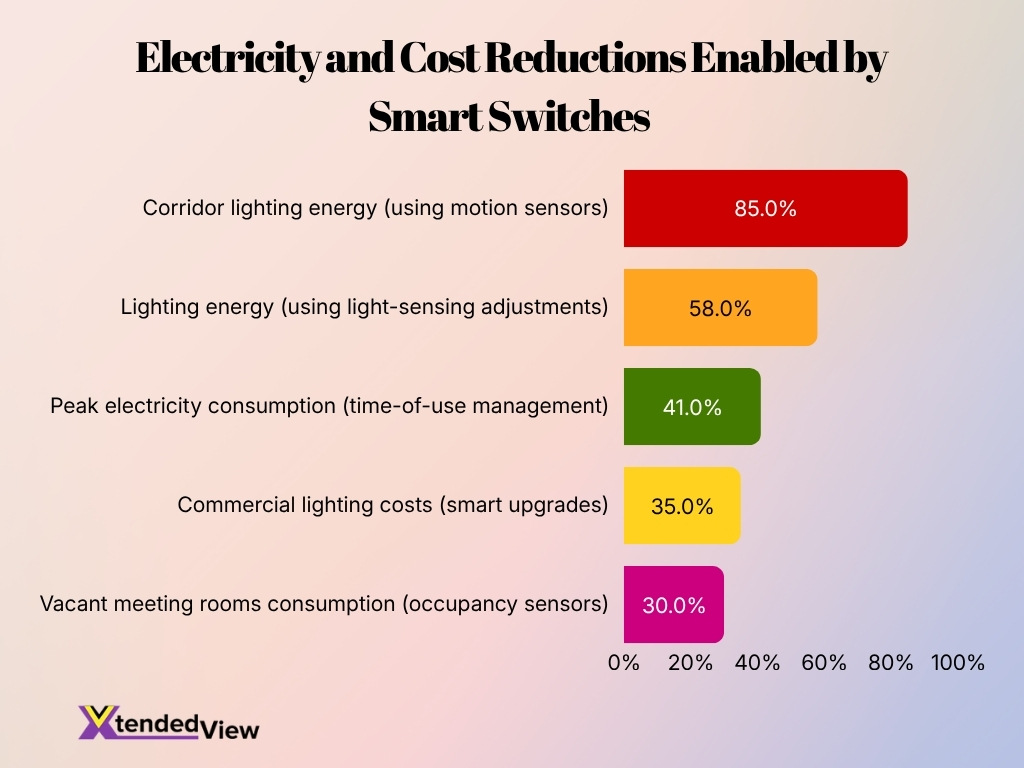
- Commercial buildings with automated systems can cut lighting energy use by as much as 35%.
- Approximately 64% of homeowners consider energy efficiency a key factor when purchasing smart devices.
- Managing time-of-use electricity via smart switches can reduce peak electricity consumption by 41%.
- Advanced light-sensing adjustments can reduce overall lighting energy consumption by up to 58%.
- Eliminating standby power with time-scheduled smart sockets saves roughly 800 kWh of electricity annually.
- Smart switches operating in standby mode consume a minimal 0.5 to 1.5 watts of electricity per hour.
- Utilizing motion sensors with smart dimming switches at night can save up to 85% of corridor lighting energy.
- Smart lighting upgrades in commercial spaces can effectively reduce total lighting costs by 35% to 70%.
- Automatically switching off lighting in vacant meeting rooms with occupancy sensors saves about 30% of consumption.
Role of AI and Automation in Smart Switch Usage
- AI-driven automated LED systems reduce lighting electricity consumption by 60-80% compared to manual switches.
- The global smart switch market driven by automation is projected to exceed $14 billion by 2030.
- Approximately 68% of users purchase smart switches primarily for their automated energy-saving capabilities.
- AI-powered dynamic dimming technology in smart switches can save up to 45% of lighting energy consumption.
- Around 62.5% of smart home users rely on smart switches to control their connected devices.
- Intelligent lighting control systems account for 63% of all adopted smart home automation devices.
- Implementing smart lighting automation in commercial buildings reduces overall energy consumption by 15-20%.
- Over 97% of smart home device owners report high satisfaction with their automated convenience.
Smart Switch Market Trends and Future Outlook
- The global smart switch market is projected to reach $47.2 billion by 2033, growing at a CAGR of 12.8%.
- Wi-Fi-enabled smart switches currently dominate the industry, capturing 38.2% of the global revenue share.
- Commercial buildings adopting smart switches report lighting energy savings ranging from 15% to 30%.
- The residential application sector accounts for 45.6% of the total market share due to smart home upgrades.
- Global deployments of voice-controlled smart switch panels have recently experienced a 29% increase in adoption.
- The Asia-Pacific region leads global demand with a 38.4% market share fueled by rapid urbanization.
- Approximately 68% of consumers purchase smart switches specifically for their energy-saving capabilities.
- The broader global smart home market is officially forecast to reach $848.47 billion by the year 2034.
- Over 250 million smart homes globally are currently equipped with IoT-connected smart sockets.
Frequently Asked Questions (FAQs)
The global smart home market is projected to reach $180.12 billion in 2026, up from $147.52 billion in 2025.
The market is forecast to grow at a 21.4% CAGR between 2026 and 2034.
North America held the largest regional share with 31.7% of the global smart home market in 2025.
Worldwide smart home market revenue is projected to reach $159.5 billion in 2026.
The global smart home market is expected to reach approximately $887.4 billion by 2033.
Conclusion
Smart switches continue to evolve as a critical component of modern smart homes and connected buildings. Driven by energy efficiency, automation, and IoT expansion, the market shows strong growth across both residential and commercial sectors. As technologies like AI, Matter, and advanced connectivity mature, smart switches will move beyond simple control devices to become intelligent systems that actively optimize energy use and user comfort.
Looking ahead, the combination of affordability, interoperability, and sustainability will shape adoption trends. For homeowners, businesses, and manufacturers alike, smart switches represent a practical entry point into the broader smart ecosystem, one that will only gain importance in the years to come.
