


Nokia remains one of the world’s most influential telecommunications infrastructure companies, powering mobile networks, fiber broadband systems, cloud-native platforms, and emerging AI-driven connectivity services. Its technologies support telecom operators, hyperscale data centers, enterprises, governments, and industrial automation projects across more than 130 countries. As AI workloads, private wireless networks, and next-generation connectivity continue to expand, Nokia’s role in digital infrastructure has become increasingly important.
Explore the latest Nokia statistics to understand the company’s financial performance, market position, technology leadership, and growth trends.
Editor’s Choice
- Nokia reported €19.89 billion in net sales for full-year 2025, representing approximately 3% year-over-year growth.
- Nokia generated approximately €2.0 billion in comparable operating profit during 2025.
- The company produced around €1.5 billion in free cash flow in 2025.
- Nokia reached 7,000 patent families declared essential to 5G standards in January 2025.
- Nokia employed approximately 78,000 people globally at the end of 2025.
- AI and cloud customers generated more than €2.4 billion in orders during 2025, highlighting a rapidly growing business segment.
- Network Infrastructure delivered approximately €8.0 billion in revenue during 2025.
- Nokia’s AI and cloud customers accounted for roughly 6% of group net sales during 2025.
- First-quarter 2026 sales to AI and cloud customers increased 49% year over year, supported by strong hyperscaler demand.
Recent Developments
- Nokia completed its acquisition of Infinera, strengthening its position in optical networking and AI data center connectivity.
- In November 2025, Nokia announced a major operating model transformation that reorganized the company into two primary operating segments.
- Beginning in 2026, Nokia shifted reporting toward the Network Infrastructure and Mobile Infrastructure segments.
- Nokia increased its forecast for AI and cloud market growth from 16% to 27% annually through 2028.
- The company secured approximately €1 billion in new AI-related orders during Q1 2026.
- Nokia reported 54% growth in comparable operating profit during Q1 2026.
- Q4 2025 net sales rose 3% year over year, reaching roughly €6.1 billion.
- Optical Networks revenue increased 17% in Q4 2025, driven by AI infrastructure investments.
- Nokia announced long-term Network Infrastructure growth targets of 6% to 8% CAGR through 2028.
General Nokia Company Statistics
- Nokia was founded in 1865, making it one of the oldest technology companies still operating globally.
- The company operates in more than 130 countries worldwide through customer, partner, and service networks.
- Nokia generated approximately €19.89 billion in revenue during 2025.
- Full-year 2024 revenue totaled approximately €19.22 billion.
- Nokia’s workforce stood at roughly 78,000 employees in 2025.
- The company invested heavily in connectivity technologies spanning mobile, fixed, optical, and cloud networking solutions.
- Nokia’s business increasingly targets AI infrastructure, hyperscalers, enterprises, and telecom operators.
- The company maintains one of the telecommunications industry’s largest intellectual property portfolios with around 20,000 patent families.
- Nokia continues to position itself as a key supplier for AI-driven networking and cloud-scale connectivity.
Nokia Revenue and Normalized Net Income Statistics
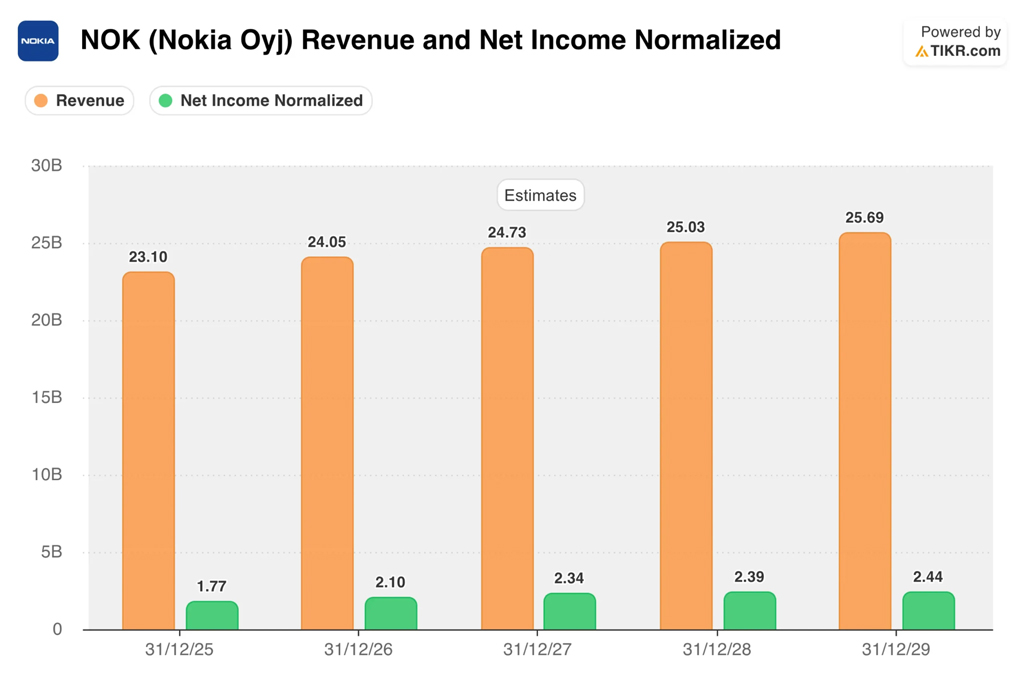
- Nokia’s revenue is projected to increase from $23.10 billion in 2025 to $25.69 billion in 2029, representing a total growth of 11.2% over the five-year period.
- The company is expected to add approximately $2.59 billion in annual revenue between 2025 and 2029.
- Nokia’s normalized net income is forecast to rise from $1.77 billion in 2025 to $2.44 billion in 2029, an increase of 37.9%.
- 2026 revenue is estimated at $24.05 billion, up 4.1% from $23.10 billion in 2025.
- Nokia’s normalized net income is expected to reach $2.10 billion in 2026, growing by 18.6% year over year.
- Revenue is projected to climb to $24.73 billion in 2027, marking another year of steady growth.
- 2027 normalized net income is estimated at $2.34 billion, crossing the $2 billion threshold for the second consecutive year.
- Nokia’s revenue is forecast to surpass $25 billion in 2028, reaching approximately $25.03 billion.
- The company’s normalized net income is expected to increase to $2.39 billion in 2028, reflecting continued profitability improvements.
- By 2029, Nokia is projected to generate its highest revenue in the period at $25.69 billion.
- Normalized net income is expected to reach $2.44 billion in 2029, the highest level shown in the forecast.
- Over the forecast period, net income growth (37.9%) significantly outpaces revenue growth (11.2%), indicating improving operational efficiency and profit margins.
- Nokia’s revenue remains above $23 billion annually throughout the forecast period, highlighting stable business performance.
- The company’s normalized net income is projected to grow every year from 2025 through 2029, with no declines during the period.
Nokia Market Share Statistics
- Nokia remains one of the world’s top three telecom network equipment suppliers alongside Ericsson and Huawei.
- The company serves hundreds of telecommunications operators globally across radio, fixed, and optical networks.
- Nokia’s 5G patent portfolio includes 7,000 declared essential patent families, reinforcing its competitive position.
- Network Infrastructure generated approximately €8 billion in revenue during 2025, making it one of Nokia’s largest businesses.
- AI and cloud customers contributed approximately 14% of Network Infrastructure sales during 2025.
- Nokia continues to hold a significant market presence in optical transport networks following the Infinera acquisition.
- The company reported strong demand from North American operators and hyperscale cloud providers in late 2025.
- Nokia expects accelerated market expansion in AI networking, forecasting annual market growth of 27% through 2028.
- Optical networking revenue grew 19% year over year during Q3 2025 on a constant-currency basis.
Nokia Mobile Networks and Infrastructure Statistics
- Mobile Networks’ net sales grew 6% year over year in Q4 2025.
- Full-year 2025 Mobile Networks sales remained broadly stable despite ongoing industry spending adjustments.
- Network Infrastructure revenue reached approximately €8.0 billion in 2025.
- Network Infrastructure revenue increased 7% in Q4 2025.
- Optical Networks revenue expanded 17% during Q4 2025.
- AI and cloud customers accounted for approximately 14% of Network Infrastructure sales.
- Network Infrastructure sales increased 28% year over year during Q3 2025.
- Nokia expects continued growth in Network Infrastructure throughout 2026 as AI data center deployments expand.
- The company identified optical, IP, and fixed networks as core pillars of its future infrastructure strategy.
Nokia Regional Sales and Revenue Statistics
- North America remained Nokia’s largest regional market during 2025, supported by telecom operators, cloud providers, and enterprise customers.
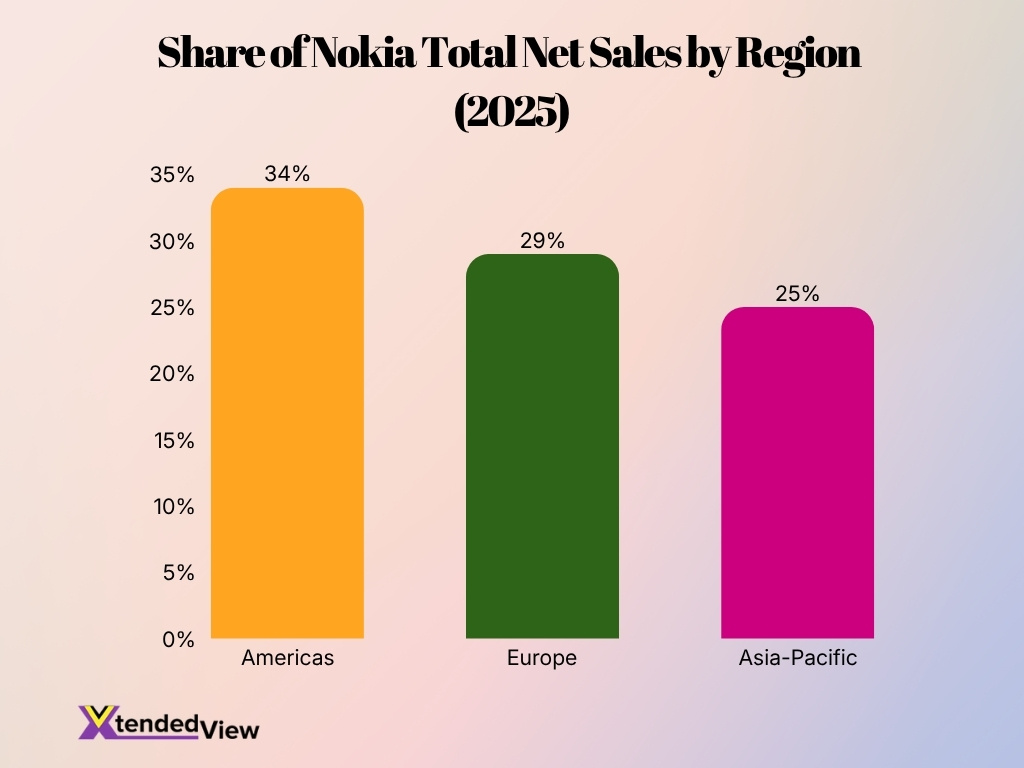
- The Americas accounted for approximately 34% of Nokia’s total net sales in recent reporting periods.
- Europe contributed roughly 29% of total revenue, making it the company’s second-largest geographic region.
- Asia-Pacific generated approximately 25% of Nokia’s revenue, supported by operator modernization projects and enterprise deployments.
- Greater China contributed a smaller share of sales compared with historical levels due to competitive market conditions.
- India remained one of Nokia’s most important growth markets, particularly for 5G deployment and network modernization projects.
- Growth in North American AI infrastructure investments supported strong optical networking demand during 2025 and early 2026.
- Nokia expanded enterprise and private wireless deployments across the Middle East, creating additional regional growth opportunities.
- Several European broadband infrastructure projects contributed to stronger fixed network sales throughout 2025.
- Regional diversification helped offset slower spending trends in selected telecommunications markets.
Nokia Cloud and Network Services Statistics
- Nokia Cloud and Network Services generated approximately €3.0 billion in net sales during 2025.
- The segment delivered a comparable operating margin of roughly 8% in 2025.
- More than 560 communications service providers worldwide use Nokia software and cloud solutions.
- Cloud-native core network products currently support over 330 mobile network operators globally.
- The Network as Code ecosystem expanded to include more than 50 partner organizations in 2025.
- Nokia achieved double-digit growth in software-based network automation contracts late in 2025.
- The autonomous network management portfolio supports networks serving billions of mobile subscribers.
- Nokia’s digital operations software is utilized by service providers across more than 100 countries.
Nokia 5G and 6G Statistics
- Nokia reached 7,000 patent families declared essential to 5G standards as of January 2025.
- The company has invested more than €150 billion collectively in global 5G research and development ecosystems through industry partnerships and innovation programs.
- Nokia supports over 700 private wireless customers, many using 5G technologies for industrial applications.
- The company has signed more than 700 commercial 5G agreements globally, including public and private network deployments.
- Nokia Bell Labs remains among the leading contributors to early 6G standardization research, collaborating with governments, universities, and telecom operators.
- Nokia participates in major 6G research initiatives across North America, Europe, and the Asia-Pacific.
- By 2026, Nokia had expanded its AirScale radio portfolio to support advanced 5G Advanced capabilities, including AI-assisted radio optimization.
- Nokia forecasts increasing operator investment in 5G Advanced technologies through 2028 as AI-driven network traffic grows.
- The company’s energy-efficient radio products can reduce network power consumption by up to 30% compared with previous-generation equipment in certain deployments.
- Nokia Bell Labs researchers continue to publish hundreds of technical contributions annually, supporting future 6G standards development.
Nokia Revenue Distribution by Business Segment
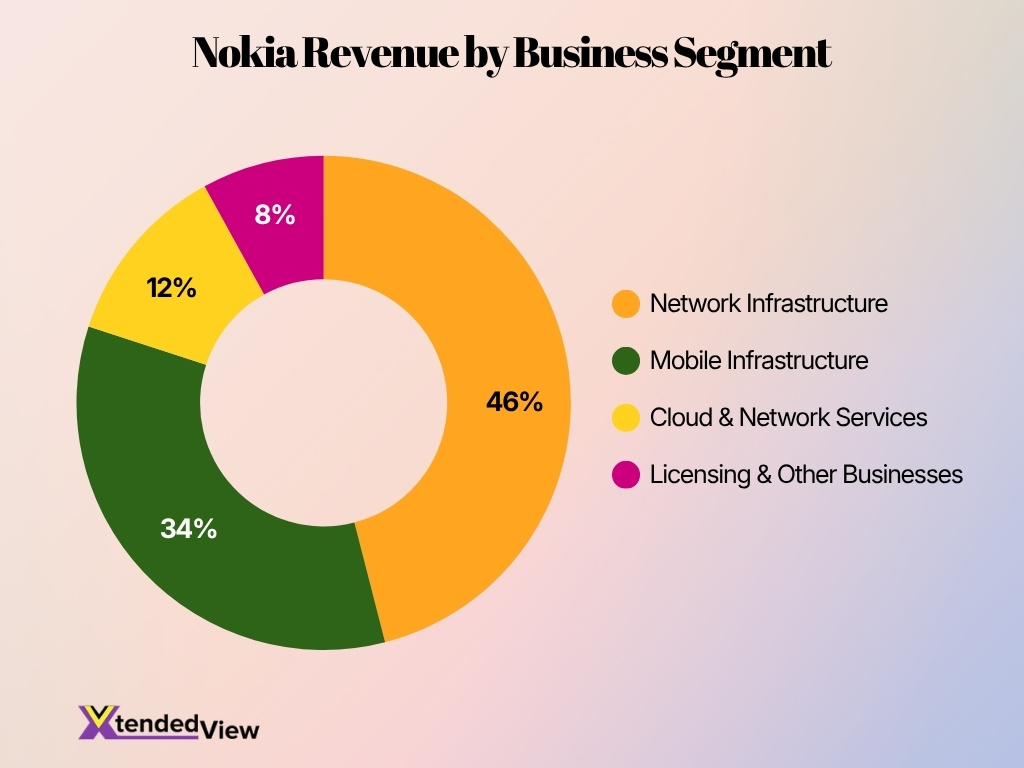
- Network Infrastructure is Nokia’s largest revenue contributor, accounting for 46% of total company revenue, highlighting its dominant role in the business portfolio.
- Mobile Infrastructure generates 34% of revenue, making it the second largest segment and a key driver of Nokia’s telecommunications operations.
- Together, Network Infrastructure and Mobile Infrastructure contribute 80% of Nokia’s total revenue, showing the company’s strong dependence on network-related businesses.
- Cloud & Network Services represents 12% of revenue, reflecting Nokia’s growing focus on cloud technologies, software solutions, and enterprise networking services.
- Licensing & Other Businesses account for the remaining 8% of revenue, demonstrating the value of Nokia’s intellectual property and patent licensing portfolio.
- The 12 percentage point gap between Network Infrastructure (46%) and Mobile Infrastructure (34%) indicates the stronger market position of Nokia’s infrastructure business.
- Nokia’s non-hardware focused segments, including Cloud & Network Services and Licensing & Other Businesses, collectively contribute 20% of total revenue.
- The revenue mix shows Nokia maintains a diversified business structure, with income streams spread across infrastructure, mobile networks, cloud services, and licensing operations.
- Nearly one out of every two euros earned by Nokia comes from its Network Infrastructure segment, underscoring its strategic importance to the company.
- The data highlights Nokia’s continued emphasis on telecommunications infrastructure while gradually expanding its software and services ecosystem.
Nokia AI and Cloud Business Statistics
- AI and cloud customers generated approximately €2.4 billion in orders during 2025, making the segment one of Nokia’s fastest-growing opportunities.
- AI and cloud customers accounted for roughly 6% of total Nokia revenue during 2025.
- In Q1 2026, Nokia reported a 49% year-over-year increase in sales to AI and cloud customers.
- Nokia secured approximately €1 billion in AI-related orders during the first quarter of 2026 alone.
- The company increased its projected AI networking market growth outlook from 16% to 27% annually through 2028.
- AI and cloud customers represented approximately 14% of Network Infrastructure sales during 2025.
- Nokia’s data center networking business expanded significantly following increased investment by hyperscale cloud providers.
- Optical networking demand linked to AI workloads helped drive double-digit revenue growth across several infrastructure categories during 2025.
- Nokia’s acquisition of Infinera strengthened its position in AI-driven data center interconnect solutions.
- The company expects AI-related networking opportunities to become a multibillion-euro annual growth driver over the next several years.
Nokia Enterprise Business Statistics
- Nokia provides private wireless solutions to over 850 enterprise customers globally.
- A remarkable 87% of enterprise network adopters achieved a positive return on investment within one year.
- Over 50% of the global private wireless market share is currently commanded by Nokia.
- Approximately 79% of organizations reported a 10% or greater reduction in emissions after deployment.
- Improved workplace safety was observed by 65% of customers, reporting a greater than 10% improvement.
- 94% of surveyed industrial enterprises utilize Nokia’s private wireless to support AI-driven applications.
- Channel sales currently account for 70% of all Nokia private network deals and deployments.
- More than 150 mining sites worldwide currently utilize Nokia industrial networking technologies.
- By the end of Q4 2025, Nokia successfully surpassed 1,000 private network contracts globally.
Nokia Sales by Customer Type Statistics
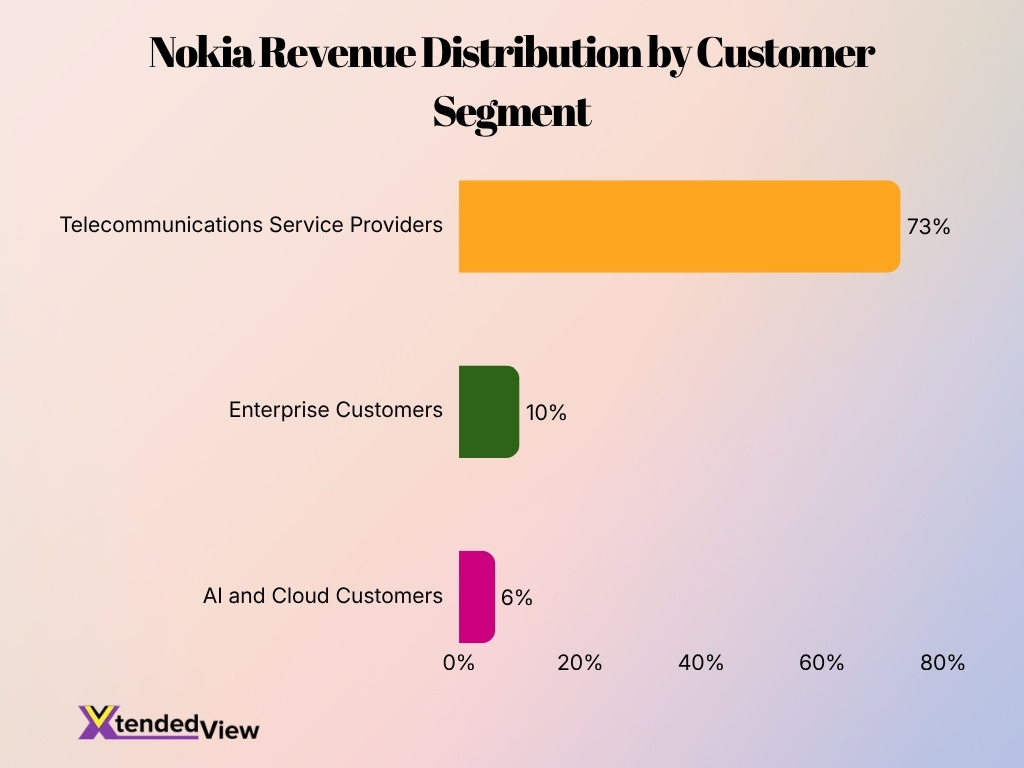
- Telecommunications service providers remain the largest group, representing approximately 73% of total annual revenue.
- Enterprise customers account for a growing share, surpassing 10% of Nokia’s overall business revenue in 2025.
- Nokia serves more than 960 private wireless customers worldwide across manufacturing, mining, transportation, and utilities.
- Hyperscale cloud providers became the fastest-growing segment, generating over EUR 2.4 billion in AI and cloud orders in 2025.
- AI and cloud customers contributed approximately 6% of company-wide revenue during the 2025 fiscal year.
- Government agencies and public-sector deployments helped Nokia capture over 50% of the global private wireless market share.
- Industrial enterprises and other verticals in North America make up 25% of Nokia’s private wireless customer base.
- Transportation operators and utility companies exhibit high retention, with Nokia reporting maintenance renewal rates above 90% in 2025.
Nokia Patent and Licensing Statistics
- Nokia owns approximately 20,000 patent families, making it one of the telecommunications industry’s largest patent holders.
- The company reached 7,000 patent families declared essential to 5G standards in 2025.
- Nokia has invested more than €150 billion in research, development, and standardization activities since 2000, which supports its patent portfolio.
- The company earns hundreds of millions of euros annually from patent licensing agreements across smartphones, consumer electronics, automotive systems, and IoT devices.
- Nokia has signed patent licensing agreements with most major smartphone manufacturers worldwide.
- In 2025, Nokia continued expanding licensing opportunities beyond mobile devices into automotive, industrial, and consumer electronics markets.
- More than 250 companies are estimated to use technologies covered by Nokia’s standard-essential patents.
- Nokia Technologies remains one of the company’s highest-margin business units due to royalty-based revenue streams.
- Patent licensing contributed significantly to Nokia’s profitability despite fluctuations in telecommunications infrastructure spending.
- Nokia’s intellectual property portfolio covers wireless communications, video technologies, AI networking, cloud infrastructure, and semiconductor innovations.
Nokia Research and Development (R&D) Statistics
- Nokia invested approximately €4.5 billion in research and development activities during the 2024 fiscal year.
- The company’s R&D expenditure accounted for an impressive 23.5% of its total annual revenue in 2024.
- Nokia has directed nearly €160 billion toward global R&D investments since the year 2000.
- Researchers at Nokia Bell Labs have been awarded 11 Nobel Prizes for groundbreaking scientific discoveries.
- The organization’s extensive worldwide patent portfolio currently encompasses approximately 30,000 unique patents.
- The prestigious Nokia Bell Labs has earned five Turing Awards for foundational achievements in modern computing.
- Nokia recently invested nearly $30 million into the initial phase of its largest Fixed Networks R&D lab.
- Network Infrastructure R&D innovations support a rapidly growing business unit driving 40% of total sales.
Nokia Employee Distribution Statistics
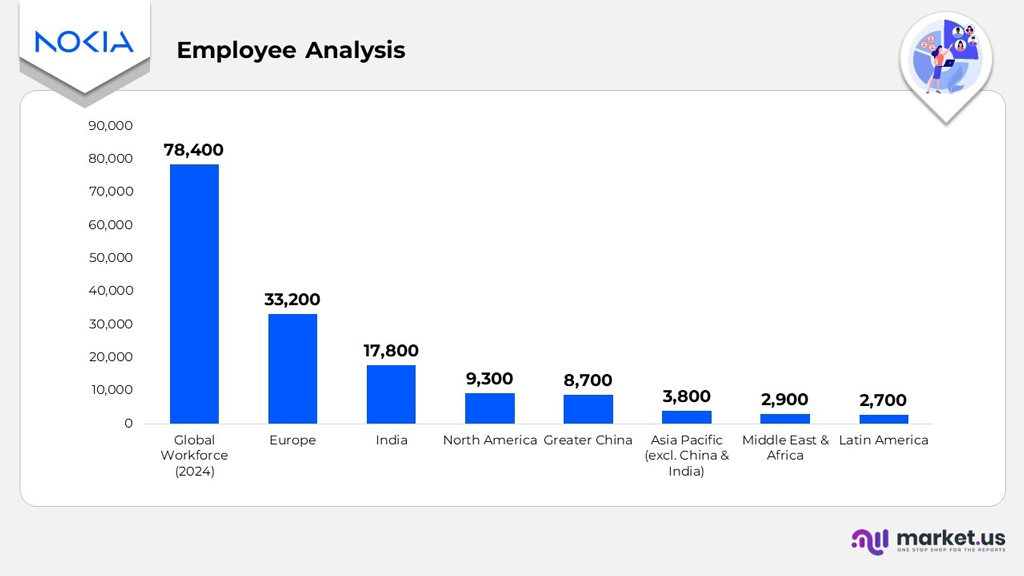
- Nokia employed a total of 78,400 people worldwide in 2024, highlighting its position as one of the largest telecommunications equipment providers globally.
- Europe remained Nokia’s largest employment hub with 33,200 employees, representing approximately 42.3% of the company’s global workforce.
- India was the second largest workforce location, employing 17,800 people, accounting for around 22.7% of Nokia’s total employees.
- North America had 9,300 employees, making up nearly 11.9% of the company’s global headcount.
- Nokia’s Greater China operations employed 8,700 workers, contributing approximately 11.1% of the worldwide workforce.
- The Asia Pacific region (excluding China and India) employed 3,800 people, representing about 4.8% of Nokia’s total workforce.
- Middle East & Africa accounted for 2,900 employees, equivalent to roughly 3.7% of the company’s global staff.
- Latin America had the smallest regional workforce, with 2,700 employees, representing around 3.4% of total employment.
- The combined workforce of Europe and India reached 51,000 employees, meaning these two regions alone accounted for approximately 65% of Nokia’s global workforce.
- Nokia employed 11.4 times more workers in Europe (33,200) than in Latin America (2,700), highlighting a strong concentration of talent in its European operations.
Nokia Sustainability Statistics
- Nokia targets achieving net-zero greenhouse gas emissions across its entire value chain by the year 2040.
- The company achieved a 91% reduction in its own operational emissions compared to its 2019 baseline.
- Nokia currently utilizes 100% renewable electricity across the vast majority of its global business operations.
- Energy-efficient radio equipment can reduce network power consumption by up to 30% compared to earlier generations.
- The company aims to successfully achieve a 95% circularity rate for operational waste and material recycling by 2030.
- Sustainable packaging design programs led to a 60% decrease in size and a 44% overall weight reduction.
- Innovative FP5 routing silicon delivers a highly efficient 75% reduction in energy consumption per bit.
- Over 95% of total emissions originate directly from the active use of Nokia’s networking products by customers.
- Modernizing existing infrastructure with advanced radio networks has saved up to 44% in energy consumption.
Nokia Stock Market and Valuation Statistics
- Nokia maintained a market capitalization of $25 billion to $35 billion during 2025 and 2026.
- The company generated approximately €1.5 billion in free cash flow throughout the full year of 2025.
- Nokia’s comparable operating profit reached €2.0 billion in 2025, yielding a 72% free cash flow conversion.
- The board proposed a maximum dividend distribution of €0.14 per share for the financial year 2025.
- Nokia concluded 2025 with a robust net cash balance of €3.4 billion following share repurchases.
- The company generated full-year 2025 net sales of approximately $21.9 billion across all its global markets.
- The total number of shares outstanding was recorded at 5.503 billion at the end of 2025.
- Comparable net sales grew by 3% year-over-year on a constant currency basis in Q4 2025.
Key Challenges Facing Nokia Statistics
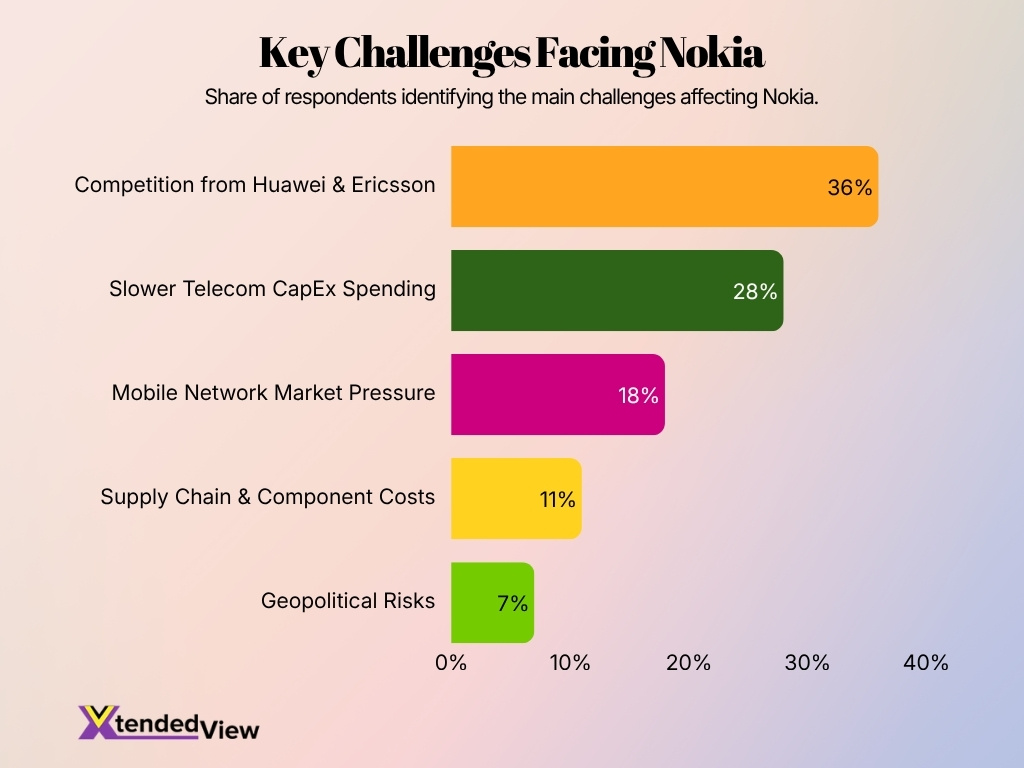
- Competition from Huawei and Ericsson is Nokia’s biggest challenge, cited by 36% of respondents, highlighting intense pressure in the global telecom equipment market.
- More than one-third (36%) of concerns are tied to competition, making rival network vendors Nokia’s most significant external threat.
- Slower telecom capital expenditure (CapEx) spending ranks second at 28%, indicating reduced investments by telecom operators are impacting Nokia’s growth prospects.
- Combined, competition and weaker telecom spending account for 64% of all identified challenges facing Nokia.
- Mobile network market pressure represents 18% of concerns, reflecting ongoing challenges in Nokia’s core network infrastructure business.
- Supply chain and component costs account for 11%, showing that rising manufacturing and procurement expenses continue to affect profitability.
- Only 7% of respondents identified geopolitical risks as Nokia’s primary challenge, making it the least-cited issue among the surveyed factors.
- The gap between the top challenge (36%) and the lowest-ranked challenge (7%) is 29 percentage points, demonstrating a clear concentration of concerns around competition.
- The top three challenges, competition (36%), CapEx spending (28%), and mobile network pressure (18%), collectively represent 82% of all concerns facing Nokia.
- Internal operational factors such as supply chain costs (11%) and geopolitical risks (7%) together account for just 18%, suggesting market-related pressures are a greater concern than operational risks.
Nokia Historical Mobile Phone Sales Statistics
- Nokia was the world’s largest mobile phone manufacturer from 1998 through 2011.
- At its peak, Nokia controlled more than 40% of the global mobile handset market.
- In 2007, Nokia sold approximately 435 million mobile phones worldwide, one of the highest annual totals ever recorded by a handset manufacturer.
- The Nokia 1100 became one of the best-selling consumer electronics products in history, with more than 250 million units sold.
- Nokia shipped hundreds of millions of feature phones annually during the early 2000s.
- The company remained the global smartphone market leader until competition from Android and iPhone devices intensified.
- Nokia’s handset division was acquired by Microsoft in 2014 for approximately €5.44 billion.
- The Nokia brand later returned to the smartphone market through licensing agreements with HMD Global.
- Feature phones carrying the Nokia brand continue to sell in numerous emerging markets worldwide.
- Nokia’s mobile phone legacy remains one of the most influential success stories in telecommunications history.
Frequently Asked Questions (FAQs)
Nokia reported €19.89 billion in net sales for full-year 2025, representing approximately 3% year-over-year growth.
Nokia reached 7,000 patent families declared essential to 5G standards in January 2025.
Nokia’s AI and cloud customer sales increased 49% year over year in Q1 2026.
Nokia booked approximately €1 billion in new AI and cloud orders during the first quarter of 2026.
Nokia’s comparable operating profit reached €281 million, a 54% increase compared with the previous year.
Conclusion
Nokia entered the year with stronger momentum across network infrastructure, AI networking, cloud services, and enterprise connectivity. The company generated nearly €20 billion in annual revenue, expanded its AI-related business, and strengthened its position in optical networking through strategic acquisitions. At the same time, Nokia maintained one of the industry’s largest patent portfolios, continued investing heavily in R&D, and advanced its sustainability goals.
Looking ahead, growth opportunities in AI infrastructure, private wireless networks, cloud-native software, and future 6G technologies are expected to play a central role in Nokia’s long-term strategy. While competition remains intense across the telecommunications sector, Nokia’s combination of innovation, intellectual property, enterprise expansion, and global network expertise positions it as a key player in the next generation of digital infrastructure.
