



Email marketing remains one of the most measurable digital marketing channels, helping businesses generate leads, retain customers, and drive repeat purchases. Retail brands use it to recover abandoned carts, while B2B companies rely on automated email sequences to nurture prospects and shorten sales cycles. As AI, personalization, and privacy regulations reshape the channel, fresh performance benchmarks have become essential. Explore the latest email marketing statistics below to understand how marketers measure success.
Editor’s Choice
- More than 4.8 billion people are expected to use email worldwide in 2026, with global adoption continuing to grow across both consumer and business users.
- Global email users are projected to exceed 4.9 billion by 2028, highlighting email’s long-term relevance despite the rise of messaging apps.
- Email marketing continues to deliver one of the strongest digital marketing returns, with many organizations reporting 10:1 to 36:1 ROI, while top-performing programs exceed 50:1.
- According to recent marketer surveys, 57% of organizations now use automation within their email marketing programs.
- Advanced AI adopters are 75% more likely to achieve email marketing ROI exceeding 45:1 than organizations with limited AI adoption.
- Recent benchmark data covering over 20 billion campaign emails reports an average campaign open rate of 30.41% across industries.
- 79% of organizations plan to maintain or increase email marketing investment during 2026 despite ongoing measurement and deliverability challenges.
Recent Developments
- AI has become a mainstream part of email production, with 78% of email teams now producing campaigns within three days or less, compared with much slower workflows just two years earlier.
- Organizations using advanced AI are 54% more likely to follow accessibility standards such as WCAG in their email programs.
- Advanced AI users are also 52% more likely to comply with newer accessibility regulations affecting email communications.
- More marketers now prioritize AI for optimization and segmentation instead of using it only for content generation.
- 41% of marketing teams currently use AI to generate email content, but only 23% report major improvements from AI alone, suggesting broader implementation remains necessary.
- Industry surveys indicate that Tuesday remains the preferred day for launching email campaigns among marketers worldwide.
- Email marketing automation continues expanding beyond promotional campaigns into onboarding, customer support, and lifecycle communications.
- Marketing teams increasingly measure revenue attribution rather than opens alone, reflecting a shift toward business outcomes instead of vanity metrics.
Global Email Usage and Growth Statistics
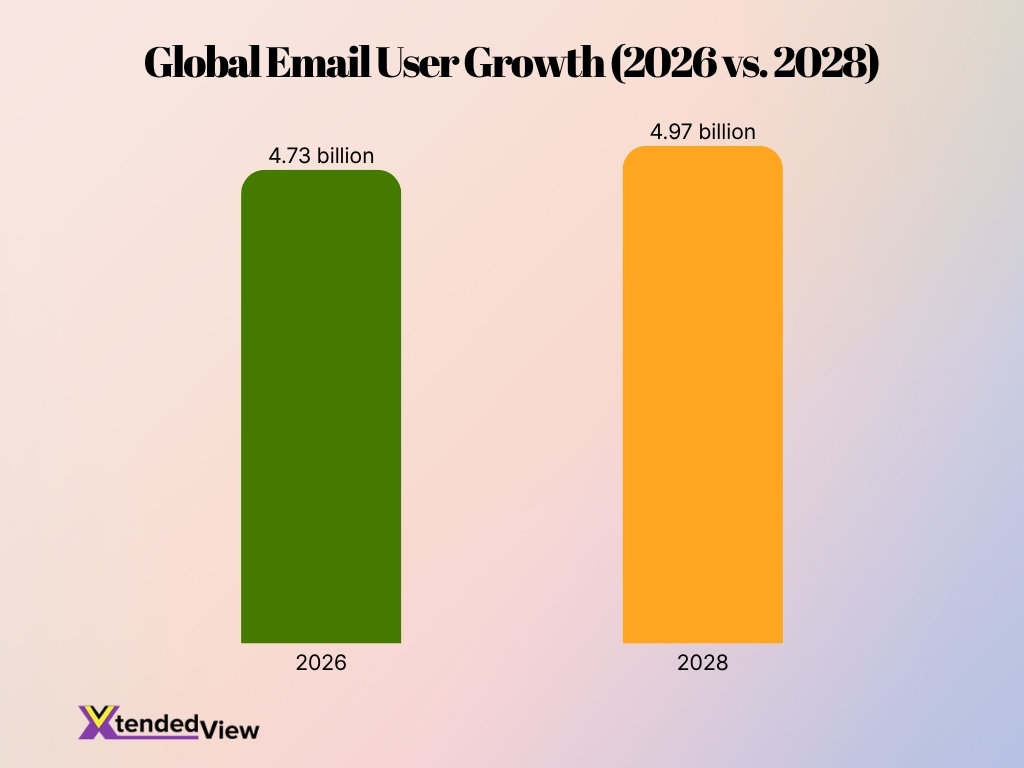
- 4.73 billion worldwide email users are projected by 2026, representing 57% of the global population.
- Global users are forecast to reach 4.97 billion by 2028, showing steady long-term channel growth.
- Approximately 392.5 billion emails are exchanged every day worldwide in 2026.
- The United States sends the most emails globally, at roughly 9.8 billion emails per day.
- Global email marketing revenue is projected to hit $17.9 billion by 2027.
- Email marketing delivers an impressive average ROI of $36 to $42 for every $1 spent.
- AI-driven email campaigns can generate a 41% increase in revenue and a 13% jump in click-through rates.
- Mobile devices now account for up to 62% of all email opens, reflecting expanding cross-device consumption.
Overall Email Marketing ROI Statistics
- Most organizations report email marketing ROI between 10:1 and 36:1, making it one of the highest-performing digital marketing channels.
- High-performing email programs commonly generate returns exceeding 36:1, while elite programs surpass 50:1.
- Recent industry research found that 35% of marketing leaders report ROI between 10:1 and 36:1.
- Another 30% of marketing leaders achieve returns between 36:1 and 50:1.
- Advanced AI adopters are 75% more likely to achieve ROI above 45:1 than organizations with limited AI maturity.
- Among businesses that actively measure ROI, 60% report earning more than $10 for every $1 invested in email marketing.
- More than 10% of organizations measuring ROI report returns approaching 40:1.
- Lifecycle campaigns and retention emails generally produce stronger long-term ROI than one-time acquisition campaigns because they target existing customers with higher purchase intent.
Email Campaign Volume and Send Frequency Statistics
- Over 20 billion campaign emails from 27,000 brands were analyzed for the 2026 benchmark.
- Currently, 57% of marketers integrate automation to scale personalized emails effectively.
- A significant 78% of email teams now build and launch campaigns in three days or less.
- The average brand sends two to three promotional emails every week to maintain brand visibility.
- Increasing frequency to over five weekly emails typically drops overall engagement rates by roughly 20%.
- Receiving too many emails remains the leading reason why 45% of subscribers actively unsubscribe.
- Behavior-driven triggered sends yield approximately 70% higher open rates than traditional batch campaigns.
- Optimizing send frequency with real-time engagement data can reduce list churn by up to 50%.
Email Marketing Success Metrics Used by Marketers
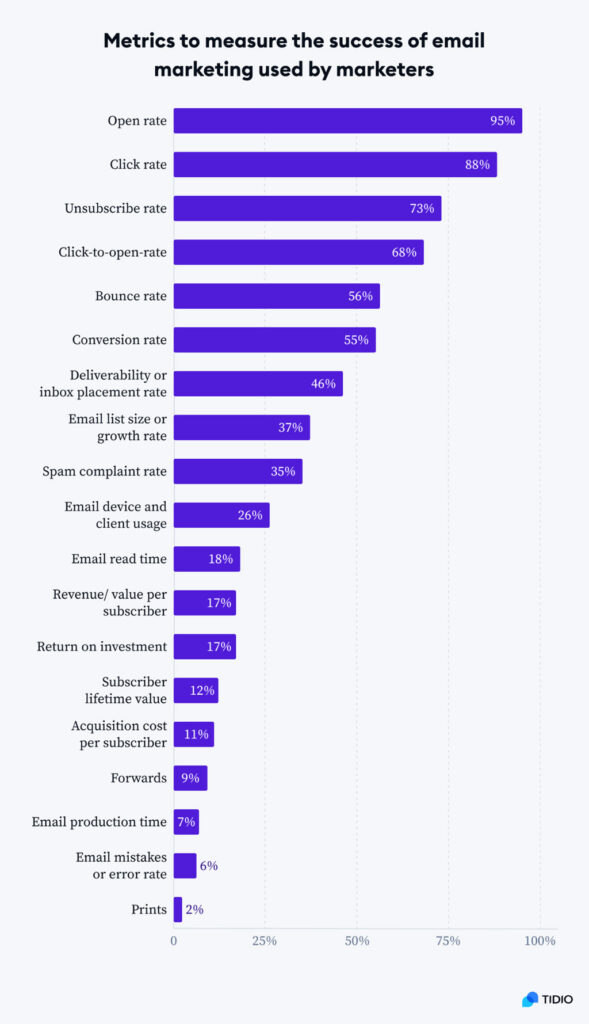
- Open rate is the most widely tracked email marketing metric, used by 95% of marketers.
- Click rate ranks second, with 88% of marketers using it to evaluate audience engagement.
- Unsubscribe rate is monitored by 73%, highlighting the importance of subscriber retention.
- Click-to-open rate is tracked by 68% of marketers to measure engagement among email openers.
- Bounce rate and conversion rate are used by 56% and 55% of marketers, respectively.
- Deliverability or inbox placement rate is measured by 46%, despite its impact on campaign visibility.
- Email list size or growth rate is monitored by 37%, while 35% track spam complaint rates.
- Only 26% of marketers analyze email device and client usage to optimize campaign design.
- Email read time is tracked by just 18%, indicating limited focus on content consumption depth.
- Revenue per subscriber and return on investment are each measured by only 17% of marketers.
- Subscriber lifetime value and acquisition cost per subscriber are tracked by 12% and 11%, respectively.
- Less commonly used metrics include forwards at 9%, email production time at 7%, and error rate at 6%.
- Prints are the least-used email marketing success metric, tracked by only 2% of marketers.
Average Email Open Rate Benchmarks
- The average email open rate across all industries currently stands at 43.46%.
- Welcome emails generate the highest engagement, with average open rates reaching 83.63%.
- Personalized subject lines have been proven to increase overall open rates by up to 26%.
- E-commerce promotional campaigns traditionally see lower engagement, averaging between 26.64% and 31.08%.
- Utilizing AI-generated subject lines can yield a 20% to 40% higher open rate compared to standard variations.
- Landing directly in the Primary inbox rather than the Promotions tab boosts open rates by 21%.
- Automated transactional emails, such as shipping confirmations, achieve consistent open rates of 62.47%.
- Highly engaged sectors like Religion and Non-profits lead industry benchmarks with open rates of 59.70% and 46.49%.
Average Click-Through Rate (CTR) Benchmarks
- The latest cross-industry benchmark reports an average email click-through rate (CTR) of 0.74% for campaign emails.
- Industry guidance generally considers a 2%–5% CTR to be a strong result, although benchmarks vary by industry and email type.
- Transactional emails frequently achieve CTRs above 5% because recipients expect and interact with order updates, receipts, and account notifications.
- Promotional emails commonly produce CTRs between 1% and 3%, depending on audience quality and offer relevance.
- Internet-related businesses recorded one of the highest campaign CTRs at 1.40% in recent ecommerce benchmark research.
- Marketers increasingly prioritize CTR over open rates because privacy protections have reduced the accuracy of open-rate tracking.
- Personalized calls to action, concise copy, and audience segmentation consistently improve click performance across industries.
- Mobile-friendly email layouts continue improving CTR as most subscribers interact with emails on smartphones before switching devices.
Mobile vs Desktop Email Performance Statistics
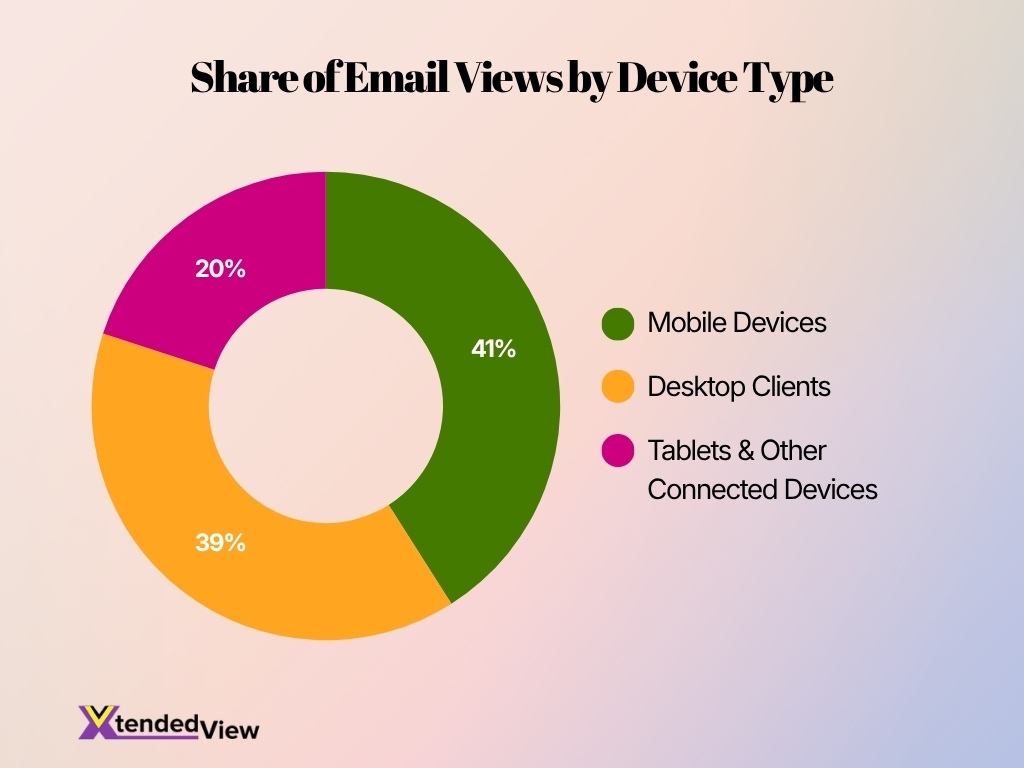
- Mobile devices currently account for approximately 41% of all email views.
- Desktop clients represent roughly 39% of total email opens.
- Tablets and other connected devices contribute the remaining 20% of email views.
- Users frequently check email first on smartphones before transitioning to larger screens.
- Only 2.82% of tracked opens and clicks occur through traditional desktop email clients.
- Web-based email clients account for 42.01% of all tracked email interactions.
- Unoptimized layouts with oversized images drastically reduce mobile engagement.
- Responsive templates consistently yield higher mobile engagement than desktop-only designs.
Click-to-Open Rate (CTOR) Benchmarks
- The latest cross-industry benchmark reports an average click-to-open rate (CTOR) of 2.44% for campaign emails.
- Industry guidance generally considers a CTOR above 20% to represent strong engagement, although targets differ by campaign type.
- General marketing emails typically achieve CTORs between 10% and 25%, depending on content quality and audience engagement.
- Educational and content-rich emails often reach 20%–30% CTOR, outperforming many promotional campaigns.
- Transactional emails frequently exceed 30% CTOR because recipients actively seek the information they contain.
- Behavior-based personalization generated 22.6× higher CTOR than non-personalized emails in retail and ecommerce analysis.
- Advanced personalization improved CTOR from 7.07% to 9.89% in recent benchmark research, highlighting the value of customer data.
- Marketers increasingly use CTOR to evaluate email content quality after an email has been opened rather than relying solely on opens.
Conversion Rate and Sales Attribution Statistics
- The latest campaign benchmark reports an average conversion rate of 0.08% across industries.
- Automated emails generate nearly 19× higher conversion rates than standard campaign emails.
- Automated email sequences also generate 22× more revenue per email than one-time campaigns.
- Welcome emails convert at approximately 2.84%, making them among the highest-performing automated email types.
- Back-in-stock notifications average about 5.84% conversion, outperforming many promotional campaigns.
- Behavior-based emails achieved up to 300.7× higher conversion rates than non-personalized broadcast emails in large-scale analysis.
- Advanced personalization increased conversion performance from 2.40% to 5.02% in recent benchmark research.
- Businesses increasingly attribute email revenue using first-party analytics and customer journey reporting rather than last-click attribution alone.
Unsubscribe and Complaint Rate Statistics
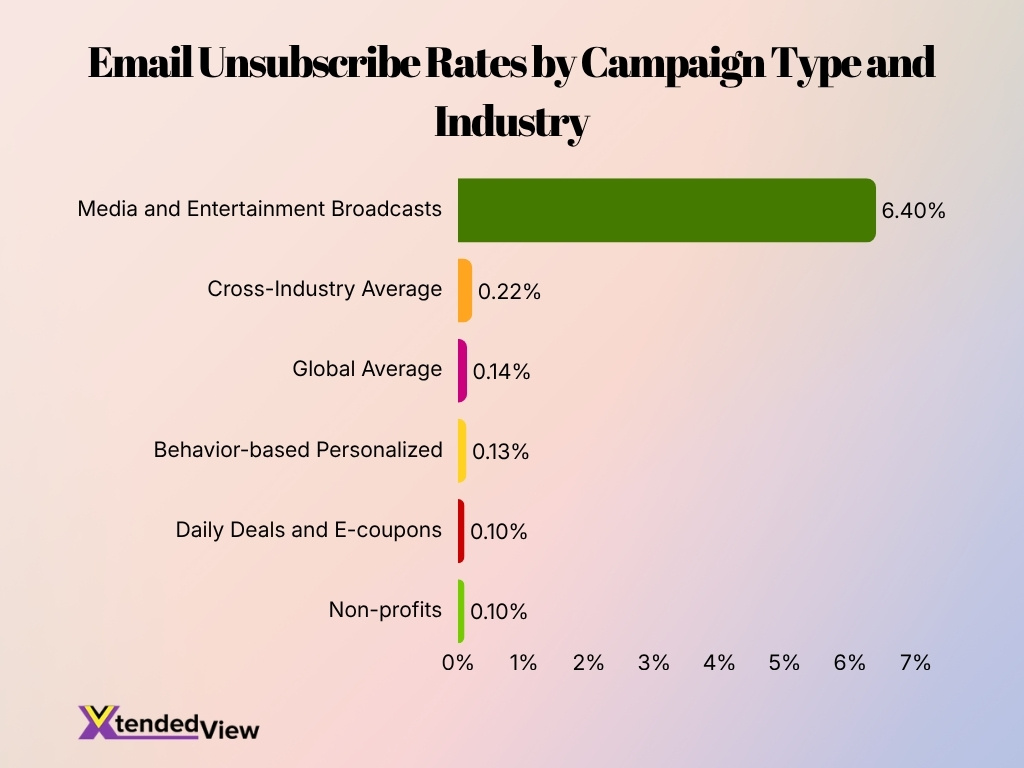
- The average email unsubscribe rate across industries recently reached 0.22%.
- A good unsubscribe rate for marketing campaigns is generally maintained below 0.5%.
- The average email spam complaint rate remains extremely low at 0% to 0.01%.
- Behavior-based personalized emails typically yield a highly favorable 0.13% unsubscribe rate.
- Broadcast campaigns in media and entertainment generate a massive 6.4% unsubscribe rate.
- Daily deals and e-coupon senders average a stable 0.10% unsubscribe rate.
- The global average unsubscribe rate currently sits at approximately 0.14%.
- Health and fitness companies experience four times higher unsubscribe rates than daily deal emails.
- Non-profit organizations maintain exceptional list retention with a 0.10% unsubscribe rate.
- An unsubscribe rate below 0.2% is universally classified as an excellent performance metric.
Bounce Rate, Deliverability, and Inbox Placement Statistics
- A total email bounce rate below 2% is widely considered a safe and healthy range across most industries.
- Maintaining a hard bounce rate below 0.5% is the minimum expectation for well-managed outbound campaigns.
- Top-performing email service providers consistently maintained inbox placement rates above 90% during 2025.
- Global email deliverability benchmarks reveal an average bounce rate between 0.5% and 0.65% for engaged lists.
- Senders who maintain bounce rates under 1.5% generally experience 10–12% higher inbox placement.
- North America currently leads regional email deliverability rates with an average inbox placement of 87.9%.
- B2B service campaigns typically experience extremely low average bounce rates ranging from 0.35% to 0.5%.
- Campaigns achieving total bounce rates under 0.06% strongly correlate with near-perfect 99.4% delivery rates.
Email List Growth and Subscriber Acquisition Statistics
- Average net list growth per month typically ranges from 0.5% to 2% for B2B and 2% to 6% for e-commerce.
- Standard embedded signup forms successfully convert between 0.3% and 1.5% of unique website visitors into new subscribers.
- Dedicated welcome emails dominate early subscriber engagement by achieving an exceptional average open rate of 83.6%.
- Automated welcome sequences generate 2x to 4x higher click rates and 30% to 60% higher conversions than standard promotions.
- Around 77% of consumers willingly share their email addresses in exchange for personalized experiences and targeted incentives.
- Hyper-segmented campaigns sent to targeted lists of 500–2,000 contacts outperform broad blasts by 3.4x on conversion rates.
- Continuous acquisition is essential since standard email lists naturally lose 15% to 30% of contacts annually to passive churn.
- Strategic welcome flows frequently account for 5% to 15% of first-time purchases among newly acquired email subscribers.
Email Reply and Open Rate Changes
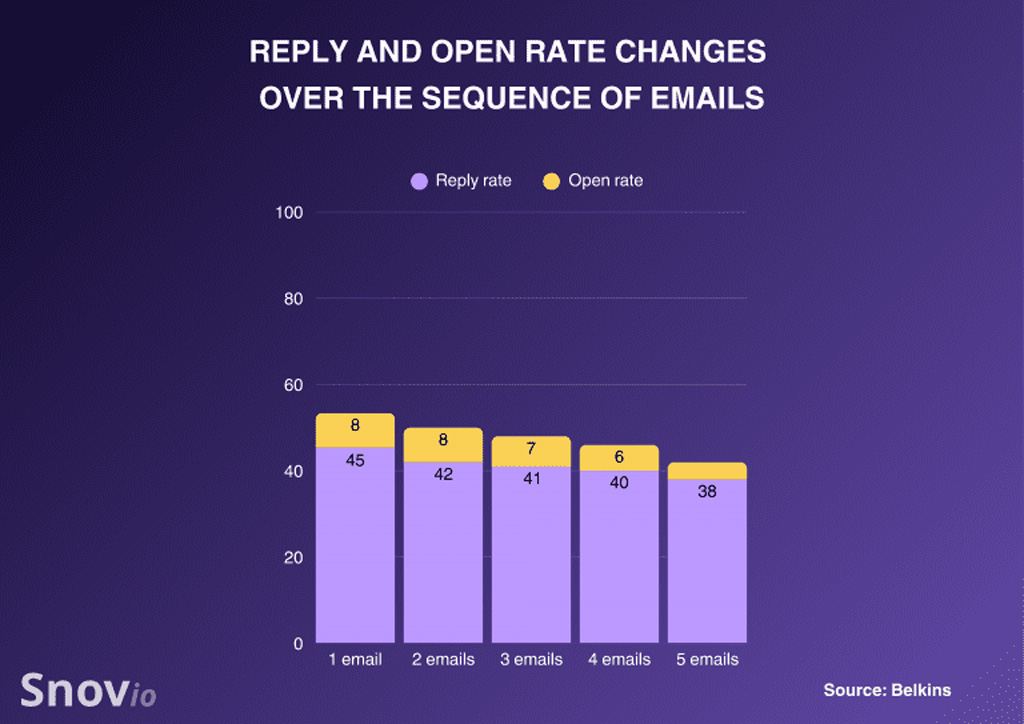
- The reply rate declined steadily from 45% after one email to 38% after five emails.
- The open rate remained at 8% for the first two emails before gradually decreasing.
- By the third email, the reply rate fell to 41%, while the open rate dropped to 7%.
- The fourth email recorded a 40% reply rate and a 6% open rate.
- The fifth email produced the lowest combined engagement, with a 38% reply rate and an estimated 4% open rate.
- Overall, the data shows that engagement weakens as more emails are added to the sequence.
- The largest decline occurred between the first and fifth emails, with the combined rate falling by about 11 percentage points.
Email Personalization, Segmentation, and Dynamic Content Performance Statistics
- Advanced personalization increased open rates from 42.05% to 50.30% compared with basic personalization.
- Advanced personalization improved CTR from 6.39% to 8.04% in recent benchmark analysis.
- Conversion performance increased from 2.40% to 5.02% when advanced personalization techniques were applied.
- Behavior-based emails generated up to 300.7× higher conversion rates than non-personalized campaigns.
- Retail and ecommerce brands recorded 60.7× higher conversion performance from behavior-based emails.
- Behavior-based campaigns also achieved 22.6× higher CTOR than broadcast emails in retail and ecommerce.
- Smaller, segmented mailing lists consistently outperform broad distribution lists in opens and clicks.
- AI-powered personalization now enables marketers to optimize content, timing, and recommendations using customer behavior instead of demographic data alone.
Marketing Automation, Triggered, and Behavioral Email Performance Statistics
- Automated emails generate 22× more revenue per message than standard campaigns.
- Automated workflows achieve nearly 19× higher conversion rates than regular emails.
- Welcome sequences deliver average conversion rates close to 2.84%.
- Back-in-stock emails drive strong engagement with conversion rates near 5.84%.
- Behavior-triggered emails yield a 71% higher open rate than traditional broadcasts.
- Cart abandonment emails successfully recover an average of 10% of lost revenue.
- Triggered messages account for over 75% of total email ROI.
- Personalized automated campaigns increase overall transaction rates by up to 600%.
- Birthday automated emails generate 342% higher revenue per message than standard promotional sends.
Industry-Wise Email Marketing Performance Benchmarks
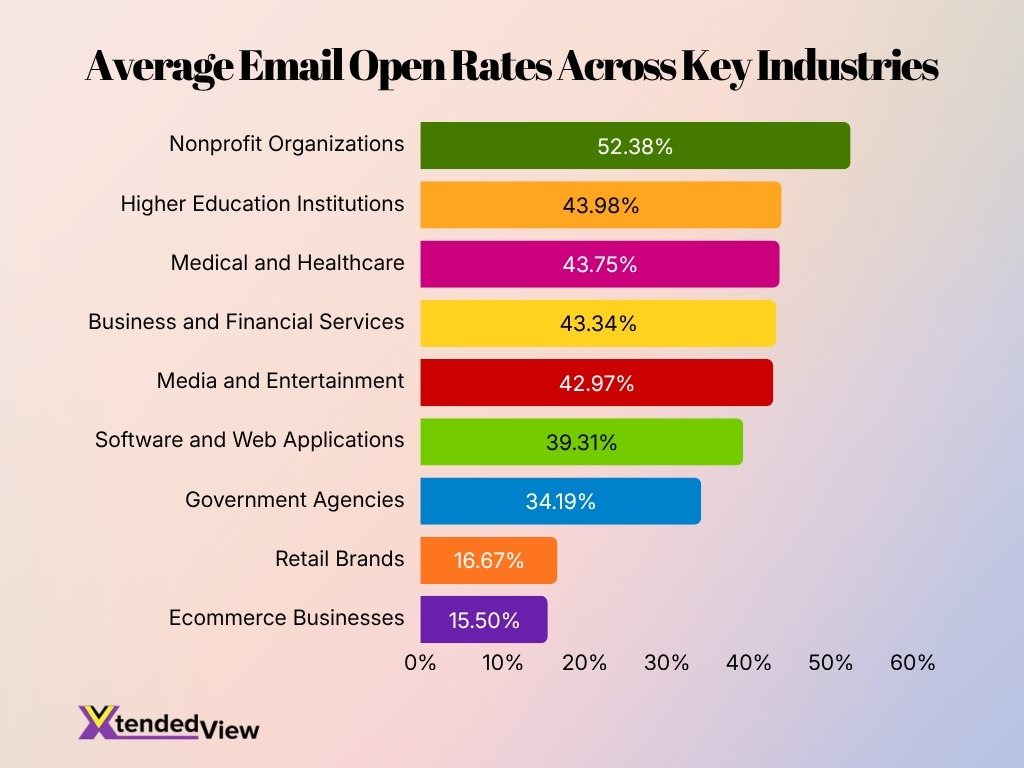
- Nonprofit organizations achieved an impressive benchmark open rate of 52.38% and a click rate of 2.90%.
- Government agencies reported the highest industry open rate of 34.19% alongside a record-low unsubscribe rate of 0.20%.
- Retail brands experienced a highly competitive inbox environment with an average open rate of 16.67%.
- Ecommerce businesses recorded an average open rate of 15.50% and a click-through rate of 2.15%.
- Automated lifecycle messages generated a 30.63% open rate and a 7.39% click-through rate, dramatically outperforming standard campaigns.
- Media and entertainment sectors maintained robust engagement with a 42.97% average open rate and a 4.10% click rate.
- Software and web application companies registered a 39.31% open rate combined with a 1.15% click rate.
- Business and financial services demonstrated strong audience retention with a 43.34% open rate and a 2.37% click rate.
- Higher education institutions successfully engaged audiences by recording a 43.98% open rate and a 2.15% click rate.
- Medical and healthcare organizations achieved solid engagement metrics with a 43.75% open rate and a 2.25% click-through rate.
AI-Powered Email Optimization and Performance Statistics
- 79% of businesses plan to maintain or increase investment in email marketing during 2026, with AI playing an expanding role in optimization.
- 60% of organizations measuring email ROI earn more than $10 for every dollar invested, and AI-supported optimization contributes to stronger performance.
- Advanced AI adopters are 75% more likely to achieve email ROI exceeding 45:1 than organizations with limited AI maturity.
- Only 23% of marketers currently report significant improvements from AI because many still limit AI to content generation instead of optimization.
- Organizations increasingly apply AI to audience segmentation, send-time optimization, personalization, and predictive engagement modeling.
- AI-powered testing enables marketers to evaluate multiple subject lines and content variations more quickly than manual A/B testing alone.
- Advanced AI users are 54% more likely to comply with accessibility best practices within their email programs.
- AI adoption continues shifting from experimental use cases toward everyday campaign optimization across enterprise marketing teams.
Customer Retention, Loyalty, and Revenue per Email Statistics
- Increasing customer retention rates by 5% increases overall company profits by 25% to 95%.
- Acquiring a new customer costs up to 5 times more than retaining an existing customer.
- Welcome emails generate 320% more revenue per email than standard promotional campaigns.
- Segmented and targeted email campaigns are responsible for driving 58% of all marketing revenue.
- Top-performing loyalty programs boost annual brand revenue from active members by 15% to 25%.
- Email marketing yields an average return on investment of $36 for every $1 spent.
- Automated email workflows generate 320% more revenue than non-automated marketing emails.
- Repeat customers typically spend 67% more per transaction than first-time buyers.
- Post-purchase emails experience an open rate that is nearly 17% higher than standard emails.
Frequently Asked Questions (FAQs)
Organizations that measure email ROI commonly report returns of more than $10 for every $1 spent, while over 10% achieve returns as high as 40:1.
According to the latest survey, 78% of email teams can create and deploy an email campaign in three days or less.
Approximately 18% of marketing emails fail to reach recipients’ inboxes due to deliverability issues.
The latest benchmark reports an average email delivery rate of 99.2% across all industry verticals.
Recent industry research shows that 35% of companies report an email marketing ROI of 36:1 or greater.
Conclusion
Email marketing continues to deliver measurable business value, supported by growing global adoption, stronger automation capabilities, and rapid AI innovation. Recent benchmarks show that personalized, behavior-driven, and automated campaigns consistently outperform traditional batch emails across engagement, conversions, and revenue. At the same time, marketers are placing greater emphasis on deliverability, first-party data, customer retention, and ROI measurement instead of relying solely on open rates.
For organizations serving US audiences and global markets alike, these statistics demonstrate that email remains one of the most dependable channels for building customer relationships and generating long-term revenue.
