



Daihatsu remains one of Japan’s most influential small-car manufacturers, especially in the kei car and compact vehicle segments. The company plays a major role in urban mobility, affordable transportation, and OEM vehicle production for major automotive brands. Its performance also affects manufacturing networks across Japan, Indonesia, and Southeast Asia. Recent certification issues, production disruptions, and recovery efforts have reshaped the company’s trajectory, making its latest numbers especially important.
Explore the statistics below to understand how Daihatsu is navigating production recovery, market competition, and global demand.
Editor’s Choice
- Daihatsu’s worldwide vehicle sales dropped to approximately 536,588 units in 2024, representing a 32.1% decline from 790,441 units in 2023.
- Sales in Japan declined 38.3% year over year to 367,348 vehicles during 2024.
- Overseas sales fell to roughly 169,240 units in 2024, down 13% from the previous year.
- Daihatsu reported its first annual operating loss in 31 years for the fiscal year ending March 2024.
- Company revenue decreased 20.9% year over year to approximately ¥1.18 trillion in FY2024.
- Following certification issues, Daihatsu temporarily suspended shipments of all Daihatsu-developed vehicles in late 2023, affecting domestic and overseas operations.
- Daihatsu resumed production at all Japanese plants by May 2024 after completing regulatory reviews and compliance measures.
- The company continues to hold one of Japan’s largest kei-car portfolios with dozens of active mini-vehicle models as of 2025.
Recent Developments
- In April 2024, Daihatsu announced plans to fully resume vehicle development activities before the end of the year.
- Toyota assigned additional oversight responsibilities for compact-car development and certification processes after the compliance scandal.
- Daihatsu restarted shipments for nearly all affected models after regulatory inspections confirmed compliance standards.
- The company identified growth opportunities in South America and Africa as part of its next-stage expansion strategy.
- In 2025, Daihatsu introduced a hybrid version of the Rocky SUV in Indonesia, strengthening its electrification strategy in Southeast Asia.
- The company announced that production of the current-generation COPEN will conclude in August 2026.
- Daihatsu launched the e-SNEAKER mobility device in 2025 to expand its presence in personal mobility solutions.
- During 2026, Daihatsu rolled out the DAVIS inspection support platform across dealership networks to improve maintenance efficiency and compliance management.
- Production and export figures released throughout 2025 showed gradual recovery trends after the severe disruptions experienced in 2024.
Daihatsu Company Overview
- Daihatsu Motor Co., Ltd. is headquartered in Ikeda, Osaka, Japan.
- The company traces its origins to 1907 and officially became Daihatsu Motor Co., Ltd. in 1951.
- The automaker operates as a wholly owned subsidiary of Toyota Motor Corporation.
- Daihatsu specializes in kei cars, compact passenger vehicles, commercial vehicles, and mobility solutions.
- Daihatsu maintains significant operations in Japan, Indonesia, and Malaysia.
- Former Toyota executive Masahiro Inoue became company president in 2024.
- Daihatsu employs more than 12,500 people globally, according to recent corporate disclosures.
- The company holds strategic ownership interests in Astra Daihatsu Motor and maintains close ties with Malaysian automaker Perodua.
- Daihatsu’s manufacturing and OEM activities support multiple Toyota Group brands across Asia.
Daihatsu Production, Sales, and Export Results
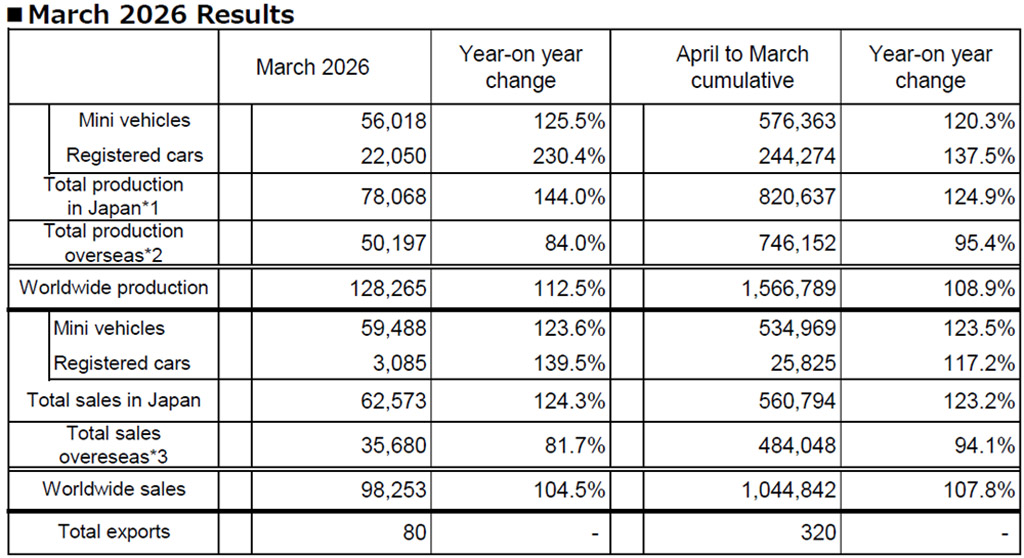
- Daihatsu’s worldwide production reached 128,265 units in March 2026, showing a 12.5% year-on-year increase compared with March 2025.
- Japan remained the strongest production base, with 78,068 units produced in March 2026, rising sharply by 44.0% year-on-year.
- Within Japan, mini vehicle production stood at 56,018 units, up 25.5% year-on-year, highlighting strong demand in Daihatsu’s core kei-car segment.
- Registered car production in Japan surged to 22,050 units, marking a major 130.4% year-on-year increase, the strongest growth rate among production categories.
- Overseas production declined to 50,197 units, down to 84.0% of the previous year’s level, indicating a 16.0% year-on-year drop.
- For the April–March cumulative period, worldwide production totaled 1,566,789 units, up 8.9% year-on-year.
- Total production in Japan reached 820,637 units cumulatively, increasing by 24.9% year-on-year, while overseas production totaled 746,152 units, down 4.6% year-on-year.
- Worldwide sales reached 98,253 units in March 2026, reflecting a 4.5% year-on-year increase.
- Total sales in Japan stood at 62,573 units, up 24.3% year-on-year, supported mainly by strong mini vehicle sales.
- Daihatsu sold 59,488 mini vehicles in Japan during March 2026, an increase of 23.6% year-on-year.
- Registered car sales in Japan rose to 3,085 units, growing by 39.5% year-on-year.
- Overseas sales declined to 35,680 units, reaching only 81.7% of the previous year’s level, which reflects an 18.3% year-on-year decrease.
- In the April–March cumulative period, worldwide sales reached 1,044,842 units, increasing by 7.8% year-on-year.
- Japan sales totaled 560,794 units cumulatively, up 23.2% year-on-year, while overseas sales fell to 484,048 units, down 5.9% year-on-year.
- Total exports remained very limited, with only 80 units exported in March 2026 and 320 units exported cumulatively from April to March.
Daihatsu Worldwide Sales Volume Statistics
- Daihatsu sold approximately 536,588 vehicles worldwide during 2024, compared with 790,441 vehicles in 2023.
- Global sales declined by roughly 32.1% year over year, primarily because of shipment suspensions in Japan.
- Japan represented approximately 68% of Daihatsu’s global sales volume in 2024.
- Overseas sales totaled around 169,240 units during 2024 despite market challenges.
- Global sales recovered gradually during late 2024 and early 2025 as production normalized.
- Compact passenger vehicles and kei cars remained the largest contributors to worldwide deliveries.
- Southeast Asian markets generated the majority of Daihatsu’s international sales volume.
- Indonesia remained the company’s largest overseas retail market throughout 2024 and 2025.
- Toyota-branded vehicles based on Daihatsu platforms continued contributing indirectly to broader group sales.
- Daihatsu’s sales recovery strategy focuses heavily on affordable mobility products and emerging-market demand.
Daihatsu Domestic Production in Japan
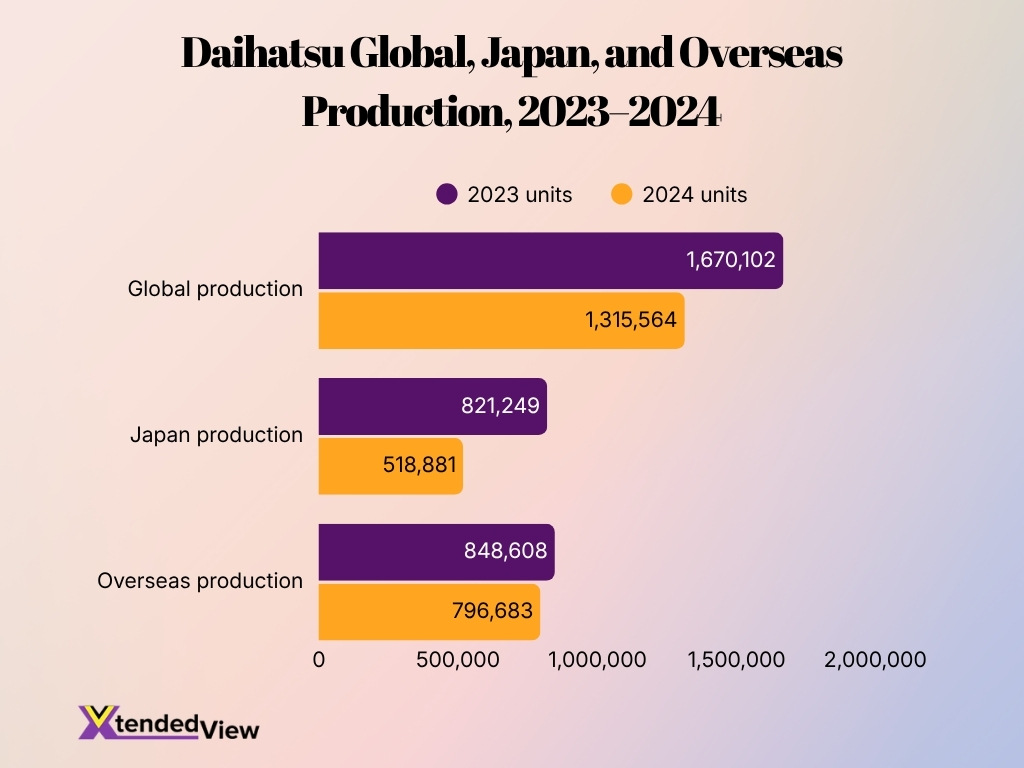
- Daihatsu produced approximately 367,000 vehicles in Japan during 2024, reflecting the impact of certification-related shutdowns and shipment suspensions.
- Domestic production fell by more than 35% year over year compared with 2023, marking one of the steepest declines among Japanese automakers during the period.
- In January 2024, domestic output dropped more than 80% year over year as assembly plants remained largely idle following the production halt.
- All four Japanese vehicle assembly facilities resumed operations by May 2024 after regulatory approval and safety reviews.
- Daihatsu’s Ikeda, Kyoto, Ryuo, and Oita operations collectively account for the majority of its Japanese manufacturing capacity.
- Kei cars continued to represent more than 70% of Daihatsu’s domestic production mix during recovery efforts.
- Production recovery accelerated during the second half of 2024 as shipment restrictions were gradually lifted.
- Domestic output improved throughout 2025, although total production remained below pre-scandal levels recorded in 2022 and 2023.
- Japan remains Daihatsu’s largest production base, accounting for a substantial share of global vehicle development and engineering activities.
Daihatsu Overseas Production by Country
- Indonesia is Daihatsu’s largest overseas production center with an annual capacity exceeding 530,000 vehicles.
- Astra Daihatsu Motor operates multiple plants in Indonesia, producing for both Daihatsu and Toyota brands.
- Malaysia is a major production hub via Daihatsu’s technical partnership with Perodua.
- Perodua produced more than 330,000 vehicles in 2024 using Daihatsu-developed platforms.
- Daihatsu-developed vehicles are made in Indonesia, Malaysia, Pakistan, and several emerging markets.
- Indonesian production supports exports to Southeast Asia, the Middle East, Latin America, and Africa.
- Overseas production volumes saw moderate declines in 2024 due to supply chain disruptions from Japan certification reviews.
- Indonesia’s manufacturing recovered faster than Japan’s domestic production due to fewer local restrictions.
- Daihatsu is expanding production localization to reduce currency exposure and logistics costs.
- Southeast Asia accounts for the overwhelming majority of Daihatsu’s overseas manufacturing output.
Daihatsu Sales in Japan
- Daihatsu registered approximately 367,348 vehicles in Japan during 2024.
- Domestic sales declined 38.3% year over year following certification-related production disruptions.
- The Tanto ranked 7th in Japan with 93,759 sales (–41.2%) in 2024.
- Kei vehicles accounted for the majority of Daihatsu registrations across Japan.
- Daihatsu’s market share dropped to 2.8% in February 2024 from 12.4% in full-year 2023.
- The Daihatsu Move surged +208.3% in October 2025 to claim 1st place among kei cars.
- Hybrid passenger vehicles (HEV) registered 4.83 thousand units in Japan in 2024.
- Japan’s total new vehicle market contracted 7.5% to 4.42 million vehicles in 2024.
- Recovery accelerated in 2025 as dealer inventories returned to normal levels.
- Japan remains Daihatsu’s largest retail market by unit volume globally.
Daihatsu Sales in Indonesia
- Daihatsu sold approximately 163,000 vehicles in Indonesia during 2024.
- The company held a 19% market share of Indonesia’s passenger vehicle market in 2024.
- In Q1 2025, Daihatsu recorded 36,917 retail sales units, led by Sigra and Gran Max.
- During October 2025, retail sales reached 12,196 units, up 7% month-over-month.
- The Gran Max Pick-up captured 58.6% of Indonesia’s low pick-up segment with 34,340 units.
- Daihatsu’s market share remained solid at 17% in 2025, ranking second nationally.
- More than 80% of Daihatsu’s sales come from the low commercial and LCGC segments.
- In Q1 2026, Daihatsu held 16.4% market share, finishing second behind Toyota.
- Daihatsu exports Indonesian-built vehicles to more than 60 countries worldwide.
Daihatsu Market Share by Country and Region
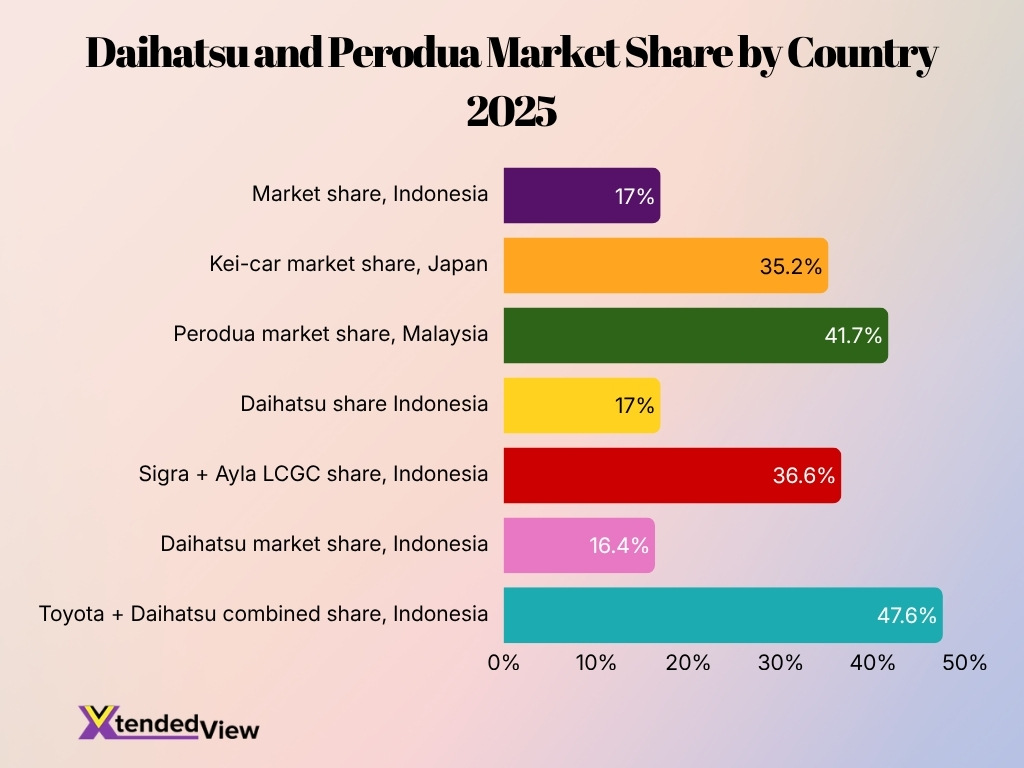
- Daihatsu held 17.0% market share in Indonesia from January to October 2025, ranking 2nd nationally.
- In Japan’s kei-car segment, Daihatsu’s domestic mini-vehicle market share reached 35.2% in FY2025.
- Perodua (Daihatsu-based) dominated Malaysia with 41.7% market share in 2025, selling 359,904 units.
- Southeast Asia accounts for the majority of Daihatsu’s overseas volume, with Indonesia (803,687 units sold in 2025) and Malaysia (862,624 units) as top markets.
- Daihatsu retail sales in Indonesia dropped 23% in 2025, yet maintained 17% share, far ahead of 3rd place.
- In Indonesia’s LCGC segment, Daihatsu’s Sigra and Ayla captured 36.6% share with 47,901 units sold in 2025.
- Daihatsu’s Q1 2026 market share in Indonesia was 16.4%, trailing Toyota’s 30.4% but ahead of Suzuki’s 9.0%.
- Toyota Group’s combined Indonesia share (Toyota + Daihatsu) reached 47.6% in 2025, down from 51.9% in 2024.
- Malaysia became Southeast Asia’s largest car market in 2025 with 820,752 vehicles, surpassing Indonesia for the first time.
Daihatsu Mini Vehicle Market Share in Japan
- Daihatsu held roughly 22.5% of Japan’s kei car market in 2024 with 350,186 units sold.
- Daihatsu’s kei passenger car sales dropped 45.2% year-over-year to 219,497 units in 2024.
- The Daihatsu Tanto ranked 3rd among kei cars with 93,759 sales in 2024, down from 159,392 in 2023.
- Daihatsu’s Mira model sold 42,758 units in 2024, a 33.3% decline from 64,080 units in the prior year.
- Kei cars captured 38% of Japan’s total passenger vehicle market in 2024 with 1.56 million units sold.
- The total kei vehicle market shrank 10.7% to 1,557,868 units in 2024 due to Daihatsu’s production scandal.
- Suzuki overtook Daihatsu as the #1 kei car brand in 2024 with 589,924 units (10.9% growth).
- Daihatsu fell to 2nd in mini vehicles overall in 2024 after holding 1st place in 2023 with 565,928 units.
- Kei cars’ market share dipped from 40% in 2023 to 38% in 2024, the lowest since 2017.
Daihatsu Electric and Hybrid Vehicle Statistics
- Petrol vehicles dominated with 89.06% share in 2024, while EV share is projected to rise from 7.01% (2025) to 12.79% (2028).
- Hybrid vehicle market share grew from 4.40% (2023) to 4.87% (2024), then to 5.31% (2025).
- The e-Hijet Cargo and e-Atrai BEVs feature a 36.6 kWh lithium-ion battery with 257 km WLTC cruising range.
- Hybrid vehicle sales in Indonesia reached 7,169 units in August 2023, showing significant market growth.
- EV market penetration in Indonesia surged to 15.2% of total passenger car sales in Q2 2025, up from 10.1% in Q1 2025.
- Daihatsu holds 16.4% market share in Indonesia’s automotive market in Q1 2026, focusing on affordable, practical vehicles.
- Mini-vehicles make up 40% of Japan’s 78 million vehicles, with over 31 million units on the road.
- Toyota and Daihatsu’s electric kei vans start at JP¥3.146 million (about $20,100), including consumption tax.
Daihatsu Sales Share by Vehicle Model
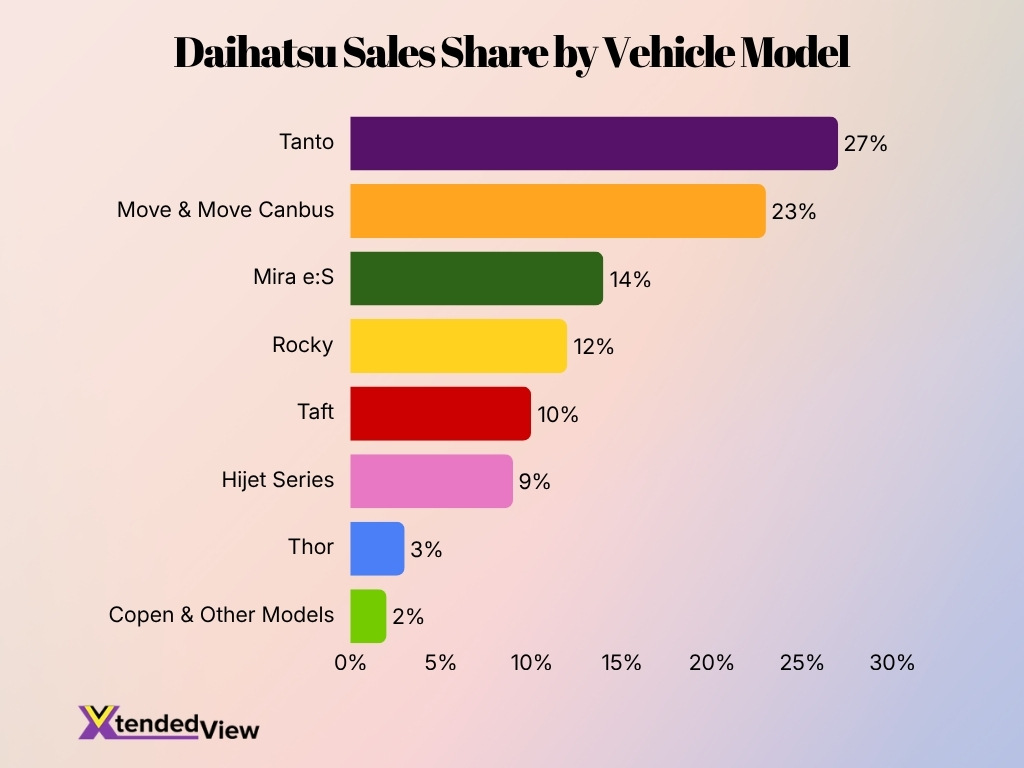
- Tanto leads Daihatsu’s model-wise sales share, accounting for the highest portion at 27% of total sales.
- Move & Move Canbus ranks second with a strong 23% share, making it one of Daihatsu’s most important model groups.
- Together, Tanto and Move & Move Canbus contribute 50% of Daihatsu’s total sales share, showing that half of the brand’s sales are driven by these two model categories.
- Mira e:S holds the third-largest share at 14%, indicating steady demand for compact and fuel-efficient Daihatsu vehicles.
- Rocky accounts for 12% of sales, making it the strongest performer among Daihatsu’s SUV-style models in this dataset.
- Taft captures 10% of the sales share, further highlighting customer interest in compact crossover-style vehicles.
- The Hijet Series contributes 9%, showing the continued relevance of Daihatsu’s commercial and utility vehicle lineup.
- Lower-volume models such as Thor at 3% and Copen & Other Models at 2% together make up only 5% of total sales.
- Daihatsu’s sales appear highly concentrated, with the top four models, Tanto, Move & Move Canbus, Mira e:S, and Rocky, accounting for 76% of total model-wise sales share.
- The data suggests that Daihatsu’s strongest sales performance comes from small cars, kei vehicles, and compact utility models, rather than niche or low-volume models.
Daihatsu Consigned and OEM Production Volumes
- FY 2024 consigned/OEM production totaled 246,411 units for Toyota, Subaru, and Mazda.
- Toyota OEM volume reached 229,229 units globally (Japan + Indonesia + Malaysia) in FY 2024.
- Subaru received 17,182 units in Japan during FY 2024 through OEM arrangements.
- Mazda got 496 units of the BONGO commercial van from Daihatsu in FY 2024.
- Consigned PROBOX production hit 57,589 units in Japan for FY 2024.
- Toyota-badged ROOMY/RAIZE totaled 153,799 units in Japan (ROOMY 85,824 + RAIZE 67,975).
- Light commercial HIJET CARGO/PIXIS VAN reached 63,235 units in Japan (HIJET CARGO 54,978 + PIXIS VAN 8,257).
- Daihatsu’s domestic production was 714,440 units, with consigned/OEM representing 34.5%.
- Indonesia OEM production totaled 269,460 units (Toyota + Mazda) in FY 2024.
- Compact MINI passenger OEM (PIXIS EPOCH/PLEO PLUS/CHIFFON/COPEN/RAIZE/ROOMY) hit 187,231 units in Japan.
Daihatsu Manufacturing Plants and Capacity
- Four primary vehicle production facilities operate in Japan, with the network centered on Ikeda, Kyoto, Ryuo, and Kyushu plants.
- The Ikeda plant functions as Daihatsu’s head-office manufacturing and development base in Osaka.
- The Kyoto (Oyamazaki) plant has an annual production capacity of about 230,000 units.
- The Shiga (Ryuo) plant is part of Japan’s core domestic assembly network and helps support Daihatsu’s total Japan capacity of up to 940,000 vehicles.
- PT Astra Daihatsu Motor’s Indonesian network has an installed production capacity of 530,000 vehicles per year.
- The renewed Karawang Assembly Plant 2 adds 140,000 vehicles per year and raises that site’s capacity to 360,000 vehicles per year.
- Daihatsu’s Malaysian operations include Perodua-linked manufacturing that produced 368,100 vehicles in 2024.
- Perodua’s two Malaysian plants have a combined capacity of 320,000 units, even though output exceeded that level in 2024.
- Daihatsu’s overseas manufacturing and sales footprint reaches about 80 countries and regions.
- The company is applying next-generation manufacturing methods, including automation, AI-based quality inspection, and a plant design aimed at cutting CO2 emissions by about 30% per year at Karawang Assembly Plant 2.
Daihatsu Worldwide Passenger Car Revenue Trends
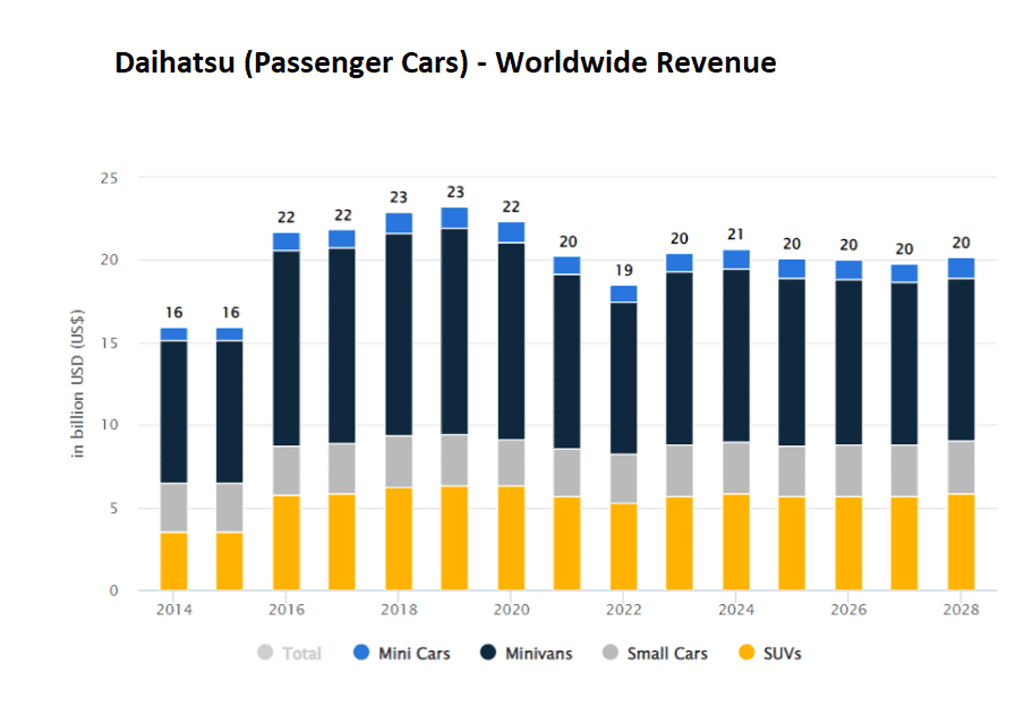
- Daihatsu’s worldwide passenger car revenue stood at $16 billion in 2014 and remained at the same level in 2015.
- Revenue jumped sharply to $22 billion in 2016, showing a strong recovery and higher global demand across passenger car segments.
- The company recorded its highest revenue level of $23 billion in both 2018 and 2019, marking the peak period in the chart.
- Daihatsu’s revenue declined from $22 billion in 2020 to $20 billion in 2021, reflecting a slowdown after the peak years.
- The lowest post-2016 revenue level was seen in 2022, when total revenue dropped to $19 billion.
- Revenue recovered slightly to $20 billion in 2023 and $21 billion in 2024, indicating moderate improvement.
- From 2025 to 2028, Daihatsu’s worldwide passenger car revenue is projected to remain stable at around $20 billion annually.
- Minivans appear to be the largest revenue-contributing segment throughout the period, consistently accounting for the biggest share of total revenue.
- SUVs form the second major revenue segment, contributing around $5.7 billion to $6.3 billion in the most recent years.
- Mini Cars contribute the smallest share, generally staying close to $1 billion annually.
- Overall, Daihatsu’s passenger car revenue shows a pattern of rapid growth from 2016, a peak in 2018-2019, followed by stabilization near $20 billion in later years.
Daihatsu Position and Ranking Among Automakers
- In 2024, Daihatsu sold 350,186 mini vehicles in Japan, ranking 2nd behind Suzuki’s 589,924 units.
- Daihatsu’s Japanese mini-vehicle sales fell 38.1% year on year in 2024, showing the impact of its recall and testing scandal.
- Japan’s total mini-vehicle market reached 1,557,868 units in 2024, and Daihatsu still held a major share of that volume.
- In fiscal 2023, Daihatsu’s domestic mini-car sales share was 27.3%, confirming its long-standing strength in Japan’s kei segment.
- Daihatsu’s domestic production of mini vehicles was about 428,530 units in fiscal 2023, underscoring its scale as a compact-car specialist.
- In Indonesia, Daihatsu sold 168,263 units in 2024, making it the 2nd best-selling brand in the market.
- Toyota and Daihatsu together controlled 50.7% of Indonesia’s wholesale market in January 2024, highlighting Daihatsu’s strategic role in the group’s regional leadership.
- In Malaysia, Perodua held a record 41.8% share in 2024, and Daihatsu technology remains central to that brand’s success.
- Perodua registered about 358,100 vehicles across Southeast Asia in 2024, placing it 2nd in ASEAN sales behind Toyota.
- Daihatsu is Toyota’s compact-car specialist for emerging markets, with its DNGA-based development and production role explicitly focused on affordable small cars.
Daihatsu Number of Employees
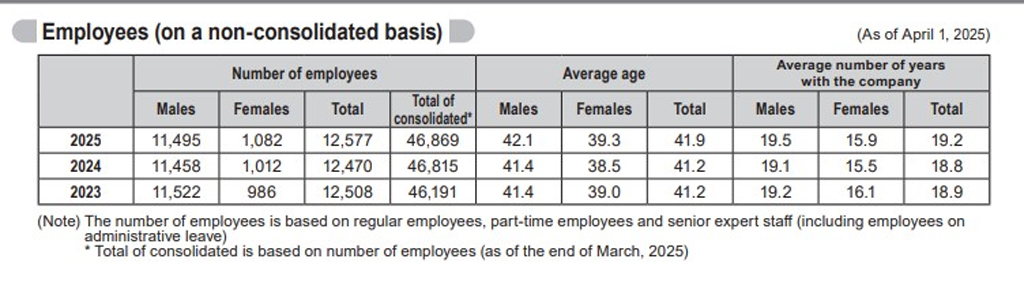
- Daihatsu reported 12,577 total employees on a non-consolidated basis in 2025, slightly higher than 12,470 employees in 2024.
- The company’s workforce increased by 107 employees from 2024 to 2025, showing a modest year-over-year rise in staff strength.
- Male employees made up the majority of Daihatsu’s workforce, with 11,495 male employees in 2025 compared to 1,082 female employees.
- Female employee numbers increased steadily, rising from 986 in 2023 to 1,012 in 2024 and 1,082 in 2025.
- Daihatsu’s total consolidated employee count reached 46,869 in 2025, up from 46,815 in 2024 and 46,191 in 2023.
- The average age of Daihatsu employees was 41.9 years in 2025, compared with 41.2 years in both 2023 and 2024.
- Male employees had an average age of 42.1 years in 2025, while female employees had an average age of 39.3 years.
- The average number of years with the company increased to 19.2 years in 2025, indicating strong workforce retention.
- Male employees had an average tenure of 19.5 years in 2025, while female employees averaged 15.9 years with the company.
- Overall, the data shows Daihatsu has a stable and experienced workforce, with gradual growth in both employee count and average tenure.
Frequently Asked Questions (FAQs)
Daihatsu sold approximately 536,588 vehicles worldwide in 2024, representing a 32.1% decline from 790,441 units sold in 2023.
Daihatsu reported approximately ¥1.181 trillion ($7.5 billion) in revenue for FY2024, down 20.9% year over year.
Daihatsu held approximately 19% of Indonesia’s automotive market in 2024, making it one of the country’s leading vehicle brands.
Daihatsu controlled an estimated 30% to 33% share of Japan’s kei-car market during 2024, ranking among the top manufacturers in the segment.
Daihatsu’s Indonesian facilities have an annual production capacity exceeding 530,000 vehicles, making Indonesia the company’s largest overseas manufacturing hub.
Conclusion
Daihatsu entered the year following one of the most challenging periods in its history. Certification-related disruptions during 2024 led to significant declines in production, sales, and profitability. Nevertheless, the company successfully resumed operations, restored manufacturing activity, and implemented stricter governance and compliance measures.
Despite temporary setbacks, Daihatsu remains a dominant force in Japan’s kei-car market and continues to hold a strong position in Southeast Asia, particularly in Indonesia and Malaysia. The company’s expertise in compact vehicle engineering, OEM manufacturing, and affordable mobility solutions continues to support its long-term competitiveness.
Looking ahead, hybrid technologies, electrification initiatives, manufacturing modernization, and expansion across emerging markets are expected to shape Daihatsu’s next phase of growth. As global demand for practical and cost-efficient transportation increases, Daihatsu remains well-positioned to leverage its strengths in small-car innovation and high-volume production.
