


Educational robots now play a larger role in classrooms, coding labs, and workforce training programs across the U.S. Schools use robotics kits to teach STEM concepts through hands-on learning, while universities and technical institutes rely on AI-powered robots to support engineering research and automation training. At the same time, companies developing humanoid and programmable robots continue to expand partnerships with educators to prepare students for future tech-driven jobs.
This article explores the latest educational robots statistics, including market growth, adoption trends, product demand, and emerging applications shaping modern education.
Editor’s Choice
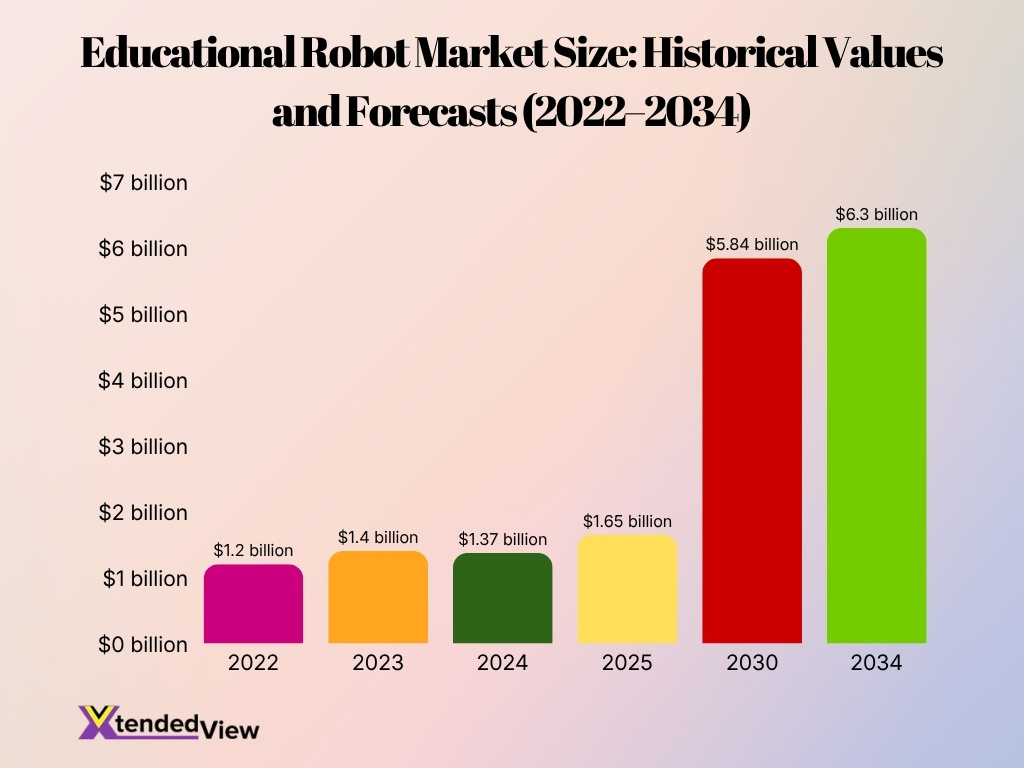
- The global educational robot market reached $1.65 billion in 2025, up from $1.37 billion in 2024.
- The educational robotics industry is projected to grow at a 28.8% CAGR between 2025 and 2030.
- Humanoid educational robots are expected to become the fastest-growing product segment through 2030.
- Non-humanoid educational robots generated $932.3 million in revenue during 2024, making them the largest product category.
- Asia-Pacific accounted for roughly 30% of the global educational robots market in 2025.
- The educational robot market could surpass $5.84 billion globally by 2030.
- Educational robots revenue increased from $1.2 billion in 2022 to an estimated $1.9 billion in 2025.
- Software for educational robotics is forecast to grow at a 19.2% CAGR through 2031 because of increased automation in learning systems.
- North America represented approximately 35% of the educational robots market share in 2025.
- Universities and research institutions continue driving demand for robotics systems tied to AI, engineering, and coding education.
Recent Developments
- In 2025, several robotics vendors expanded AI integration in classroom robots to improve adaptive learning and speech interaction capabilities.
- Humanoid robot investments have surpassed $5 billion globally since 2024, accelerating educational and companion robot development.
- Research published in 2025 reviewed 258 studies on AI in STEM education, showing growing integration of robotics into elementary learning programs.
- About 45% of AI education studies focused on intelligent tutoring systems connected to robotics and automation learning.
- Robotics researchers reported that 65% of AI-based STEM studies concentrated on upper elementary education levels.
- Educational robot developers increasingly shifted toward affordable modular robotics platforms for schools during 2025.
- AI-enhanced robotics platforms expanded into inclusive learning environments, especially for coding and problem-solving instruction.
- Educational robotics vendors introduced static and wheeled robot models designed for lower classroom maintenance costs.
- Robotics education programs in emerging economies expanded through STEM-focused nonprofit initiatives and government-backed training labs.
- Developers increasingly use conversational AI in educational robots to improve student engagement and natural-language learning.
Global Educational Robots Market Size
- The global educational robot market was valued at approximately $1.37 billion in 2024.
- Market revenue is expected to reach around $1.65 billion in 2025.
- Another industry estimate placed the 2025 market value at $1.8 billion globally.
- Some market analysts forecast educational robotics revenue to exceed $6.3 billion by 2034.
- A separate projection estimates the market could climb to $17.36 billion by 2034 under aggressive adoption scenarios.
- Educational robot sales grew steadily from $1.2 billion in 2022 to $1.6 billion in 2024.
- The sector continues expanding because schools increasingly prioritize hands-on STEM instruction and coding literacy.
- Asia-Pacific remains the largest regional contributor with approximately 30% market share in 2025.
- North America accounted for roughly 35% of global educational robotics revenue in 2025.
- Europe contributed around 25% of the total educational robot market demand in 2025.
Educational Robots Market Growth Rate and Forecast
- The educational robot market is forecast to grow at a 28.8% CAGR from 2025 to 2030.
- One long-range forecast projects a 29.16% CAGR between 2025 and 2034.
- Another industry report predicts a 25.72% CAGR through 2034.
- Conservative estimates still place educational robotics growth above 12.5% CAGR from 2026 to 2034.
- The market may reach $5.84 billion by 2030, according to multiple forecasts.
- Forecast models suggest educational robot demand will accelerate because of expanding AI adoption in classrooms.
- Software and analytics systems tied to educational robots are expected to outpace hardware growth in several regions.
- Increasing investments in STEM learning continue to drive robotics procurement in K-12 schools and universities.
- Growth in coding boot camps and technical education programs also contributes to robotics adoption rates.
- Analysts expect humanoid educational robots to achieve the highest growth momentum through the next decade.
Breakdown of Educational Robots by Product Type
- Non-humanoid robots generated $932.3 million in revenue during 2024, leading the market by sales volume.
- Humanoid robots are the fastest-growing educational robotics category with a projected CAGR of 28.4% through 2030.
- Wheeled educational robots hold 62% of the elementary STEM classroom market due to lower costs and simpler maintenance.
- Programmable coding robots are now used in 45% of U.S. schools focusing on computational thinking instruction.
- AI-powered conversational robots saw 37% increased classroom adoption during 2025 due to speech recognition improvements.
- Modular robotics kits are now present in 58% of middle-school engineering and maker-space programs globally.
- Educational robotics software is projected to grow at 31.2% CAGR, outpacing hardware’s 24.7% CAGR through 2031.
Educational Robots Market Share by Application
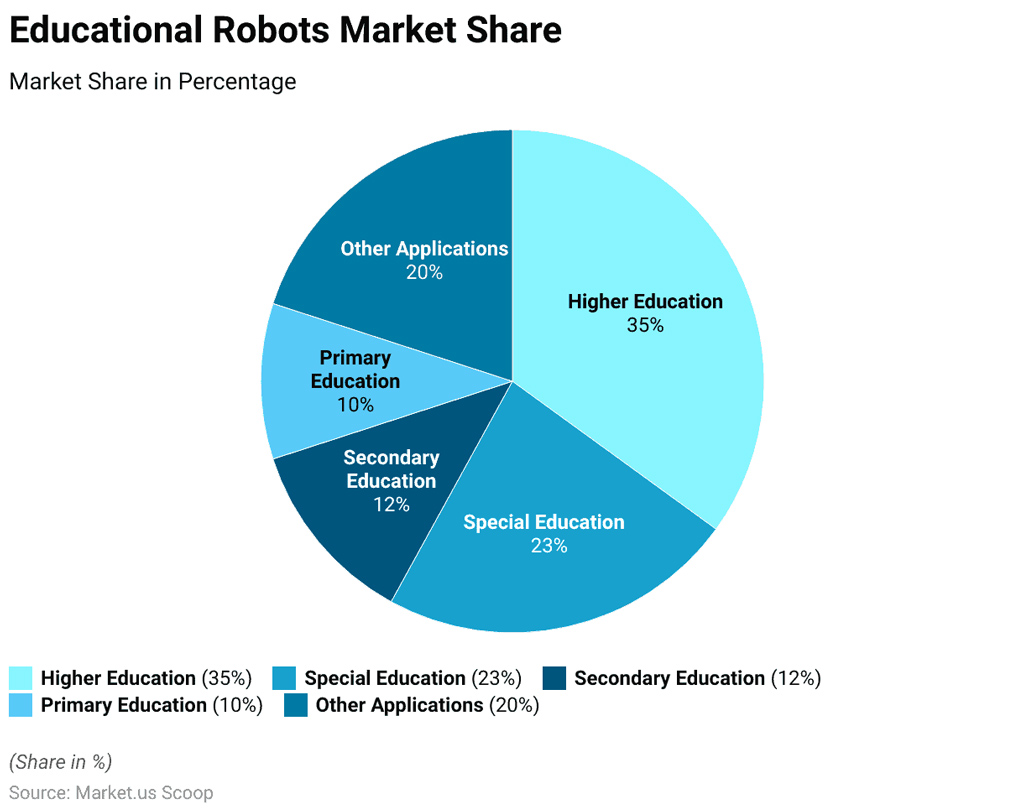
- Higher Education holds the largest share of the educational robots market at 35%, showing strong adoption in universities, research labs, engineering programs, and advanced learning environments.
- Special Education accounts for 23% of the market, highlighting the growing use of robots to support personalized learning, therapy, communication, and inclusive classroom experiences.
- Other Applications represent 20% of the market, indicating that educational robots are also being used beyond traditional classrooms, such as training centers, museums, coding clubs, and informal STEM learning spaces.
- Secondary Education captures 12% of the market, suggesting moderate adoption among middle and high schools for robotics, programming, science, and technology-based learning.
- Primary Education has the smallest share at 10%, but it still reflects rising interest in early STEM exposure, coding basics, and interactive classroom learning for younger students.
- Combined, Higher Education and Special Education make up 58% of the educational robots market, showing that advanced learning and assisted learning are the two strongest application areas.
- The data shows that educational robot adoption is currently more concentrated in specialized and advanced education settings than in early-school environments.
- Schools and institutions investing in robots are likely prioritizing use cases where robots deliver measurable value, especially in hands-on technical education, special needs support, and research-based learning.
Use of Educational Robots in STEM Education
- 7% of all AI classroom applications analyzed in a 2025 review of 258 studies were educational robotics.
- Around 65% of AI-STEM studies focused on upper elementary students, showing growing robotics exposure for younger learners.
- Mathematics accounted for 38% of robotics-integrated STEM learning activities in recent AI education studies.
- More than 2,000 coding clubs across the UK now teach students to build apps, games, and robots.
- Educational robotics programs are expanding in K-12 education as schools prioritize coding and engineering literacy.
- AI-enhanced robotics kits now include adaptive feedback systems that improve student coding accuracy in real time.
- Governments and nonprofit organizations are heavily investing in robotics-driven STEM initiatives for underserved schools.
Adoption of Educational Robots by Teachers and Schools
- About 29.82% of primary school teachers responsible for grades 1–4 reported using educational robots in teaching activities.
- Teacher education programs showed the highest robotics adoption rate at 46.93% among surveyed faculty groups.
- Research involving 605 science teachers found an increasing willingness to integrate robotics into STEM classrooms.
- More schools now adopt robotics tools because educators see stronger student engagement during hands-on activities.
- A national educator survey in Pakistan found that over two-thirds of teachers expressed willingness to adopt AI-powered educational technologies when training and support are available.
- Approximately one-third of surveyed educators reported frequent AI tool usage in classrooms during 2025.
- U.S. math and science teachers increasingly use generative AI and robotics tools for lesson planning and classroom demonstrations.
- Indonesian K-12 teachers reported growing use of AI and robotics for assessment preparation and instructional media in 2026.
- Schools continue investing in robotics because STEM-focused curricula increasingly require practical coding and automation instruction.
- Teacher adoption remains uneven across regions because infrastructure access and training availability still vary widely.
Most Common Uses of Educational Robots
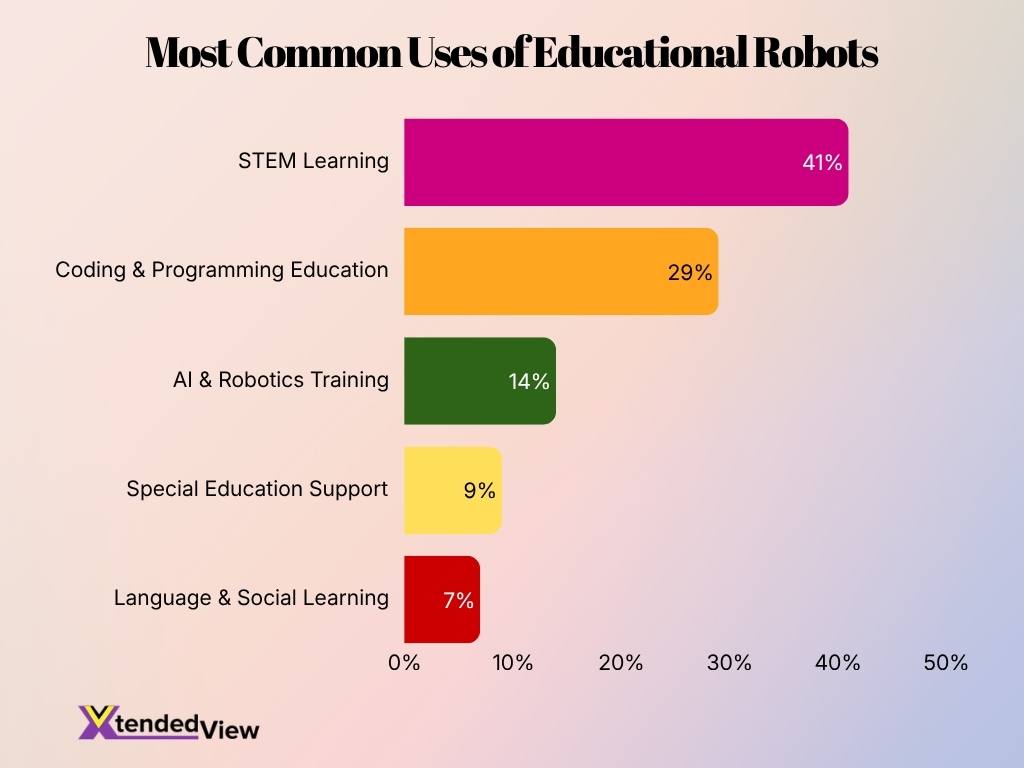
- STEM Learning is the leading use case for educational robots, accounting for 41% of total usage.
- Coding & Programming Education ranks second with a 29% share, showing that robots are widely used to teach practical digital skills.
- Together, STEM Learning and Coding & Programming Education make up 70% of educational robot usage, highlighting their strong role in technical education.
- AI & Robotics Training represents 14% of usage, suggesting growing adoption of robots for advanced technology learning.
- Special Education Support accounts for 9%, showing that educational robots are also being used to support personalized and inclusive learning.
- Language & Social Learning has the smallest share at 7%, but it reflects the expanding role of robots in communication, interaction, and soft-skill development.
- The data shows that educational robots are primarily focused on science, technology, engineering, coding, and AI-related learning, rather than general classroom support.
- Non-technical applications such as Special Education Support and Language & Social Learning together represent 16%, indicating a smaller but important role in inclusive and social learning environments.
Educational Robots Usage by Subject Area
- Mathematics‑focused robotics activities account for 38% of AI‑assisted STEM studies in K–12 classrooms.
- Computer science programs use programmable robots in 72% of introductory coding courses to teach algorithm logic.
- Engineering labs integrate robotics platforms in 65% of hands‑on prototyping exercises for mechatronics and design.
- Language‑learning classrooms deploy conversational robots in 28% of advanced foreign‑language sections to improve pronunciation practice.
- Science teachers rely on robotics kits for 51% of kinematics and mechanics demonstrations in middle‑school physics units.
- AI tutoring robots were used in 33% of mathematics remediation programs in 2025 to support adaptive learning pathways.
- Robotics‑assisted art and design electives grew by 40% year‑on‑year, combining coding with 3D fabrication projects.
- Career and technical education (CTE) programs use industrial‑style robots in 46% of courses, simulating manufacturing workflows.
- STEM clubs and after‑school coding groups report robotics usage in 79% of regular project cycles outside standard subjects.
- Universities employ advanced robotics systems in 58% of AI and autonomous navigation research labs during 2025–2026.
Educational Robots Adoption by Age and Teacher Demographics
- Upper elementary students represented 65% of the analyzed AI‑robotics studies, making them the dominant age‑group focus.
- Primary education generated 36.81% of global educational robot revenue in 2025, the largest age‑based segment.
- Special education robotics applications are forecast to grow at an 18.63% CAGR through 2031.
- Mid‑career teachers in Indonesia reported 25% higher perceived value from AI and robotics tools than early‑career educators.
- Elementary school teachers showed 41% more consistent AI and robotics usage compared with senior high school peers.
- K‑12 schools accounted for 39.2% of all educational service‑robot applications in 2025, the leading institutional segment.
- Younger students engaged 34% more frequently with social and humanoid robots during collaborative learning tasks.
- Teacher education faculties recorded 58% of surveyed institutions with high robotics integration, the strongest adoption rate.
- Homeschool communities increased educational‑robot usage by 37% between 2024 and 2025 as modular kits became more affordable.
- Rural and underserved schools reported 29% lower robotics adoption rates than their urban counterparts due to infrastructure and funding gaps.
Popular Educational Robot Brands and Models
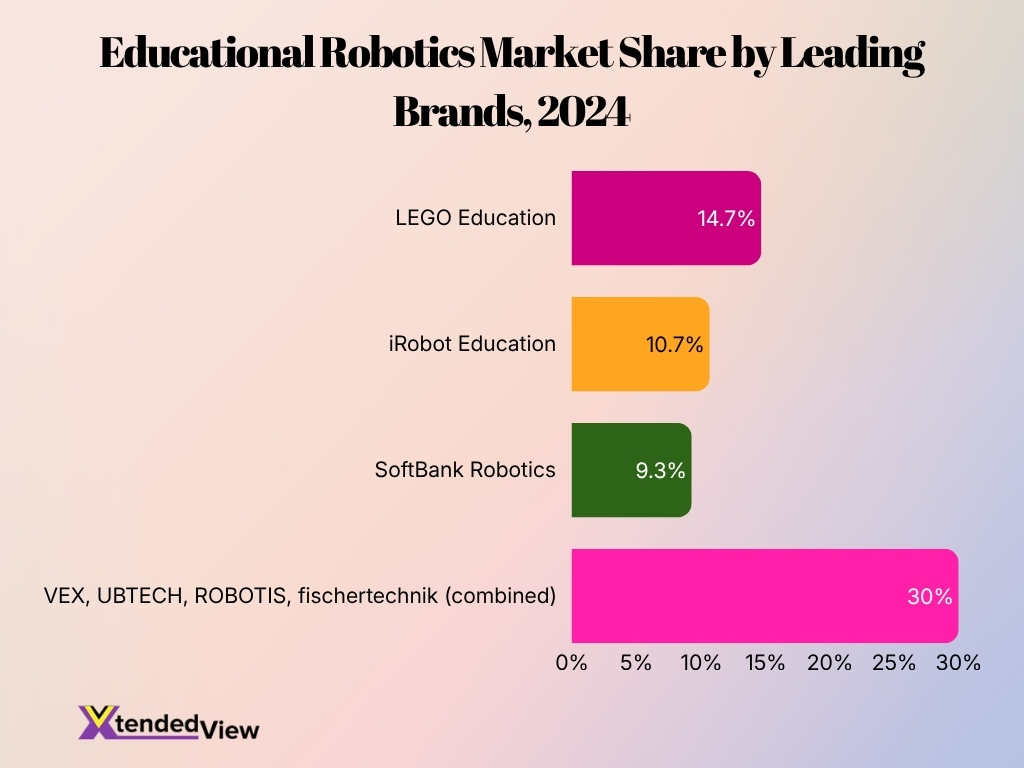
- LEGO Education captured about 14.7% of the global educational robotics market in 2024.
- LEGO Education generated roughly $220 million in educational robotics revenue during 2024.
- The LEGO SPIKE Prime platform is used in over 130,000 K–12 STEM classrooms worldwide.
- iRobot Education held approximately 10.7% of the educational robotics market share in 2024.
- SoftBank Robotics commanded around 9.3% of the educational robotics market via humanoid robots.
- The NAO robot is deployed in more than 15,000 universities and research institutions globally.
- Wonder Workshop recorded about $120 million in annual revenue from Dash & Dot educational robots.
- Makeblock’s mBot kits are sold in over 140 countries, with more than 10 million units shipped.
- Sphero’s BOLT platform is used in over 60,000 schools using app‑based coding instruction.
- VEX Robotics, UBTECH, ROBOTIS, and fischertechnik collectively supply more than 30% of global robotics kits to K–12 institutions.
Educational Robots in Special Education and Inclusive Learning
- The educational robots market was about $1.4 billion in 2023 and is forecast to exceed $4.3 billion by 2031.
- Special education accounts for about 23% of the educational robots market, making it one of the largest segments.
- In one autism-focused robot study, 100% of participants improved math skills, and 92% improved social skills.
- The same study found the robot could detect child engagement with 90% accuracy, supporting more responsive instruction.
- A long-term home study involved 17 children with autism and showed personalized robot-led learning could adapt to individual needs.
- Research on social humanoid robots reports gains in eye contact, joint attention, and communication initiation for many children with ASD.
- A review of educational robotics in special needs education found that robots can improve engagement, social skills, and the consistency of therapeutic support.
- Cost and teacher training remain major barriers, with one review identifying them as the two primary obstacles to wider classroom adoption.
- Inclusive education research says technology can increase access, motivation, and differentiated learning, but funding and specialist shortages still limit rollout.
Educational Robots in Higher Education and Research
- Higher education accounted for approximately 35% of the educational robots market share among educational applications.
- Universities remain major buyers of humanoid and programmable robots for AI and engineering research programs.
- Robotics research labs increasingly use AI-powered educational robots for autonomous navigation experiments.
- Engineering departments continue to adopt robotics systems to simulate industrial automation and manufacturing environments.
- Educational robotics platforms now integrate machine learning, cloud computing, and computer vision technologies.
- Universities expanded interdisciplinary robotics research involving healthcare, transportation, and smart manufacturing during 2025.
- Demand for robotics-skilled graduates continues to rise because employers increasingly seek automation and AI expertise.
- Robotics education market revenue reached approximately $3.2 billion in 2025, driven partly by university-level adoption.
- North America accounted for roughly 34.8% of the robotics education market revenue in 2025.
- Higher education institutions continue partnering with robotics vendors to expand STEM workforce development initiatives.
Regional Markets for Educational Robots
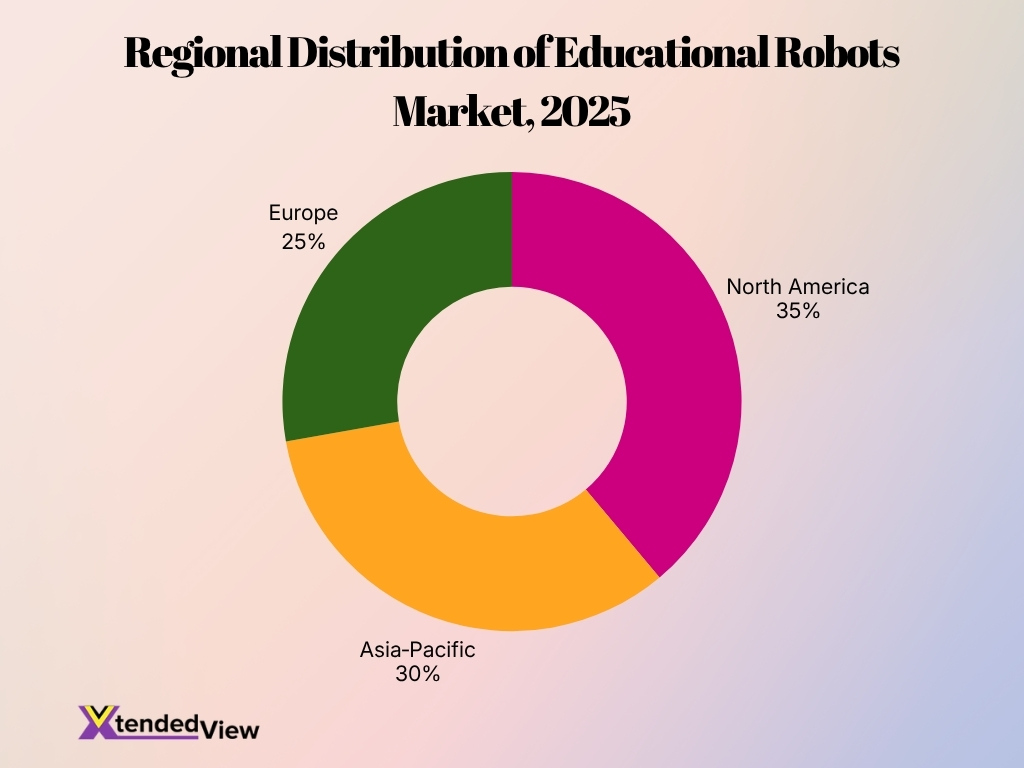
- North America accounted for approximately 35% of global educational robot revenue in 2025.
- Asia‑Pacific represented nearly 30% of the educational robotics market share in 2025.
- Europe contributed around 25% of global educational robot demand in 2025.
- China generated about 22% of worldwide educational robotics sales in 2025.
- The United States supplied roughly 40% of global university robotics research funding in 2025.
- India reached roughly 50,000 government‑backed STEM labs and coding classrooms by the end of 2025.
- Japan allocated over $1.2 billion toward humanoid and AI‑assisted educational robotics programs in 2025.
- Middle Eastern countries invested nearly $800 million in smart classroom robotics and digital‑education initiatives in 2025.
- Latin America grew its educational robotics market by about 18% year‑on‑year in 2025.
- Schools in lower‑income economies still face over 60% lower robotics‑adoption rates than higher‑income regions in 2025.
Educational Robots in Vocational and Technical Training
- $23.5 billion global industrial robotics market value in 2025, growing at a ~10–14% CAGR into the late 2020s.
- Collaborative robots made up 10.5% of industrial robots installed worldwide in 2023, with rising adoption in training labs.
- Forecasts project the industrial robotics market to reach $43–44 billion in 2026, reflecting rapid investment in automation skills.
- ~44% of worker skills are expected to face disruption within five years due to automation and AI adoption.
- India’s industrial robotics units reached 7.6 thousand units in 2025, signalling expanding vocational training demand.
- 60% of jobs will see significant task changes from AI by 2030, increasing the need for reskilling in vocational programs.
- Community colleges expanded manufacturing and robotics pathways across 2025–2026, with multiple programs added to meet employer demand.
- Predictive maintenance adoption in robotic factories reduced unplanned downtime by double-digit percentages in industry studies.
- Governments announced multi‑hundred‑million‑dollar robotics and AI skilling initiatives (India example: ₹10,300+ crore AI investment umbrella) to close workforce gaps.
- Automotive and aerospace training centers increasingly use cobots and simulation tools, mirroring industry share growth and hands‑on curricula updates.
Funding, Acquisitions, and Mergers in Educational Robotics
- Robotics companies raised a record $40.7 billion in 2025, equal to 9% of all global venture funding.
- AI companies pulled in $226 billion in 2025, capturing 48% of total venture funding worldwide.
- The educational robot market is projected to reach US$3.1 billion by 2027, growing at a 18.7% CAGR from 2022 to 2027.
- The robotics education market is valued at $1.24 billion in 2026 and is forecast to hit $1.7 billion by 2030.
- The global educational robot market is expected to rise from $1.6 billion in 2024 to $1.9 billion in 2025.
- The same market is projected to surpass $4.3 billion by 2031, showing strong long-term investment momentum.
- The AI in education market is projected to grow from $2.21 billion in 2024 to $5.82 billion by 2030.
- The broader AI EdTech market is expected to reach $5.3 billion in 2025.
- Higher education accounts for 35% of the educational robots market, making it the largest application segment.
- Educational robot adoption is being supported by rising STEM and coding demand across schools and universities.
Robotics Education Builds Future-Ready Skills
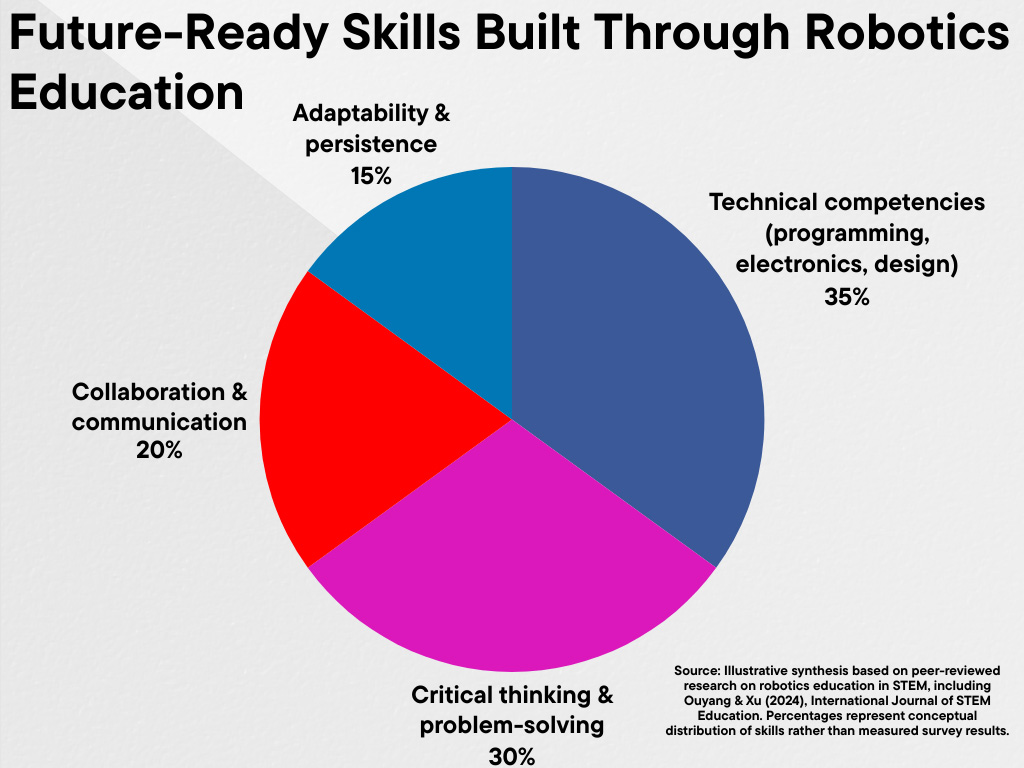
- Technical competencies make up the largest share at 35%, showing that robotics education strongly supports skills like programming, electronics, engineering design, and hands-on technology use.
- Critical thinking and problem-solving account for 30%, highlighting how robotics helps students analyze challenges, test solutions, debug errors, and improve designs through practical learning.
- Collaboration and communication represent 20% of the skill distribution, showing that robotics projects often encourage students to work in teams, share ideas, explain designs, and solve problems together.
- Adaptability and persistence contribute 15%, suggesting that robotics education helps students build resilience by learning from failure, refining prototypes, and continuing through trial-and-error processes.
- The data shows that robotics education is not limited to technical training; it also develops soft skills, including teamwork, communication, creativity, and perseverance.
- Together, technical competencies and problem-solving skills account for 65%, making them the two most important future-ready outcomes linked to robotics education.
- The chart suggests that robotics programs can prepare students for STEM careers, where both technical knowledge and real-world problem-solving ability are highly valuable.
- Since the percentages are described as a conceptual distribution, they should be used as an illustrative insight rather than a direct survey-based measurement.
AI and Advanced Technologies in Educational Robots
- 27.5% CAGR projected for the educational robot market 2025–2034.
- $1.38B estimated global educational robot market size in 2024.
- 45% of AI-in-education studies in recent STEM reviews focused on AI tutoring systems.
- 86% of education organizations reported using generative AI by 2025.
- 69% of adolescent users said generative AI helped them learn something new.
- 48% CAGR for AI education market growth in Asia‑Pacific (fastest regional growth).
- 10x higher engagement reported for AI-powered active learning versus passive methods.
- 57% increase in learning efficiency from AI‑powered personalized learning.
- 28.8% CAGR forecast for educational robots 2025–2030 in alternative industry estimates.
Challenges and Barriers to Educational Robot Adoption
- 70% of school districts cite high upfront costs as a primary barrier to robotics adoption in classrooms.
- 35–65% of low-income schools report unstable internet or insufficient infrastructure for AI/robotics deployment.
- Only 18% of teachers feel confident teaching tech subjects, slowing robotics integration.
- Over 40% of educators report insufficient technical support for classroom robotics systems.
- 58% of school administrators list privacy or student-data security as a major concern with AI systems.
- Annual maintenance costs can add 10–15% of the initial robotics lab investment, limiting upgrades.
- ~50% of teachers hesitate to adopt robotics due to a lack of coding/AI experience.
- STEM resource access is 2–3× lower in rural schools compared with urban schools, widening the robotics gap.
- AI bias or ethical concerns are raised in 30–45% of policy discussions on educational robotics.
- Curriculum integration issues affect approx 40% of schools because robotics requires schedule and infrastructure changes.
Frequently Asked Questions (FAQs)
The global educational robot market is projected to reach $5.84 billion by 2030, growing at a 28.8% CAGR from 2025 to 2030.
The educational robot market was valued between $1.65 billion and $2.32 billion in 2025, depending on the market model and forecast scope.
North America held approximately 35% of the global educational robotics market share in 2025.
Humanoid robots captured 49.13% of the educational robot market share in 2025 and are forecast to grow at a 15.03% CAGR through 2031.
The software segment in educational robotics is expected to grow at a 19.2% CAGR through 2031 because of rising demand for automation and AI-enabled learning systems.
Conclusion
Educational robots continue to reshape how students learn coding, engineering, mathematics, and automation skills. Market growth remains strong as schools, universities, and workforce training centers increase investments in AI-powered robotics systems. At the same time, demand for hands-on STEM education and automation-ready skills continues pushing educational institutions toward programmable and humanoid robotics platforms.
However, adoption challenges still exist. Budget constraints, teacher training gaps, infrastructure limitations, and data privacy concerns continue to slow deployment in many regions. Even so, long-term market forecasts show steady momentum as robotics vendors introduce lower-cost systems, AI-enhanced tutoring capabilities, and cloud-connected learning tools.
Looking ahead, educational robots will likely play a larger role in personalized learning, vocational training, and inclusive education. As AI technology evolves, robotics-based education could become a standard part of classrooms worldwide, especially in programs tied to STEM innovation and future workforce development.
