


Cloud storage has become a core part of how people manage documents, photos, videos, and business files across devices. From remote teams collaborating on shared folders to students storing assignments in real time, platforms like Google Drive and Dropbox continue to shape digital workflows worldwide. Businesses also rely on these tools for backup management, file synchronization, and AI-powered collaboration.
This article explores the latest Google Drive vs Dropbox statistics, covering user growth, market share, adoption trends, and performance insights that define the cloud storage industry today.
Editor’s Choice
- Google Drive surpassed 2 billion monthly active users in 2025, making it one of the world’s largest cloud productivity platforms.
- Dropbox reported more than 700 million registered users globally across over 180 countries.
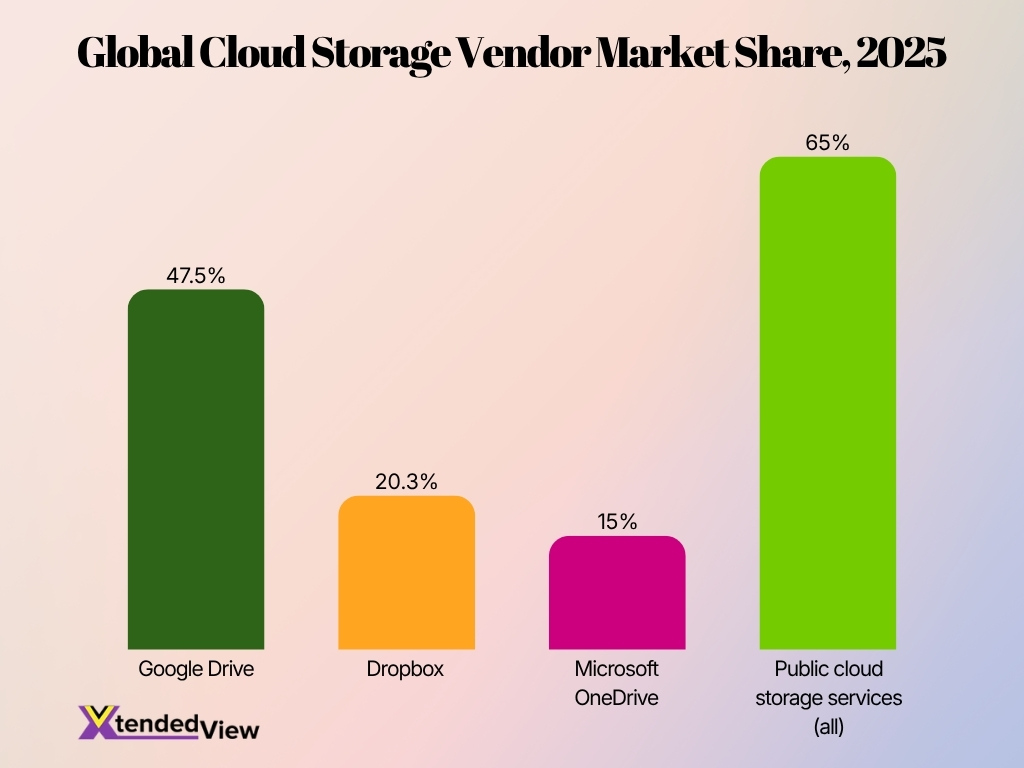
- Google Drive controlled nearly 47% to 48% of the cloud storage market share in 2025.
- Dropbox held approximately 20.6% market share in the file hosting and storage segment in 2025.
- Dropbox generated $2.52 billion in revenue during fiscal year 2025.
- Around 2.3 billion people worldwide used personal cloud storage services in 2025, including Google Drive and Dropbox users.
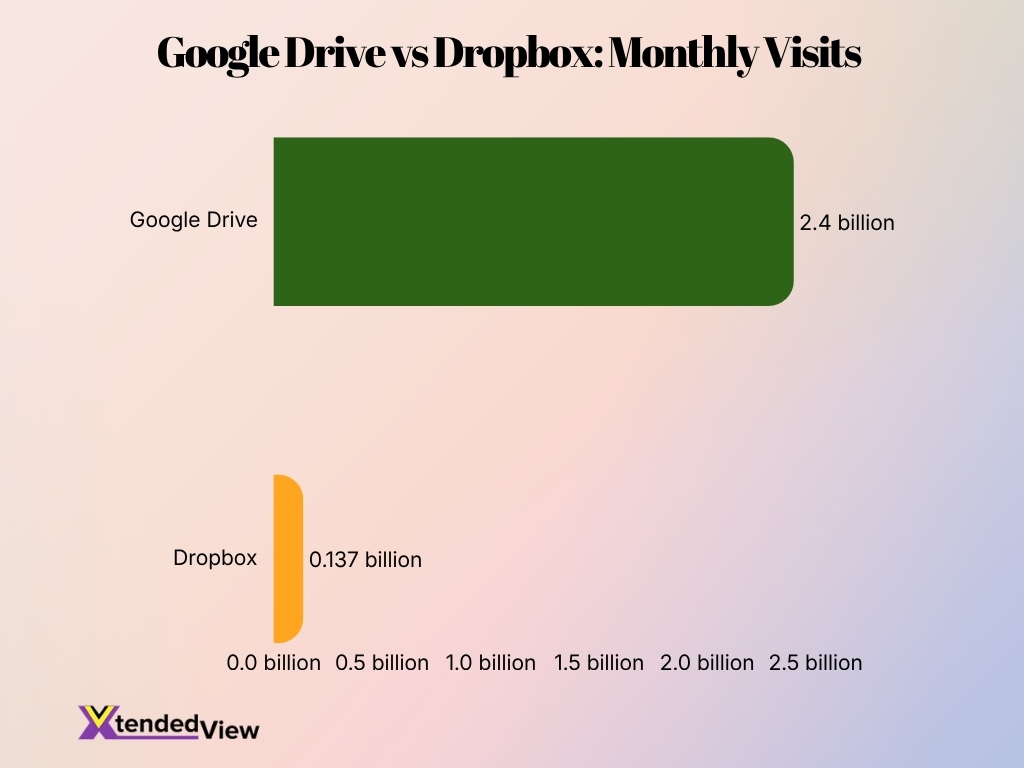
- Google Drive delivered nearly 2.4 billion monthly website visits in 2025 compared to Dropbox’s 137 million.
- Dropbox maintained more than 18 million paying users in 2025 despite increasing competition from bundled cloud ecosystems.
Recent Developments
- Google expanded Gemini AI integration across Drive and Workspace apps during 2025 to automate file summaries, search, and document generation workflows.
- Dropbox continued scaling its AI-powered “Dash” search assistant to improve enterprise file discovery and workflow automation.
- In 2025, Dropbox reported around 575,000 paying business teams using its collaboration ecosystem.
- Google Drive strengthened its position in education and hybrid work environments due to deeper integration with Android and Google Workspace products.
- Dropbox introduced broader video review and content collaboration features aimed at marketing and creative agencies in 2025.
- Google Drive traffic crossed 2 billion monthly visits, reflecting rising demand for browser-based collaboration tools.
- Dropbox maintained strong profitability margins close to 40% operating margin despite slower overall user growth.
- The global cloud storage market reached $161.3 billion in 2025 and is projected to expand rapidly through 2034.
- Remote and hybrid work models continued driving enterprise demand for secure file-sharing services in North America and Europe.
- Google Drive remained heavily favored among mobile-first users because of its native integration with Android smartphones and Chromebooks.
Market Share in Cloud Storage and File Sharing
- Google Drive controlled around 47% to 48% market share in the cloud storage category during 2025.
- Dropbox held roughly 20% to 20.67% market share in the global file hosting segment.
- Microsoft OneDrive ranked behind Google Drive and Dropbox with approximately 15% market share in 2025.
- Google Drive led the market largely because it comes bundled with Google accounts and Workspace subscriptions.
- Dropbox remained one of the most recognized standalone cloud storage brands despite competition from ecosystem-driven platforms.
- The global cloud storage market reached $161.28 billion in 2025 and is projected to surpass $800 billion by 2034.
- Public cloud storage services accounted for nearly 65% of the consumer cloud storage market in 2025.
- Consumer cloud storage services are projected to grow at a CAGR above 21% through 2032.
- Google Drive maintained a stronger share in education and small business markets, while Dropbox held stronger positioning among creative agencies and freelancers.
- North America represented the largest regional market for cloud storage adoption with over 46% market share in 2025.
Global Adoption of Google Drive vs Dropbox
- Google Drive serves more than 2 billion monthly active users worldwide, dwarfing Dropbox’s roughly 700 million registered users.
- Google Drive holds about 7.43% of the global file‑sharing market share, while Dropbox accounts for roughly 1.94%.
- In April 2025, drive.google.com attracted around 2.4 billion visits, compared to about 137.2 million visits for Dropbox.com.
- Around 54.6% of global cloud storage users rely on three or more services, often stacking Google Drive with Dropbox and another provider.
- Google Drive powers roughly 3 billion Google Workspace users, giving it a much wider enterprise footprint than Dropbox’s 18.08 million paying customers as of 2025.
- In large enterprises with 1,000+ employees, Google Drive adoption sits at about 29%, while Dropbox adoption is around 25%.
- Google Drive offers 15 GB of free storage per account, whereas Dropbox historically provides only 2 GB in its free tier.
- In small businesses already using Gmail, Google Drive adoption can exceed 80%, whereas Dropbox usage in the same segment often stays below 35%.
- Over 47% of university‑based cloud storage activity in the US flows through Google Drive, versus roughly 8% through Dropbox.
- Dropbox generates about $2.52 billion in annual revenue with 18.08 million paying users, while Google Drive monetization is embedded across a multibillion‑dollar ecosystem.
Total Registered Users Statistics
- Google Drive crossed the milestone of 2 billion active users globally by 2025.
- Dropbox maintained over 700 million registered users worldwide in 2025.
- Dropbox user numbers grew from 500 million in 2018 to 700 million by 2020, then stabilized over the next few years.
- Google Drive had nearly double Dropbox’s user base as early as 2018.
- Dropbox reported around 18.08 million paying subscribers in fiscal year 2025.
- Google Workspace reportedly served between 6 million and 8 million paying business customers globally in 2025.
- Dropbox’s paying customer conversion rate remained relatively stable despite competition from bundled cloud ecosystems.
- Google Drive benefited from automatic onboarding through Gmail account creation and Android device activation.
- Dropbox continued attracting professional users through premium storage and advanced synchronization features.
- Google Drive’s user ecosystem expanded rapidly because of integration with Docs, Sheets, Slides, and Classroom.
Monthly Active Users Comparison
- Google Drive recorded more than 2 billion monthly active users in 2025.
- Dropbox’s monthly web traffic averaged roughly 137 million visits during 2025.
- Google Drive generated approximately 2.4 billion monthly visits, highlighting a much larger active ecosystem.
- Google Drive maintained stronger daily engagement because of its connection to Gmail, Google Photos, and Workspace applications.
- Dropbox continued seeing high engagement among enterprise and creative users managing large media files.
- Google Docs accounted for nearly 58.9% of active usage time within the Google productivity ecosystem.
- Mobile app downloads for Google Drive exceeded 4.8 million in a single month during 2024, supporting active user expansion entering 2025.
- Dropbox usage remained highly concentrated among professional users willing to pay for premium synchronization performance.
- Google Drive benefited from broader casual consumer adoption due to free storage allocations and Android integration.
- Hybrid work continued increasing active usage across both platforms, especially among distributed US teams.
Revenue and Growth Trends
- Dropbox generated approximately $2.52 billion in annual revenue during fiscal year 2025, up slightly from 2024.
- Google Workspace, which includes Google Drive, produced an estimated $48 billion in annualized revenue for Alphabet in 2025.
- Dropbox’s average revenue per paying user reached nearly $140.66 annually in 2025.
- Google Cloud revenue grew by more than 28% year over year in 2025, helping Drive expand enterprise adoption.
- Dropbox reported over 18 million paying users worldwide in 2025 despite slower user growth.
- Google Workspace surpassed 10 million paying organizations globally across education, enterprise, and SMB sectors.
- Dropbox maintained operating margins near 39% to 40%, reflecting strong subscription profitability.
- The global cloud storage market is expected to grow at a CAGR exceeding 20% through 2030.
- Google Drive’s growth continued accelerating in AI-enabled collaboration and enterprise productivity use cases.
- Dropbox is increasingly focused on premium business tools and AI-powered workflow products to improve monetization.
United States Leads Google Drive and Dropbox Customer Base
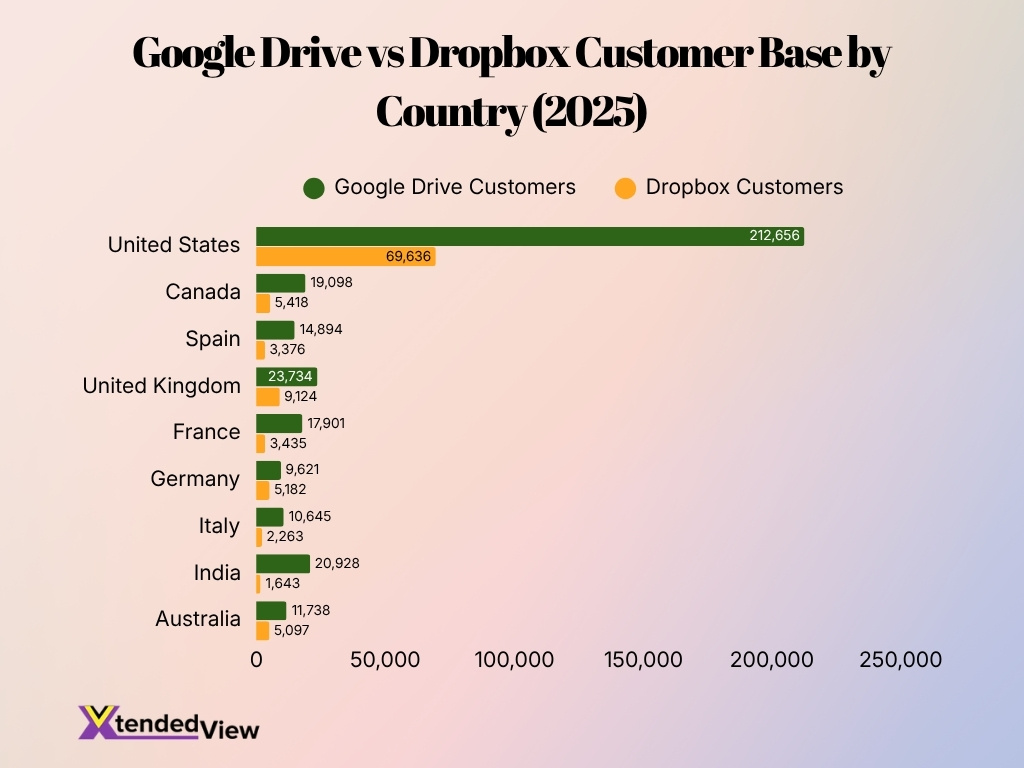
- The United States has the largest customer base for both platforms, with 212,656 Google Drive customers and 69,636 Dropbox customers.
- Google Drive has a much larger customer base than Dropbox in every listed country, showing its stronger global adoption.
- The United Kingdom ranks second for Google Drive among the listed countries, with 23,734 customers, followed by India with 20,928 customers.
- For Dropbox, the United Kingdom is also the second-largest market after the United States, with 9,124 customers.
- Canada has 19,098 Google Drive customers and 5,418 Dropbox customers, making it one of the strongest markets for both platforms.
- France records 17,901 Google Drive customers, compared to only 3,435 Dropbox customers.
- India shows a major gap between the two services, with 20,928 Google Drive customers but only 1,643 Dropbox customers.
- Germany has the smallest gap among major listed markets, with 9,621 Google Drive customers and 5,182 Dropbox customers.
- Australia has 11,738 Google Drive customers and 5,097 Dropbox customers, indicating relatively stronger Dropbox adoption compared to some European and Asian markets.
- Italy has 10,645 Google Drive customers and 2,263 Dropbox customers, showing Google Drive’s stronger presence in the country.
- Overall, the data suggests that Google Drive dominates Dropbox across all listed countries, especially in the United States, India, France, and Spain.
Average Storage Used per User
- Average personal cloud storage consumption reached 25 GB per user in 2024, driven by photo and video content comprising 68% of volume.
- The global cloud storage market grew from $124B in 2025 to $150B in 2026, a 21% increase.
- Personal cloud users numbered 2.3 billion worldwide in 2025, doubling from a decade prior.
- Small businesses averaged 3 TB per cloud account for documents and client files.
- Video content accounted for 68% of consumer cloud storage volume growth.
- Dropbox Business provided 3 TB per active user license starting in 2025.
- Enterprise cloud storage volumes surged 35% year-over-year in 2025 amid a data explosion.
- Creative agencies using Dropbox often exceeded 2 TB thresholds with high-res media.
- Consumer cloud storage market hit $14.9B in 2025, growing at 21.3% CAGR.
File Upload Size Limits and Daily Caps
- Google Drive supported individual file uploads up to 5 TB for paid users in 2026.
- Dropbox also allowed uploads up to 50 GB through the web interface and larger transfers through desktop syncing.
- Google Docs files converted into native Workspace formats remained exempt from traditional storage size limits.
- Dropbox Transfer supports file sharing transfers up to 250 GB on enterprise plans.
- Google Drive imposed a daily upload limit of roughly 750 GB per account.
- Users hitting Google Drive’s upload cap had to wait 24 hours before resuming uploads.
- Dropbox desktop syncing typically handles large folder uploads faster than browser-based uploads.
- Businesses increasingly relied on chunked uploads and background syncing for massive media archives.
- More than 60% of enterprise cloud uploads now include video or multimedia assets.
- File upload limits became increasingly important for production teams working with AI-generated media and 4K video files.
Google Drive Vs Dropbox Storage Limits And Pricing Insights
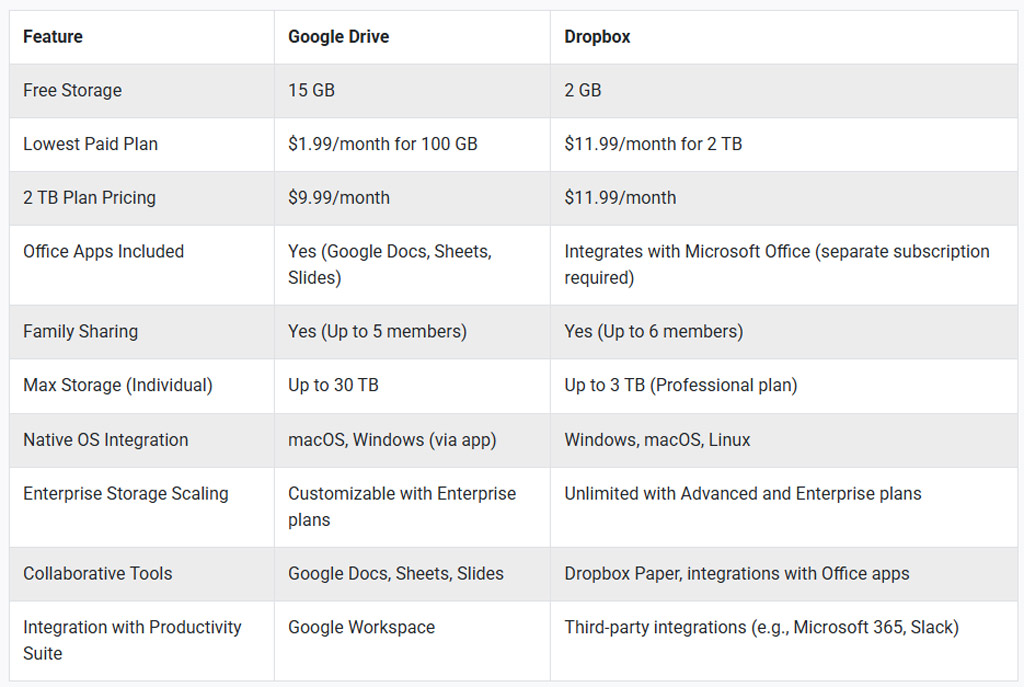
- Google Drive offers more free storage, providing 15 GB compared to Dropbox’s 2 GB, making it more attractive for casual users and beginners.
- Google Drive has a much cheaper entry-level paid plan, starting at $1.99/month for 100 GB, while Dropbox’s lowest paid plan starts at $11.99/month for 2 TB.
- For users needing 2 TB of storage, Google Drive is slightly more affordable at $9.99/month, compared to Dropbox at $11.99/month.
- Google Drive includes office apps such as Google Docs, Sheets, and Slides, giving users built-in productivity tools without needing a separate subscription.
- Dropbox relies more on Microsoft Office integrations, but users may need a separate Microsoft Office subscription to access full productivity features.
- Both platforms support family sharing, but Dropbox allows sharing with up to 6 members, while Google Drive supports up to 5 members.
- Google Drive offers higher individual storage capacity, with plans going up to 30 TB, compared to Dropbox’s individual limit of 3 TB on its Professional plan.
- Dropbox has stronger native operating system support, covering Windows, macOS, and Linux, while Google Drive supports macOS and Windows via an app.
- For enterprise users, Dropbox provides unlimited storage with its Advanced and Enterprise plans, while Google Drive offers customizable enterprise storage.
- Google Drive is better suited for users who want a complete productivity ecosystem through Google Workspace, while Dropbox is more focused on third-party integrations such as Microsoft 365 and Slack.
- In terms of collaboration, Google Drive benefits from built-in tools like Docs, Sheets, and Slides, whereas Dropbox offers Dropbox Paper along with external app integrations.
Sync Performance and Reliability Metrics
- Dropbox completed 75 out of 84 sync comparisons faster than Google Drive, Box, and OneDrive.
- Dropbox block-level sync uploaded folders 71% faster than Google Drive in tests.
- Dropbox synced a 100KB edit to a 25MB file in 89% less time vs. Box.
- Dropbox took 12 seconds for a 20MB file initial sync, vs. a 70-second average.
- Google Drive file sharing and syncing scored 90% (“Excellent”) in performance tests.
- Dropbox processes incremental edits up to 40% faster than Google Drive for large files.
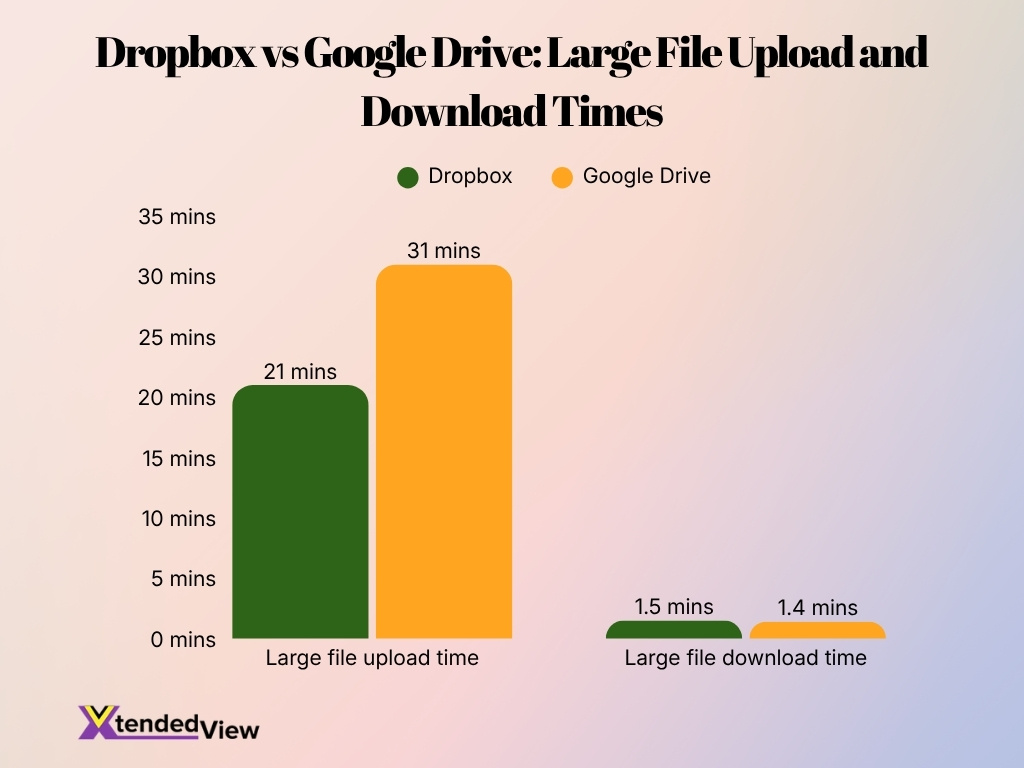
- Dropbox uploaded a large file in 21 minutes, beating Google Drive’s 31 minutes.
- 83% of cloud users prioritize synchronization reliability when choosing providers.
- 90% of enterprises lack full high-availability sync features in storage.
- Dropbox customer retention holds at 88% due to reliable enterprise sync.
Uptime and Service Availability Statistics
- Google Drive delivered 99.9% average uptime for consumer workloads in 2025, aligning with its standard SLA tier.
- Google Workspace’s enterprise‑tier SLA guarantees 99.9% service availability when measured monthly.
- Dropbox’s Business and Enterprise plans advertise 99.99% uptime commitments for paying customers.
- Independent monitoring showed 99.999% theoretical availability for Dropbox core infrastructure during 2025.
- Google Workspace reported fewer than 10 major public incidents in 2025 affecting a small fraction of global users.
- Dropbox recorded fewer than 5 major platform‑wide outages in 2025, most localized to specific regions or services.
- Average recovery time for Google Drive‑related disruptions across Google Cloud services fell below 90 minutes in 2025.
- Dropbox’s internal recovery benchmarks for enterprise storage nodes averaged under 60 minutes per incident in 2025.
- More than 71% of IT decision‑makers ranked 99.9%+ uptime SLAs as a top criterion when selecting cloud storage vendors.
- Major cloud storage downtime during 2025 cost enterprises an estimated $9,000 per minute on average.
File Upload and Download Speed Benchmarks
- Dropbox uploaded files in 21 minutes versus 31 minutes for Google Drive in one large-file test, making Dropbox about 45% faster for uploads.
- In the same test, download times were nearly identical at 1.5 minutes for Dropbox and 1.4 minutes for Google Drive, a gap of only 8% to 10%.
- Dropbox’s block-level sync uploads only changed file portions, which is why it is often faster than full-file reupload workflows.
- One 2026 benchmark found Dropbox maintained ±6.3% transfer-rate deviation on 10 GB transfers, while Google Drive showed ±32.7%, indicating more stable Dropbox throughput.
- Google Drive’s upload cap is 750 GB per 24 hours, while Dropbox allows uploads up to 2 TB at a time, giving Dropbox a much higher ceiling for large transfers.
- Enterprise cloud infrastructure spending reached $102.6 billion in Q3 2025, up 25% year over year, reflecting the scale of cloud usage behind sync and collaboration traffic.
- The global cloud collaboration market was estimated at $48.50 billion in 2024 and is projected to grow at 16.2% CAGR from 2025 to 2030, showing continued demand for sync-heavy workflows.
- In 2025, the world’s online population grew by more than 240 million people, and about 6 billion people were using the Internet, expanding the base for cloud file uploads and downloads.
- Global monthly mobile data usage was projected to reach about 200 exabytes in 2025, while the average smartphone user was expected to consume 23 GB per month, highlighting rising bandwidth demand.
- Google Drive held 7.43% of the file-sharing market versus Dropbox’s 1.94%, while Dropbox still posted up to 40% faster incremental edits in some tests.
Platform and Device Usage Share
- Android dominates with over 3 billion devices, fueling Google Drive‘s massive mobile footprint.
- Google Drive commands 47.4% cloud storage share, dwarfing Dropbox‘s 1.94% in file-sharing.
- 52.8% global internet access via mobile drives 58% cloud storage usage on phones in 2025.
- ChromeOS holds 60.1% education market, boosting Google Drive on Chromebooks in US schools.
- drive.google.com logged 2.4 billion visits in April 2025, vs Dropbox‘s 137.2 million.
- 7.33 billion global smartphone users will expand mobile cloud storage activity in 2025.
- Dropbox draws creative professionals with 40% faster block-level sync for large files.
- 18.22 million paying Dropbox users favor desktop apps for offline sync in 2025.
- Desktop claims 45.61% web traffic share, key for Dropbox handling design and video files.
Team and Enterprise Adoption Statistics
- Google Workspace surpassed 10 million paying organizations globally in 2025.
- Dropbox supported approximately 575,000 paying business teams worldwide during 2025.
- Around 89% of enterprises used some form of cloud storage service by 2025.
- Google Drive adoption remained especially strong among startups, educational institutions, and SMBs.
- Dropbox retained strong traction among creative agencies, media companies, and distributed production teams.
- Nearly 60% of US businesses increased cloud collaboration spending during 2025.
- Enterprise demand for hybrid work collaboration tools continued to accelerate across North America and Europe.
- Google Workspace became one of the leading productivity ecosystems for remote-first organizations.
- Dropbox Business customers frequently adopted advanced admin controls and compliance management tools.
- Large enterprises increasingly deploy multi-cloud storage strategies rather than relying on a single provider.
Google Drive Leads Dropbox Across All Employee Size Segments
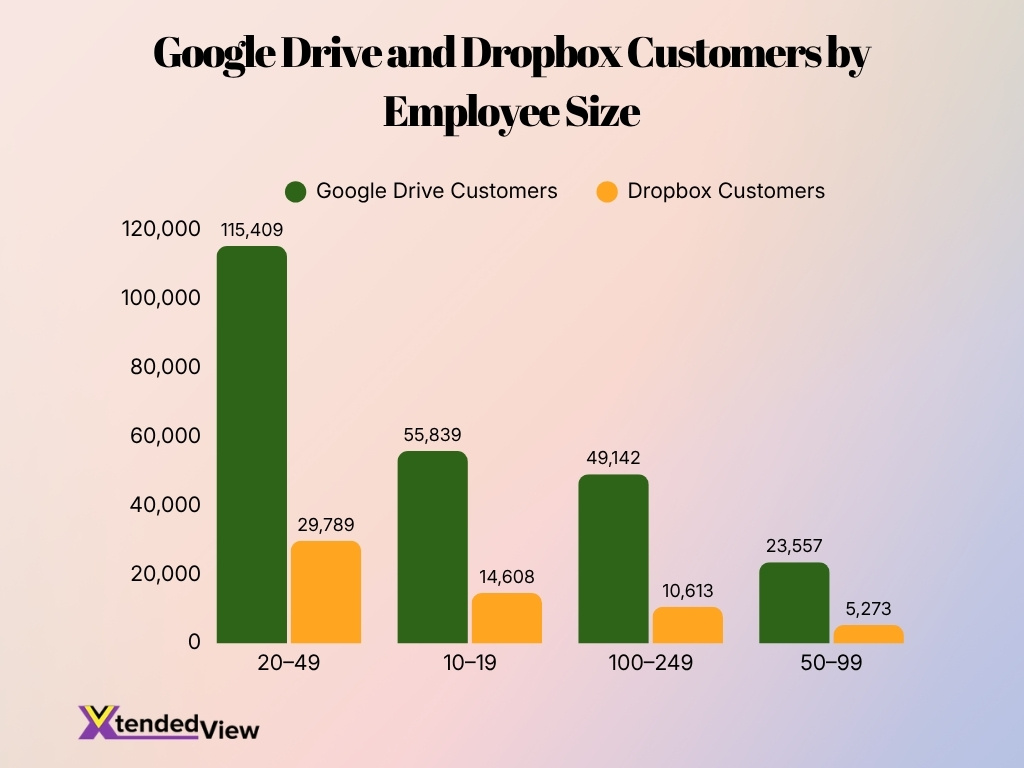
- Google Drive has the highest customer count among companies with 20–49 employees, reaching 115,409 customers, compared to 29,789 Dropbox customers.
- The 20–49 employee segment is the strongest customer base for both platforms, showing higher adoption among small businesses.
- Companies with 10–19 employees account for 55,839 Google Drive customers and 14,608 Dropbox customers, making it the second-largest segment for both tools.
- In the 100–249 employee segment, Google Drive has 49,142 customers, while Dropbox has 10,613 customers.
- The 50–99 employee group has the lowest customer count in this dataset, with 23,557 Google Drive customers and 5,273 Dropbox customers.
- Across every employee size category, Google Drive has significantly more customers than Dropbox.
- The biggest gap appears in the 20–49 employee segment, where Google Drive has 85,620 more customers than Dropbox.
- Overall, the data suggests that Google Drive is more widely adopted than Dropbox among small and mid-sized businesses.
Collaboration and Sharing Activity Metrics
- Google Drive held a 7.43% share of the file-sharing market in 2025.
- Over 1.8 billion active users synced files monthly on Google Drive in 2025.
- 75% of Google Drive users shared files via email or link for collaboration.
- Google Drive recorded 2.4 billion visits in April 2025.
- Dropbox had 18.08 million paying customers at the fiscal 2025 close.
- Cloud collaboration tools boosted productivity by up to 400% via real-time access.
- Remote workers using structured virtual tools saw 25% productivity gains in 2025.
- AI in Google Drive helped users find files twice as fast on average.
- 73% of remote workers relied on cloud platforms like Drive and Dropbox daily in 2025.
Security Features Adoption and Security Track Record
- 87% of enterprises with over 10,000 employees enabled MFA on cloud platforms.
- 70% overall workforce MFA adoption rate is expected to be reached in cloud services by 2025.
- 82% of businesses cite security as their primary cloud storage concern.
- 61% of organizations face security and compliance as top cloud adoption barriers.
- 54% of organizations reported a rise in direct cloud infrastructure attacks in 2025.
- Cloud high-severity security alerts increased 235% throughout 2024 into 2025.
- 76% of enterprises report a shortage in cloud security expertise.
- The zero-trust market reached $33.9 billion in 2025 for enterprise adoption.
- Google Drive complies with GDPR, HIPAA, and SOC 2 standards across tiers.
- 64% of enterprises prioritize cloud security as a pressing discipline.
AI and Automation Feature Adoption
- Google expanded Gemini AI integration across Drive and Workspace products throughout 2025.
- Dropbox continued rolling out AI-powered universal search through its Dash platform.
- Around 67% of enterprises planned to increase AI-powered workflow automation investments in 2026.
- Google Drive users increasingly relied on AI-generated summaries, smart search, and content recommendations.
- Dropbox AI tools focused heavily on improving document discovery and cross-platform file retrieval.
- AI-assisted productivity features reduced average document search times by nearly 35% in workplace environments.
- Businesses using AI-powered collaboration tools reported measurable gains in employee productivity during 2025.
- Google Workspace AI adoption accelerated rapidly because of tight integration with Docs, Sheets, Meet, and Gmail.
- Dropbox positioned AI search and organization as a key differentiator for enterprise users managing fragmented workflows.
- Generative AI features became one of the fastest-growing areas of investment across the cloud productivity market in 2026.
Frequently Asked Questions (FAQs)
Google Drive holds approximately 47% to 48% of the global cloud storage and file-sharing market as of 2025.
Dropbox has more than 700 million registered users worldwide across over 180 countries.
Google Drive provides 15 GB of free storage, while Dropbox offers 2 GB on its free plan.
Dropbox reported approximately 18.22 million paying users in 2025.
The global consumer cloud storage market is expected to grow at a 21.3% CAGR from 2025 to 2032.
Conclusion
Google Drive and Dropbox remain two of the most influential cloud storage platforms, yet they continue serving slightly different user needs. Google Drive dominates global adoption through its integration with Android, Gmail, and Workspace collaboration tools, while Dropbox maintains strong loyalty among professionals who prioritize synchronization speed, large-file management, and enterprise-grade workflow reliability.
The latest statistics also show how AI, hybrid work, and mobile collaboration continue to reshape the cloud storage industry. As businesses generate larger volumes of data and rely more heavily on distributed teams, both platforms are investing aggressively in automation, security, and real-time productivity features. While Google Drive leads in scale and ecosystem reach, Dropbox continues carving out a strong position in premium collaboration and creative workflows.
