


Supercomputers power some of today’s most complex tasks, from climate modeling and drug discovery to training large-scale AI systems. Governments and enterprises rely on these machines to process massive datasets in seconds, enabling faster innovation and more accurate predictions. As performance races into the exascale era, understanding the numbers behind these systems reveals how quickly computing power is evolving. Let’s explore the latest statistics shaping this space.
Editor’s Choice
- The world’s fastest supercomputer, El Capitan, achieved 1.742 exaflops (2025) on the HPL benchmark.
- As of late 2025, there are 4 exascale supercomputers globally, marking a major computing milestone.
- The United States holds 48.4% of total global supercomputing power, dominating the TOP500 rankings.
- The U.S. also leads in system count with 171–175 supercomputers on the TOP500 list in 2025.
- Performance of top supercomputers has grown from gigaflops in the 1990s to exaflops in 2025, a million-fold increase.
- The TOP500 list has been published twice annually since 1993, tracking global HPC trends.
- AMD-powered systems account for 34% of all TOP500 machines (2025), reflecting a major hardware shift.
Recent Developments
- The 66th TOP500 list (Nov 2025) confirmed El Capitan as the world’s fastest system.
- Europe reached a milestone with JUPITER Booster, its first exascale system delivering 1 exaflop performance.
- The top three supercomputers, El Capitan, Frontier, and Aurora, are all located in the United States Department of Energy labs.
- HPE-built systems have secured the No.1 rank for 8 consecutive TOP500 releases.
- NVIDIA entered the exascale race with JUPITER Booster using GH200 superchips.
- Exascale computing enables systems to perform 10¹⁸ calculations per second, a benchmark for modern HPC.
- Green500 rankings show increasing focus on energy-efficient supercomputing architectures.
- The number of countries represented in the TOP500 exceeds 40 nations, showing global adoption.
- Direct liquid cooling is now used in 10 of the top 20 energy-efficient systems, improving performance per watt.
Overview of Supercomputer Concepts
- A supercomputer is defined as a system capable of performing quadrillions to quintillions of operations per second.
- Performance is typically measured in FLOPS (Floating Point Operations Per Second).
- Modern systems operate at petaflop (10¹⁵) to exaflop (10¹⁸) scales.
- The TOP500 list ranks systems based on the LINPACK benchmark, a standardized performance test.
- Supercomputers often consist of thousands to millions of cores working in parallel.
- They are widely used in weather forecasting, nuclear simulations, and AI training workloads.
- HPC systems increasingly integrate CPUs, GPUs, and specialized accelerators for hybrid workloads.
- Interconnect networks like InfiniBand or Slingshot enable high-speed communication between nodes.
- The shift from traditional computing to HPC reflects a move toward data-intensive and AI-driven applications.
Top 10 Fastest Supercomputers in 2026
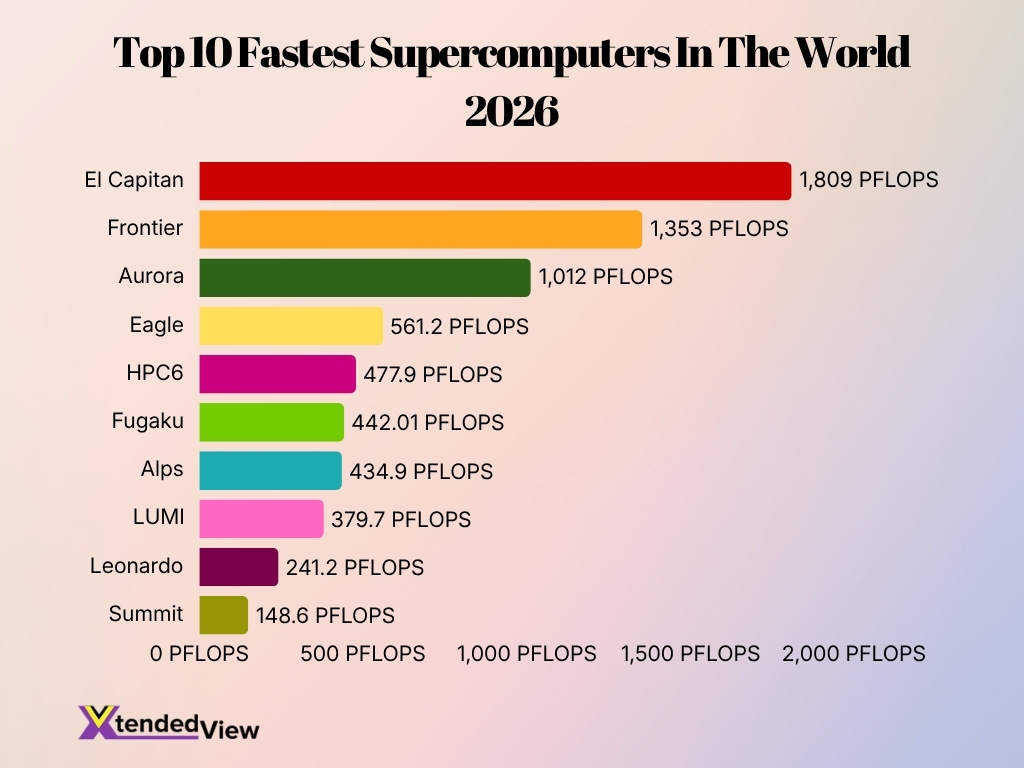
- The global leader is El Capitan, delivering an unmatched 1,809 PFLOPS, making it the most powerful supercomputer in the world.
- Frontier secures the second position with 1,353 PFLOPS, maintaining a strong lead over the rest of the competition.
- Aurora ranks third, crossing the 1,000 PFLOPS milestone with 1,012 PFLOPS, highlighting the rise of exascale computing.
- There is a significant performance drop after the top three, with Eagle in fourth place at 561.20 PFLOPS, nearly 50% lower than Aurora.
- Mid-tier systems like HPC6 (477.90 PFLOPS), Fugaku (442.01 PFLOPS), and Alps (434.90 PFLOPS) show closely clustered performance levels.
- LUMI holds the eighth position with 379.70 PFLOPS, continuing Europe’s presence in high-performance computing.
- The lower tier includes Leonardo (241.20 PFLOPS) and Summit (148.60 PFLOPS), showing a steep decline compared to the top-ranked systems.
- The performance gap between Rank 1 (1,809 PFLOPS) and Rank 10 (148.60 PFLOPS) is massive, exceeding 1,660 PFLOPS.
- The top three supercomputers alone all exceed 1 exaflop (1,000+ PFLOPS), marking a major shift toward exascale dominance.
- Overall, the data reflects rapid advancements in computing power, with a clear concentration of performance among the top-tier systems.
Measurement Methods for Supercomputer Performance
- The HPL (High Performance LINPACK) benchmark remains the primary ranking metric for TOP500.
- El Capitan achieved 1.809 exaflops in HPL (2025 update), highlighting incremental improvements.
- HPCG benchmarks measure real-world application performance, complementing HPL results.
- Green500 rankings evaluate energy efficiency (FLOPS per watt) across systems.
- JUPITER Booster achieved 63 gigaflops per watt, making it highly efficient among exascale systems.
- Peak performance (Rpeak) and measured performance (Rmax) are key metrics for system evaluation.
- HPC benchmarks now include AI-specific workloads and mixed precision tests.
- Systems are evaluated on latency, bandwidth, and scalability, not just raw FLOPS.
- Benchmark diversity helps capture real-world workloads like simulations and machine learning.
Historical Supercomputer Rankings Over Time
- The TOP500 project began in 1993, creating a standardized global ranking.
- Early systems in 1993 operated at gigaflop-level performance, far below today’s exascale systems.
- Supercomputer performance has historically doubled roughly every 14 months, following Moore’s Law trends.
- By 2018, top systems reached 187 petaflops, marking the petascale era peak.
- The transition to exascale computing occurred in the early 2020s, accelerating AI and scientific computing.
- Over 30+ years, performance has improved by more than a million times.
- The number of countries participating in TOP500 has grown to 40+ regions globally.
- The ranking now reflects not just speed but also efficiency and architectural diversity.
- Continuous biannual updates allow tracking of rapid technological shifts in HPC ecosystems.
Supercomputers Market Growth Statistics
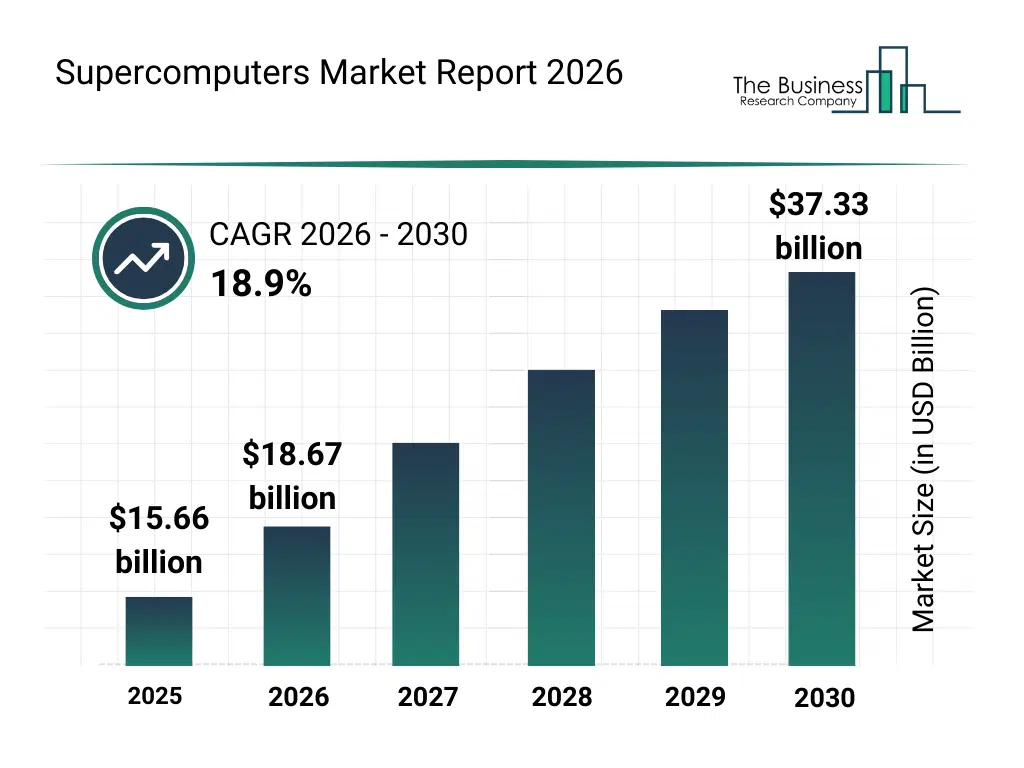
- The global supercomputers market is valued at $15.66 billion in 2025, establishing a strong baseline for future expansion.
- The market is projected to reach $18.67 billion in 2026, reflecting a notable year-over-year growth.
- Between 2026 and 2030, the market is expected to grow at a robust CAGR of 18.9%, indicating rapid industry acceleration.
- By 2027, the market size is estimated to surpass $21 billion, driven by increasing demand for high-performance computing.
- In 2028, the market is projected to grow further to approximately $25.5 billion, fueled by AI and data-intensive workloads.
- The market is expected to reach around $30.5 billion in 2029, highlighting sustained investment in advanced computing infrastructure.
- By 2030, the supercomputers market is forecasted to hit $37.33 billion, marking a more than 2.3× increase from 2025 levels.
- The overall growth trajectory shows a consistent upward trend, with each year adding significant incremental value.
- The increase from $18.67 billion (2026) to $37.33 billion (2030) represents an absolute growth of over $18.6 billion in just four years.
- This rapid expansion underscores the rising importance of AI, big data analytics, and scientific computing in driving supercomputer adoption.
Performance Distribution Across Supercomputer Rankings
- The top 10 systems contribute nearly 35% of total TOP500 computing power, highlighting concentration at the high end.
- Over 60% of systems operate below 1 petaflop, indicating a long performance tail.
- Only 4–5 systems globally exceed 1 exaflop (2025), marking the cutting edge of HPC.
- The median system performance in TOP500 stands at approximately 5–7 petaflops.
- Systems ranked 100–500 show slower growth, with average performance under 3 petaflops.
- The performance gap between rank 1 and rank 500 exceeds 100,000x, reflecting rapid scaling at the top.
- GPU-accelerated systems dominate the top tier, while CPU-only systems remain common in lower tiers.
- Cloud-based HPC systems now represent ~10% of TOP500 entries, indicating distributed performance models.
- Performance density (FLOPS per rack) has improved by over 5x since 2018, enabling compact deployments.
Fastest Supercomputers by Country
- The United States leads with 170+ systems on the TOP500 (2025), accounting for the largest share globally.
- China follows with approximately 130–135 systems, maintaining a strong HPC footprint.
- Japan holds around 30–35 supercomputers, with Fugaku still among the fastest globally.
- Germany operates over 30 systems, boosted by JUPITER Booster entering the top ranks.
- France and the United Kingdom each host 15–20 systems, supporting national research and defense computing.
- India maintains 10–12 systems in the TOP500, with steady investment in HPC infrastructure.
- The U.S. dominates performance share with ~48% of total global compute power, far exceeding system count share.
- European Union countries collectively account for ~20% of total TOP500 systems, showing regional collaboration.
- Emerging economies like Saudi Arabia and Brazil now host at least 1–3 systems each, expanding global HPC reach.
Global Supercomputer Market Share by Region
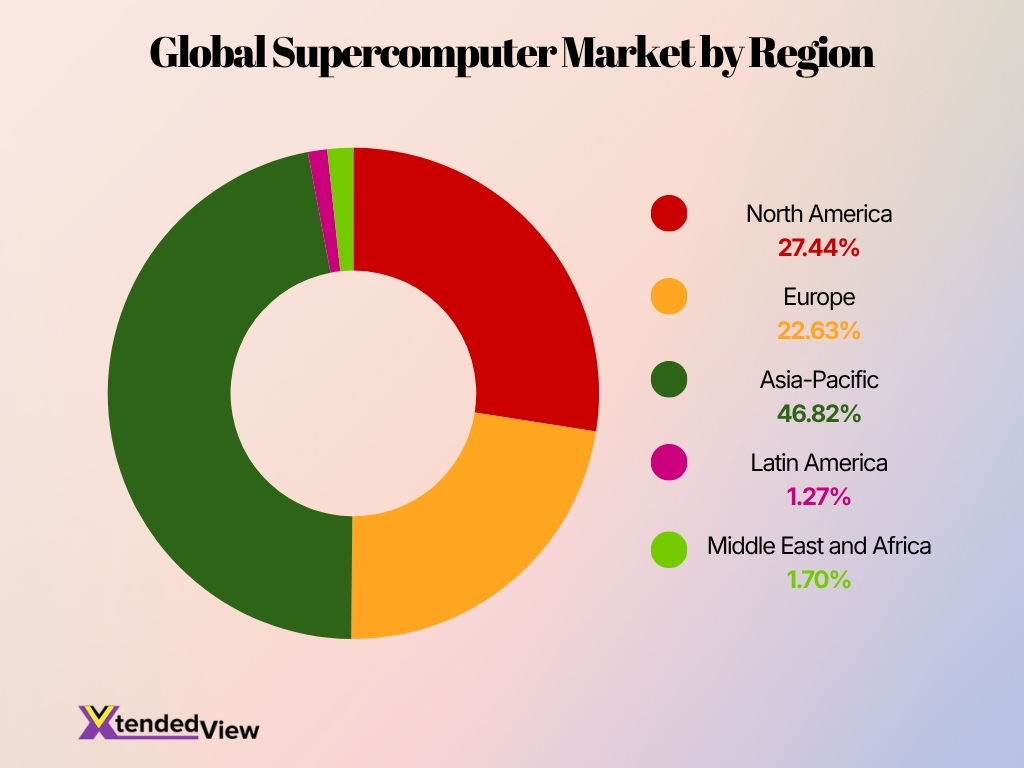
- Asia-Pacific dominates the global market with a leading share of 46.82%, accounting for nearly half of the total market.
- North America holds the second position with 27.44%, representing a significant portion of global supercomputing investments.
- Europe contributes 22.63%, making it the third-largest regional market with strong research and HPC infrastructure.
- The combined share of North America and Europe reaches 50.07%, slightly surpassing Asia-Pacific’s individual dominance.
- Latin America remains a niche market with only 1.27%, indicating limited adoption and infrastructure development.
- The Middle East and Africa account for 1.70%, showing early-stage growth potential in the supercomputing sector.
- The top three regions (Asia-Pacific, North America, Europe) collectively control a massive 96.89% of the global market, highlighting strong regional concentration.
- Emerging regions like Latin America and MEA together contribute just 2.97%, signaling untapped opportunities for future expansion.
- The data reflects a highly concentrated global market, where advanced economies dominate supercomputing capabilities and investments.
Core Counts in Modern Supercomputer Systems
- Leading exascale systems feature over 10 million CPU and GPU cores combined.
- Frontier uses over 8.7 million cores, combining CPUs and GPUs.
- Average core count across TOP500 systems exceeds 250,000 cores per system (2025).
- The number of cores in top systems has increased by ~3x since 2018, driven by parallel processing needs.
- GPU cores now outnumber CPU cores in top 10 systems by a ratio of more than 3:1.
- Mid-tier systems (rank 100–300) typically feature 50,000–150,000 cores.
- Hyperscale AI-focused systems often exceed 1 million GPU cores, optimized for deep learning workloads.
- Core density per node has improved by 2–4x over the last decade, reducing physical footprint.
- Multicore processors now commonly include 64–128 cores per CPU, boosting parallelism.
Peak vs Actual Performance in Supercomputer Systems
- Peak performance (Rpeak) often exceeds actual performance (Rmax) by 10–30% in modern systems.
- Aurora has a peak performance of over 2 exaflops, but delivers lower real-world output.
- Efficiency ratios (Rmax/Rpeak) typically range between 70% and 85% for top systems.
- Older systems show lower efficiency, sometimes below 60% utilization.
- GPU-accelerated architectures achieve higher efficiency compared to CPU-only systems.
- Memory bandwidth and latency constraints often limit actual performance.
- Real-world applications (HPCG benchmark) often achieve less than 5% of peak performance, highlighting bottlenecks.
- Software optimization plays a critical role, with tuned applications improving efficiency by 15–25%.
- Energy constraints also impact achievable performance, especially in exascale systems.
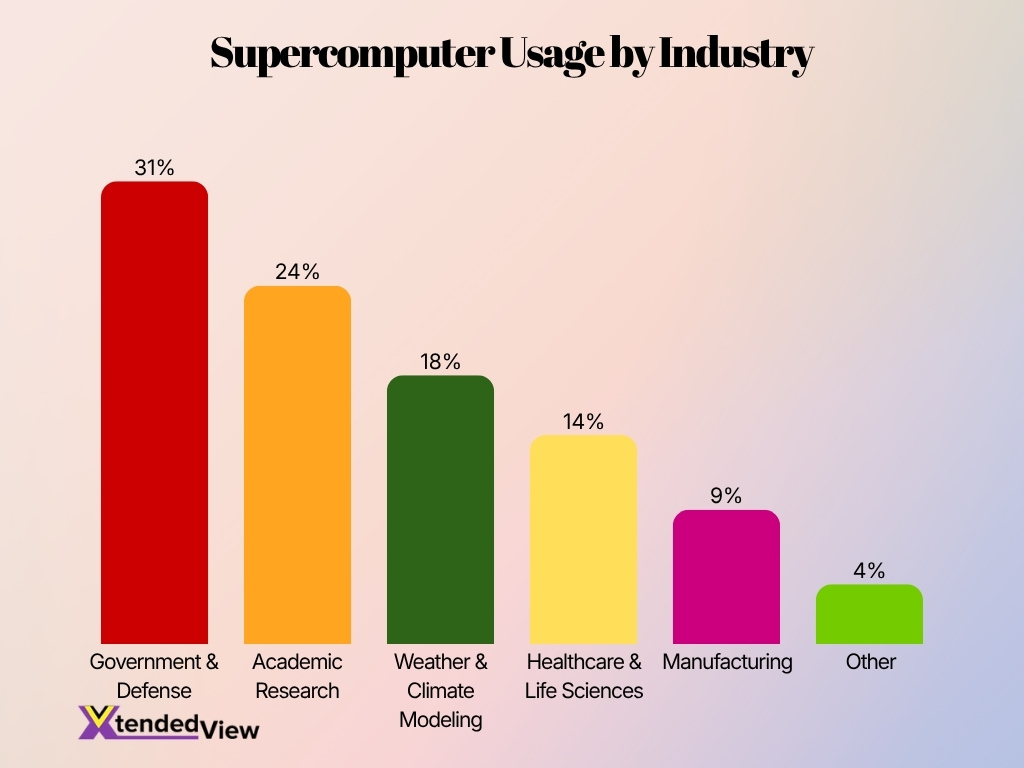
Supercomputer Usage by Industry
- Government & Defense leads with 31%, making it the largest consumer of supercomputing resources, driven by national security, simulations, and advanced research.
- Academic Research accounts for 24%, highlighting the critical role of universities and research institutions in scientific discovery and innovation.
- Weather & Climate Modeling holds 18%, reflecting the growing importance of climate prediction, disaster forecasting, and environmental research.
- Healthcare & Life Sciences contribute 14%, showing how supercomputers are increasingly used for drug discovery, genomics, and medical simulations.
- Manufacturing represents 9%, indicating adoption in product design, engineering simulations, and industrial optimization, though still behind research-focused sectors.
- The “Other” category makes up just 4%, suggesting limited but emerging use cases across smaller industries and niche applications.
- The top three sectors (Government, Academic, and Climate) together account for a dominant 73% share, emphasizing that public sector and research-driven applications dominate supercomputing usage.
- There is a clear skew toward research and public-good applications, with commercial industries still catching up in adoption.
Architecture Trends in Supercomputer Design
- Hybrid CPU‑GPU architectures now underpin over 70% of the Top 100 systems (2025).
- AMD EPYC processors are used in roughly 34% of TOP500 machines, reflecting strong data‑center adoption.
- ARM‑based architectures feature in prominent systems such as Fugaku, which ranks among the top‑10 supercomputers globally.
- NVIDIA GPUs dominate accelerator usage, appearing in over 60% of GPU‑enabled HPC platforms.
- More than 85% of the TOP100 HPC systems now rely on GPU‑accelerated computing, reversing the CPU‑dominant landscape of 2019.
- Modular architectures enable commercial clusters to scale beyond exaflop thresholds, with peak systems exceeding 1.5 exaflops in leading AI‑factory deployments.
- AI‑focused designs integrate tensor cores and mixed‑precision units, achieving up to 10× higher throughput on FP16 and INT8 workloads versus FP64‑only nodes.
- Liquid cooling solutions are deployed in over 40% of top‑tier systems, slashing thermal design power density by 30–50% compared with air‑cooled racks.
- High‑speed interconnects such as NVIDIA InfiniBand and Slingshot now link over 70% of the Top 10 supercomputers, sustaining multi‑terabit‑per‑second bisection bandwidth.
- Edge‑HPC clusters are emerging, with more than 15% of new mid‑tier deployments targeting localized AI inference and real‑time simulation workloads.
Operating Systems Used in Supercomputer Environments
- Linux powers 100% of the TOP500 supercomputers worldwide since November 2017.
- Red Hat Enterprise Linux holds 43.1% market share in enterprise Linux servers for HPC.
- SUSE Linux Enterprise commands 11.2% share in HPC manufacturing sectors.
- Slurm dominates HPC schedulers, powering the majority of the world’s largest supercomputers.
- Containerization, like Singularity, is used in ~60% of HPC centers surveyed.
- The United States operates 172 (34.4%) of the TOP500 Linux supercomputers.
- NVIDIA accelerators equip 211 (42%) of TOP500 systems.
- OS optimizations boost HPC performance efficiency by 10–20%.
Interconnect Technologies in Supercomputer Networks
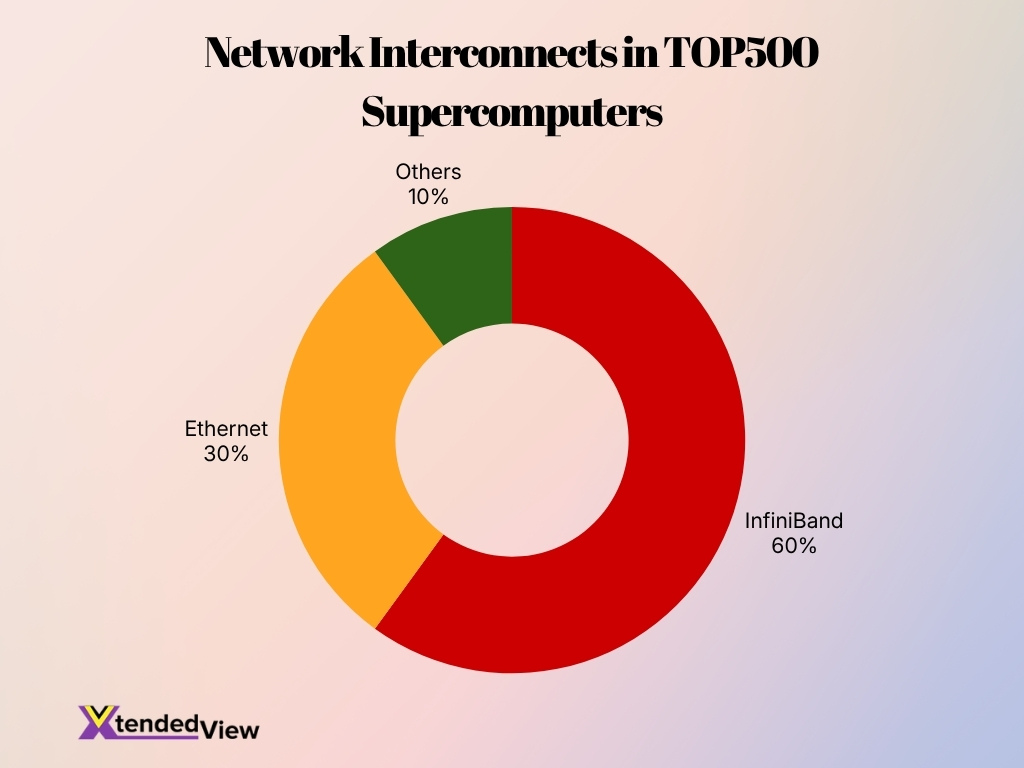
- InfiniBand is used in over 60% of TOP500 systems, making it the dominant interconnect.
- Ethernet-based interconnects account for 30% of systems, especially in lower tiers.
- HPE Slingshot technology powers systems like Frontier.
- High-speed interconnects now support bandwidths exceeding 400 Gbps per link.
- Latency improvements of over 50% in the past decade enable faster node communication.
- Dragonfly and fat-tree topologies are common in modern HPC networks.
- Network scalability allows systems to connect millions of cores efficiently.
- Optical interconnects are emerging to support next-gen exascale and beyond systems.
- Network performance directly impacts application scaling and efficiency in large workloads.
Accelerators and GPUs in Supercomputer Systems
- GPUs are used in over 55% of TOP500 systems (2025), showing widespread adoption.
- NVIDIA accelerators dominate, present in over 70% of GPU-enabled systems.
- AMD GPUs power systems like Frontier and El Capitan.
- GPU-accelerated systems account for all the top 10 supercomputers globally.
- Accelerators improve performance efficiency by up to 5–10x compared to CPU-only systems.
- AI workloads have driven GPU adoption, with over 80% of AI-focused HPC systems using GPUs.
- Specialized accelerators are used in select HPC and AI clusters, though less common than GPUs.
- Mixed-precision computing using tensor cores boosts AI performance significantly.
- GPU memory bandwidth now exceeds 3 TB/s in high-end systems, supporting data-intensive workloads.
Energy Efficiency in Supercomputer Operations
- The Green500 list ranks systems by FLOPS per watt, emphasizing energy efficiency.
- Leading systems achieve over 60 gigaflops per watt (2025), a major improvement over past generations.
- Energy consumption for top systems can exceed 20–30 megawatts, comparable to small cities.
- Liquid cooling is used in ~40–50% of high-performance systems, reducing energy waste.
- Power efficiency has improved by over 15x since 2010, driven by hardware innovation.
- Data center cooling accounts for 30–40% of total energy use, making optimization critical.
- Renewable energy integration is increasing, with several HPC centers targeting 100% clean energy usage.
- Energy-aware scheduling can reduce power consumption by 10–20% without impacting performance.
- Efficiency gains are essential to scaling beyond exascale due to power and thermal constraints.
Supercomputer Vendor Market Share
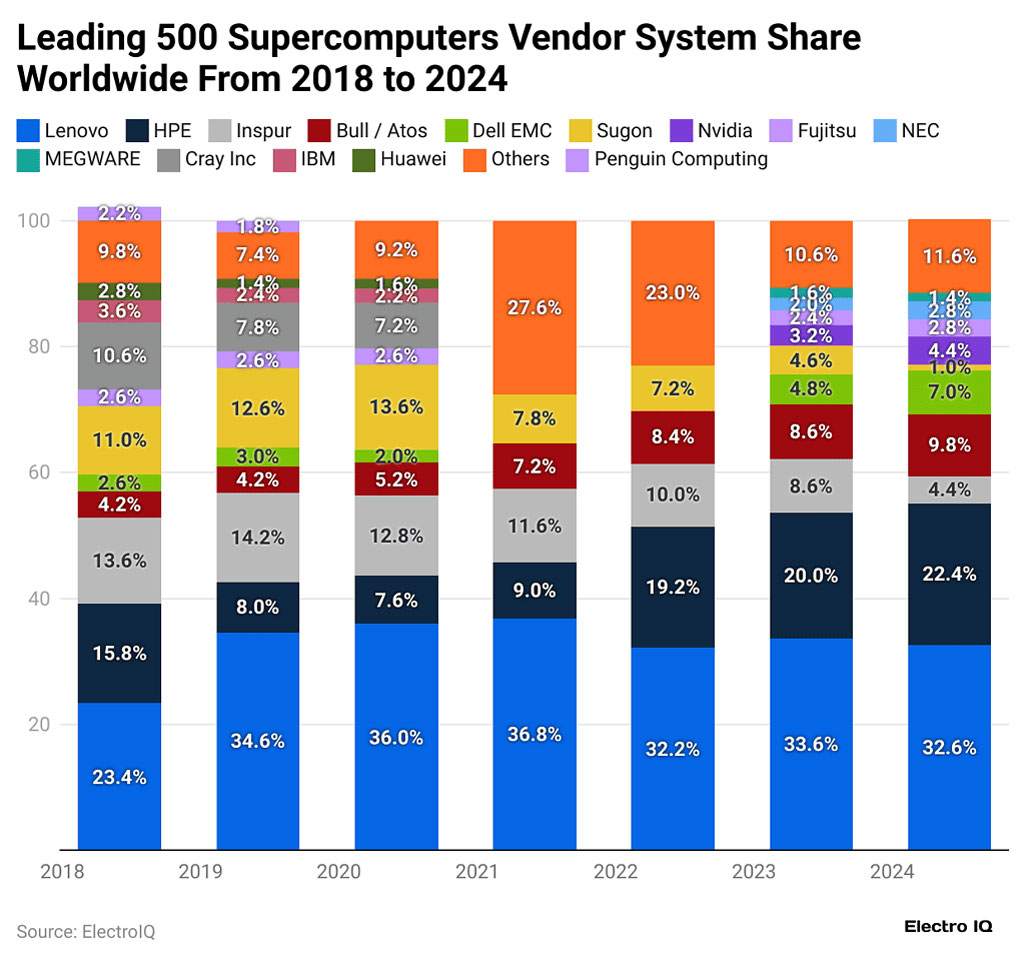
- Lenovo dominated the market, maintaining the #1 position throughout 2018–2024, peaking at 36.8% in 2021 and stabilizing at 32.6% in 2024.
- HPE showed strong growth momentum, rising from 8.0% in 2019 to 22.4% in 2024, making it the second-largest vendor globally.
- Inspur experienced a consistent decline, dropping from 14.2% in 2019 to just 4.4% in 2024, indicating a major loss in market presence.
- Bull / Atos steadily expanded its share, increasing from 4.2% in 2018 to 9.8% in 2024, nearly doubling over the period.
- Dell EMC rebounded strongly, growing from 2.0% in 2020 to 7.0% in 2024, after a minimal presence in 2021–2022.
- Sugon peaked at 13.6% in 2020, but saw a sharp decline afterward, becoming negligible by 2024.
- The “Others” category surged significantly, reaching 27.6% in 2021 and 23.0% in 2022, indicating market fragmentation and emerging players.
- NVIDIA entered the market later but scaled quickly, growing to 4.4% share in 2024, highlighting the rise of GPU-driven supercomputing.
- Fujitsu maintained a stable niche presence, hovering around 2.6%–2.8% across most years.
- NEC and MEGWARE emerged recently, reaching 2.8% and 1.4% respectively in 2024, signaling new competitive entrants.
- Cray Inc declined sharply, from 10.6% in 2018 to disappearing after 2020, largely due to acquisition by HPE.
- IBM’s share diminished, falling from 3.6% in 2018 to negligible levels after 2020.
- Huawei showed an early presence but weakened over time, dropping from 2.8% in 2018 to 1.0% in 2024.
- Overall, the market shows a shift from traditional vendors to diversified and GPU-focused players, especially post-2021.
- The period 2021–2022 marks a structural shift, with a higher “Others” share and vendor reshuffling, indicating rapid technological and geopolitical changes in the supercomputing industry.
Exascale Advancements in Supercomputer Development
- Exascale systems perform over 1 quintillion calculations per second (10¹⁸ FLOPS).
- The U.S. leads with three exascale systems, Frontier, Aurora, and El Capitan.
- Europe entered the exascale race with JUPITER Booster.
- Exascale computing enables simulations at unprecedented resolution, especially in climate science and genomics.
- Memory capacity in exascale systems exceeds 10 petabytes, supporting large datasets.
- These systems integrate millions of cores and thousands of GPUs, requiring advanced orchestration.
- Development costs for exascale systems often exceed $500 million per installation.
- AI and machine learning workloads are a primary driver of exascale adoption.
- Future roadmaps target zettascale computing (10²¹ FLOPS) within the next decade.
Frequently Asked Questions (FAQs)
The fastest system, El Capitan, delivers about 1.742 exaflops (1.742 quintillion calculations per second) on the LINPACK benchmark.
The United States accounts for roughly 48.4% of total global supercomputing capacity.
The U.S. leads with approximately 171 supercomputers in the TOP500 rankings as of 2025.
The TOP500 list is published twice annually, once in June and once in November.
Performance has grown by over 1,000,000 times from gigaflops in 1993 to exaflops in 2025.
Conclusion
Supercomputing continues to push the boundaries of what machines can achieve, moving rapidly from petascale to exascale and beyond. These systems now sit at the core of breakthroughs in AI, healthcare, energy, and climate science, enabling faster insights and more accurate predictions. As hardware innovation, energy efficiency, and global investments accelerate, the next decade will likely redefine computing limits, making it essential to track the data behind these powerful systems.
