



Operating systems power nearly every connected device, from smartphones and laptops to enterprise servers and embedded systems. Their market share shapes software development, cybersecurity priorities, and hardware purchasing decisions across industries. For example, app developers prioritize Android and iOS compatibility to reach the largest mobile audiences, while enterprises evaluate Windows, Linux, and macOS adoption when planning IT infrastructure and security strategies. Explore the latest operating system statistics to understand how user preferences, market dynamics, and platform innovations continue to reshape the global technology landscape.
Editor’s Choice
- Android remained the world’s largest operating system, accounting for 36.2% of all connected devices globally in June 2026.
- Windows ranked second with a 26.7% global operating system share across all device categories in June 2026.
- iOS held approximately 16.6% of the worldwide operating system market during the same period.
- Apple operating systems collectively represented more than 7.7% of worldwide operating system usage when combining OS X and macOS figures.
- Android and iOS together controlled over 99% of the global mobile operating system market entering 2026, leaving only a fraction for all other platforms.
- Windows 11 adoption accelerated significantly during early 2026 as organizations and consumers upgraded devices ahead of Windows 10 support milestones.
- Mobile operating systems now account for the majority of global internet activity, reflecting the continued shift from desktop computing to smartphones.
Recent Developments
- Microsoft continued driving Windows 11 adoption through AI-enabled PCs and ongoing migration from Windows 10 during 2025–2026.
- Windows 11’s desktop share climbed to more than 72% among Windows installations by early 2026, according to web usage measurements.
- Windows 10 usage declined rapidly as organizations prepared for the end of mainstream support, accelerating enterprise migration projects.
- Android maintained its position as the leading mobile operating system despite slowing smartphone shipment growth in several global markets.
- Apple improved its iPhone shipment outlook for 2026 compared with earlier forecasts because of stronger-than-expected demand in premium markets.
- AI integration became a key competitive focus across desktop operating systems, with vendors expanding built-in productivity and automation capabilities throughout 2025 and 2026.
- Developers increasingly optimized applications for cross-platform compatibility as Android, Windows, iOS, Linux, and macOS ecosystems continued to overlap across devices.
- Security enhancements, privacy controls, and on-device AI processing emerged as leading operating system priorities across both mobile and desktop platforms during 2025–2026.
Operating System Market Share Worldwide
- Android remains the largest operating system worldwide, accounting for 41.39% of the global market share, highlighting its continued dominance across smartphones and other mobile devices.
- Windows ranks second with a 27.67% market share, maintaining a strong position as the leading desktop operating system worldwide.
- iOS holds 19.68% of the global operating system market, making it the third most widely used operating system and the second largest mobile platform.
- OS X represents 4.75% of the worldwide operating system market, reflecting its continued usage across legacy Apple desktop and laptop devices.
- macOS accounts for 2.96% of the global market, demonstrating Apple’s steady presence in the personal computer ecosystem.
- Linux captures 2.94% of the worldwide operating system market, underscoring its importance across enterprise, server, and developer environments despite its relatively small consumer share.
- The top three operating systems, Android, Windows, and iOS, collectively account for 88.74% of the global operating system market, indicating a highly concentrated competitive landscape.
- The remaining platforms, OS X, macOS, and Linux, together contribute 10.65% of the worldwide market, serving specialized desktop, enterprise, and professional user segments.

Mobile Operating System Market Share
- Android held a 70.6% share of the worldwide mobile operating system market during early 2026.
- Apple’s iOS accounted for 28.7% of the global market, making the mobile ecosystem a two-platform environment.
- Android and iOS together controlled 99.3% of all global smartphone operating system usage.
- Legacy platforms like Windows Phone and BlackBerry OS have disappeared, showing 0% mainstream usage.
- Android maintained its leadership with 3.9 billion active devices across all global smartphone tiers.
- Apple’s iOS dominated the premium smartphone segment by capturing 64.2% of global app revenue.
- US teen preference for iOS hit 87% as competition shifted toward AI features and ecosystem integration.
- Mobile operating systems supported billions of users by facilitating over 142 billion total app downloads.
Desktop Operating System Market Share
- Microsoft Windows remained the leading desktop operating system with approximately 60.8% global market share as of 2026.
- Desktop Mac operating systems accounted for roughly 14.4% of worldwide desktop usage.
- Desktop Linux reached approximately 3.2% of the global desktop operating system market.
- ChromeOS represented about 1.6% of worldwide desktop operating system usage.
- Windows 11 adoption accelerated throughout late 2025 and early 2026 as more users upgraded compatible PCs.
- Windows 10 usage continued declining as Microsoft encouraged migration ahead of support deadlines.
- Enterprise refresh cycles and AI-capable PCs contributed to stronger desktop operating system upgrade activity during 2026.
- Desktop operating system competition increasingly emphasizes productivity, security, AI integration, and cross-device experiences rather than traditional interface improvements alone.
Tablet Operating System Market Share
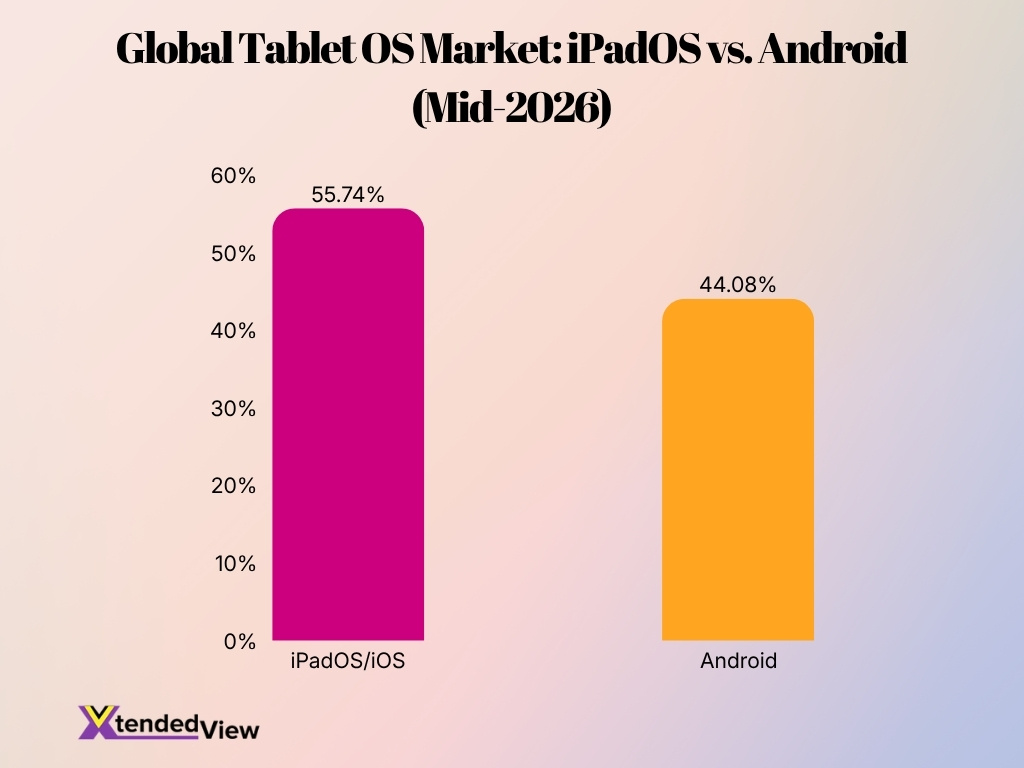
- In a near-even duopoly, iPadOS/iOS and Android account for more than 99% of worldwide tablet usage.
- As of mid-2026, Apple’s iPadOS led the global tablet market with 55.74% usage.
- Android follows closely, holding a 44.08% share of the worldwide tablet market.
- While significant in other sectors, Windows maintains a minor presence on tablets, estimated at near 0% globally.
- In India, Android dominates the tablet OS market with a 68.9% share as of 2025.
- Conversely, iOS holds 21.7% of the Indian tablet market, anchoring the premium segment.
- The Windows tablet market in India is projected to be the fastest-growing OS segment, with an estimated ~9.45% CAGR through 2034.
- Overall tablet usage remains a small fraction of total device usage in India, holding just 0.57% compared to mobile and desktop.
Operating System Market Share by Device Type
- Across desktop, mobile, and tablet devices, Android held 36.22% of worldwide operating system activity in June 2026. Windows followed with 26.68%, while iOS accounted for 16.62%.
- Mobile devices continued to favor Android. The platform controlled about 70% of global mobile activity entering 2026, compared with roughly 29% for iOS.
- Windows remained the largest desktop platform. However, its worldwide desktop share fell to 56.55% in June 2026, down from 63.60% in April 2026.
- Apple operating systems had a stronger position on tablets than on desktop computers. iPadOS and iOS represented approximately 52% of worldwide tablet activity, while Android held about 48%.
- In the US desktop market, Windows accounted for 53.33% of activity in June 2026. OS X and macOS jointly represented 30.16%, showing Apple’s stronger domestic desktop position.
- Linux captured 5.71% of US desktop activity in June 2026, nearly double its 2.99% worldwide desktop share recorded in April 2026.
- ChromeOS represented 2% of US desktop usage and 2.01% across North America in June 2026. Its position remained concentrated in education and browser-centered computing.
- Device type strongly affects platform leadership. Android leads mobile devices, Windows leads desktops, and Apple maintains a narrow worldwide advantage in tablets.
Operating System Market Share by Region
- In Asia, Android led with 45.83% of operating system activity in June 2026. Windows held 22.50%, while iOS accounted for 13.13%.
- Asia’s Android share exceeded the worldwide average by 9.62 percentage points in June 2026, reflecting the region’s large base of mobile-first users.
- In Europe, Windows ranked first at 32.04% in June 2026, followed by Android at 28.51% and iOS at 18.68%.
- Europe showed a more balanced Windows-Android market than Asia. Only 3.53 percentage points separated the two leading operating systems in June 2026.
- North America’s desktop market remained more favorable to Apple than the worldwide market. OS X and macOS combined for 29.39% of regional desktop activity in June 2026.
- Windows controlled 53.84% of North American desktop activity in June 2026, compared with 53.33% in the US alone.
- Linux represented 2.47% of all-device activity in Europe in June 2026. Its share exceeded the corresponding 1.50% recorded across Asia.
- Apple’s iOS share reached 18.68% in Europe, 5.55 percentage points above its 13.13% share in Asia. This difference points to regional variation in income, handset pricing and ecosystem preference.
Operating System Market Share by Country
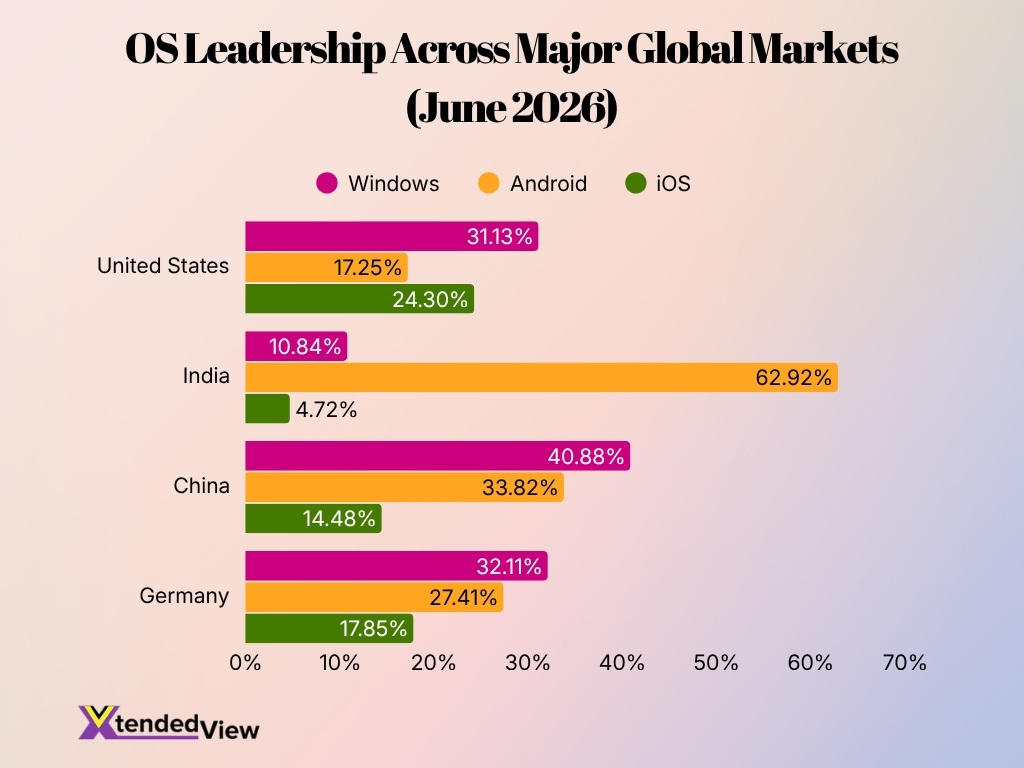
- In the US, Windows held 31.13% of operating system activity across all devices in June 2026. iOS followed with 24.30%, while Android represented 17.25%.
- Apple’s desktop systems reached a combined 17.60% of US all-device activity when OS X and macOS shares were added together.
- India remained heavily mobile-first. Android accounted for 62.92% of all-device activity in June 2026, while Windows held 10.84%.
- India’s iOS share stood at 4.72%, more than 20 percentage points below the 24.30% recorded in the US.
- In China, Windows led at 40.88% in June 2026. Android followed at 33.82%, while iOS held 14.48%.
- Windows controlled 79.31% of China’s desktop market in June 2026. Apple’s OS X and macOS platforms jointly accounted for 7.72%.
- In Germany, Windows represented 32.11% of all-device activity, ahead of Android at 27.41% and iOS at 17.85% in June 2026.
- In France, Android led with 33.13% in June 2026. Windows followed closely at 31.18%, creating a gap of only 1.95 percentage points.
- The leading platform differed across major markets: Windows ranked first in the US, China and Germany, Android led India and France, and Apple held its strongest relative position in the US.
Operating System Usage by Version
- Windows 11 surpassed Windows 10 in 2025, reaching 52% of measured Windows desktop activity, compared with 44.59% for Windows 10.
- Windows 11’s share rose from 50.73% in December 2025 to 62.41% in January 2026, a gain of 11.68 percentage points in one month.
- Windows 11 then reached 72.78% in February 2026, adding another 10.37 percentage points from January.
- Windows 10 fell to 26.27% of measured Windows installations in February 2026. The shift followed its end-of-support date on Oct. 14, 2025.
- The combined share of older Windows editions, including Windows 7, Windows 8, Windows 8.1 and Windows XP, had dropped to roughly 1% by February 2026.
- Windows 11 had passed 400 million active devices by 2023, roughly two years after release. Windows 10 reached the same level in about one year, showing Windows 11’s initially slower adoption.
- Version fragmentation remains more pronounced on Android because manufacturers and carriers control many update schedules. By contrast, Apple distributes iOS and iPadOS updates directly to supported devices.
- Version-level web measurements can change sharply when analytics systems revise device identification. Therefore, month-to-month shifts should inform trend analysis rather than serve as exact installed-base counts.
Operating System Adoption Trends
- Android’s worldwide all-device share stood at 36.21% in June 2026, making it the most-used operating system measured through web activity.
- Windows represented 26.67% of global all-device activity in June 2026. Its position reflects desktop leadership but limited presence in smartphones and tablets.
- iOS accounted for 16.62% of worldwide activity in June 2026, giving Apple a strong mobile position despite Android’s wider range of manufacturers and prices.
- Windows 11 adoption accelerated after Windows 10 support ended. Its measured Windows share increased by 22.05 percentage points between December 2025 and February 2026.
- Android’s Asian share declined from 47.13% in January 2026 to 45.83% in June, while Windows fell from 27.58% to 22.50%. Unidentified traffic increased during the period, so the shift does not necessarily represent direct platform switching.
- Europe’s Android share moved from 29.16% in April to 28.51% in June 2026, while Windows declined from 33.11% to 32.04%.
- Apple’s iOS share in Europe fell from 20.30% in April to 18.68% in June 2026, a decline of 1.62 percentage points over two months.
- Linux reached 5.71% of the US desktop market in June 2026. This level suggests gradual adoption among developers, technical users and people seeking alternatives to commercial desktop systems.
- Operating system adoption increasingly depends on hardware eligibility, security support, application compatibility and ecosystem integration. Windows 11’s hardware requirements and Windows 10’s support deadline illustrate how these factors can speed up or delay migration.
Operating Systems Market Size Statistics
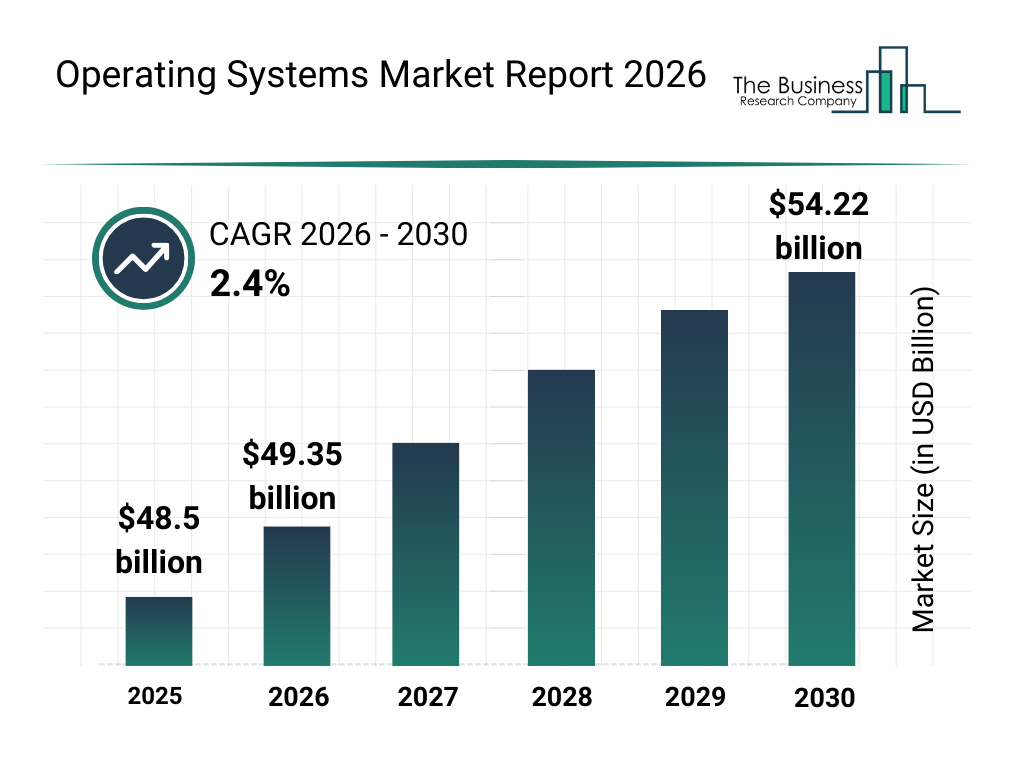
- The global operating systems market was valued at $48.5 billion in 2025 and is projected to reach $49.35 billion in 2026, reflecting steady year-over-year growth.
- The market is expected to expand at a compound annual growth rate (CAGR) of 2.4% between 2026 and 2030, indicating consistent long-term demand.
- By 2027, the operating systems market is estimated to surpass $50.5 billion, highlighting continued investment in operating system technologies.
- The market is projected to grow to approximately $51.75 billion in 2028, supported by increasing adoption across consumer and enterprise devices.
- In 2029, the market size is estimated to reach nearly $53 billion, demonstrating sustained expansion before the end of the forecast period.
- By 2030, the global operating systems market is forecast to reach $54.22 billion, representing an increase of $5.72 billion compared to 2025.
- Overall, the chart indicates that the operating systems industry will maintain stable and predictable growth throughout the 2025 to 2030 forecast period.
Operating System User Base Statistics
- Windows 11 reportedly surpassed 1 billion users by early 2026, less than five years after its October 2021 release.
- Windows 11 had more than 400 million active devices in 2023, meaning its reported base more than doubled by early 2026.
- Android and iOS together controlled more than 99% of worldwide mobile operating system activity entering 2026. This concentration gives developers access to most smartphone users through two platforms.
- Android’s 36.21% all-device share exceeded Windows’ 26.67% share by 9.54 percentage points in June 2026.
- Apple platforms collectively represented 24.33% of worldwide all-device activity when iOS, OS X and macOS were combined in June 2026.
- In the US, Apple’s iOS, OS X and macOS platforms jointly generated 41.90% of all-device activity in June 2026. Windows and Android together generated 48.38%.
- In India, Android’s 62.92% share was nearly 5.8 times Windows’ 10.84% share, illustrating how mobile-first markets reshape the worldwide operating system user base.
- Linux has maintained 100% representation among the world’s 500 highest-performing supercomputers since 2017. This niche differs sharply from its single-digit desktop share.
- Linux also represented an estimated 63.1% of the global server operating system market, showing that consumer desktop statistics do not capture its importance in infrastructure.
- Web usage, active-device totals, shipments and installed-base estimates measure different behaviors. Therefore, readers should compare figures only when the underlying device category, period and methodology match.
macOS Market Share Statistics
- Apple’s OS X and macOS categories jointly represented 7.71% of worldwide all-device activity in June 2026. OS X accounted for 5.60%, while macOS contributed 2.11%.
- On desktop computers, OS X held 11.89% of worldwide activity in June 2026. The separately reported macOS category held another 4.48%.
- Combined, Apple’s desktop operating systems reached 16.37% of the worldwide desktop market in June 2026. This put the Mac ecosystem well ahead of Linux but behind Windows.
- Apple’s combined desktop share exceeded Linux’s 4.36% share by 12.01 percentage points worldwide in June 2026.
- In North America, OS X held 21.62%, and macOS held 7.77% of desktop activity. Together, they accounted for 29.39% of the regional desktop market.
- Apple’s North American desktop share was approximately 13 percentage points higher than its worldwide desktop share in June 2026.
- In the US all-device market, OS X represented 12.84%, and macOS accounted for 4.76%. Their combined share reached 17.60% in June 2026.
- When iOS, OS X, and macOS are combined, Apple platforms represented 24.33% of worldwide all-device activity in June 2026.
- A 2026 desktop automation benchmark included 676 tasks across 25 macOS applications, with nearly 60% requiring both graphical and command-line interaction. Its best tested configuration achieved a 73.7% first-attempt success rate.
Windows Market Share Statistics
- Windows generated 26.67% of worldwide operating system activity across desktop, mobile and tablet devices in June 2026. It ranked behind Android but ahead of iOS.
- Windows controlled 56.55% of the global desktop market in June 2026. Despite retaining first place, its share fell below 60% during the reporting period.
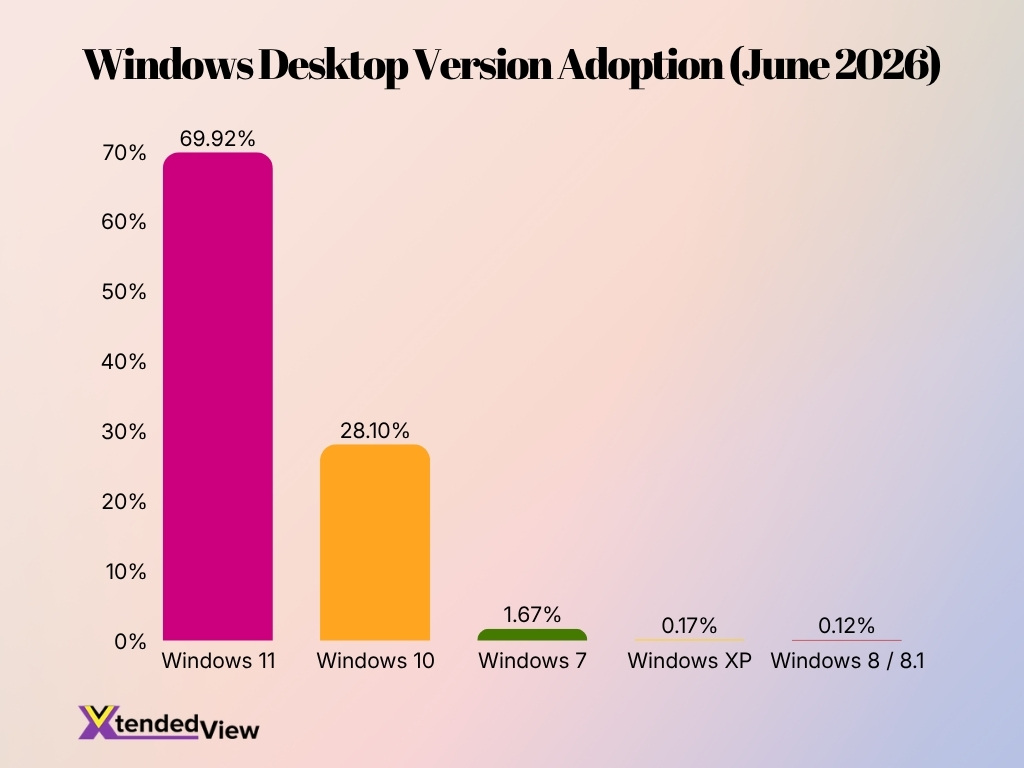
- Windows 11 represented 69.92% of Windows desktop activity worldwide in June 2026. Windows 10 followed with 28.10%.
- Windows 11’s lead over Windows 10 reached 41.82 percentage points in June 2026, showing how quickly users migrated after Windows 10 reached the end of standard support.
- Windows 7 retained 1.67% of Windows desktop activity, while Windows XP accounted for 0.17% in June 2026. These legacy editions remained present despite long-expired support periods.
- Windows 8.1 and Windows 8 jointly represented only 0.12% of measured Windows desktops in June 2026.
- Windows held 53.84% of the North American desktop market in June 2026, slightly below its worldwide desktop position.
- Windows accounted for 31.13% of all-device activity in the US during June 2026, compared with 17.25% for Android and 24.30% for iOS.
- Windows 11 rose from 50.73% in December 2025 to 72.78% in February 2026 in one earlier measurement series. That 22.05-point rise illustrates the speed of post-support migration from Windows 10.
Linux Market Share Statistics
- Linux held 4.36% of worldwide desktop activity in June 2026, compared with 2.99% in an earlier April 2026 measurement.
- Linux exceeded ChromeOS on desktops by 3.15 percentage points in June 2026. ChromeOS accounted for 1.21% of the worldwide desktop market.
- Linux represented 5.52% of North American desktop activity in June 2026, exceeding its global desktop share by 1.16 percentage points.
- Across all device types, Linux reached 2.94% of worldwide activity in July 2026. It ranked close to the separately identified macOS category at 2.96%.
- Linux led the enterprise server market with an estimated 65.72% share in 2025. The same analysis projects a 6.89% compound annual growth rate through 2031.
- Another server operating system forecast projects Linux to capture 63.73% of the market in 2026, confirming its stronger position on servers than consumer desktops.
- Linux powered the systems listed in the November 2025 ranking of the world’s 500 highest-performing supercomputers, including machines running Ubuntu, Rocky Linux and other distributions.
- The November 2025 supercomputer list included 171 US systems, 43 Japanese systems and 40 systems each from Germany and China. Linux supported workloads across this diverse hardware base.
- A 2026 Linux kernel study examined 878 modules across 169 subtrees and identified 586 device-control dispatch points, 1,289 decoded command codes and 3,583 controlled-input sinks. The findings illustrate the scale of Linux’s hardware support and security surface.
Android and iOS Market Share Statistics
- Android controlled 69.11% of worldwide mobile operating system activity in June 2026. iOS accounted for 30.86%.
- Android led iOS by 38.25 percentage points in the worldwide mobile market during June 2026.
- Together, Android and iOS represented 99.97% of measured mobile operating system activity, leaving almost no share for alternative mobile platforms.
- Across every major device category, Android held 36.21% of global operating system activity in June 2026. iOS held 16.62%.
- Android’s all-device share was approximately 2.18 times larger than the iOS share in June 2026.
- The UK showed a different mobile pattern: iOS led with 51.28%, while Android held 48.70% in June 2026.
- Android accounted for 62.92% of all-device activity in India, while iOS represented 4.72% in June 2026. Android’s share was more than 13 times larger.
- In the US, iOS held 24.30% of all-device activity, exceeding Android’s 17.25% share by 7.05 percentage points in June 2026.
- Developers can use Google Play to reach more than 2.5 billion active Android devices, including phones, tablets, watches, cars and televisions.
- A 2026 iOS automation benchmark tested 133 tasks across 26 applications. Its best configuration completed 52% overall, but only 37% of tasks involving multiple apps.
Enterprise Operating System Selection Statistics
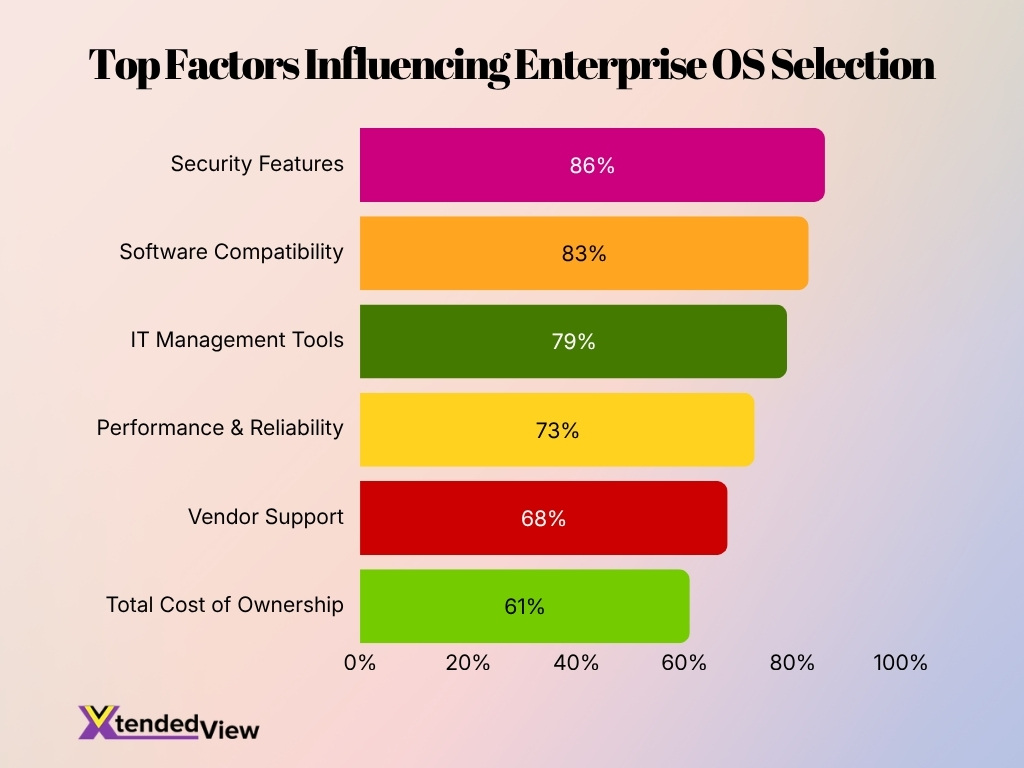
- Security features are the top priority, with 86% of organizations considering them the most important factor when selecting an enterprise operating system.
- Software compatibility ranks second at 83%, highlighting the need for operating systems that seamlessly support existing business applications and workflows.
- 79% of enterprises value IT management tools, reflecting the growing demand for centralized administration, automation, and device management capabilities.
- Performance and reliability influence purchasing decisions for 73% of organizations, emphasizing the importance of stable and efficient operating system performance.
- 68% of businesses consider vendor support a key factor, demonstrating the value of timely updates, technical assistance, and long-term maintenance.
- Total cost of ownership is important to 61% of organizations, showing that licensing, deployment, maintenance, and operational costs remain significant considerations during OS selection.
- The data indicates that security, compatibility, and IT management are the three most influential factors, each being prioritized by nearly four out of five organizations.
- Overall, enterprises increasingly prefer operating systems that deliver strong security, seamless software support, centralized management, and dependable performance, while also balancing long-term operating costs.
Frequently Asked Questions (FAQs)
Android ranked first with 36.21% of worldwide operating system web activity in June 2026, followed by Windows at 26.67% and iOS at 16.62%.
Windows accounted for approximately 72% of worldwide desktop operating system activity in June 2026, while OS X held 15.16% and macOS held 5.71%.
Android held about 69.11% of the worldwide mobile market in June 2026, while iOS represented roughly 30.86%, giving the two platforms almost 100% combined share.
Windows ranked first in the US with 31.13% of operating system activity in June 2026, followed by iOS at 24.30% and Android at 17.25%.
The server operating system market is projected to expand from 33.24 million units in 2026 to 79.10 million units by 2034, representing an 11.40% CAGR.
Conclusion
The global operating system market continues to evolve as mobile computing, artificial intelligence, cloud services, and enterprise digital transformation reshape user preferences and technology investments. Android remains the leading operating system across all connected devices, Windows continues to dominate the desktop environment, Apple maintains a strong position in premium consumer markets, and Linux plays a critical role in servers, cloud infrastructure, and high-performance computing. At the same time, organizations are accelerating migrations to newer operating system versions to improve security, productivity, and compatibility with modern hardware.
These statistics demonstrate that operating system adoption varies significantly by device type, region, and industry, making market share only one part of the broader technology landscape. Whether you are an IT decision-maker, software developer, business leader, researcher, or technology enthusiast, understanding these trends can help you make more informed decisions about platform support, software development, infrastructure planning, and future technology investments.
