


Meta Platforms continues to position Facebook Messenger as one of the world’s largest messaging platforms, serving consumers, brands, and businesses across nearly every market. Companies use Messenger to handle customer support, automate sales conversations, and deliver personalized shopping experiences, while individuals rely on it for messaging, voice calls, and group communication.
As messaging increasingly replaces email and phone calls for everyday interactions, understanding the latest Facebook Messenger statistics can help marketers, businesses, and technology leaders identify where the platform stands today. Explore the data below to see how Messenger continues to shape digital communication.
Editor’s Choice
- Facebook Messenger has approximately 1.3 billion monthly active users worldwide in 2026, keeping its position among the largest messaging platforms globally.
- Users send around 20 billion messages every day through Messenger.
- More than 40 million businesses actively use Messenger for customer interactions and support.
- Messenger hosts more than 300,000 active chatbots, reflecting the platform’s growing automation ecosystem.
- Over 8 billion messages are exchanged each month between businesses and consumers through Messenger.
- Messenger accounts for roughly 30% of global mobile messaging app users, highlighting its broad international reach.
- Users spend an average of 30 minutes per day on Messenger, making it one of the most engaging communication apps within Meta’s ecosystem.
Recent Developments
- In December 2025, Meta officially began shutting down the standalone Messenger desktop application for Windows and Mac, redirecting users to browser-based access through Messenger.com and Facebook.com.
- Meta’s family of apps, including Messenger, reached approximately 3.58 billion daily active people in late 2025.
- Meta reported a decline of around 20 million daily active users across its family of applications during the first quarter of 2026.
- Messenger continues to benefit from Meta’s AI investments, with conversational AI features increasingly integrated into messaging experiences across the platform.
- End-to-end encryption became the default standard for Messenger conversations, strengthening privacy protections for users worldwide.
- Messenger remains among the top messaging applications globally despite rising competition from WhatsApp and Telegram.
- Businesses continue increasing their use of Messenger for customer service because messaging channels often deliver faster response times than email support.
- Messenger’s role within Meta’s broader ecosystem has expanded as private messaging becomes a key engagement driver across social platforms.
Overview of Global Facebook Messenger Statistics
- Facebook Messenger launched in 2011 and has grown into one of the world’s most widely used messaging services.
- The platform now serves approximately 1.3 billion monthly active users globally.
- Messenger ranks among the top three messaging applications worldwide by active users.
- The application supports messaging, voice calls, video calls, group chats, and business communications from a single interface.
- Around 20 billion messages flow through Messenger every day.
- More than 40 million businesses have established a presence on Messenger to communicate with customers.
- Messenger’s ecosystem includes more than 300,000 chatbots, making it one of the largest chatbot environments among social platforms.
- The platform remains deeply integrated with Facebook’s ecosystem, which serves over 3 billion monthly users globally.
- Messenger’s popularity remains particularly strong in North America, Southeast Asia, and Latin America.
Statistics on Monthly Active Facebook Messenger Users
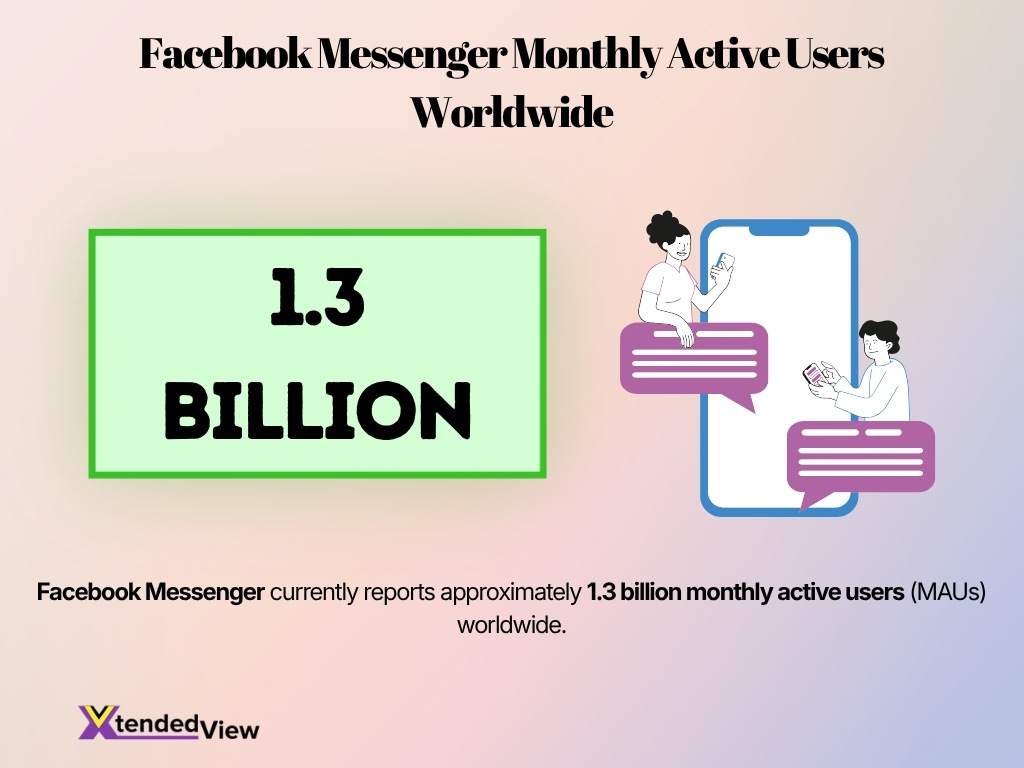
- Facebook Messenger currently reports approximately 1.3 billion monthly active users (MAUs) worldwide.
- Messenger represented around 30% of all mobile messaging app users globally in recent industry estimates.
- The platform remains substantially smaller than WhatsApp, which has surpassed 2 billion monthly active users.
- Messenger’s monthly user base exceeds that of several competing messaging services, including Snapchat and Discord.
- More than one out of every eight people on Earth uses Messenger each month based on current population estimates.
- Messenger benefits from Facebook’s ecosystem of over 3 billion monthly users, giving the app significant cross-platform reach.
- The application consistently ranks among the world’s most downloaded and used communication apps on both iOS and Android devices.
- Despite fierce competition from newer platforms, Messenger has maintained a user base above 1 billion MAUs for nearly a decade.
- Messenger’s scale continues to make it one of the most important channels for customer communication and conversational commerce worldwide.
Statistics on Daily Active Facebook Messenger Users
- Facebook Messenger does not publicly disclose standalone daily active users (DAUs), but industry estimates suggest that between 700 million and 900 million people use the app daily.
- Messenger users collectively send around 20 billion messages every day, indicating extremely high daily engagement.
- More than 2.4 billion messages containing emojis are sent on Messenger every day.
- Meta’s family of apps, including Messenger, reached 3.58 billion daily active people in late 2025, demonstrating the scale of its messaging ecosystem.
- The average Messenger user spends approximately 30 minutes per day on the platform.
- In the United States, adults spend roughly 24 minutes per day using mobile messaging apps, with Messenger remaining one of the leading choices.
- Messenger’s daily activity spikes during weekends and holidays as users increasingly rely on private messaging instead of public social posting.
- More than 8 billion business-to-consumer messages are exchanged every month on Messenger, translating into hundreds of millions of daily interactions.
- Despite increased competition, Messenger continues to maintain one of the largest active messaging audiences in the world.
Growth Trends of Facebook Messenger Users
- Messenger crossed the 1 billion monthly user milestone in 2016 and has continued expanding since then.
- By 2024, Messenger had reached approximately 1.04 billion active users worldwide.
- User numbers climbed further to roughly 1.3 billion monthly active users in 2025 and remained near that level in 2026.
- Messenger’s growth increasingly comes from emerging markets where mobile messaging adoption continues to rise.
- Private messaging has become one of Meta’s fastest-growing engagement areas, benefiting Messenger’s ecosystem.
- Messenger remains one of only a handful of messaging platforms worldwide to surpass 1 billion users.
- The platform’s integration with Facebook allows users to move seamlessly between social networking and direct messaging experiences.
- Business messaging and customer support interactions have emerged as significant growth drivers for Messenger adoption.
- Continued investments in AI and encryption are expected to support Messenger’s long-term engagement trends.
Country-Wise Facebook Messenger Penetration Statistics
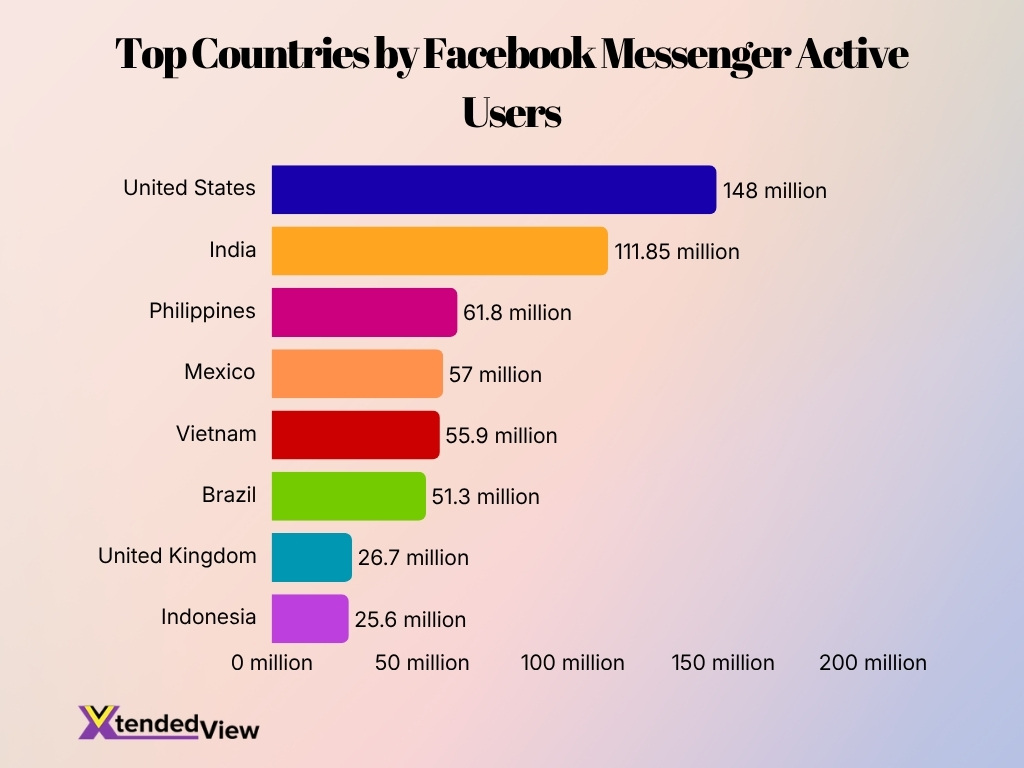
- India holds the highest Messenger ad reach globally with over 111.85 million active users.
- The United States remains a top individual market with approximately 148 million Messenger users.
- The Philippines reports exceptionally high penetration with 61.8 million active Messenger users.
- Mexico leads Latin American engagement with 57.0 million active Messenger accounts.
- Vietnam demonstrates massive adoption in Southeast Asia with 55.9 million Messenger users.
- Brazil maintains a highly engaged presence with 51.3 million active Messenger users.
- The United Kingdom drives European penetration with 26.7 million active Messenger users.
- Indonesia showcases significant platform adoption with 25.6 million active Messenger users.
- South-Eastern Asia dominates global penetration by hosting 212 million active Messenger users.
- Southern Asia accounts for 18% of the global total with 170 million Messenger users.
Market Share of Facebook Messenger Among Messaging Apps
- Facebook Messenger accounts for approximately 30% of global mobile messaging app users.
- Messenger remains the third-largest messaging platform worldwide, trailing only WhatsApp and WeChat in monthly users.
- WhatsApp serves more than 2 billion monthly active users, substantially ahead of Messenger’s 1.3 billion users.
- Messenger’s user base slightly exceeds WeChat’s estimated 1.24 billion users, depending on reporting periods and regional calculations.
- Telegram has approximately 550 million monthly active users, less than half of Messenger’s audience.
- Snapchat’s global user base remains below Messenger, with around 514 million monthly users.
- In the United States, nearly 90% of mobile messaging app users use Facebook Messenger.
- Messenger ranks among the world’s top 10 social and communication apps by active users and engagement.
- The platform continues to hold a dominant position in North America and several developing markets despite increasing competition from encrypted messaging apps.
Regional Facebook Messenger Usage Statistics
- In the United States, Messenger reached 194.8 million active users in 2025, covering 56.6% of the population.
- Brazil and Mexico showcase powerful Latin American adoption with 51.3 million and 57.0 million active users, respectively.
- The Philippines and Vietnam dominate Southeast Asia, where Messenger reaches 79.4% and 76% of all internet users.
- Despite regional competition, Eastern Europe maintains 46.5 million active users, while Western Europe holds 24.8 million.
- Northern Africa alone contributes 68.6 million active users, driving massive growth across the Middle East and Africa.
- Emerging markets remain critical to overall expansion, with India leading the pack at over 109 million active users.
- Conversational customer support thrives in Asia-Pacific, heavily contributing to the 20 billion messages sent between users and businesses monthly.
- Developing market engagement drives high app retention, boosting Messenger’s average global usage time to 3 hours and 18 minutes per user monthly.
- Cross-border communication features help sustain its global rank as the third-largest messaging app worldwide with 1.01 billion active users.
Demographics of Facebook Messenger Users by Age and Gender
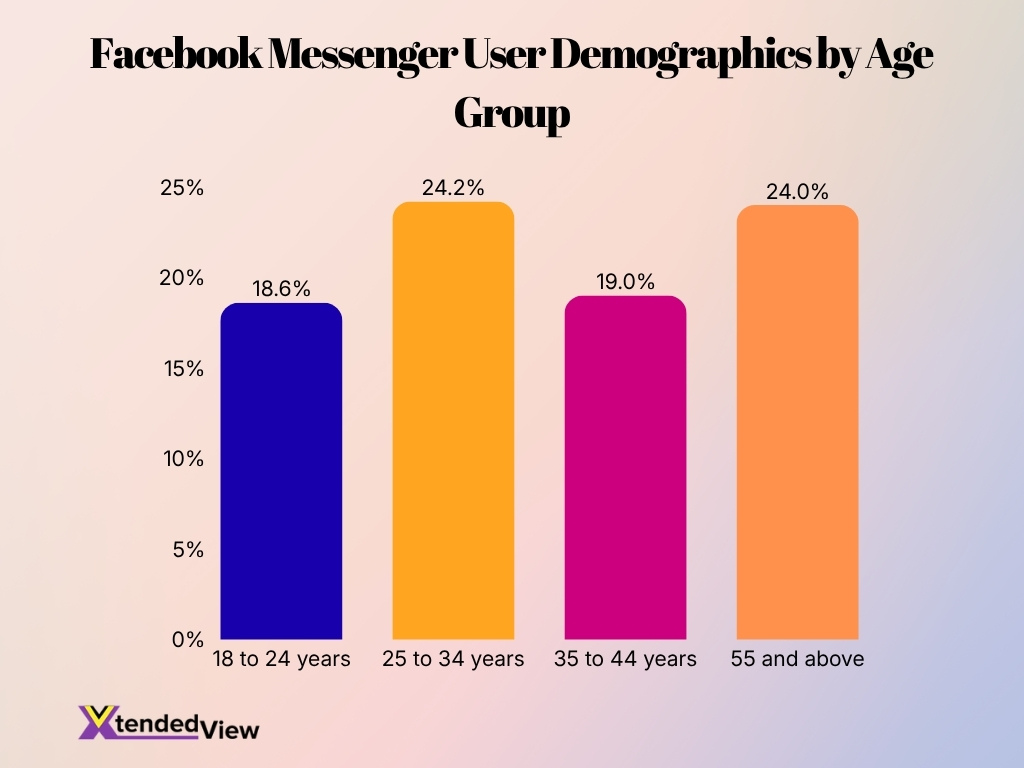
- Adults aged 25 to 34 years form the largest demographic, representing approximately 24.2% of the global audience.
- Users aged 18 to 24 years account for roughly 18.6% of the total user base, making them a major active segment.
- Millennials and Gen Z drive high engagement, contributing significantly to the platform’s 1.01 billion monthly active users.
- The 35 to 44 age group makes up a solid 19% of the audience, heavily using the app for family and community networks.
- Older users aged 55 and above account for nearly 24% of the overall audience, increasingly relying on it for family communication.
- The global gender split skews slightly male, with 55.6% men compared to 44.4% women using the messaging app.
- In the United States, women comprise the majority of the user base at 54.6%, frequently engaging in social communication.
- Men aged 25 to 34 stand out as the single largest segment globally, representing exactly 18.4% of all active users.
- Businesses actively target these demographics, exchanging over 8 billion monthly messages with customers for conversational commerce.
Trends in Facebook Messenger Downloads and Installs
- Between 2010 and 2019, Facebook Messenger ranked as the 2nd most downloaded app globally.
- The messaging platform surpassed 5 billion total downloads strictly on the Google Play Store.
- During 2020, global downloads reached approximately 485 million amid pandemic communication shifts.
- The application continuously expands, adding 10 million new users within a single 3-month period.
- In major expanding markets like India, the platform amassed over 112 million active users.
- During New Year’s Eve, the application recorded twice as many group video chats compared to an average day.
- The messaging tool actively supports an estimated 1.01 billion active monthly users worldwide.
- By 2024, roughly 90% of mobile messaging users in the U.S. regularly utilized the application.
Engagement and Usage Frequency on Facebook Messenger
- Users send approximately 20 billion messages every day on Facebook Messenger, making it one of the world’s busiest communication platforms.
- The average user spends around 30 minutes per day using Messenger features, including chats, calls, and media sharing.
- Messenger users exchange more than 2.4 billion emojis daily, highlighting the platform’s highly interactive nature.
- Around 17 billion photos are shared annually through Messenger conversations.
- Group chats remain one of Messenger’s most-used features, particularly among users aged 18 to 34.
- More than 500 million people use Messenger Stories and related visual-sharing features each month.
- Mobile devices account for the vast majority of Messenger activity, with over 95% of usage occurring on smartphones and tablets.
- Messaging activity typically increases during holidays, major sporting events, and global celebrations as users prefer private communication channels.
- Messenger’s integration with Facebook Groups and Marketplace has significantly increased user engagement and session frequency.
Statistics on Facebook Messenger Voice and Video Calls
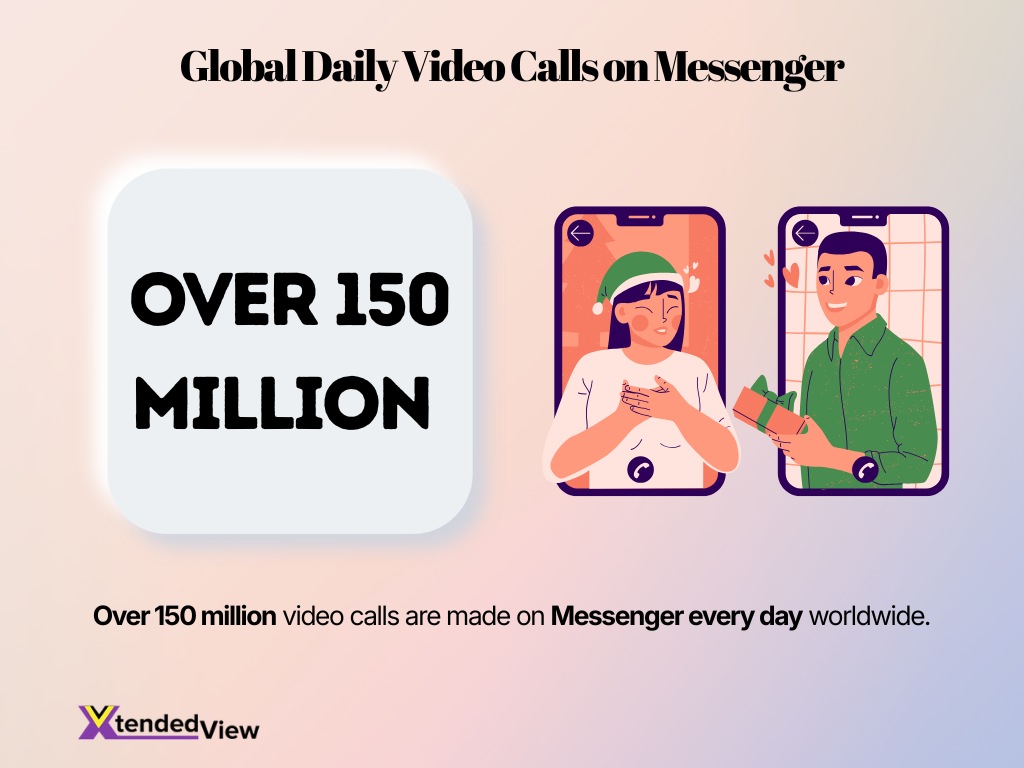
- Over 150 million video calls are made on Messenger every day worldwide.
- Approximately 400 million people use the voice and video chat feature every month.
- Messenger Rooms supports group video calls with up to 50 participants and no time limits.
- The Messenger app accounts for over 10% of all global mobile VoIP calls.
- An hour-long Messenger video call consumes an average of 260 MB of data.
- Voice calls on the platform use roughly 333 KB per minute, totaling 20 MB per hour.
- During the initial pandemic surge, voice and video call volumes more than doubled in several regions.
- Over 700 million accounts participate in voice and video calls daily across Messenger and WhatsApp.
Business and Brand Adoption of Facebook Messenger
- More than 40 million businesses actively use Messenger to communicate with customers worldwide.
- Businesses and consumers exchange over 8 billion messages every month on Messenger.
- Approximately 64% of consumers prefer messaging businesses instead of calling customer service lines.
- Nearly 70% of customers expect companies to provide messaging support channels.
- Messenger has become a key customer support channel for retailers, restaurants, travel companies, and financial institutions.
- Businesses using Messenger often report faster response times and higher customer satisfaction compared with email support.
- Messenger’s integration with Facebook Pages enables brands to automate responses and manage customer interactions at scale.
- Small businesses increasingly use Messenger as a low-cost alternative to traditional customer support software.
- Messenger remains one of the most popular conversational platforms for customer engagement in North America and Southeast Asia.
Marketing and Advertising Statistics on Facebook Messenger
- Messenger ads deliver a 2x higher response rate than traditional landing-page-based ads.
- Marketing campaigns on Messenger achieve 50% to 80% open rates, significantly outperforming email marketing.
- Retargeted users on Messenger are 43% more likely to convert into paying customers.
- Automated chatbots can resolve up to 79% of routine customer queries without needing human intervention.
- Click-to-message ads generate 61% higher revenue per user compared to traditional feed placements.
- Messenger campaigns average impressive 10% to 20% recovery rates for abandoned shopping carts.
- Retargeting campaigns on the platform can achieve a click-through rate of up to 56%.
- Sponsored messages can reduce customer acquisition costs to just $10 to $40 per qualified lead.
- Users spend an average of 19 minutes daily engaging and communicating on the Messenger app.
- Facebook Messenger boasts over 2 billion active users, offering a massive global reach.
Facebook Messenger Advertising Audience by Age and Gender
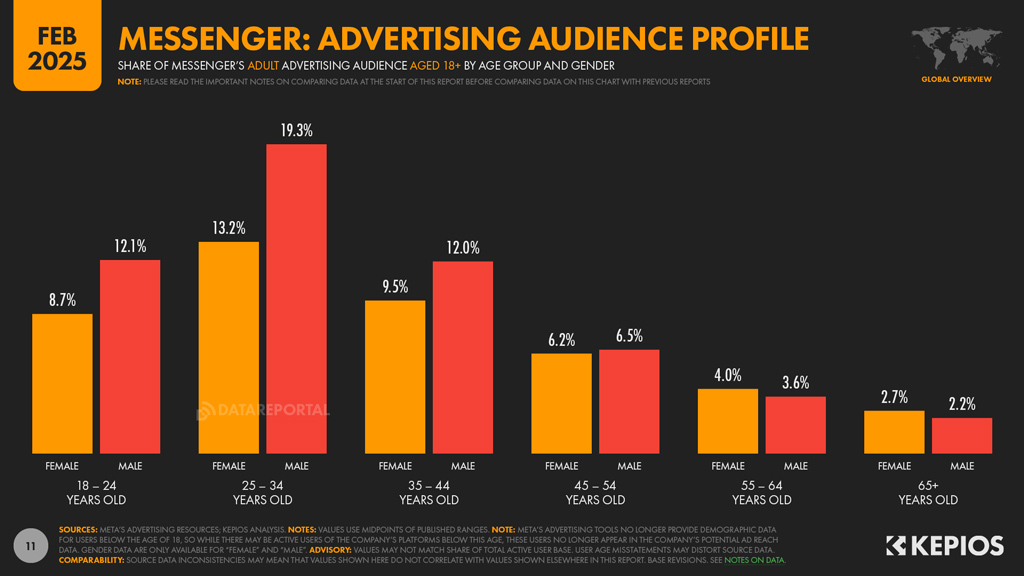
- Men aged 25–34 represent the largest Messenger advertising audience at 19.3%.
- Women aged 25–34 account for 13.2% of Messenger’s global advertising audience.
- The 18–24 age group makes up 12.1% of the audience for men and 8.7% for women.
- Among users aged 35–44, men account for 12.0%, compared to 9.5% for women.
- The 45–54 age segment is nearly balanced, with 6.5% men and 6.2% women.
- In the 55–64 age group, women (4.0%) slightly outnumber men (3.6%).
- The 65+ audience is the smallest demographic, with 2.7% women and 2.2% men.
- Men have a larger advertising audience share than women across the 18–54 age groups.
- Women surpass men only in the 55–64 and 65+ age categories.
- The 25–44 age range represents the largest share of Messenger’s global adult advertising audience across both genders.
Chatbot and Automation Statistics on Facebook Messenger
- Facebook Messenger currently hosts over 300,000 active chatbots globally.
- More than 20 billion messages are exchanged between businesses and users monthly.
- Chatbots can successfully resolve up to 80% of routine customer questions instantly.
- Messenger automation campaigns deliver 10x to 80x better engagement than email.
- Implementing conversational AI helps businesses reduce customer support costs by 30%.
- Approximately 64% of consumers highlight 24/7 availability as the best chatbot feature.
- Companies see conversion rate improvements of 20% or more using proactive bots.
- Around 87.2% of consumers rate their brand chatbot interactions as neutral or positive.
- Chatbots are proven to reduce response times by up to 80% for common inquiries.
Ecommerce and Shopping Trends on Facebook Messenger
- Over 20 billion messages are exchanged between businesses and users monthly on Facebook Messenger.
- Messenger marketing campaigns achieve a 70% better open rate than traditional email marketing.
- Approximately 73.3% of online adults prefer messaging as their primary way to communicate with a business.
- Messaging a business to ask product questions delivers a 91.0% enjoyment rate among consumers.
- Nearly 72.4% of online adults are more likely to purchase from brands that offer messaging.
- Automated abandoned cart recovery campaigns on Messenger achieve a 10% to 20% recovery rate.
- Facebook Messenger messages regularly achieve 3.5X higher revenue per subscriber compared to email.
- Around 77.7% of social shoppers prefer purchasing through Facebook Marketplace over other integrated shops.
- More than 33% of small businesses leverage Facebook platforms to promote and sell products directly.
Comparison of Facebook Messenger and Other Messaging Apps
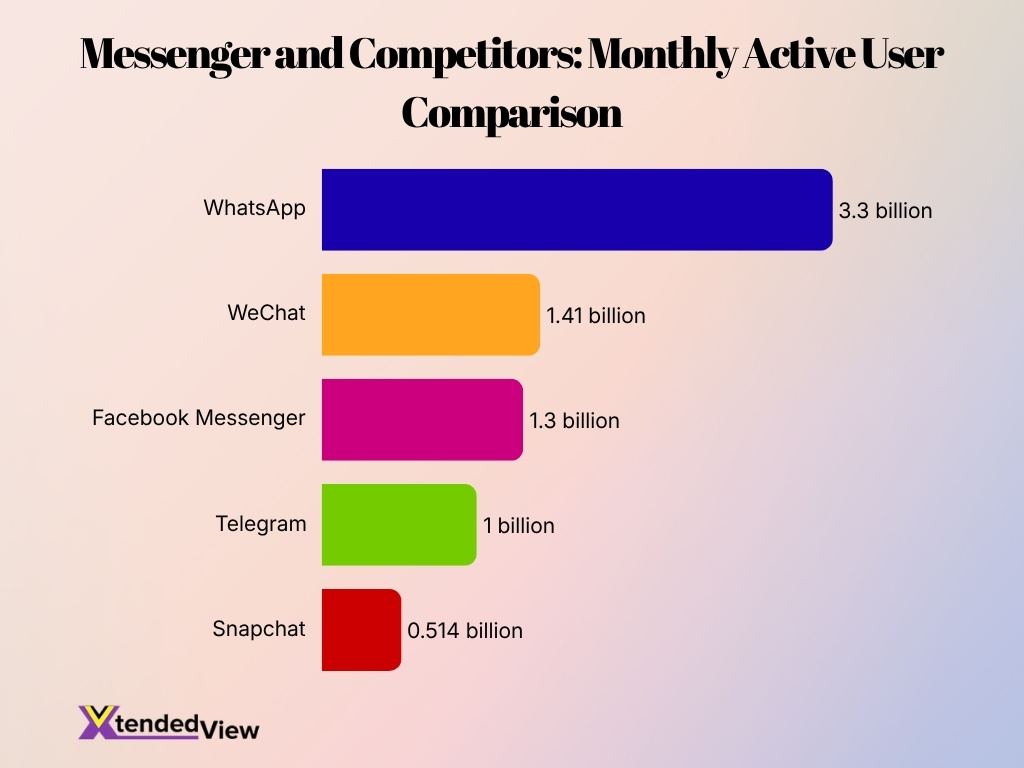
- Facebook Messenger connects the world with approximately 1.3 billion monthly active users.
- WhatsApp currently leads the global messaging landscape with over 3.3 billion monthly active users.
- WeChat rivals its top competitors by actively serving more than 1.41 billion users globally.
- Telegram has grown its privacy-focused platform to surpass 1 billion monthly active users.
- Snapchat commands a highly engaged audience with roughly 514 million monthly active users.
- WhatsApp facilitates massive daily communication by processing over 150 billion messages every single day.
- Facebook Messenger users spend an average of 19 minutes daily interacting on the application.
- Telegram continues its rapid worldwide expansion by registering about 2.5 million new users daily.
- WeChat demonstrates immense daily engagement by controlling 35% of all mobile usage time in China.
Frequently Asked Questions (FAQs)
Facebook Messenger has approximately 1.3 billion monthly active users worldwide in 2026.
Facebook Messenger accounts for around 30% of all mobile messaging app users globally.
More than 8 billion messages per month are exchanged between businesses and consumers through Facebook Messenger.
Over 40 million businesses actively use Facebook Messenger to communicate with customers and prospects.
Facebook Messenger ranks as the third-largest messaging app in the world by monthly active users, behind WhatsApp and WeChat.
Conclusion
Facebook Messenger remains one of the world’s most influential messaging platforms, with approximately 1.3 billion monthly active users and billions of daily interactions. The platform has evolved far beyond personal messaging and now serves as a critical channel for customer support, conversational commerce, and business communication.
Although competition from WhatsApp, Telegram, and other messaging services continues to intensify, Messenger’s integration with Facebook’s ecosystem, its growing automation capabilities, and its extensive business adoption help maintain its global relevance. As messaging increasingly becomes the preferred way for people and brands to communicate, Facebook Messenger is likely to remain a major force in digital engagement and conversational commerce for years to come.
