


Social media platforms dominate how billions connect, share, and interact today. Yet, as usage grows, so does concern about addictive behavior around scrolling, notifications, and endless content feeds. Governments, researchers, and health experts now flag compulsive use as a public health issue with measurable impacts on mental well‑being. From regulatory actions in Europe to rising self‑reported dependency among young adults, the topic carries real‑world consequences in education and workplace productivity. Explore key statistics shaping our understanding of social media addiction below.
Editor’s Choice
- ~210 million people worldwide are estimated to suffer from social media addiction in 2025–2026.
- In the U.S., ~10% of adults, roughly 33 million people, are considered addicted to social media.
- ~82% of Gen Z adults self‑identify as dependent on social platforms.
- ~36% of teens report excessive social media use linked to addiction patterns.
- The average global user spends about 2h20m per day on social media.
- TikTok leads engagement, with users spending 55-60 minutes daily.
- Regulatory actions, such as potential redesign mandates on TikTok in the EU, reflect official acknowledgment of addictive design concerns.
Recent Developments
- European regulators have charged TikTok with violating digital safety standards due to addictive design elements such as infinite scroll and autoplay.
- The EU warns platforms to improve screen time management and parental controls or risk fines.
- Multiple countries, including Spain and Australia, are advancing restrictions on youth social media access for safety.
- Meta’s internal AI enhancements have increased engagement, but also spotlight concerns about algorithm‑driven compulsive use.
- Many U.S. states consider laws limiting youth exposure to addictive social media features.
- Research continues to separate screen time from addictive use, emphasizing compulsive patterns over mere hours online.
- Debate over social media’s legal responsibility for addiction effects continues globally in courts and legislatures.
- Public discourse often frames social media addiction alongside other behavioral health concerns.
Global Prevalence Statistics
- Around 210 million people globally are estimated to be addicted to social media as of 2025–2026.
- That figure represents roughly ~4.7–5% of all social media users worldwide.
- In a review across studies, social media addiction prevalence has ranged from 5% to 31%, depending on methods and region.
- Meta‑analyses show ~18.4% of young adults may meet criteria for social network addiction.
- College student surveys indicate rates as high as 55% in specific subgroups.
- Regions such as Asia report elevated addiction prevalence relative to global averages.
- Global addiction is linked to increased social media access, now at ~5.41 billion users.
- Daily global hours spent on social platforms exceed billions collectively.
US Social Media Addiction by Age Group
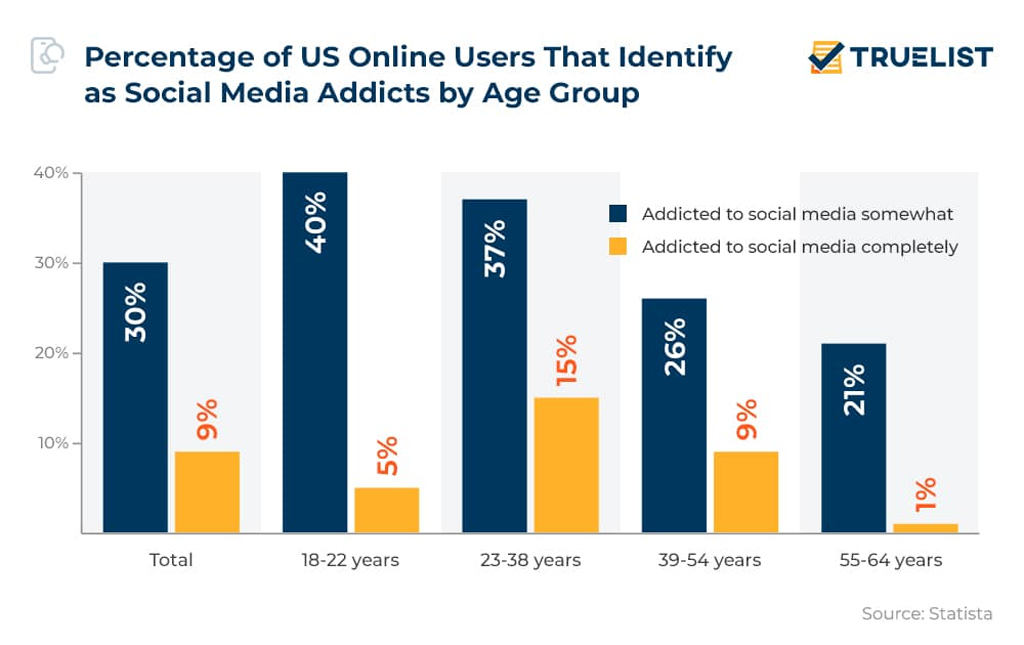
- Overall, 30% of US online users say they are somewhat addicted, while 9% admit being completely addicted to social media.
- Young adults (18–22 years) show the highest moderate dependency, with 40% identifying as somewhat addicted, though only 5% report being fully addicted.
- Users aged 23–38 years report the highest severe addiction rate, as 15% consider themselves completely addicted, alongside 37% who feel somewhat addicted.
- Among middle-aged adults (39–54 years), 26% feel somewhat addicted, while 9% describe themselves as completely dependent on social platforms.
- Older users (55–64 years) show the lowest addiction levels, with just 21% reporting some addiction and only 1% identifying as completely addicted.
- The data highlights a clear age-based decline, showing that social media addiction decreases steadily after the age of 38 years.
- Peak vulnerability appears among users aged 18–38 years, where over 37%–40% experience at least moderate addiction symptoms.
- The contrast between age groups is significant, as 18–22-year-olds are 40× more likely to report addiction than users aged 55–64 years (40% vs 1% in severe cases).
Teen Addiction Statistics
- About 36% of U.S. teens report excessive social media use associated with addiction patterns.
- WHO data shows ~11% of adolescents demonstrate problematic social media behaviour.
- Girls report slightly higher rates of problematic use (13%) vs boys (9%).
- Nearly half of U.S. teens say they are online “constantly”, with social apps a major driver.
- Noneducational screen media usage for teens averages ~5.5 hours daily.
- Addictive use in teens raises risks for mental health issues like depression and anxiety.
- Sleep and focus disruptions are reported by significant shares of teens with heavy social media use.
- Peer‑reported addiction tendencies often influence academic performance negatively.
Young Adult Usage Data
- ~82% of Gen Z adults acknowledge dependency on social media platforms.
- Young adults (18–29) dominate social media engagement globally.
- Average daily social media time globally sits around 2h21m, heavily influenced by young adults.
- In the U.S., ~40% of 18–22‑year‑olds identify addictive use.
- Young adult users typically access multiple platforms daily, exceeding six on average.
- College demographics show up to 60% reporting signs of addiction.
- Digital use associated with social validation correlates strongly with compulsive patterns.
- Young adults report higher anxiety and stress tied to social media dependency than older cohorts.
Gen Z Screen Time
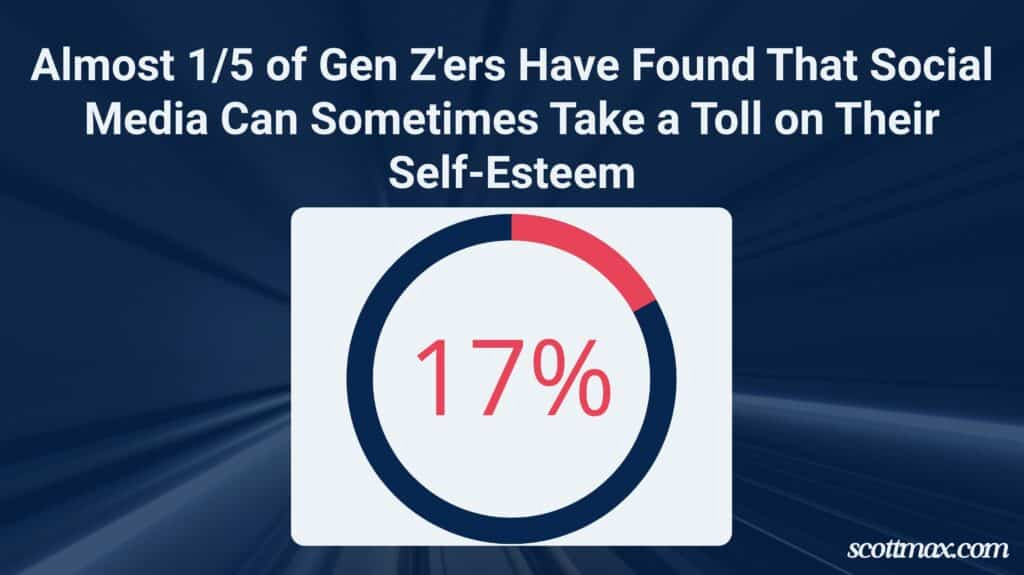
- Almost 1/5 of Gen Zers have found that social media can sometimes take a toll on their self-esteem.
- ~60% of Gen Z individuals report using social media for at least 4 hours daily, with 22% spending 7+ hours per day.
- Nearly 50% of adult Gen Z social media users spend 2–4 hours daily on platforms.
- A broader survey shows 5.1 hours/day on social apps for younger Gen Z (2025 data), up from 4.5 hours in 2023.
- ~82% of Gen Z consider social media “addicting,” and 76% acknowledge dependency on technology.
- ~60% of Gen Z say they spend too much time on social media.
- Roughly 94% of Gen Z find platforms entertaining, signaling high habitual engagement.
- Actions to curb usage show ~42% unfollow, or mute accounts, and ~40% delete apps to cut time online.
- 69% of Gen Z believe their mental health would improve with less mobile phone app usage.
Millennial Habits Overview
- Millennials (born 1981–1996) use social media less than Gen Z but still actively, with heavy engagement on Facebook, Instagram, and TikTok, according to usage surveys.
- In 2025, 84% of U.S. adults reported using YouTube, a favorite platform among millennials, too.
- Instagram use is steady among U.S. adults (50% usage), many of whom are millennials.
- Millennial daily usage often exceeds 2–3 hours, reflecting habitual, if not addictive, patterns.
- Cross‑cohort data indicate that Gen Z spends nearly twice as much time as millennials on social apps daily.
- X daily use shows a gender split with more male engagement, a pattern visible in older cohorts, including millennials.
- Millennial users balance social media with work commitments, but ~38% say they struggle to take breaks from tech, a sign of habitual use.
- Device addiction data show that 41% of 20–29‑year‑olds find it hard to disconnect from technology, including social apps.
Daily Time Spent on Social Media by Age and Gender
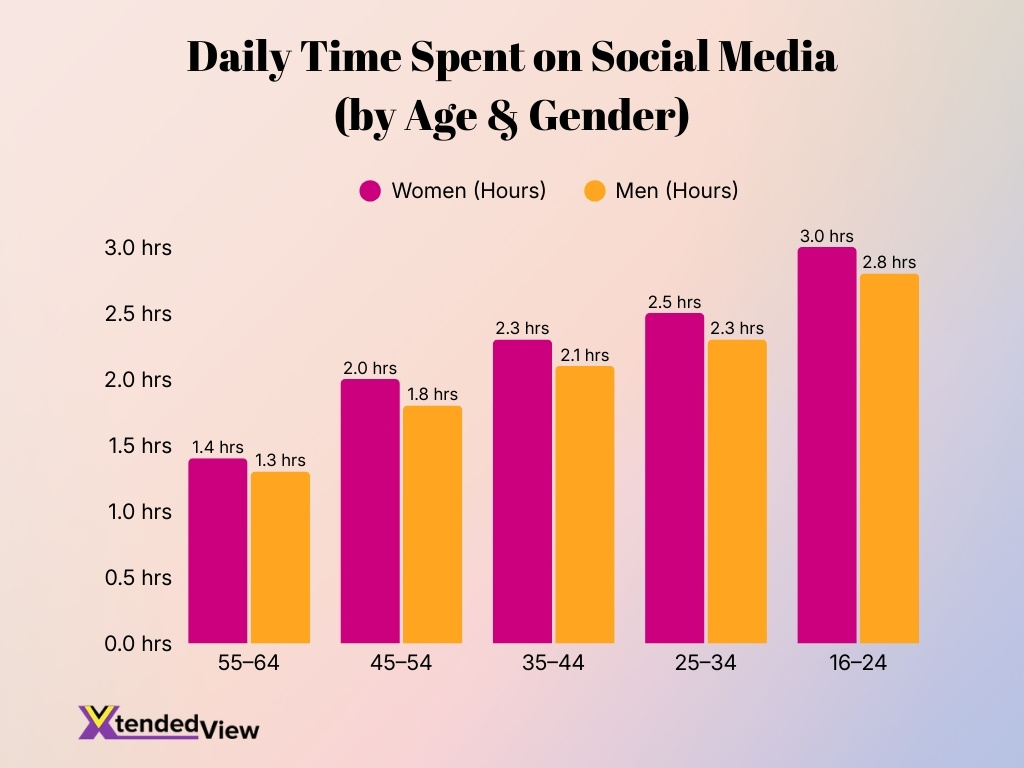
- Young adults (16–24) spend the most time on social media, with women averaging 3.0 hours/day and men 2.8 hours/day, making this the highest-engagement age group.
- Users aged 25–34 also show strong activity, with women spending 2.5 hours/day and men 2.3 hours/day, reflecting heavy daily dependence on social platforms.
- Among adults aged 35–44, average usage remains high, with women at 2.3 hours/day and men at 2.1 hours/day, indicating consistent long-term engagement.
- The 45–54 age group spends moderately less time online, with women using social media for 2.0 hours/day and men for 1.8 hours/day.
- Seniors aged 55–64 record the lowest social media usage, with women averaging 1.4 hours/day and men 1.3 hours/day, showing reduced digital dependency.
- Across all age groups, women consistently spend more time on social media than men, with a gap of 0.1–0.2 hours per day.
- Social media usage shows a clear upward trend among younger generations, rising from 1.3–1.4 hours (55–64) to 2.8–3.0 hours (16–24).
- The data highlights a strong generational shift, where Gen Z and young millennials dominate daily screen time, making them the primary audience for digital platforms and advertisers.
Average Daily Time Spent
- On average, users spend ~2.5–3 hours/day on social media platforms as of 2025–26 research.
- Many users check social media first thing in the morning (61%).
- Teens spend ~4.8 hours daily on social platforms in U.S. studies.
- Gen Z’s typical daily engagement often exceeds 5 hours, reflecting intense habits.
- Daily Instagram users among U.S. adults remain high, with ~50% reporting use.
- A significant number of users (38%) say they cannot go hours without checking feeds.
- Global daily social media time has risen steadily over the last decade.
- Mobile social access accounts for the majority of daily use, often outside traditional work periods.
Mental Health Impacts
- Up to 95% of youth ages 13–17 report using a social media platform.
- More than a third of adolescents use social media almost constantly.
- Adolescents spending more than 3 hours/day on social media face double the risk of depression and anxiety symptoms.
- 41% of teens with the highest social media use rate their mental health as poor or very poor.
- Children/adolescents spending 3+ hours/day on social media face double the risk of mental health problems.
- 10% of high social media users among teens expressed suicidal intent or self-harm in the past year.
- 46% of adolescents aged 13–17 say social media makes them feel worse about their body image.
- 31% of US adolescents show increasing addictive social media use trajectories linked to higher suicidal behaviors.
- 65.8% of school adolescents felt anxious due to social media use.
- 40% of depressed/suicidal youth report problematic social media use with higher depressive symptoms.
Gender Distribution by Region: Key Insights
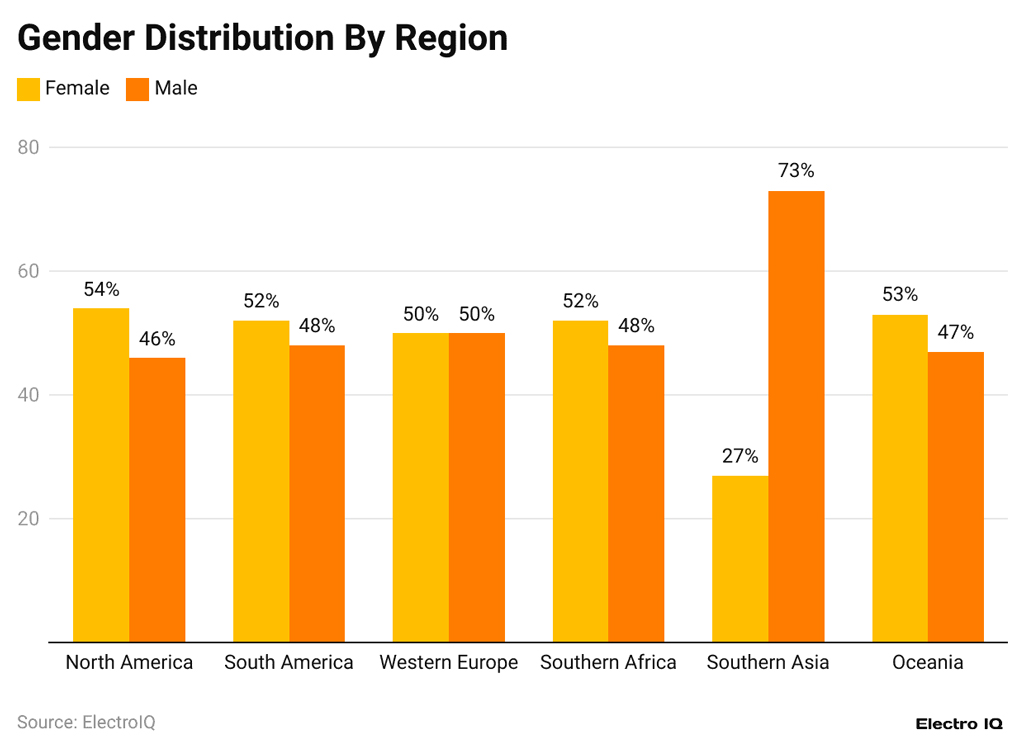
- North America shows a female majority at 54%, compared to 46% male, indicating a slightly higher female representation.
- South America records 52% females and 48% males, reflecting a balanced gender distribution with a small female edge.
- Western Europe has an equal split, with 50% female and 50% male, highlighting perfect gender parity.
- Southern Africa reports 52% female and 48% male, maintaining a moderate female dominance.
- Southern Asia stands out with a strong male majority of 73%, while females account for only 27%, showing the widest gender gap among all regions.
- Oceania shows 53% female and 47% male, indicating a stable and balanced gender ratio.
- Across most regions, female participation ranges between 50% and 54%, suggesting consistent representation outside Southern Asia.
- Southern Asia’s 46-point gender gap (73% vs 27%) represents the most significant imbalance, which may reflect cultural, social, or economic factors.
Anxiety and Depression Links
- 40% of depressed and suicidal youth report problematic social media use.
- The highest quartile of daily social media time is linked to 1.66 times higher odds of depression in young adults.
- The highest quartile of weekly social media visits is associated with 2.74 times greater odds of depression.
- The highest global frequency of social media use correlates with 3.05 times increased odds of depression.
- 48.3% of frequent social media users experience depression, 22.6% anxiety.
- Teens with addictive screen behaviors face double to triple the suicidal risk compared to low-use peers.
- Limiting social media to 30 minutes/day significantly reduces loneliness and depression over 3 weeks.
- 70% rise in anxiety and depression prevalence among youth over the last 25 years is tied to social media.
- >4 hours/day social media use yields 2.09 times higher odds of depression in young adults.
Physical Health Effects
- Nearly 30% of young adults show high sleep disturbance from 61 minutes of daily social media use.
- Frequent social media checkers face a 3 times higher sleep disturbance risk.
- Teens using social media for over 3 hours daily sleep after 23:00 and wake at night.
- Evening smartphone use causes significant melatonin suppression, delaying sleep onset.
- Social media addiction prevalence is 17.7% among students, tied to poor sleep.
- Heavy users average 7.5 hours daily device time, with 26.3% getting ≤6 hours of sleep.
- Prolonged device use >6 hours daily raises eye strain, dry eyes, and neck pain.
- Quarantine raised social media time from 2.59 to 3.15 hours, worsening musculoskeletal disorders.
- 70% of Australian adults sit >8 hours daily, with social media boosting obesity risk.
Most Addictive Platforms
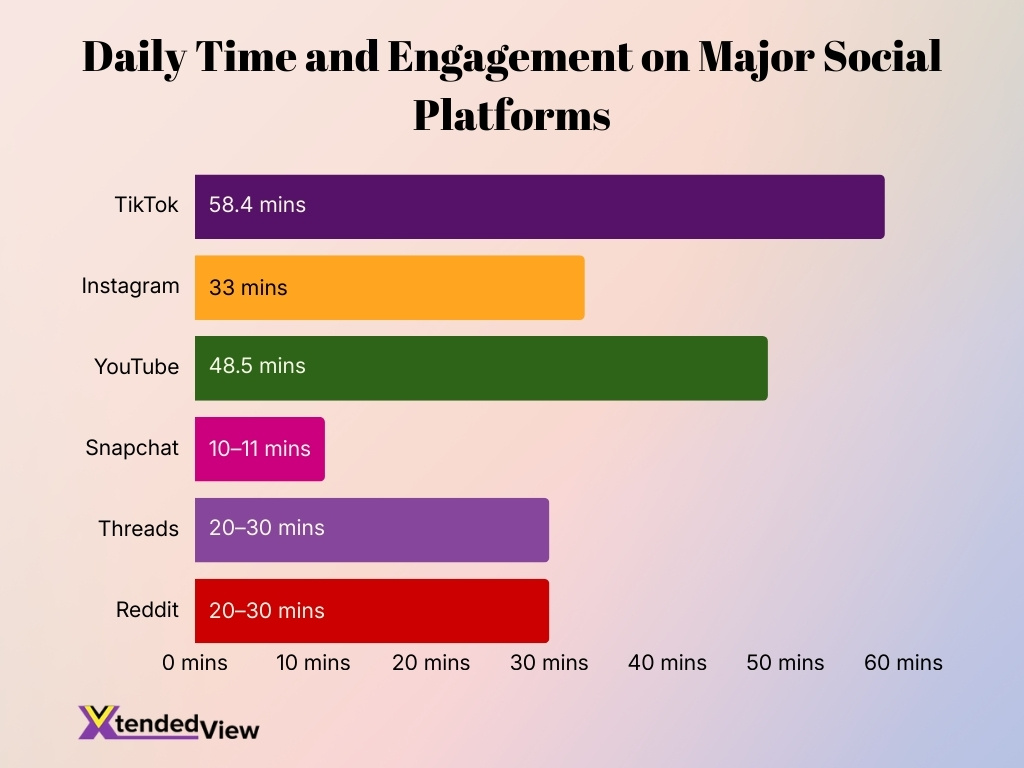
- TikTok users average 58.4 minutes daily, topping addictive rankings.
- Instagram sees 76% of 18-29 year-olds using it for 33 minutes daily.
- YouTube dominates with 48.5 minutes average daily time spent globally.
- Snapchat and TikTok lead session times at 10-11 minutes per use.
- Instagram sessions average 33 minutes due to visual feedback loops.
- Regulators cite TikTok‘s infinite scroll as addictive by design.
- Threads and Reddit grow but trail with 20-30 minutes daily.
- Engagement cycles boost addiction; TikTok at 19 opens per day.
Behavioral Changes Observed
- Students spending over 3 hours daily on social media are 4.7 times more likely to experience mental exhaustion.
- Adolescents addicted to social media show social withdrawal scores averaging 88.3, versus 34.1 for non-addicted peers.
- Heavy users (>5 hours/day) are 70% more likely to go to bed late than average users.
- University students using >3 hours/day face a 7.4 times higher risk of social isolation.
- Compulsive Facebook use affects 360 million users, interfering with sleep and work.
- Over 3 hours/day on social media increases anxiety risk by 22 times among students.
- Heaviest users (>5 hours/day) are 91% more likely to wake after 8 am.
- Social media addiction leads to 74% of heavy users reporting social isolation.
- 52% of Facebook users engage problematically, with 30% fully addicted.
- Addicted adolescents exhibit markedly higher social withdrawal than non-addicted ones.
Impact of Social Media on Emotional Well-Being
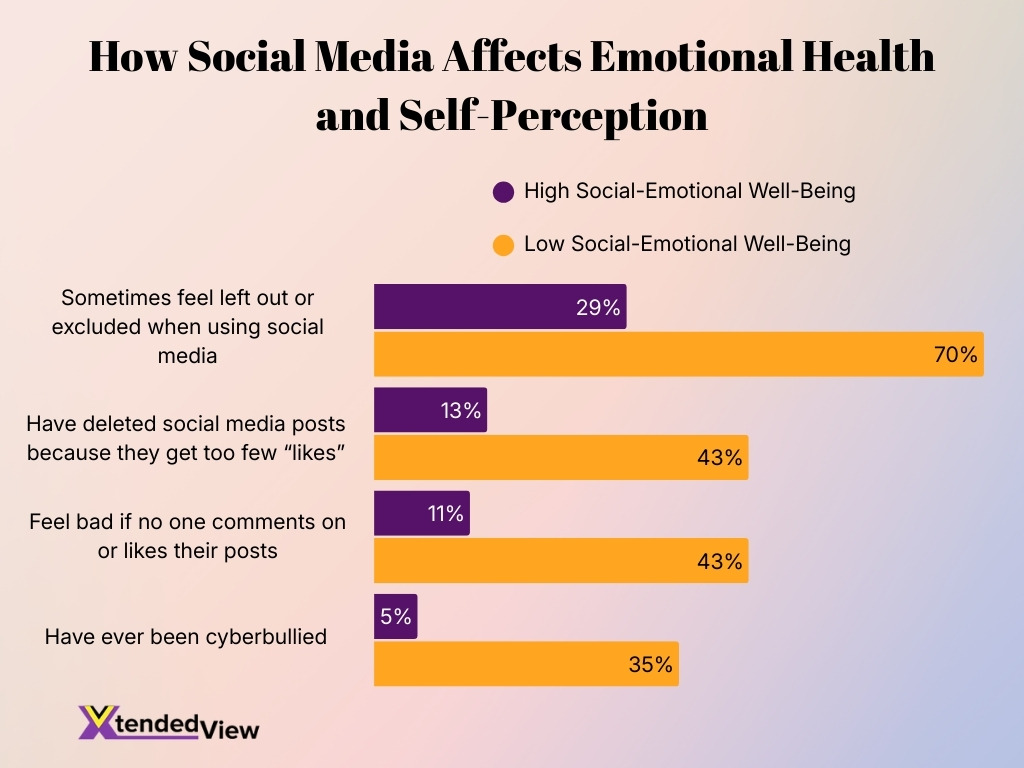
- 70% of users with low social-emotional well-being say they feel left out or excluded when using social media, compared to only 29% among those with high well-being.
- 43% of low well-being users admit they have deleted posts due to too few “likes”, while just 13% of high well-being users report the same behavior.
- 43% of people with low emotional well-being say they feel bad when their posts receive no likes or comments, versus only 11% among high well-being individuals.
- 35% of low well-being respondents have experienced cyberbullying, which is seven times higher than the 5% reported by users with high emotional well-being.
- Overall, individuals with lower social-emotional well-being are significantly more vulnerable to social comparison, validation pressure, and online harassment on social platforms.
Causes and Risk Factors
- Infinite scroll extends social media sessions by an average of 50%.
- Notifications trigger dopamine release, with users checking phones up to 150 times daily.
- 41% of teens with heavy social media use report poor mental health.
- Anxiety correlates with social media use at r=0.348; depression at r=0.273.
- High social media users face 2.8x higher depression risk.
- 54% of adolescent girls link social media to low self-esteem.
- 56% experience FOMO, driving constant social media engagement.
- Peer pressure boosts adolescent social media addiction by 28%.
- 95% access social media via mobile, fueling prolonged use.
- 11% of teens showed addictive social media behaviors in 2026.
Recovery and Treatment Options
- CBT reduces internet addiction by over 30% in adolescents with p<0.001.
- Group counseling drops severe addiction from 31.4% to 14.3%.
- Digital literacy interventions lower addiction scores by 21% in students.
- One hour of bedtime screen time raises the risk by 59%.
- Two-week social media detox cuts usage by 77.7%.
- CBT significantly reduces addiction (SMD=1.05, P=0.003).
- CBT leads to 55% drop in compulsive social media use.
- Digital detox reduces depressive symptoms (SMD=-0.29).
Frequently Asked Questions (FAQs)
About 210 million people globally are estimated to be addicted to social media and internet use.
Approximately 4.69% of all social media users worldwide are estimated to struggle with social media addiction.
Around 33.19 million Americans, or about 10% of the U.S. population, are estimated to be addicted to social media.
About 11% of adolescents showed signs of problematic or addiction‑like social media behavior in global studies.
Approximately 45% of U.S. teens report that they spend too much time on social media, according to the latest survey.
Conclusion
Social media addiction continues to pose a multi‑faceted public health challenge affecting mental, physical, and behavioural well‑being around the world. Current research underscores strong links between heavy use and anxiety, depression, sleep disruption, and social isolation, particularly among youth and young adults. Evidence also points to underlying causes such as algorithm‑driven design and psychological vulnerabilities, with therapeutic approaches like CBT and digital literacy programs gaining traction as effective supports.
As awareness grows, coordinated efforts across families, schools, clinicians, and technology platforms are increasingly crucial to help individuals build healthier relationships with social media use.
