


Samsung Electronics continued to define global tech benchmarks with strong revenue, evolving market positioning, and technology leadership. The company’s performance spans smartphones, memory chips, and connected devices, with key shifts visible in recent financial results. In the smartphone industry, Samsung remains a top contender alongside Apple, while its semiconductor operations grapple with rapid industry changes. Below, we unpack the latest Samsung statistics that matter most to businesses, investors, and tech consumers.
Editor’s Choice
- Samsung reported KRW 333.6 trillion in annual revenue for FY 2025, an all‑time high.
- Q4 2025 consolidated revenue hit KRW 93.8 trillion (≈ $65.5 billion).
- Samsung’s mobile shipments grew ~7% year‑over‑year in 2025.
- Samsung held roughly 20–22% global smartphone market share in 2025 across key quarters.
- Samsung’s semiconductor memory sales saw strong demand, especially for HBM3E products.
- The company operates with over 260,000 employees in 76+ countries.
- Samsung aims to enable 800 million AI‑powered devices with Google’s Gemini by the end of 2026.
Recent Developments
- In early 2026, Samsung’s co‑CEO revealed plans to double the number of AI‑enabled Gemini devices to 800M within the year.
- Samsung expanded the adoption of HBM3E memory chips in 2025 to meet AI and data center demand.
- Despite growth, some quarters in 2025 showed profit fluctuations due to external pressures on chip exports.
- Samsung’s quarterly financial reporting emphasizes AI memory and display business adjustments.
- The firm broadened its strategic focus into automotive electronics and robotics in late 2024 and early 2025.
- Initiatives such as the Samsung Innovation Campus expanded digital skills training worldwide.
- Smartphone lineup refreshes, including new Galaxy models, fuel ongoing consumer interest.
- Samsung’s environmental strategies now target mid‑ to long‑term net-zero goals.
- Capacity planning for production sites expanded to support 5G and future networks.
Key Statistics on Samsung
- Samsung posted KRW 333.6 trillion in consolidated annual revenue for FY 2025.
- Q4 2025 revenue of KRW 93.8 trillion was the highest recorded by the company.
- Operating profit for FY 2025 reached KRW 43.6 trillion (+33.2% YoY).
- Samsung’s quarterly operating profit more than tripled in late 2025.
- Galaxy mobile devices helped drive stronger mobile sales growth in 2025.
- Samsung operates 240+ global bases and 40+ R&D facilities.
- Workforce exceeds 260,000 employees worldwide.
- Samsung’s sustainability goals target net-zero carbon emissions in the DX division by 2030.
- The company’s broad tech portfolio includes AI, 5G, 6G, and automotive electronics.
Samsung Yearly Revenue Trends
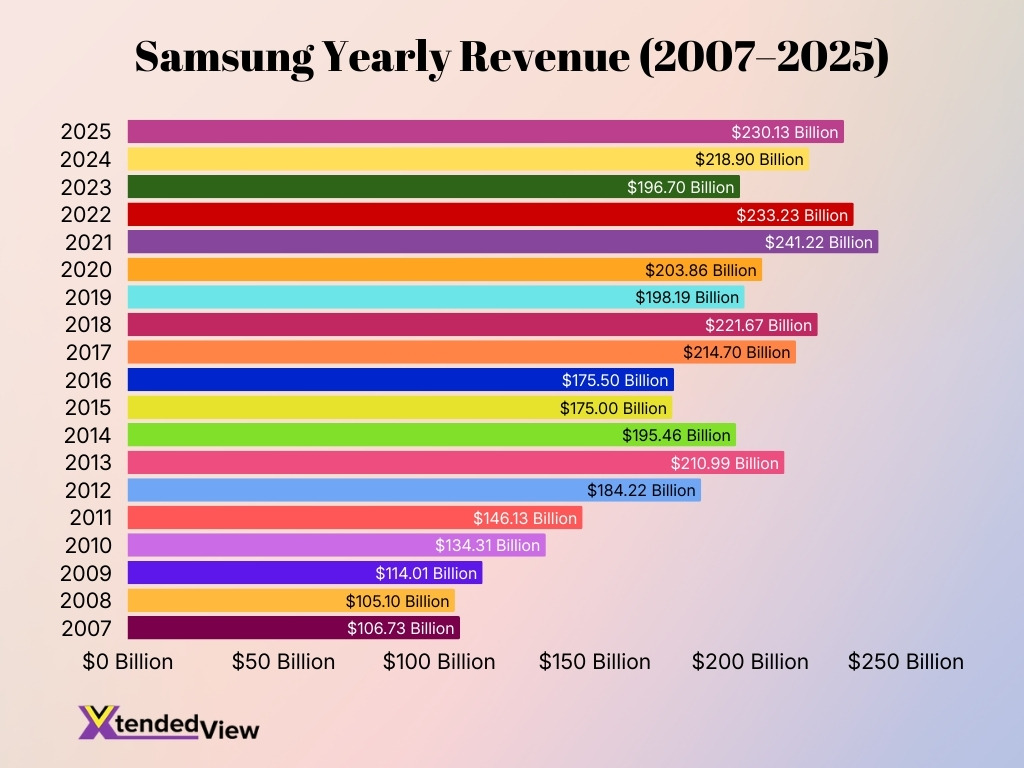
- Samsung Electronics’ revenue increased from $106.73 billion in 2007 to $230.13 billion in 2025, reflecting strong long-term business expansion.
- The company recorded its highest annual growth in 2012, with revenue surging by 26.07%, driven by rapid smartphone adoption and semiconductor demand.
- Samsung reached its peak revenue in 2021, generating $241.22 billion, marking its most successful year during this period.
- The sharpest revenue decline occurred in 2023, when earnings dropped by 15.66% to $196.70 billion, mainly due to weak global chip and electronics demand.
- After the downturn, Samsung showed a strong recovery in 2024 and 2025, posting 11.28% and 5.13% growth, reaching $230.13 billion in 2025.
- Between 2010 and 2012, revenue rose from $134.31 billion to $184.22 billion, representing a cumulative growth of over 37% in just two years.
- Revenue contractions were observed in 2008 (-1.53%), 2014 (-7.36%), 2015 (-10.47%), 2019 (-10.59%), 2022 (-3.31%), and 2023 (-15.66%), highlighting periodic market slowdowns.
- The 2017 growth surge of 22.33% reflected strong performance in memory chips and flagship smartphones, pushing revenue to $214.70 billion.
- During the pandemic period, Samsung maintained stability, with revenue growing by 2.86% in 2020 and jumping 18.32% in 2021, showing strong operational resilience.
- Overall, from 2007 to 2025, Samsung more than doubled its revenue, reinforcing its position as a global leader in electronics, semiconductors, and consumer technology.
Market Capitalization of Samsung
- Samsung Electronics remains one of the world’s most valuable tech firms, though exact 2026 figures vary by market conditions.
- In 2023, its market cap stood at ~$520 billion, ranking in the global top tiers.
- Samsung often features in major stock indices due to its revenue scale.
- Its semiconductor and mobile futures are key drivers of investor sentiment.
- Market cap trends are influenced by quarterly earnings expectations.
- Competition from Apple and other tech giants affects valuation dynamics.
- Samsung’s capex in memory and fabrication expansion projects supports stockholder confidence.
- Analysts monitor memory price cycles closely for valuation impacts.
Global Sales Performance of Samsung
- Samsung held approximately 20–22% of global smartphone shipments in 2025 across different quarters.
- In Q3 2025, Samsung captured ~18.8% of global smartphone shipments.
- Global smartphone shipments grew ~2% year‑over‑year in 2025.
- Samsung’s mobile shipments expanded about 7% YoY in 2025.
- Samsung maintained a lead in Q1 2025 with roughly 20% of shipments.
- Samsung’s global smartphone presence varies by region, with stronger shares in Africa and South America.
- Samsung’s market position adjusted due to intensifying competition from Apple and emerging brands.
- Regional market trends show share growth in select markets like the U.S. mid‑year 2025.
Global Smartphone Market Share & Growth Trends
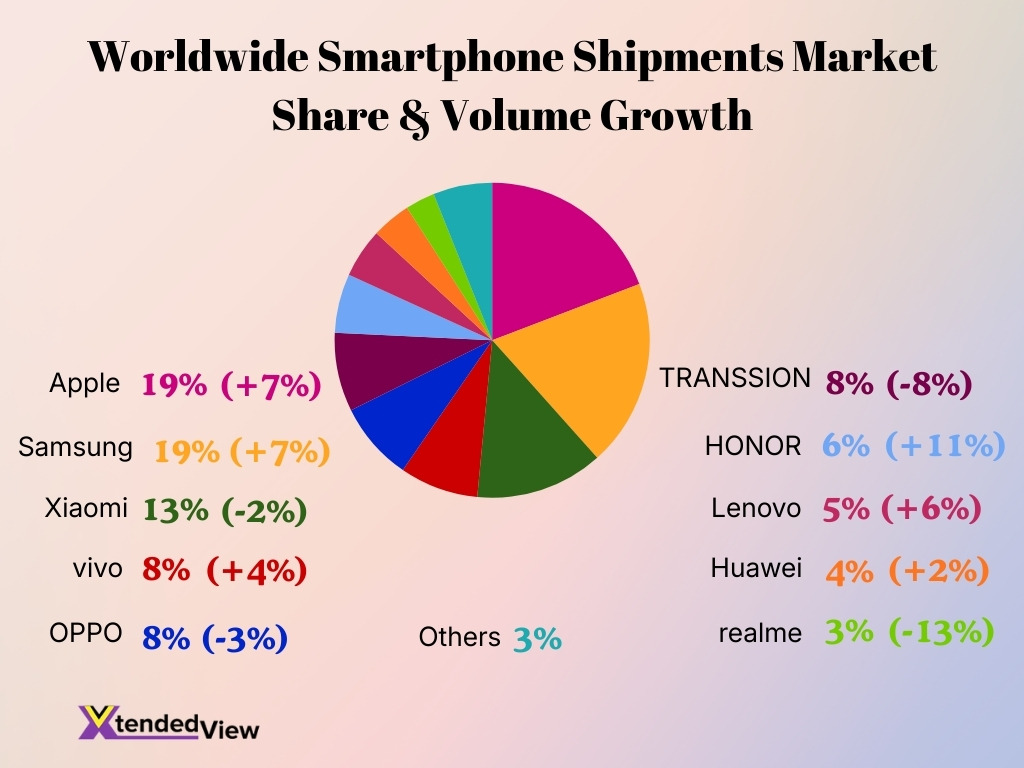
- Apple and Samsung jointly led the global smartphone market in 2025, each holding 19% market share with +7% shipment growth, reflecting strong flagship demand.
- Xiaomi ranked third with a 13% market share, despite recording a -2% decline in shipment volume during the year.
- vivo, OPPO, and TRANSSION each captured 8% market share, with vivo growing by +4%, while OPPO declined by -3% and TRANSSION fell by -8%.
- HONOR emerged as the fastest-growing major brand, securing 6% market share with an impressive +11% growth rate in 2025.
- Lenovo maintained steady expansion, achieving 5% market share and +6% year-over-year growth in smartphone shipments.
- Huawei held 4% market share and posted +2% growth, signaling a gradual recovery in key regional markets.
- realme experienced the steepest contraction among leading brands, dropping to 3% market share with a -13% decline in shipments.
- Other smartphone vendors collectively accounted for 6% of global shipments, highlighting continued market fragmentation beyond the top brands.
- The top two brands, Apple and Samsung, together controlled 38% of the global smartphone market, reinforcing their dominance in the premium and mass-market segments.
- Overall, the 2025 smartphone market showed mixed performance, with leading brands posting strong single-digit growth, while several mid-tier players faced declining shipment volumes.
Semiconductor Business Insights at Samsung
- Samsung’s Device Solutions segment reported record‑high memory revenue in Q3 2025, driven by strong AI‑related demand.
- Third‑quarter revenue for DS hit KRW 33.1 trillion, with an operating profit of about KRW 7.0 trillion.
- HBM3E high‑bandwidth memory sales expanded sequentially through 2025, meeting strong server and AI application demand.
- Samsung anticipates mass production of HBM4 memory products in 2026 to capture AI market growth.
- Forecasts suggest Samsung’s global HBM market share could exceed 30% in 2026 as next‑gen products enter broader customer pipelines.
- Beyond HBM, Samsung expanded sales of DDR5, LPDDR5X, and high‑density SSD offerings in late 2025.
- The foundry business improved earnings with better fab utilization and customer orders in advanced nodes.
- System LSI operations aim to strengthen premium SoC and image sensor competitiveness in 2026.
- Samsung’s semiconductor strategy leverages AI‑centric memory and compute components to offset cyclical market pressures.
Top Semiconductor Companies by Revenue Share
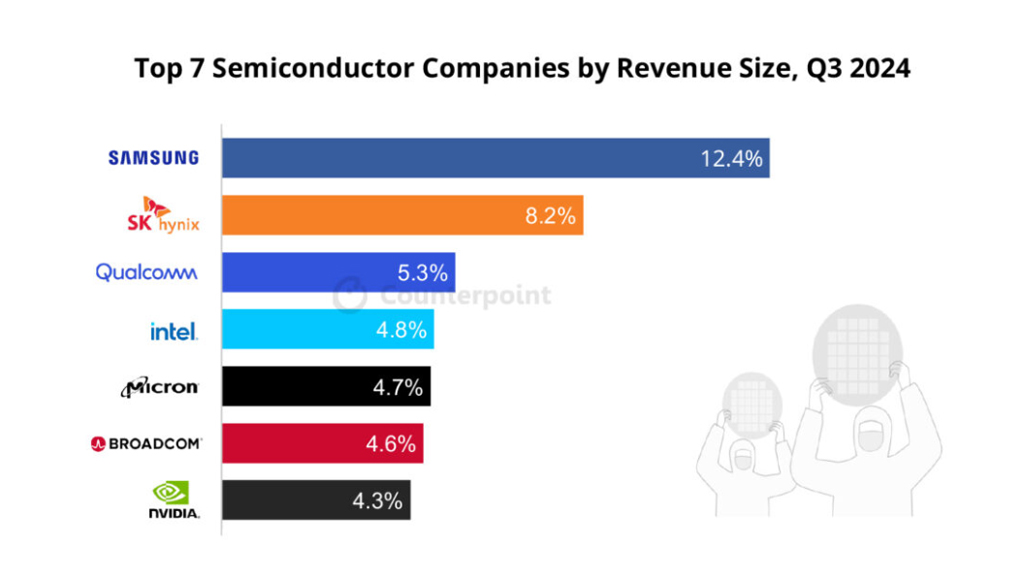
- Samsung leads the global semiconductor market with a dominant 12.4% revenue share, maintaining its position as the industry’s top revenue generator.
- SK Hynix secures the second spot with 8.2%, driven by strong demand for memory chips and AI-related hardware.
- Qualcomm holds 5.3% market share, reflecting its continued strength in mobile processors and wireless technologies.
- Intel captures 4.9%, highlighting its steady presence despite increasing competition in advanced chip manufacturing.
- Micron Technology accounts for 4.7%, supported by rising demand for DRAM and NAND flash memory solutions.
- Broadcom records 4.6% share, benefiting from its diversified portfolio in networking, broadband, and enterprise chips.
- NVIDIA rounds out the top seven with 4.3%, fueled by rapid growth in AI, GPU, and data center processors.
Product Segment Revenue Breakdown at Samsung
- In 2025, Samsung’s Device eXperience (DX) division accounted for ~62% of total sales, highlighting the role of mobile and consumer products.
- The Device Solutions (DS) unit contributed ~34.5% of overall revenue, reflecting strong semiconductor demand.
- Revenue from display panels and TV segments showed mixed performance due to competitive pricing and cyclical demand.
- Mobile and connectivity devices, Galaxy phones, tablets, and wearables, drove a majority of DX revenue gains.
- High‑value memory products bolstered DS revenue figures, especially for enterprise and AI workloads.
- Samsung’s digital appliance segment experienced less robust growth due to market saturation and pricing pressures.
- The display panel business aimed to expand premium OLED supply in 2026 to support broader mobile and TV offerings.
- Software and services attached to devices continue to diversify Samsung’s revenue streams, though still smaller compared to hardware units.
- B2B solutions and IoT integrations have shown incremental revenue contributions as Samsung expands ecosystem services.
Global Samsung Smartphone Usage by Country
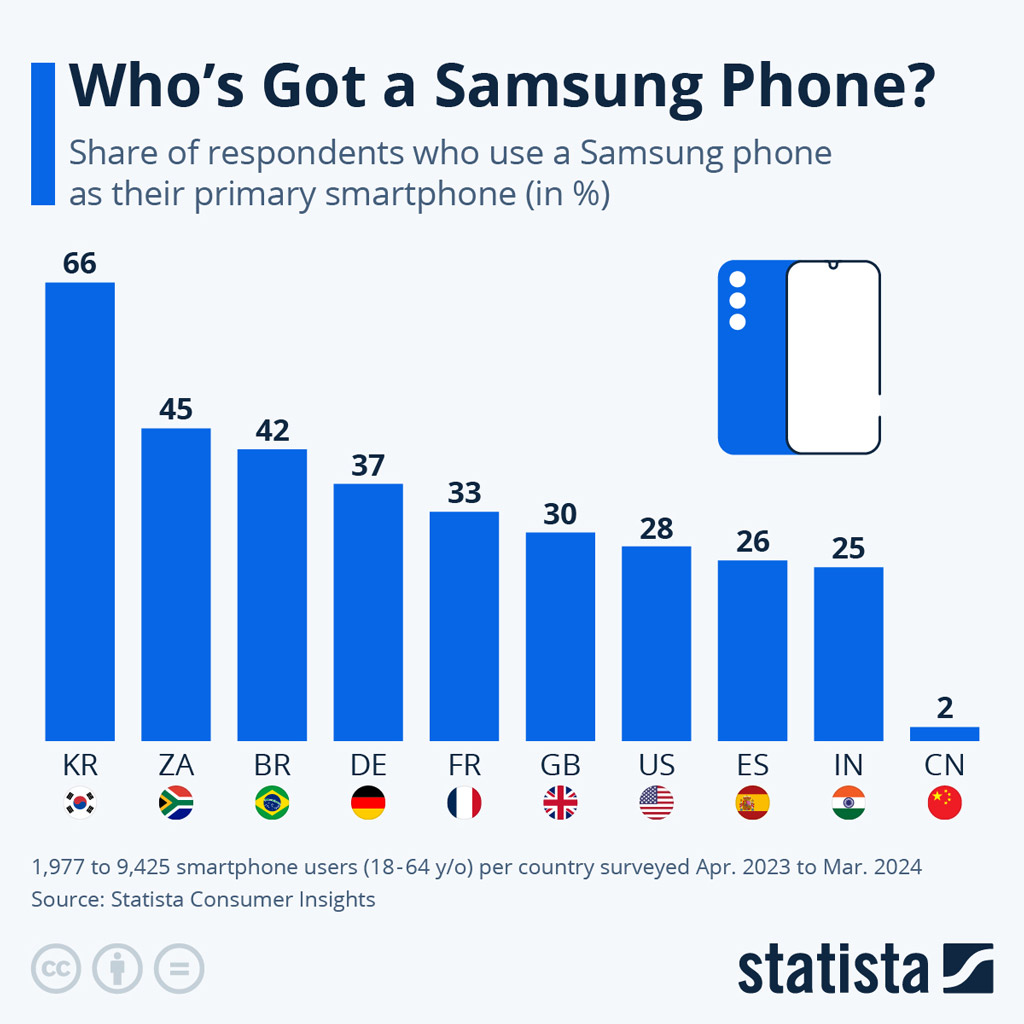
- The data was sourced from Statista Consumer Insights, a leading global market research platform.
- South Korea leads globally, with 66% of respondents using Samsung as their primary smartphone, highlighting the brand’s strong domestic dominance.
- South Africa ranks second, where 45% of users prefer Samsung, reflecting strong brand loyalty in emerging markets.
- Brazil follows closely, with 42% of smartphone users choosing Samsung as their main device.
- Germany reports a 37% adoption rate, showing a solid European market presence for Samsung devices.
- France records 33% usage, indicating consistent demand for Samsung smartphones in Western Europe.
- The United Kingdom shows 30% penetration, with nearly one in three users relying on Samsung phones.
- In the United States, 28% of respondents use Samsung, highlighting strong competition with Apple.
- Spain posts 26% market usage, maintaining steady Samsung adoption across Southern Europe.
- India reports 25% usage, demonstrating Samsung’s significant presence in one of the world’s largest smartphone markets.
- China shows the lowest adoption at just 2%, reflecting intense competition from domestic smartphone brands.
- The survey was conducted between April 2023 and March 2024, covering users aged 18–64 years.
- Each country included between 1,977 and 9,425 respondents, ensuring strong statistical reliability.
Galaxy Series Overview from Samsung
- Galaxy S25 series sold 20.22 million units by June 2025, surpassing S24 by ~2 million.
- Galaxy AI reached over 400 million devices worldwide by the end of 2025.
- 70% of Galaxy S25 users actively use Galaxy AI features.
- Samsung held 19% global smartphone market share in 2025, up 1% YoY.
- Galaxy S25 series sales grew 14% over the S24 series.
- Galaxy A series dominated midrange, holding top 5 spots in Q3 2025 best-sellers.
- Galaxy Z Fold7/Flip7 led foldables with 64% market share in Q3 2025, up 32% shipments YoY.
- Samsung shipped 241.2 million smartphones in 2025, up 7.9% YoY.
- Galaxy S26 series targets 35 million units annually.
- Samsung smartwatch/band shipments hit 11.8 million in the first 3 quarters of 2025.
Foldable and Flagship Devices by Samsung
- Global foldable phone shipments grew ~14% YoY in Q3 2025, marking record volumes for the category.
- Samsung held ~64% share of the foldable smartphone market in Q3 2025.
- Galaxy Z Fold7 shipments rose 32% YoY for Samsung in Q3 2025.
- Foldables accounted for 2.5% of total global smartphone shipments in Q3 2025.
- Huawei captured 15%, Motorola 7%, and Honor 6% of the foldable market share in Q3 2025.
- Z Fold7 pre-orders surged nearly 50% vs its predecessor.
- Z Fold7 and Z Flip7 combined pre-orders up >25% over the previous generation.
- Carrier pre-orders for Z Fold7/Flip7 jumped 60% YoY.
- Galaxy Z TriFold sold out in 5 minutes at $2,899 US launch.
R&D and Innovation Investments by Samsung
- Samsung invested a record KRW 37.7 trillion in R&D across 2025, marking the highest annual spend to date.
- Q4 2025 R&D outlays reached KRW 10.9 trillion, up KRW 2 trillion quarter-over-quarter.
- R&D investments surged 23.5% year-over-year to KRW 35 trillion in 2024, fueling AI and semiconductors.
- Q1 2025 R&D spending hit KRW 9 trillion, a 16% increase from Q1 2024.
- Samsung plans a KRW 20 trillion investment by 2030 in semiconductor R&D at the NRD-K complex.
- Samsung’s 2024 R&D of $9.5 billion ranked it third globally in consumer electronics.
- AI chips and HBM production expanded, targeting leadership in high-performance computing.
- Flexible display R&D advances foldable tech like dual in-folding OLED for Galaxy Z Fold7 SE.
- Galaxy AI partners with Google Cloud integrate Gemini models for enhanced ecosystems.
Biggest Challenges in CTV/OTT Advertising
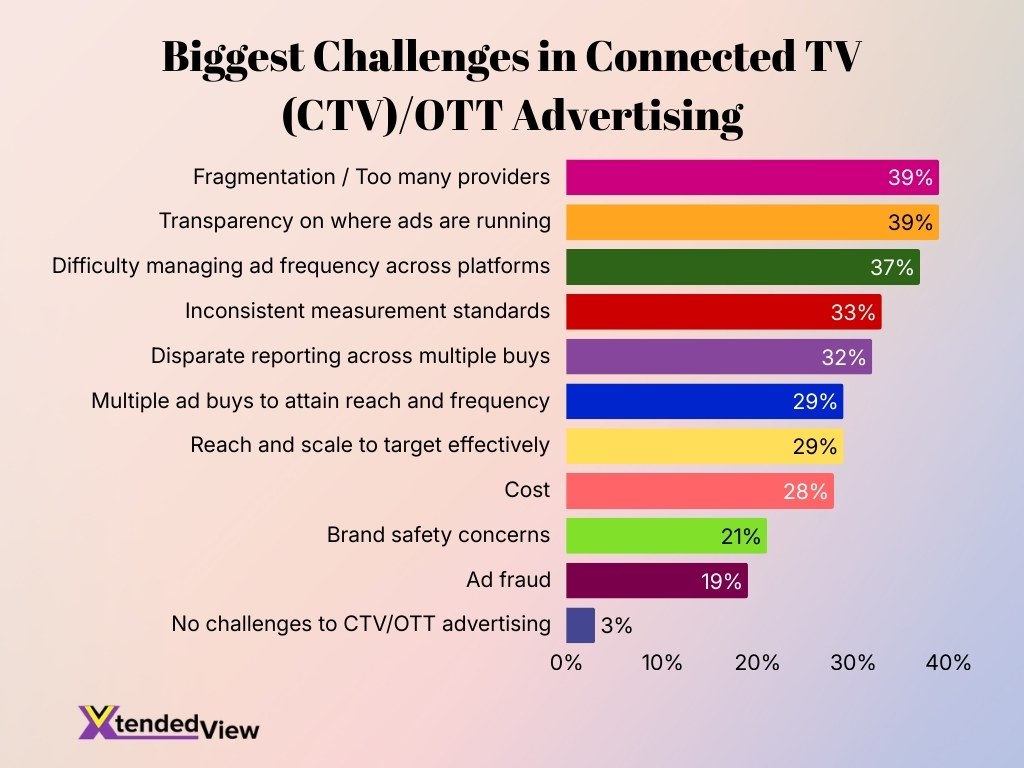
- Fragmentation and too many providers rank as the top challenge, reported by 39% of US CTV/OTT advertisers, making campaign coordination more complex.
- Lack of transparency on where ads are running is equally critical, affecting 39% of respondents and limiting visibility into ad placements.
- Difficulty managing ad frequency across multiple platforms impacts 37%, increasing the risk of overexposure and wasted ad spend.
- Inconsistent measurement standards trouble 33% of advertisers, highlighting the absence of unified performance benchmarks.
- Disparate reporting across multiple buys is a concern for 32%, complicating campaign analysis and ROI tracking.
- Multiple ad buys to achieve reach and frequency challenge 29% of marketers, increasing operational workload and costs.
- Limited ability to reach and scale target audiences effectively affects 29%, reducing campaign efficiency.
- Rising advertising costs are cited by 28%, putting pressure on marketing budgets.
- Brand safety concerns remain significant for 21%, as advertisers seek safer and more controlled environments.
- Ad fraud risks continue to impact 19% of respondents, threatening campaign credibility and performance.
- Only 3% of advertisers report no major challenges, showing that 97% still face obstacles in CTV/OTT advertising.
Manufacturing and Supply Chain Operations of Samsung
- Samsung operates an extensive global manufacturing footprint with over 275 subsidiaries worldwide handling production, sales, and supply chain operations.
- The company’s supply chain emphasizes ethical sourcing and responsible materials procurement, aiming to align with global environmental and labor standards.
- Samsung’s sustainable supply chain framework supports suppliers to improve competitiveness and meet environmental, health, and safety criteria.
- A robust risk‑management process is used to minimize environmental and human‑rights risk in upstream supply stages.
- Samsung’s manufacturing capacity spans advanced semiconductors to consumer products, enabling supply resilience and agility.
- Supply‑chain investments include automation and digital traceability to enhance responsiveness to demand shifts.
- Samsung’s integrated operations support fast scaling of next‑gen devices, especially AI‑enabled hardware lines.
- Continuous collaboration with global partners underpins its competitive logistics and delivery performance.
Environmental and Sustainability Impact of Samsung
- DX Division achieved a 93.4% renewable energy transition rate by the end of 2024.
- High-efficiency technologies reduced average product power consumption by 31.5% compared to 2019.
- Samsung incorporated recycled content into 31% of plastic parts used in products as of 2024.
- E-waste collection programs operate in approximately 80 countries worldwide.
- All global DS Division sites received Platinum “Zero Waste-to-Landfill” certification.
- DX Division targets net-zero Scope 1 and 2 emissions by 2030.
- DS Division aims for net-zero Scope 1 and 2 emissions by 2050.
- Goal set to apply recycled materials to all plastic components by 2050.
User Base and Installed Device Stats for Samsung
- Samsung maintains over 1 billion active smartphones worldwide as of 2025.
- SmartThings platform serves 430 million users globally by late 2025.
- Samsung commands 20% of the global active smartphone base.
- Galaxy AI reaches 70% adoption among Galaxy S25 users.
- Samsung shipped 61.2 million smartphones in Q4 2025, at 18.2% market share.
- SmartThings connects 1 billion Galaxy devices and appliances.
- Over 500 million users in Samsung’s SmartThings community.
- Samsung holds 22% tablet market share, with 26 million 2023 shipments.
- SmartThings links 140 million IoT devices from 300+ providers.
Samsung Profit Growth and Forecast
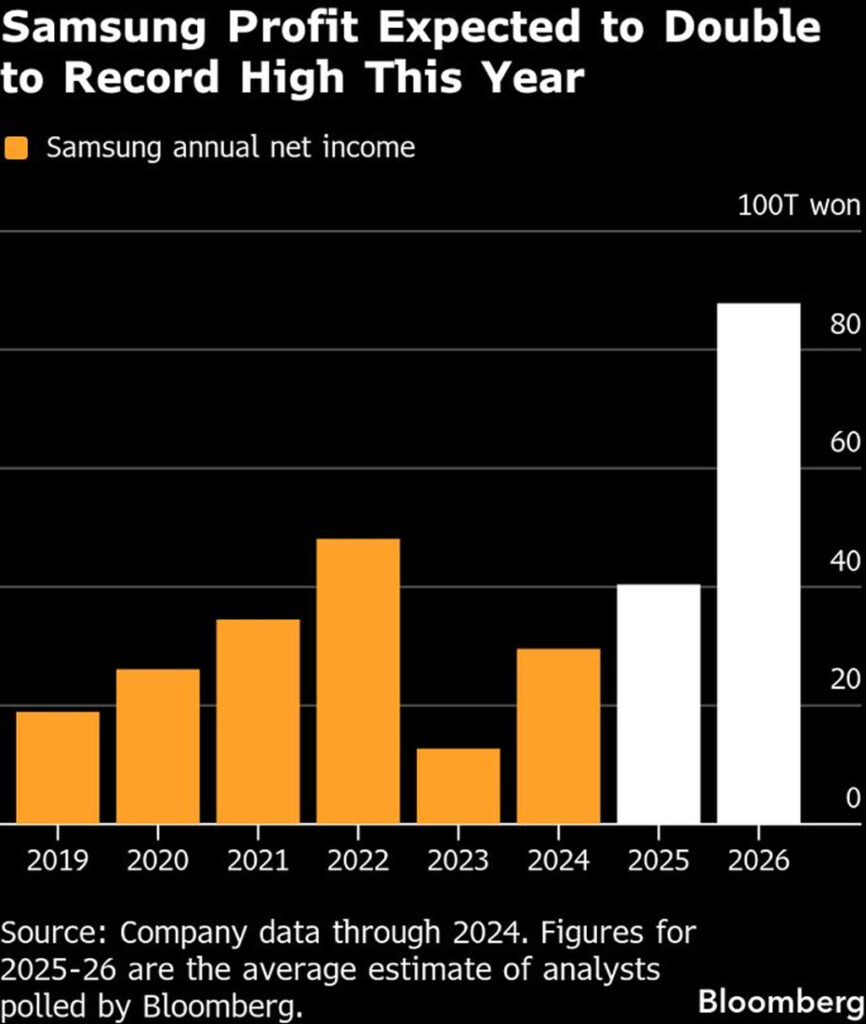
- Samsung’s annual net income increased steadily from ₩15 trillion in 2019 to ₩45 trillion in 2022, reflecting strong business expansion before the industry slowdown.
- In 2023, profits dropped sharply to around ₩10 trillion, marking the lowest level in the last eight years due to weak semiconductor demand.
- The company showed signs of recovery in 2024, with net income rising to nearly ₩25 trillion, supported by improving global tech markets.
- Analysts estimate that Samsung’s profit will reach about ₩35 trillion in 2025, indicating continued earnings momentum.
- By 2026, net income is projected to surge to nearly ₩85 trillion, moving close to the ₩100 trillion milestone.
- This forecast suggests Samsung’s profits could more than triple from 2023 to 2026, highlighting a strong long-term rebound.
- From 2024 to 2026, earnings are expected to grow by over 240%, driven by demand for memory chips and AI-related hardware.
- The sharp rise after 2024 reflects renewed investor confidence and market optimism.
- If projections hold, 2026 will become Samsung’s most profitable year on record.
- Overall, the data shows a clear shift from post-pandemic growth (2019–2022) to a downturn (2023) and then to a powerful recovery phase (2024–2026).
Competitive Positioning of Samsung in the Market
- Samsung held a close 19% global smartphone market share in 2025, trailing Apple’s 20%.
- Samsung shipped 241.2 million smartphones in 2025, up 7.9% YoY, yet Apple led with 247.8 million.
- In semiconductors, Samsung captured 10.6% market share worldwide in 2024, reclaiming the top spot.
- Samsung ranked 2nd in the foundry market with 7.3% share in Q2 2025, behind TSMC’s dominance.
- Samsung’s brand value reached $90.5 billion in 2025, securing 5th place globally for the sixth year.
- Chinese brands like Vivo (19%) and Xiaomi (13%) outpaced Samsung (16%) in India’s 2025 smartphone market.
- Samsung’s total revenue hit $234 billion in 2025, versus Apple’s leading $416 billion.
- Samsung’s high-end smartphone sales in India surged 45% YoY in 2025 amid premium demand.
- Xiaomi and Oppo each grabbed 13% in India’s Q3 2025 shipments, pressuring Samsung in the midrange.
Online Store and Ecosystem Performance of Samsung
- Galaxy Store served 24.3 million monthly active users from Feb-Jul 2024.
- SmartThings reached 430 million users globally by Dec 2025.
- Galaxy AI targets 400 million devices by the end of 2025.
- samsung.com generated $24.8B in online sales revenue in 2024, up over 50% YoY.
- Galaxy Store revenue share improved to 80/20 for apps and 85/15 for subscriptions since May 2025.
- Galaxy Store preloaded on approx. 1.2 billion devices worldwide.
- Over 70% of Galaxy S25 users actively engage with Galaxy AI features.
- samsung.com expects 5-10% revenue growth in 2025 with 74% mobile sales.
- Galaxy Store saw top apps like SiriusXM and TikTok dominate downloads in Fall 2025.
Frequently Asked Questions (FAQs)
Samsung posted KRW 333.6 trillion in consolidated revenue for the full fiscal year 2025.
In Q3 2025, Samsung shipped 61.4 million units and held about 18.8% of the global smartphone market.
Samsung’s share of the US smartphone market rose to 31% in Q2 2025, up from 23% in Q2 2024.
Global smartphone shipments reached 1.25 billion units in 2025, growing approximately 2% year‑over‑year.
As of early 2026, Samsung held approximately 20.3% of the global mobile vendor market share.
Conclusion
Samsung Electronics stands at a strategic intersection of innovation, sustainability, and competitive agility. Investments in AI‑centric chips and ecosystem experiences are elevating its global footprint, while robust manufacturing and supply chain practices support long‑term growth. Samsung’s commitment to environmental goals and a broad installed base underscores its relevance across consumer and enterprise technology landscapes.
As the tech sector evolves, Samsung’s diversified performance positions it to remain a central force in global electronics and semiconductor markets.
