


OpenAI continues to define the pace of generative AI’s global growth, marked by unprecedented user adoption, expanding enterprise use, and rapid revenue growth. From individuals leveraging AI for daily productivity to large companies integrating models into core workflows, OpenAI’s technologies shape how people work, learn, and create content. In healthcare and customer support, for example, organizations use ChatGPT to automate responses and boost efficiency, while developers integrate APIs to build AI-enhanced applications. These real-world impacts set the stage for a deeper look at OpenAI statistics. Let’s dive into the latest data.
Editor’s Choice
- 800 million weekly ChatGPT users as of late 2025.
- 61.3% market share for ChatGPT in generative chatbot use, excluding Copilot.
- OpenAI’s annualized revenue $12 billion in 2025.
- 92% of Fortune 500 firms use OpenAI products.
- 663.6 million plus monthly visits to OpenAI’s site in mid-2025.
- 5.4 billion monthly ChatGPT visits.
- SoftBank-led funding valuing OpenAI at roughly $300 billion.
Recent Developments
- OpenAI released GPT-5.2 on December 11, 2025, featuring a 400,000-token context window for complex tasks.
- Disney invested $1 billion in OpenAI, licensing 200+ characters like Mickey Mouse for AI video experiences.
- OpenAI plans IPO filing by late 2026, targeting $1 trillion valuation with $60 billion raise.
- GPT-5.2 scores 70.9% on GDPVal, outperforming professionals on knowledge work tasks.
- GPT-5.2 Pro achieves 93.2% on GPQA Diamond science benchmark, rivaling top models.
- AWS-OpenAI $38 billion seven-year deal provides hundreds of thousands of NVIDIA GPUs.
- ChatGPT reached 800 million weekly active users and 5.72 billion monthly visits in 2025.
- Awareness of AI tools like ChatGPT rose to 90% globally in 2025 from 78% prior year.
- Generative AI risks include synthetic media comprising large proportions of online content by 2026.
OpenAI Statistics Overview
- 800 million weekly active users of ChatGPT in 2025, doubling earlier in the year.
- Monthly ChatGPT visits exceed 5.1 to 5.7 billion.
- ChatGPT holds roughly 61 to 82% market share among generative chat tools, depending on the measurement.
- OpenAI’s platform draws 663.6 million plus monthly site visits.
- ChatGPT answers over 1 billion questions per day.
- ChatGPT has crossed 1 billion global downloads across platforms.
- Enterprise message volume in ChatGPT products rose about 8% year over year.
- OpenAI technologies reach users across 150-plus countries.
OpenAI Adoption by Company Size
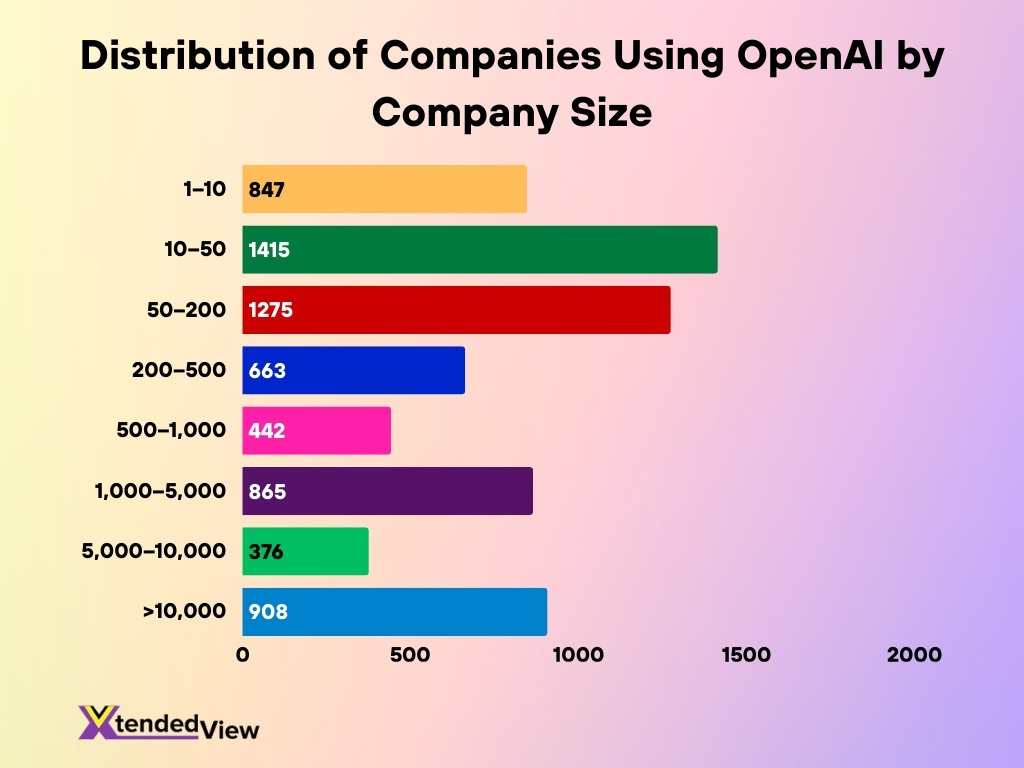
- Small businesses dominate adoption, with 1,415 companies in the 10–50 employee range — the largest user segment overall.
- Early-stage startups (1–10 employees) show strong engagement, accounting for 847 companies, highlighting OpenAI’s appeal to lean teams and founders.
- Mid-sized companies (50–200 employees) represent a major adoption group with 1,275 companies, reflecting growing use in scaling organizations.
- Adoption declines in upper mid-market firms, with only 663 companies in the 200–500 range and 442 companies in the 500–1,000 range.
- Enterprise adoption rebounds significantly, as 865 companies in the 1,000–5,000 employee segment actively use OpenAI.
- Very large enterprises (>10,000 employees) account for 908 companies, demonstrating strong institutional and enterprise-level adoption.
- The lowest adoption is observed among companies with 5,000–10,000 employees, totaling just 376 companies.
- Overall, the data shows broad adoption across all company sizes, with particularly strong usage among small businesses and large enterprises, indicating OpenAI’s versatility and scalability.
ChatGPT User and Adoption Statistics
- ChatGPT’s weekly user base grew from 400 million to 800 million in one year.
- Monthly visits exceed 5 billion sessions.
- ChatGPT accounts for over 61% of generative chatbot usage, excluding Copilot.
- Rapid feature expansion fueled accelerated adoption in 2025.
- U.S. users contribute roughly 14 to 15% of total usage.
- Adoption spans diverse demographics and professional roles.
- Engagement includes billions of prompts and sessions each month.
- Paid subscription adoption continued to rise steadily.
OpenAI User Demographics (Age, Gender, Profession)
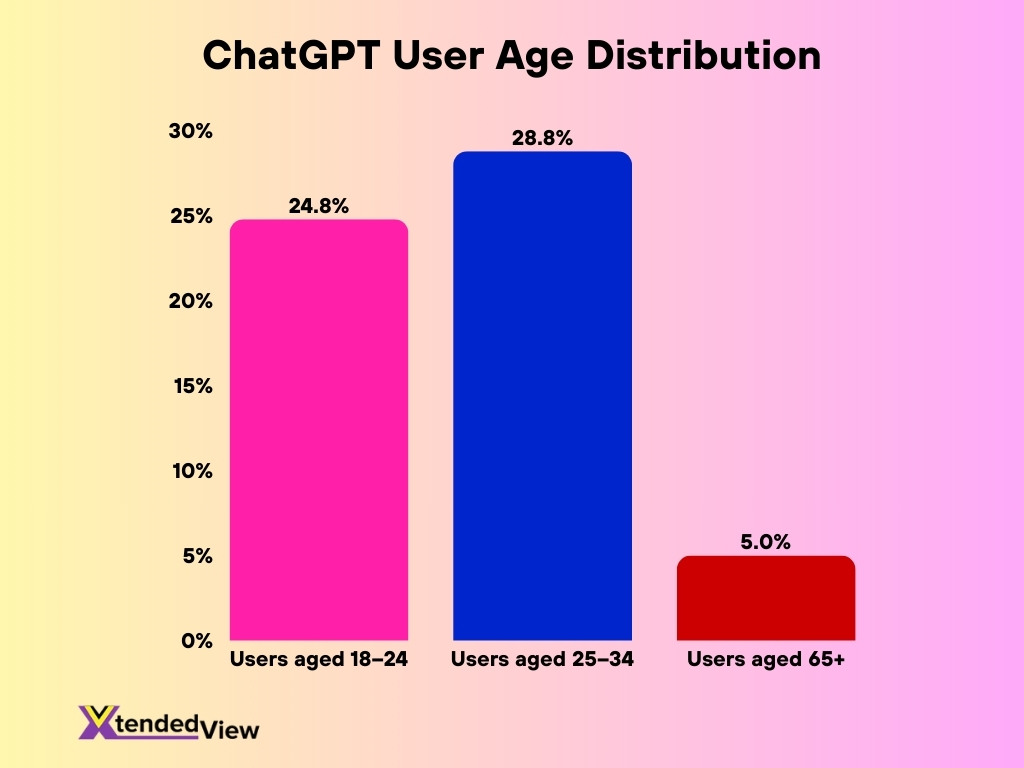
- Users aged 25-34 comprise the largest share at 28.8% of ChatGPT’s audience.
- 18-24 year olds represent 24.8% of total users.
- 65+ users account for just over 5% of the user base.
- Males hold a slight majority, while females make up 46%.
- 79% of developers actively use ChatGPT for professional tasks.
- Over half of weekly active users now have typically female names as of June 2025.
- Nearly half of the messages come from 18-25 year olds.
- 46% of college graduates use ChatGPT for work versus 37% without degrees.
- 57% adoption in computer-related fields and 50% in management.
- Students form a key segment, with over one-third of US college-aged adults using it.
OpenAI Revenue and Monetization Statistics
- OpenAI’s annual recurring revenue reached roughly $12 to $13 billion in 2025.
- Revenue nearly tripled year over year compared with 2024.
- The company achieved a $10 billion annualized run rate by mid-2025.
- First-half 2025 revenue totaled about $4.3 billion.
- ChatGPT generated over 70% of total revenue via subscriptions and premium tiers.
- Enterprise contracts significantly increased recurring revenue streams.
- API usage contributes a growing share of monetization.
- Heavy reinvestment in research and computing continues to affect profitability.
- Subscription and enterprise products boosted long-term customer value.
- Revenue forecasts project movement toward $15 to $20 billion annually.
Distribution of Companies Using OpenAI by Industry
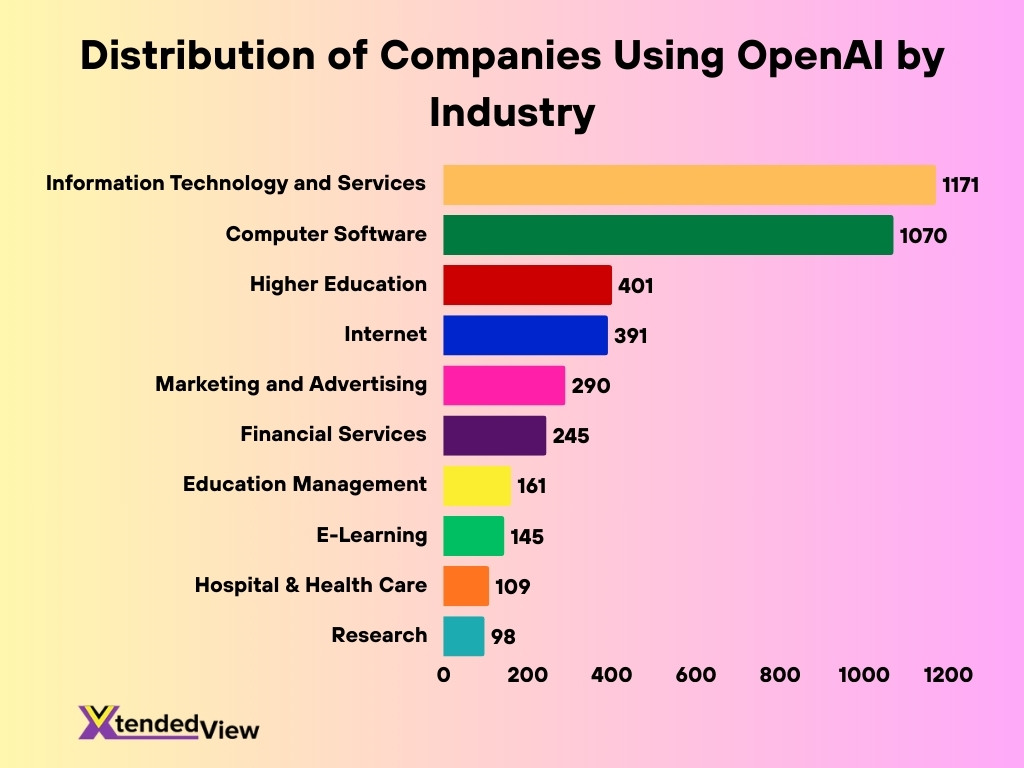
- Information Technology and Services leads adoption, with 1,171 companies, highlighting AI’s strong foothold in core tech and digital infrastructure sectors.
- Computer Software follows closely with 1,070 companies, showing widespread integration of OpenAI tools into software development and products.
- Higher Education ranks third, with 401 organizations, reflecting the growing use of AI in teaching, research, and academic administration.
- The Internet industry accounts for 391 companies, indicating strong adoption among online platforms and digital-first businesses.
- Marketing and Advertising includes 290 companies, emphasizing AI’s role in content creation, personalization, and campaign optimization.
- Financial Services shows solid uptake with 245 companies, driven by applications in analytics, automation, and customer support.
- Education Management reports 161 companies, suggesting increasing reliance on AI for institutional planning and operations.
- E-Learning has 145 companies, underlining AI’s impact on personalized learning and digital education platforms.
- Hospital & Health Care records 109 companies, reflecting cautious but growing adoption in clinical, administrative, and patient-facing uses.
- Research rounds out the list with 98 organizations, demonstrating AI’s importance in data analysis, experimentation, and knowledge discovery.
Valuation and Investment Statistics
- A $40 billion funding round valued OpenAI at $300 billion in 2025.
- Later employee share sales implied a valuation near $500 billion.
- Valuation climbed sharply from about $80 billion in 2024.
- Major investors include SoftBank, Microsoft, and leading venture firms.
- Investor confidence reflects expectations for long-term AI market growth.
- OpenAI remains loss-making while prioritizing research and scale.
- Internal projections target hundreds of billions in revenue by 2030.
- OpenAI ranks among the most valuable private tech companies globally.
- Repeated investment rounds reinforced strong institutional demand.
- Capital inflows support expansion into new AI products and regions.
Funding and Capital Raises
- OpenAI raised a record $40 billion in its Series F round led by SoftBank in March 2025.
- Total funding across all rounds reached $63.92 billion as of March 2025.
- The $40 billion round valued OpenAI at $300 billion post-money.
- Microsoft invested a total of $13 billion in OpenAI since 2019.
- Secondary share sale in October 2025 valued OpenAI at $500 billion.
- Nvidia committed $100 billion investment for OpenAI data centers in 2025.
- SoftBank provided $10 billion initially, with $30 billion more by year-end 2025.
- OpenAI plans $1.4 trillion for 30 gigawatts of compute infrastructure expansion.
- Microsoft holds a 27% stake worth $135 billion in OpenAI post-restructure.
OpenAI Usage by Country and Region
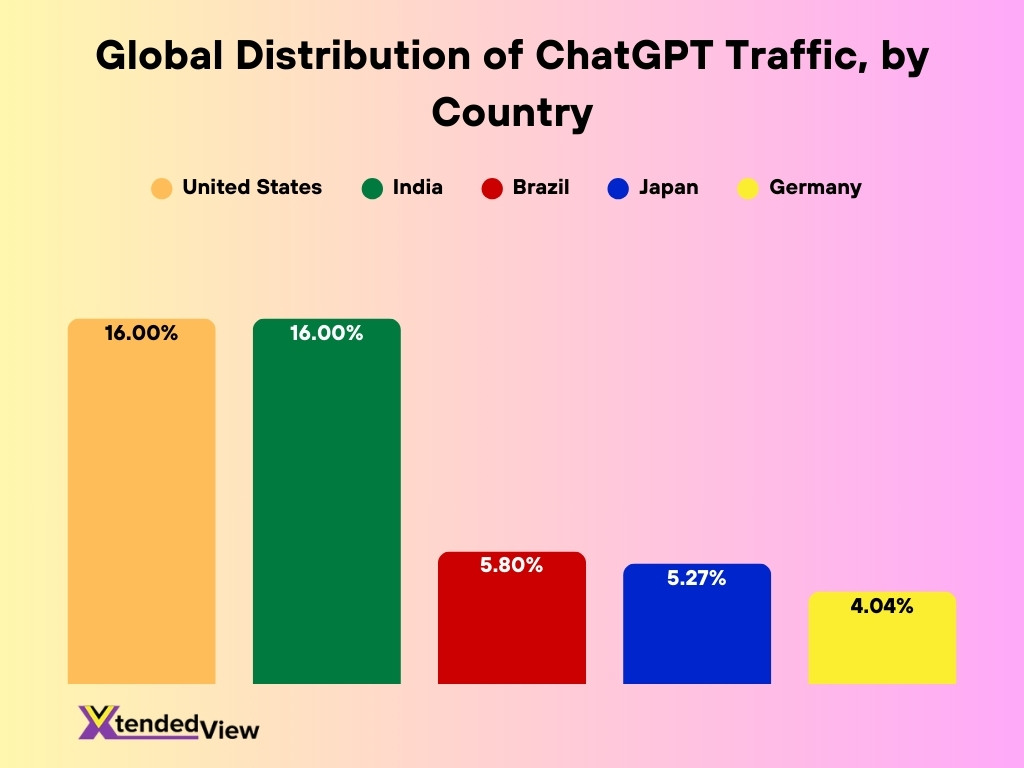
- The United States leads with 16% of global ChatGPT traffic share.
- India ties at 16% ChatGPT visitor share, matching the U.S.
- Brazil contributes 5.8% of total ChatGPT visitors worldwide.
- Japan accounts for 2.9–5.27% of OpenAI usage across sources.
- Germany generates 4.04% of the global ChatGPT user proportion.
- Lower-income countries show 4x faster AI adoption growth than high-income nations.
- India experienced 3x YoY growth in OpenAI AI adoption momentum.
- Emerging markets record the fastest ChatGPT growth rates in 2025.
- Non-U.S. markets drive over 55% of total ChatGPT usage by late 2025.
- Asia features two top countries with India (11.71%) and Japan (5.27%) traffic.
GPT Model Usage and Performance Statistics
- ChatGPT garners 4.61 billion monthly visits worldwide.
- GPT-5 scores 94.6% on the AIME 2025 math benchmark, surpassing GPT-4’s 71%.
- Workers save 40-60 minutes daily using GPT models for productivity.
- ChatGPT handles 2.5 billion prompts daily from 800 million weekly users.
- GPT-5 achieves 74.9% on SWE-bench Verified coding tasks.
- OpenAI projects $13 billion in revenue in 2025, driven by GPT products.
- 71% of enterprises adopted generative AI like GPT models by 2025.
- GPT-5 offers 25x improvement in task complexity over GPT-4.
- Over 80% of Fortune 500 firms have integrated ChatGPT into workflows.
DALL·E Usage and Image Generation Statistics
- DALL·E 3 averages over 22 million monthly active users globally as of Q2 2025.
- DALL·E users generate over 40 million images daily as of July 2025.
- Over 3.1 billion images generated using DALL·E since public release.
- Microsoft Copilot users generated 580 million DALL·E images in H1 2025.
- 1.2 million enterprise API calls made weekly to DALL·E backend.
- 74% of marketing agencies integrated DALL·E into 2024 campaigns.
- 61% of graphic designers used DALL·E or similar tools in the past 12 months.
- 49% of DALL·E users access via ChatGPT Pro integration.
- Shopify’s DALL·E tool was used by 270,000 merchants in Q1 2025.
- 85% of users report being satisfied with DALL·E output quality.
Traffic Sources Breakdown for OpenAI.com
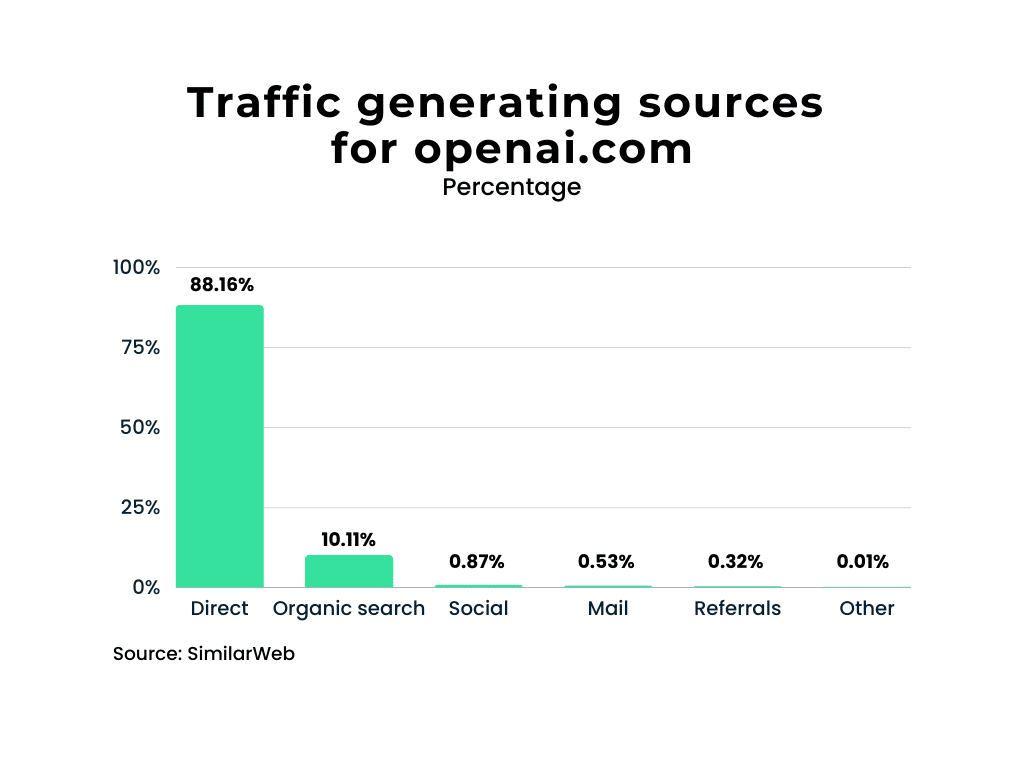
- Direct traffic dominates OpenAI.com, accounting for 88.16% of total visits, indicating strong brand recognition and a high number of users accessing the site directly via URL or bookmarks.
- Organic search is the second-largest source at 10.11%, showing that search engines still play a meaningful role in user discovery.
- Social media traffic contributes only 0.87%, suggesting that social platforms are not a primary driver of visits compared to direct and search channels.
- Email (Mail) traffic represents 0.53%, indicating limited reliance on email campaigns or newsletters for driving site visits.
- Referral traffic stands at 0.32%, showing that relatively few users arrive via external websites or backlinks.
- Other sources are negligible at 0.01%, having minimal impact on overall traffic.
- Overall, the data highlights a highly brand-driven traffic profile, with OpenAI.com relying far more on direct access than on third-party channels.
Sora and Video Generation Usage Statistics
- Sora enables text-to-video generation for short-form AI videos.
- Early versions support clips of up to about 20 seconds.
- 63% of early Sora users identify as creative professionals.
- Use cases include storytelling, advertising, and product demos.
- Sora adoption is strongest among ChatGPT Plus and Business users.
- Video generation aligns with growth in creative AI demand.
- Public usage metrics remain limited, but adoption trends are strong.
- Improvements in realism support wider non-technical use.
OpenAI API Usage and Developer Statistics
- OpenAI API processes 6B tokens per minute on the platform.
- Daily API calls surpassed 2.2 billion in 2025, up from 1.3 billion last year.
- Over 4 million developers have built with OpenAI APIs.
- 2.1 million developers are actively building on the OpenAI platform as of Q2 2025.
- 92% of Fortune 500 companies use OpenAI APIs by mid-2025.
- An average enterprise integrates OpenAI API into 5+ internal apps.
- 28% of API usage from no-code platforms like Zapier and Bubble.
- 70% of new API signups in 2025 will be from outside the United States.
- 85,000 monthly active apps use OpenAI function-calling.
- 148% year-over-year growth in API usage from browser extensions.
OpenAI Enterprise Adoption Statistics
- Over 1 million businesses actively use OpenAI products worldwide.
- ChatGPT Enterprise seats grew 9x year-over-year.
- 7 million ChatGPT for Work seats reached, up 40% in two months.
- Weekly ChatGPT Enterprise messages surged 8x in the past year.
- API reasoning token consumption per organization increased 320x year-over-year.
- Workers save 40-60 minutes daily using OpenAI tools.
- 75% of workers report improved productivity from AI.
- The technology sector AI usage grew 11x year-over-year.
- Healthcare adoption expanded 8x year-over-year.
- Australia saw 187% growth in paying business customers.
Frequently Asked Questions (FAQs)
ChatGPT has around 800 million weekly active users as of 2025, more than double from early 2025 levels.
OpenAI reported an annualized revenue of about $12 billion in 2025, up significantly from 2024.
ChatGPT’s monthly active user count stands at 355 million in 2025.
ChatGPT logged approximately 5.846 billion monthly website visits in August 2025.
Conclusion
OpenAI’s influence spans developers, enterprises, industries, and regions, embedding AI deeply into modern workflows. Tools like Sora signal a shift toward seamless multimodal creation, while ChatGPT and GPT models underpin productivity at a global scale. With over 1 million businesses and hundreds of millions of users engaged weekly, adoption reflects real operational value rather than experimentation alone.
Usage growth across emerging markets, diverse age groups, and professional roles highlights AI’s broad appeal. Together, these statistics show OpenAI’s role not just as a tool provider, but as a foundational layer of the digital economy.
