


Nintendo Co., Ltd. stands at a turning point, marked by both the launch of the new console and shifts in annual performance. The company’s latest figures show a renewed hardware momentum, while its legacy platforms and software libraries continue to play a meaningful role. In practical terms, game developers are aligning their release strategies around Nintendo’s ecosystem, and investors are watching how hardware cycles impact long‑term recurring revenue. Explore the full article below for detailed statistics across Nintendo’s operations.
Editor’s Choice
- Nintendo’s net sales in the dedicated video game platform business increased by 142.5% year‑on‑year, reaching ¥555.5 billion.
- In the April‑June quarter of fiscal 2026, Nintendo recorded revenue of ¥572.636 billion (≈ $3.806 billion), up 132% year‑on‑year.
- Lifetime shipments for the Nintendo Switch platform reached approximately 153.10 million units worldwide as of June 30, 2025.
- The newly launched Nintendo Switch 2 sold over 3.5 million units in its first four days, setting a new company record.
- MacroTrends cites Nintendo’s annual revenue for 2025 at $7.688 billion, representing a 33.35% decline from 2024.
- According to Ampere Analysis, the Switch 2 is forecast to reach 31 million devices in‑market by the end of 2026.
- A consumer survey found that 40.8% of respondents consider the Switch 2 “fair value”, despite pricing concerns.
Recent Developments
- The Switch 2 launched on June 5, 2025, offering upgraded features and commanding a higher price point than its predecessor.
- Nintendo maintained its full‑year forecast of 15 million Switch 2 units for the fiscal year ending March 2026.
- Digital game sales in the April‑June quarter reached ¥69.8 billion, though this marked a 13.5% drop year‑on‑year.
- Mobile and IP revenue rose by 13.6%, reaching ¥16.7 billion in the same quarter.
- Hardware shipments of the Switch 2 exceeded 5.8 million units by the end of June 2025.
- Consumer perception remains positive: only 6.3% of survey respondents considered the console “significantly overpriced.”
- MacroTrends reports a 12.79% year‑on‑year decline in revenue for the 12 months ending June 30, 2025, amounting to $8.896 billion.
- Nintendo’s dedicated video game platform net sales grew to ¥555.5 billion in the first fiscal quarter, underscoring hardware strength.
Console Games Market Growth
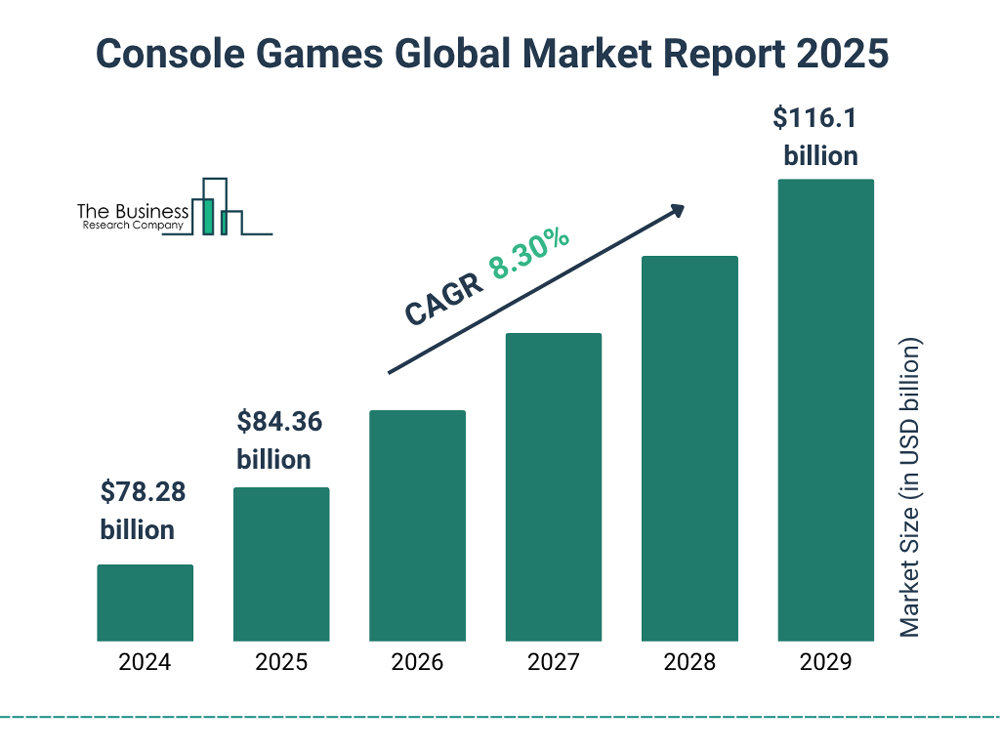
- The global console games market is expected to reach $84.36 billion in 2025, up from $78.28 billion in 2024.
- This represents a year-over-year growth of $6.08 billion from 2024 to 2025.
- The market is projected to grow at a compound annual growth rate (CAGR) of 8.30% from 2025 to 2029.
- By 2029, the market size is forecasted to hit a massive $116.1 billion.
- Between 2025 and 2029, the industry is expected to add over $31.74 billion in market value.
- The rising trend shows consistent annual growth, indicating strong consumer demand and platform innovation.
- This upward trajectory highlights favorable market conditions for major players like Nintendo, Sony, and Microsoft.
- The forecast suggests significant opportunities in digital games, DLCs, and subscription-based ecosystems.
- A CAGR of 8.30% signals a high-growth environment for developers, publishers, and hardware manufacturers.
- The market outlook supports aggressive investment and product expansion strategies through 2029.
Historical Milestones and Achievements
- The original Game & Watch series sold 43.4 million units worldwide.
- The Nintendo Entertainment System revived the U.S. market, selling over 61.91 million units.
- The Nintendo DS remains top with 154.02 million units sold globally.
- The Wii achieved 101.63 million units sold worldwide due to motion controls.
- Nintendo Switch hit 153.10 million units by June 2025.
- The Switch 2 launched in 2025, selling 10 million units in record time.
- Mario has sold over 971.69 million game units, and Pokémon over 489 million.
- Nintendo shifted business focus to recurring digital services and IP licensing beyond hardware.
- Its global reach covers DeNA partnership, theme park deals, and licensing icons outside gaming.
- Nintendo’s total hardware now exceeds 860 million consoles and 5.9 billion games sold globally.
Company Revenue and Financial Performance
- Annual revenue for 2024: $11.536 billion, a 2.67% decline from 2023.
- Annual revenue for 2025: estimated at $7.688 billion, representing a 33.35% decline from 2024.
- For the quarter ended June 30, 2025, revenue stood at ¥572.636 billion (~$3.806 billion), up 132% year‑on‑year.
- Dedicated video‑game platform business net sales: ¥555.5 billion, up 142.5% year‑on‑year.
- Operating income in the April‑June quarter: ¥56.928 billion (~$362 million), up 4.44% year‑on‑year.
- Ordinary income dropped by 15.55% to ¥95.822 billion (~$637 million) in the same quarter.
- Digital game sales (April‑June quarter): ¥69.8 billion, declined 13.5% from the prior year.
- Mobile and IP revenue: ¥16.7 billion (~$111 million), increased 13.6% year‑on‑year.
- The significant drop in full‑year revenue for 2025 reflects the transitional phase between platforms and the timing of launches.
Nintendo Switch Estimated Yearly Sales
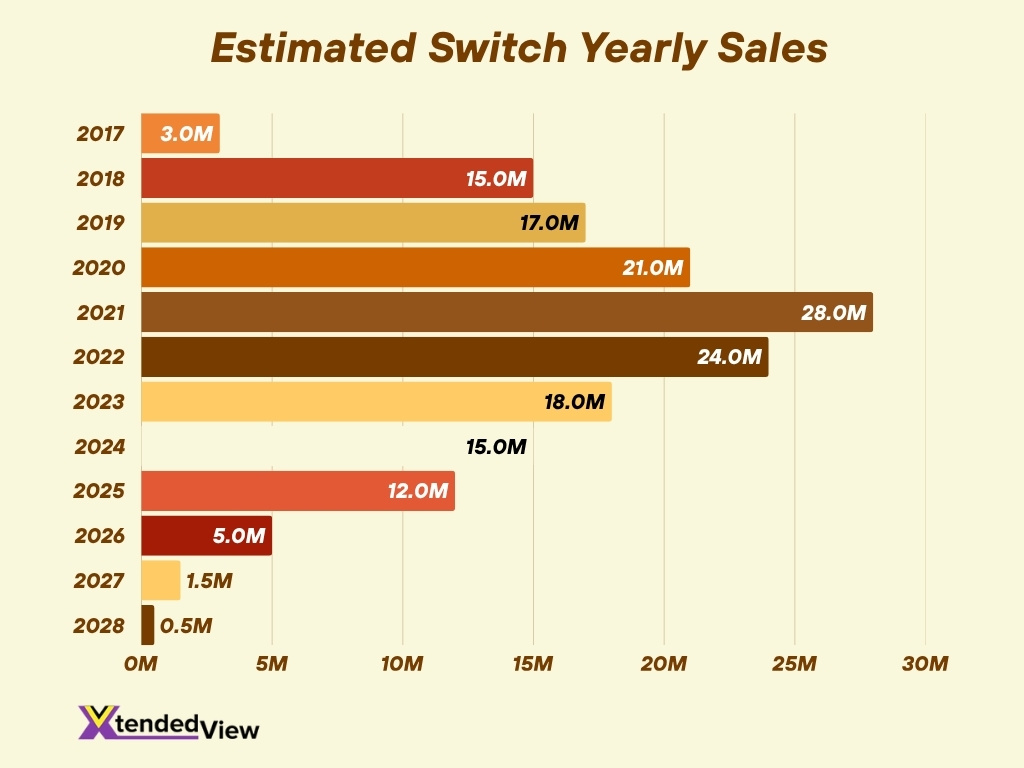
- Peak sales occurred in 2021, with an estimated 28 million units sold, marking the strongest year in the Switch’s lifecycle.
- 2022 followed closely with around 24 million units, showing continued strong demand post-peak.
- The initial growth phase started in 2017 with approximately 3 million units, then surged in 2018 to around 15 million units.
- 2019 and 2020 maintained strong momentum, each exceeding 18–21 million units respectively.
- From 2023 onwards, a steady decline in sales is evident, dropping to 17 million in 2023 and 14 million in 2024.
- In 2025, sales declined further to approximately 12 million units, coinciding with the release of the Switch successor.
- The sharpest drop appears between 2025 and 2026, falling to 5 million units, indicating a generational transition.
- By 2027 and 2028, estimated sales are expected to plummet to under 2 million units combined, signaling product lifecycle closure.
- The data reflects a typical hardware arc, growth, plateau, and decline, with longevity exceeding many console predecessors.
- Nintendo’s ability to extend high-volume sales over nearly a decade underscores the Switch’s success and user engagement.
Nintendo DS Sales Data
- Nintendo DS hardware shipments: Lifetime total reached 154.02 million units worldwide.
- Software units sold: The DS family saw 948.76 million units sold globally.
- The DS ranks as Nintendo’s best-selling handheld and one of the top game consoles in history.
- Dual screens plus touch controls drove wide adoption, especially in the early-to-mid 2000s.
- The figure of 154.02 million units is a benchmark that the Switch aimed to surpass in the 2020s.
- The attach rate for DS games was 6–8 titles per console in its lifetime.
- DS ecosystem supported broad demographics, with strong uptake among non-traditional gamers and for educational titles.
- The DS legacy install base drives content library growth and fuels second-hand market activity.
- Top-selling DS software includes New Super Mario Bros. with over 30.8 million copies, and the Nintendogs series at over 23.9 million units.
- Although not in active production, the DS remains influential for retro gaming and backward compatibility.
Wii Sales Statistics
- Wii hardware shipments: Lifetime total of 101.63 million units worldwide.
- Wii software shipments: Reached 921.85 million units globally.
- At launch, North America and Europe accounted for over 60% of initial sales volume.
- Wii Sports sold approximately 82.9 million units, the highest for any Wii title.
- The Wii remained Nintendo’s best-selling home console until the Switch surpassed it in 2023.
- Motion control gameplay drove widespread adoption, with over 40% buyers outside core gaming markets.
- Wii Fit sold 22.67 million copies, making it one of the top fitness games globally.
- The average software attach rate for Wii was 9.1 games per console.
- Production ended in October 2013, but second-hand sales still contribute millions annually.
- The Wii’s install base remains vital for backward compatibility and digital legacy content today.
Nintendo 3DS Statistics
- Hardware shipments: 3DS family reached 75.94 million units worldwide as of September 30 2025.
- Software units: 3DS has sold 392.29 million units globally.
- Mario Kart 7 is the top-selling 3DS game, reaching 18.99 million units sold.
- Pokémon X/Y combined sales: 16.78 million units.
- The average software attach rate for 3DS is 4.8 games per console, higher than Switch’s 2.4.
- In fiscal year 2025, Nintendo still sold around 270,000 software units for 3DS, despite hardware discontinuation.
- The Nintendo DS sold 154.02 million units, more than double that of the 3DS.
- The Nintendo Switch surpassed 3DS with over 150 million units sold as of mid-2025.
- Digital sales for 3DS soared after physical cartridge production slowed, with some titles getting 67% of sales digitally by 2020.
- The 3DS eShop shutdown occurred in March 2023, but digital software sales remained strong until then.
Game Boy Advance & Game Boy Sales
- The Game Boy Advance sold approximately 81.51 million hardware units worldwide.
- The original Game Boy shipped about 118.69 million units worldwide.
- These platforms laid the groundwork for Nintendo’s long‑term dominance in handheld gaming.
- Software shipments for Game Boy Advance totalled approximately 377.42 million units.
- Software shipments for Game Boy were around 501.11 million units globally.
- The lifetime hardware volumes make both systems among the most successful handheld consoles in history.
- Their success helped establish Nintendo’s IP ecosystem and portable gaming strategy, feeding into later platforms.
- While neither system was active in 2025, their cumulative figures remain part of Nintendo’s historical performance narrative.
Top Selling Nintendo Games
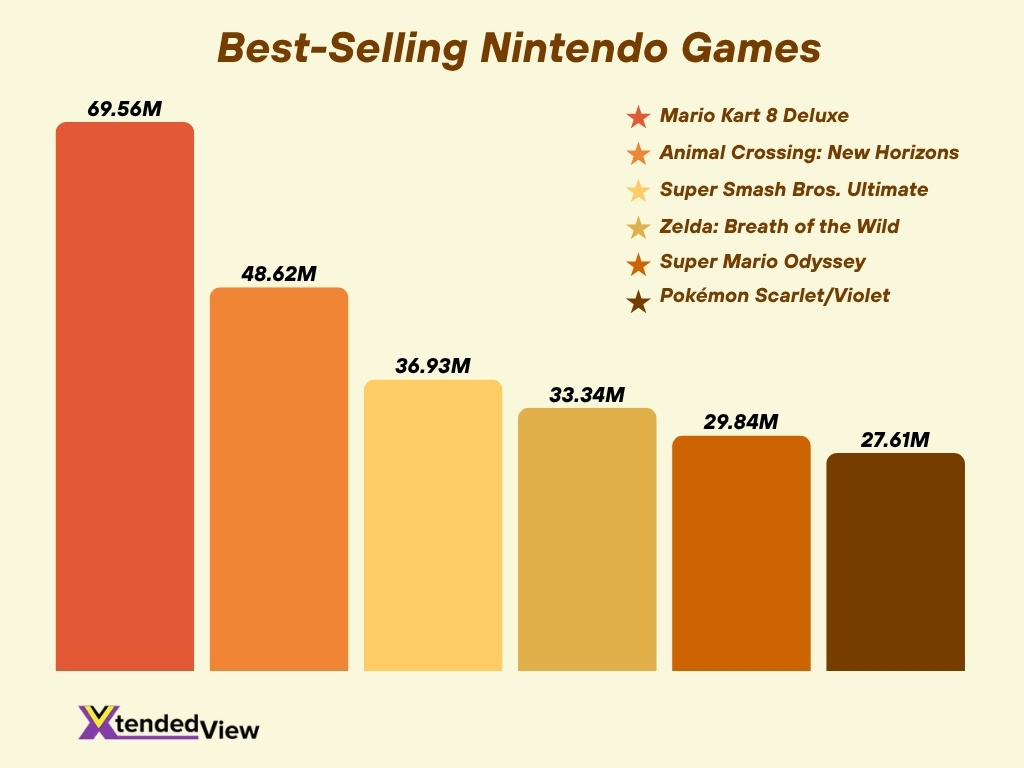
- The game Mario Kart 8 Deluxe has sold approximately 69.56 million copies worldwide as of September 30, 2025.
- Animal Crossing: New Horizons has sold around 48.62 million units globally.
- Super Smash Bros. Ultimate has reached approximately 36.93 million units sold worldwide.
- The Legend of Zelda: Breath of the Wild stands at about 33.34 million copies sold globally.
- Super Mario Odyssey has sold more than 29.84 million units worldwide.
- The franchise Pokémon Scarlet and Violet has sold around 27.61 million copies worldwide.
- These top titles highlight the strength of flagship IPs in driving game sales, independent of hardware.
Best‑Selling Franchises
- The Mario franchise has sold approximately 850.2 million units worldwide as of September 2025.
- The Pokémon franchise stands at roughly 480.7 million units in lifetime sales.
- The Legend of Zelda series is reported to have sold around 130.5 million units as of late 2025.
- The Animal Crossing franchise reached approximately 95.3 million units lifetime in late 2025.
- The Super Smash Bros. franchise has sold around 89.1 million units by September 2025.
- Smaller but notable franchises: the Kirby series has sold more than 50 million units worldwide.
- Combined, the top five Nintendo franchises contribute a significant share of the company’s software revenue and library strength.
- The franchise data underscores how Nintendo leverages enduring IPs rather than purely hardware cycles.
Regional Sales Breakdown
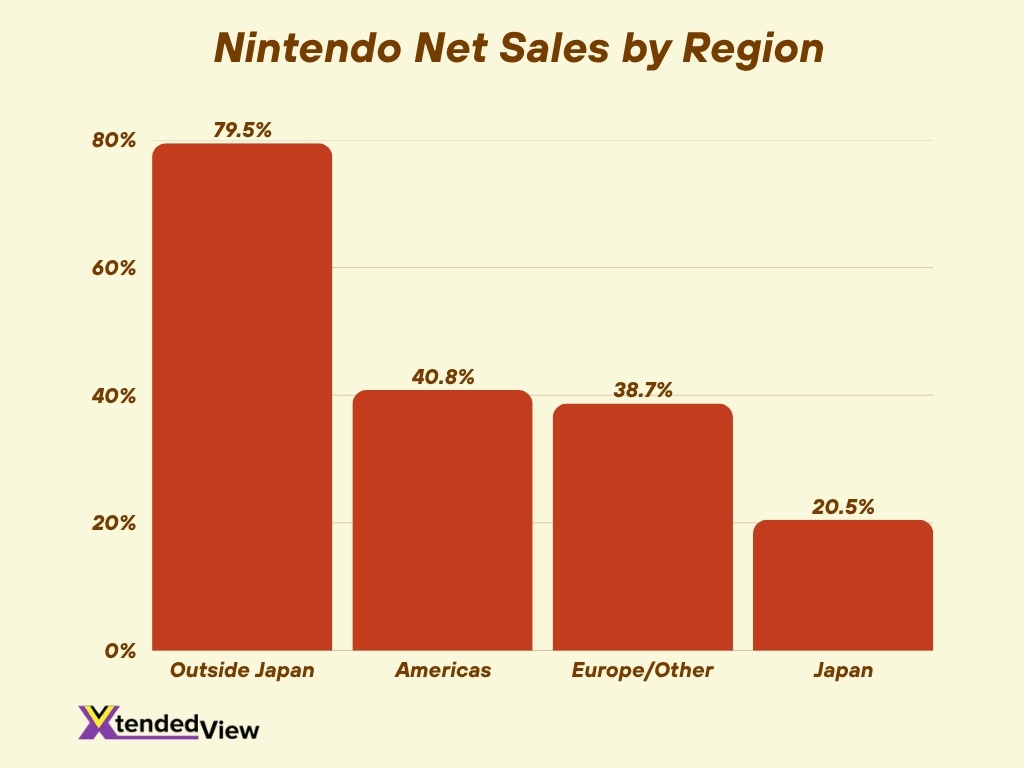
- In the first half of Nintendo’s fiscal year ending March 2026, about 79.5% of net sales came from outside Japan.
- The Americas region accounted for approximately 40.8% of total sales in that same period.
- Europe and “Other” regions made up the remaining ~38.7% of global net sales in that period.
- For software/downloadables on the Nintendo Switch, North America reportedly leads digital adoption, with over 70% of games in that region purchased digitally.
- Digital vs physical purchase trends vary significantly by region; in Japan, physical still dominates (~52% of purchases).
- Global hardware market share: Sony leads with ~45%, followed by Nintendo at ~27%.
- These regional breakdowns highlight the importance of North American and European markets for Nintendo’s growth.
- They also illustrate that shifts in digital vs physical purchasing have strong regional variability.
Digital vs Physical Game Sales
- As of 2025, digital game purchases for Nintendo account for approximately 63% of all game purchases, up from ~57% in 2024.
- In North America, over 70% of Nintendo game purchases are now digital.
- Industry‑wide, downloads/streaming now represent about 95% of game sales versus just 5% physical in aggregate.
- A survey of Switch owners found that the typical library is approximately 52% digital and 48% physical.
- In Japan, collector and retail culture keeps physical purchases at roughly 52% of the total, and physical remains meaningful.
- The shift toward digital benefits Nintendo through higher margin content and recurring services, though it also exposes dependence on network infrastructure.
- The physical‑to‑digital transition presents strategic implications for retail partners, cartridge production, and backward compatibility.
Nintendo Online Services Statistics
- Nintendo Switch Online (NSO) boasts 34 million subscribers as of September 30, 2025.
- 78.66% of Switch owners hold an active NSO subscription per recent player surveys.
- Around 60% of NSO subscribers choose the higher-tier “Expansion Pack” with extra content.
- NSO drives recurring revenue for Nintendo through cloud saves, classic games, and multiplayer services.
- Hardware and software sales increased ~119.7% year-on-year in Nintendo’s first half FY2026, with NSO/digital services supporting the surge.
- NSO’s online membership user base enables robust cross-selling of first-party Nintendo titles and sustained engagement.
- Expansion Pack subscribers increased steadily since 2021, accounting for a majority of overall growth in 2025.
- Nintendo’s digital sales made up 54.5% of total sales in FY2026’s first half, up from 52.4% a year earlier.
- The NSO ecosystem delivers an estimated $2.36/month ARPU, making it a strategic digital platform for Nintendo.
- NSO’s integration with Switch 2 is expected to raise user retention rates by up to 13% after new hardware launches.
Monthly Active Users and User Growth
- 78.66% of Nintendo’s global install base is actively engaged through NSO subscriptions, according to 2025 survey data.
- The global gaming audience will reach 3.32 billion players in 2025, representing all platforms.
- Nintendo Switch’s average attach rate is 9 games per console as of 2025, signaling high user engagement.
- Switch 2 launched with 10.36 million units sold worldwide in under four months, boosting Nintendo’s ecosystem.
- Nintendo reported ¥1,066.1 billion net sales from dedicated gaming platforms in H1 FY26, reflecting robust user growth.
- NSO subscriptions hit 42 million globally by Q1 2025, up from 39.5 million in 2024, with 35% choosing the Expansion Pack tier.
- NSO members average 7.8 hours/week online play, and 93% use cloud saves, indicating healthy engagement and platform loyalty.
- In the US, Nintendo accounts for 45% of all NSO subscribers, with Europe at 22% and Japan at 18%.
- Subscription revenue per NSO user is $2.36/month, slightly below rivals but offset by scale.
- Switch family software attach rate rose to 9.24 by mid-2025, reinforcing user activity and spending.
Console Market Share
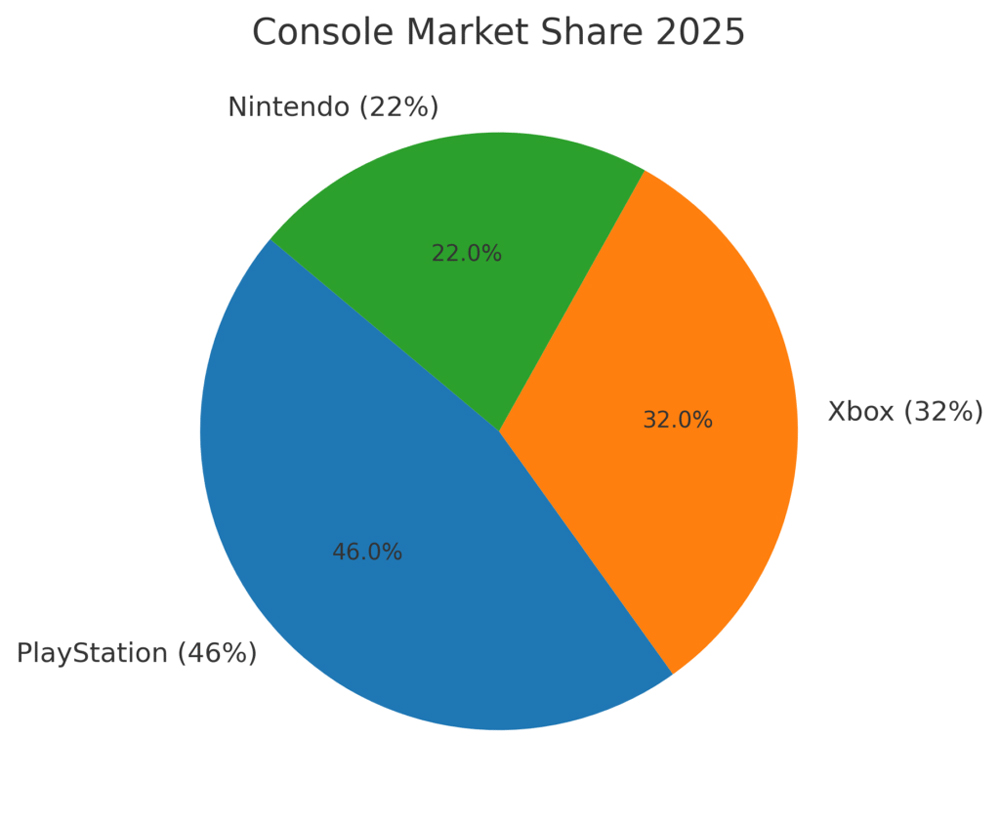
- PlayStation leads the global console market in 2025 with a dominant 46% share.
- Xbox holds the second position with a competitive 32% market share.
- Nintendo trails in third, accounting for 22% of the total console market.
- The gap between PlayStation and Nintendo is 24 percentage points, highlighting a substantial lead.
- Combined, PlayStation and Xbox control 78% of the market, showcasing their strong competitive hold.
- Nintendo’s 22% share reflects a decline from prior years, when it neared Xbox’s market presence.
- The pie chart indicates a polarized market, with Nintendo facing pressure to innovate to gain ground.
- PlayStation’s nearly half-market dominance suggests strong first-party titles and a loyal user base.
- Xbox’s 32% share underscores its growing ecosystem with Game Pass and hardware performance advantages.
- Nintendo’s future growth strategy may depend on expanding Switch 2 adoption and deepening digital engagement.
Future Projections and Trends
- Nintendo raised its Switch 2 sales forecast to 19 million units for the fiscal year ending March 2026, up from the original 15 million units projection.
- The company increased its Switch 2 game forecast from 45 million to 48 million new titles expected to be sold in the same period.
- The global gaming market is projected to reach $733.82 billion by 2031, growing at a CAGR of 13.40% from 2024.
- Digital game sales accounted for 83% of console games sold in 2023, leaving only 17% as physical copies, with the trend accelerating further in 2024.
- Nintendo Switch Online subscribers reached over 34 million globally as of September 2024, generating $1.19 billion in revenue with a 19% year-over-year increase.
- Nintendo generated nearly $2.2 billion in revenue across nine mobile games, with mobile and IP-related business contributing $453 million in the recent fiscal year.
- The subscription-based gaming market is expected to reach $17.46 billion by 2029, growing at a CAGR of 9.84% from $10.92 billion in 2024.
- Tariff risks could increase console prices by approximately $100 per unit with 25% tariffs, impacting 96% of gaming consoles imported to the U.S. from China.
- Nintendo’s active Switch install base stood at approximately 105 million consoles in active use by the end of 2024, providing a strong foundation for Switch 2 adoption.
- Digital distribution now accounts for 95% of all game sales globally when including PC games, with physical media declining to just 5% of total sales.
Frequently Asked Questions (FAQs)
The Switch 2 has sold 10.36 million units worldwide as of September 30, 2025.
Approximately 79.5% of Nintendo’s net sales for that period came from outside Japan.
Nintendo raised its sales target for the Switch 2 to 19 million units for the fiscal year ending March 2026.
The Switch family is reported at approximately 153.10 million units worldwide as of June 30, 2025.
Nintendo reported overall net sales of ¥1,099.5 billion, which translates to roughly $$6.2 billion, for the period ending September 30, 2025.
Conclusion
Nintendo Co., Ltd. continues to demonstrate the strength of a diversified video‑game ecosystem: iconic franchises delivering lifetime sales, a healthy shift to digital game consumption, robust regional performance outside Japan, and growing subscriber‑based services anchoring long‑term engagement.
While hardware cycles drive headline figures, the transition to digital and service‑oriented models will shape Nintendo’s next chapter. With the Switch 2 launch and strong first‑party titles on the horizon, the company is positioned for sustained relevance, though execution will be critical. For a full breakdown of every segment, dive into the article above.
