



The cloud‑computing platform Microsoft Azure stands at a pivotal moment: it’s no longer just part of the cloud conversation; it’s a major force in enterprise IT. From powering corporate digital‑transformation initiatives to underpinning AI workloads for healthcare providers and financial services firms, Azure’s reach is vast. For example, global retailers are leveraging Azure’s scalability to handle seasonal spikes, and manufacturing companies are relying on Azure to run industrial IoT operations. The numbers ahead illustrate how Azure is shaping the cloud landscape.
Editor’s Choice
- Azure surpassed US $75 billion in annual revenue in fiscal year 2025, up around 34% year‑over‑year.
- Azure held about 20–22% of the global cloud infrastructure services market in Q2 2025, placing it second behind AWS.
- In Q1 2025, Azure achieved roughly 22% market share and + 21% revenue growth year‑over‑year.
- Microsoft’s Intelligent Cloud segment (which includes Azure) generated $26.8 billion in revenue in Q3 2025, up 21% YoY.
- Azure customer base grew from 157,000 to 193,000 between 2023 and 2024 ( 23% growth).
- Around 78% of Azure customers spend less than USD 1,000 per month, indicating broad SMB participation.
- Azure is used by approximately 85% of Fortune 500 companies, reflecting strong enterprise penetration.
Recent Developments
- In MS FY 2025 Q4, Azure revenue growth was guided at approximately. 37% in constant currency for Q1, reflecting strong demand.
- Azure and other cloud services revenue rose 39% YoY in the Q4 earnings call, ahead of expectations.
- Microsoft announced it now operates over 400 datacenters across more than 70 regions, making every Azure region “AI‑first”.
- The company scaled more than 2 gigawatts of new data‑centre capacity in the past 12 months.
- Azure’s partnership with OpenAI and the rollout of the GPT‑4 O family of models contributed to inference‑token efficiency improvements of 90% YoY.
- Capital expenditure has surged; Microsoft’s AI‑infrastructure spend is a major driver behind Azure’s readiness for large‑scale workloads.
- Capacity constraints remain a challenge, even as Azure adds infrastructure, demand continues to exceed immediate supply.
- Azure’s non‑AI cloud workloads showed decelerated growth compared to AI‑driven segments, indicating a workload mix shift.
Azure Market Share
- In Q2 2025, Azure captured 20% of the global cloud infrastructure market, down from 23% in Q2 2024.
- Some reports peg Azure at 21–22% market share as of Q1 2025.
- Another data point shows Azure at 23% market share in Q1 2025, per Canalys.
- The top three providers (AWS + Azure, + Google Cloud) accounted for about 63% of the global market in Q1 2025.
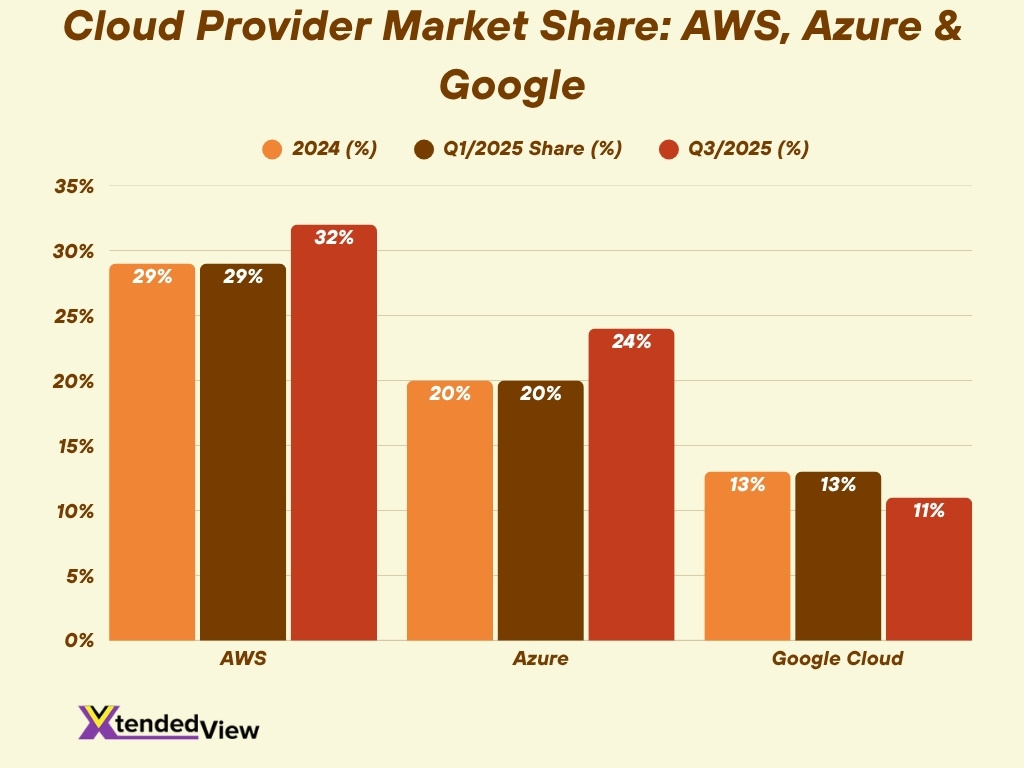
- In a recent quarter, AWS 29%, Azure 20%, and Google 13%.
- At the end of 2022, Azure’s share was 23%.
- CAGR for cloud infrastructure remains above 20%, supporting Azure’s share‑growth potential.
- Azure’s share is trending modestly lower in the near term due to increased competition in AI and infrastructure.
Microsoft Cloud Revenue Growth
- Strong Upward Trend:
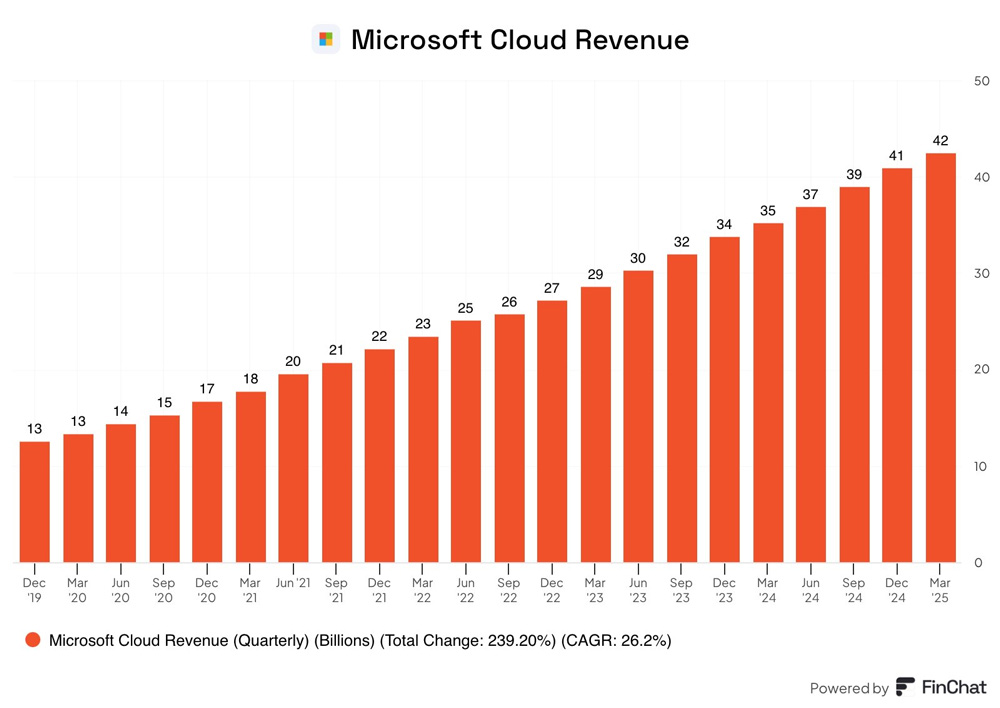
- Microsoft Cloud revenue increased from $13 billion in December 2019 to $42 billion in Mar 2025, showing consistent quarterly growth.
- Total Growth:
- Over the observed period, the revenue grew by an impressive 239.2%, reflecting sustained market expansion.
- Compound Annual Growth Rate (CAGR):
- The CAGR stands at 26.2%, indicating robust long-term performance across multiple years.
- Yearly Milestones:
- 2020: Revenue rose from $13B to $17B, despite global economic uncertainty.
- 2021: Continued momentum with growth to $22B by year-end.
- 2022: Surpassed $26B, maintaining double-digit quarterly growth.
- 2023: Crossed the $30B mark, ending the year at $34B.
- 2024–2025: Expected to reach $42B by Mar 2025, demonstrating ongoing scalability.
Azure Customer Base
- Azure’s customer base reached nearly 350,000 businesses by 2024, with 14.2% growth from 2023.
- Between 2023 and 2024, the Azure customer count grew from 157,000 to 193,000 (23% growth).
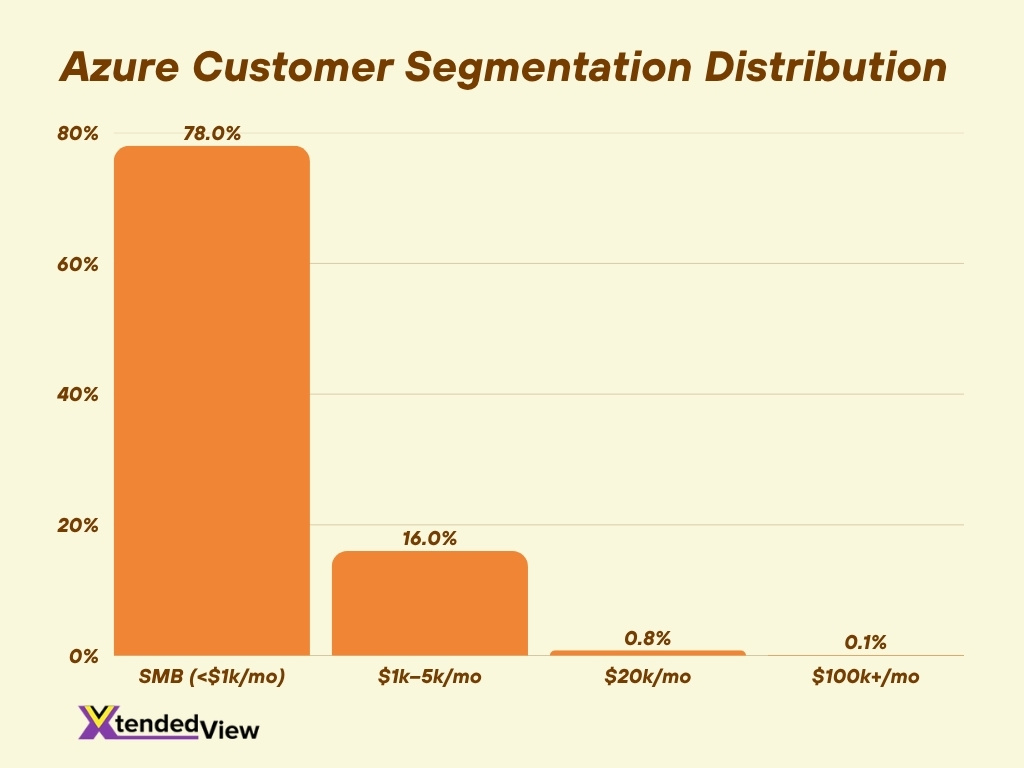
- 78% of Azure customers spend less than USD 1,000 per month, indicating wide SMB usage.
- 16% spend between $1,000‑5,000/month, 0.8% spend $20,000/month, 0.1% spend over $100,000/month.
- Azure is used by 85% of Fortune 500 companies.
- In 2024, more than 130,000 Azure buying organizations were identified in North America and EMEA.
- 36% of Azure customers also use another leading cloud provider alongside Azure.
- Startup segment growth in Azure’s customer base was 23% YoY, higher than mid‑market and large enterprise rates.
Azure Adoption Growth Rate
- Azure and related services reported 33% year‑over‑year growth in Q1 2025, with AI contributing 12 percentage points.
- In Q2 FY 2025, Azure grew 31% YoY in constant currency.
- For FY 2025, Azure revenue exceeded $75 billion, up 34% from the prior year.
- 46% of organizations report running significant workloads on Azure.
- 94% of enterprises use cloud services, with Azure benefiting from this trend.
- Azure is doubling down on AI‑driven workloads, outpacing non‑AI growth.
- 89% of organizations use multiple public clouds, aiding Azure’s multi‑cloud appeal.
- As infrastructure constraints ease, Azure’s growth rate may further accelerate.
- Azure base is expanding fastest in start‑up and mid‑market segments (22‑25% growth).
- 67% of CIOs cite cloud cost control as the top priority, supporting Azure migration.
Azure Subscribers by Industry
- 65% of Fortune 500 companies engage with the Azure + OpenAI ecosystem.
- 98% of financial services organizations use some cloud services, and many choose Azure.
- The BFSI vertical held 26% of cloud revenue in 2024, with Azure competing strongly.
- 79% of micro‑businesses are cloud‑only; larger firms prefer hybrid via Azure.
- 78% of smaller customers spend under $1,000/month, showing Azure’s SMB reach.
- Azure’s AI and security attract healthcare firms with double-digit growth in adoption.
- Retail firms using Azure cite 14% annual growth in cloud workloads.
- Start‑ups and mid‑markets are growing at 23% YoY in Azure’s base.
- 36% of Azure customers use another major provider, indicating cross-industry adoption.
- The Azure consulting market is growing at 18.5% CAGR from 2024‑2030.
Azure Geographic Distribution
- Regional Leaders:
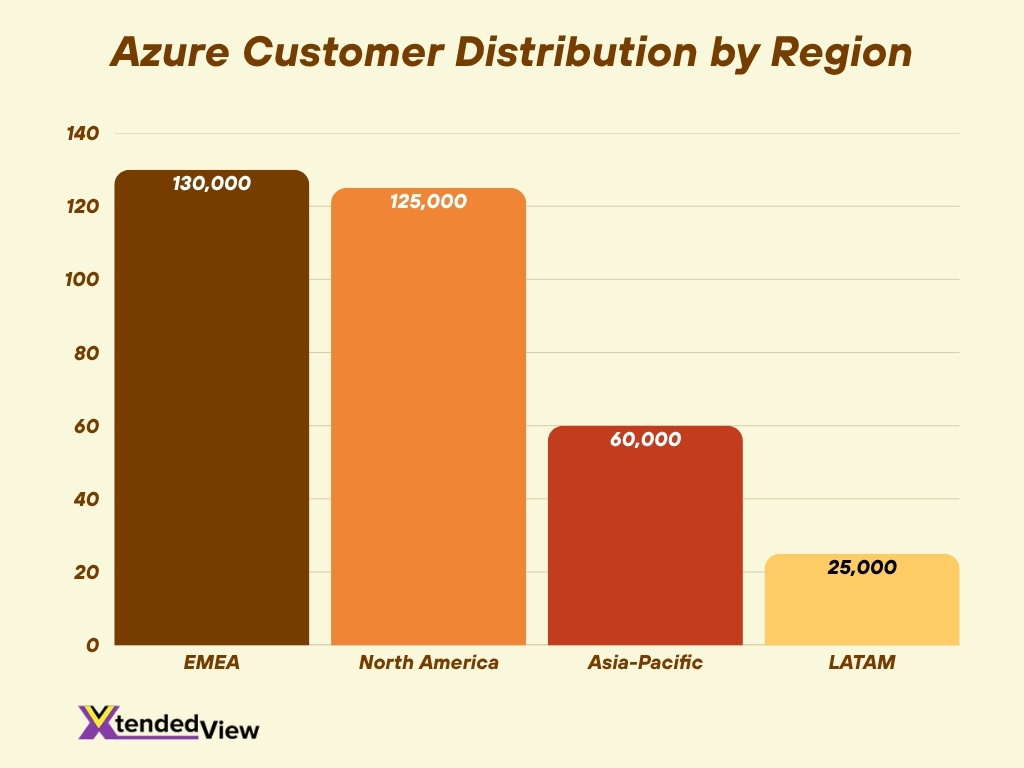
- EMEA (Europe, the Middle East, and Africa) leads with approximately 130,000 customers, making it Azure’s largest regional market.
- North America follows closely with around 125,000 customers, highlighting strong adoption in the U.S. and Canada.
- Emerging Markets:
- Asia-Pacific (APAC) accounts for roughly 60,000 customers, showing steady growth potential in markets like India, Japan, and Australia.
- LATAM (Latin America) trails with about 25,000 customers, but presents expansion opportunities for future Azure penetration.
Azure Enterprise Usage
- Azure is used by about 85% of Fortune 500 companies.
- AI‑enabled workloads on Azure grew 39% YoY in Q4 FY 2025.
- 78% of Azure customers spend under $1,000/month, but the top tier spends over $100,000/month.
- Azure Arc and Stack support hybrid workloads for large firms.
- 36% of Azure customers also use another major provider in multi‑cloud setups.
- Enterprises value Azure’s integration with Microsoft 365, Teams, and Windows Server.
- The Azure consulting market is growing at 18.5% CAGR, showing enterprise demand.
- Enterprise workloads include AI/ML, data analytics, IoT, and mission‑critical apps.
- Azure gains traction in regulated industries with high‑compliance workloads.
- 67% of CIOs prioritize cloud cost-optimization, influencing Azure usage patterns.
Azure vs. Competitors (AWS, Google Cloud)
- In Q3 2025, the combined share of Amazon Web Services (AWS), Microsoft Azure, and Google Cloud in global enterprise cloud infrastructure services was about 62%.
- In Q1 2025, those three providers captured approximately 63% of the global market.
- AWS held a roughly 29% share in Q1 2025, representing the market leader position.
- Azure held approximately 20% share in Q3 2025, securing the second‑largest provider slot.
- Google Cloud posted around a 12–13% share in 2025, continuing as the third‑largest cloud provider.
- Analysts estimate AWS had between 31‑32% in 2024, with Azure around 23‑24%, and Google Cloud around 11%.
- The “Big Three” together continue to dominate, leaving less than 40% of the infrastructure market to all other providers.
- Although AWS leads in absolute size, Azure’s year‑over‑year growth rate has often outpaced AWS in selected quarters.
- Growth momentum in AI‑centric workloads gives Google Cloud a faster growth trajectory, even as its share remains lower than Azure’s.
Azure Products and Services Statistics
- As of 2025, Azure offers more than 5,379 distinct services and products, particularly in AI/ML and cloud infrastructure.
- Azure supports offerings across IaaS, PaaS, and SaaS, spanning computing, storage, networking, analytics, and AI.
- The Azure product catalogue includes compute (e.g., Virtual Machines), storage (Blob Storage, Files, Data Lake), database and networking services, developer tools, and AI/ML solutions.
- The Azure services portfolio is available across 70+ regions, supporting global scale and geographic reach.
- Azure integrates with Microsoft’s broader ecosystem, including Microsoft 365, GitHub, Power BI, and developer tooling, increasing service uptake.
- Many enterprises using Azure cite the “single pane of management” and hybrid‑cloud extend‑to‑edge capability as key service differentiators.
- Azure’s service usage is growing fastest among AI, analytics, and hybrid‑cloud support services, rather than basic lift‑and‑shift workloads.
- The product‑and‑services mix shift indicates that value‑added services (AI/ML, analytics, edge) are contributing an increasing share of Azure usage.
- Azure’s developer‑centric tools (DevOps, GitHub integration, serverless compute) are driving adoption in start‑ups and mid‑market segments.
- The breadth of Azure’s service catalogue assists cross‑selling and “stickiness” of existing customers, helping expansion within organizations already committed to Microsoft.
Azure Artificial Intelligence (AI) Integration
- Azure AI Foundry supports over 60,000 customers.
- Azure AI has an annualized run‑rate of $13 billion, up 175% YoY.
- Enterprise generative AI adoption reached 75% in 2024, up from 55% in 2023.
- 46% of organizations use AI agents, 52% in Switzerland automate entire processes.
- Over 1,000 real‑world transformation stories show Azure AI’s impact.
- Azure is named a Leader in the 2025 Gartner MQ for Data Science & ML Platforms.
- AI workloads added 13 percentage points to Azure’s Q2 growth.
- Azure integrates both in-house and OpenAI models for flexibility.
- Microsoft published its 2025 Responsible AI Transparency Report.
Azure Data Center Expansion
- Azure operates 400+ datacenters across 70+ regions.
- Microsoft expanded data‑center capacity by 2 gigawatts in FY 2025.
- US $80 billion committed to AI‑ready datacenter infrastructure in 2025.
- Global AI data‑center demand projected at 33% CAGR from 2023 to 2030.
- 33% of global data‑center capacity in 2025 will be dedicated to AI.
- Azure adds more availability zones and edge nodes for compliance needs.
- Microsoft is investing US $7 billion in a new Wisconsin datacenter site.
- Expansion enables support for high‑performance, compliance‑sensitive workloads.
Azure Cloud Storage Statistics
- Global data expected to reach 200 zettabytes by 2025, 50% in the cloud.
- 70% of cloud storage is object storage.
- Azure offers Blob Storage, Files, and Data Lake Gen2 for broad use cases.
- Azure’s AI integration boosts storage adoption.
- Cloud storage enables cost and scalability optimization for enterprises.
- Hybrid (edge + cloud) storage is rising amid compliance needs.
- Azure storage tools improved for faster, large‑scale data migrations.
- Demand driven by IoT, analytics, and AI requires high‑volume storage.
Azure Hybrid Cloud Statistics
- Azure is named a Leader in the 2025 Gartner MQ for Distributed Hybrid Infrastructure.
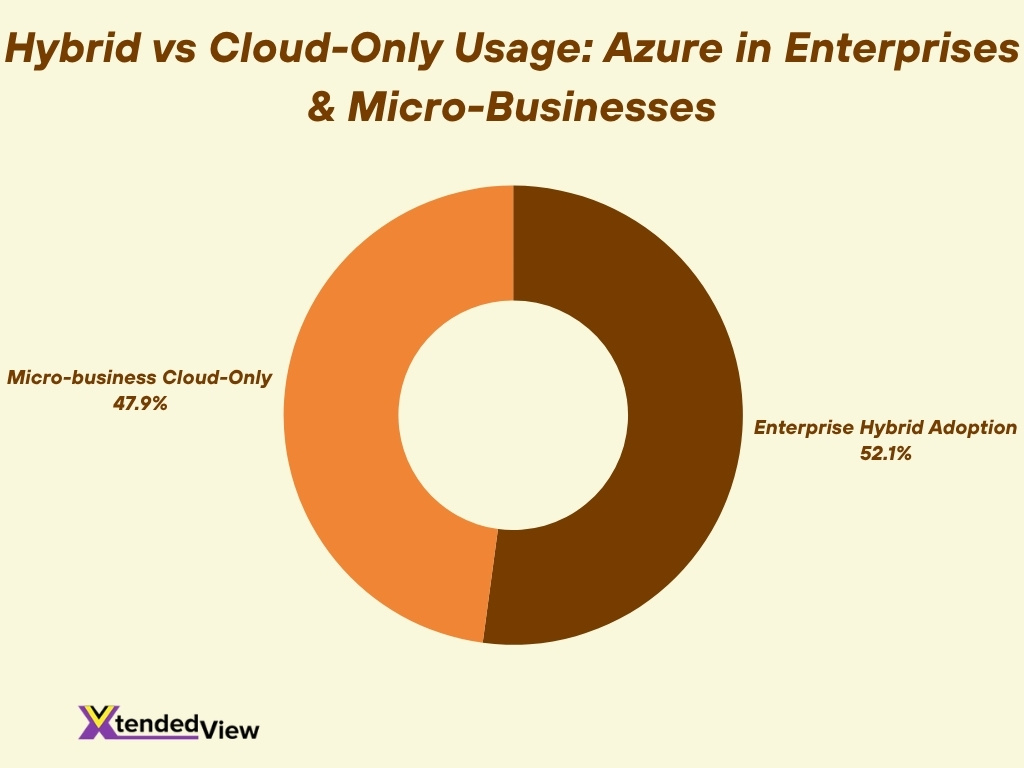
- 86% of enterprises use hybrid, while 79% of micro‑businesses go cloud‑only.
- The hybrid model appeals to regulated industries needing on‑prem data.
- Azure Arc allows unified hybrid management across cloud, on‑prem, and edge.
- Key motivations: legacy integration, data sovereignty, edge use cases.
- Hybrid helps reduce latency and meet compliance goals.
- Many firms use Azure in multi‑cloud + hybrid strategies.
- Adoption grows as firms modernize post lift‑and‑shift migrations.
Azure Security Statistics
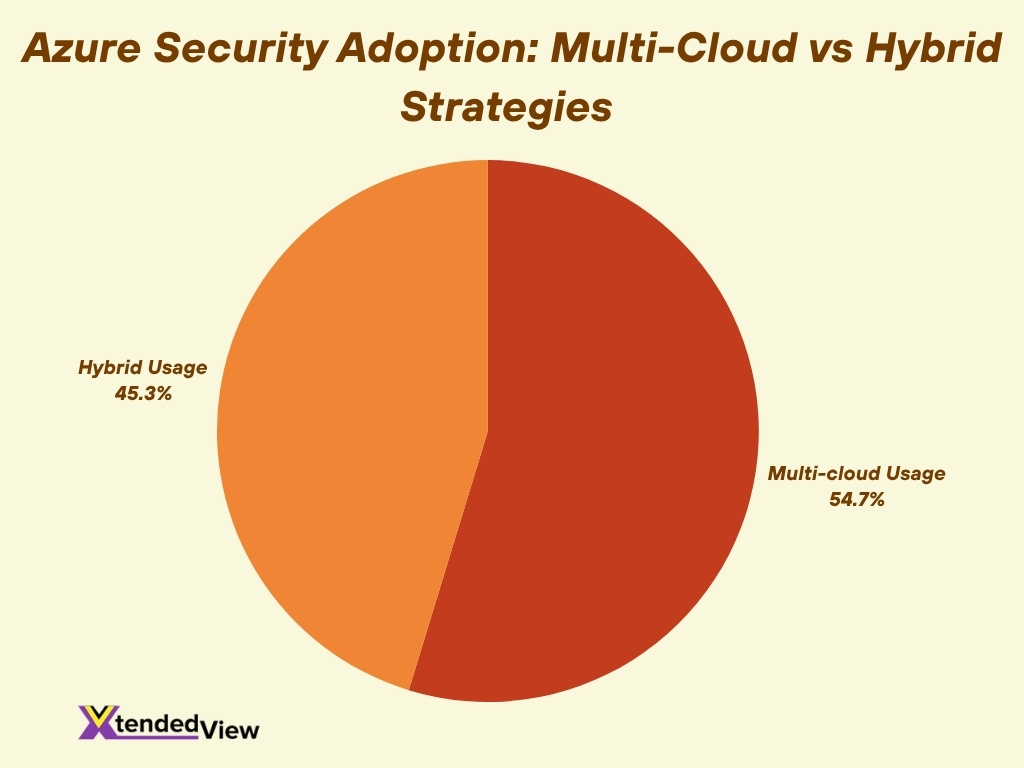
- 87% of organizations use multi‑cloud, 72% hybrid, raising security needs.
- Cloud security is a top enterprise concern into 2032.
- Azure embeds security across storage, AI, and hybrid services.
- Microsoft deployed custom security chips on Azure servers to fight cybercrime.
- Azure attracts finance and healthcare due to its high compliance standards.
- AI analytics power Azure’s threat detection systems.
- Azure offers zero‑trust architecture, encrypted compute, and identity controls.
- Cloud security is central to digital transformation planning.
Azure Sustainability and Eco Initiatives
- Microsoft commits to protect more land than it uses in datacenter expansion.
- Azure uses renewable energy and efficient cooling across its footprint.
- 600,000 km of network fibre, 190+ PoPs optimize Azure’s energy use.
- AI datacenters prioritize power efficiency and sustainable design.
- Azure edge options reduce load on central data centers.
- Azure helps customers achieve ESG compliance with built-in tools.
- Scale allows Azure to negotiate large renewable and carbon-offset contracts.
Azure Cloud Migration Trends
- Azure Migrate will be updated in 2025 to support full cloud transformation.
- Migration brings efficiency, innovation, and scale.
- Hybrid and multi‑cloud dominate enterprise strategies with Azure as the core.
- Azure migration reduces capex and enables pay-per-use pricing.
- Governance and skills are key migration challenges.
- Post‑migration phases focus on AI, hybrid, and modernization.
- Regulated industries are now moving mission‑critical workloads to Azure.
- Expansion and AI growth reduce migration hesitation risks.
Frequently Asked Questions (FAQs)
Microsoft reported that Azure’s annual revenue surpassed US$75 billion, up 34 % year‑over‑year.
Azure held about 20 % of the global cloud infrastructure services market in Q2 2025.
Azure and related cloud services revenue grew by approximately 33 % year‑over‑year in Q3 2025.
UBS projected Azure revenue would reach around $83.3 billion, with a growth rate of about 28.6% YoY.
Together, they captured about 63% of the global enterprise cloud infrastructure services market in Q1 2025.
Conclusion
Microsoft Azure is firmly positioned at the intersection of cloud, AI, hybrid cloud, and sustainability. Its rapid growth in AI integration, expansive data‑centre build‑out, enhanced storage and hybrid‑cloud capabilities, strong security investments, and migration momentum all reflect a mature cloud platform evolving into an enterprise digital‑transformation engine.
Whether your organization is moving workloads, extending AI capabilities, or refining a hybrid‑cloud strategy, Azure offers deep resources and global scale. Dive into the data above and see how Azure’s statistical trajectory aligns with your cloud journey.
