


The rise of internet addiction is becoming a major focus for behavioral health and digital‑wellness research. From the workplace to the classroom, excessive online engagement is affecting productivity, emotional well‑being, and social dynamics. Real‑world examples include companies seeing drops in employee performance due to non‑work internet time, and colleges reporting rising support‑service demand for students struggling with compulsive online use. Explore the full article to understand how this trend is evolving and what the data reveal.
Editor’s Choice
- Approximately 14% of U.S. adults had definite or severe internet addiction in a pandemic‑era study.
- A global meta‑analysis found a 14.22% pooled prevalence of internet addiction (general population).
- Worldwide, an estimated 210 million people may suffer from social media and internet addiction by 2025.
- In 2025, around 21.8% of internet users globally show signs of moderate to severe internet addiction.
- Among university students worldwide, the prevalence of internet addiction is about 41.84% (95% CI: 35.89‑48.02).
- The U.S. survey shows that about 48% of internet users feel they are addicted to digital devices.
- Global pooled prevalence for smartphone addiction is 26.99% (95% CI: 22.73‑31.73).
Recent Developments
- A U.S.-based study in 2023-24 found 41% of adults were “probable addiction or risk” and 14% had definite/severe internet addiction.
- Research shows the COVID-19 pandemic period marked an uptick, with one Chinese sample showing 36.7% prevalence (33.9% moderate, 2.8% severe).
- A worldwide review highlights that pre-pandemic estimates (U.S. general population) ranged from 0.3% to 8.2%, underlining a sharp increase.
- Countries are implementing public-health responses, e.g., in late 2024, the government of Greece launched a national strategy to protect minors from internet addiction.
- The average American adult now reports 7.6 hours per day of screen/internet time in 2025.
- Digital-wellness clinics are emerging globally as services respond to rising behavioral addiction demands.
- Industry analysts note that “digital device addiction” is increasingly discussed alongside substance and gambling addictions in public health circles.
Global Prevalence of Internet Addiction
- A systematic review covering over 2 million people across 64 countries found the pooled prevalence of internet addiction at 14.22% (95% CI: 12.90‑15.65).
- Another meta-analysis among university students globally found prevalence at 41.84% (95% CI: 35.89‑48.02).
- Prior estimates for the general population ranged from 1% to 21.3% in Europe, and 0.3% to 8.2% in the U.S. before major pandemic shifts.
- A 2025 forecast estimates that 21.8% of internet users worldwide show moderate to severe signs of internet addiction.
- In 2024, technology-addiction data suggest over 35% of people may meet criteria for internet-addiction behaviours.
- Some sources project global internet and social media addiction numbers reaching 210 million individuals.
- Variability remains high across regions and measurement tools, complicating exact comparisons.
Internet Addiction Risk by Age Group
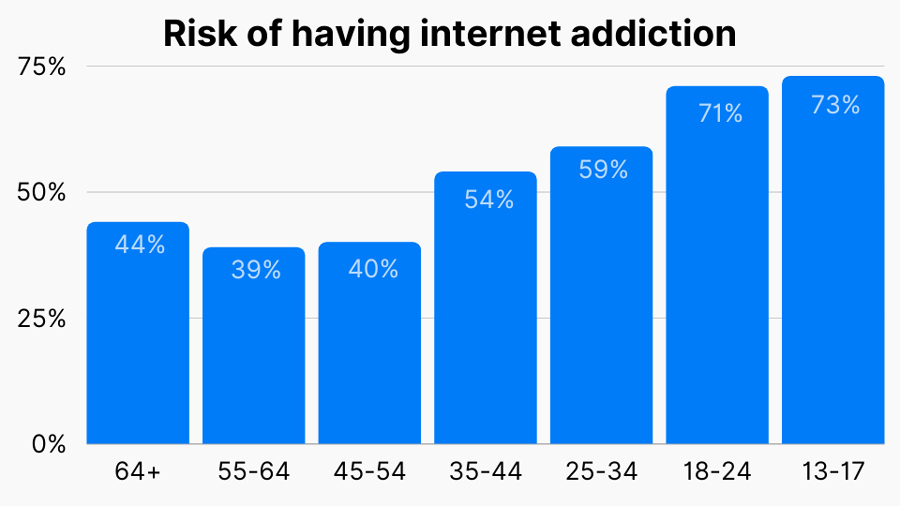
- The highest risk appears among teenagers aged 13–17, with 73% showing signs of potential internet addiction.
- Young adults between 18 and 24 follow closely at 71%, indicating that late adolescence and early adulthood are the most vulnerable years.
- The 25–34 age group still has a notable risk, with 59% potentially affected, showing that addiction concerns extend well into early career stages.
- Adults aged 35–44 show reduced risk but still significant at 54%, marking a moderate decline as age increases.
- Mid-life adults 45–54 have a lower rate of 40%, suggesting internet dependence continues to decrease through this stage.
- Individuals aged 55–64 show further decline, with 39% at risk, roughly half the rate seen in teenagers.
- Seniors 64+ display a 44% risk, slightly higher than the two preceding age groups, possibly due to increased online engagement in recent years.
Internet Addiction by Gender
- Some studies show women are approximately twice the risk of men to be addicted to men in certain cohorts.
- A review noted global smartphone addiction at ~27% and social-media addiction at ~17.4%; gender breakdowns varied markedly.
- In U.S. data, about 10% of social media users are addicted, with women showing slightly higher self-reported numbers.
- Other regional studies show male youth traditionally had higher internet-gaming addiction, but gender gaps are narrowing in general online addiction.
- Pre-pandemic European surveys estimated male prevalence around 1.5‑8.2%, but gender-specific data were limited.
- Some research indicates female users increase the severity of internet-addiction risk when combined with certain stressors.
- Higher internet-use risk among women may link to social-media patterns, while in men, more often, gaming/interactive use dominates.
Geographic Breakdown of Internet Addiction
- In the U.S., before the pandemic, estimates of internet-addiction prevalence ranged from ~0.3% to ~8.2% in general population surveys.
- Asia reported higher adolescent rates, e.g., in China, 8.1‑31.0% in various studies.
- One Americas-based survey found in a sample, no addiction 45%, probable addiction 41%, definite/severe 14%.
- Global meta-analysis across 64 countries placed internet addiction general population prevalence at ~14.22%.
- In low- and middle-income countries, some specific student/cohort studies show rates >20%.
- In Europe, prevalence estimates varied regionally from 1% to 21.3%.
- Access and internet‑penetration level correlate strongly with higher addiction-risk rates in many countries.
Internet Addiction Among Students and Teenagers
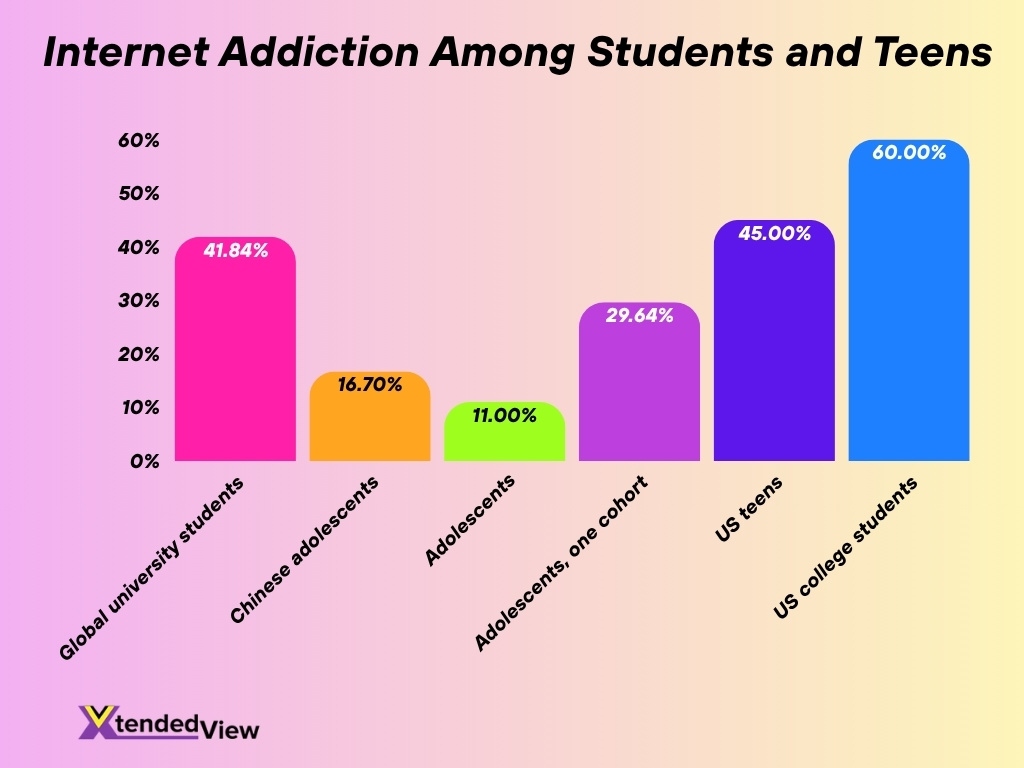
- A meta-analysis of university students reported a pooled prevalence of 41.84% (95% CI: 35.89‑48.02) for internet addiction globally.
- In a study of adolescents aged 13‑18 in China, 16.7% exhibited physical-mental multimorbidity associated with excessive internet use (≥ 2 hrs/day).
- Among adolescents, more than 1 in 10 (11%) showed signs of problematic social media behaviour, including loss of control and negative consequences.
- Research on adolescents found a prevalence of 29.64% for internet addiction in one cohort.
- In a U.S.-based survey, 45% of teens said they spend too much time on social media, up from 36% in 2022.
- Teenage girls averaged 5.3 hours/day on social media compared with 4.4 hours for boys.
- Among U.S. teens aged 18‑22, self-reported social-media addiction reached 40% according to some estimates.
- Around 60% of U.S. college students report feeling addicted to social media in some surveys.
- In a U.S. study, teens spending 5‑7 hours on social media daily were twice as likely to show signs of mental-health problems.
Common Types of Internet Addiction
- One framework identifies five subtypes: cybersexual addiction, cyber-relationship addiction, net-compulsion (e.g., gambling/shopping), information overload (compulsive surfing), and computer-game addiction.
- Behavioural addiction research shows that high or increasing trajectories of mobile phone use (~49% of the young cohort) were linked to a higher risk of addiction-like outcomes.
- Studies estimate that 36.7% of the global population experiences some level of internet addiction (33.9% moderate, 2.8% severe).
- Among U.S. adults age 18‑22, about 40% acknowledged social media addiction, aligning with the “young adult” subtype.
- Teenagers 13‑18 spend an average of 3+ hours per day on social media; some heavily addicted teens may spend up to 9 hours daily.
- Women reported higher self-rates of social-media addiction, around 34% vs 26% for men in some U.S. studies.
- Individuals spending 3 + hours/day on social media were more likely to report negative well-being.
- Globally, an estimated 210 million people are addicted to social media/internet use by one measure.
Symptoms and Behavioral Indicators
- Excessive internet use time (≥ 2 hrs/day) among adolescents was associated with 45% higher odds of physical-mental multimorbidity.
- Addictive use patterns (not just time) for social media and mobile phones among children, ~40% high or increasing trajectories.
- The World Health Organization reports 13% of adolescent girls vs 9% of boys showing problematic social media behaviour.
- Among teens, 45% say social media hurts their sleep, 40% say it harms productivity.
- Symptoms include withdrawal when offline, neglect of other activities, increased tolerance (need to spend more time online), and unsuccessful attempts to cut back.
- Teens who spend 3+ hours/day on social media were more than twice as likely to experience mental-health issues (e.g., depression/anxiety).
- Adolescents with high internet-addiction behaviours had significantly worse sleep, diet quality, and higher tobacco/alcohol consumption (mediators).
- Heavy online gaming/screen use among children correlated with double the risk of suicidal behaviours compared to low-use peers.
Internet Addiction and Mental Health Correlations
- A review found a strong association between internet addiction and increased rates of depression, anxiety, and psychological distress.
- Among rural Chinese adolescents, internet addiction was significantly linked to poorer mental health outcomes, including depression and physical‑mental multimorbidity.
- Teen girls are more likely than boys to say social media hurt their mental health, 25% vs 14%.
- Addictive use trajectories, not just screen time, were found to raise suicidal ideation risk by 2–3×.
- In some studies, 40% of depressed and suicidal youth reported problematic social media use.
- Internet addiction among university students correlated with a higher prevalence of depression, with male students having an OR of 1.32 times higher risk than females.
- Problematic social media users reported poorer social and emotional well‑being compared to non‑problematic users.
- Time online alone was less predictive than addictive behaviour patterns for mental health risk.
Internet Gaming Disorder Rates by Region & Demographics
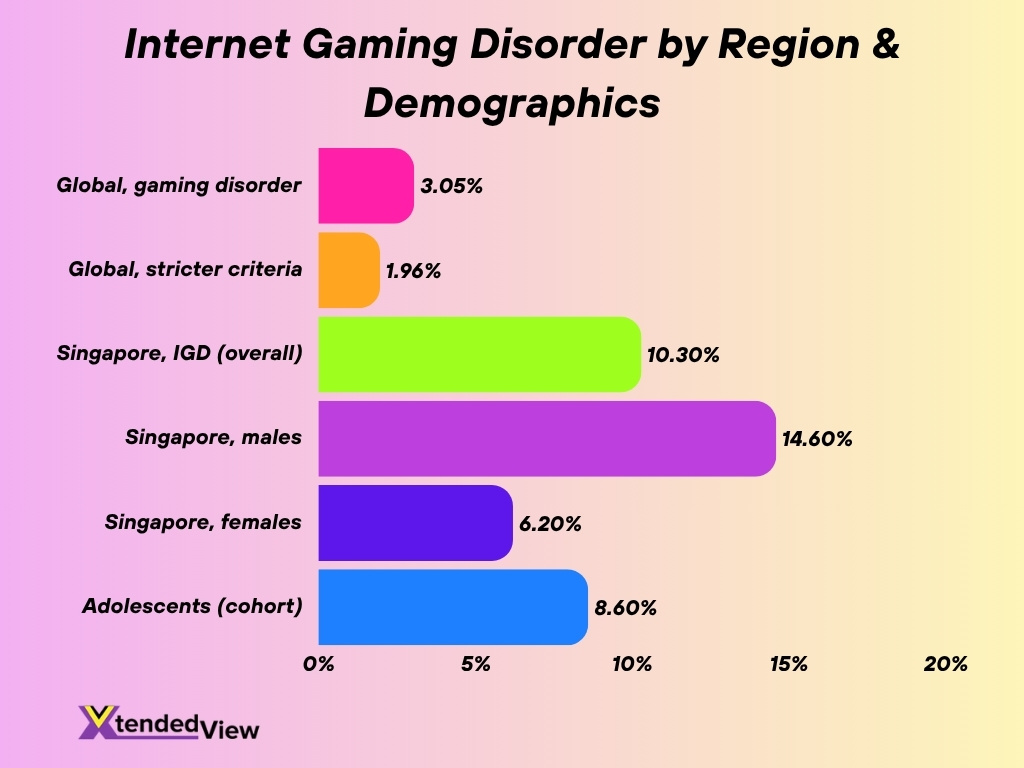
- The global prevalence of Internet Gaming Disorder (IGD) is estimated at 3.05% of the population.
- Under stricter diagnostic criteria, the global rate decreases to 1.96%, showing variability based on how IGD is defined and measured.
- Singapore reports significantly higher IGD rates, with 10.30% overall, more than three times the global average.
- Male gamers in Singapore show the highest rate among the groups listed, with 14.60% experiencing symptoms of gaming disorder.
- Female gamers in Singapore have a much lower rate at 6.20%, indicating a notable gender gap in IGD prevalence.
- Among adolescents, IGD rates reach 8.60%, highlighting younger populations as particularly vulnerable to gaming-related behavioral issues.
Effects of Internet Addiction (Physical & Emotional)
- Adolescents with ≥ 2 internet addiction behaviours had an OR of 5.80 (95% CI: 4.90‑6.86) for physical‑mental multimorbidity.
- Heavy internet use was linked to sleep deprivation, poorer diet, and increased tobacco or alcohol consumption.
- Teenagers spending 5–7 hours on social media daily were twice as likely to show signs of anxiety, depression, or body‑image issues.
- Physical symptoms may include muscle aches, back/neck pain, headaches, insomnia, and unintended weight change.
- One study estimated global internet addiction prevalence to be ~17.9% in 2025, implicating large numbers facing physical and emotional risk.
- A large proportion of teens report that social media use hurts their sleep (50% girls, 40% boys).
- Smartphone addiction estimates for teens and young adults indicate 20‑30% show signs of problematic use.
- Connectivity overload and constant checking correlate with elevated stress, irritability, and emotional dysregulation.
Causes and Risk Factors for Internet Addiction
- Loneliness, ethnicity, lower maternal education, smoking, and physical illness were identified as significant risk factors for internet addiction in adolescents.
- Family and school environment were significant predictors of adolescent internet addiction (prevalence 29.64%).
- Risk factors included age (younger), male gender, neuroticism, longer internet use time, and life impairment.
- Lower-income regions showed a higher prevalence of addiction among students.
- A J‑shaped relationship was found where internet use time, too little or too much,h correlated with higher health risk.
- Peer influence and social contagion emerged as mechanisms for addictive use of social media and the internet.
- Lack of hobbies, minimal physical activity, and poor sleep were behavioural risk markers in students.
- Younger age at device exposure correlates with a higher risk of addiction behaviours later.
Impact on Relationships and Social Life
- Around 1 in 4 relationships are affected by “phubbing” as people prioritize phones over partners.
- 42% of professionals check work emails compulsively after hours, interfering with family time.
- More than 50% of smartphone users check their devices within an hour of waking or before sleep, disrupting social connections.
- Teens with high addictive screen‑use trajectories are twice as likely to show signs of social isolation or suicidal ideation.
- 67% of adolescents report anxiety when separated from their phones.
- Nearly 44% say their smartphone use interferes with face‑to‑face conversations or social time.
- Around 210 million people affected by social‑media addiction imply large‑scale relational effects.
- 57% of U.S. adults feel addicted to their phones, affecting interpersonal interactions.
- 51% believe phone use harms their physical health, contributing to household tension.
- The average person spends 4+ hours daily on social platforms, reducing direct social interaction time.
Academic and Occupational Consequences
- 41% of U.S. teens say screen use hurts sleep, 21% say it hurts school performance.
- High internet‑use or gaming‑addiction behaviours correlate with lower academic achievement and missed classes.
- Smartphone addiction correlates with self‑reported lower productivity and higher distraction at work.
- Employees may lose 2+ hours per workday to phone use.
- Digital distractions contribute to as much as $1.3 trillion in global productivity loss.
- 51% of U.S. employees admit to using phones during work hours for non‑work purposes.
- 60% of college students report feeling addicted to social media, which impacts study focus.
- Young adults aged 18‑22 report 40% social‑media addiction, affecting job readiness.
- Excessive gaming (> 4 hours/day) raises the risk of absenteeism and behavioural issues.
- The average global screen time for adults is 6h 38m/day, reducing time for learning and productivity.
Workplace Productivity and Internet Overuse
- Employees report interruptions every 3 minutes, and it takes 23 minutes to regain full focus.
- Remote workers saw a 6% increase in productivity, but digital distractions remain significant.
- Only 31% of office staff are productive for most of the workday.
- Disengaged employees cost $8.9 trillion in lost productivity globally.
- Smartphone users check their devices 58‑144 times per day, depending on the region.
- Digital distractions cost businesses billions annually due to task‑switching fatigue.
- 47% of users say smartphones negatively affect their emotional well‑being.
- 44% feel anxious when separated from their phones, disrupting focus.
- 54.7% report eye strain from smartphone use, reducing workplace comfort and efficiency.
Percentage of Gamers Among Internet Users by Age & Gender
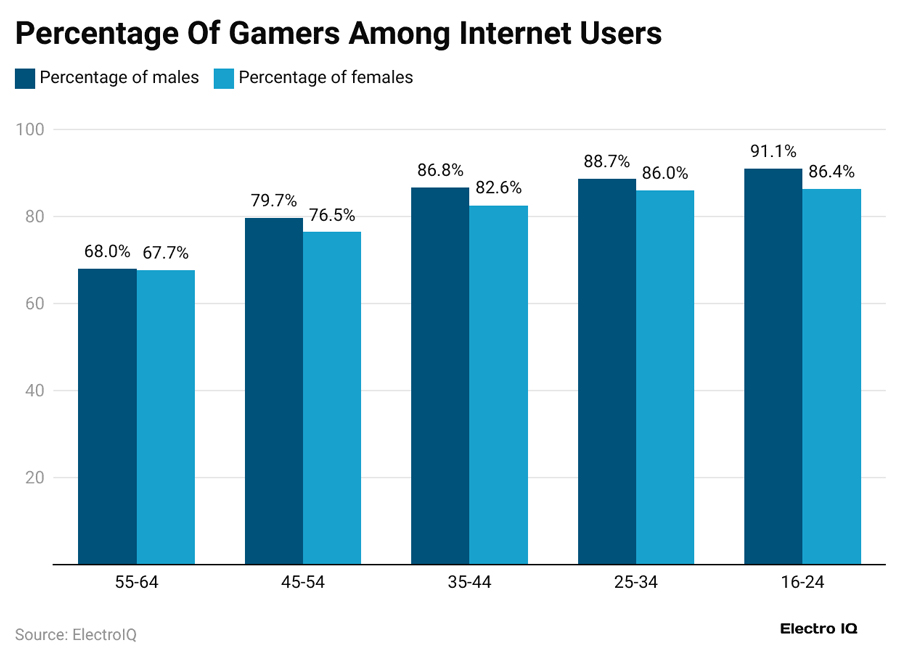
- Gaming participation is very high among young internet users, with 91.1% of males and 86.4% of females aged 16–24 identifying as gamers, the highest engagement of all age groups.
- The 25–34 age group also shows strong participation, with 88.7% of males and 86.0% of females gaming online.
- Among users aged 35–44, gaming remains popular: 86.8% of males and 82.6% of females say they play games.
- In the 45–54 age range, gaming rates dip slightly to 79.7% of males and 76.5% of females, but still represent a majority of internet users.
- The 55–64 age group has the lowest gaming participation, yet still high overall, with 68.0% of males and 67.7% of females identifying as gamers.
- Gender gap is minimal across all ages, with only a 3–5% difference between male and female gamers in most ranges, highlighting the broad appeal of gaming across genders.
Social Media Addiction Statistics
- About 210 million people worldwide are addicted to social media.
- In the U.S., about 33.19 million people are affected.
- 82% of Gen Z adults acknowledge platform dependency.
- 36% of teens consider themselves addicted to social media.
- Social‑network addiction prevalence is 18.4% Asia and 22.8%.
- Average daily use is 2h 19m on social platforms.
- Women have 34% vs men’s 26% addiction rates.
- TikTok users average 53.8 minutes/day, the highest addiction risk.
Smartphone Use Habits in the UK
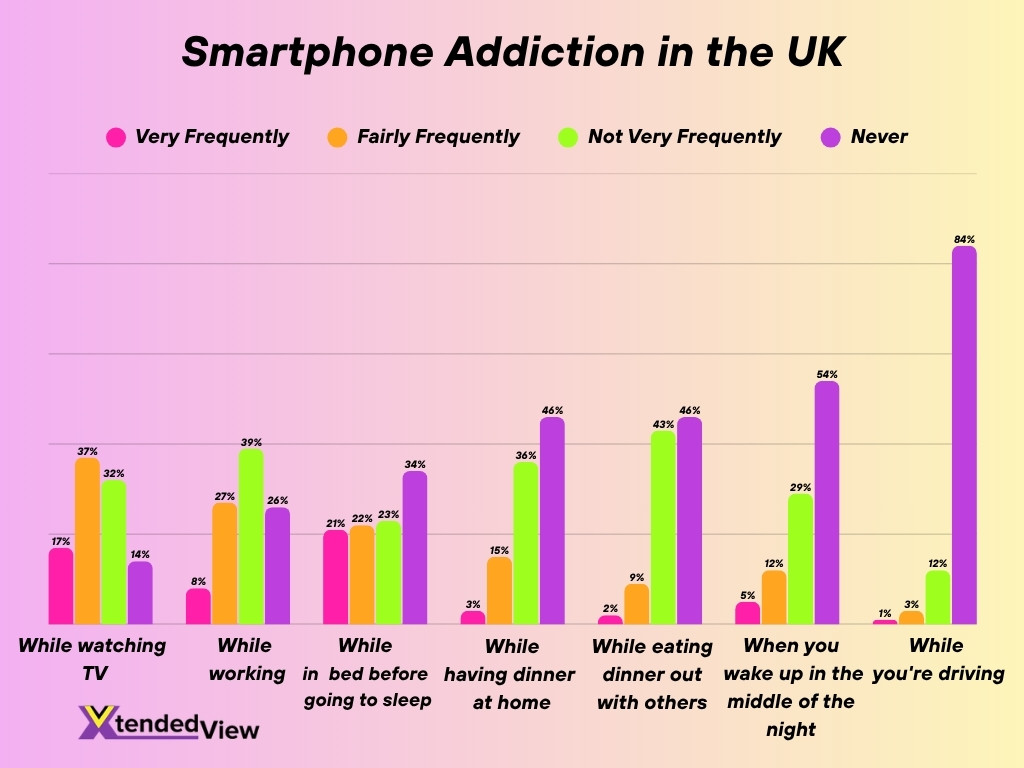
- Over half (54%) of people check their phones very or fairly frequently while watching TV, making it the most common distraction activity.
- Bedtime phone use is high, with 43% looking at their phones before going to sleep, potentially impacting sleep quality.
- Even during work, 35% of people use their phones frequently (8% very frequently, 27% fairly frequently).
- Late-night phone use remains notable; 17% check their phones when waking up in the middle of the night.
- During meals at home, only 18% check their phones frequently, with 46% saying they never do, showing stronger self-control at family mealtimes.
- In social settings, such as eating out with others, 11% still check phones frequently, while 46% never do.
- Driving sees the lowest phone use, with 84% saying they never use their phones while driving, the strongest avoidance behavior.
Treatment and Recovery Rates
- Only a small proportion of affected individuals receive structured treatment.
- 56.9% of American adults self‑report phone addiction; treatment‑seeking unclear.
- Adolescents with high addictive‑use patterns show significantly higher suicidal behaviour, requiring early intervention.
- The scale of addiction outpaces available treatment programs.
- Higher physical activity and resilience are linked to reduced smartphone addiction symptoms in some students.
- States in the U.S. have enacted regulations to protect minors from social‑media harm, though legal debates continue.
- Online therapy and digital‑detox programs are rising, but consistent recovery‑rate data are limited.
- Because many studies assess “problematic use,” recovery‑rate precision remains unavailable.
Frequently Asked Questions (FAQs)
About 48% of teens report that social media has a mostly negative effect on people their age.
An estimated 210 million people worldwide suffer from addiction to social media and the internet.
The pooled global prevalence among university students is 41.84%.
In one survey, 73% of 13‑17‑year‑olds were reported to be at risk of internet addiction.
Nearly 48% of internet users in the United States say they feel addicted to their digital devices.
Conclusion
The latest data show that internet addiction and related behaviors affect hundreds of millions globally, with substantial consequences for mental health, physical well‑being, relationships, academic outcomes, and workforce productivity. Despite the scale of the issue, treatment access and recovery programs lag behind demand. As screen engagement continues to rise across age groups, public‑health frameworks, educational guidance, and workplace policies must evolve to support healthy digital habits.
Moving forward, a balanced approach that blends awareness, prevention, and supportive intervention is essential for reducing harm and promoting digital well‑being.
