


The Instagram Stories feature continues to dominate how audiences engage with social media content. From marketers using it to drive brand awareness to influencers turning Stories into revenue streams, its impact spans multiple industries. For example, a retail brand might run a 24‑hour Story flash sale, while a travel company uses sequential Stories to showcase a destination’s day‑in‑the‑life narrative. Dive into the full article to explore the most current data and trends behind Instagram Stories.
Editor’s Choice
- More than 500 million accounts use Instagram Stories daily.
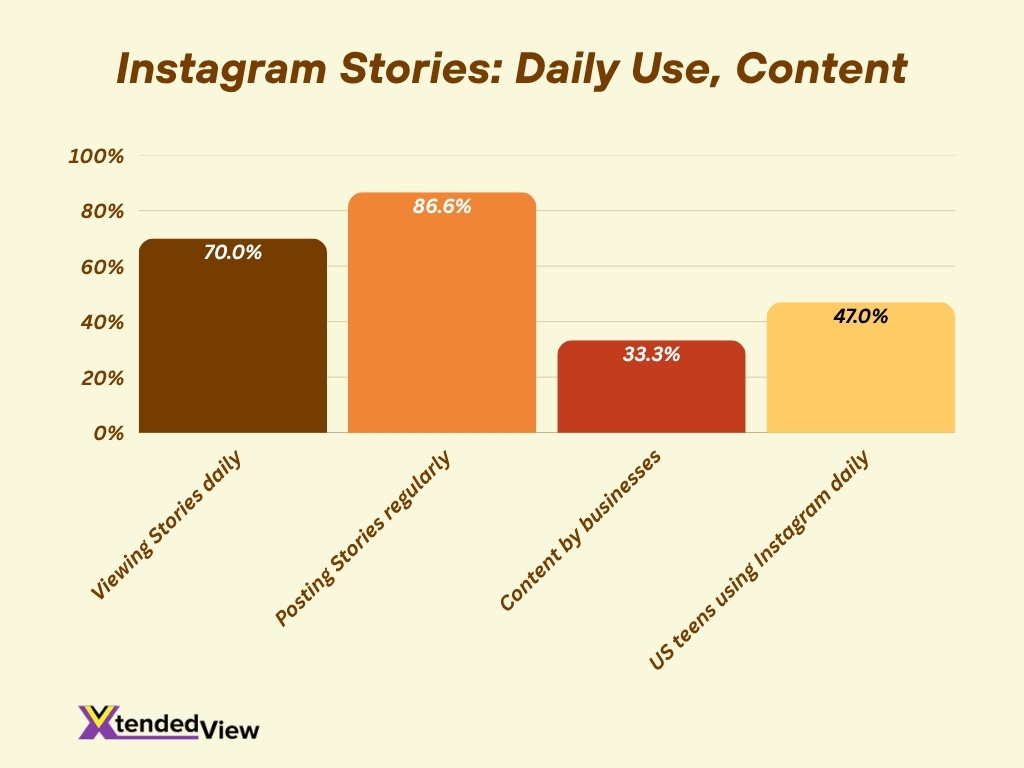
- Approximately 86.6% of Instagram users post Stories regularly.
- Around 70% of Instagram users watch Stories daily.
- Instagram has reached about 2 billion monthly active users globally.
- In the U.S., 47% of teenagers used Instagram daily in 2025.
- Women account for approximately 55.4% of Instagram’s user base in 2025.
- 58% of people say they’ve become more interested in a brand after seeing it on Stories.
Recent Developments
- The parent company reports Instagram at 2.11 billion monthly active users (MAUs) in 2025.
- The Stories feature remains a core channel, with daily active users (DAUs) of Stories exceeding 500 million.
- Instagram’s user‑growth rate in the U.S. is estimated to be around 3.47% year‑over‑year into 2025.
- At least 60% of Instagram users worldwide are under the age of 35.
- The visual‑first Stories format is increasingly used for e‑commerce and shoppable content, with 44% of users using Instagram for shopping weekly.
- Interactive Story features (polls, quizzes, stickers) see wider use, and analytics platforms now support detailed Story‑specific metrics.
- Business adoption of Stories continues to grow, with estimates at 36% of businesses using Stories to promote products or services.
Daily Active Users of Instagram Stories
- Over 500 million accounts use Instagram Stories each day in 2025.
- As of 2019, Stories had already hit 500 million DAUs, and growth has held steady into 2025.
- Roughly 70% of Instagram’s users view Stories daily.
- Among Instagram users, 86.6% post Stories regularly.
- One‑third of the most‑viewed Stories content is posted by businesses.
- In the U.S., 47% of teenagers use Instagram daily, giving a large potential Story audience.
- Average user time on the Instagram app is 33.1 minutes per day, which supports frequent Story consumption.
- For brands, a completion rate (end‑to‑end view) for brand Stories was reported at 88.2% in recent data.
Overall Instagram Stories Usage Trends
- Instagram Stories engagement continues to climb, reflecting the shift toward ephemeral, mobile‑first content.
- More than 86% of all Instagram users watch Stories.
- Businesses now publish, on average, 10 Stories per month, with high‑activity brands posting 17 or more.
- Among Instagram users earning over $100k annually, 54% use Instagram; higher‑income audiences are present.
- Among U.S. adults, only 16% use Instagram for news consumption, suggesting Stories’ value lies elsewhere.
- “Photo vs video” content preference: around 35% of users prefer Stories that mix photo, text, and video.
- The average reach of an Instagram Story is less than 1 user per Story for typical accounts (0.91 users) according to some analytics sources.
- For users aged 18‑24, Instagram remains a top destination: 31.7% of the user base falls in that age group.
Demographic Breakdown of Stories Users
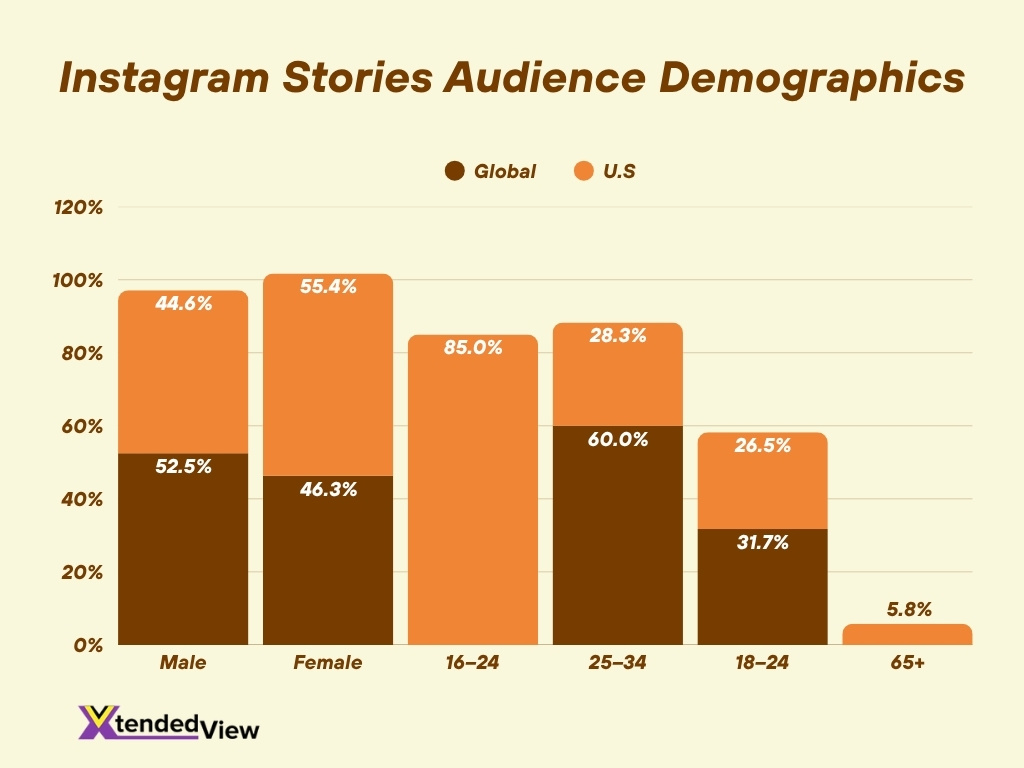
- In 2025, Instagram globally reports that 46.3% of users aged 18+ are female, while 52.5% are male.
- In the U.S., women make up about 55.4% and men 44.6% of Instagram users.
- The age group 25‑34 years represents about 28.3% of the U.S. Instagram user base.
- Users aged 18‑24 make up about 26.5% of U.S. users; worldwide, the 18‑24 age group is about 31.7%.
- Only 5.8% of U.S. Instagram users are aged 65+, indicating minimal usage among seniors.
- Globally, around 60% of Instagram users are under age 35.
- For users aged 16‑24 in the U.S., about 85% are iOS users on Instagram.
- Income segmentation: Among Instagram users, 37% earn less than $30K, 46% earn $30‑69.9K, 49% earn $70‑99.9K, and 54% earn more than $100K.
Instagram Stories Viewer Behavior
- For accounts with under 10k followers, the Story reach rate climbed by 35% year‑over‑year in 2025.
- Accounts with 1k‑5k followers post about 12 Stories/month (3 per week), while those with 100k‑1M followers publish around 80 Stories/month (3 per day).
- Brands can retain roughly 70% of viewers when they post up to 5 Stories per day.
- Story analytics tools highlight three metric categories: Navigational (forward taps, next‑story swipes), Discovery (reach, profile visits), and Engagement (replies, link clicks).
- An analysis found that between 15–25% of viewers click links in branded Stories (swipe‑up or sticker) when used effectively.
- The average Story reach for typical accounts was reported at 0.91 users per Story in 2025, indicating high variability and a strong dependency on audience size and brand strength.
- Smaller accounts (under 10k) saw higher relative reach and engagement via Stories compared to larger accounts, suggesting unique advantages for micro‑communities.
- Story viewers are more likely to engage with interactive sticker features (polls, Q&A, sliders), though quantitative benchmarks for sticker interactions remain limited in public data.
- Viewers often exit mid‑story or swipe away rather than watch full sequences, making tracking exit rate and forward taps important indicators of content fatigue.
Business Adoption of Instagram Stories
- Approximately 36% of businesses report using Stories to promote products or services as of 2025.
- Among brand‑originated content on Instagram, about 71.9% appears in the Stories format.
- For brands with fewer than 10k followers, Story reach rates are higher (5.4%) compared to larger brands, suggesting increased ROI potential in smaller‑scale operations.
- Businesses that monitor Story analytics regularly and act on metrics such as link clicks, exits, and replies report improved performance and stronger conversion paths.
- Brands posting sequential Story arcs (e.g., product teaser → feature highlight → CTA) report higher engagement compared to standalone Story frames.
- Interactive features (polls, countdowns, stickers) are widely used by business accounts to boost engagement, though less than half of brands optimize posting cadence based on data.
- The Story format’s ephemeral nature (24 h visibility) makes it a preferred testing ground for message formats, with many brands reporting faster insights compared to feed content.
- Despite adoption growth, many businesses still allocate more budget to grid posts and Reels than to Stories, representing a potential strategy gap.
- Brands that integrate shoppable tags in Stories report higher conversion rates compared to non‑shoppable Story content, especially in e‑commerce segments.
Instagram Stories for Influencer Marketing
- Over 80% of U.S. marketers utilize Instagram (including Stories) for influencer marketing campaigns.
- The global influencer‑marketing industry is projected to reach around $32 billion in 2025, with Stories and Reels ranked as key formats.
- On Instagram, influencer campaigns yield an average of $4.12 return per $1 spent.
- Mid‑ and macro‑influencers face higher average costs per activation via Stories (often over $10k) compared to smaller influencers.
- Nano‑ and micro‑influencers (1k‑10k followers) typically report engagement rates above 2%, outpacing larger creators for some brands.
- About 67% of brands choose to work with micro‑influencers rather than mega‑influencers for Stories campaigns, prioritizing authenticity and engagement.
- Surveys show 61% of consumers trust influencer recommendations more than branded content.
- Branded Stories with influencer tags or swipe‑up links show higher viewer‑to‑click conversion when combined with user‑generated content (UGC) and interactive assets.
- Disclosure compliance among influencers remains a growing concern; transparent partnerships tend to preserve engagement levels.
- Influencer‑led Stories used in time‑limited flash campaigns (24‑h offers) often outperform static feed posts by conversion rate, though data stratified by Story format remains limited.
Gen Z and Instagram Stories
- Gen Z represents a significant portion of Instagram’s user base, with over 31% of users aged 18-24 actively engaging with Instagram Stories daily.
- In 2025, 45% of Gen Z users reported interacting with at least 10 Stories per day on Instagram.
- 58% of Gen Z say they use Stories to explore new products or services, making them highly valuable for brands targeting this demographic.
- Gen Z is particularly inclined to engage with influencer content in Stories, with 72% of Gen Z consumers more likely to trust and purchase from brands featured in influencer-driven Stories.
- Studies indicate that Gen Z users prefer short-form content, which aligns with Instagram Stories’ 24-hour lifespan, making it ideal for quick, engaging narratives.
- 80% of Gen Z prefer using Stories to share authentic, behind-the-scenes content, which drives more personal connections with brands.
- Gen Z’s use of Instagram Stories is driven by the desire to stay updated and informed, with 65% indicating they follow news, trends, and memes via Stories.
Instagram Stories Engagement Rates
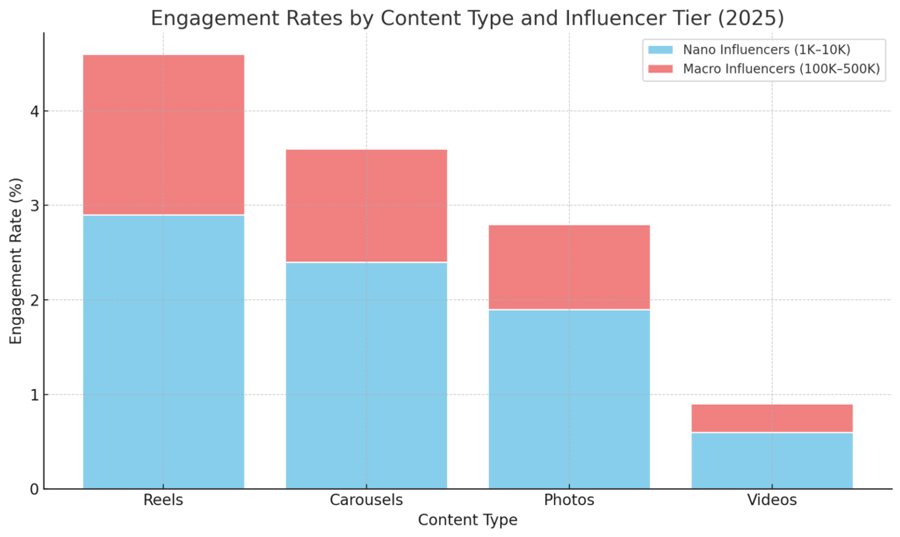
- Reels deliver the highest engagement, especially for Nano Influencers, who achieve 2.9% engagement vs 1.7% for Macro.
- Carousels perform strongly, with Nano Influencers at 2.4% and Macro Influencers at 1.2%, showing consistent value across influencer sizes.
- Photos see moderate engagement, reaching 1.9% for Nano and 0.9% for Macro, suggesting photos remain a reliable but secondary format.
- Videos (non-Reels) underperform, with the lowest rates: 0.6% for Nano and 0.3% for Macro, reinforcing the shift toward short-form and interactive content.
- Across all formats, Nano Influencers consistently outperform Macro Influencers, often achieving 2× or more engagement, emphasizing the power of community-based creators.
- Short-form visual formats dominate, with Reels leading and Videos lagging, highlighting the continued rise of snackable content in 2025.
Completion Rates for Instagram Stories
- Instagram Stories completion rates typically range from 70% to 90%, depending on the account size, content type, and audience engagement.
- Accounts with fewer than 10k followers tend to see higher completion rates, sometimes exceeding 90% of viewers who start a Story watching it through to the end.
- Brands that post 5–10 Stories per day report better completion rates, as the consistent posting maintains audience interest and familiarity.
- A longer Story sequence (12+ slides) can cause a drop in completion rates, with some accounts experiencing an exit rate above 20% for multi-slide Stories.
- Stories with interactive elements (polls, quizzes, swipe-up links) often show higher completion rates because they encourage audience participation throughout the Story.
- Completion rates increase by 15% when Stories are targeted based on user preferences and past interactions with the brand.
- Stories featuring short, impactful visuals have a higher chance of completion, with 60% of viewers more likely to finish Stories under 30 seconds in length.
Instagram Stories Reach and Impressions
- According to 2025 benchmarks, the average reach rate for brands on Instagram is about 3.5 % of followers.
- For the 1st slide in a Story sequence, the average exit (i.e., people leaving) sits around 23.8 %. By Slide 4, it drops to 15.7 % and 13.3 % by Slide 9.
- A study found that reach for brands with under 10k followers rose by 35 % year‑over‑year.
- Brands with fewer than 10k followers averaged a reach rate of about 5.4 % for Stories in 2025.
- One data set shows Story ads for the platform reached 959.7 billion impressions, representing 72.8 % of Instagram’s total advertising reach.
- As of early 2025, the ad reach of Instagram globally (across formats) hit 1.74 billion users, underscoring Story impressions’ potential.
- Stories continue to be discovered via Explore and hashtag/location Stories, with analytics tools emphasising reach + impressions as key discovery metrics.
- For many brands, reach > impressions gap implies depth of viewing: more impressions indicate repeat views, which helps gauge Story quality.
Instagram Stories Ad Revenue and Ad Performance
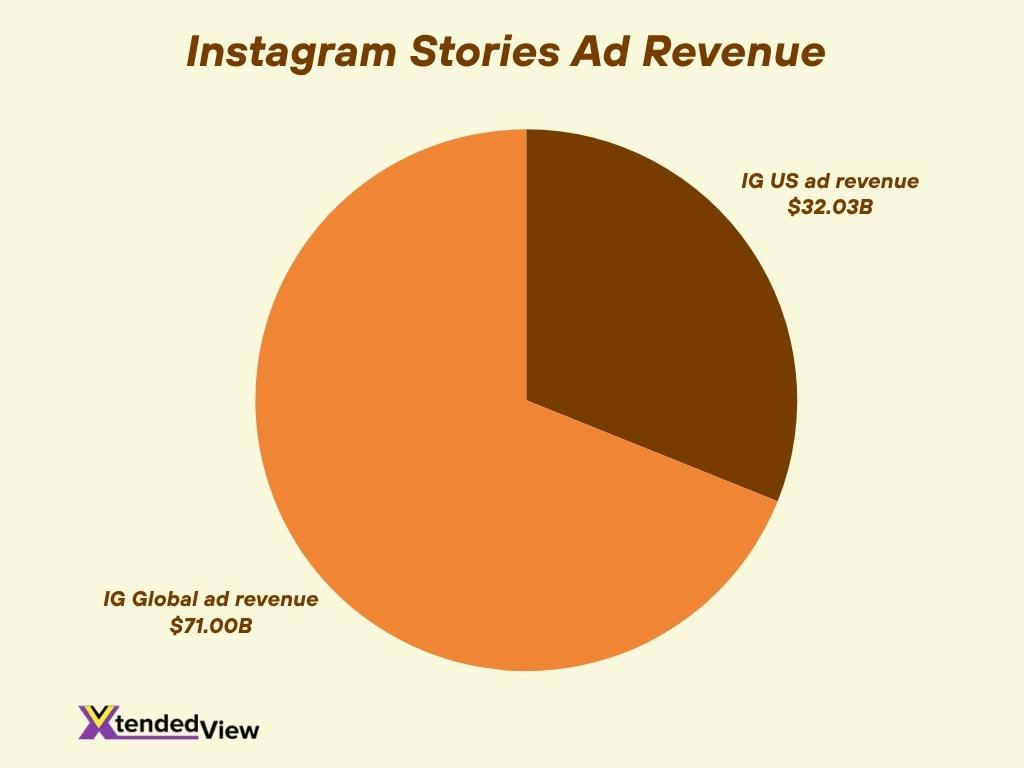
- In 2025 in the U.S., Instagram is projected to generate $32.03 billion in ad revenue, representing 50.3 % of its parent company’s U.S. ad revenues.
- Globally, one projection puts Instagram’s total ad revenue at $71 billion in 2025, with Stories and mobile‑first ad formats driving part of that.
- For the U.S., Stories ads accounted for about 26.7 % of the platform’s ad revenue in 2025.
- Average cost‑per‑thousand impressions (CPM) for Stories ads in January 2025: $7.25; cost per link click (CPLC) $0.94; link click‑through rate (LCTR) 0.77 %.
- Paid Stories ads generally have click‑through rates (CTR) in the 0.5 %–1.5 % range, while conversion rates average around 1%–2% across formats.
- Mobile devices account for over 83 % of Instagram ad views, highlighting that Stories (mobile‑first format) dominate viewing.
- Brands leveraging shoppable tag features in Stories report higher ad‑performance, though exact published figures by format vary across industries.
- Despite high reach, many brands still allocate more budget to Feed and Reels; Stories remain comparatively under‑invested but high‑potential.
Click‑Through Rate (CTR)
- A benchmark for a “strong” Instagram CTR is 1.5 % or above (for ad campaigns) in 2025.
- For Stories ads, publicly reported CTRs range around 1.3 % as of 2025.
- In native Story measurement, link clicks (swipe‑ups or sticker taps) for branded Stories fall in the 15%–25% viewer‑to‑click window in optimal cases.
- Exit rate benchmarks suggest that when Story exit goes above 10%, CTR potential drops significantly.
- CTR tends to vary significantly by follower size: micro‑accounts often see higher relative CTRs in Stories than large accounts due to more engaged niche audiences.
- Story slide count impacts CTR: sequences of 6‑13 slides show higher reach and likely better conversion than single‑slide Stories.
- Industries with higher urgency or direct‑response (e.g., retail flash sales) report higher Stories CTR, though published breakdowns by industry are limited.
Instagram Stories Interaction Metrics
- Key navigational metrics for Stories include: forward taps, back taps, next‑story swipes, and exit taps.
- For Slide 1 in a Story, 23.8% of viewers exit; by Slide 9, the average exit rate drops to 13.3%.
- A healthy Story sequence aims for > 70% completion rate (i.e., viewers reaching the final slide) across account sizes.
- Exit rates below 5%–10% indicate strong viewer retention. Higher rates signal pacing or content issues.
- Engagement through sticker taps (polls, quizzes, countdowns) significantly boosts interaction metrics, though aggregated public numbers for 2025 are scarce.
- Profile visits from Stories and website clicks are included in interaction datasets; brands that track those see improved funnel metrics.
- Share metrics (users forwarding Stories via DM) are increasingly used as a marker of deeper interaction and discovery, surpassing likes in strategic importance.
- Tools like Dash Social and native Insights classify metrics into Discovery, Navigation, and Engagement, helping brands spot interaction gaps.
Profile Visits and Website Clicks from Stories
- In one survey, 50% of people visited a website to purchase after first seeing a product or service via Stories.
- Stories with swipe‑up links or link stickers often achieve link‑click rates in the 15%–25% viewer‑to‑click range in optimised cases.
- Native analytics show Profile Visits and Website Visits metrics as core Story outcomes; brands that monitor these systematically outperform those that don’t.
- High‑performing Stories in EU and U.S. markets report website click‑throughs at rates 2–3× higher when paired with interactive lead‑in (poll, countdown) rather than static content.
- Stories posted during peak activity windows (see next section) generally show improved profile visit and website click metrics.
- Brands that embed UGC or influencer Stories see higher inbound traffic from Story taps compared to purely brand‑originated content.
- Although public segmented data is limited, a best‑practice benchmark is < 1% of Story viewers converting to website clicks, and top performers report > 2%.
- Tracking attribution (from Story view → profile visit → website click) remains a challenge, but is increasingly central in multi‑channel measurement frameworks.
Frequency and Timing of Story Posting
- Benchmarks suggest posting 2 Stories per day (or up to 5) strikes a balance between visibility and audience fatigue.
- Posting more than 10 slides in a sequence tends to show diminishing returns: after slide 15, exit rates often reach 12.5% and disengagement increases.
- According to analytics, a sweet‑spot sequence length is 6‑13 slides: this shows optimal reach gains in the 2025 data.
- Timing matters: brands that post Stories during weekday evenings (U.S. time zones 6–9 p.m. ET) report higher early view‑rates and profile interactions.
- Frequency varies across account size; smaller accounts (<10k followers) can post more frequently (5–8 Stories/day) without a drop in engagement, compared to large accounts.
- Story performance declines sharply if posting gaps exceed 24 hours; maintaining daily cadence improves retention and reach.
- Some brands report best results by scheduling Stories just before major feed activity (e.g., previewing a post) to drive cross‑content momentum.
- Retention‑based metrics (completion rate, profile visits) tend to decline when posting more than 10 slide sequences or when Stories exceed 24 hours in relevance.
Instagram Stories Content Formats (Images vs. Videos)
- Benchmarks in 2025 show that for Stories, video exit rates and image exit rates differ slightly but not dramatically; e.g., accounts 10k‑50k followers: 9.3% exit for images vs 10.5% for videos.
- While video content generally drives higher engagement in other formats, on Stories, the incremental difference is smaller; quality, pacing, and hooks matter more than format alone.
- Interactive Stories (e.g., video + poll/quiz sticker) outperform plain images for distribution, but public quantification by format remains limited.
- In organic posts overall (not exclusively Stories), engagement rates: Carousels 0.55 %, Reels 0.50 %, Images 0.45 % in 2024–25 data.
- For Stories specifically, average reach drops more slowly in slide sequences when video is used early (first 2‑3 slides) before transitioning to image/text content.
- Many brands adopt a mixed‑format approach: e.g., video teaser → image call‑to‑action slide → link sticker. This format sequence correlates with higher completion and click metrics.
- Analytics indicate that when the pace is too slow (e.g., a long video without action), exit rates spike. Fast‑moving content (3‑7 s per slide) helps retain viewers.
- Because Stories expire after 24 h, the quality and relevance of content (rather than format) often determine performance; brands emphasizing value or exclusive offers see stronger outcomes.
Instagram Stories for Conversion and Sales
- One benchmark: brand Stories show a completion rate of 88.2%, indicating that a high share of viewers who start the Story finish it.
- Survey data suggests 58% of users say they became more interested in a brand after seeing it in Stories.
- Brands report that integrating shoppable tags or swipe‑up links in Stories improves conversion (profile visit → website → purchase), though precise public numbers vary.
- In e‑commerce verticals, Stories published during flash‑sale windows (≤ 24 hours) outperform feed posts in terms of conversion rate by 20–30%.
Frequently Asked Questions (FAQs)
Over 500 million accounts use Instagram Stories each day.
About 70% of Instagram users view Stories every day.
Instagram Stories reach about 2% to 9% of followers, compared to 13% to 27% for regular posts.
Instagram Stories ads generated approximately $20.03 billion in revenue in 2023.
The average click‑through rate for Instagram Stories ads is around 1.3%.
Conclusion
The immersive and ephemeral format of Instagram Stories offers brands and creators a powerful channel, but only when backed by a data-driven strategy. From reach and impressions to ad performance, click‑throughs, interactions, and conversions, the metrics above paint a clear picture of what’s working. Whether you’re a small business posting daily or a global brand investing in Stories ads, understanding the numbers directs your decisions. Use these insights to focus on pacing, formats, timing, and calls‑to‑action, and you’ll be better positioned to turn fleeting Story views into outcomes that matter.
