



The email service Gmail remains a cornerstone of digital communication worldwide, serving both personal and business use. From multinational teams coordinating via email to individuals managing daily inboxes, Gmail’s scale and reach shape how we connect. For example, marketing teams leverage Gmail to deliver campaign messages, and educational institutions deploy it for student‑faculty correspondence. Explore the full article to understand the latest Gmail metrics and what they mean for users and organizations.
Editor’s Choice
- As of 2025, Gmail is reported to have over 2.5 billion active users globally.
- Gmail holds around 26.7 % market share among email clients worldwide in early Sept 2025.
- Gmail processes an estimated 121 billion emails daily as of 2024.
- Mobile access accounts for approximately 75 % of Gmail users, according to recent reports.
- In the U.S., roughly 75 % of adults report using Gmail as a primary or among primary email services.
- The average Gmail user holds about 1.7 accounts (personal + work) worldwide.
- Gmail’s spam and malware filters block over 99.9 % of dangerous content before inbox delivery.
Recent Developments
- In 2025, Gmail rolled out improved subscription‑management tools, helping users unsubscribe and clean up old mailing lists.
- Gmail plans to replace SMS‑based two‑factor authentication with QR‑code sign‑in to reduce SIM‑swap and SMS‑fraud risk.
- As of mid‑2025, Google alerted Gmail’s 2.5 billion users to password hygiene and potential phishing risk following broader security advisories.
- Gmail’s mobile app usage has climbed, with 2 billion handsets accessing the app each month.
- The service introduced new AI‑based inbox filters to reduce unwanted messages and categorize content more smartly.
- Integration between Gmail and cloud‑workspace tools (e.g., Google Drive, Google Meet) has accelerated in 2025 to support hybrid work flows.
- Business adoption has surged, with millions of companies now using Gmail as their primary mail platform.
Global Gmail User Base
- One source reports over 2.5 billion Gmail users globally in 2025.
- Another indicates roughly 2 billion handsets access Gmail monthly.
- Historical data: Gmail had 1.8 billion users in 2024.
- Gmail’s user base made up about 22 % of the global population in one report, citing 1.8 billion accounts.
- Total global email users across all services are expected to hit 4.83 billion in 2025, and Gmail captures a large share of that.
- The average user maintains about 1.7 Gmail accounts (personal/work) worldwide.
- In regions with rising connectivity (e.g., Asia, Africa), Gmail’s user growth remains strong.
- Monthly platform visits for Gmail reportedly exceeded 10 billion visits in certain estimates.
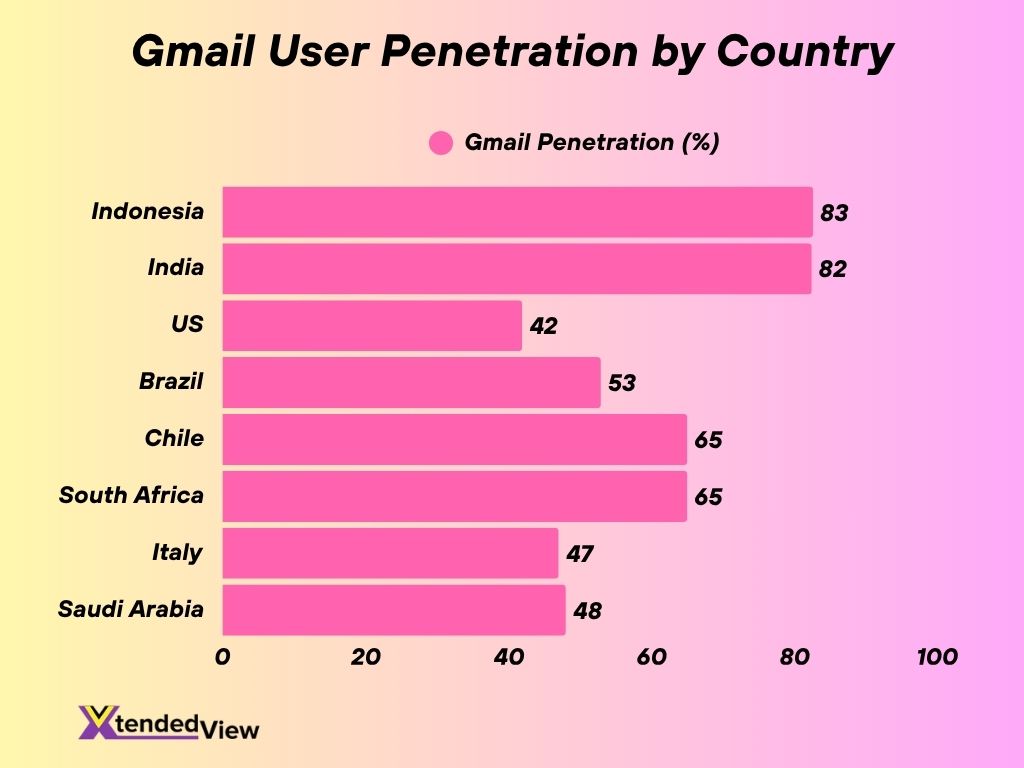
- According to a country‑by‑country breakdown, India and Indonesia each show over 82 % of residents using Gmail.
Gmail Demographics
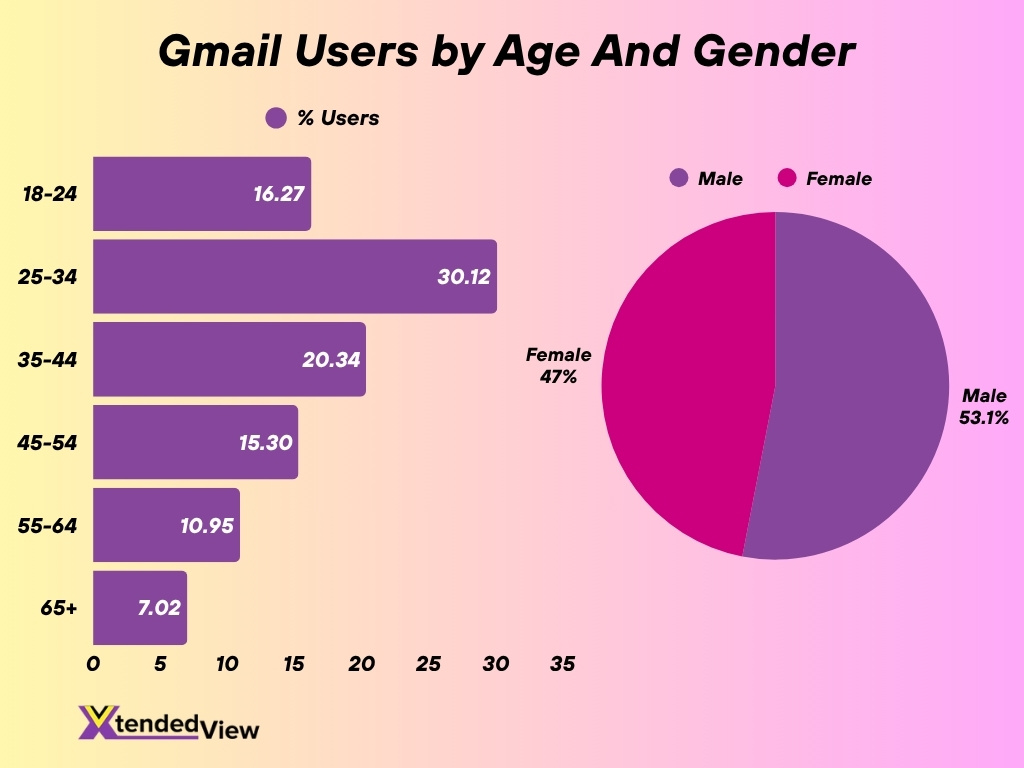
- Among Gmail users, the age group 25‑34 accounts for 30.12 % of users.
- Age group 18‑24 comprises 16.27 % of Gmail users.
- Age group 35‑44 holds 20.34 %, 45‑54 holds 15.30 %, 55‑64 10.95 %, 65+ 7.02 %.
- Gender split: about 53.05 % of users are male and 46.95 % female.
- Mobile‑first usage: 75 % of Gmail users access via smartphone.
- In the U.S., around 75 % of adults report using Gmail.
- Emerging economies show a younger average user age, given rapid mobile adoption and Gmail usage growth.
- Users often hold more than one Gmail account, with an average of 1.7 accounts per user globally.
Gmail’s Market Share
- As of Sept 2025, Gmail held about 26.72 % email client market share globally.
- Another source lists Gmail at 25.89 % market share in 2025.
- A different estimate places Gmail’s market share at 39.39 % in 2025.
- In the U.S., Gmail, including Google‑provided email addresses, is used by about 75 % of respondents.
- Among email‑client opens, Gmail is second only to Apple Mail (which held 51.52 %).
- Gmail’s market share has moved from 28.8 % early in 2025 to 30.7 % by mid‑2025 in one projection.
- For business and enterprise email management, over 3.8 million companies reportedly began using Gmail in recent years.
- In emerging markets, Gmail often dominates the free email service share among younger or mobile‑first users.
Historical Trends and Growth
- Gmail launched publicly in April 2004 and by 2012 had 425 million users.
- The user base grew from 1 billion users in 2016 to 1.8 billion by 2024.
- World email user base is projected to grow from 4.83 billion in 2025 to 5.61 billion by 2030, CAGR 3.4 %.
- Gmail’s share of email‑sent volume: 333 billion emails in 2024, rising to 376.4 billion bythe end of 2025.
- The average number of Gmail visits and app accesses continues to grow, underlining deepening engagement.
- Earlier market‑share estimates placed Gmail at 30.57 % in 2022 data, suggesting modest growth since.
- Overall, email traffic globally is expanding despite new messaging platforms emerging, with Gmail benefiting from that growth.
- Gmail’s rise has been aided by Android device proliferation, bundling with Google accounts, and shifting mobile behaviours.
Global Growth of Gmail Users
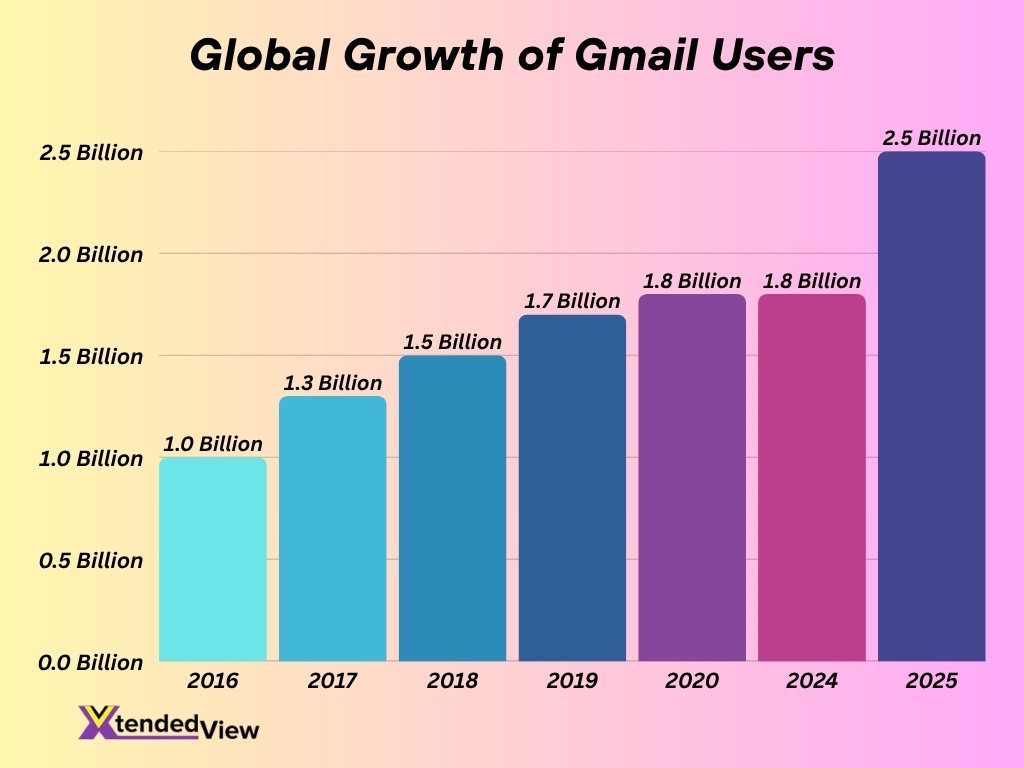
- Gmail’s user base has seen consistent growth over the years.
- In 2016, Gmail had 1.0 billion users.
- User numbers rose to 1.3 billion in 2017 and 1.5 billion in 2018.
- By 2019, the platform reached 1.7 billion users.
- Growth continued with 1.8 billion users in 2020.
- The user count stayed at 1.8 billion by 2024, showing a brief plateau.
- A strong surge is projected for 2025, expected to hit 2.5 billion users.
- Overall, Gmail is projected to grow by 1.5 billion users from 2016 to 2025.
Gmail Engagement Metrics
- Gmail processes an estimated 121 billion emails per day.
- Gmail may handle up to 131 billion emails daily by 2025 if its share rises.
- The average user holds approximately 1.7 Gmail accounts.
- About 75 % of Gmail users access via mobile, indicating strong engagement.
- Gmail holds 30.70 % share of email client opens globally.
- Email marketing campaigns sent to Gmail users see an open rate of 19.2 %.
- Promotional messages to Gmail see 3 % click‑through rate.
- Approximately 68 % of messages arriving in Gmail are classified as promotions.
- The average time spent on Gmail daily is 28 minutes.
Gmail Usage by Country
- In Indonesia, Gmail penetration is around 82.6 %.
- In India, penetration is approximately 82.4 %.
- In the U.S., Gmail usage is reported at about 41.9 %.
- Brazil shows Gmail penetration at 52.9 %.
- Chile and South Africa each show Gmail usage above 65 %.
- Approximately 29.75 % of global Gmail traffic originates from the U.S.
- Countries like Italy and Saudi Arabia show Gmail use in the 45–50 % range.
- Gmail supports interfaces in over 105 languages.
- Gmail serves about 22 % of the global population as of 2025.
Gmail Mobile Adoption
- Around 75 % of Gmail users access their inbox via a mobile device.
- 55 % of email opens for Gmail occur on mobile exclusively.
- Gmail’s app had over 220 million monthly active users in Q1 2025.
- The Gmail app has been downloaded more than 10 billion times.
- Users managing multiple Gmail accounts often do so via mobile.
- Gmail sees 66.64 billion monthly visits, including mobile.
- Mobile‑first markets like India and Indonesia contribute to Gmail’s growth.
- Offline access and swipe actions improve mobile engagement.
Gmail Features and Innovations
- Gmail offers 15 GB of free storage across services.
- Features like Smart Compose and Smart Reply enhance workflows.
- AI features are used by over 70 % of Gmail users.
- A “Manage subscriptions” tool was added in 2025.
- Gmail’s spam filter blocks 99.9 % of dangerous content.
- Gmail integrates with Google Drive, Meet, and Calendar.
- Gmail is available in 100+ languages.
- One company used Gmail with 110,000 Gemini AI queries in a month.
Gmail Business Adoption
- 90 % of startups in the U.S. use Gmail as their primary platform.
- 60 % of mid‑sized U.S. companies rely on Gmail.
- Over 299,000 companies adopted Gmail for business by 2024.
- Gmail serves 6× more monthly users than Outlook.
- Google Workspace reduces email clutter by 40 %.
- Gmail supports custom domain hosting for businesses.
- Mobile Gmail usage helps remote workforce management.
- Productivity gains post‑Gmail adoption are estimated at 35 %.
Most Used Email Clients Worldwide
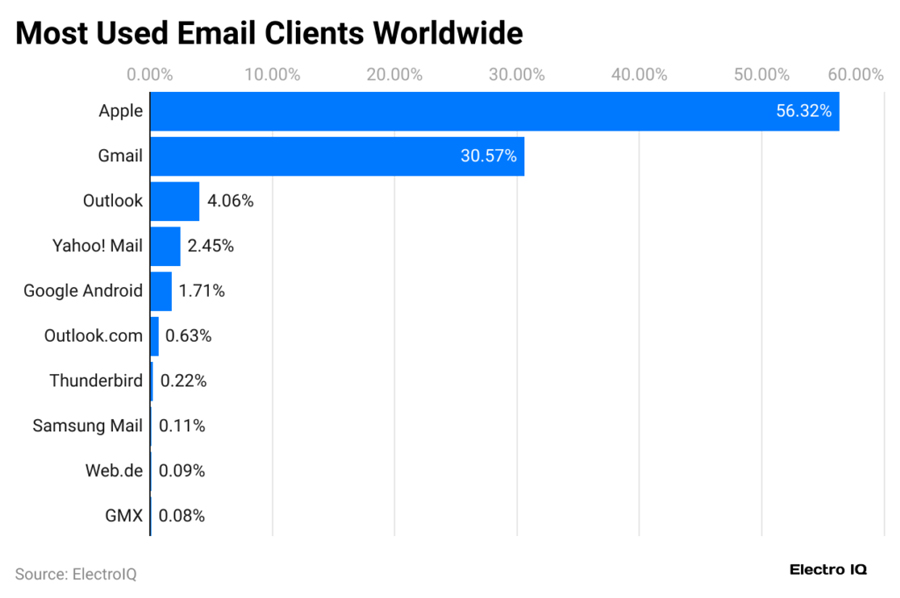
- Apple dominates the global email client market with 56.32% usage share, more than half of all email users.
- Gmail ranks second, holding a strong 30.57% market share.
- Microsoft Outlook stands in third place with 4.06% usage.
- Yahoo! Mail remains in the market with 2.45% share.
- Google Android Mail accounts for 1.71% of email users.
- Outlook.com web client makes up 0.63%.
- Thunderbird, an open-source alternative, has 0.22% market share.
- Samsung Mail holds 0.11% of the market.
- Web.de captures 0.09%, while GMX follows closely at 0.08%.
- Combined, Apple and Gmail control nearly 87% of the email client market, showcasing their overwhelming dominance.
Gmail Security and Spam Protection
- Gmail blocks more than 99.9 % of spam, phishing, and malware.
- Gmail blocks nearly 15 billion unwanted emails daily.
- Gmail’s AI stops almost 10 million spam emails per minute.
- A recent leak affected 183 million email passwords.
- Gmail is replacing SMS codes with QR‑based sign‑in.
- Senders with spam rates over 0.3 % are flagged.
- 67 % of users have at least one third‑party app connected.
- Admins can monitor phishing attempts using filter reports.
- Attackers exploit credential reuse and browser‑stored passwords.
- Phishing attacks mimic Gmail UI, targeting emerging markets.
Gmail Free Storage and Account Limits
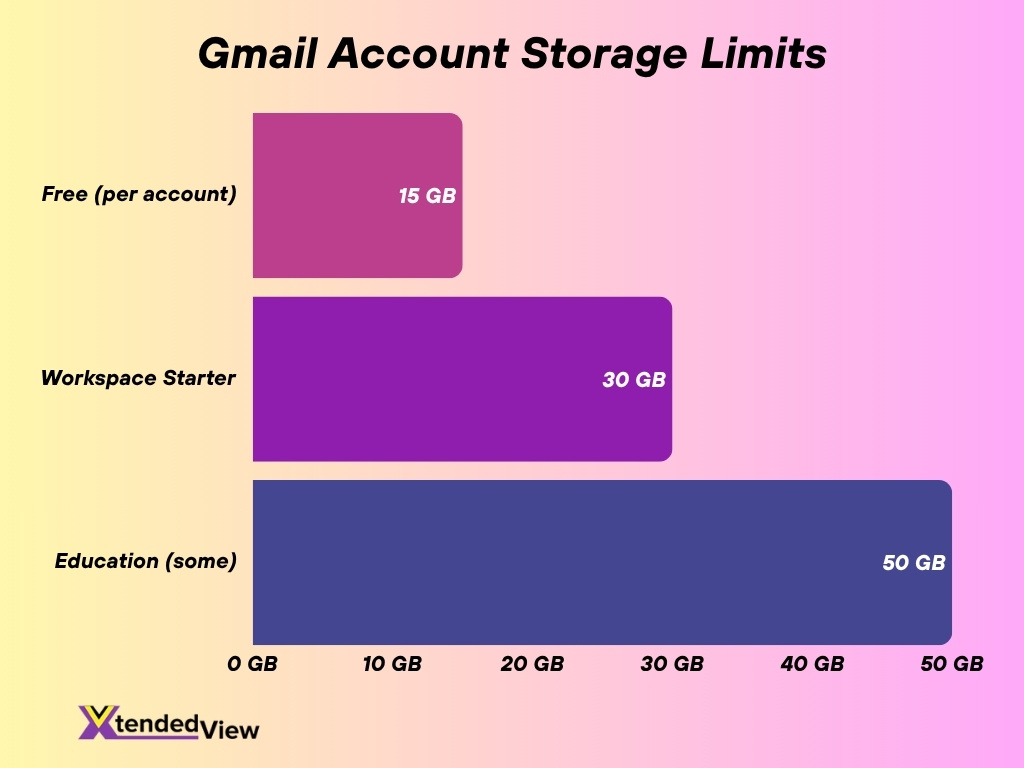
- Free accounts offer 15 GB of storage.
- Workspace Starter gives 30 GB per user, Business Standard 2 TB, and Business Plus 5 TB.
- Some educational accounts face 50 GB limits.
- Upload limits include 750 GB/day for Drive.
- Most users stay under 10 GB, but high usage can hit caps.
- Storage includes emails, attachments, and Drive items.
- Reaching the limit may block email functionality.
- Admins can request an additional 5 TB blocks.
Integration with Other Services & Platforms
- Gmail integrates natively with over 15 core Google services, including Drive, Meet, Calendar, Docs, and Chat, creating a unified productivity ecosystem.
- As of 2025, Gmail’s API enables over 1 million apps and scripts to automate functions like sending, labeling, and archiving emails.
- 90% of U.S. startups rely on Gmail-integrated workflows within Google Workspace, according to adoption surveys.
- Gmail supports OAuth 2.0 for secure third-party integrations, with 67% of users having at least one third-party app linked to their Google account.
- Over 299,000 companies globally use Gmail as part of their productivity suite, benefiting from integrations with CRMs, ERPs, and analytics platforms.
- Gmail connectors are supported in automation platforms like Zapier, Make, and UiPath, enabling 4,000+ workflow templates.
- Gmail allows direct attachment uploads from Google Drive, cutting down storage duplication and reducing attachment size constraints.
- Gmail supports integrations with popular marketing tools like Mailchimp, HubSpot, and Salesforce, helping marketers sync email engagement data in real time.
- Gmail API handles billions of API calls per month, underlining its role in enterprise-level email automation.
- Enterprise users can combine Gmail with BigQuery and Looker Studio to visualize email performance and user behavior at scale.
Challenges & Risks
- Gmail users are vulnerable to phishing and data leaks.
- Email spoofing remains a threat.
- Bulk senders must stay under a 0.3 % spam complaint rate.
- Spam filters may block legitimate emails.
- Storage limits impact large organizations.
- 86 % of users use Google SSO, 67 % have authorized third‑party apps.
- Mobile Gmail access exposes users to device risks.
- Deliverability filters and tabbing challenge marketers.
Implications for Marketers & Businesses
- Implications for Marketers & Businesses
- Gmail handles over 121 billion emails per day, making it essential for marketers to optimize for high-volume deliverability.
- Email open rates for Gmail hover around 19.2%, while promotional emails often land in the Promotions tab, impacting visibility.
- Marketers targeting Gmail users must maintain spam complaint rates below 0.3%, per Gmail’s sender policy rules.
- Gmail represents 26.72% of the global email client market share, meaning it’s a leading platform to prioritize in campaign planning.
- Mobile usage dominates Gmail access, with 75% of users checking email on their phones, urging marketers to design mobile-first campaigns.
- Gmail’s AI-based filters impact placement; emails with poor engagement metrics are more likely to be filtered or tabbed.
- Google Workspace, which includes Gmail, is used by over 90% of U.S. startups, highlighting its role in B2B communications.
- Businesses using Gmail for internal and external communication report productivity gains of up to 35% after adoption.
- Gmail’s storage quota and attachment policies affect how marketers send large campaign assets, requiring smarter file hosting and linking.
- Third-party deliverability tools are often used to monitor Gmail inbox placement, since Gmail doesn’t provide direct inbox analytics.
Future Outlook & Predictions
- Gmail users may surpass 2.5 billion in new markets.
- Email volume may rise to 131 billion/day.
- Dynamic storage models are likely to evolve.
- AI features and API‑driven automation will expand.
- Marketers will rely more on Gmail‑specific engagement strategies.
- Privacy laws will impact third‑party app usage.
- Gmail may evolve toward unified communications.
- Security threats will persist and demand vigilance.
Frequently Asked Questions (FAQs)
Gmail has over 2.5 billion active users worldwide.
Gmail holds approximately 26.72 % of the global email‑client market.
Gmail processes around 121 billion emails per day.
About 75 % of Gmail users access their inbox via mobile devices.
In Indonesia, about 82.6 % of citizens use Gmail.
Conclusion
Gmail stands as a foundational element of digital communication and enterprise infrastructure. With billions of users, advanced spam and security systems, vast storage ecosystems, and deep integrations across platforms, Gmail’s statistical footprint speaks to both scale and sophistication. At the same time, storage constraints, deliverability shifts, security risks, and evolving business usage mean that marketers, IT professionals, and end‑users must remain strategic and adaptive.
Explore the full article to understand how individual figures connect and what they imply for your use of Gmail today and tomorrow.
