



Cyber insurance has become a critical risk management tool as ransomware, data breaches, and business interruption events continue to impact organizations across the United States and worldwide. Companies now rely on cyber insurance to offset financial losses, support incident response, and meet vendor or regulatory requirements. From healthcare providers protecting patient data to manufacturers securing connected operations, cyber insurance plays a growing role in business resilience. The statistics in this report highlight the latest market trends, adoption patterns, pricing movements, and coverage developments shaping the cyber insurance industry.
Editor’s Choice
- The global cyber insurance market is projected to reach approximately $33.4 billion in 2026, up significantly from roughly $16.7 billion in 2025.
- Industry forecasts estimate the cyber insurance market will grow from $26.25 billion in 2025 to more than $223 billion by 2034, reflecting sustained double-digit expansion.
- Approximately 62% of organizations reported having cyber insurance coverage in 2025, compared with lower adoption levels in previous years.
- The average global data breach cost reached $4.88 million in 2024, the highest level recorded at that time.
- Global average breach costs declined to $4.44 million in 2025, largely due to faster containment enabled by AI-assisted security operations.
- Publicly disclosed cyberattacks increased by nearly 50% during 2025.
- The cyber insurance market is expected to expand at a CAGR exceeding 20% through the end of the decade.
- More than 40% of cyber insurance claims are reportedly denied, with missing security controls cited as a leading reason.
Recent Developments
- Cyber insurance pricing remained relatively stable across many markets during 2025 after several years of steep increases.
- Competition among insurers increased throughout 2025, contributing to softer premium growth compared with the 2021–2022 period.
- Industry reports indicate the market reached roughly $14.7 billion in 2025, compared with $14.4 billion in 2024.
- Cyber insurance carriers increasingly require multifactor authentication (MFA) before issuing or renewing policies.
- AI-powered risk assessments became more common during underwriting reviews in 2025 and 2026.
- Insurers expanded incident-response partnerships with cybersecurity vendors to reduce claim severity.
- Organizations increasingly view cyber insurance as a core security strategy rather than solely a post-breach financial tool.
- Ransomware remained the primary driver of underwriting decisions and policy conditions entering 2026.
- Publicly reported ransomware activity reached record levels during 2025, influencing policy wording and exclusions.
Cyber Insurance Market Growth Statistics
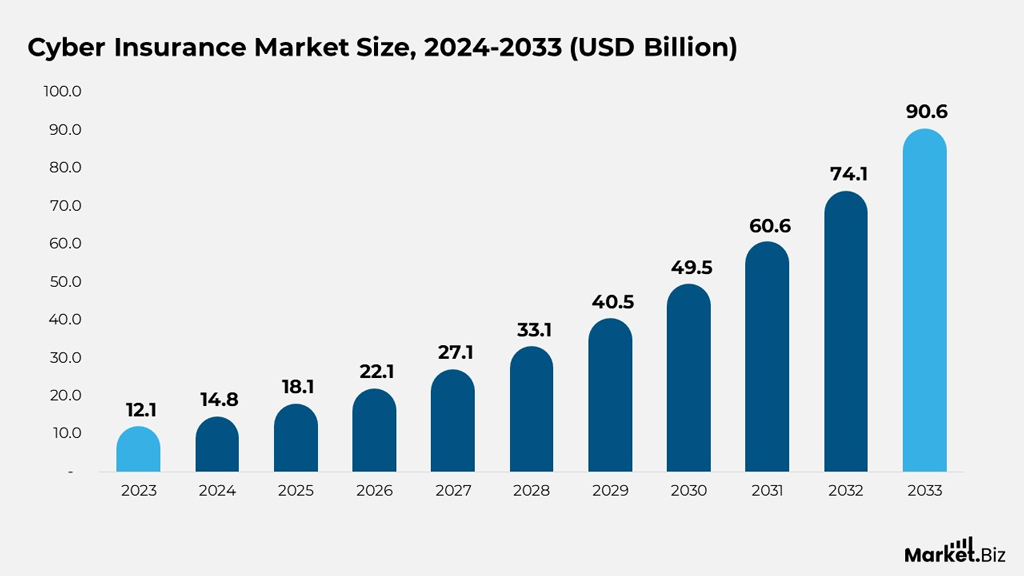
- The global cyber insurance market is projected to grow from $14.8 billion in 2024 to $90.6 billion by 2033, highlighting rapid industry expansion.
- Market value is expected to increase by 512% between 2024 and 2033, reflecting strong demand for cyber risk protection.
- The market is forecast to surpass $22.1 billion in 2026, driven by rising cybersecurity threats and regulatory requirements.
- By 2028, the cyber insurance industry is projected to reach $33.1 billion, more than doubling its 2024 size.
- The market is expected to cross the $40 billion mark in 2029, reaching approximately $40.5 billion.
- Cyber insurance market size is forecast to approach $50 billion in 2030, totaling $49.5 billion.
- The industry is projected to exceed $60.6 billion in 2031, signaling accelerating adoption among businesses.
- By 2032, global cyber insurance premiums are expected to reach $74.1 billion, a significant year-over-year increase.
- The largest annual market value in the forecast period is $90.6 billion in 2033, the highest level recorded on the chart.
- Market growth accelerates steadily throughout the decade, rising from $12.1 billion in 2023 to $90.6 billion in 2033.
Cyber Insurance Premium Pricing and Renewal Trends
- Global cyber insurance premium rates decreased by an average of 11% in 2025 due to increased carrier capacity.
- The global cyber insurance market is projected to reach $16.4 billion in total premiums by the end of 2026.
- Analysts forecast that premium pricing will increase by 15% to 20% throughout 2026 following recent market stabilization.
- Ransomware incidents currently drive major financial losses and account for 60% of the total value of large claims.
- Underwriters denied 82% of cyber insurance claims for organizations lacking mandatory MFA implementation across their critical systems.
- Companies demonstrating strong continuous security controls saw their large claim frequency drop by 30% in early 2025.
- The manufacturing sector faced tighter underwriting scrutiny after generating 33% of all large cyber claims in 2025.
- Cyber insurance policy adoption among small and mid-sized businesses climbed to 71% entering 2026 amid favorable renewal conditions.
- Businesses suffering from data exfiltration faced severe financial impacts as it factored into 40% of large claims in 2025.
Cyber Insurance Coverage and Policy Limits
- Ransomware accounts for 60% of the value of large cyber insurance claims exceeding €1 million.
- The majority of mid-sized business policies now feature coverage limits between $1 million and $5 million.
- Incident response and crisis management currently drive 73% of all business cyber insurance claims.
- Organizations implementing continuous security monitoring file 73% fewer claims than the industry average.
- Third-party and supply chain failures are projected to cause over 30% of all data breaches.
- Around 40% of cyber insurance claims face denials or sublimits due to missing security controls like MFA.
- The global cyber insurance market size is expected to reach $33.44 billion by 2026 as coverage demand expands.
- Data privacy liabilities and regulatory breach responses constitute nearly 9% of modern cyber insurance claims.
Cyber Insurance Adoption and Penetration Rates
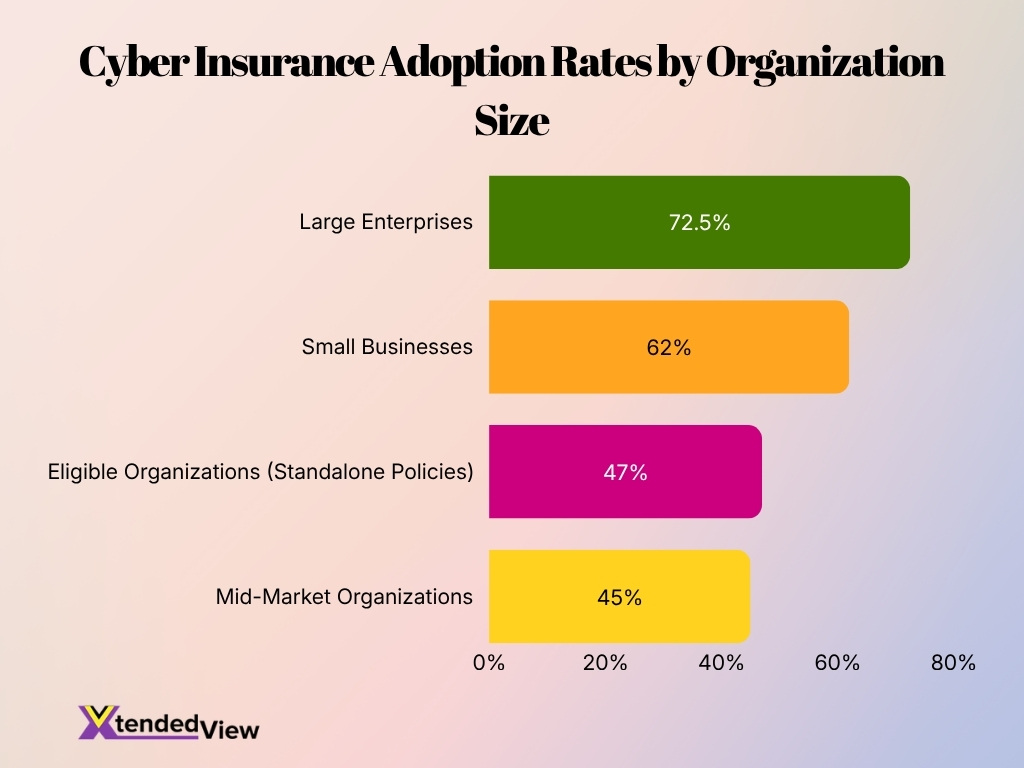
- Approximately 62% of small businesses carried cyber insurance coverage globally in 2025.
- Global adoption rates show that only 47% of eligible organizations possess a standalone policy.
- Large enterprises maintain the highest penetration rates at 70% to 75% globally.
- Escalating ransomware incidents currently drive 60% of the value of all large cyber claims.
- Exactly 99.5% of insurers mandate strict cybersecurity controls before approving coverage.
- North American organizations represent the largest market share at 36.4% of global insured risk.
- Healthcare and financial services remain heavily insured due to average breach costs hitting $5 million.
- Mid-market organizations are rapidly increasing demand to reach a 40% to 50% penetration rate by 2026.
- The global cyber insurance market is projected to double in value to $33.4 billion by 2026.
Average Cyber Insurance Claim Costs and Payouts
- The average global data breach cost reached $4.88 million in 2024, setting a record high for losses.
- Average breach costs declined to $4.44 million in 2025, reflecting improvements in AI-assisted detection.
- Organizations using AI and automation reduced breach costs by approximately $1.9 million compared to non-users.
- The average cyber incident cost for a large enterprise now stands at $10.3 million per event.
- Ransomware claims average $631,000 per incident, making it the costliest attack type by far.
- Small to medium enterprises face an average total claim cost of $345,000 for cyber incidents.
- Legal defense and regulatory expenses frequently represent 20% to 30% of total cyber claim values.
- Business interruption coverage is triggered in 33% of ransomware claims, averaging $510,000 in severity.
- Third-party liability lawsuits are the fastest-growing category, rising 70% year over year.
- Financial fraud represents roughly 30% of all cyber insurance claims, making it the most common category.
Major Drivers of Cyber Insurance Claims
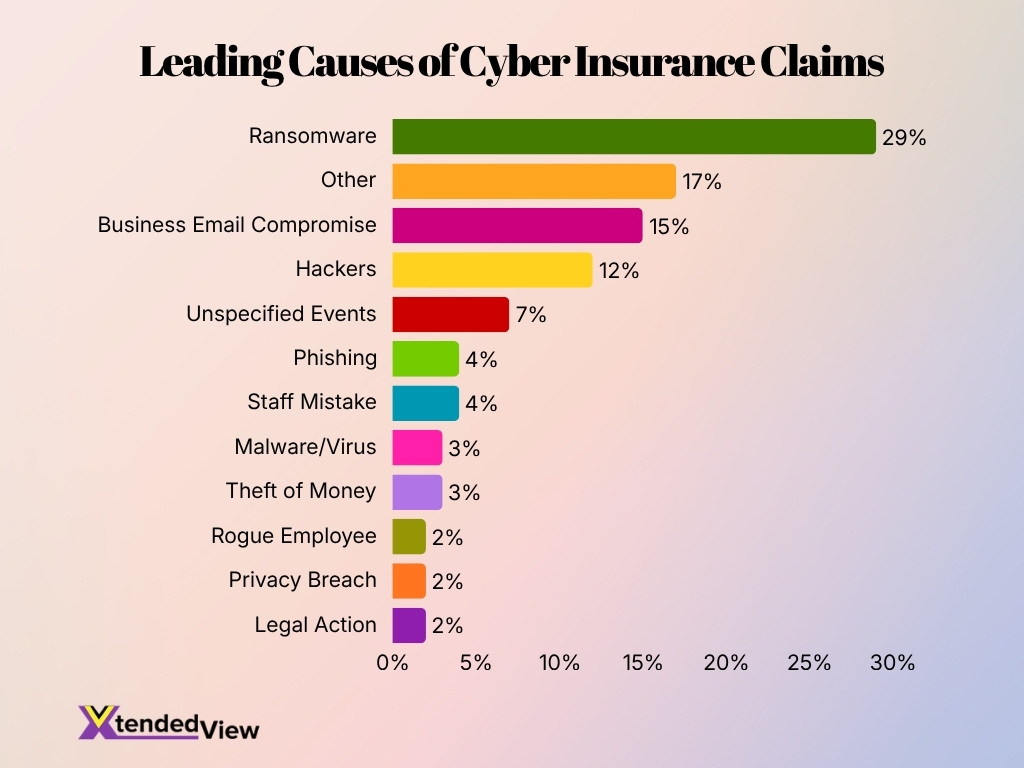
- Ransomware is the leading cause of cyber insurance claims, accounting for 29% of all reported claims.
- Other incidents represent 17% of claims, making them the second-largest category.
- Business Email Compromise (BEC) contributes 15% of cyber insurance claims.
- Hackers are responsible for 12% of claims, highlighting persistent external threats.
- Unspecified Events account for 7% of total cyber insurance claims.
- Phishing and Staff Mistakes each generate 4% of cyber insurance claims.
- Malware/Virus attacks and Theft of Money both represent 3% of claims.
- Rogue Employee, Privacy Breach, and Legal Action each account for 2% of cyber insurance claims.
- The top four causes, Ransomware (29%), Other (17%), BEC (15%), and Hackers (12%), collectively make up 73% of all claims.
- Human-related incidents, including BEC, Phishing, Staff Mistakes, and Rogue Employees, contribute 25% of total cyber insurance claims.
Cyber Insurance Claim Denial Rates and Causes
- More than 40% of all cyber insurance claims face denial, primarily due to the absence of required security controls.
- Approximately 82% of denied cyber claims are directly linked to the failure to implement multifactor authentication (MFA).
- Nearly 27% of data breach claims contain specific policy exclusions that result in partial or zero financial payouts.
- Unapproved remediation costs cause 58% of businesses to experience partial coverage denials during the claims process.
- An overwhelming 99.5% of organizations report that insurers actively verify security questionnaires before approving any policies or payouts.
- Incidents involving third-party vendors and supply chain failures are responsible for over 30% of all recorded data breaches.
- Around 45% of companies face coverage disputes because their specific incident costs fall completely outside the policy scope.
- Failure to patch known vulnerabilities resulted in $307 million in preventable losses across 614 organizations facing ransomware attacks.
- Missing compliance measures and delayed incident reporting lead to 14% of policyholders facing outright claim rejections.
- Ransomware claims average $631,000 per incident, driving 60% of the total value for large cyber insurance claims.
Cyber Insurance Statistics for Small and Medium-Sized Businesses
- Small businesses account for approximately 43% of all cyberattack victims globally.
- More than 60% of small businesses facing a severe cyberattack close permanently within 6 months.
- Only 10% to 20% of SMEs carry cyber insurance, trailing the 70% large enterprise adoption rate.
- Business email compromise remains a top threat, accounting for 73% of attacks targeting SMBs.
- Most SMB cyber insurance policies provide coverage limits ranging from $1 million to $5 million.
- Ransomware attacks were involved in 88% of all SMB data breaches recorded throughout 2025.
- About 40% of SMB cyber insurance claims are denied due to a lack of cybersecurity training and controls.
- With 86% of SMBs using cloud services, increased exposure drove average breach costs to $3.31 million.
- By 2026, 35% of insurers will offer built-in cyber risk management services alongside SMB policies.
Cyber Insurance Claims by Industry Sector
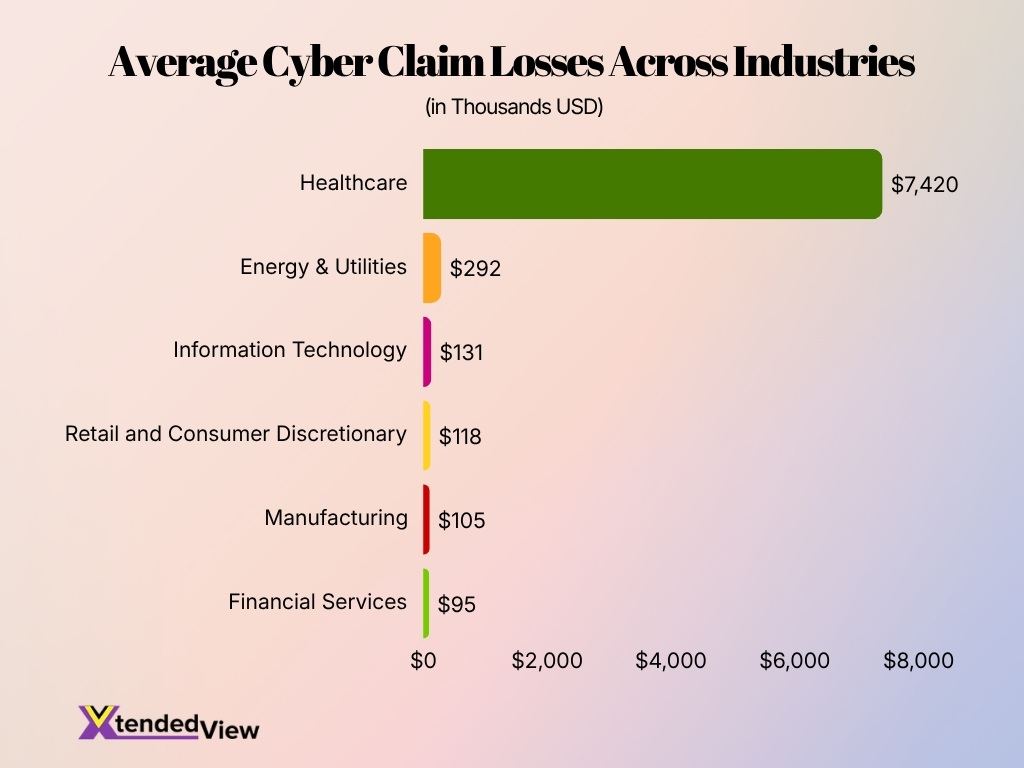
- The average cost of a healthcare data breach reached $7.42 million in 2025, maintaining its position as the most expensive sector.
- Financial services organizations reported a claims frequency of 1.47% with average losses of $95,000 per incident in 2024.
- The manufacturing sector saw a 4% year-over-year increase in claims frequency, averaging a loss of $105,000.
- Business Email Compromise (BEC) and Funds Transfer Fraud incidents accounted for 60% of all cyber insurance claims by volume.
- Around 33% of large cyber insurance claims by value were concentrated across the education, energy, and public entity sectors.
- The retail and consumer discretionary sector experienced an average claim severity of $118,000 per cyber incident.
- Information technology companies reported an 11% year-over-year increase in claims severity, reaching an average loss of $131,000.
- The energy and utilities industry faced a massive 1,200% spike in claims severity, driving average losses up to $292,000.
- Ransomware accounted for 60% of the total value for large cyber claims exceeding €1 million across all industries.
- Data breaches involving remote work factors cost an average of $173,074 more than those affecting centralized corporate networks.
Enterprise Cyber Insurance Statistics
- Large enterprises with revenues exceeding $1 billion maintain a cyber insurance penetration rate of 60% to 70%.
- Global cyber insurance premiums for the large enterprises segment reached $5.68 billion in 2024.
- The average cyber incident cost for a large company currently stands at $10.3 million.
- Data exfiltration was present in 40% of large cyber claims, up from 25% the previous year.
- Ransomware accounts for 60% of the total value of large cyber claims exceeding €1 million.
- Rising AI-driven threats are expected to drive cyber insurance premium increases of 15% to 20% in 2026.
- Integrating proactive cybersecurity services has helped enterprise policyholders reduce claim frequency by up to 25%.
- Insured large enterprises recover financially from major cyber incidents up to 60% faster than uninsured counterparts.
- Approximately 80% of companies utilizing AI-powered security defenses receive premium reductions from their insurers.
Ransomware and Cyber Extortion Statistics
- Publicly disclosed ransomware victims increased by 81% in 2025 compared to the previous year.
- More than 5,400 publicly disclosed ransomware attacks were reported globally during 2025.
- The average ransomware payment declined to approximately $553,959 in 2024.
- Nearly 70% of organizations hit by ransomware reported operational disruptions lasting longer than one week.
- Approximately 44% of all data breaches analyzed in recent industry reports involved ransomware.
- The global average cost to recover from a ransomware incident reached $1.53 million in 2025.
- An estimated 80% of organizations that pay a ransom are attacked again within 12 months.
- Roughly 64% of ransomware victims now completely refuse to pay the demanded extortion fees.
Cyber Insurance Costs Rise With Workforce Size
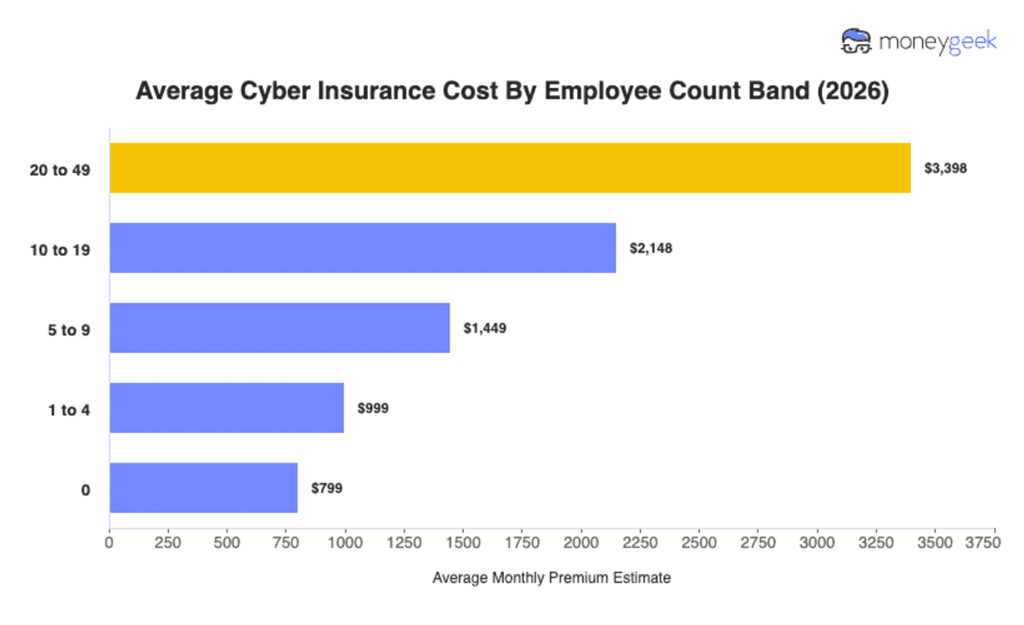
- Businesses with 20 to 49 employees face the highest average cyber insurance premium at $3,398 per month.
- Companies with 10 to 19 employees pay an average monthly cyber insurance cost of $2,148.
- Firms employing 5 to 9 workers spend approximately $1,449 per month on cyber insurance coverage.
- Small businesses with 1 to 4 employees have an average monthly premium of $999.
- Businesses with no employees still pay around $799 per month for cyber insurance protection.
- The premium for firms with 20 to 49 employees is more than 4.2 times higher than for businesses with no employees.
- Cyber insurance costs show a clear upward trend as employee count increases, reflecting higher organizational risk exposure.
Data Breach Cost Statistics
- The global average cost of a data breach reached $4.88 million in 2024, the highest level ever recorded at the time.
- The average breach cost moderated to approximately $4.44 million in 2025, reflecting faster detection and containment capabilities.
- Healthcare continued to experience the highest average breach cost at approximately $9.77 million per incident.
- Organizations using security AI and automation extensively saved an average of $1.9 million per breach compared with organizations without those capabilities.
- Breaches involving stolen credentials required an average of 292 days to identify and contain.
- Cloud-related breaches represented one of the fastest-growing categories of cybersecurity incidents.
- Lost business costs remained the largest component of breach-related financial damage.
- Organizations that detected breaches within 200 days experienced substantially lower recovery costs than slower responders.
- Regulatory fines and compliance expenses continue increasing the overall financial burden of data breaches worldwide.
- Third-party vendor breaches frequently generate higher-than-average remediation and notification expenses.
Cyber Risk and Threat Statistics
- Global cybercrime is projected to cost the economy approximately $10.5 trillion annually by 2026.
- Human error remains the root cause in nearly 68% of all security breaches.
- Stolen credentials are utilized as the initial attack vector in 53% of data breaches.
- Phishing remains a primary threat, accounting for 42% of all global cyber incidents.
- A record-breaking 48,174 new software vulnerabilities were disclosed during 2025.
- Over 66% of organizations have suffered a software supply chain attack in the past 18 months.
- Global organizations faced a staggering average of 1,968 weekly cyberattacks.
- AI-generated phishing campaigns have increased malicious click-through rates by up to 54%.
- Financially motivated cybercrime drives an overwhelming 95% of all cyberattacks globally.
- The global average cost of a data breach has reached $4.44 million.
Regional Cyber Insurance Statistics
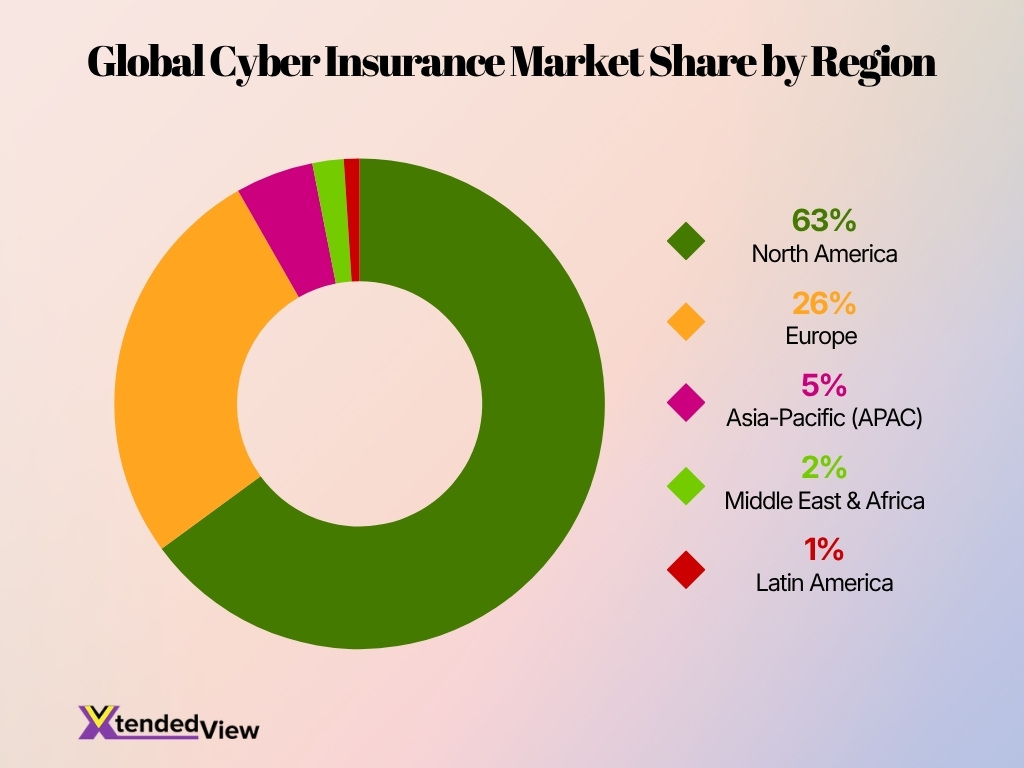
- North America represents approximately 63% of all global cyber insurance premiums.
- The United States market dominates worldwide figures with nearly $9.14 billion in direct written premiums.
- Europe stands as the second-largest region, accounting for 26% of the global cyber insurance market share.
- Approximately 41% of large European companies expect to purchase new cyber insurance policies within five years.
- The Asia-Pacific region currently holds a 5% market share but demonstrates one of the fastest global growth rates.
- India is experiencing surging regional demand, with its domestic cyber insurance market valued at $580 million.
- Over 21% of global cyberattacks recently targeted APAC, dramatically accelerating the region’s insurance adoption.
- Cyber insurance penetration across Latin America remains drastically underrepresented at just 1% of global premiums.
- Organizations in the Middle East and Africa currently account for only 2% of worldwide cyber coverage purchases.
ROI and Financial Impact of Cyber Insurance
- Implementing strong cybersecurity controls like MFA can lower cyber insurance premiums by 15% to 30%.
- The average cyber insurance claim payout for businesses in high-risk sectors recently reached $350,000.
- Organizations carrying cyber insurance generate an estimated 19% ten-year ROI when handling major claims.
- Business interruption and incident response costs account for 73% of all triggered cyber insurance clauses.
- Small to mid-sized enterprises represent 98% of claims by volume but only 49% of the total financial cost.
- Containing a data breach lifecycle to under 200 days saves organizations an average of $1.14 million.
- The average large-company cyber incident currently demands $10.3 million in total financial recovery expenses.
- Ransomware incidents drive 60% of the total value of large cyber claims exceeding $1 million.
- Uninsured micro-enterprises face an average financial impact of $79,000, which often causes operational closures.
- Data exfiltration events cost insured businesses more than double the financial value of standard cyber claims.
AI and Cyber Insurance Statistics
- More than 70% of organizations are actively exploring or deploying AI-driven cybersecurity capabilities.
- Organizations using AI and automation extensively reduced their average breach costs by $1.9 million.
- AI-assisted threat detection has successfully shortened average breach containment timelines by 80 days.
- Approximately 63% of cyber insurers now incorporate AI-based risk scoring into their underwriting decisions.
- Over 80% of companies utilizing AI-powered security defenses now receive premium credits or reductions.
- Generative AI has accelerated phishing and impersonation attacks, which currently comprise 37% of AI-driven incidents.
- Unmonitored shadow AI adds an average of $670,000 to the total cost of an enterprise data breach.
- Cyber insurance premiums are forecasted to increase by 15% to 20% in 2026 due to escalating AI-powered threats.
- Nearly 57% of small and medium enterprises report experiencing an attack tied to an AI-related vulnerability.
- Global cyber insurance premiums are projected to reach $33.4 billion in 2026 as AI integration expands.
Frequently Asked Questions (FAQs)
The global cyber insurance market is projected to reach approximately $22.5 billion in 2026, with some forecasts estimating values above $30 billion depending on market scope and methodology.
Approximately 62% of organizations reported having cyber insurance coverage in 2025, reflecting continued growth in adoption rates worldwide.
The average global cost of a data breach was $4.44 million in 2025, down from $4.88 million in 2024 due largely to faster AI-assisted breach detection and containment.
The cyber insurance market is expected to grow at a 14.2% CAGR between 2025 and 2030, while some forecasts project a 20.8% CAGR from 2026 to 2030.
North America accounted for approximately 69% of global cyber insurance premiums in 2024, making it the largest cyber insurance market worldwide.
Conclusion
Cyber insurance continues evolving from a niche financial product into a core component of enterprise risk management. Organizations faced rising ransomware activity, expanding regulatory obligations, and increasingly sophisticated cyber threats. As a result, demand for cyber insurance continued to grow across both large enterprises and small businesses.
The data shows that organizations combining strong cybersecurity controls with comprehensive cyber insurance achieve better financial outcomes after cyber incidents. At the same time, insurers are leveraging AI, advanced underwriting models, and continuous monitoring to improve risk assessment and reduce losses.
Looking ahead, cyber insurance adoption is expected to expand significantly as businesses seek protection against escalating cyber risks, while insurers continue refining coverage structures to address emerging threats such as AI-enabled attacks, supply chain compromises, and systemic cyber events.
