


Smart doors have evolved from basic connected locks into integrated entry systems that combine video, mobile credentials, sensors, AI detection and home automation. Homeowners now use smart locks and video doorbells to monitor deliveries, verify visitors and control access remotely, while apartments, hotels, offices and other commercial properties increasingly rely on digital credentials to simplify access management. Growth in smart locks, video doorbells and interoperable standards shows that connected entry is becoming a core part of the wider smart-home and building-security market.
At the same time, buyers are paying closer attention to privacy, subscription costs, installation options and compatibility with ecosystems such as Apple Home, Google Home, Amazon Alexa and SmartThings. The statistics in this article show how adoption, consumer behavior, technology and market growth are shaping the next phase of smart-door use.
Editor’s Choice
- Smart doorbell revenue is estimated to rise from $7.5 billion in 2025 to $9.9 billion in 2026, a one-year increase of roughly 32% based on the reported market estimates.
- Smart lock revenue is projected to increase from $3.3 billion in 2025 to $4 billion in 2026 under one current forecast, reflecting continued demand for connected access control.
- North America represented 41.5% of global smart lock revenue in 2025, making it the largest regional smart lock market under that methodology.
- Residential buyers accounted for 83.4% of smart doorbell revenue in 2025, showing how strongly the category remains tied to household security.
- Deadbolts generated 42.4% of smart lock revenue in 2025, the largest product share within the smart lock category.
- Bluetooth accounted for 34.8% of smart lock protocol revenue in 2025, ahead of the other protocols measured in the same market analysis.
- Asia Pacific is forecast to record a 24.5% CAGR in smart locks from 2026 to 2033, making it the fastest-growing region in that forecast.
- A U.S. smart-doorbell forecast places adoption at 26% of households in 2026, up from 24% in 2024 and 17% in 2020.
Recent Developments
- In February 2026, the smart access industry introduced Aliro 1.0, a unified specification designed to standardize digital credentials across residential, commercial, hospitality and institutional access systems.
- The Aliro initiative brought together more than 220 member companies, indicating substantial industry participation behind interoperable digital access.
- Aliro 1.0 supports three key access approaches: NFC, Bluetooth Low Energy and Bluetooth LE combined with Ultra-Wideband for hands-free authentication.
- The standard has support from the three major mobile-wallet ecosystems, Apple, Google and Samsung, creating a path for digital door credentials to work through widely used smartphones and wearables.
- One Aliro-compatible NFC keypad received certification on Feb. 26, 2026, showing that certified access hardware entered the ecosystem alongside the specification’s launch.
- Another Aliro development platform received certification on March 2, 2026 and supports technologies including UWB, NFC and secure credential storage.
- By July 2026, a certified smart lock supporting Matter and Aliro offered six access methods: digital wallet, fingerprint, keypad, app, voice assistant and physical backup key.
- The same July 2026 certified lock supports Apple Home, Google Home, Amazon Alexa, SmartThings and Home Assistant, illustrating how the market is shifting toward multi-ecosystem access rather than single-platform control.
Global Smart Door Market Overview
- The broader global doors market was valued at approximately $152 billion in 2025 and is projected at $159.9 billion in 2026 under one current estimate; smart and automated doors form a growing technology segment within this larger market.
- Another global doors forecast places the market at $81.1 billion in 2025 and $105 billion by 2032, illustrating how market totals differ significantly according to product definitions and methodology.
- Smart door locks represent a multibillion-dollar connected-access segment, with one 2026 forecast placing their value at $4.22 billion, up from $3.5 billion in 2025.
- Under that forecast, smart door lock revenue could reach $17.75 billion by 2034, representing a 19.7% CAGR from 2026 onward.
- Smart doorbells add another major connected-door category, with one estimate placing their market at $9.9 billion in 2026.
- Connected door and window sensors form a smaller supporting segment, valued at $980.37 million in 2025 and projected at $1.06 billion in 2026.
- The smart door and window sensor category is forecast to reach $1.65 billion by 2032, representing a 7.72% CAGR under that market model.
- High-speed doors, which increasingly incorporate automation and smart controls in logistics and industrial facilities, are projected to grow from $4.58 billion in 2025 to $4.8 billion in 2026 and $6.97 billion by 2034.
Global Automatic & Smart Door Market Revenue
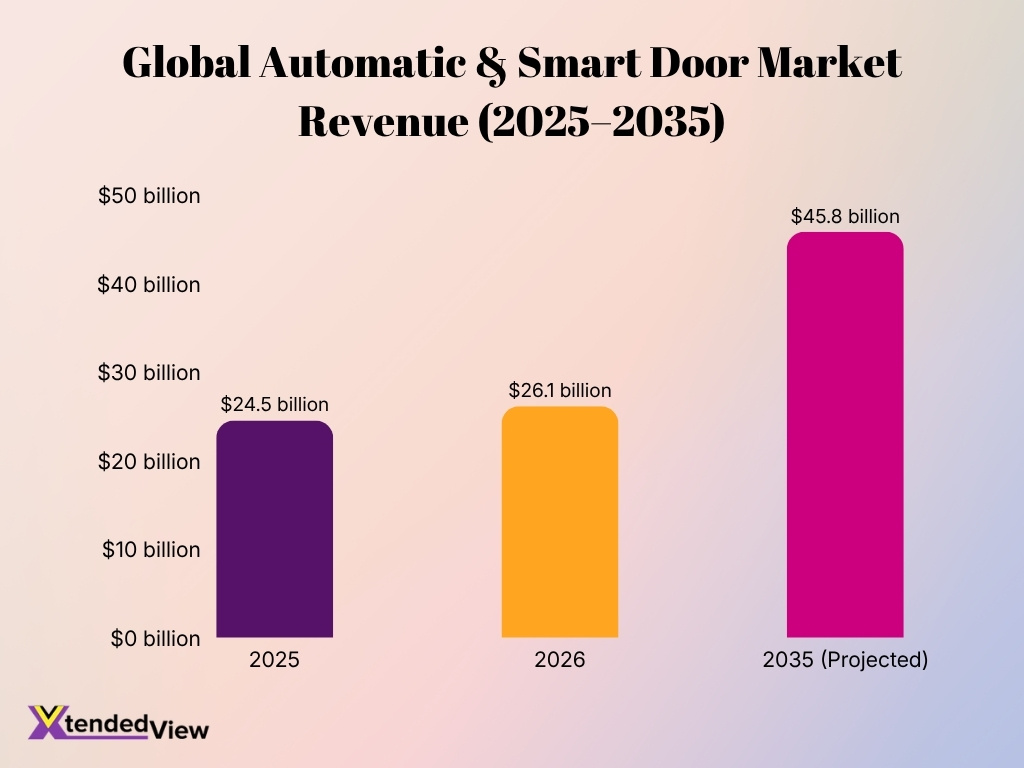
- The global automatic and smart door market is estimated to generate $24.5 billion in revenue in 2025, highlighting substantial demand for automated access and smart entry solutions.
- Market revenue is expected to increase to $26.1 billion in 2026, representing annual growth of approximately 6.5%.
- By 2035, global market revenue is projected to reach $45.8 billion, nearly $20 billion higher than the 2026 level.
- Between 2025 and 2035, the market is projected to expand by approximately 87%, indicating significant long-term growth potential.
- The increase from $24.5 billion to $45.8 billion suggests that automatic and smart doors could see sustained adoption across residential, commercial, and institutional applications.
Smart Door Lock Market Size and Growth
- The global smart lock market generated approximately $3.3 billion in 2025 and is estimated at $4 billion in 2026 under one current industry forecast.
- The same forecast projects revenue of $14.3 billion by 2033, representing a 20.1% CAGR from 2026 through 2033.
- Another 2026 estimate places smart door lock revenue at $3.5 billion in 2025 and $4.22 billion in 2026, followed by $17.75 billion in 2034.
- A separate forecast values the market at $3.23 billion in 2025 and $3.72 billion in 2026, with a 15.11% CAGR through 2031.
- Another 2026 study estimates smart locks at $3.28 billion in 2025 and $3.77 billion in 2026, with revenue projected to reach $14.33 billion by 2036.
- On a unit basis, that forecast expects global smart lock sales to reach 110.5 million units by 2036, representing a 15.1% volume CAGR.
- Deadbolts accounted for 42.4% of smart lock revenue in 2025, giving them the largest product-level share in the current segmentation.
- Residential applications represented 46.6% of smart lock revenue in 2025, ahead of the other applications included in the same market analysis.
- Smartphone-based authentication held 33.2% of the smart lock market in 2025, demonstrating the growing role of phones as digital keys.
Smart Door Adoption Rates by Region
- In the U.S., 32% of internet households owned at least one smart camera, video doorbell or smart lock in recent smart-access research.
- U.S. video doorbell penetration stood at 22% of internet households, compared with 20% for smart cameras and 10% for smart door locks in the same dataset.
- Roughly 8 million U.S. internet households owned both a video doorbell and smart lock, showing that connected front-door devices increasingly operate as a combined security setup.
- A separate U.S. forecast estimates 35 million smart-doorbell households in 2026, equal to approximately 26% of total households.
- That forecast shows U.S. smart-doorbell household penetration rising from 17% in 2020 to 24% in 2024 and 26% in 2026, with 27% projected for 2028.
- North America captured 41.5% of global smart lock revenue in 2025, while the U.S. ranked as the largest individual country market within that analysis.
- Asia Pacific is forecast to deliver the fastest smart lock expansion, with a 24.5% CAGR from 2026 through 2033.
- In the UK, 29% of adults owned smart doorbells in 2025, while 19% said they planned to purchase one within the following year.
- A separate 2025 UK technology survey found 27% ownership of smart home video doorbells or security cameras across its full respondent base, providing another indicator of mainstream connected-entry security adoption.
Smart Security Device Ownership Statistics
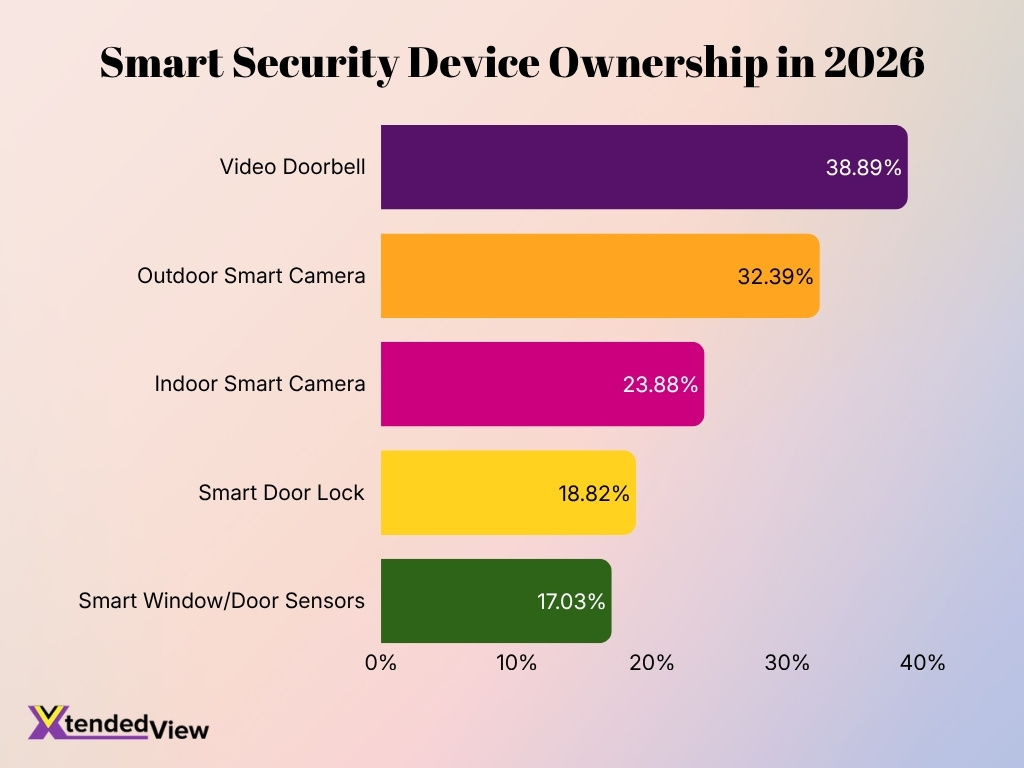
- Video doorbells lead smart security device ownership in 2026, with 38.89% of consumers owning one.
- Outdoor smart cameras rank second at 32.39%, showing strong demand for monitoring areas outside the home.
- Indoor smart cameras have an ownership rate of 23.88%, around 15 percentage points lower than video doorbells.
- Smart door locks are owned by 18.82% of consumers, placing them fourth among the smart security devices surveyed.
- Smart window and door sensors record the lowest ownership rate at 17.03%, just 1.79 percentage points below smart door locks.
- Overall, camera-based security devices dominate adoption, with video doorbells and outdoor cameras recording the two highest ownership rates.
Residential vs Commercial Smart Door Usage Statistics
- Residential applications accounted for 46.6% of global smart lock revenue in 2025, making homes the largest smart lock application segment. Commercial installations are expected to grow faster from 2026 through 2033 as offices and managed properties adopt centralized access systems.
- A separate smart digital lock analysis placed residential demand at 66.0% of global revenue in 2025, compared with 25.9% for commercial properties and 8.1% for hospitality. Differences reflect how research firms define the smart lock category.
- Under that segmentation, residential smart digital locks generated about $2.48 billion in 2025, compared with $969.4 million from commercial installations.
- Hospitality applications represented approximately $304.5 million, or 8.1% of smart digital lock revenue, in 2025. Hotels increasingly use digital credentials to streamline check-in, room changes, and checkout.
- Another electronic smart lock assessment found residential applications generated 65.0% of 2025 revenue, versus 24.8% for commercial environments and 10.2% for industrial and government installations.
- Residential smart door lock hardware and components represented about 73.8% of global revenue in 2025, while commercial applications accounted for 26.2%.
- In the U.S., households with a security system showed substantially higher smart lock adoption: 25% owned a smart door lock, compared with only 3% of households without a security system.
- Smart locks reached 11% of U.S. internet households in 2026, showing continued residential adoption even as the technology expands into multifamily and commercial buildings.
- More than half of U.S. households planning to move within six months reported plans to purchase a smart lock, indicating that moving, renovation, and property turnover remain important residential purchase triggers.
Top Smart Door Brands and Market Share
- Ring represented 43% of primary security-system or camera users in a 2026 survey of 2,435 U.S. adults, placing the brand well ahead of other camera-focused home-security providers.
- ADT ranked second in that U.S. security survey at 10%, while Google Nest accounted for 7%.
- Wyze represented 6% of surveyed U.S. security users, followed by Xfinity and SimpliSafe at 5% each.
- eufy represented 4% of primary home-security brands in the same 2026 U.S. survey, while Honeywell and Vivint each accounted for 3%.
- In the global smart doorbell segment, Ring held an estimated 14.35% market share in 2025, ahead of the other individually measured suppliers.
- The same global smart doorbell assessment put Hikvision at 8.07%, Google Nest at 5.24%, BTicino/Legrand at 3.74% and eufy at 3.20%.
- Those five smart doorbell suppliers collectively represented 34.6% of global 2025 revenue, leaving 65.4% spread across regional manufacturers and other suppliers.
- In North American residential smart locks, Allegion led with an estimated 21.5% share in 2025, supported primarily by Schlage-branded residential products.
- The five largest North American residential smart lock suppliers collectively controlled 70.2% of revenue in 2025, indicating substantially greater concentration than in the global doorbell segment.
- Globally, the five largest residential smart lock companies held about 56.4% of 2025 revenue. ASSA ABLOY led at 18.5%, while Allegion represented 13.2%, showing that established lock manufacturers continue to hold significant positions as technology companies enter the category.
Consumer Preferences and Buying Behavior
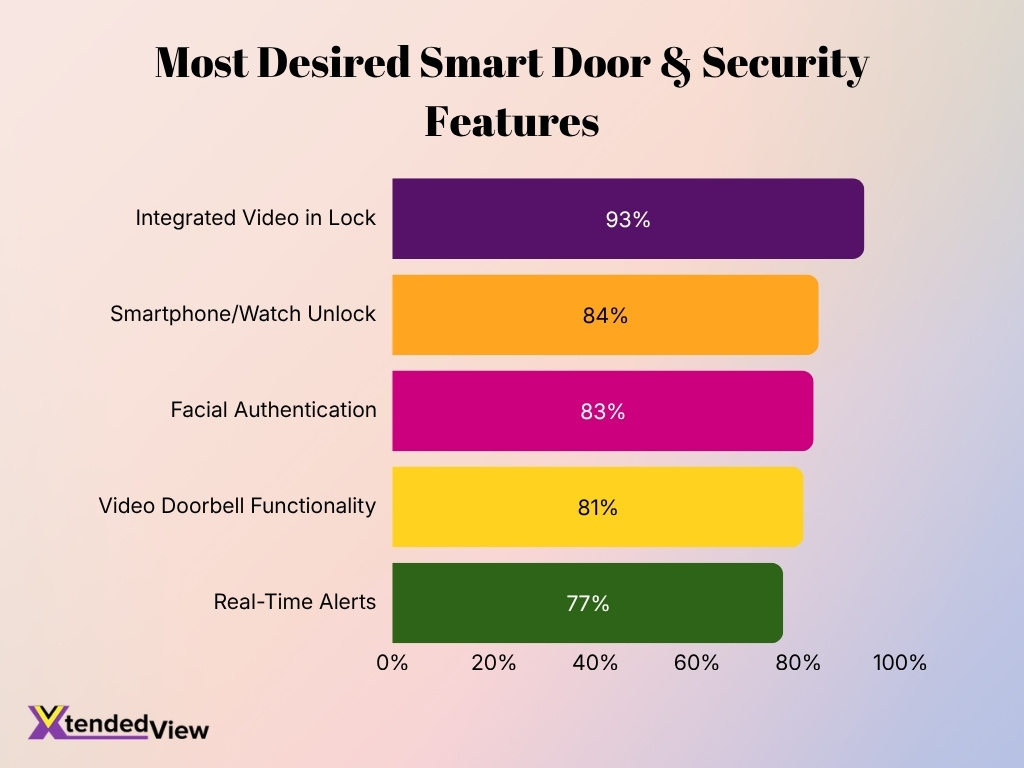
- Among 1,380 U.S. consumers shopping for home security in 2026, 81% wanted a video doorbell, making it the second-most requested feature after outdoor security cameras at 83%.
- Mobile notifications also rank highly: 77% of shoppers wanted real-time alerts from their security systems, reinforcing consumer demand for immediate visibility when someone approaches an entry point.
- Smart home products appealed to 50% of in-market security shoppers, suggesting that buyers increasingly evaluate door security as part of a larger connected-home setup.
- 84% of people intending to buy a smart lock expressed interest in tapping a smartphone or smartwatch to unlock their door, making mobile credentials one of the strongest emerging access preferences in 2026.
- Another consumer study found 93% of smart lock purchase intenders wanted video integrated into their next lock, and 50% described integrated video as a must-have feature.
- Facial authentication also attracted strong interest: 83% of prospective smart lock buyers wanted face-based unlocking, including 33% who considered it a must-have.
- In a 2025 homeowner study, 61% had purchased one to three smart devices during the previous 12 months, while 55% planned another smart-device purchase during the following year.
- About 19% of homeowners planned to buy a smart doorbell during the following 12 months, showing continued purchase intent heading into 2026.
- Cost remains an important restraint. In a recent U.S. smart-home survey, 53% cited cost as a barrier, while 33% pointed to privacy concerns and 23% worried about device reliability or glitches.
- Consumers also favor flexibility over contracts: 71% of 2026 security shoppers said a contract-free option would make them more likely to choose a provider.
Wireless vs Wired Smart Door Devices
- Bluetooth represented 34.8% of global smart lock revenue by protocol in 2025, establishing it as the largest wireless connectivity protocol.
- Sales of wired electronic locks are forecasted to reach US$ 5.13 billion by 2034, driven by higher stability and reliability.
- Smartphone-based authentication accounted for 33.2% of smart lock revenue in 2025, directly linking wireless entry with mobile usage.
- The global wireless door lock market is projected to expand at a 5.3% CAGR, reaching a total value of US$ 7.73 billion by 2036.
- Approximately 77% of security shoppers in 2026 preferred devices supporting mobile alerts, heavily favoring connected wireless systems.
- Wi-Fi-enabled wireless locks currently account for 27.5% of the market and represent the fastest-growing protocol with a 15.5% CAGR.
- Wired electronic locks are projected to grow at a steady 12% CAGR due to their uninterrupted direct power supply and superior hack resistance.
- North America dominated the overall smart door lock market with a 43.2% share in 2025, fueled by widespread residential smart home automation.
Automatic & Smart Door Revenue by Technology Type
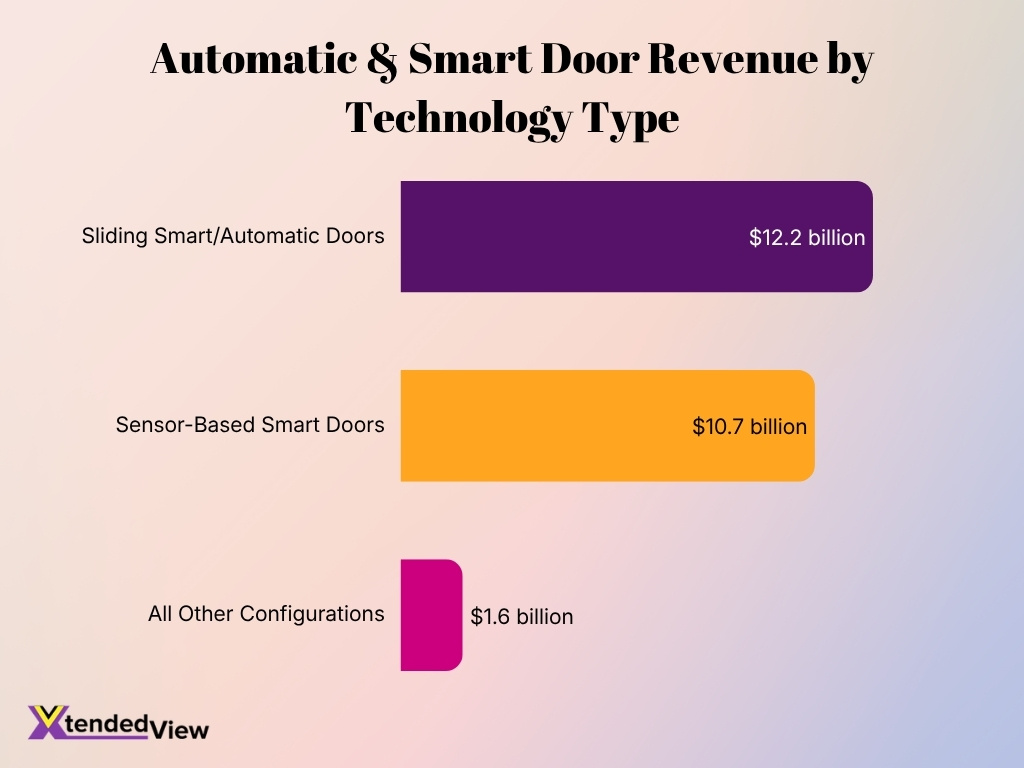
- Sliding smart and automatic doors led the market in 2025, generating approximately $12.2 billion in annual revenue.
- Sensor-based smart doors followed closely with $10.7 billion in revenue, highlighting strong demand for automated sensing technologies.
- Combined, sliding and sensor-based doors generated $22.9 billion, accounting for the vast majority of revenue across the listed technology types.
- All other door configurations generated just $1.6 billion, significantly below the two leading categories.
- Sliding smart and automatic doors generated about $1.5 billion more revenue than sensor-based smart doors in 2025.
- Total revenue across the listed technology types reached approximately $24.5 billion in 2025.
Smart Door Integration with Home Ecosystems
- 63% of U.S. home-security shoppers in a 2026 survey already used at least one smart home ecosystem, making compatibility an important consideration for most potential smart-door buyers.
- Amazon Alexa had the largest ecosystem footprint in that survey at 38% of respondents, followed by Google Home at 24%.
- Samsung SmartThings reached 9% of respondents, while Apple HomeKit accounted for 5% in the same survey.
- In May 2025, Matter 1.4.1 introduced three setup improvements: Enhanced Setup Flow, multi-device QR setup and onboarding information stored in NFC tags.
- Matter 1.4.2 followed in August 2025 with additional security, certification and infrastructure improvements while maintaining backward compatibility with previous Matter versions.
- Aliro 1.0 launched in February 2026 with support from more than 220 companies, linking smart locks and access readers with major mobile-device and wallet ecosystems.
- Aliro’s launch included commitments from three major wallet ecosystems, Apple, Google and Samsung, to support standardized mobile access credentials.
- Apple Home supports both HomeKit and Matter-compatible locks, while supported products can also add a home key directly to Apple Wallet.
- Apple Wallet digital keys can extend beyond single-family homes to apartments, condominiums and participating hotels, demonstrating how the same smartphone credential model can apply across residential and hospitality doors.
- By July 2026, a certified Aliro smart lock could connect without a dedicated gateway to Apple Home, Google Home, Amazon Alexa, SmartThings and Home Assistant while also supporting six unlocking methods.
Security Features, AI, and Advanced Detection Capabilities
- In a 2026 U.S. survey, 28% of home-security users already used AI person or package detection, showing that object classification has moved beyond early adoption.
- Facial recognition had a lower current adoption rate of 13%, but 39% of respondents expressed interest in adding the capability.
- About 18% of all U.S. adults reported owning a smart doorbell with AI features in February 2026.
- AI-enabled smart doorbell ownership reached 23% among adults ages 30 to 49, compared with 18% among ages 18–29 and 50–64, and 14% among adults 65 and older.
- Among prospective video doorbell buyers, 84% wanted AI facial recognition capable of identifying family and friends, and roughly one-third considered the feature essential.
- Consumer demand is similarly strong for integrated smart locks: 83% of prospective lock buyers wanted facial unlocking, including 33% who called it a must-have feature.
- 93% of smart lock purchase intenders wanted an integrated video camera, with half saying video inside the lock itself was a must-have.
- UWB-equipped access systems can measure both distance and angle of arrival, allowing a lock to distinguish where an authorized device is located and improve inside-versus-outside detection.
- Aliro 1.0 uses asymmetric cryptography and supports NFC, Bluetooth LE, and Bluetooth LE plus UWB to provide secure tap-based, longer-range, and hands-free authentication options.
- Despite growing AI use, security remains tied to consumer trust: 37% of U.S. home-security users worried about who could access their camera footage, even though 87% said home-security technology increased their peace of mind.
Smart Door Installation Trends: DIY vs Professional
- In 2026, 51% of U.S. home-security shoppers preferred DIY installation, making self-installation the most popular installation approach among surveyed buyers.
- Among consumers already using professionally installed security, roughly 74% had considered switching to DIY, indicating strong pressure on traditional installation models.
- Cost drives much of the shift: 70% of DIY-preferring shoppers identified lower cost as their main reason for choosing self-installation.
- Scheduling also matters. 43% of DIY-oriented consumers said they valued being able to install equipment on their own timetable.
- Another 2026 U.S. survey found 49% of alarm-system users installed their systems themselves, compared with 42% who used a professional installer.
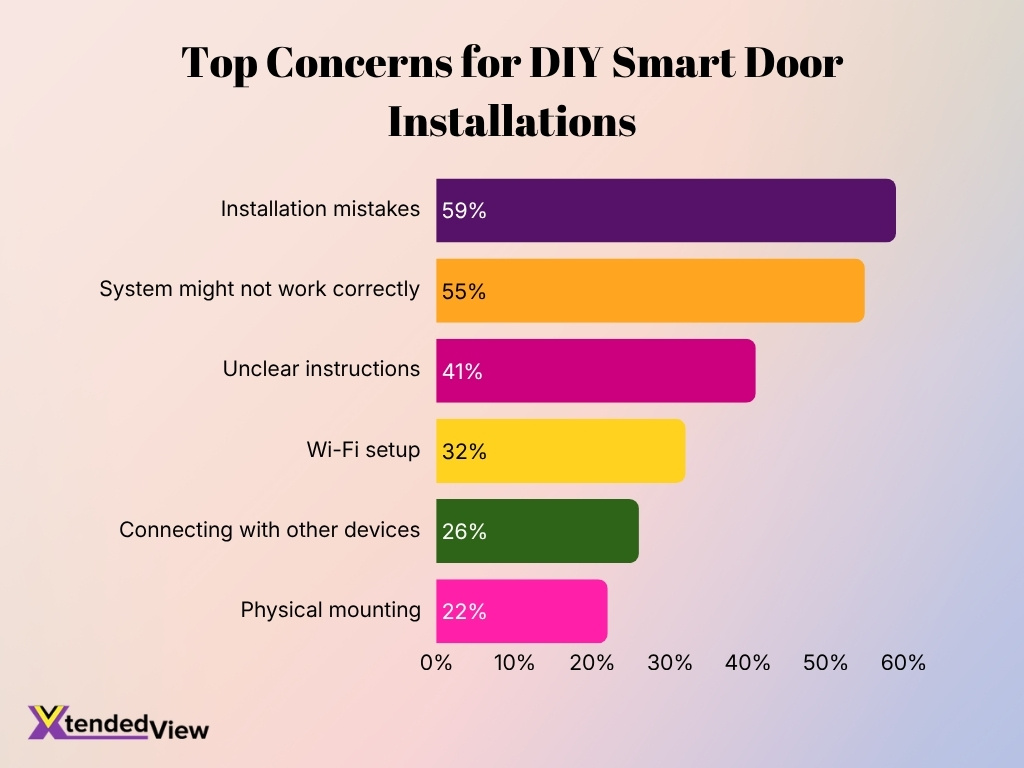
- Potential performance problems remain the largest DIY concern: 55% of DIY-friendly consumers worried that the system might not work correctly after installation.
- Unclear instructions concerned 41% of DIY-oriented shoppers, showing that installation documentation can directly influence the smart-device experience.
- Wi-Fi setup created concern for 32% of DIY consumers, while 26% worried about connecting new equipment with other smart home devices.
- Physical mounting ranked lower than software-related concerns: only 22% cited mounting or equipment installation as a concern, suggesting connectivity can create more friction than fastening the device to a door or wall.
- Professional monitoring attracts relatively limited demand among new security buyers. Only 5% of current non-users planned to add professional monitoring in the next 12 months in one 2026 survey.
Privacy and Data Security Concerns
- A 2025 North American smart-home survey found 26.2% of consumers cited data privacy as a concern, while privacy concerns rose to 43.5% when respondents considered AI-powered applications.
- Better transparency could directly improve adoption: 53.8% of consumers said improved data transparency would increase their likelihood of adopting smart or AI capabilities.
- Personalized control also matters. 53.2% of respondents showed greater interest when they could configure AI workflows around their own preferences.
- A 2026 U.S. home-security survey found 37% of users worried about who could access their camera footage, an important concern for video doorbell owners whose devices monitor front-door activity.
- Another 23% of U.S. security users said they felt uneasy about how much technology watches their homes. However, 87% still said security technology gave them greater peace of mind.
- Storage preferences reflect that privacy trade-off. In 2026, 49% of security camera and doorbell users preferred a combination of cloud and local storage, compared with 32% using cloud-only storage and 19% choosing local-only storage.
- A December 2025 U.S. study surveyed 401 smart-home users across five device categories. Between slightly more than half and almost three-quarters of respondents were at least somewhat concerned about device security and privacy, depending on category.
- That study also found that more than half of participants believed they understood the security and privacy risks associated with their devices, with users reporting the strongest understanding for smart security devices.
- Research covering nearly 600 smart-home vendors found 10.57% lacked a privacy policy, while 43.52% relied on general policies that did not specifically address smart-home devices. Only 64.38% provided readily accessible device privacy policies.
- A 2026 review of human-centered smart-home security research noted that only 10% of devices examined in an earlier manufacturer study discussed security updates, while the same share provided security-hygiene guidance. This gap remains relevant as connected locks and cameras become more common.
Subscription and Service Model Trends
- Among owners of security cameras, whole-home security systems, or smart doorbells, 40% subscribed to a monthly premium service in consumer research, while 60% did not.
- Among premium-service subscribers, 27% identified 24/7 continuous video recording as their primary reason for paying, while 19% prioritized greater access to historical video clips.
- In 2026, monthly cost ranked as the second-most important home-security purchase factor, selected by 46% of U.S. users. Ease of use ranked first at 50%.
- 71% of in-market U.S. security shoppers said a contract-free option would make them more likely to choose a provider, signaling strong demand for month-to-month service models.
- The preference reached 78% among DIY-oriented buyers, 73% among undecided shoppers and 63% among people who preferred professional installation.
- Only 27% of DIY-system shoppers said the availability of professional monitoring would make them more likely to choose one system over another. By comparison, 75% prioritized lower cost.
- Among U.S. consumers who did not already use the relevant home-security services, just 5% planned to add professional monitoring during the next 12 months in 2026.
- Subscription pressure is already affecting retention. In 2026, 6% of security users had canceled or downgraded a subscription during the previous 12 months, while another 7% reduced paid features or add-ons.
- Cloud dependence creates a direct link between subscriptions and recorded evidence: 32% of security-camera users relied on cloud-only storage in 2026, compared with 19% who used only local storage.
- The software side of the smart doorbell market is projected to expand at a 24.48% CAGR from 2026 to 2035, supported by AI alerts, facial recognition, cloud storage and app-based services that can generate recurring revenue.
Smart & Automatic Door Sales Channel Statistics
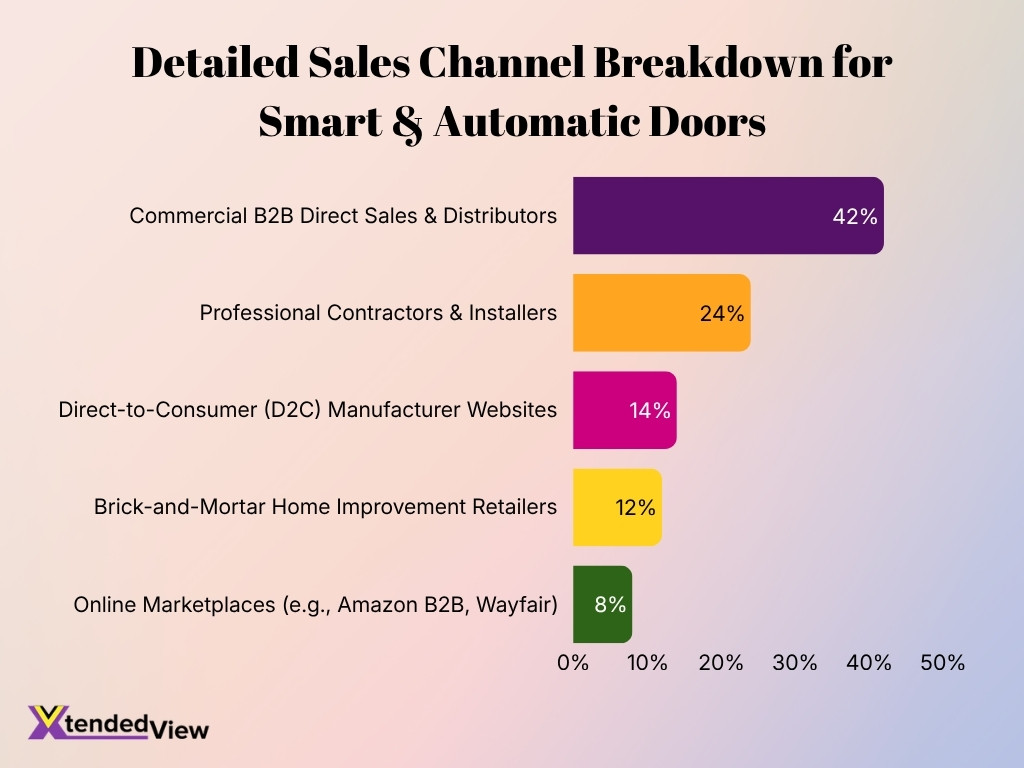
- Commercial B2B direct sales and distributors dominate the market with a 42% share, making this the largest individual sales sub-channel.
- Professional contractors and installers account for another 24% of total sales, highlighting the importance of specialist installation networks.
- Combined, offline channels represent 78% of the smart and automatic door market, showing that traditional sales remain the primary route to customers.
- Direct-to-consumer (D2C) manufacturer websites generate 14% of total sales, making them the largest online sales channel.
- Brick-and-mortar home improvement retailers contribute 12% of market sales, maintaining a meaningful role despite growing digital purchasing options.
- Online marketplaces, including platforms such as Amazon B2B and Wayfair, hold the smallest share at 8%.
- Overall, online channels account for 22% of sales, compared with 78% through offline channels, indicating a strong 3.5-to-1 advantage for offline distribution.
Smart Door Market Challenges and Emerging Growth Opportunities
- Cost remains the largest smart-home adoption barrier. A 2025 survey found it affected 48.8% of respondents, compared with 27.9% who identified setup complexity and 26.2% who cited general data privacy concerns.
- The integration gap remains substantial: only 8.5% of surveyed homes qualified as fully integrated smart environments in 2025, leaving room for simpler systems that connect locks, doorbells, lighting and security devices.
- Security represents a major growth opportunity because 55.9% of consumers ranked safety and security as a top smart-home priority.
- AI could strengthen that opportunity: 26.7% of respondents expressed willingness to adopt AI for security applications, while 45% identified security automation as the most useful AI-enabled smart-home application.
- Renters represent another growth segment. In 2026, 27% of renters without relevant security products planned to add or upgrade a video doorbell within the next year, compared with 19% of homeowners.
- Installation remains a potential friction point even as DIY grows. Among DIY-friendly U.S. consumers, 59% worried about installation mistakes, 55% feared that a system might not work properly, and 32% worried about Wi-Fi setup.
- Interoperability gained momentum in February 2026 with the launch of Aliro 1.0, a standardized digital-access specification designed for single-family homes, multifamily buildings, offices, universities and hospitality properties.
- Smart doorbells still face cybersecurity and counterfeit-product challenges. Current market research identifies cybercrime, data breaches and counterfeit devices as factors capable of slowing category growth despite strong demand.
- Commercial access offers another expansion route. Lever-handle smart locks are forecast to grow at a 21.2% CAGR from 2026 to 2033, supported by offices, hospitals, public infrastructure and multifamily properties.
- Emerging markets could outpace mature markets. India’s smart lock market is projected to grow from $72 million in 2026 to $380.7 million in 2033, representing a 26.9% CAGR.
Smart Door Market Forecast and Future Growth
- One current smart lock forecast values the global market at $4 billion in 2026 and projects $14.3 billion by 2033, representing a 20.1% CAGR.
- Under that forecast, global smart lock revenue would increase by more than 3.5 times between 2026 and 2033, reflecting sustained adoption in homes and commercial properties.
- Residential smart locks alone generated $1.54 billion in 2025 under the same market methodology and are projected to reach $6.62 billion by 2033.
- Individual-household smart lock revenue is projected to increase from $687.7 million in 2025 to $2.83 billion in 2033, representing a 19.4% CAGR over the forecast period.
- A separate 2026 smart door lock analysis projects the market from $3.75 billion in 2026 to $12.54 billion in 2033, representing an 18.8% CAGR.
- Another forecast places the broader smart lock market at $5 billion in 2026 and $13 billion by 2033, equivalent to a 14.6% CAGR. The variation illustrates how market definitions can produce different totals.
- Smart doorbells carry an even higher growth forecast under one current model, rising from $9.9 billion in 2026 to $94.4 billion by 2033 at a 38.1% CAGR.
- A more conservative smart doorbell methodology projects a 11.74% CAGR through 2031, demonstrating why long-range market forecasts should be treated as scenarios rather than precise future sales totals.
- Asia Pacific represents one of the clearest geographic growth opportunities. Smart locks are projected to expand at a 24.5% CAGR from 2026 through 2033 in the region, faster than the global rate in the same forecast.
- U.S. purchase intentions also support continued category growth: 22% of current non-users planned to add or upgrade a video doorbell during the next 12 months in a nationally representative 2026 survey, while 7% planned to add an access-control system.
Frequently Asked Questions (FAQs)
The global smart doorbell market is estimated at $9.9 billion in 2026, up from $7.5 billion in 2025.
The global smart doorbell market is projected to grow at a 38.1% CAGR from 2026 to 2033, reaching $94.4 billion by 2033.
The global smart door lock market is projected to reach $4.22 billion in 2026, compared with $3.50 billion in 2025.
North America held about 41.5% to 43.2% of global smart lock revenue in 2025, depending on the market methodology used.
Residential applications accounted for 46.6% of global smart lock revenue in 2025, making residential use the largest application segment.
Conclusion
Smart door statistics point to a market moving beyond standalone connected hardware toward integrated access, video, AI and digital-credential systems. Smart locks and video doorbells continue to gain traction across homes, multifamily properties, hotels and commercial buildings, while mobile access, AI-based detection and interoperability standards are expanding what these products can do. Consumer behavior also shows a clear preference for convenient installation, real-time alerts, flexible subscriptions and compatibility with existing smart-home ecosystems.
However, privacy concerns, cybersecurity risks, recurring service costs and inconsistent interoperability still influence purchase decisions. As manufacturers improve local processing, credential security and cross-platform support, smart doors are likely to become a more common part of both residential security and professional access-control systems.
