

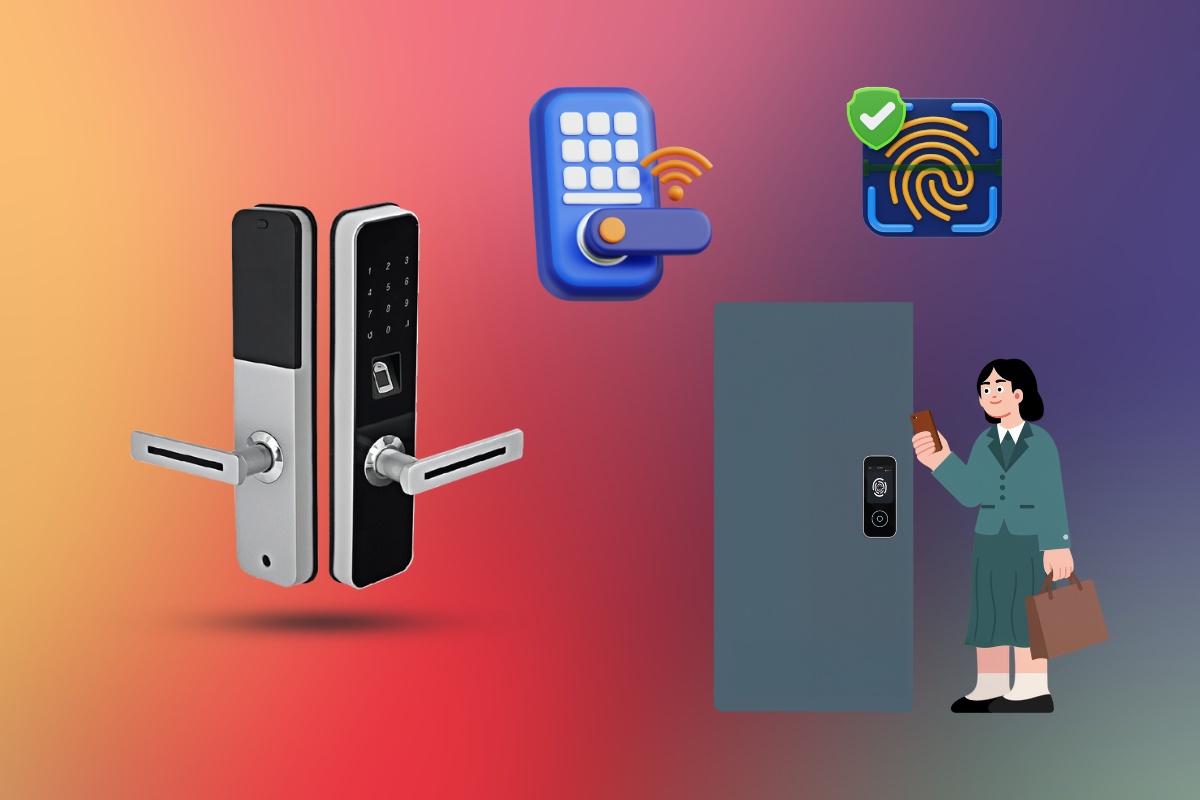
Smart door locks have moved from niche smart-home gadgets to mainstream security devices. Homeowners use them to manage remote access, while property managers rely on them to automate guest entry and building security. Growing smart-home adoption, advances in biometric authentication, and stronger connectivity standards continue to expand the market. The statistics below reveal how smart door locks are reshaping residential and commercial access control.
Editor’s Choice
- The global smart door lock market reached approximately $3.5 billion in 2025 and is projected to exceed $4.2 billion in 2026.
- Industry forecasts indicate a long-term CAGR of nearly 19.7% through the next decade.
- North America accounted for roughly 43.2% of global market revenue in 2025, maintaining its leadership position.
- The worldwide smart lock market generated approximately $2.77 billion in revenue during 2024.
- Smart locks were present in 19% of smart-enabled U.S. households in 2025.
- Residential applications represented about 56.8% of the smart door lock market in 2025.
- Biometric-enabled smart locks held around 35% market share among authentication technologies.
- More than 60% of U.S. households now own at least one smart-home device, supporting demand for smart locks.
- The U.S. smart lock market continues to expand as nearly 3 in 5 consumers are expected to adopt smart-home solutions in the coming years.
Recent Developments
- Facial-recognition smart locks entered the consumer market during 2024, expanding biometric access options beyond fingerprints.
- Palm-recognition door locks debuted at CES 2025, introducing vein-pattern authentication for residential users.
- Ultra-wideband (UWB) technology emerged as a major trend, enabling hands-free door unlocking through compatible smartphones and wearables.
- Several new smart lock models launched with integrated video doorbells, combining surveillance and access control in a single device.
- Matter-over-Thread support expanded significantly in 2024 and 2025, improving interoperability across smart-home ecosystems.
- New premium smart locks now offer battery life ranging from 6 months to 1 year on a single charge.
- Apple Home Key compatibility became a key purchasing feature in newly released smart locks during 2025.
- Hospitality operators increasingly adopted smart locks, making hotels one of the fastest-growing commercial segments with a projected growth near 23.9% CAGR.
- Smart-home cybersecurity concerns intensified as attacks on connected home devices increased by 124% during 2024.
Smart Locks Market Growth Highlights
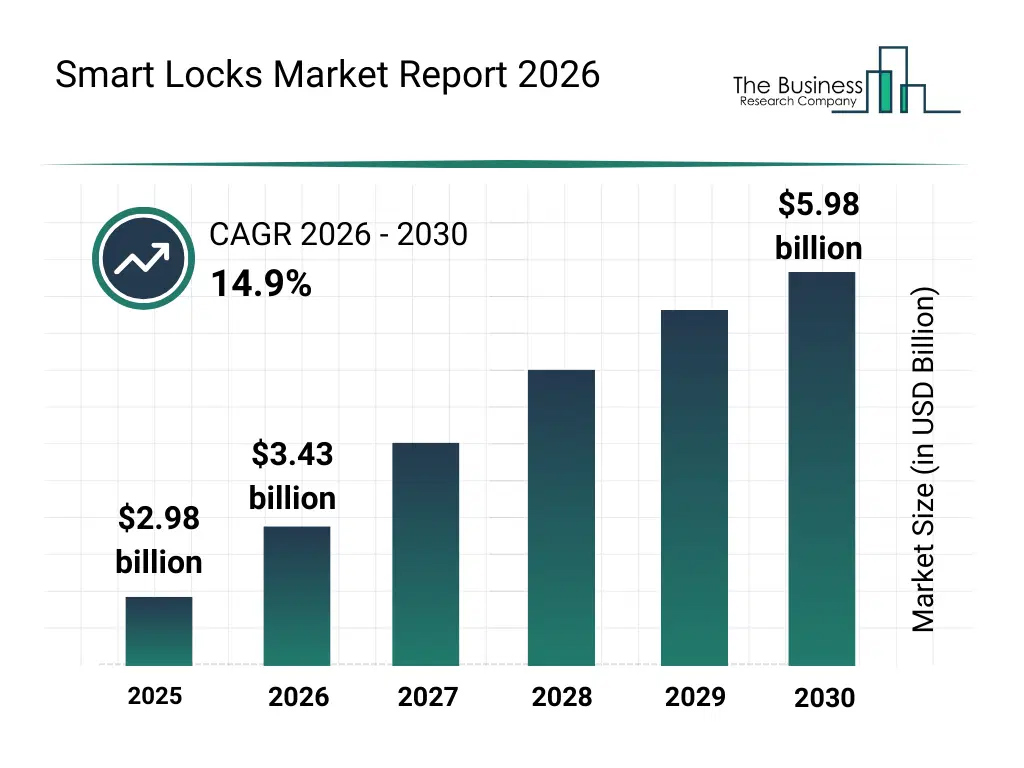
- Smart locks market size is projected to grow from $2.98 billion in 2025 to $5.98 billion by 2030, nearly doubling within five years.
- The market is expected to reach $3.43 billion in 2026, reflecting strong early growth momentum.
- The industry is forecast to expand at a robust 14.9% CAGR between 2026 and 2030.
- Smart locks market value is estimated to surpass $4.0 billion in 2027, marking a key growth milestone.
- By 2028, the global smart locks market is projected to reach approximately $5.0 billion.
- Market revenue is expected to climb to around $5.5 billion in 2029, driven by rising smart home adoption.
- The market is anticipated to add roughly $3.0 billion in new value between 2025 and 2030.
- 2030 is forecast to be the largest year on record, with the market reaching $5.98 billion.
Household Adoption Rates for Smart Door Locks
- Smart locks were installed in 19% of smart-enabled U.S. households in 2025.
- More than 60% of U.S. households now own at least one smart-home device.
- Around 3 in 5 Americans are expected to adopt smart-home solutions over the coming years.
- Among households with professionally monitored security systems, 25% own a smart door lock.
- Only 3% of households without security systems own a smart door lock, highlighting the link between home security investments and lock adoption.
- Smart locks consistently rank among the top five most desired smart-home products in the U.S. market.
- Rental property operators increasingly deploy smart locks to support self-check-in and remote access management.
- Growing integration with Alexa, Google Home, Apple Home, and SmartThings continues to improve household adoption rates.
- Rising consumer concerns about package theft and home security remain major drivers of smart lock adoption.
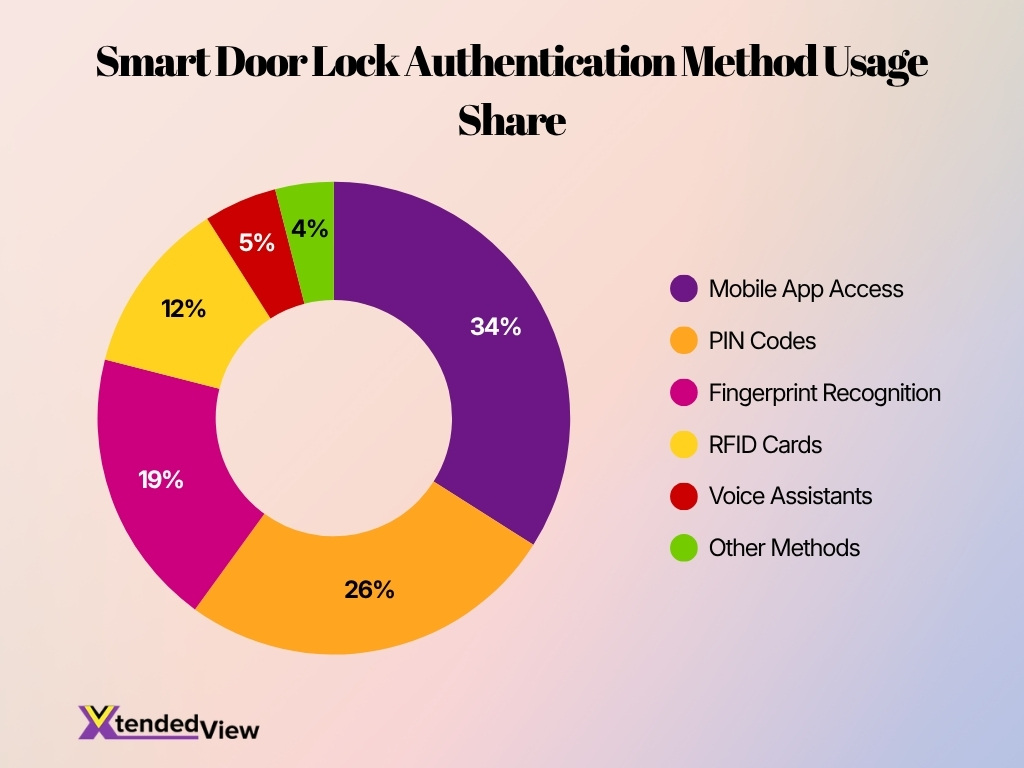
Smart Door Lock Statistics by Authentication Method
- Mobile App Access leads smart door lock authentication methods, with 34% of users preferring smartphone-based control and access.
- PIN Codes remain a popular authentication option, accounting for 26% of smart door lock usage.
- Fingerprint Recognition represents 19% of authentication methods, highlighting the growing demand for biometric security.
- RFID Cards make up 12% of authentication usage, reflecting continued adoption in residential and commercial settings.
- Voice Assistants account for 5% of authentication methods, indicating limited but emerging hands-free access adoption.
- Other Methods contribute 4% of authentication usage, showing a small share of alternative access technologies.
- The combined share of Mobile App Access, PIN Codes, and Fingerprint Recognition reaches 79%, dominating smart door lock authentication preferences.
- Biometric authentication through fingerprint recognition captures nearly one-fifth (19%) of the market, reinforcing security-focused consumer trends.
- Traditional access methods, such as PIN Codes and RFID Cards together account for 38% of authentication usage.
- Smartphone-based authentication is 8 percentage points more popular than PIN Codes and 15 percentage points ahead of Fingerprint Recognition.
Connectivity Technologies Adopted in Smart Door Locks
- Bluetooth-enabled smart locks accounted for approximately 38% of connectivity deployments in 2025, making it the most common method.
- Wi-Fi-enabled smart locks represented roughly 31% of global installations, driven by demand for remote access and cloud management.
- Zigbee and Z-Wave technologies collectively accounted for nearly 18% of smart lock ecosystem integrations in 2025.
- More than 70% of newly launched premium smart locks support smartphone control through Bluetooth and Wi-Fi simultaneously.
- Matter compatibility expanded significantly, with over 50 new lock models supporting cross-platform smart-home integration in 2025.
- Thread-based connectivity adoption accelerated in 2025, reducing device power consumption by an estimated 30% for better responsiveness.
- UWB-enabled smart locks emerged as a fast-growing category, capturing a projected 15% market growth rate in North America.
- Cloud-connected locks generated up to 25% higher recurring software revenue through remote management and access-control subscriptions.
- Commercial deployments favor Wi-Fi and Ethernet-connected systems, accounting for roughly 30% of overall smart lock demand.
Smart Door Lock Growth in Residential and Commercial Sectors
- The residential segment accounted for approximately 56.8% of global smart door lock revenue in 2025.
- Residential smart lock demand is projected to grow at a CAGR exceeding 18% through 2030.
- Commercial smart lock deployments are forecast to expand at nearly 20% CAGR during the next decade.
- Hotel and hospitality installations represent one of the fastest-growing commercial use cases, with a projected growth of around 23.9% CAGR.
- More than 65% of vacation rental operators now use digital access solutions instead of physical key management.
- Multifamily residential properties increasingly deploy smart locks to support remote leasing and self-guided tours.
- Office buildings continue replacing traditional access cards with mobile credentials integrated into smart lock systems.
- Educational institutions have accelerated smart lock deployments to improve campus security and emergency response capabilities.
- Healthcare facilities increasingly adopt smart access systems to improve controlled entry management and compliance requirements.
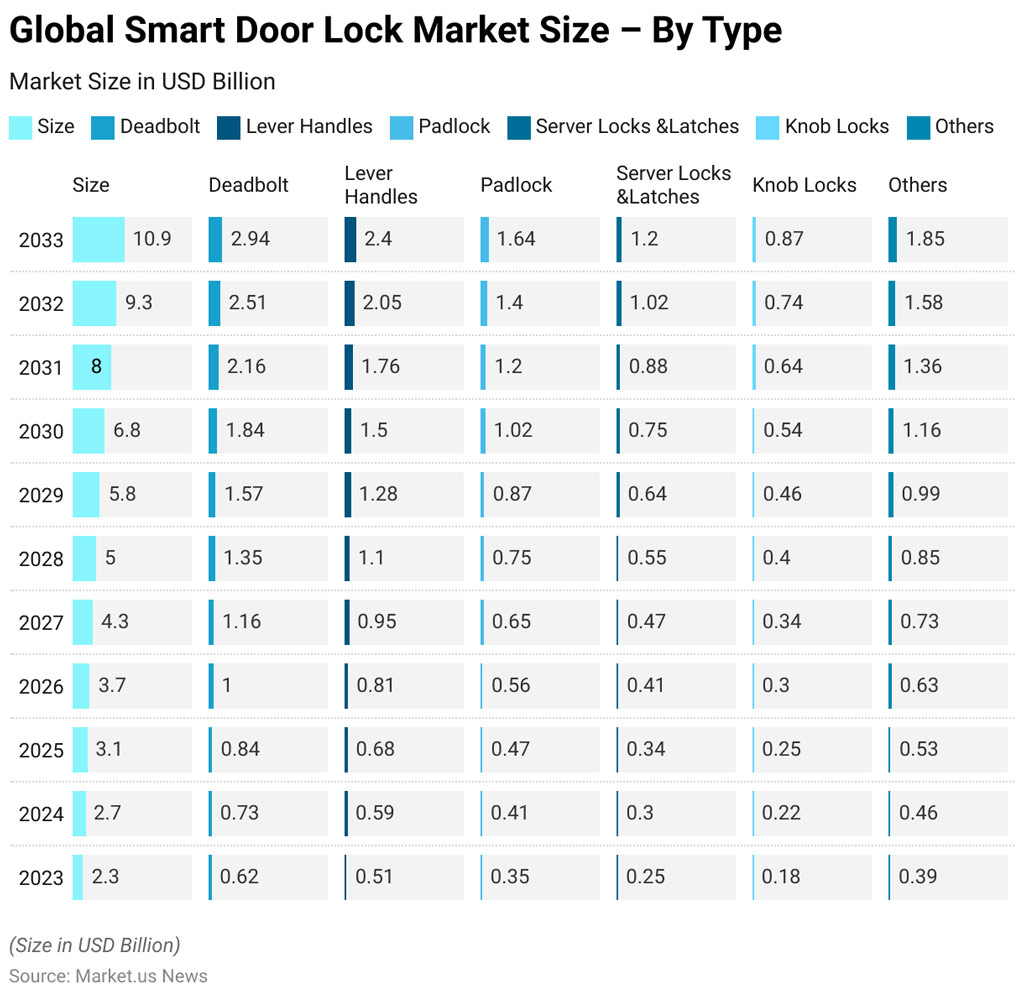
Smart Door Lock Market Share by Product Type
- Global smart door lock market size is projected to grow from $2.3 billion in 2023 to $10.9 billion by 2033, nearly 4.7× growth.
- Deadbolt smart locks remain the largest segment, expanding from $0.62 billion in 2023 to $2.94 billion in 2033.
- Lever-handle smart locks are forecast to increase from $0.51 billion to $2.40 billion between 2023 and 2033.
- Padlock smart lock revenue is expected to rise from $0.35 billion in 2023 to $1.64 billion in 2033.
- Server locks and latches will grow from $0.25 billion to $1.20 billion over the forecast period.
- Knob lock market value is projected to climb from $0.18 billion in 2023 to $0.87 billion in 2033.
- The Others category is expected to expand from $0.39 billion to $1.85 billion, adding $1.46 billion in revenue.
- The overall market is forecast to surpass $5 billion in 2028, reaching approximately $5.0 billion.
- By 2030, the global smart door lock market is expected to reach $6.8 billion, nearly triple its 2023 size.
- Deadbolt locks alone are projected to generate almost $3 billion in annual revenue by 2033.
- Lever handles are expected to account for over $2.0 billion in market revenue by 2032.
- Every major smart door lock segment shows consistent year-over-year growth throughout the 2023–2033 forecast period.
Smart Door Lock Installation Costs and Maintenance Statistics
- The average smart lock device costs between $150 and $400, depending on features and connectivity options.
- Premium biometric smart locks often retail for $300 to $500+.
- Professional installation typically costs between $100 and $250 in the United States.
- DIY-compatible smart locks can reduce total installation costs by more than 40% compared with professional installation.
- Most battery-powered smart locks require battery replacement every 6 to 12 months.
- Some newer models introduced in 2025 advertise battery life of up to one year per charge cycle.
- Cloud-based access management subscriptions can add $3 to $10 per month for certain premium features.
- Maintenance costs remain relatively low because most systems rely primarily on software updates and battery replacements.
- Retrofit smart locks generally cost less to install than full lock replacement systems.
Smart Door Lock User Demographics and Smart Home Integration
- Adults aged 25 to 44 account for more than 45% of smart lock purchases in major markets.
- Millennials lead smart-home adoption by making up over 50% of the active user base.
- Households earning above $100,000 annually represent nearly 60% of residential smart lock ownership.
- More than 60% of smart lock owners also integrate smart cameras into their security systems.
- Approximately 69% of smart lock users also own smart speakers for home automation.
- Voice control integration is a primary adoption driver for over 40% of new smart lock consumers.
- Over 70% of premium smart lock models launched in 2025 support multiple smart-home platforms.
- The adoption of Matter has reduced smart-home hub reliance by 30% through direct interoperability.
- Nearly 80% of vacation rental owners deploy smart locks to remotely manage property access.
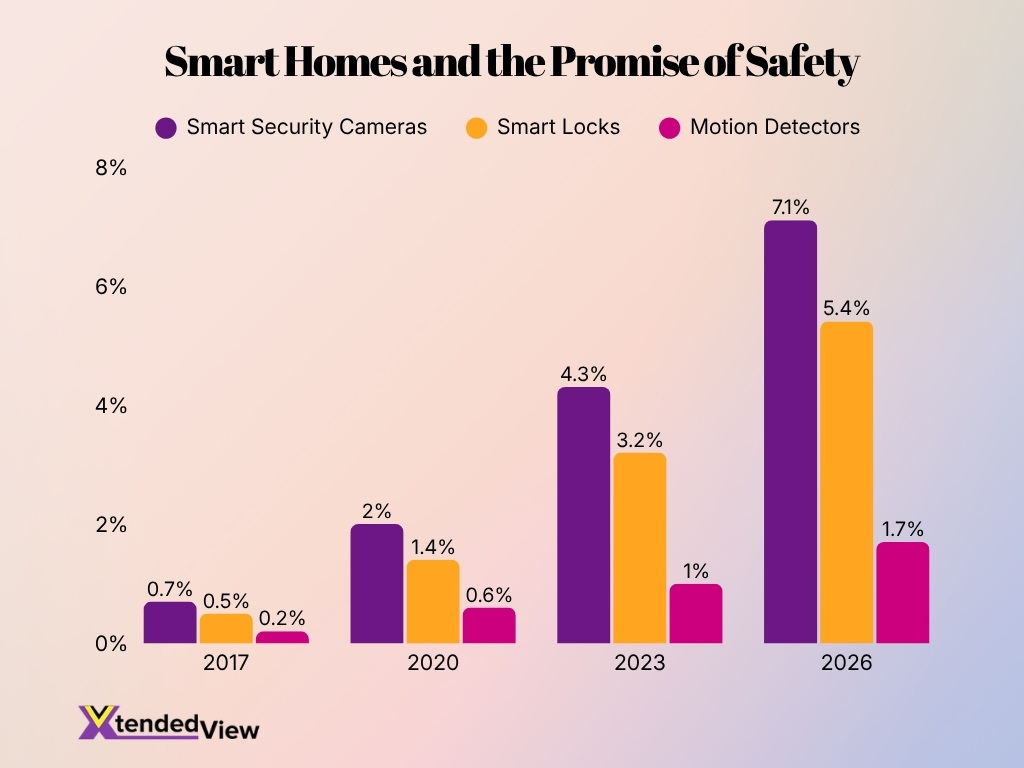
Smart Home Security Adoption Statistics
- Smart security cameras recorded the highest household penetration, rising from 0.7% in 2017 to 7.1% in 2026.
- Smart locks expanded rapidly, increasing from 0.5% in 2017 to 5.4% in 2026 worldwide.
- Motion detectors grew steadily from 0.2% in 2017 to 1.7% in 2026, despite lower adoption levels.
- Between 2023 and 2026, smart security cameras surged from 4.3% to 7.1%, adding 2.8 percentage points.
- Smart locks climbed from 3.2% in 2023 to 5.4% in 2026, marking a 68.8% increase.
- Household adoption of motion detectors rose from 1.0% in 2023 to 1.7% in 2026, a 70% increase.
- In 2026, smart security cameras (7.1%) maintained a clear lead over smart locks (5.4%) and motion detectors (1.7%).
- The combined penetration of all three smart home security products reached 14.2% in 2026, up from 1.4% in 2017.
- Smart security cameras achieved more than a 10× increase in penetration between 2017 and 2026.
- The data highlights the growing consumer preference for connected home security devices across global households.
Regional Smart Door Lock Market Statistics
- North America dominated the global landscape with a massive 43.20% market share in 2025.
- The Asia-Pacific region is forecast to experience a rapid 26% volume CAGR from 2025 to 2032.
- Europe expects its smart lock market to surge from $0.79 billion in 2025 to $3.08 billion by 2035.
- China will advance at a robust 13.8% CAGR by 2036 due to rising mobile-first access and housing demand.
- The United States smart lock industry reached an estimated valuation of $0.84 billion in 2025.
- Over 40 million smart lock installations were successfully recorded across North America in 2024.
- Nearly 30% of internet-connected households in the U.S. planned to purchase a smart lock by late 2024.
- The Asia-Pacific sector will maintain a steady 16.25% revenue CAGR through 2035, driven by rapid urbanization.
North America Smart Door Lock Statistics
- North America accounted for approximately 43.2% of global smart door lock revenue in 2025.
- The U.S. represented the largest smart lock market within the region.
- More than 60% of U.S. households now own at least one smart-home device.
- Smart lock ownership among professionally monitored security-system households reached approximately 25%.
- Consumer demand for package protection and remote access remains a leading adoption driver.
- Apple Home Key adoption accelerated premium smart lock sales during 2025.
- Multifamily housing developers increasingly install smart locks as a standard amenity in new projects.
- The U.S. smart lock market is forecast to maintain double-digit annual growth through 2030.
- Commercial adoption continues to expand across offices, hospitality venues, and educational institutions.
Europe Smart Door Lock Statistics
- Europe held approximately 28% of global smart lock revenue during 2025.
- Germany, the UK, and France remain the region’s largest smart lock markets.
- Smart-home adoption across Europe exceeded 100 million connected households in 2025.
- Retrofit smart lock solutions are especially popular in Europe because many residential buildings use existing door hardware systems.
- Energy-efficient smart building regulations continue to support the adoption of connected access technologies.
- Apartment and condominium installations represent a growing portion of smart lock deployments.
- Demand for Matter-compatible devices increased sharply during 2024 and 2025.
- Property management companies increasingly use smart locks to streamline tenant access management.
- Europe is expected to maintain annual smart lock growth above 15% CAGR through the next decade.
Asia-Pacific Smart Door Lock Statistics
- The Asia-Pacific smart lock market is projected to reach $2,965.9 million by 2030 with a 24.0% CAGR.
- China dominates regional sales by accounting for 51.7% of the Asia-Pacific market share in 2023.
- South Korea boasts a highly mature market with a residential smart lock penetration rate of approximately 70%.
- India is emerging as a rapidly expanding region with an anticipated CAGR of 26.3% through 2030.
- The deadbolt lock segment held the largest regional revenue share at 44.9% due to its widespread residential adoption.
- China’s smart door lock sales reached 22.3 million units in 2023, reflecting a 12.7% year-on-year increase.
- Fingerprint recognition technology leads biometric access methods, comprising over 48% of the market share.
- The market penetration of smart locks in Chinese lower-tier cities has reached 16.5%, expanding middle-income adoption.
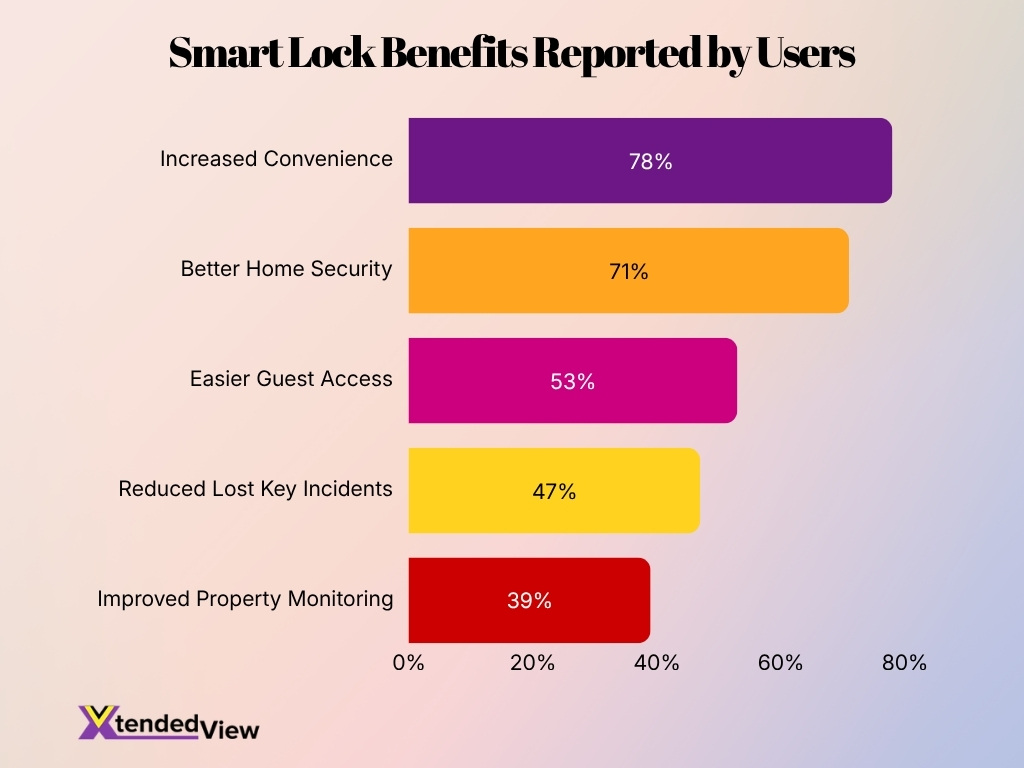
Smart Lock User Benefits Statistics
- 78% of users report increased convenience, making it the most valued benefit of smart lock adoption.
- 71% of users say smart locks provide better home security, highlighting strong confidence in connected access control.
- 53% of respondents value easier guest access, allowing temporary or remote entry without physical keys.
- 47% of users experience fewer lost key incidents, reducing the hassle and cost of key replacement.
- 39% of users report improved property monitoring, benefiting from real-time access tracking and alerts.
The Impact of Smart Door Locks on Burglary Prevention
- Over 70% of consumers cite improved security as their primary motivation for purchasing a smart lock.
- Homes lacking visible security technology are up to 300% more likely to be targeted by opportunistic burglars.
- Approximately 55.7% of all burglaries involve forcible entry, a vulnerability mitigated by keyless smart deadbolts.
- An estimated 30% of burglars enter through an unlocked door, which smart auto-lock features completely eliminate.
- Roughly 34% of intruders access homes through the front door, making robust smart locks essential for frontline defense.
- Utilizing temporary digital credentials reduces the risk of unauthorized entry from copied physical keys by 100%.
- Vacation rental operators report a 40% decrease in security incidents through automated credential expiration.
- Integrating smart locks with cameras and alarms creates a layered defense that boosts burglary deterrence by 60%.
- Over 65% of smart lock owners actively monitor access logs to maintain strict awareness and accountability.
Cybersecurity Risks and Vulnerability Data for Smart Door Locks
- Cyberattacks targeting connected smart home devices increased by a massive 124% during 2024.
- The global IoT ecosystem currently faces an alarming average of 820,000 hacking attempts every single day.
- An estimated 98% of all IoT device traffic remains unencrypted and highly exposed to interception.
- Approximately 15% of smart device owners never change their highly vulnerable default passwords.
- Security solutions blocked over 629 million attacks targeting vulnerable IoT endpoints in early 2025.
- The average smart home network now experiences up to 10 distinct cyberattack attempts every 24 hours.
- Exploiting default credentials directly accounts for 5.27% of attacks achieving lateral network movement.
- Unsecured IoT vulnerabilities recently fueled a staggering 400% year-over-year increase in malware attacks.
Top Smart Door Lock Brands and Market Share Statistics
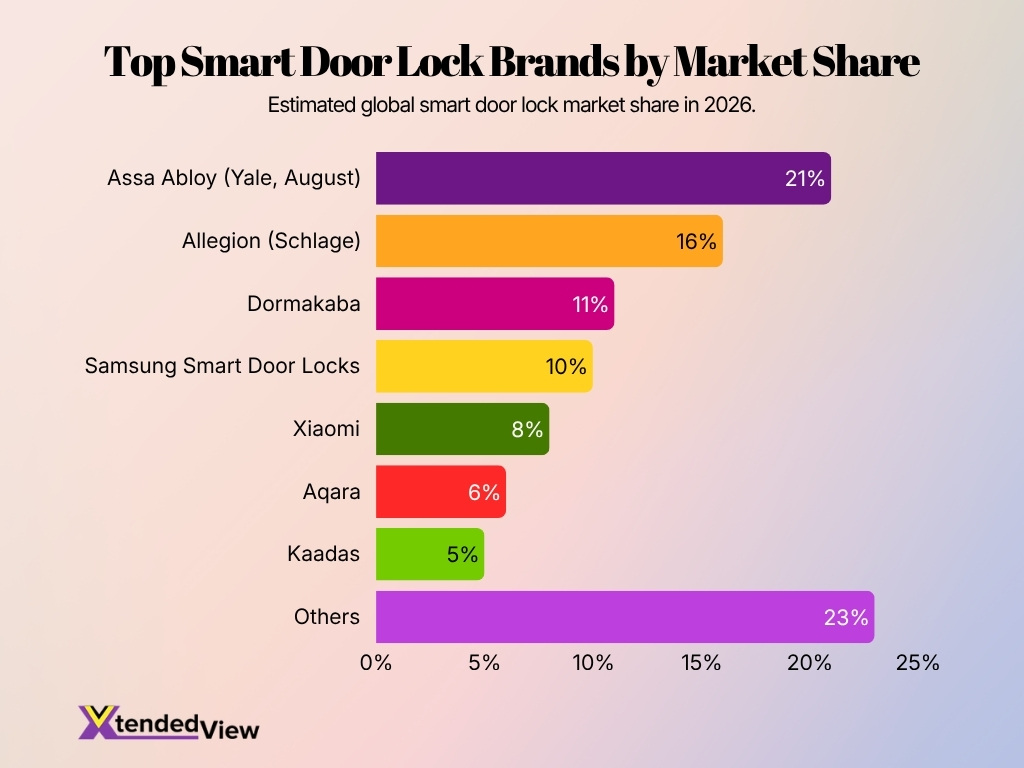
- Others collectively hold the largest share at 23%, highlighting the fragmented nature of the smart door lock market.
- Assa Abloy (Yale, August) leads individual brands with 21% market share, making it the top smart door lock provider.
- Allegion (Schlage) ranks second with 16%, maintaining a strong presence in the global market.
- Dormakaba captures 11% of the market, securing a position among the leading smart lock manufacturers.
- Samsung Smart Door Locks account for 10% of the market, reflecting strong demand for connected security solutions.
- Xiaomi holds 8% market share, benefiting from its growing smart home ecosystem.
- Aqara represents 6% of the market, supported by its focus on smart home integration.
- Kaadas commands 5% market share, establishing itself as a notable player in the smart lock industry.
- The top two brands alone control 37% of the market, indicating significant concentration among leading manufacturers.
- The top five brands collectively account for 66% of the global smart door lock market share in 2026.
Future Outlook of Smart Door Lock Industry
- The global smart lock market is projected to reach $15.73 billion by 2035, growing at a strong CAGR of 17.3%.
- The worldwide market size is estimated to hit $9.8 billion by 2032, expanding rapidly from $2.2 billion in 2022.
- Deadbolt locks remain the leading product type, securely capturing over 40% of the global revenue share.
- The residential sector is expected to heavily dominate adoption, projected to account for 71.0% market share in 2026.
- Bluetooth-enabled smart locks are projected to hold a commanding 49.0% share of the connectivity segment by 2026.
- North America is anticipated to maintain the largest regional presence, representing around 37% of the market by 2035.
- The broader digital door lock systems market is forecast to generate an impressive $14.3 billion by 2032.
- China and India are expected to advance rapidly, recording a robust 13.8% CAGR by 2036 due to mass urbanization.
- Offline sales channels continue to drive the vast majority of distribution, securing over 61.2% of the market share.
- The commercial application segment is consistently projected to account for roughly 30% of total global demand.
Frequently Asked Questions (FAQs)
The global smart door lock market is projected to reach approximately $4.22 billion in 2026, up from $3.50 billion in 2025.
The market is forecast to grow at a 19.7% CAGR between 2026 and 2034.
North America accounted for approximately 43.2% of global smart door lock revenue in 2025, making it the leading regional market.
The global smart lock market was valued at about $2.77 billion in 2024.
Biometric authentication systems account for roughly 35% of the smart lock authentication market, making them one of the most widely adopted access methods.
Conclusion
The smart door lock industry continued its strong upward trajectory. Rising smart-home adoption, expanding biometric authentication options, and stronger interoperability standards have accelerated both residential and commercial deployments. North America remains the largest market, while Asia-Pacific leads global growth. At the same time, cybersecurity, privacy protection, and long-term device support have become increasingly important purchasing factors.
Looking ahead, the combination of Matter compatibility, UWB access, AI-powered security features, and growing smart-city investments is expected to drive sustained market expansion. As consumers prioritize convenience and security, smart door locks are likely to become a standard component of connected homes and modern access-control systems worldwide.