


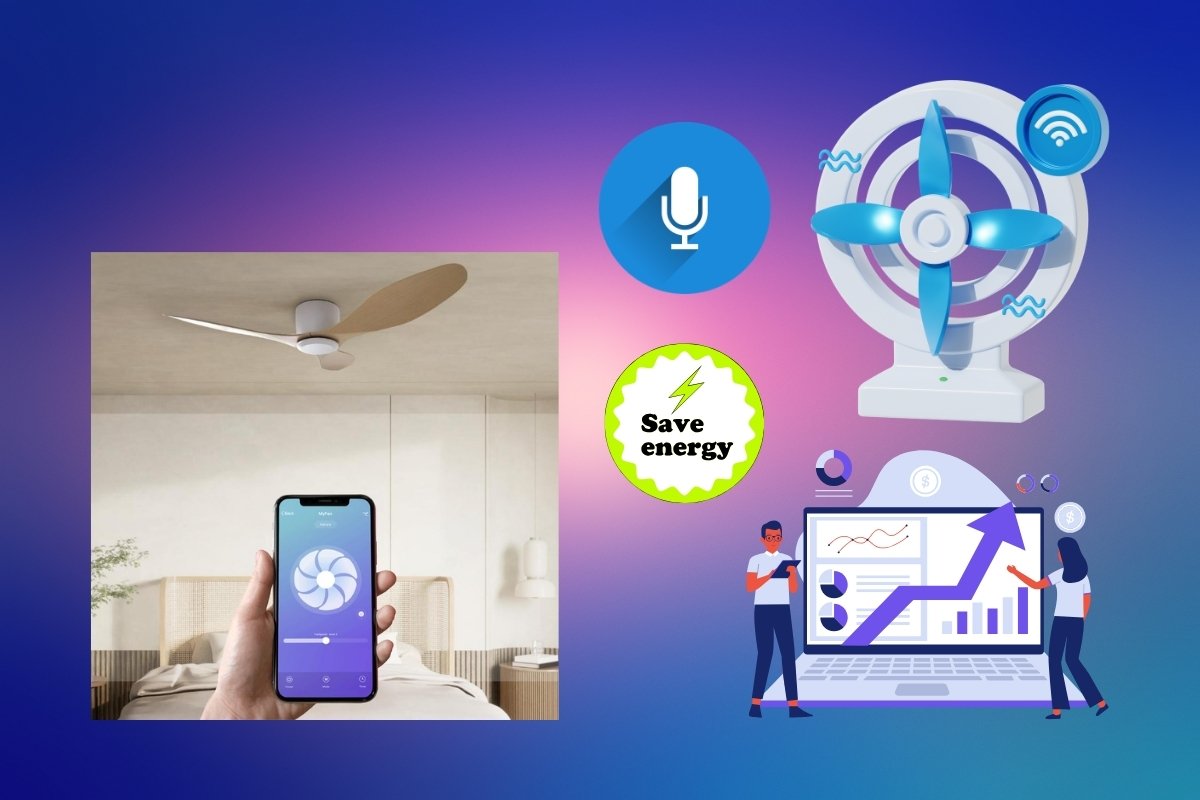
Smart fans are becoming a larger part of the connected home market as manufacturers combine airflow control with Wi-Fi, mobile apps, voice assistants, sensors, and energy-efficient BLDC motors. The global smart ceiling-fan market was valued at about $1.04 billion in 2025, while the wider ceiling-fan market is projected to exceed $12 billion in 2026, showing the scale of the installed base that can shift toward connected models. In homes, smart fans can coordinate with thermostats and voice assistants to improve comfort and reduce unnecessary cooling, while hotels, offices, and other commercial buildings can use automated scheduling and centralized controls to manage energy use.
This article explores the latest statistics on market growth, regional demand, technology adoption, pricing, consumer behavior, energy efficiency, sales channels, and the future of smart fans.
Editor’s Choice
- $1.04 billion: The global smart ceiling-fan market value reported for 2025.
- 5.1% CAGR: The projected global smart ceiling-fan growth rate from 2026 through 2034.
- $12.31 billion: One estimate for the complete global ceiling-fan market in 2026, up from $11.83 billion in 2025.
- 63.82%: Asia Pacific’s share of the broader global ceiling-fan market in 2025, making it the dominant geographic market.
- $7.90 billion: The projected value of Asia Pacific’s ceiling-fan market in 2026, compared with $7.55 billion in 2025.
- 5.4% CAGR: Smart ceiling fans represent the fastest-growing residential ceiling-fan product category across the U.S. and Canada in one current forecast.
- 7.85% CAGR: India’s smart ceiling-fan market is forecast to grow at this rate between FY2026 and FY2033.
- 41.5%: Online stores accounted for this share of global smart ceiling-fan sales in 2025 in one market segmentation, highlighting the role of e-commerce in adoption.
- 4.8%-5.2% CAGR: North America’s smart ceiling-fan market is forecast to grow within this range through 2034 as connected-home and retrofit demand expands.
- 6.2% CAGR: The global BLDC ceiling-fan market is projected to expand at this rate through 2035, providing a strong technology tailwind for energy-efficient smart fans.
Recent Developments
- In 2026, smart home products account for four of the five fastest-growing consumer technology categories tracked in a major U.S. ownership study, creating a more favorable ecosystem for connected fans and other automated appliances.
- A July 2026 fan launch in India paired a 34-watt BLDC motor with a 5-star energy rating and smart operating modes, reflecting the industry’s shift toward combining connected controls with lower-power motors.
- That newly introduced 2026 BLDC model launched at approximately ₹3,700, showing that smart and high-efficiency features are moving into products below luxury-appliance price levels in large emerging markets.
- U.S. energy policy changed in March 2025 when a proposed conservation standard covering ceiling fans was among four appliance standards withdrawn, altering the near-term federal regulatory environment for fan manufacturers.
- Federal enforcement remained active in 2025. An order dated Jan. 17, 2025, identified four ceiling-fan models that failed to comply with applicable energy conservation standards.
- Updated standardized testing materials for small-diameter ceiling fans were issued on Jan. 17, 2025, maintaining a formal framework for recording energy-performance test results.
- Smart ceiling-fan controllers formed a $1.8 billion market in 2025 under one broad connected-controller definition, with the category forecast to reach $3.9 billion by 2034.
- The BLDC ceiling-fan segment is estimated at $4.09 billion in 2026 and forecast to reach $7.04 billion by 2035, signaling continued investment in motor technology commonly used to improve smart fan efficiency and electronic control.
- The broader global ceiling-fan market is expected to move from $12.9 billion in 2025 to $13.3 billion in 2026 under another current estimate, supported partly by demand for energy-efficient and smart products.
Global Smart Fan Market Size and Growth
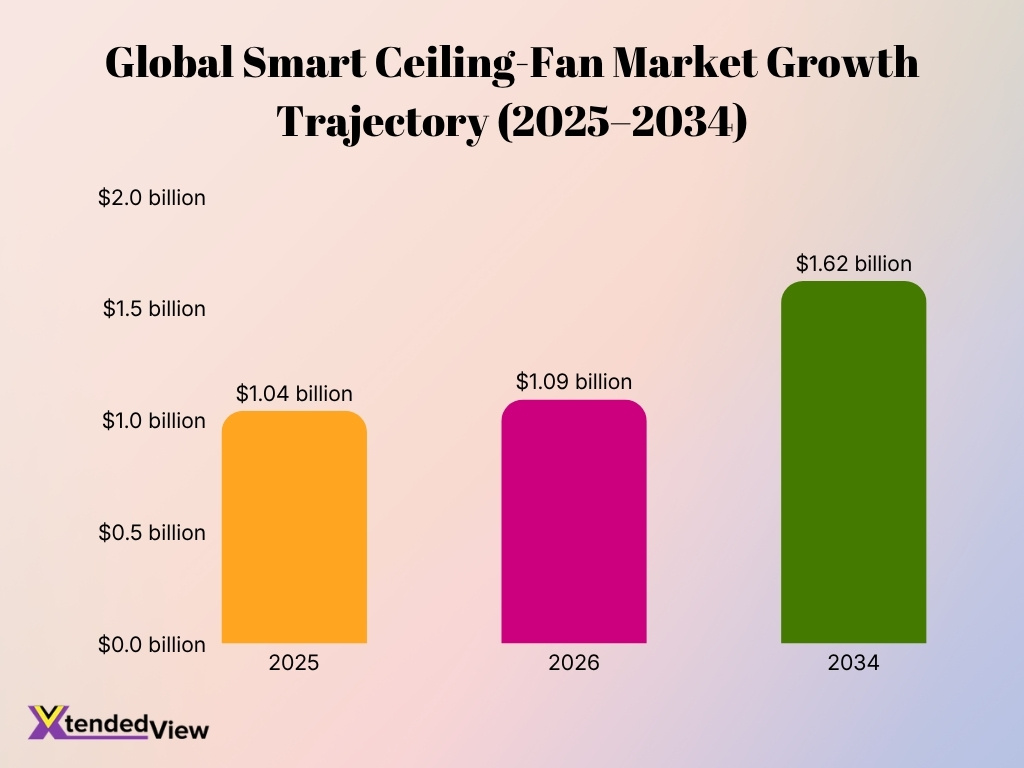
- The global smart ceiling-fan market generated an estimated $1.04 billion in 2025, establishing connected fans as a meaningful segment within the larger fan industry.
- Applying the published 5.1% long-term growth rate to the 2025 base produces an indicative 2026 market level of about $1.09 billion; this is a calculated estimate rather than a separately reported market value.
- The segment is projected to reach $1.62 billion by 2034, adding roughly $580 million to its 2025 market value.
- That 2025-to-2034 forecast represents total nominal market expansion of approximately 56% over nine years.
- An earlier smart ceiling-fan forecast placed the category at $987.38 million in 2024 and projected $1.44 billion by 2031, supporting the longer-term direction of continued connected-fan growth.
- The wider global ceiling-fan industry increased from $11.83 billion in 2025 to a projected $12.31 billion in 2026 under one current market model.
- Another market model estimates the wider category at $13.3 billion in 2026 and $18.1 billion in 2035, demonstrating why smart-fan statistics should remain separated from total fan-market estimates.
- The total ceiling-fan category is projected to grow at about 3.4% annually through 2035 under that forecast, compared with 5.1% for the smart ceiling-fan segment in another current forecast.
- BLDC ceiling fans, which provide an important hardware base for electronically controlled smart models, are forecast to increase from $4.09 billion in 2026 to $7.04 billion in 2035.
- The projected 6.2% CAGR for BLDC ceiling fans exceeds the growth rate reported for the overall ceiling-fan industry, indicating that buyers are shifting toward more efficient motor technologies even beyond explicitly connected products.
Smart Ceiling Fan Market Projections
- The global smart ceiling-fan market is forecast to reach $1.62 billion by 2034, compared with $1.04 billion in 2025.
- Its projected 5.1% CAGR from 2026 to 2034 points to steady rather than one-time growth as Wi-Fi, Bluetooth, sensors, apps, and voice control enter more fan models.
- North American smart ceiling-fan revenue is expected to grow at approximately 4.8% to 5.2% annually through 2034.
- India’s smart ceiling-fan market is forecast to rise from $29.34 million in FY2025 to $53.71 million in FY2033, an increase of about 83% across the forecast horizon.
- India’s projected 7.85% CAGR gives the country a faster smart-fan growth profile than the 5.1% global estimate from another market forecast.
- In the U.S. and Canada, smart ceiling fans are forecast to be the fastest-growing residential fan type, with a 5.4% CAGR.
- Traditional standard ceiling fans still hold 56% of the U.S. and Canadian residential category, leaving substantial room for connected products to gain share through replacement purchases.
- The global BLDC ceiling-fan category is forecast to reach $7.04 billion by 2035, up about 72% from its projected 2026 value.
- In the overall fan market, BLDC technology is expected to expand at a 6.6% CAGR through 2035 in another technology-segment forecast, making it the fastest-growing motor category there.
- By comparison, AC motor-based fans held roughly 58% of the broader ceiling-fan market in 2025, indicating that the industry’s transition toward electronically controlled, efficient motors still has significant runway.
Smart Fan Adoption and Penetration Rates
- Smart ceiling fans are projected to expand at a 5.4% CAGR across the U.S. and Canada.
- Standard ceiling fans still command 56% of residential sales in North America.
- Residential applications generate more than 80% of total smart ceiling-fan revenue.
- Residential buyers accounted for 74% of global ceiling-fan demand in 2025.
- Global residential use is projected to capture 71.81% of total ceiling-fan revenue in 2026.
- Online e-commerce channels captured 41.5% of global smart fan sales in 2025.
- Online smart-fan distribution channels are expanding at over 6% annually.
- India reached $29.34 million in smart fan revenue against a total market of 43.94 million units in 2025.
- Smart home devices secured 4 of the 5 fastest-growing consumer technology segments in 2026.
- An estimated 52% of smart device owners plan to upgrade to next-generation connected products.
Regional Smart Fan Market Statistics
- Asia Pacific represented 63.82% of global ceiling-fan revenue in 2025, making the region the largest underlying market for both conventional and increasingly smart fan products.
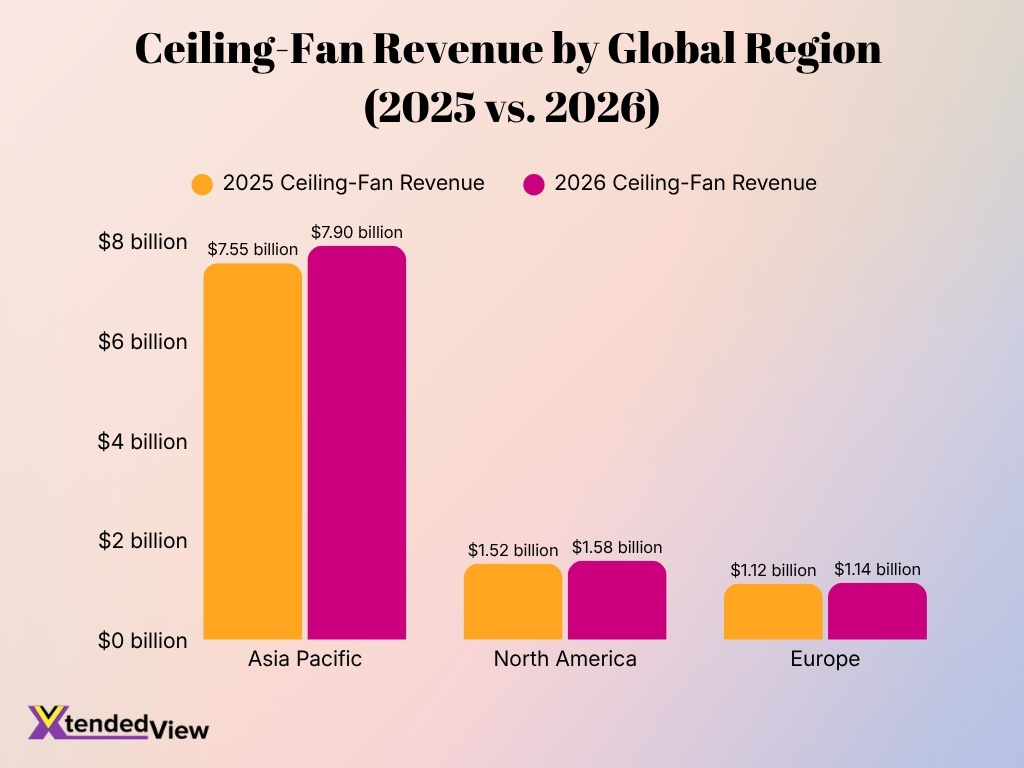
- Asia Pacific ceiling-fan revenue reached $7.55 billion in 2025 and is projected to increase to $7.90 billion in 2026.
- That increase equals approximately 4.6% year-over-year growth for Asia Pacific between 2025 and 2026.
- North America generated about $1.52 billion in broader ceiling-fan revenue in 2025 under one global market estimate, equal to 12.88% of the market.
- North American revenue under the same methodology is forecast to reach $1.58 billion in 2026, a gain of roughly 3.9% from 2025.
- Europe accounted for approximately $1.12 billion in 2025 and is forecast at $1.14 billion in 2026, representing 9.47% of the global market in 2025.
- The U.S. ceiling-fan market alone is projected to reach about $1.16 billion in 2026 under the same global segmentation.
- Japan’s ceiling-fan market is projected at approximately $830 million in 2026, making it one of the larger individual country markets in Asia.
- India recorded 43.94 million ceiling-fan units in 2025 and is forecast to reach 52.14 million units by 2034, giving smart fan brands a large replacement and upgrade pool.
- Within India specifically, the smart ceiling-fan category is forecast to grow at 7.85% annually through FY2033, substantially faster than the 1.92% unit CAGR forecast for India’s overall ceiling-fan market through 2034.
Smart Fan vs Traditional Fan Market Share
- Traditional ceiling fans still lead global sales. Standard three-blade AC models accounted for 37.81% of the market in 2025, while energy-saving models are forecast to grow at a 5.47% CAGR through 2031.
- AC motors held 55.49% of global ceiling-fan market share in 2025. In contrast, BLDC motors are forecast to grow at 6.22% annually through 2031 as manufacturers expand efficient electronically controlled models.
- Another 2025 industry assessment placed conventional standard ceiling fans at approximately 38% of worldwide sales, confirming that traditional models remain the largest single product category.
- Under that assessment, AC motor technology represented about 62% of the market in 2025. Differences between estimates reflect variations in geographic coverage and market definitions.
- Smart app and voice-controlled products accounted for an estimated 24.36% of home ceiling-fan revenue in 2025 under one control-system analysis. Remote-controlled models held 40.71%, while wall-controlled fans represented 34.92%.
- Energy-saving ceiling fans are forecast to grow at 5.47% annually through 2031, giving efficient and smart-ready products a faster growth trajectory than many conventional models.
- The global smart ceiling-fan category is projected to increase from $733.88 million in 2024 to $1.10 billion by 2032, representing a 5.14% CAGR between 2025 and 2032.
- BLDC technology is also gaining share faster than legacy AC technology. The segment’s projected 6.22% CAGR through 2031 reflects consumer demand for lower power consumption, electronic speed control, and quieter operation.
- The market remains far from fully smart: conventional AC technology still accounted for more than half of 2025 sales. Therefore, the industry’s installed base creates a substantial replacement opportunity for BLDC and connected fans during the rest of the decade.
Smart Fan Consumer Preferences and Buying Behavior
- Energy-saving ceiling-fan models are projected to grow at 5.47% annually through 2031.
- Online sales are forecast to advance at a 5.87% CAGR through 2031.
- Multi-brand stores captured 39.74% of global ceiling-fan sales in 2025.
- Online channels accounted for 41.5% of global smart ceiling-fan sales in 2025.
- Specialty smart-home retailers represented 23.3% of smart fan purchases in 2025.
- Broader offline retail accounted for 35.2% of the smart fan market in 2025.
- Mass-market conventional AC fans sell below $24, while BLDC-plus-IoT models range from $150 to $400.
- Standard residential fans in developing markets typically retail for $25 to $60.
- U.S. connected models generally range from $160 to $600, with premium Wi-Fi units reaching $849 or more.
Smart Fan Features and Technology Adoption
- Wi-Fi-enabled products represented an estimated 42.3% of smart ceiling-fan sales in 2025, making Wi-Fi the largest connectivity category in one current global segmentation.
- Bluetooth-enabled fans held another 33.7% of the smart ceiling-fan market, showing that local wireless connectivity remains important alongside cloud-connected Wi-Fi systems.
- Remote-controlled models represented the remaining 24% in that connectivity segmentation, indicating that RF and infrared controls still compete with fully connected systems.
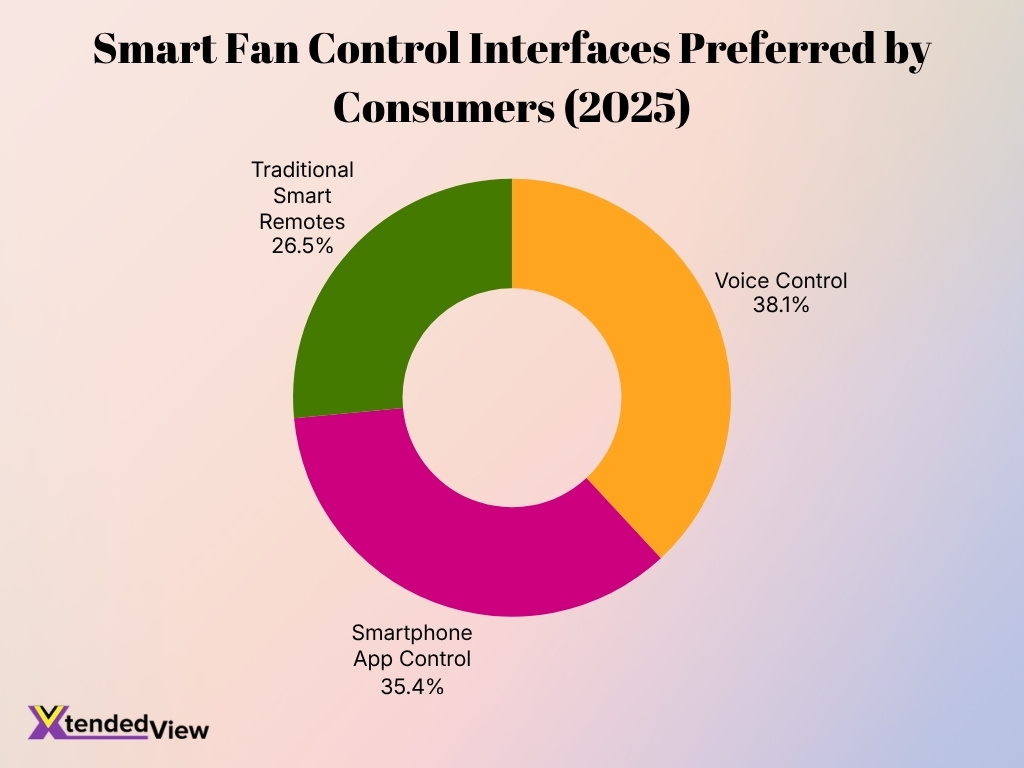
- Voice control represented 38.1% of smart fan control technology in 2025, making it the largest control interface in one global market assessment.
- Smartphone app control followed at 35.4%, while traditional smart remotes accounted for 26.5%. Together, app and voice interfaces represented nearly three-quarters of that smart-control segmentation.
- DC motors now appear in most newly introduced smart ceiling-fan models covered by a 2025 market assessment, reflecting the close relationship between motor efficiency and digital control.
- Smart fan development increasingly extends beyond on/off commands. Current market research tracks products with air-quality sensors, alongside Wi-Fi, Bluetooth, app automation, and emerging interoperability standards.
- Energy-efficient connected models increasingly combine smart functions with high airflow performance. Current certified fan requirements use a weighted CFM-per-watt efficiency metric that incorporates performance across multiple speeds and standby operation.
- The 2025 list of highest-efficiency certified ceiling fans contained 197 product records, demonstrating the depth of efficient products available as smart controls and advanced motors spread across the category.
Voice Control and Smart Home Integration Statistics
- Voice control represented approximately 38.1% of the smart ceiling-fan control market in 2025, ahead of app control at 35.4% and traditional smart remotes at 26.5%.
- Smart app and voice-controlled systems collectively captured an estimated 24.36% of total home ceiling-fan revenue in 2025 under a broader control-system analysis.
- Remote control remained larger at 40.71% of 2025 revenue, suggesting that voice and app interfaces still have room to replace established control methods.
- Wall controls accounted for 34.92% under the same analysis, meaning smart app and voice systems trailed both established control categories in the overall home fan market.
- Advanced smart voice-controlled fans represented approximately 44.2% of voice-controlled ceiling-fan revenue in 2025 in one specialized market analysis.
- Entry-level voice-controlled models accounted for another 28.5% of that market, showing that voice functionality now spans both basic and advanced connected products.
- Current U.S. connected models can integrate with three major ecosystems, Alexa, Apple HomeKit and Google Home, through built-in Wi-Fi connectivity.
- One major U.S. manufacturer currently lists 16 Alexa-compatible fan products, illustrating how voice control has expanded from isolated premium models into a broader product family.
- Connected functionality has also reached certified efficient fans. Current energy-efficiency guidance explicitly notes that some certified ceiling fans support smartphone and voice-assistant control, linking smart-home adoption with energy-saving hardware.
Smart Fan Energy Efficiency and Savings Data
- Certified ceiling fans operate up to 44% more efficiently than conventional U.S. models.
- Canadian comparisons show certified ceiling fans use about 60% less energy than standard models.
- Certain smart connected fans are up to 64% more energy efficient than traditional fan models.
- Advanced 60-inch smart fans can deliver an exceptional 483 CFM per watt of electricity.
- Raising thermostats by 4 degrees Fahrenheit yields 1.39 kWh per square foot in annual savings.
- Annual energy-cost savings for smart fans peak at $0.209 per square foot in San Francisco.
- Modeled energy reductions reach 1.20 kWh in Houston and 1.01 kWh in Chicago per square foot annually.
- Current 2026 efficiency guidance recommends increasing thermostats by 4 degrees alongside fan use.
Smart Fan Installation and Setup Costs
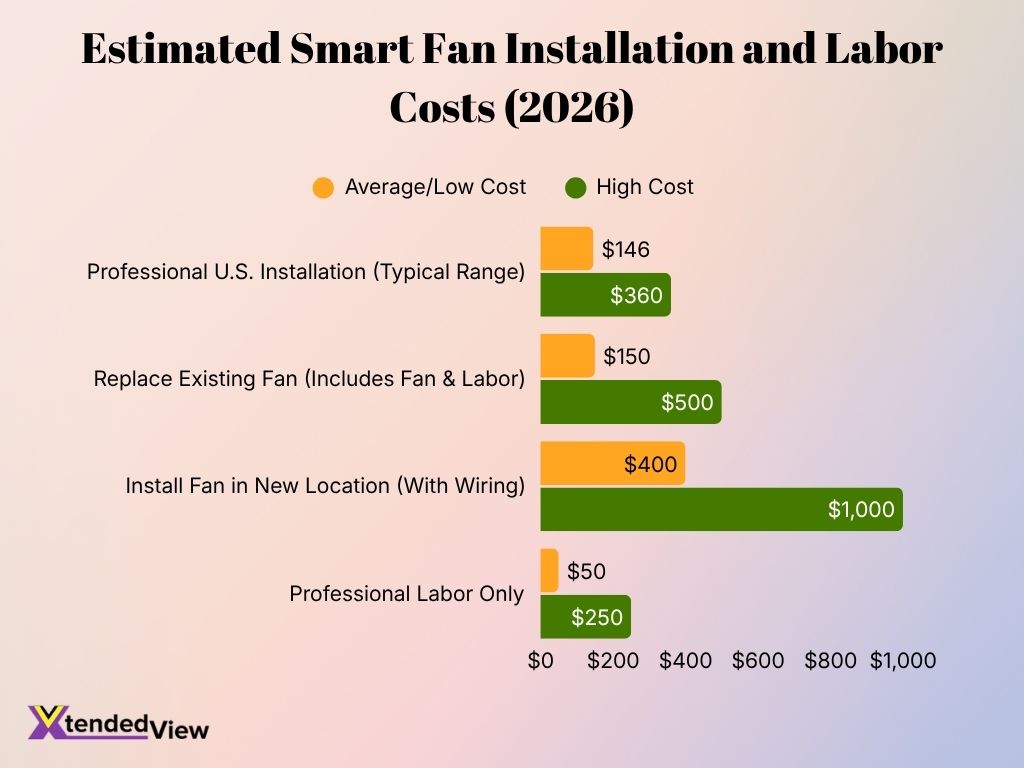
- Professional U.S. ceiling-fan installation costs an average of about $253 in 2026, with a typical range of $146 to $360.
- A separate July 2026 cost analysis reports the same $253 average, with projects ranging from $146 to $360 depending on fan type, labor, and installation complexity.
- Basic replacement installations can cost as little as $85, while complex jobs or higher-end fans can push installation spending to approximately $650.
- Replacing an existing fan, including the fan and labor, typically costs $150 to $500 in 2026. Installing a fan in a new location with wiring generally costs $400 to $1,000.
- Professional labor alone generally costs $50 to $250, making existing wiring and a fan-rated electrical box important factors in the final installation bill.
- Complex electrical work can change the economics substantially. Adding wiring may raise costs to as much as $2,000 in difficult projects.
- Residential ceiling-fan hardware spans roughly $50 to $1,400, while commercial products can reach $3,500 or more before accounting for installation.
- In 2025, another national estimate placed complete installation at $337 to $613, with an average of $475. The variation illustrates how cost methodologies differ depending on whether hardware, labor and electrical work are included.
- Fan size also affects installation. For rooms of roughly 225 to 400 square feet, installing a 50- to 72-inch fan carried an estimated $65-to-$650 range in 2025.
- Smart setup itself may not require separate hub hardware on Wi-Fi-integrated products. For example, some current connected models include Wi-Fi directly and support three major smart-home ecosystems, reducing the need for an additional control bridge.
Smart Fan Price Range and Segmentation
- Current U.S. smart ceiling-fan pricing spans a wide range. Connected products from one major manufacturer currently run from approximately $159.99 to $599.99, depending on size, design, and included features.
- A 54-inch connected fan with integrated LED lighting currently sells for about $159.99, demonstrating that Wi-Fi control has entered the sub-$200 segment.
- Midrange 52- to 60-inch smart models commonly sit near $270 to $350, with Wi-Fi, remote control and integrated LED lighting available at that price level.
- Larger 70- to 72-inch connected models reach about $600, reflecting premiums for blade span, airflow capability and higher-end construction.
- Another major smart fan range currently starts around $399 for several 56- to 60-inch models, while many 60- to 65-inch connected designs fall between $479 and $599.
- Premium designer models can move substantially higher: one current 58-inch smart model reaches $1,549, showing that design materials and finishes can create a luxury tier well beyond mainstream smart-fan pricing.
- A premium Wi-Fi-equipped residential model with an integrated LED light currently costs $849, placing high-end connected fans in the same purchase range as some major household appliances.
- Across the broader global market, affluent buyers increasingly choose BLDC-plus-IoT fans priced at approximately $150 to $400, while mass-market households in developing economies often purchase AC-motor fans below $24.
- Standard conventional fans typically cost around $25 to $60 in several high-volume emerging markets, showing why the initial price premium remains one barrier to smart fan adoption.
- Industry segmentation now formally separates smart ceiling fans into mass/economy and premium price tiers, indicating that connected technology no longer belongs exclusively to the high-end segment.
Top Smart Fan Brands and Market Share
- Hunter held more than 4% of the global ceiling-fan market in 2025, leading all individual manufacturers.
- The top five brands collectively controlled about 20% of global ceiling-fan sales in 2025.
- Independent and regional manufacturers accounted for roughly 80% of global sales, indicating high market fragmentation.
- North America generated 34% to 36% of global smart ceiling-fan revenue in 2025.
- The U.S. accounted for 78% to 82% of total North American smart fan sales in 2025.
- Asia Pacific captured approximately 31% to 33% of global smart fan revenue in 2025.
- Connected fan leaders Hunter, Orient Electric, and Atomberg each achieved double-digit sales growth.
- Atomberg posted ₹958 crore in FY2025 operating revenue, representing a 20% year-over-year increase.
Residential vs Commercial Smart Fan Usage
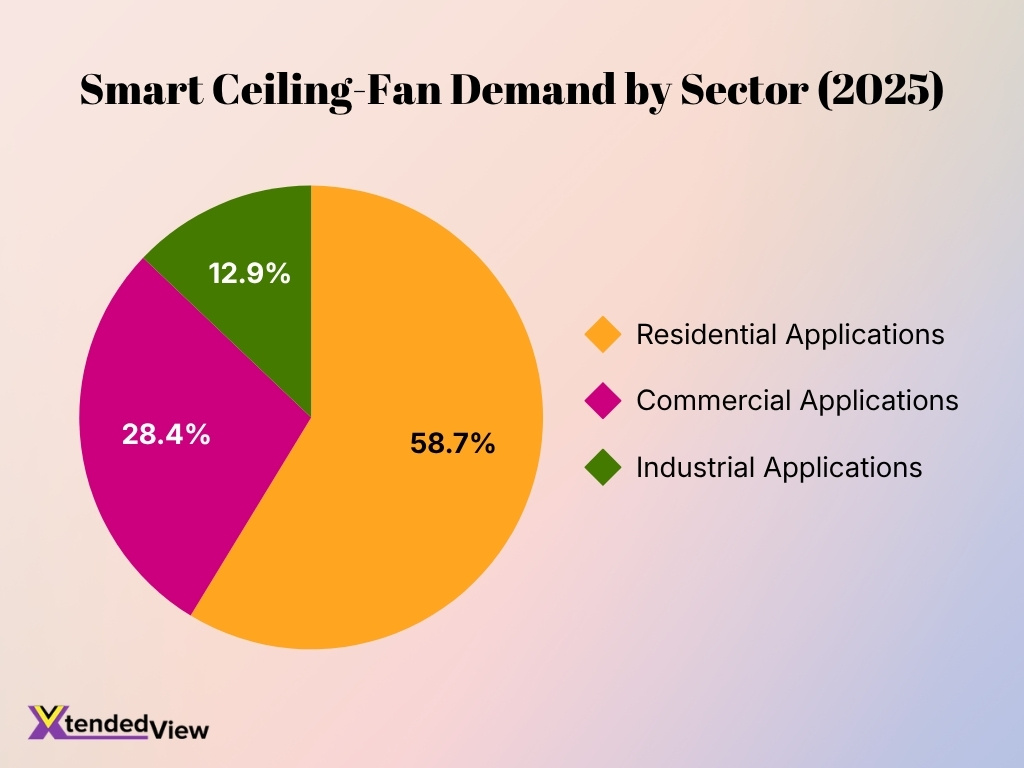
- Residential applications accounted for 58.7% of smart ceiling-fan sales in 2025 under one current segmentation, making households the largest end-use market for connected fans.
- Commercial applications represented another 28.4% of smart fan demand in 2025, including offices, hospitality properties, retail spaces and other buildings using connected controls.
- Industrial applications made up the remaining 12.9%, where intelligent airflow controls can support warehouses, production spaces and facility-management systems.
- Therefore, commercial and industrial applications combined represented approximately 41.3% of the 2025 smart ceiling-fan market under that segmentation.
- Other market research places residential use at more than 80% of smart ceiling-fan revenue under a narrower category definition. The difference shows how end-use estimates can change substantially depending on whether commercial and industrial connected systems fall within the research scope.
- In the broader ceiling-fan market, residential users accounted for 75.77% of 2025 sales, confirming that homes remain the industry’s dominant installation environment even outside the smart segment.
- Commercial ceiling-fan demand is forecast to expand at a 5.32% CAGR through 2031, faster than the 3.88% forecast for the complete ceiling-fan market.
- The Middle East and Africa smart fan market is forecast to grow by roughly 4.6% to 5.0% annually from 2026 to 2034, with hotels, villas, retail spaces and shaded outdoor environments supporting commercial adoption.
- Large high-speed and industrial fan manufacturers reported double-digit order growth during 2024-2025 as warehouses, workshops and cold-chain facilities increased their use of high-airflow systems.
- Residential demand will likely remain the largest smart fan opportunity through the forecast period, but faster commercial growth creates additional demand for building automation, sensors and centralized fan management.
Smart Fan Motor Technology Trends
- Conventional AC motors still controlled 55.49% of the global ceiling-fan market in 2025, but BLDC motors are expanding faster as efficiency, electronic control, and smart-home functions become more important.
- BLDC ceiling fans are projected to grow at a 6.22% CAGR through 2031, compared with 3.88% growth for the overall ceiling-fan market during 2026-2031.
- A separate long-range forecast projects BLDC ceiling fans to grow from about $4.09 billion in 2026 to $7.04 billion in 2035, equal to a 6.2% CAGR.
- BLDC fans can deliver around 50% to 60% lower electricity consumption than conventional AC-motor products. Typical efficient models consume roughly 28 to 35 watts compared with about 70 to 75 watts for traditional fans.
- Motor costs still affect adoption. Conventional AC motors were estimated at roughly $8 to $12 per unit in 2025, compared with $18 to $28 for BLDC motors.
- However, declining BLDC component costs continue to narrow that price gap. In some midtier models, the BLDC price premium has fallen into the single-digit percentage range, strengthening its mass-market potential.
- Panasonic smart DC fan designs with occupancy sensors have produced reported energy reductions of approximately 15% to 20%, showing how sensor-based automation can create savings beyond the motor itself.
- A new BLDC model launched in July 2026 uses a 34-watt motor and carries a 5-star efficiency rating, illustrating how low-wattage motors are moving deeper into mainstream fan portfolios.
- Another 2026 product line advertises BLDC fans using up to 65% less electricity than conventional models, reinforcing energy efficiency as one of the industry’s main competitive claims.
- Smart-home adoption is adding another growth layer to the motor transition: rising smart-home penetration contributes an estimated 0.8 percentage points to forecast ceiling-fan CAGR in one industry driver analysis.
Smart Fan Sales Channel Statistics
- Online stores captured approximately 41.5% of global smart ceiling-fan sales in 2025, making e-commerce the largest distribution channel in the current smart-fan segmentation.
- Offline retail accounted for another 35.2% of smart ceiling-fan sales, including home improvement centers and conventional appliance or electrical retailers.
- Specialty stores represented the remaining 23.3% of smart fan distribution in 2025, including dedicated smart-home retailers, lighting stores and specialist electrical suppliers.
- Online smart fan sales are projected to grow at a 13.2% CAGR through 2034, substantially faster than the forecast growth rate of the total smart ceiling-fan market in several current industry estimates.
- Specialty smart fan retail is projected to expand at a 10.8% CAGR through 2034, supported by consumers seeking installation advice and whole-home automation integration.
- In the broader ceiling-fan category, multi-brand physical retailers held 39.74% of global sales in 2025, while online channels are forecast to grow at 5.87% annually through 2031.
- The difference suggests that smart fan customers are more digitally oriented: online channels held 41.5% of smart fan sales, compared with physical multi-brand stores leading the broader category.
- Manufacturer-branded stores can support premium purchases. One retail network recorded an 18% higher average selling price through stores that demonstrate BLDC and connected fan features directly to shoppers.
- Quick-commerce fan sales recorded 140% year-over-year growth in Q4 FY2025 in one reported retail partnership, indicating that faster appliance delivery is opening another digital sales route.
- As a result, the 2026 smart fan sales model increasingly combines online discovery, direct-to-consumer ordering, marketplace sales and specialist installation support rather than relying solely on traditional appliance stores.
Technology Challenges Limiting Smart Ceiling Fan Adoption
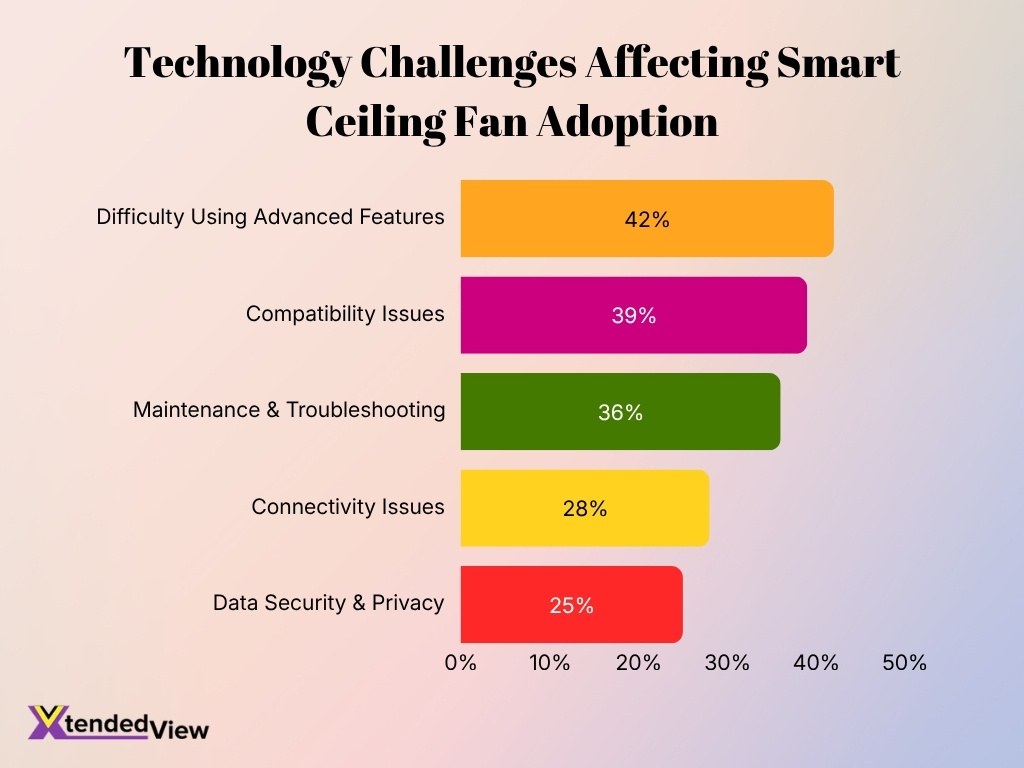
- Difficulty using advanced features is the leading technology challenge, affecting 42% of users and highlighting usability concerns around increasingly sophisticated smart controls.
- Compatibility issues affect 39% of users, suggesting that integration with existing smart home devices and ecosystems remains a significant adoption barrier.
- Maintenance and troubleshooting are a concern for 36% of users, indicating that technical complexity can create challenges after installation.
- Connectivity issues impact 28% of users, showing that reliable Wi-Fi, app connectivity, and device communication remain important considerations.
- Data security and privacy concerns affect 25% of users, making it the least-cited challenge in the dataset but still relevant for one in four users.
- Overall, the figures show that ease of use, compatibility, and maintenance are more prominent barriers than connectivity and privacy concerns in smart ceiling fan adoption.
Smart Fan Future Outlook and Forecast
- One of the latest smart ceiling-fan forecasts values the global market at $1.04 billion in 2025 and projects it to reach $1.62 billion by 2034.
- That forecast implies a 5.1% CAGR from 2026 through 2034, supported by smart-home integration, rising electricity costs and demand for efficient supplemental cooling.
- Another current market methodology places smart ceiling fans at $1.66 billion in 2025 and forecasts $2.27 billion by 2031, equivalent to 5.35% annual growth. Differences result from varying product and geographic definitions.
- The broader ceiling-fan industry is estimated at $12.89 billion in 2026 and projected to reach $15.60 billion by 2031 under one recent forecast.
- Another current methodology projects the overall category to move from $12.31 billion in 2026 to $17.98 billion in 2034, representing a 4.85% CAGR.
- Smart fan growth should outpace standard products in several markets. Smart ceiling fans are identified as the fastest-growing fan type, with growth above 5% annually through 2033.
- Asia Pacific’s smart fan market is forecast to expand at approximately 5.6% to 6.0% CAGR through 2034, faster than North America’s projected 4.8% to 5.2%.
- India’s smart ceiling-fan market has an even faster outlook, rising from $29.34 million in FY2025 to $53.71 million by FY2033, representing a 7.85% CAGR.
- BLDC motor adoption will remain an important technology driver. The BLDC ceiling-fan market is forecast to reach $7.04 billion by 2035, up from $4.09 billion in 2026.
- Connectivity should become a larger product differentiator through 2034. The technology component of the smart ceiling-fan market is projected to grow at approximately 5.2% to 5.6% annually, supported by Wi-Fi, Bluetooth, apps, voice control, scheduling and automation.
Frequently Asked Questions (FAQs)
The global smart ceiling fan market is estimated at $1.66 billion in 2025, with forecasts placing it at $2.27 billion by 2031.
The global smart ceiling fan market is projected to grow at a 5.35% CAGR through 2031.
The broader global ceiling fan market is projected at approximately $12.31 billion in 2026, up from $11.83 billion in 2025.
Asia Pacific accounted for 63.82% of global ceiling fan revenue in 2025, representing about $7.55 billion.
The global BLDC ceiling fan market is projected to grow at a 6.2% CAGR, rising from about $4.09 billion in 2026 to $7.04 billion by 2035.
Conclusion
Smart fans entered the year as a billion-dollar connected-appliance category, with one forecast placing the market at $1.04 billion in 2025 and $1.62 billion by 2034. Residential demand remains the industry’s foundation, while commercial adoption, e-commerce, and BLDC motors create additional growth opportunities. Online channels already account for 41.5% of smart ceiling-fan sales in one market estimate, and efficient motor technologies continue to grow faster than the broader fan category. Overall, the statistics point to a steady shift from conventional AC fans toward efficient, connected, and software-controlled cooling products.
