



Robotaxis are moving from pilot programs to commercial transportation networks, reshaping how people think about urban mobility. Cities now use autonomous ride-hailing services to reduce operating costs, expand transportation access, and support smart city initiatives. Businesses across logistics, ride-hailing, and automotive manufacturing are also investing heavily as autonomous driving technology matures. Explore the statistics below to understand how robotaxis are transforming the transportation industry.
Editor’s Choice
- The global robotaxi market is projected to surpass $100 billion by the early 2030s, with double-digit annual growth driven by AI, autonomous driving software, and electric vehicles.
- Waymo expanded to 500,000 paid robotaxi rides per week across 10 U.S. cities during 2026, a tenfold increase from mid-2024.
- Waymo’s autonomous fleet has accumulated more than 220 million fully autonomous rider-only miles through March 2026.
- Apollo Go completed 3.2 million fully driverless rides in Q1 2026, while cumulative public rides exceeded 22 million by April 2026.
- Waymo reports 94% fewer crashes causing serious or fatal injuries than comparable human drivers across its operating regions.
- Commercial robotaxi deployments expanded rapidly during 2025 and 2026, with new launches across the U.S., China, the Middle East, and Europe.
- Investment in autonomous mobility continues to accelerate as automakers, technology firms, and ride-hailing platforms compete to commercialize large-scale robotaxi services.
Recent Developments
- Waymo increased weekly paid robotaxi rides from 200,000 in early 2025 to 500,000 by March 2026, highlighting rapid commercial adoption.
- Waymo announced that its autonomous vehicles now travel more than 4 million miles every week across operating markets.
- Apollo Go recorded 3.2 million fully driverless rides during the first quarter of 2026, representing over 120% year-over-year growth.
- Apollo Go expanded operations into 27 cities globally by May 2026, including new markets in the Middle East and Europe.
- Zoox received U.S. regulatory approval to launch paid commercial robotaxi rides in Las Vegas during August 2026.
- Uber announced plans to integrate autonomous robotaxis into its platform across multiple U.S. metropolitan areas through partnerships with autonomous vehicle developers.
- Waymo continued expanding airport and freeway operations after deploying updated autonomous driving software.
- Several autonomous vehicle developers shifted from limited pilot testing toward commercial ride-hailing services, signaling broader industry maturity.
- Global expansion accelerated as companies entered markets across North America, Europe, China, and the Middle East during 2025–2026.
Global Robotaxi Market Size and Growth Projections
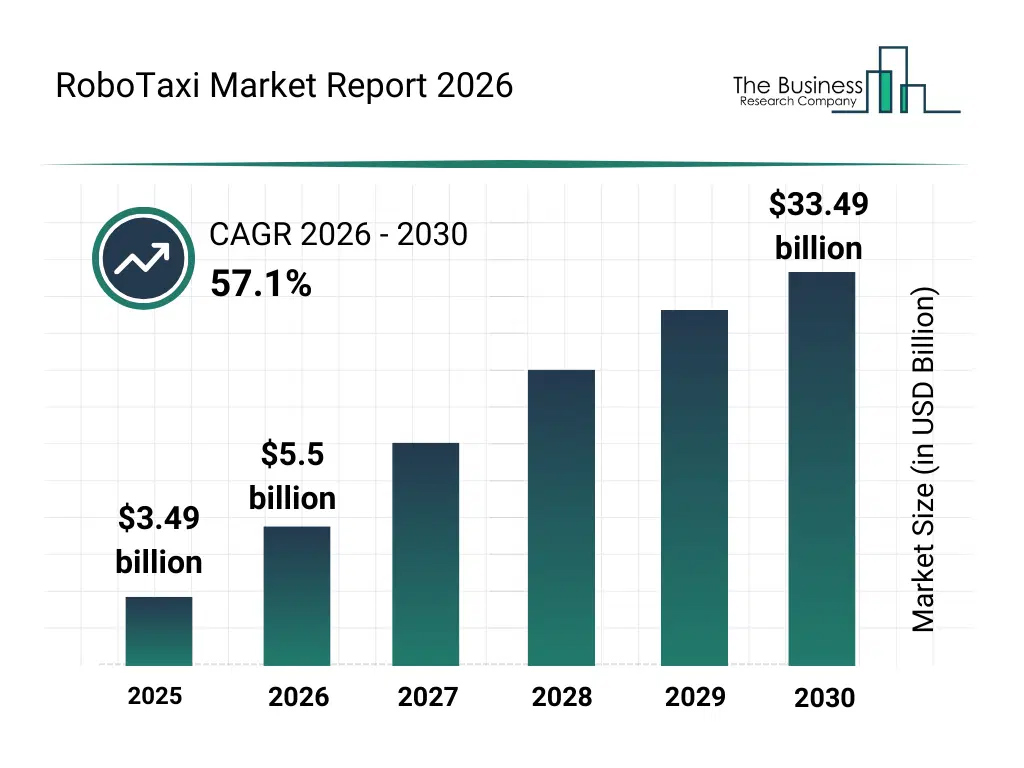
- The global RoboTaxi market is projected to grow from $3.49 billion in 2025 to $33.49 billion by 2030, indicating rapid industry expansion.
- In 2026, the RoboTaxi market is expected to reach $5.5 billion, up significantly from the previous year.
- Between 2026 and 2030, the market is forecast to expand at an impressive 57.1% CAGR.
- The market is estimated to reach approximately $8.99 billion in 2027, continuing its strong upward growth trajectory.
- By 2028, the RoboTaxi market could climb to roughly $14.74 billion, nearly three times its projected 2026 size.
- Market value is estimated to surpass $22 billion by 2029, highlighting accelerating commercial adoption of autonomous ride-hailing services.
- By 2030, the market is projected to be nearly 9.6 times larger than in 2025, reaching $33.49 billion.
- Overall, the figures point to rapid commercialization and market scaling, with RoboTaxis moving toward a substantially larger global transportation market by the end of the decade.
Leading Robotaxi Operators and Rankings
- Waymo leads the U.S. market with 500,000 weekly paid rides and operations across 10 cities.
- Apollo Go ranks among the world’s largest robotaxi operators after surpassing 22 million cumulative public rides.
- Waymo accumulated more than 220 million autonomous miles, giving it one of the industry’s largest real-world autonomous driving datasets.
- Apollo Go reported over 330 million autonomous kilometers, including more than 220 million fully driverless kilometers.
- Tesla accelerated commercial robotaxi deployment during 2026 through early autonomous ride services and Cybercab development.
- Zoox became the first company to receive a U.S. federal exemption allowing commercial deployment of steering wheel-free robotaxis.
- Uber strengthened its autonomous mobility strategy by partnering with multiple autonomous vehicle technology providers instead of developing its own autonomous platform.
- Competition increasingly centers on fleet scale, safety performance, geographic coverage, and operating cost rather than solely autonomous driving capability.
- Industry analysts consider Waymo and Apollo Go the current leaders in commercial robotaxi deployment based on ride volume and operational maturity.
Waymo Robotaxi Statistics
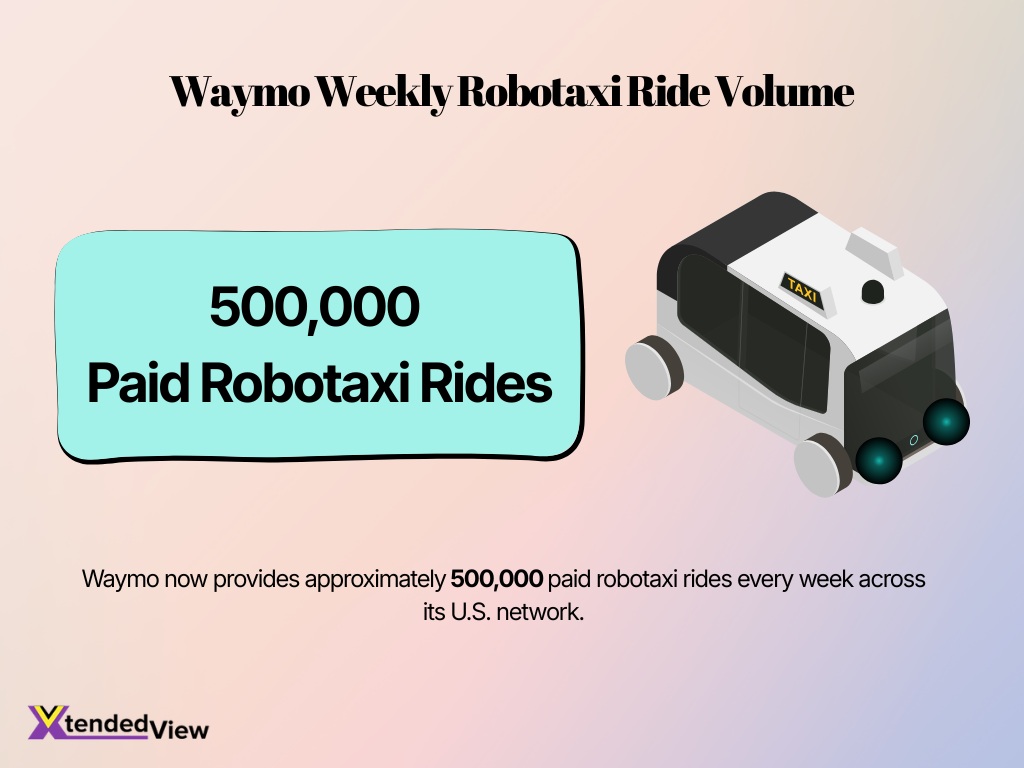
- Waymo now provides approximately 500,000 paid robotaxi rides every week across its U.S. network.
- Weekly paid rides increased tenfold between May 2024 and March 2026.
- Waymo has logged 220.6 million rider-only autonomous miles through March 2026.
- Autonomous vehicles now drive over 4 million miles every week across Waymo’s operating markets.
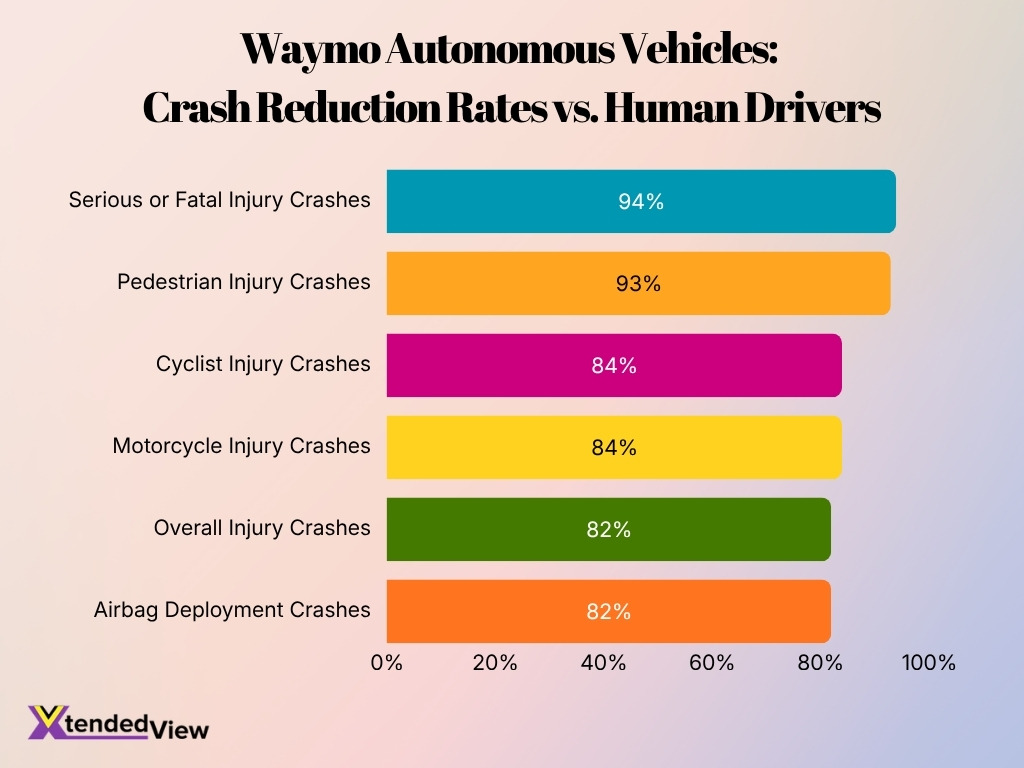
- Compared with human drivers, Waymo reports 94% fewer serious or fatal injury crashes.
- The company also reports 82% fewer injury crashes and 82% fewer airbag deployment crashes than comparable human drivers.
- Waymo experienced 93% fewer pedestrian injury crashes, 84% fewer cyclist injury crashes, and 84% fewer motorcycle injury crashes than human benchmarks.
- Operations now span 10 U.S. metropolitan markets, including Phoenix, San Francisco, Los Angeles, Austin, Atlanta, Miami, Dallas, Houston, San Antonio, and Orlando.
- Company leadership expects Waymo to exceed 1 million paid weekly robotaxi rides before the end of 2026.
Baidu Apollo Go Robotaxi Statistics
- Apollo Go completed 3.2 million fully driverless rides during Q1 2026, representing more than 120% year-over-year growth.
- Weekly robotaxi rides peaked at more than 350,000 during March 2026.
- As of April 2026, Apollo Go had delivered over 22 million cumulative public robotaxi rides.
- Apollo Go expanded its global footprint to 27 cities by May 2026.
- The fleet has accumulated more than 330 million autonomous kilometers, including 220 million fully driverless kilometers.
- Fully driverless operations now cover multiple districts in Dubai, with commercial app-based ride booking available.
- Apollo Go plans open-road testing in Switzerland and expects pilot operations in London through mobility partnerships.
- Apollo Go remains one of the world’s largest commercial robotaxi services based on cumulative public rides and geographic deployment.
- Baidu continues expanding Apollo Go internationally while maintaining a strong safety record across commercial operations.
Tesla Robotaxi and Cybercab Statistics
- Tesla targets a purchase price for the purpose-built Cybercab of under $30,000.
- The estimated operating cost for the autonomous fleet is projected to reach approximately $0.20 per mile.
- Cumulative paid Robotaxi miles completed by autonomous Teslas reached 2.4 million by the second quarter of 2026.
- The unsupervised Robotaxi fleet logged 0 notable incidents across its first 380,000 miles traveled.
- Tesla achieved an initial annual production capacity exceeding 125,000 units for the dedicated Cybercab.
- The autonomous Robotaxi service has expanded its unsupervised operations into 6 metro areas.
- The Cybercab is designed exclusively for 2 passengers and operates entirely without a steering wheel or pedals.
- Energy consumption for the Cybercab is highly efficient, estimated between 130 and 200 watt-hours per mile.
- Tesla’s vision-first approach could potentially reduce total per-mile costs by 40% below competitor Waymo’s long-term capabilities.
Robotaxi Market CAGR by Country
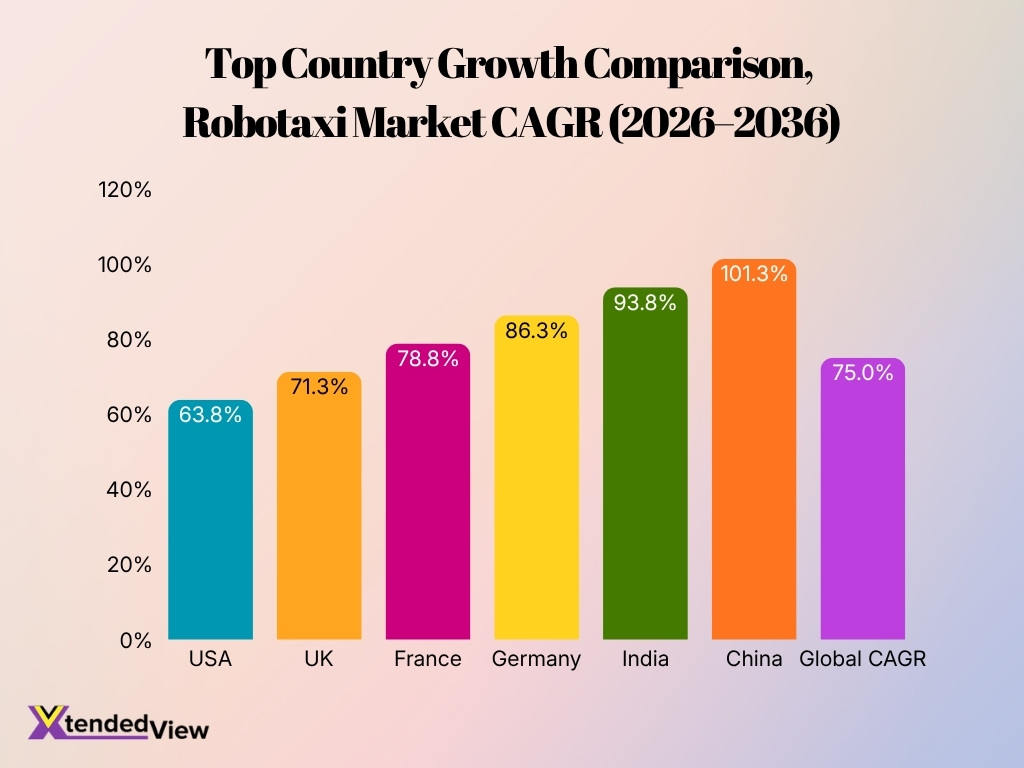
- China is projected to record the fastest robotaxi market growth, with a remarkable 101.3% CAGR between 2026 and 2036.
- India ranks second among the analyzed countries, with its robotaxi market expected to expand at a strong 93.8% CAGR.
- Germany is forecast to achieve an 86.3% CAGR, highlighting rapid robotaxi adoption and market development in Europe.
- France is expected to post a 78.8% CAGR, slightly exceeding the projected global CAGR of 75.0% during the forecast period.
- The UK robotaxi market is projected to grow at a 71.3% CAGR, placing it below the global growth benchmark.
- The USA has the lowest projected growth rate among the six countries shown, although its 63.8% CAGR still indicates substantial expansion.
- China’s 101.3% growth rate is 37.5 percentage points higher than the USA’s 63.8%, illustrating a significant gap between the fastest- and slowest-growing markets.
- Overall, China, India, Germany and France are projected to grow faster than the 75.0% global CAGR, positioning these countries as major growth markets for robotaxi services.
Other Major Robotaxi Players Statistics
- Zoox received federal approval in August 2026 to begin paid commercial robotaxi rides.
- Zoox has logged over 3 million autonomous miles and nearly 1 million rides during testing.
- Zoox plans an annual manufacturing capacity of 10,000 robotaxis for its commercial expansion.
- Uber has committed approximately $10 billion toward autonomous mobility partnerships.
- Autonomous rides currently make up less than 0.5% of Uber’s total ride volume.
- Federal exemptions allow Zoox to commercially deploy up to 2,500 robotaxis annually.
- Zoox expanded operations into 2 new markets following 2 years of fleet testing.
- Zoox ranks number 9 on the Robotaxi Index with a composite score of 37.1.
Robotaxi Rides and Trip Volume Statistics
- Waymo now completes approximately 500,000 paid rides every week, the highest publicly reported commercial robotaxi volume in the United States.
- Waymo’s weekly paid rides increased from about 200,000 in early 2025 to 500,000 by early 2026.
- Apollo Go delivered 3.2 million rides during Q1 2026 alone.
- Apollo Go exceeded 22 million cumulative rides by April 2026.
- Weekly Apollo Go ride volume surpassed 350,000 during March 2026.
- Zoox completed nearly 1 million rides before launching paid commercial service.
- Commercial robotaxi trips continue expanding as companies enter new metropolitan areas across North America, China, and the Middle East.
- Industry analysts expect annual autonomous ride volumes to accelerate as fleets expand and geographic coverage increases.
- Higher ride frequency improves fleet utilization, helping operators reduce the cost per completed trip over time.
Robotaxi Miles Driven Statistics
- Waymo has accumulated 220.6 million fully autonomous rider-only miles through March 2026.
- Waymo vehicles now travel over 4 million autonomous miles every week.
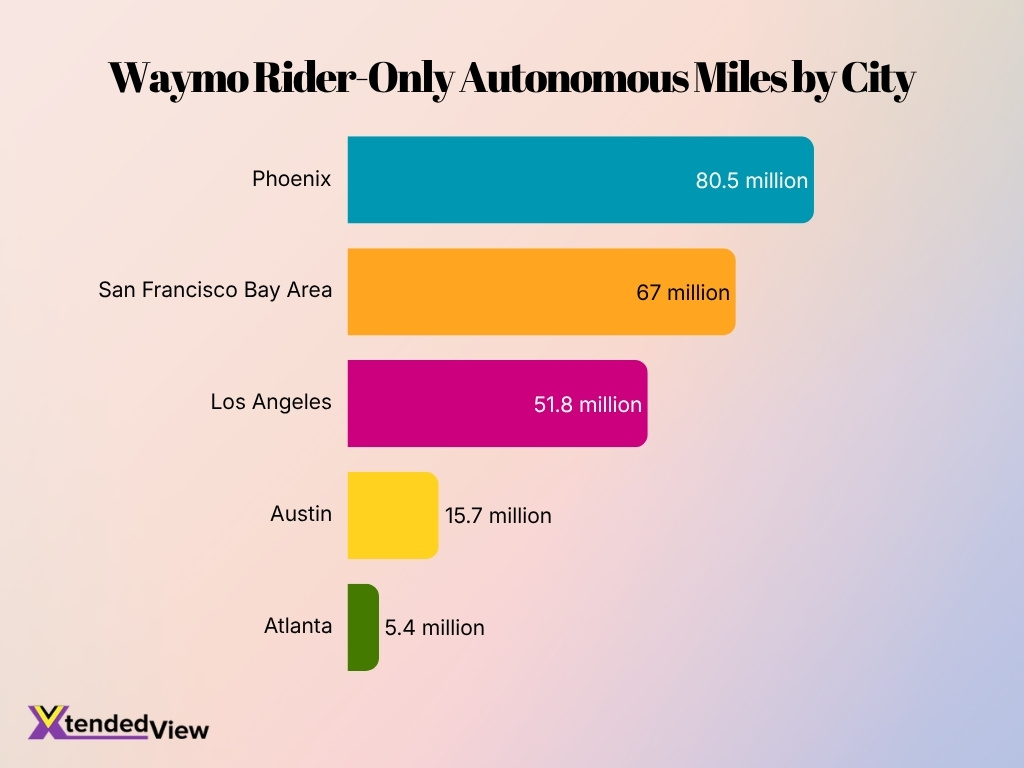
- Phoenix accounts for more than 80.5 million rider-only miles, the largest share of Waymo’s commercial operations.
- San Francisco Bay Area contributes more than 67 million rider-only autonomous miles.
- Los Angeles has recorded nearly 51.8 million autonomous miles.
- Austin has surpassed 15.7 million autonomous miles since commercial deployment began.
- Atlanta contributed approximately 5.4 million autonomous miles through March 2026.
- Apollo Go fleets have accumulated more than 330 million autonomous kilometers, including 220 million fully driverless kilometers.
- Growing autonomous mileage provides companies with larger real-world datasets for improving AI driving performance and safety validation.
Robotaxi Fleet Size and Deployment Statistics
- Waymo currently operates its commercial robotaxi services across 10 U.S. metropolitan markets.
- Waymo’s autonomous fleet consistently drives more than 4 million miles every week.
- Apollo Go has successfully deployed robotaxi services across 27 cities worldwide.
- Zoox received federal approval to deploy up to 2,500 steering wheel-free robotaxis over two years.
- Zoox has manufactured over 100 vehicles while targeting an annual production of 10,000 units.
- Waymo currently provides more than 500,000 paid robotaxi rides per week to its users.
- Apollo Go recently delivered over 3.4 million fully driverless trips within a single quarter.
- Apollo Go vehicles have accumulated over 190 million kilometers in fully driverless mode.
- Tesla is currently testing a localized fleet of approximately 42 robotaxis in Texas.
Robotaxi Safety, Accident, Injury, and Fatality Statistics
- Waymo reports 94% fewer crashes causing serious or fatal injuries than comparable human drivers.
- The company records 82% fewer injury crashes than human-driven vehicles operating in similar environments.
- Waymo experiences 82% fewer crashes involving airbag deployment.
- Pedestrian injury crashes are 93% lower than human driver benchmarks.
- Cyclist injury crashes occur 84% less frequently than comparable human-driven vehicles.
- Motorcycle injury crashes are also 84% lower than benchmark human driving performance.
- Based on current operating mileage, Waymo estimates its system prevents approximately one serious injury crash every eight days.
- Autonomous vehicle operators continue working with regulators to improve performance in construction zones, emergency scenes, and severe weather conditions.
- Safety remains the primary factor influencing commercial expansion, regulatory approvals, and public acceptance of robotaxi services.
Robotaxi Cost Comparison Statistics
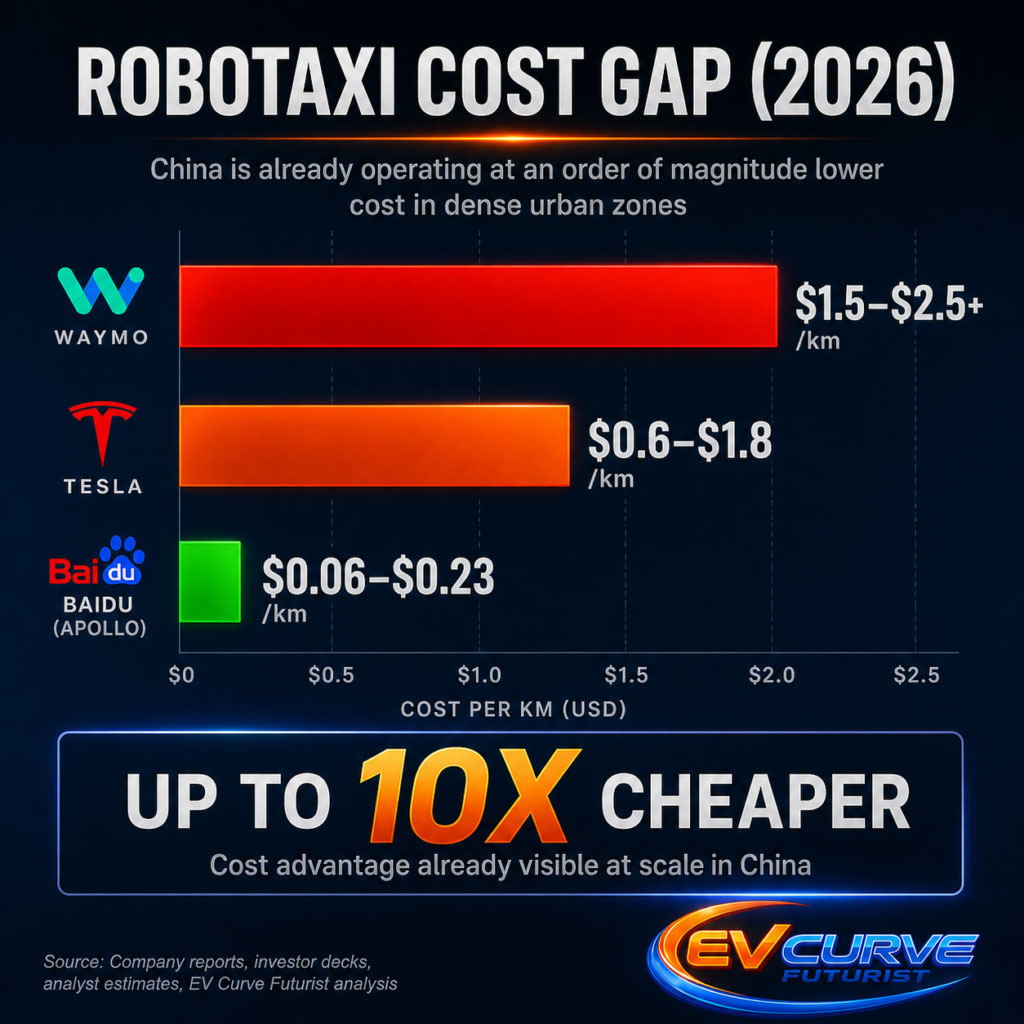
- Waymo has the highest estimated robotaxi operating cost, ranging from $1.50 to more than $2.50 per kilometer in 2026.
- Tesla’s estimated robotaxi cost ranges between $0.60 and $1.80 per kilometer, placing it below Waymo but substantially above Baidu Apollo.
- Baidu Apollo records the lowest estimated cost, at just $0.06 to $0.23 per kilometer, highlighting China’s cost advantage in dense urban markets.
- At the lower end of the estimates, Baidu Apollo’s $0.06 per km cost is about 90% lower than Tesla’s minimum estimate of $0.60 per km.
- Compared with Waymo’s minimum cost of $1.50 per km, Baidu Apollo’s upper estimate of $0.23 per km is roughly 85% cheaper.
- The data indicates that Chinese robotaxi operations can achieve costs up to 10X cheaper than higher-cost autonomous ride-hailing models.
- The wide gap between $0.06 and $2.50+ per km shows how significantly robotaxi economics can vary by operator, market, and deployment model.
- Overall, the figures suggest that cost efficiency could become a major competitive advantage as robotaxi companies scale commercial services.
Robotaxi Revenue and Investment Statistics
- Global investment in autonomous driving technologies has surpassed $100 billion over the past decade.
- The global robotaxi market is projected to skyrocket to $45.7 billion by 2030.
- Waymo secured a record-breaking $16 billion funding round in 2026, bringing its total external capital to $27.1 billion.
- Waymo’s early 2026 annualized revenue reached approximately $355 million, reflecting a 127% year-over-year growth.
- Uber has committed roughly $10 billion toward forming autonomous mobility partnerships and related ventures.
- Baidu’s Apollo Go achieved a major milestone by completing over 22 million cumulative rides globally by early 2026.
- The robotaxi industry is expected to grow at an unprecedented compound annual growth rate of 91.8% leading up to 2030.
- Operating costs for commercial robotaxis could plummet to just $0.25 per mile by 2030, unlocking massive passenger demand.
Robotaxi Adoption and Consumer Acceptance Rates
- Nearly 38%of American consumers are likely to try a robotaxi within the next 12 months.
- Gen Z is the most trusting demographic, with 29% fully trusting robotaxis during unexpected situations.
- Approximately 35% of consumers believe that autonomous robotaxis are safer than traditional human drivers.
- Access directly drives adoption, as 37% of residents in robotaxi-enabled cities have already taken a ride.
- Fear of accidents and system failures remains the top barrier, concerning 43% of potential passengers.
- Around 41% of consumers consider remote human oversight extremely important for improving their trust.
- Only 4% of people outside active markets fully trust them, compared to 23% within robotaxi cities.
- A significant 74% of drivers are now actively aware of commercial robotaxis operating in major cities.
- Older demographics show high resistance, with 48% of Baby Boomers being very unlikely to ride one.
Robotaxi vs Human Driver Comparison Statistics
- Waymo reports 94% fewer serious or fatal injury crashes than comparable human drivers.
- Injury crashes decline by 82% when comparing Waymo’s autonomous vehicles with human-operated vehicles.
- Pedestrian injury crashes are 93% lower in Waymo’s commercial operations than benchmark human driving.
- Cyclist injury crashes decrease by 84% compared with comparable human drivers.
- Motorcycle injury crashes are also 84% lower than human driving benchmarks.
- Human drivers remain responsible for more than 90% of road crashes globally due to human error.
- Autonomous driving systems never experience distraction, fatigue, or impairment, addressing several major causes of traffic accidents.
- Human drivers continue outperforming autonomous systems in certain rare or highly unpredictable driving scenarios, including severe weather and unusual road conditions.
- Ongoing improvements in AI perception and decision-making continue narrowing the remaining performance gap between autonomous systems and experienced human drivers.
Robotaxi Regulatory Environment and Policy Statistics
- More than 30 U.S. states have officially enacted legislation or executive actions regarding autonomous vehicle deployment.
- California actively manages a comprehensive program with 30 companies holding drivered permits and 6 companies possessing driverless testing permits.
- Operators in California must demonstrate 50,000 miles of supervised testing to secure a driverless testing permit.
- China will implement mandatory national safety standards for Level 3 and Level 4 autonomous vehicles effective July 1, 2027.
- Dubai officially aims for 25% of all transportation trips to become fully autonomous by the year 2030.
- The Dubai smart mobility strategy targets deploying 4,000 autonomous taxis to capture AED 22 billion in annual economic benefits.
- The United Kingdom is actively developing its national legislative framework to support broad commercial autonomous vehicle operations by 2026.
- Switzerland successfully approved additional autonomous vehicle testing frameworks during 2026 to support widespread robotaxi expansion.
- Proposed regulatory updates require heavy-duty autonomous vehicles to complete 500,000 miles of supervised testing before commercial expansion.
Robotaxi Environmental and Emissions Impact Statistics
- A fully electric autonomous fleet conducting 500,000 trips weekly can prevent an estimated 530 tons of CO₂ emissions.
- The per-mile greenhouse gas emissions of an electric robotaxi are projected to be 63% to 82% lower than a privately owned hybrid vehicle.
- Widespread adoption of shared autonomous electric vehicles could reduce total transportation greenhouse gas emissions by up to 34% by 2050.
- Shared autonomous vehicle availability actively reduces private car dependency, prompting 54% of surveyed households to reconsider purchasing a personal vehicle.
- Autonomous driving algorithms that prioritize eco-driving minimize unnecessary acceleration and can cut energy consumption by up to 20%.
- Introducing just 5% autonomous vehicles into traffic can smooth traffic flow and reduce total fuel consumption for all surrounding vehicles by up to 40%.
- Combining eco-driving algorithms with vehicle platooning in autonomous fleets can reduce overall vehicle greenhouse gas emissions by 35%.
- Using autonomous vehicles for last-mile connections to public transit generates over 33% in energy savings compared to using private vehicles.
- Robotaxis serve as an effective public transit complement, with approximately 36% of riders in urban markets using the service to access transit stations.
Frequently Asked Questions (FAQs)
Waymo provides approximately 500,000 paid robotaxi rides per week across multiple U.S. cities as of 2026.
Apollo Go has completed more than 22 million cumulative public robotaxi rides as of April 2026.
Apollo Go completed 3.2 million fully driverless rides during the first quarter of 2026, representing over 120% year-over-year growth.
Waymo has accumulated more than 200 million fully autonomous rider-only miles on public roads.
Industry forecasts estimate the global robotaxi market could reach approximately $1 trillion by 2040.
Conclusion
Robotaxis have evolved from limited pilot programs into rapidly expanding commercial mobility services. Waymo and Apollo Go currently lead the industry in ride volume, operational scale, and real-world autonomous mileage, while Tesla, Zoox, and several emerging companies continue expanding commercial deployments. At the same time, improving safety performance, declining operating costs, supportive regulations, and continued investment continue accelerating market growth. Although regulatory challenges and public trust remain important considerations, current trends indicate that autonomous ride-hailing is steadily becoming an integral part of urban transportation worldwide.
