



Google Chrome remains the world’s most widely used web browser, powering everyday activities ranging from online banking and e-commerce to enterprise productivity workflows. Its dominance across desktop and mobile devices influences how businesses design websites, optimize digital experiences, and deploy web-based applications. As browser competition intensifies and AI-powered features reshape user expectations, Chrome continues to play a central role in the global internet ecosystem. Explore the latest statistics to understand Chrome’s market position, growth trajectory, and user adoption trends.
Editor’s Choice
- Google Chrome holds 70.25% of the global browser market share as of May 2026, maintaining a substantial lead over all competitors.
- Chrome’s nearest competitor, Safari, accounts for 15.72% of the worldwide browser market.
- An estimated 3.83 billion people use Google Chrome globally in 2026.
- Chrome added approximately 770 million new users since 2020, reflecting continued expansion despite market maturity.
- Chrome’s desktop browser market share worldwide stands at 71.48% in 2026.
- In the United States, Chrome controls 53.38% of browser usage across desktop, mobile, and tablet devices.
- Chrome for Android represents 38.92% of all browser versions used worldwide, making it the most popular browser version globally.
- Chrome surpassed 71.8% global market share during late 2025, reaching one of its highest levels on record.
Recent Developments
- Google continues its four-week release cycle, delivering more frequent feature and security updates to Chrome users.
- Chrome’s global browser share increased from approximately 66% in 2025 to over 70% in 2026, reinforcing its market leadership.
- Chrome’s estimated user base grew by 5.8% year over year between 2024 and 2026.
- Chrome reached a record 71.86% market share in September 2025, according to browser tracking data.
- Google expanded performance-focused tools such as Memory Saver and Energy Saver to improve efficiency on laptops and desktops.
- Chrome’s Android version remained the most-used browser version globally, accounting for nearly 39% of browser-version activity in 2026.
- AI-driven browsers entered the market in 2025, yet Chrome retained approximately 68% global market share despite new competition.
- Chromium-based browsers collectively account for roughly 83% of browser activity, highlighting Chrome’s influence on web standards.
- Chrome continues to receive automatic security and feature updates without requiring manual downloads.
Google Chrome Market Share Statistics
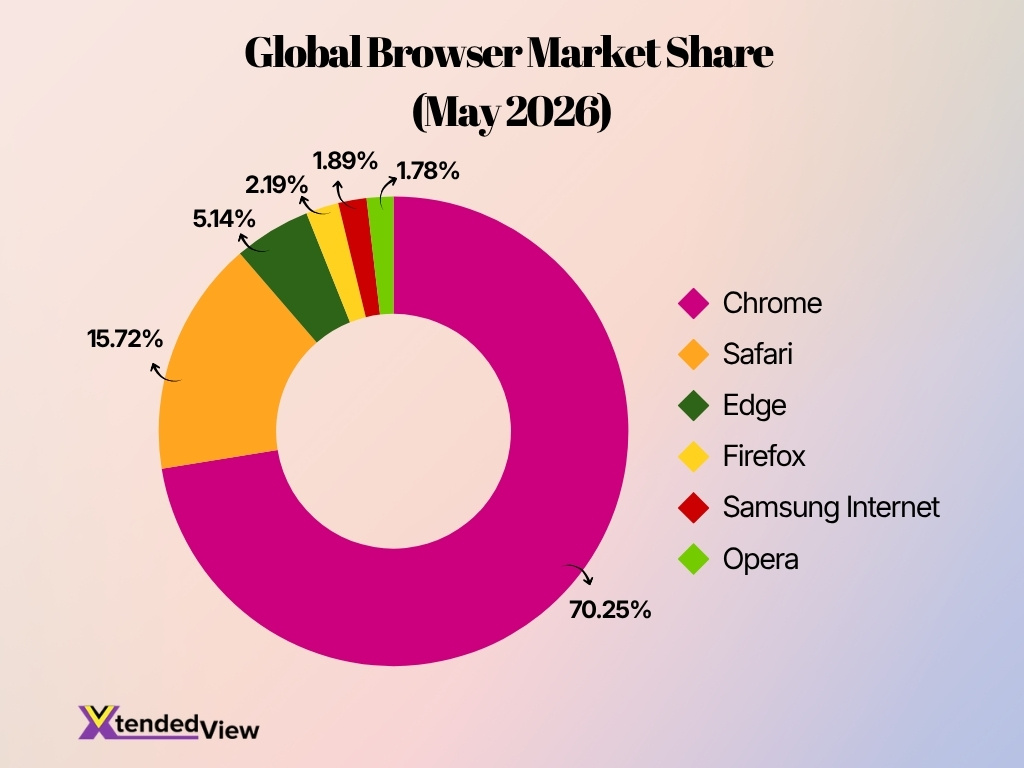
- Chrome commands 70.25% of the worldwide browser market as of May 2026.
- Safari ranks second with 15.72% market share worldwide.
- Microsoft Edge holds 5.14% of the global browser market.
- Firefox accounts for 2.19% of browser usage worldwide.
- Samsung Internet captures 1.89% of the market.
- Opera maintains a 1.78% global market share.
- Chrome’s share exceeded 68% throughout much of 2025 and 2026, reflecting stable leadership.
- Chrome has maintained more than 60% market share since 2019, demonstrating long-term dominance.
- Independent measurements place Chrome’s market share between 68% and 75%, depending on methodology and traffic sources.
Google Chrome Global Market Share
- Chrome controls 70.25% of browser usage worldwide in May 2026.
- Chrome held approximately 66% of the global browser market during 2025.
- Chrome’s share rose to nearly 72% in September 2025, setting a record level.
- Chrome’s desktop market share reached 71.48% globally in April 2026.
- Chrome’s mobile market share stood at roughly 65.5% worldwide in 2026.
- Chrome maintains more than a 4-to-1 lead over Safari globally.
- Chrome’s market share exceeds the combined share of Edge, Firefox, Opera, and Samsung Internet.
- Chrome for Android alone accounts for nearly 40% of browser-version traffic worldwide.
- Chrome remains the default browser choice for billions of Android users globally.
Google Chrome Market Share in the United States
- Chrome holds 53.38% of browser usage across all devices in the United States as of May 2026.
- Safari ranks second with 29.26% market share in the U.S.
- Microsoft Edge accounts for 7.59% of U.S. browser usage.
- Firefox captures 3.81% of the U.S. market.
- Chrome’s share in the U.S. stood at over 59% during late 2025, according to industry tracking.
- Another measurement recorded Chrome at 50.03% of browser usage in April 2026.
- Chrome maintains a lead of more than 20 percentage points over Safari in the U.S. market.
- Chrome versions account for several of the most-used browser builds in the United States.
- Chrome remains the most popular browser among U.S. consumers across desktop, mobile, and tablet devices.
Total Number of Google Chrome Users
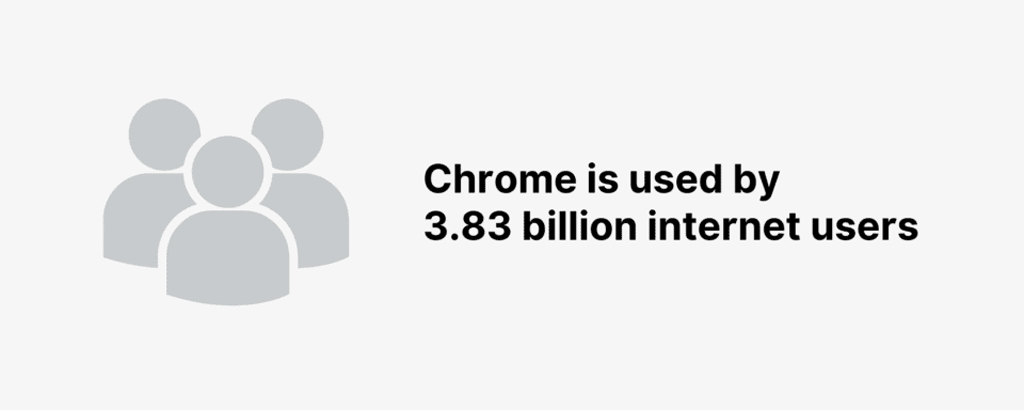
- Google Chrome has an estimated 3.83 billion users worldwide in 2026.
- Another industry estimate places Chrome’s user base at 4.16 billion users based on internet population data.
- Demand-based estimates suggest approximately 3.62 billion people use Chrome globally.
- Chrome’s user base increased by 25.16% since 2020.
- Chrome added roughly 770 million users between 2020 and 2026.
- User estimates indicate Chrome gained about 210 million users between 2023 and 2024.
- Chrome users represented more than two-thirds of global internet users in 2026.
- Chrome remains the largest browser platform by user count, exceeding the combined audiences of several major competitors.
- The browser continues to attract millions of new users annually despite reaching a mature-market scale.
Chrome Desktop Browser Statistics
- Chrome owns 71.48% of the global desktop browser market as of 2026.
- Microsoft Edge ranks second on desktop with approximately 13.9% market share.
- Firefox maintains around 6% of desktop browser usage globally.
- Chrome has remained above 65% desktop market share since 2020.
- Chrome’s desktop share increased by roughly 3 percentage points between early 2024 and 2026.
- More than 1.3 billion users access Chrome through desktop and laptop devices.
- Chrome supports Windows, macOS, Linux, and ChromeOS, contributing to its broad desktop adoption.
- Chrome’s desktop browser share in North America exceeds 60%, despite stronger competition from Safari and Edge.
- Enterprise deployments continue to favor Chrome because of centralized management tools and security controls.
Chrome Mobile Browser Statistics
- Chrome holds approximately 65.5% of the global mobile browser market in 2026.
- Safari ranks second on mobile with roughly 22% market share globally.
- Chrome for Android represents 38.92% of all browser versions used worldwide.
- Android powers more than 70% of global smartphone shipments, supporting Chrome’s mobile reach.
- Mobile users generate the majority of Chrome’s total browsing sessions worldwide.
- Chrome remains the default browser on billions of Android smartphones.
- Chrome mobile usage exceeds desktop usage by nearly 2-to-1 globally.
- Emerging markets in Asia, Africa, and Latin America contribute a significant share of Chrome mobile growth.
- Chrome mobile users benefit from synchronized passwords, tabs, and browsing history across devices.
Chrome Usage by Device Type
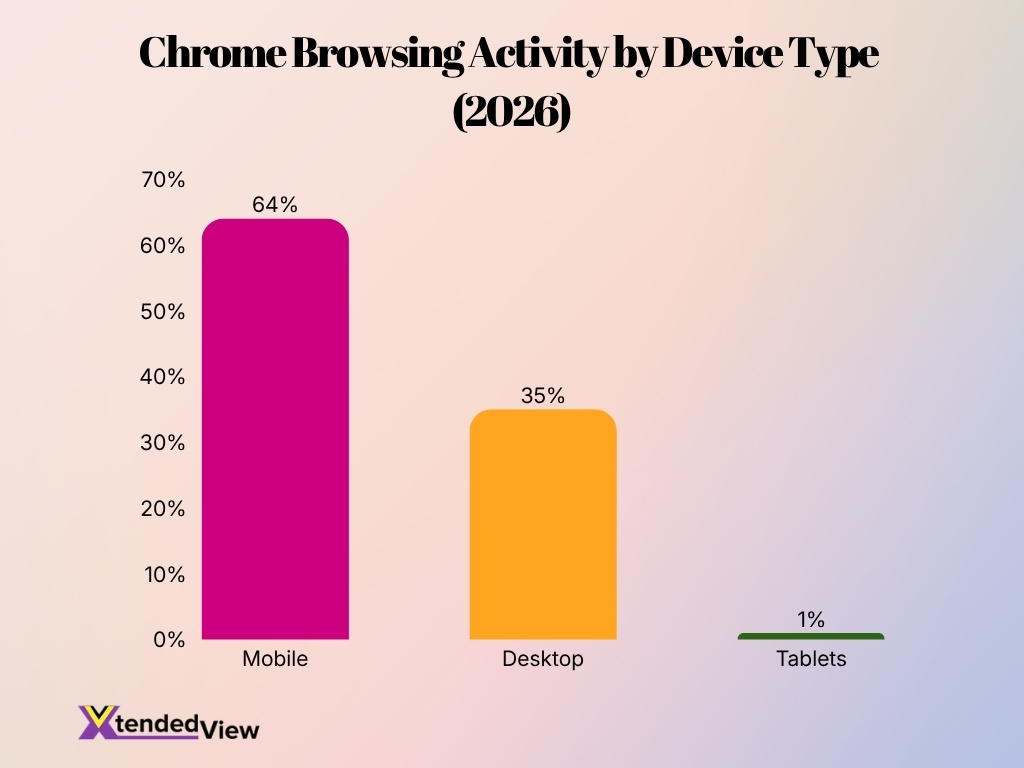
- Mobile devices account for approximately 64% of all Chrome browsing activity worldwide in 2026.
- Desktop devices generate roughly 35% of Chrome traffic, reflecting Chrome’s continued strength on PCs and laptops.
- Tablets contribute about 1% of global Chrome usage, remaining a niche browsing platform.
- Chrome maintains over 65% market share on mobile devices globally, making it the dominant mobile browser.
- On desktop systems, Chrome captures approximately 71.5% market share worldwide.
- Android devices account for the vast majority of Chrome mobile users due to Chrome’s default browser status.
- More than 3 billion Chrome users access the browser through smartphones each month.
- Mobile browsing volume surpassed desktop browsing volume by more than 80% globally in 2026.
- Chrome usage across connected devices continues to grow as web applications replace many native desktop applications.
Google Chrome User Demographics
- Users aged 25–34 make up 29% of the audience globally, representing the largest demographic segment.
- Over 68% of the overall user base is under the age of 44, reflecting massive adoption among younger internet users.
- Chrome usage among Gen Z on smartphones reaches 74.5% in North America and 73% in South America.
- The global audience skews male, with male users accounting for 61.67% and female users making up 38.33%.
- More than 70% of students rely on Chrome for assignments, driven largely by Chromebook adoption in education systems.
- A significant portion of Chrome’s 3.83 billion active users rely on the browser for cloud-based remote work.
- The browser spans incredibly diverse geographies, holding a 68.02% global market share and an 87.63% share in India.
- Cloud collaboration is supported by a massive ecosystem of over 137,000 Chrome extensions tailored for productivity.
- Capturing 65.54% of the mobile market, Chrome is significantly preferred by mobile-first consumers over legacy browsers.
Chrome Market Share by Region
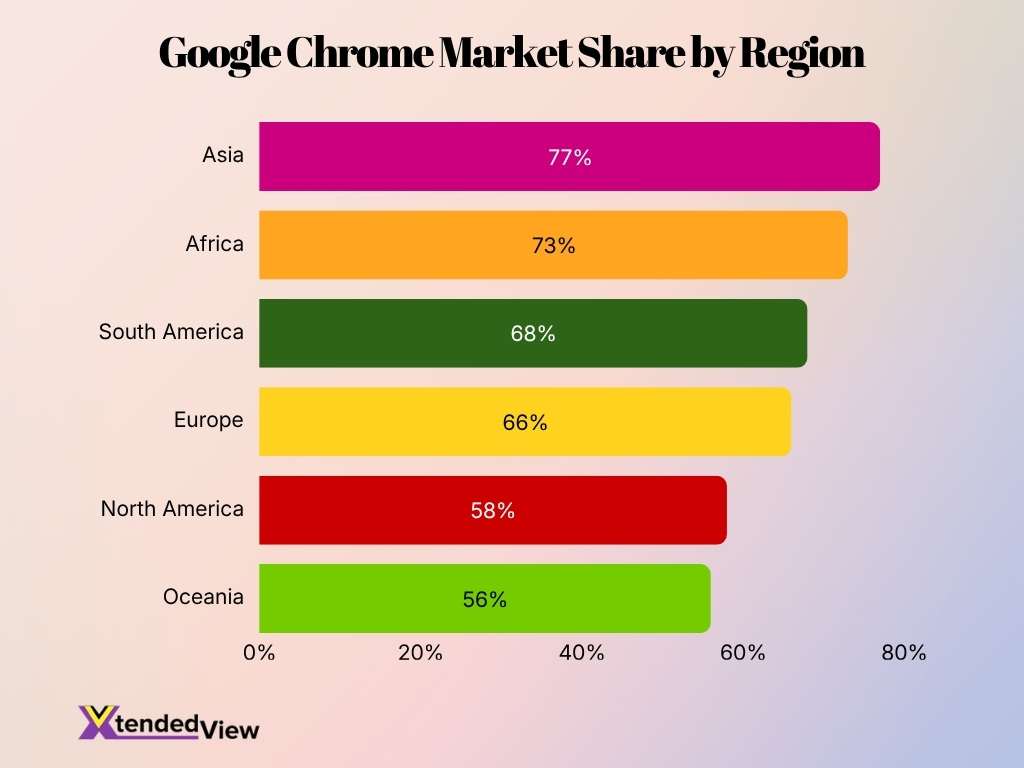
- Chrome’s market share in Asia exceeds 77%, making it the region where Chrome is strongest.
- In Europe, Chrome controls approximately 66% of browser usage.
- Chrome holds around 68% market share in South America.
- In Africa, Chrome accounts for more than 73% of browser activity.
- Chrome’s market share in North America remains near 58%, facing stronger competition from Safari.
- Oceania records approximately 56% Chrome market share.
- Chrome remains the leading browser in more than 180 countries worldwide.
- Several Asian countries report Chrome adoption rates above 80%.
- Regional differences largely reflect operating system preferences and smartphone penetration levels.
Chrome Security and Privacy Statistics
- Google actively tracked and managed 90 zero-day vulnerabilities exploited in the wild during 2025.
- Chrome utilizes Safe Browsing technology to provide security protections for over 5 billion devices worldwide.
- Recent data indicates that 95% to 99% of all web page navigation in Chrome now occurs via encrypted HTTPS connections.
- Standard Chrome security updates are deployed approximately every 2 to 3 weeks to maintain browser integrity.
- Enhanced protection modes in Chrome are designed to provide 2x the level of defense against phishing compared to standard browsing.
- The browser’s sandbox technology remains a primary security layer that isolates processes to mitigate malware risks.
- Google’s infrastructure successfully blocks billions of individual phishing and malware warnings for users annually.
- Emergency security patches are released by Google on an as-needed basis whenever critical zero-day threats are identified.
- Chrome is engineered to automatically issue real-time warnings when users attempt to download potentially harmful files.
- Google’s security intelligence teams continue to prioritize the rapid deployment of patches to minimize the window for exploit development.
Historical Growth of Google Chrome
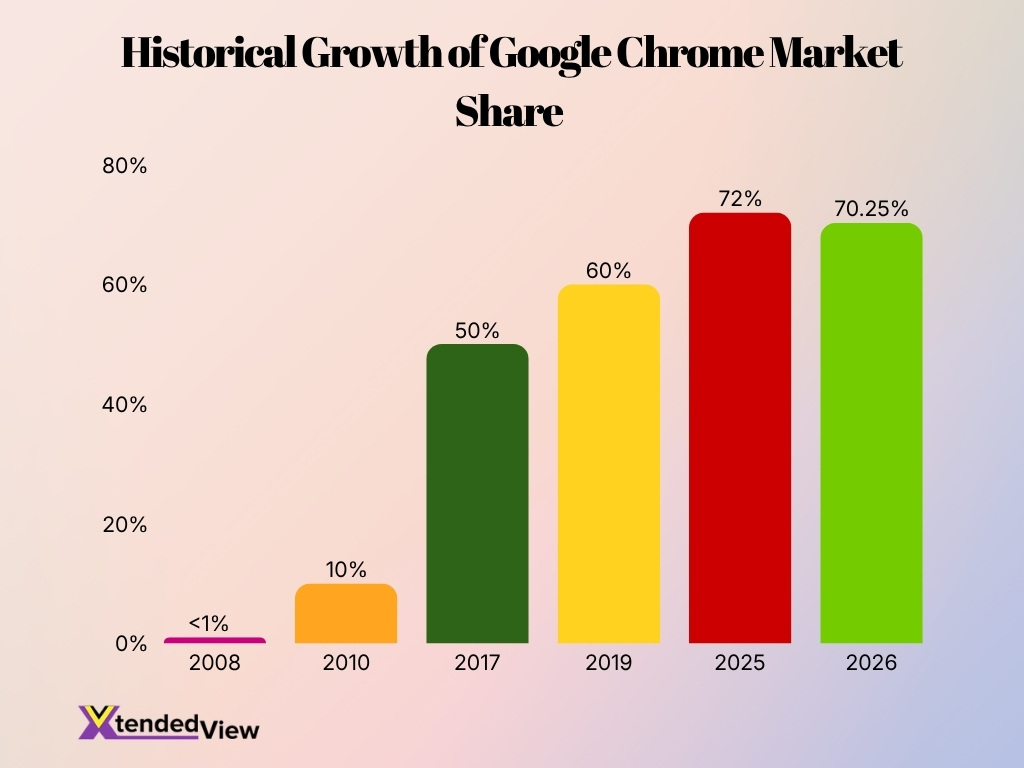
- Chrome launched in September 2008 with less than 1% browser market share.
- Chrome surpassed 10% global market share by 2010.
- In 2012, Chrome overtook Internet Explorer to become the world’s leading browser.
- Chrome crossed 50% global market share for the first time in 2017.
- Chrome exceeded 60% market share by 2019.
- Estimated Chrome users grew from approximately 3.06 billion in 2020 to 3.83 billion in 2026.
- Chrome added nearly 770 million users over the last six years.
- Chrome maintained the number one browser position globally throughout the entire 2020–2026 period.
- Chrome reached a record market share approaching 72% during 2025, its highest level to date.
Google Chrome Performance Statistics
- Google Chrome maintains a global desktop market share of approximately 74.93% as of mid-2026.
- Memory Saver technology can reduce inactive tab RAM consumption by up to 80%.
- The browser supports a massive ecosystem of over 250,000 extensions available for user customization.
- Chrome serves an estimated 3.83 billion internet users worldwide as of the 2026 reporting period.
- Modern Chrome versions have demonstrated up to 40% improvement in memory efficiency compared to legacy releases.
- Benchmark testing consistently places Chrome Canary and standard builds within the top-tier Speedometer performance rankings.
- Chrome users maintain an average of 11.4 open tabs per active browsing session in 2026.
- Internal data indicates that 60% of discarded tabs are revisited by users within a 24-hour period.
Chrome Enterprise Adoption Statistics
- Google Chrome commands a 71.37% global browser market share, serving as the foundational tool for many enterprise ecosystems.
- Over 10 million employees and students rely on Chrome Enterprise solutions for secure, managed digital environments worldwide.
- IT administrators can leverage more than 500 configurable policies to maintain granular control over browser settings and organizational security.
- The global Chrome Enterprise consulting service market reached approximately $1.37 billion in 2026, driven by high demand for cloud-first solutions.
- 65% of enterprises are transitioning toward cloud-first consulting models, further accelerating the adoption of managed Chrome environments.
- Recent data indicates 3.62 billion people use Google Chrome globally, creating high interoperability for web applications across enterprise networks.
- Zero Trust security frameworks are now integrated into more than 55% of all enterprise deployments using Chrome management tools.
- Over 30 million students utilized Chromebooks in K-12 settings for hybrid learning, cementing their dominance in the educational sector.
- Chrome remains the leading browser for 49% of SMBs utilizing BYOD environments, highlighting its flexibility in diverse workplace settings.
- The Chromebook market is valued at $7.1 billion in 2026, with consistent year-over-year expansion in enterprise and public sector usage.
Chrome Extension Distribution by User Base
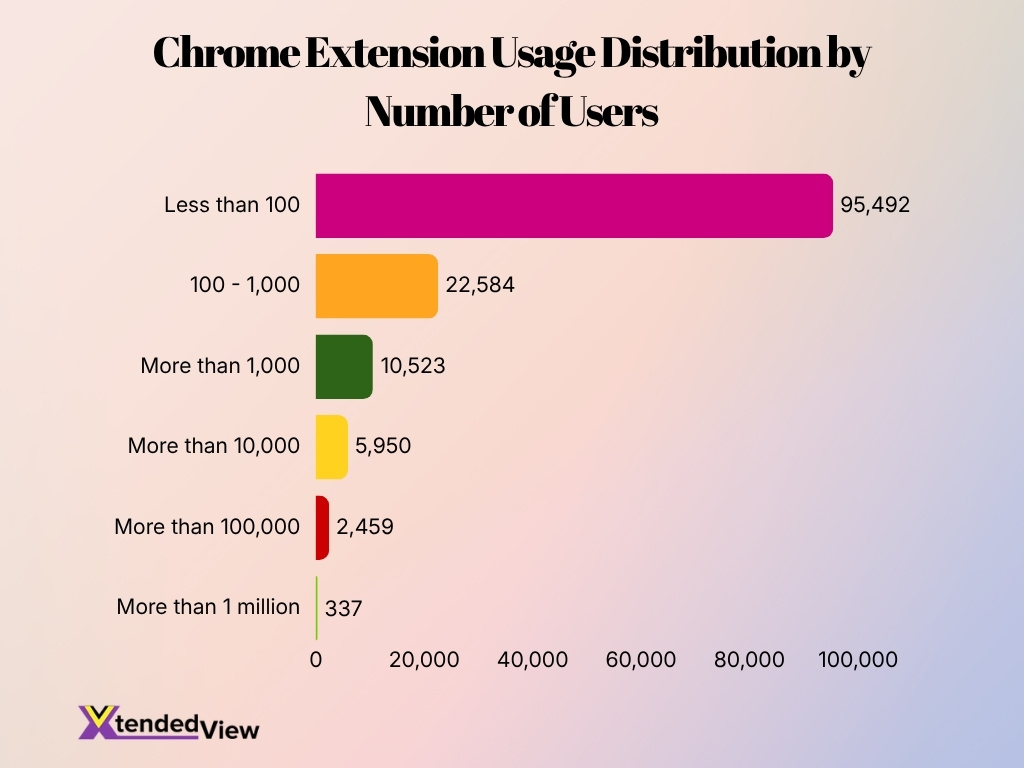
- 69.53% of all Chrome extensions, representing 95,492 extensions, have fewer than 100 users, showing that the vast majority of extensions have a very limited audience.
- The 100–1,000 user category accounts for 22,584 extensions or 16.44% of the total ecosystem, making it the second-largest segment.
- Only 7.66% of Chrome extensions, equivalent to 10,523 extensions, have surpassed the 1,000-user mark.
- Extensions with more than 10,000 users total 5,950, representing just 4.33% of all available extensions.
- A small fraction of extensions, 1.79% or 2,459 extensions, have managed to attract more than 100,000 users.
- Just 337 extensions have exceeded 1 million users, accounting for only 0.24% of the entire Chrome extension marketplace.
- The data highlights a highly concentrated market where a relatively small number of extensions capture the majority of users.
- More than 85.97% of all extensions have fewer than 1,000 users, emphasizing the challenges developers face in gaining visibility and adoption.
- Less than 6.36% of extensions have reached the significant milestone of 10,000+ users, indicating that widespread adoption is relatively rare.
- The distribution demonstrates a classic long-tail ecosystem, where thousands of niche extensions coexist alongside a small group of highly successful products.
Google Chrome User Behavior Statistics
- The average global internet user spends over 6 hours online daily with significant engagement through browser-based platforms.
- Google Chrome maintains a 65.1% share of the global all-device browser market as of early 2026.
- Approximately 60.7% of all global internet traffic originates from mobile devices, heavily influencing browser accessibility.
- Google Password Manager, integrated into Chrome, holds a 32% market share among users for managing online credentials.
- The average Chrome user installs 8 to 12 browser extensions, though most users actively utilize only 2 to 3 of them.
- Over 55% of all extensions available in the official store are categorized specifically as productivity tools.
- Roughly 60% of Chrome users never uninstall an extension once it has been added to their browser environment.
- Agentic AI and autonomous browsing features saw traffic growth of 7,851% year-over-year as of 2026.
Chrome vs. Competitor Browser Statistics
- Chrome leads the global browser market with 70.25% share in 2026.
- Safari ranks second globally with 15.72% market share.
- Microsoft Edge holds approximately 5.14% of worldwide browser usage.
- Firefox accounts for about 2.19% of the global browser market.
- Opera maintains roughly 1.78% market share worldwide.
- Chrome’s market share exceeds the combined share of Edge, Firefox, Opera, and Samsung Internet.
- Chrome’s desktop market share of 71.48% significantly outpaces Edge’s desktop share.
- Safari performs strongest in markets with high Apple device penetration, particularly North America.
- Chromium-based browsers collectively account for more than 80% of global browser usage, underscoring Chrome’s influence on the web ecosystem.
Frequently Asked Questions (FAQs)
Google Chrome holds 70.25% of the worldwide browser market share as of May 2026, making it the most widely used browser globally.
Google Chrome has an estimated 3.62 billion to 3.83 billion users globally in 2026, representing the largest browser user base in the world.
Chrome accounts for approximately 53.54% of browser usage in the United States, ahead of Safari and Microsoft Edge.
Chrome commands 71.48% of the worldwide desktop browser market as of April 2026.
Chrome for Android represents 38.92% of the global browser-version market share, making it the single most-used browser version worldwide.
Conclusion
Google Chrome continues to dominate the browser market, serving billions of users across desktop and mobile devices. Its leadership stems from a combination of broad platform support, strong security protections, a massive extension ecosystem, and continuous performance improvements. While competitors such as Safari, Edge, and Firefox maintain loyal user bases, Chrome retains a substantial lead in both market share and user adoption.
Looking ahead, AI-powered browsing experiences, enterprise security requirements, and mobile-first internet usage will continue shaping Chrome’s evolution. Based on current trends, Chrome is well-positioned to remain the world’s most widely used browser for the foreseeable future.
