



Smart video doorbells have become a major part of modern home security systems, especially as homeowners look for real-time monitoring and remote access features. These devices now support package delivery verification, visitor screening, AI-powered alerts, and integration with smart home ecosystems. Property managers, single-family homeowners, and short-term rental hosts increasingly rely on video doorbells to improve security and reduce theft incidents.
As adoption accelerates across the U.S. and global markets, the industry continues to expand through AI innovation, wireless connectivity, and subscription-based services. Explore the latest smart video doorbell statistics, market growth trends, and adoption insights shaping the industry.
Editor’s Choice
- The global video doorbell market is projected to reach $2.11 billion in 2025 and could grow to $8.47 billion by 2035 at a CAGR of 14.9%.
- The broader smart doorbell market is expected to hit $19.03 billion by 2033, growing at a CAGR of 17.3% beginning in 2026.
- Around 48% of U.S. households are expected to own a video doorbell camera in 2026, representing nearly 58.9 million homes.
- Approximately 37% of U.S. households already use a video doorbell system as of early 2026.
- North America accounted for more than 41% of the smart home security camera market revenue share in 2025, driven by strong demand for connected home security devices.
- The smart doorbell market reached an estimated value of $5.57 billion in 2025 and could surpass $23.99 billion by 2035.
- Video doorbells represented one of the fastest-growing smart home security categories, with adoption in U.S. internet households increasing from 4% in 2017 to 20% in 2023.
- Wireless smart doorbells continue to dominate the market because homeowners prefer DIY installation and app-based management features.
- The global smart home market is forecast to expand from $147.52 billion in 2025 to $848.47 billion by 2034, helping accelerate demand for connected video doorbells.
Recent Developments
- AI-powered motion detection and facial recognition features became standard in premium smart video doorbell models launched in 2025 and 2026.
- Several manufacturers introduced battery-efficient wireless doorbells with longer standby life exceeding six months per charge cycle during 2025.
- Smart doorbell vendors increasingly bundled cloud storage subscriptions with hardware purchases to boost recurring revenue streams in 2025.
- AI software segments within smart doorbell platforms are projected to grow at a CAGR of 24.48% through 2032.
- Online sales channels for smart doorbells are forecast to grow at a CAGR of 22.89%, fueled by e-commerce adoption and direct-to-consumer sales.
- Commercial deployment of smart doorbells accounted for nearly 59% of market share in 2024, especially across office buildings and rental properties.
- Manufacturers expanded compatibility with voice assistants such as Alexa and Google Assistant to strengthen smart home integration.
- Companies increased investment in encrypted video storage and cybersecurity features after rising consumer concerns around privacy and unauthorized access.
- Smart video doorbell brands focused heavily on subscription-based AI alerts, package detection, and cloud storage monetization in 2025.
Video Doorbell Market Growth Insights
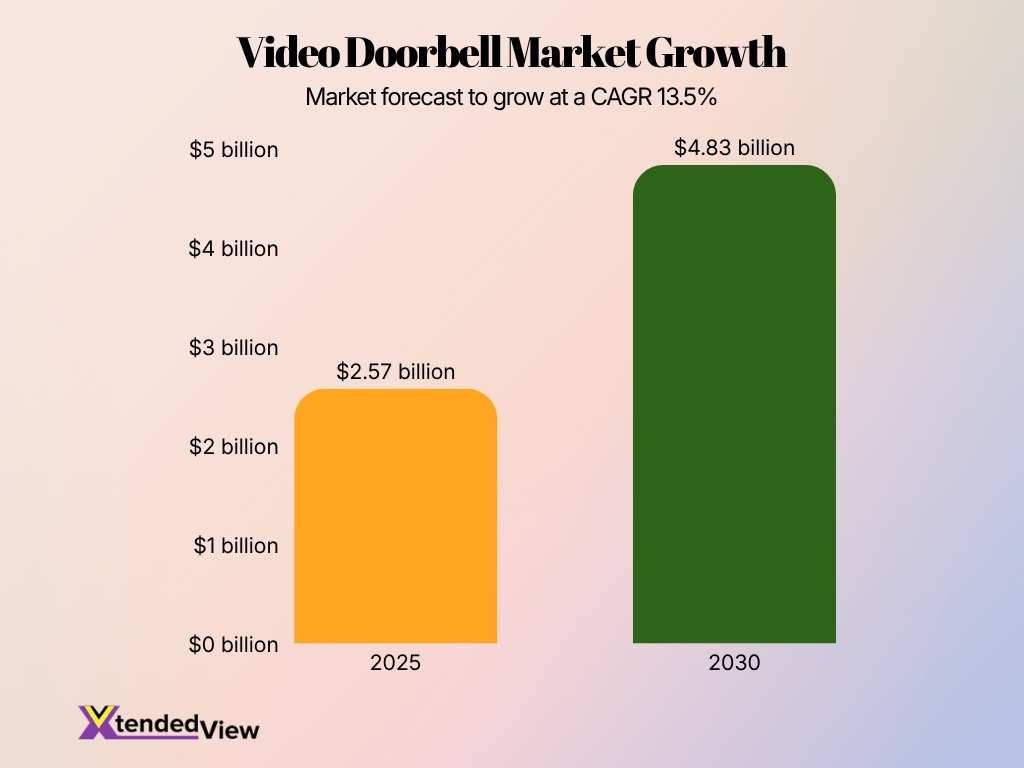
- The video doorbell market is forecast to grow from $2.57 billion in 2025 to $4.83 billion by 2030.
- The market is expected to expand at a strong CAGR of 13.5% during the 2025–2030 forecast period.
- Between 2025 and 2030, the market size is projected to increase by $2.26 billion.
- The data shows that the video doorbell market could nearly double in value within five years.
- Rising demand for smart home security, remote monitoring, and connected doorbell cameras is likely supporting this market growth.
- The forecast indicates strong consumer interest in home surveillance devices, especially products offering motion alerts, video recording, and mobile app connectivity.
- By 2030, the market will reach $4.83 billion, highlighting video doorbells as an important segment within the broader smart home security industry.
Smart Video Doorbell Revenue Growth and CAGR Statistics
- The global smart doorbell market is forecast to grow at a CAGR of 16.8% between 2025 and 2033.
- Another projection estimates CAGR growth of 17.65% from 2025 to 2033.
- Grand View Research forecasts an aggressive CAGR of 33.4% from 2023 to 2030 for smart doorbells.
- The smart doorbell camera market may register a CAGR of 20.6% through 2035.
- The broader video doorbell industry is expected to grow at a CAGR of 13.5% between 2026 and 2035.
- Technavio predicts the smart doorbell industry will add more than $9.15 billion in new market value by 2030.
- The software component segment is forecast to expand faster than hardware because of AI analytics and cloud subscriptions.
- Service-based revenue, including cloud video storage and smart alerts, is projected to grow at a CAGR above 14% through 2031.
- The U.S. smart doorbell market alone is projected to grow at a CAGR of 12.94% between 2026 and 2035.
Regional Smart Video Doorbell Market Statistics
- North America held over 41% revenue share of the smart home security camera market in 2025.
- Asia-Pacific is expected to record the fastest smart home growth rate through 2034.
- India’s video doorbell market was valued at $64.7 million in 2025.
- India’s market could grow to $218 million by 2034 at a CAGR of 14.01%.
- The U.S. remains the largest smart video doorbell market due to high smart home penetration.
- European demand for smart doorbells continues to rise due to apartment security upgrades.
- Urban homeowners in North America show higher adoption rates because of package delivery monitoring.
- Online retail channels contribute significantly to regional growth in the Asia-Pacific due to lower hardware costs.
- Emerging economies are seeing rapid smart doorbell adoption because of expanding smart city projects.
U.S. Household Security Device Adoption
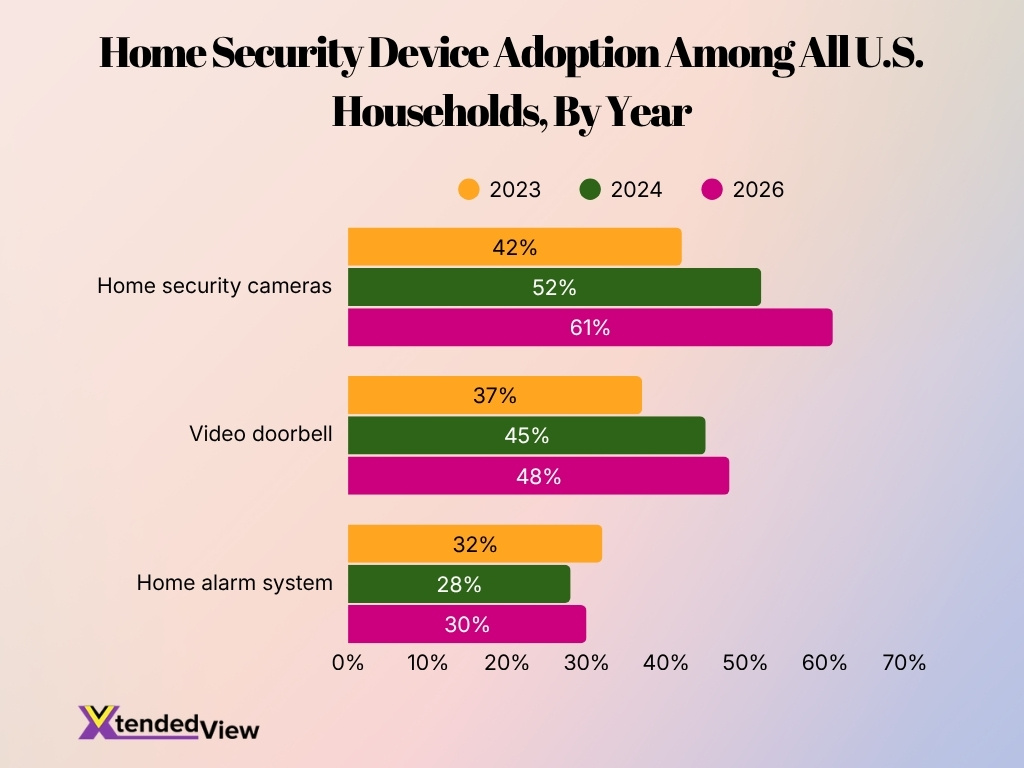
- Home security cameras recorded the highest adoption among U.S. households, rising from 42% in 2023 to 61% in 2026.
- Adoption of home security cameras increased by 19 percentage points between 2023 and 2026, showing the strongest growth among all listed devices.
- Video doorbells also saw steady growth, increasing from 37% in 2023 to 48% in 2026.
- The adoption rate of video doorbells grew by 11 percentage points from 2023 to 2026, reflecting continued consumer interest in smart entryway monitoring.
- Home alarm systems showed relatively flat adoption, moving from 32% in 2023 to 30% in 2026.
- Unlike cameras and video doorbells, home alarm systems declined from 32% in 2023 to 28% in 2024, before slightly recovering to 30% in 2026.
- By 2026, home security cameras were adopted by 61% of U.S. households, making them the most widely used home security device in the dataset.
- In 2026, video doorbells reached 48% adoption, while home alarm systems remained lower at 30%.
- The data suggests that U.S. households are shifting toward smart, camera-based security solutions, especially security cameras and video doorbells.
- Overall, visual monitoring devices are gaining stronger adoption than traditional alarm systems, highlighting a broader move toward app-connected and real-time home surveillance.
Household Ownership Statistics for Video Doorbells
- Around 48% of U.S. households are projected to own a video doorbell by 2026, up from roughly 41% in 2024.
- Approximately 58.9 million homes in the United States currently use video doorbells or connected entry cameras.
- Nearly 39% of Americans reported owning a smart video doorbell in 2026.
- Homeowners are more likely to own video doorbells than renters, with ownership rates exceeding 52% among homeowners in suburban regions.
- About 72% of smart home device owners consider video doorbells an essential home security product.
- Millennials account for the highest smart video doorbell ownership segment, representing nearly 44% of active users.
- More than 60% of households with children reported using some form of smart home surveillance, including video doorbells.
- Multi-device smart homes are increasingly common, with connected households owning an average of 2.2 security camera devices.
- Roughly 27% of U.S. households installed their first smart video doorbell after experiencing package theft concerns.
- Video doorbell ownership among urban households remains significantly higher than rural regions because of apartment security and delivery traffic.
Residential vs Commercial Smart Doorbell Usage Statistics
- Residential users accounted for nearly 41% of smart doorbell deployments globally in 2025.
- Commercial installations represented approximately 59% market share in 2024, largely due to office complexes and rental housing adoption.
- Property management firms increasingly install video doorbells in apartment buildings to monitor visitor access and package deliveries.
- Smart video doorbells are now commonly integrated into vacation rental properties, especially among short-term rental hosts.
- More than 45% of commercial buyers cited visitor verification as the primary reason for deploying smart entry systems.
- Residential consumers primarily purchase video doorbells for theft prevention and remote monitoring purposes.
- Businesses increasingly connect smart doorbells with cloud-based access control systems and surveillance platforms.
- Smart office deployments rose significantly after hybrid work adoption increased building access monitoring needs.
- Approximately 33% of small commercial properties added connected video security devices between 2023 and 2025.
- Commercial demand for AI-enabled facial recognition doorbells increased because of automated visitor logging features.
Smart Video Doorbell Market Share by Type
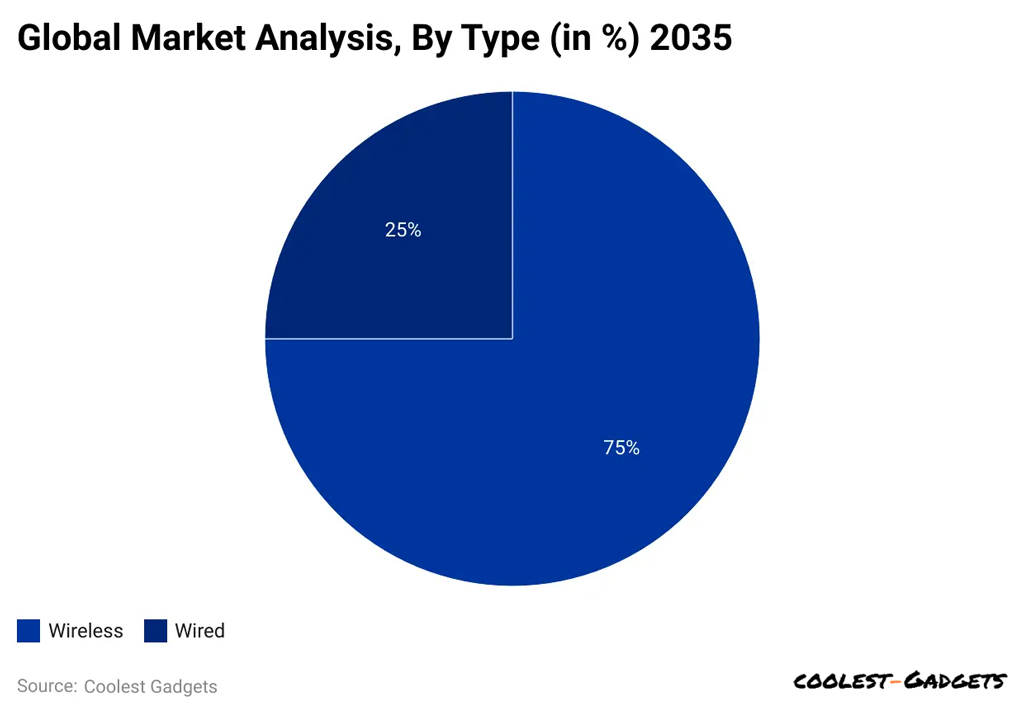
- Wireless smart video doorbells dominate the global market, accounting for 75% of the total market share in 2035.
- Wired smart video doorbells hold a smaller share, representing 25% of the global market by type.
- The data shows that wireless models are three times more popular than wired smart video doorbells.
- The strong lead of wireless video doorbells suggests growing consumer preference for easy installation, flexibility, and smart home compatibility.
- Wired smart video doorbells still maintain a notable 25% market share, likely supported by users who prefer stable power connections and long-term reliability.
- Overall, the market is clearly shifting toward wireless smart video doorbell solutions, making them the leading product type in the category.
- For brands and manufacturers, the 75% wireless share highlights a major opportunity to focus on battery-powered, Wi-Fi-enabled, and app-connected doorbell devices.
Consumer Purchase Behavior for Video Doorbells
- Around 63% of consumers cited home security as the primary reason for buying a smart video doorbell.
- Package theft concerns influenced nearly 27% of smart video doorbell purchases in the United States.
- Consumers increasingly prioritize AI-powered motion detection and package recognition when selecting devices.
- More than 55% of buyers prefer devices compatible with existing smart home ecosystems such as Alexa or Google Home.
- Subscription-free video storage options became a major selling point among privacy-conscious buyers in 2025.
- Roughly 46% of shoppers researched video doorbell reviews online before making a purchase decision.
- Consumers increasingly purchase smart video doorbells during major e-commerce sales events such as Black Friday and Prime Day.
- Younger buyers prefer app-based installation and smartphone-controlled monitoring features.
- Video quality, night vision, and storage flexibility ranked among the top five buying considerations in 2026 surveys.
- Buyers are increasingly willing to pay monthly subscription fees for cloud recording and AI notification services.
Leading Smart Video Doorbell Vendors by Units Sold
- Ring held 34% global unit market share in 2023, maintaining top vendor position through 2025.
- Google Nest captured top-three shipments in North America and Europe, with North America accounting for 41.8% global market share in 2026.
- Arlo Technologies reached 5.4 million cumulative paid accounts by November 2025, representing 27% year-over-year growth.
- Eufy differentiated via local storage capabilities, with top players collectively holding 32.9% market share in 2025.
- Xiaomi dominated Asia-Pacific markets, where the region posted fastest CAGR at 14.55% through 2031.
- Wireless smart doorbells shipped 125.8 million units globally in 2024, valued at $18.9 billion.
- Online retail held 67.10% revenue share in 2025 and is accelerating at 15.11% CAGR.
- AI-enabled doorbells grew at 14.88% CAGR through 2031 with higher average selling prices than standard HD models.
Smart Video Doorbell Brand Market Share Statistics
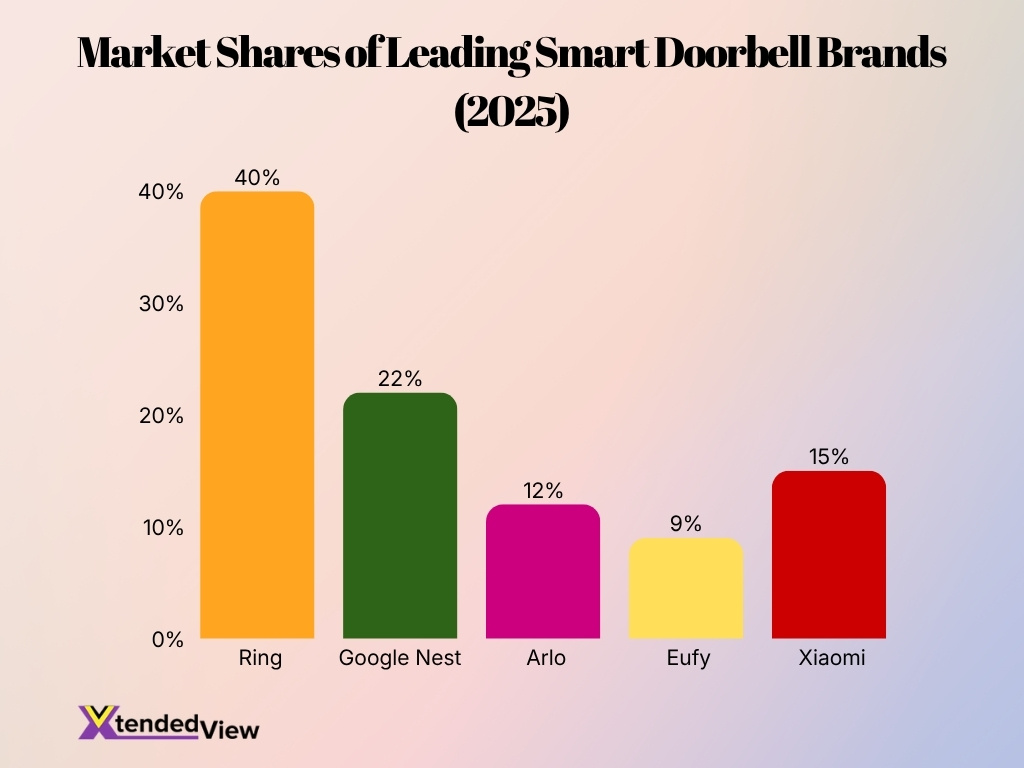
- Ring held 35%–40% of U.S. smart doorbell sales in 2025, keeping the largest installed user base.
- Google Nest grew to ~22% market share in 2025 by integrating with Google Home and adding AI-powered alerts.
- Arlo captured ~12% of the premium segment with 2K video quality and advanced AI detection features.
- Eufy reached ~9% market share among privacy-focused buyers thanks to local storage and subscription-free recording.
- Xiaomi won ~15% of Asia-Pacific smart doorbell sales in 2025 via lower-cost ecosystem products.
- Ring + Nest together accounted for >55% of the North American smart doorbell market visibility in 2025.
- Cloud storage subscriptions now drive ~60% of recurring revenue for top smart doorbell brands in 2025.
- Mid-tier brands grew ~28% year-over-year through e-commerce and direct-to-consumer pricing in 2025.
- Smart home–integrated brands showed ~35% higher customer retention than standalone device vendors in 2025.
Consumer Satisfaction and User Experience Statistics
- 74% of smart video doorbell owners said devices improved their sense of home security.
- 68% of users preferred video doorbells integrated with broader smart home systems rather than standalone devices.
- 85% reduction in false notifications achieved by AI-powered alerts distinguishing humans, vehicles, and pets.
- 72% of smart doorbell cameras now come equipped with secure cloud backup features for privacy.
- 41% of models also offer SD-card compatibility for local storage alongside cloud backup.
- 64% of consumers expressed little to no trust in smart home devices regarding data privacy.
- The wireless segment holds 68.3% market share in 2026 due to convenience despite battery concerns.
- Smart doorbell adoption expanded by 18.7% in 2024, driven by AI features and remote monitoring.
- 20% of US internet households now have a video doorbell, up from 4% in 2017.
AI and Facial Recognition in Smart Video Doorbells
- The AI-enabled smart doorbell software segment is projected to grow at a CAGR of 24.48% through 2032.
- Facial recognition features are now in over 65% of premium video doorbells released in 2025–2026.
- More than 58% of consumers expressed interest in AI-based visitor recognition technology for home security.
- AI-assisted package detection reduces false notifications by up to 70% from animals, weather, and vehicles.
- Smart video doorbells using machine learning improve motion classification accuracy by 35–45% over time.
- Commercial buildings adopted facial recognition doorbell systems at a rate of 28% in 2025 for visitor verification.
- AI-based smart alerts boosted customer satisfaction scores by 22% due to more relevant notifications.
- Privacy concerns about facial recognition drove new regulations in 12 US states and EU member countries.
- Vendors market AI-powered person-only alerts that cut unnecessary mobile interruptions by 55–60%.
- Over 73% of new smart doorbells now integrate with cloud analytics platforms for behavioral monitoring.
Smart Video Doorbell Feature Adoption Statistics
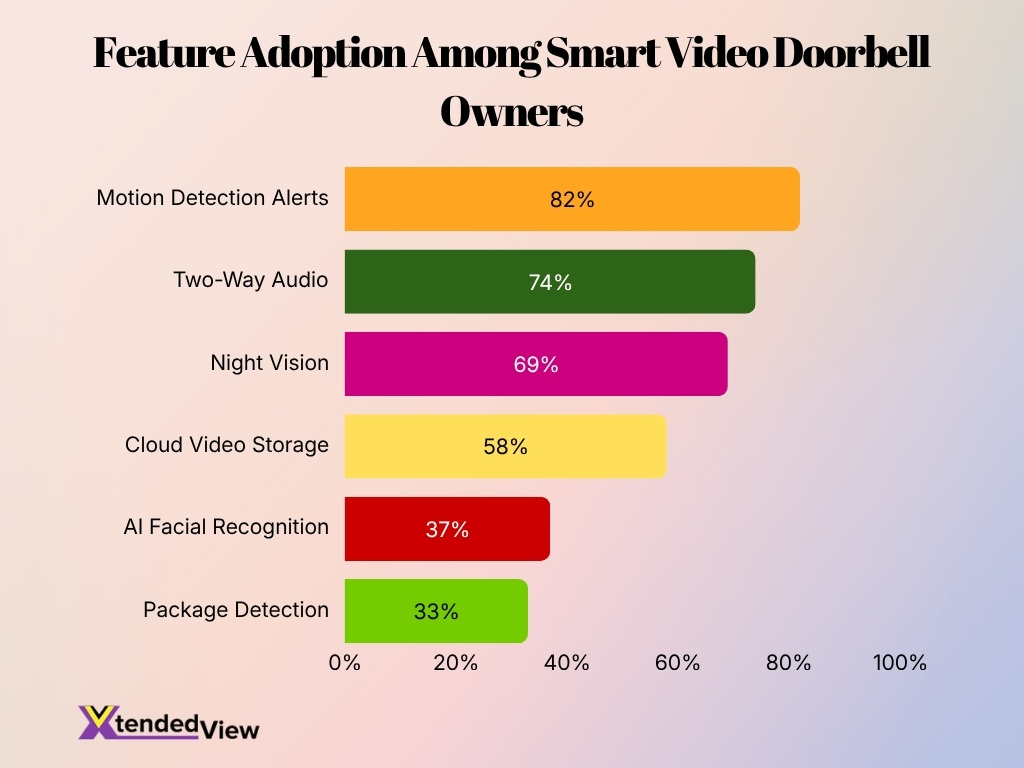
- Motion detection alerts are the most widely used smart doorbell feature, with 82% adoption, showing that real-time security notifications are the top priority for users.
- Two-way audio ranks second at 74%, highlighting strong consumer demand for speaking with visitors, delivery staff, or strangers remotely.
- Night vision is used by 69% of smart doorbell owners, making it a key feature for improving home security during low-light or nighttime conditions.
- Cloud video storage has 58% adoption, indicating that more than half of users prefer saving and reviewing doorbell footage online.
- Advanced AI-based features are still growing, with AI facial recognition adopted by 37% of users.
- Package detection has the lowest adoption among the listed features at 33%, but it remains important as online shopping and doorstep deliveries continue to rise.
- The data shows that users prioritize core security features such as motion alerts, audio communication, and night vision over newer AI-powered features.
- There is a clear adoption gap between basic security tools and advanced automation features, with motion detection alerts 49 percentage points higher than package detection.
Cloud Storage vs Local Storage Usage Statistics
- More than 62% of consumers use cloud recording services for storing video doorbell footage globally.
- Approximately 48% of users expressed concern about storing home surveillance footage on third-party cloud servers.
- Local storage adoption increased among privacy-conscious consumers seeking subscription-free alternatives in 2025.
- Brands offering expandable local storage reported stronger growth among budget-focused buyers in 2025.
- Hybrid storage models combining local backup with cloud synchronization became more common in premium devices during 2026.
- Public cloud storage dominates with ~65% market share in 2025, driven by cost efficiency and scalability.
- Local storage solutions gained traction after rising consumer awareness around cybersecurity and data privacy.
- Smart video doorbell users increasingly compare subscription costs before purchasing devices, with plans ranging from $3–$20/month.
Smart Video Doorbell Integration with Other Smart Home Devices
- 68% of video doorbell users connect their devices with broader smart home ecosystems.
- Smart locks integration grew by 42% in 2025 as the fastest-growing connected home automation trend.
- Alexa and Google Assistant support 87% of major smart doorbell brands for voice control.
- 73% of smart doorbells now integrate with connected lighting systems to automate entryway illumination.
- Homeowners with integrated security ecosystems reported 28% higher satisfaction than standalone device users.
- 61% of connected households use Smart TVs or displays as interfaces for live video doorbell feeds.
- Cross-device automation, like triggering alarms or smart locks after motion detection, grew 55% in 2025.
- Apple HomeKit compatibility expanded to 34% of premium smart doorbell vendors in 2025–2026.
- 79% of consumers prefer ecosystems supporting unified mobile app management for cameras, locks, and sensors.
- Smart home integration capabilities influence 65% of purchasing decisions across North America and Europe.
Doorbell Camera Owner Interaction Insights
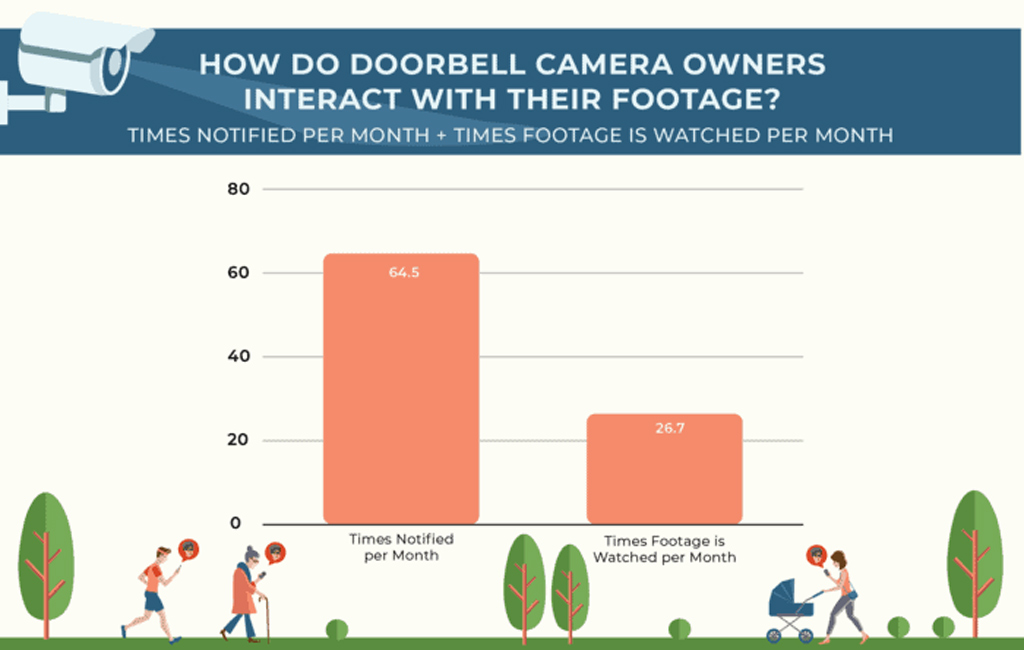
- Doorbell camera owners receive an average of 64.5 notifications per month, showing that motion alerts and visitor detection are highly active features.
- Footage is watched 26.7 times per month, meaning users review their doorbell camera videos less often than they receive alerts.
- Notifications are about 2.4 times higher than actual footage views, suggesting many alerts may not require users to open or review the video.
- The data shows that smart doorbells are used more for real-time awareness than for frequent video playback.
- High monthly notification activity highlights the importance of motion detection accuracy, as too many alerts can lead to notification fatigue.
- With users watching footage nearly 27 times per month, video doorbells still play a strong role in home monitoring, package tracking, and visitor verification.
- The gap between 64.5 alerts and 26.7 footage views suggests that users may rely on quick phone notifications before deciding whether to watch recorded footage.
Privacy Concerns and Public Perception of Smart Doorbells
- 72% of smart home product owners say they are concerned about the security of personal data collected by their devices, showing privacy is a mainstream issue for connected home products.
- Only 14% of homeowners said they read a privacy policy before buying a smart thermostat, which suggests many buyers still skip the fine print.
- About 59% of U.S. internet households found that stronger user-control guarantees are highly effective in easing privacy and security worries.
- More than 41% of smart home devices have at least one vulnerability that could allow unauthorized access, reinforcing concerns about connected security systems.
- About 38% of consumers cited data privacy concerns as a key hesitation when considering smart doorbell cameras.
- In 2025, the smart doorbell market was valued at $5.341 billion, showing that demand remains strong despite privacy debates.
- The video doorbell market was estimated at $2.11 billion in 2025, indicating continued consumer adoption of these devices.
- A separate forecast valued the smart doorbell market at $ 4.61 billion in 2024 and projected $ 19.91 billion by 2033, reflecting growth even as privacy scrutiny rises.
- Ring-style video systems store footage in the cloud and can support end-to-end encryption, but that feature is often optional rather than default, which keeps privacy concerns active.
- Law enforcement access remains a public flashpoint because companies can respond to legal orders, emergency disclosures, and community video requests, intensifying debate over surveillance and control.
Future Outlook and Forecast Statistics for Smart Video Doorbells
- The global smart doorbell market could surpass $19 billion by 2033.
- Another long-term forecast estimates the market may exceed $23.99 billion by 2035.
- The broader smart home industry is projected to grow to $848.47 billion by 2034, supporting future video doorbell demand.
- AI-powered video analytics are expected to become a core competitive differentiator among leading vendors.
- Wireless smart doorbells are forecast to remain the dominant installation category through the next decade.
- Subscription-based cloud services are expected to contribute a larger share of smart doorbell company revenues by 2030.
- Demand for integrated smart home security ecosystems will likely accelerate adoption across residential and commercial properties.
- Emerging economies in the Asia-Pacific and Latin America are projected to experience some of the fastest adoption growth rates.
- Smart video doorbells with edge AI processing and local analytics could gain stronger adoption among privacy-focused buyers.
- Analysts expect competition among vendors to intensify around AI accuracy, subscription pricing, and ecosystem integration features.
Frequently Asked Questions (FAQs)
The global smart doorbell market is expected to reach $19.03 billion by 2033, growing at a CAGR of 17.3% from 2026 to 2033.
An estimated 58.9 million U.S. households are expected to use video doorbells in 2026.
The smart doorbell market is projected to grow at a CAGR of 22.1% between 2026 and 2030.
The smart doorbell market could surpass $23.99 billion by 2035.
North America held more than 38.9% market share of the global AI doorbell market in 2024.
Conclusion
Smart video doorbells continue evolving from simple home monitoring tools into advanced AI-powered security platforms. Growing concerns around package theft, visitor verification, and connected home automation are pushing adoption across residential and commercial markets alike. Wireless installations, cloud services, AI analytics, and smart ecosystem integrations now shape purchasing behavior more than hardware alone.
The U.S. market remains a major growth driver, but Asia-Pacific and other emerging regions are rapidly expanding as smart home adoption accelerates globally. At the same time, privacy concerns, facial recognition debates, and cybersecurity expectations are influencing both consumer preferences and regulatory discussions.
Looking ahead, the smart video doorbell industry is expected to remain one of the fastest-growing categories within connected home security. Companies that combine AI innovation, privacy controls, flexible storage options, and seamless smart home integration will likely lead the next phase of market growth.
