


Home security cameras have become a standard part of modern households as consumers prioritize safety, package monitoring, and remote home access. Smart cameras now support real-time alerts, AI-based motion detection, and cloud video storage, making them useful for homeowners, renters, and small property managers alike. Retailers, insurance companies, and smart home providers also continue to expand camera-based services to reduce theft risks and improve connected living experiences.
As adoption accelerates across the U.S. and global markets, the latest statistics reveal how consumer behavior, technology, and market growth continue to reshape the home security industry.
Editor’s Choice
- The global home security camera market is expected to grow from $23.79 billion in 2025 to $27.37 billion in 2026.
- The smart home security camera market is projected to reach $7.29 billion in 2026, up from $6.87 billion in 2025.
- Around 61% of U.S. households now use at least one security camera, compared to 52% in 2024.
- Approximately 74.9 million U.S. homes currently have indoor or outdoor security cameras installed.
- Global smart home device shipments are forecast to approach 1.25 billion units in 2026.
- The U.S. smart home market is expected to increase from $50.3 billion in 2025 to $54.5 billion in 2026.
- The smart home camera market is forecast to grow at a 20.6% CAGR between 2024 and 2029.
- Wireless home security cameras generated $9.8 billion in global market value in 2024.
- Ring remains the leading consumer home security camera brand, recognized by 43% of U.S. users.
- Around 58.9 million Americans now own video doorbells.
Recent Developments
- Matter 1.5 introduced official support for home security cameras in late 2025, improving compatibility across smart home ecosystems.
- Samsung SmartThings became one of the first major platforms to integrate Matter 1.5 camera support in 2025.
- New Matter standards now support Wi-Fi, PoE, Ethernet, indoor, outdoor, and doorbell camera integrations.
- Security camera manufacturers increasingly added AI-powered facial recognition and package detection during 2025 product launches.
- The use of edge AI processing accelerated in 2025 and 2026 to reduce cloud storage costs and improve privacy controls.
- Several brands introduced subscription-free local storage camera systems in response to growing consumer concerns about recurring cloud fees.
- AI-enabled surveillance analytics became a major driver behind growth in the global surveillance camera market in 2026.
- Camera manufacturers increasingly launched 2K and 4K residential cameras with low-light imaging capabilities during 2025.
- Integration between home cameras and voice assistants such as Alexa and Google Home expanded significantly across U.S. households.
- Rising package theft incidents in urban areas continued to boost demand for entryway and video doorbell cameras in North America.
Global Home Security Camera Overview
- More than 94 million U.S. households are expected to use some type of home security system in 2025.
- Roughly 38% of households worldwide own at least one connected camera device.
- North America contributes nearly 40% of the total global security camera market growth.
- China accounts for approximately 54% of the world’s connected surveillance cameras.
- An estimated 770 million surveillance cameras operate globally across residential and commercial environments.
- Smart cameras continue gaining share within the broader home security industry and are expected to reach $10 billion in market value by 2025.
- Urban crime awareness remains one of the strongest drivers behind residential camera adoption worldwide.
- Consumers increasingly prefer app-controlled cameras with mobile alerts and cloud-based monitoring features.
- The Asia-Pacific region is forecast to record one of the fastest adoption rates for smart home cameras through 2033.
- Affordable wireless cameras sold through ecommerce platforms continue expanding adoption in India and Southeast Asia.
Smart Home Security Camera Market Growth Insights
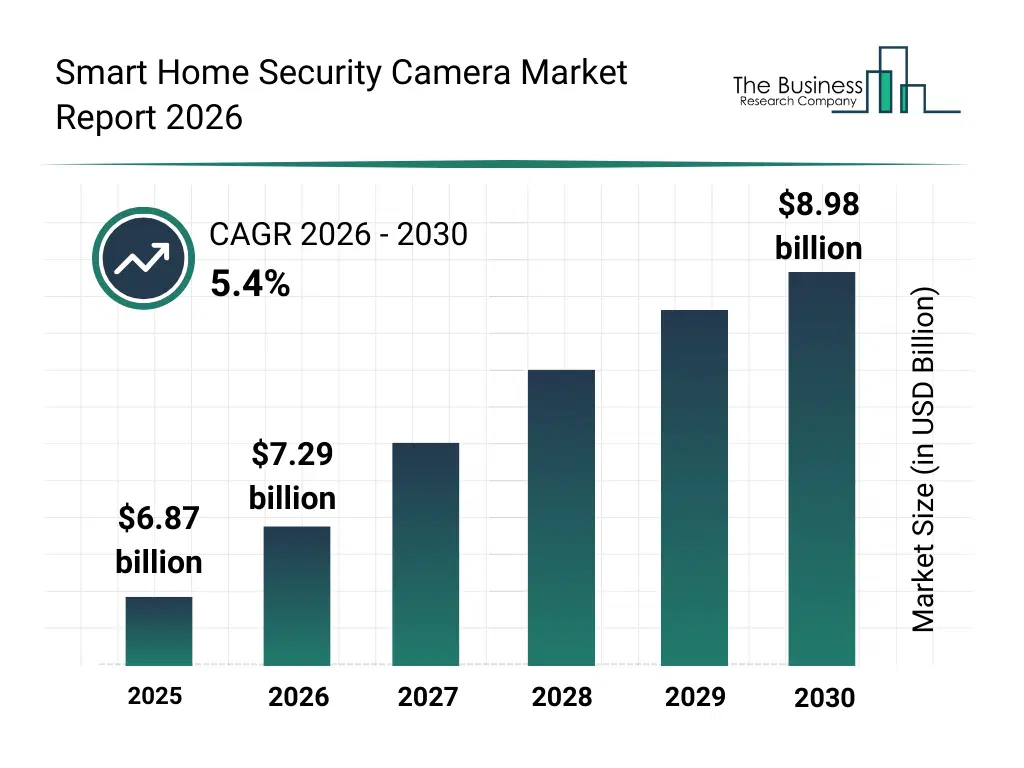
- The smart home security camera market is projected to grow steadily from $6.87 billion in 2025 to $8.98 billion by 2030.
- The market is expected to record a 5.4% CAGR between 2026 and 2030, showing consistent demand for connected home security solutions.
- In 2026, the market size is estimated at $7.29 billion, increasing from $6.87 billion in 2025.
- By 2030, the market is forecast to add more than $2.1 billion in value compared with 2025.
- The upward trend suggests growing consumer adoption of smart surveillance cameras, AI-enabled security features, and connected home monitoring systems.
- The market’s steady expansion highlights rising interest in remote monitoring, video doorbells, cloud storage, and home automation integration.
- Overall, the data indicates that smart home security cameras will remain a fast-growing segment within the broader smart home and residential security market.
Home Security Camera Market Growth and Forecasts
- The global home security camera market is expected to expand at a 15.04% CAGR from 2026 to 2031.
- Smart home security cameras are projected to grow at a 12.61% CAGR between 2026 and 2031.
- The smart home camera market overall may grow at 20.6% CAGR through 2029.
- The wireless home security camera segment is forecast to reach $37.5 billion by 2034.
- The U.S. smart home security camera market could grow at a 23.56% CAGR through 2034.
- India’s smart home security market is forecast to expand at a 26.45% CAGR from 2026 to 2034.
- The smart surveillance camera industry could exceed $161.2 billion globally by 2032.
- Doorbell camera applications are projected to grow at a 16.5% CAGR between 2025 and 2030 in North America.
- Europe’s smart home camera market is expected to grow at a 21.6% CAGR through 2033.
- AI integration, 5G connectivity, and falling hardware costs continue driving long-term growth across residential security systems.
Smart Home Security Camera Market Statistics
- The global smart home security camera market was valued at $10.51 billion in 2024.
- Analysts project the market could reach nearly $60.99 billion by 2034.
- The industry is forecast to grow at a 19.23% CAGR from 2025 to 2034.
- Another market estimate places the 2026 smart home security camera market at $7.29 billion globally.
- Smart home camera demand in the U.S. may surpass $11 billion by 2036.
- Indoor smart security cameras are forecast to grow at a 10.4% CAGR because of demand for pet and elderly monitoring.
- Approximately 77.05 million U.S. homes actively use smart home devices in 2026.
- Smart home adoption across U.S. and Canadian households rose from 49% in 2024 to 59% in 2025.
- U.S. internet households with video doorbells increased from 4% in 2017 to 20% in 2023.
- AI-powered analytics and cloud-managed surveillance remain among the fastest-growing features in the smart camera category.
Home Security Device Adoption Among Homeowners and Renters
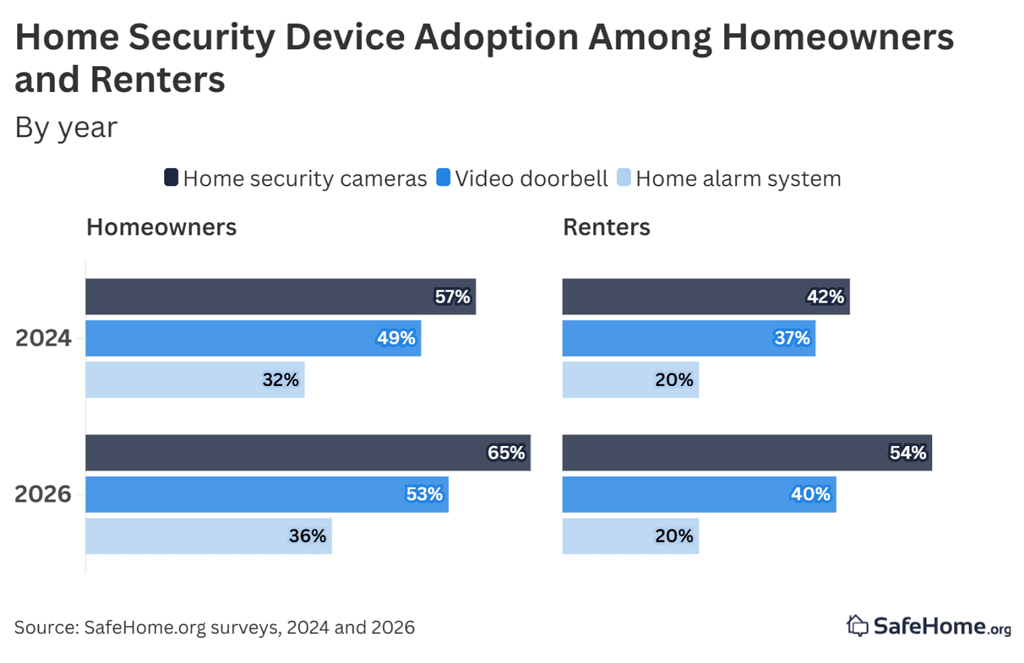
- Home security cameras are the most widely adopted device among both groups, reaching 65% of homeowners and 54% of renters in 2026.
- Among homeowners, adoption of home security cameras increased from 57% in 2024 to 65% in 2026, showing an 8 percentage point rise.
- Renters also showed strong growth in camera adoption, rising from 42% in 2024 to 54% in 2026, a 12 percentage point increase.
- Video doorbells remain the second-most popular security device, used by 53% of homeowners and 40% of renters in 2026.
- Homeowners saw a moderate increase in video doorbell adoption, from 49% in 2024 to 53% in 2026.
- Renters’ use of video doorbells grew slightly, moving from 37% in 2024 to 40% in 2026.
- Home alarm systems are less common than cameras and video doorbells, with 36% of homeowners and 20% of renters using them in 2026.
- Among homeowners, home alarm system adoption increased from 32% in 2024 to 36% in 2026.
- Renters showed no growth in home alarm system adoption, remaining flat at 20% in both 2024 and 2026.
- The data suggests that renters are adopting security cameras faster than homeowners, especially between 2024 and 2026.
- Homeowners continue to lead renters across all device categories, but the gap is narrowing for home security cameras.
- Overall, the strongest adoption trend is toward camera-based security devices, while traditional alarm systems remain the least adopted option.
Home Security Camera Shipments and Unit Sales
- Global smart home device shipments are expected to surpass 1.25 billion units in 2026, with security cameras representing one of the fastest-growing categories.
- Worldwide video surveillance camera shipments exceeded 1 billion units cumulatively across residential and commercial sectors by 2025.
- Residential smart camera shipments increased by approximately 18% year over year in 2025 due to stronger demand for DIY home security systems.
- North America accounted for nearly 34% of global smart camera shipments in 2025.
- China shipped more than 200 million surveillance and smart home cameras during 2025 alone.
- Demand for wireless home cameras helped push the connected camera hardware segment above $9 billion in annual sales globally.
- Entry-level smart cameras priced below $100 represented over 45% of global unit sales in 2025.
- Video doorbell shipments across the U.S. and Europe rose by more than 16% year over year in 2025.
- Ecommerce marketplaces generated over 55% of total consumer camera sales worldwide in 2025.
- Subscription-based camera bundles contributed to rising recurring revenue for major home security brands in 2026.
Households With Smart Security Cameras Worldwide
- Around 61% of U.S. households now use at least one security camera device.
- Approximately 74.9 million homes in the U.S. currently have security cameras installed.
- Global smart home penetration reached nearly 430 million active households in 2025.
- More than 38% of households globally now own at least one connected security camera.
- Smart security cameras ranked among the top three most-used smart home devices in North America during 2025.
- Roughly 20% of internet-connected households worldwide installed video doorbells by 2025.
- Urban households were nearly 2.4 times more likely to own smart cameras compared to rural households in 2025.
- Multi-camera households became more common, with U.S. users averaging 2.8 connected cameras per home in 2025.
- Families with children represented one of the largest user segments for indoor smart monitoring cameras in 2025.
- Consumer surveys showed that homeowners were nearly three times more likely to install security cameras than renters.
What Matters Most When Choosing Home Security Products
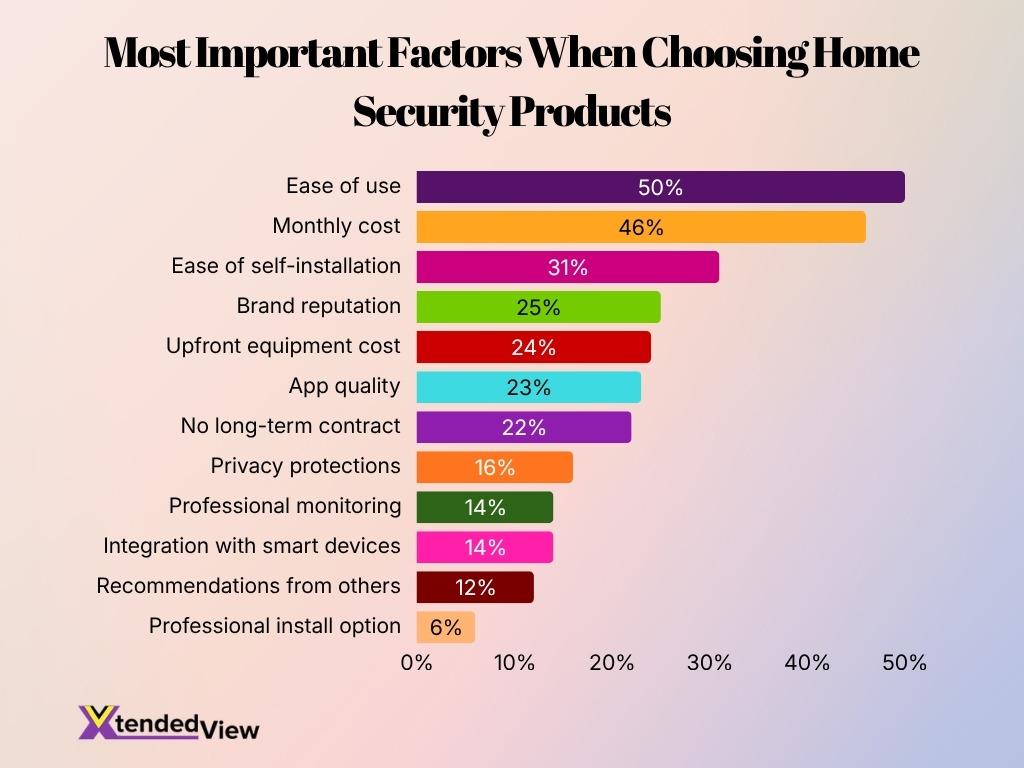
- Ease of use is the top priority, with 50% of users saying it is the most important factor when choosing home security products.
- Monthly cost ranks second, influencing 46% of users, which shows that affordability remains a major concern for buyers.
- Ease of self-installation matters to 31% of users, suggesting many consumers prefer DIY-friendly home security systems.
- Brand reputation influences 25% of users, showing that trust and reliability still play an important role in purchase decisions.
- Upfront equipment cost is important for 24% of users, meaning buyers consider both initial and ongoing expenses before choosing a product.
- App quality is a key factor for 23% of users, highlighting the importance of smooth mobile control and remote monitoring features.
- No long-term contract matters to 22% of users, indicating that flexibility is important for modern home security customers.
- Privacy protections are important to 16% of users, showing growing concern about data security, camera footage, and personal information.
- Professional monitoring and smart device integration are equally important, with each selected by 14% of users.
- Recommendations from others influence 12% of users, suggesting word-of-mouth still affects home security product choices.
- Professional installation is the least important factor, with only 6% of users prioritizing it, which may reflect rising demand for self-installable systems.
Home Security Camera Adoption by Country and Region
- The United States leads the global smart home security camera market with $4.37 billion in revenue for 2025.
- 61% of U.S. households (74.9 million) use home security cameras in 2026.
- China holds 47% of the global surveillance camera market revenue in 2025.
- India’s smart home security camera market grows at 22.25% CAGR from 2026 to 2034.
- 29% of UK adults own security cameras as of 2025.
- North America accounts for 37.6% of the global home security camera market in 2025.
- Asia-Pacific exhibits the fastest growth at 16.34% CAGR in home security cameras through 2031.
- Germany’s smart home market is expected to reach $9.45 billion by 2025, boosting security adoption.
- Latin America surveillance camera market hits $3.03 billion in 2025 amid urban demand.
Wired vs Wireless Home Security Camera Statistics
- Wireless home security cameras generated approximately $9.8 billion in market revenue during 2024.
- Wireless models represented more than 63% of consumer home camera sales globally in 2025.
- Consumers increasingly favored wireless cameras because of easier DIY installation and app-based controls.
- Wired cameras still maintained stronger adoption in large residential properties requiring continuous recording.
- Battery-powered wireless camera sales increased by more than 20% year over year in 2025.
- PoE-enabled wired systems gained popularity among premium smart home users because of stable connectivity and higher video quality.
- Nearly 72% of first-time buyers preferred wireless cameras over wired alternatives in 2025.
- Wired systems remained common in professionally monitored home security packages across the U.S. market.
- Advances in Wi-Fi 6 connectivity improved wireless camera streaming reliability and reduced latency issues during 2025.
- Hybrid systems combining wired outdoor cameras with wireless indoor cameras gained popularity among suburban households.
Home Security Camera Usage by Purpose
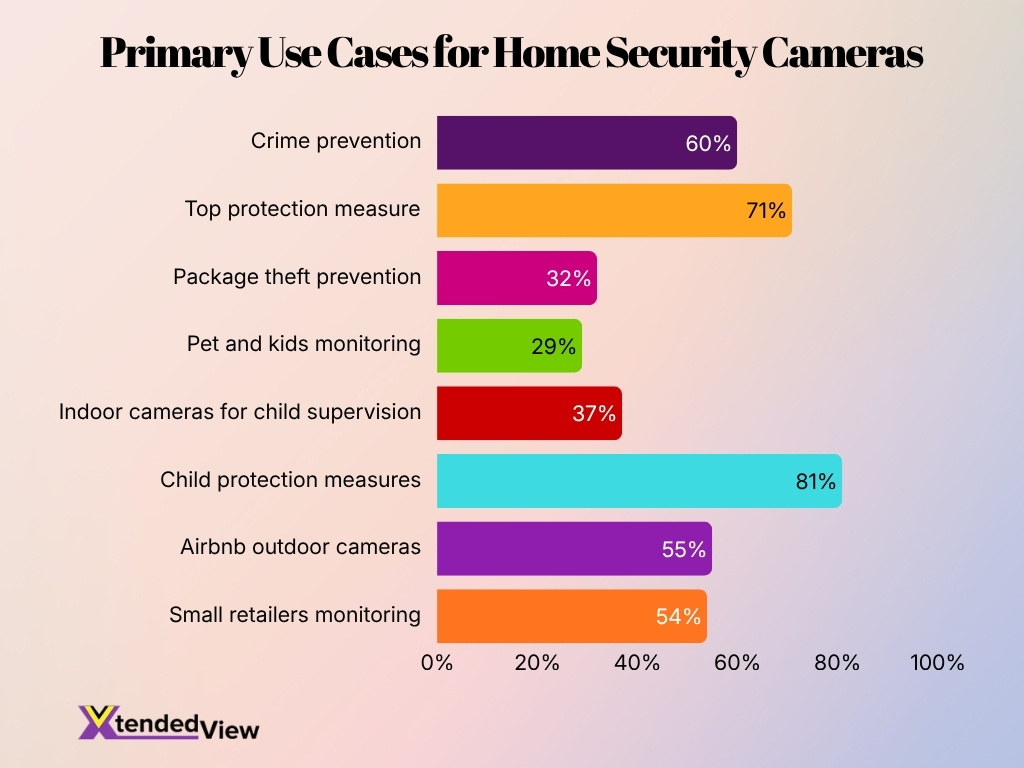
- Over 60% of U.S. users owned cameras primarily for crime prevention in 2025.
- 71% of homeowners used security cameras as their top protection measure in 2025.
- 32% of Americans installed cameras after experiencing package theft.
- 29% of owners monitored pets and kids using home security systems.
- 37% of households with children deployed indoor cameras for supervision.
- 81% of parents with kids at home installed measures like cameras for child protection.
- 28% of users adopted AI person detection for smarter elder motion alerts.
- 55% of Airbnb hosts used outdoor cameras for vacation property surveillance post-2024.
- Home insurers offered 5-20% discounts for homeowners with connected camera systems.
- 54% of small retailers installed security cameras to monitor deliveries and customers.
Indoor vs Outdoor Home Security Camera Usage
- Outdoor security cameras represented about 53.6% of the home security camera market size in 2025 due to perimeter‑protection demand.
- Indoor cameras accounted for roughly 46.4% of the residential camera market by volume in 2025, driven by inside‑premise monitoring.
- More than 40% of U.S. smart‑camera owners reported using indoor cameras specifically for pet monitoring while away from home.
- Around 38% of surveyed smart‑camera users in North America used outdoor cameras primarily to deter package and vehicle theft.
- Approximately 35% of U.S. households with cameras in 2025 operated both indoor and outdoor systems for full‑home coverage.
- Nearly 61% of U.S. households already owned at least one security camera (indoor or outdoor) by early 2026, up from 52% in 2024.
- High‑income homeowners made up over 28% of buyers of AI‑powered outdoor cameras with human, vehicle, and animal recognition in 2025.
- Budget indoor cameras under $50 captured about 22% of smart‑camera ecommerce sales during holiday shopping periods in 2025.
- Outdoor cameras with built‑in floodlights grew by roughly 18% year‑on‑year in North America, becoming one of the fastest‑rising premium segments.
- Smart backyard and driveway monitoring systems were adopted by nearly 19% of higher‑income homeowners in 2025, often bundled with outdoor cameras.
Video Doorbell and Entryway Camera Statistics
- Around 58.9 million Americans currently own video doorbells.
- U.S. internet households with video doorbells increased from 4% in 2017 to 20% by 2023.
- The global video doorbell market is projected to surpass $15 billion by 2030.
- Package theft concerns remained one of the primary reasons consumers installed entryway cameras in 2025.
- More than 70% of video doorbell owners reported checking live feeds remotely at least once per week.
- Doorbell cameras featuring two-way audio became standard across most mid-range and premium models.
- AI-enabled package detection became a major feature upgrade among top-selling video doorbells in 2025.
- Subscription-based cloud storage plans generated rising recurring revenue from video doorbell ecosystems.
- Multifamily apartment buildings increasingly adopted shared smart entryway camera systems during 2025.
- Video doorbell adoption rates remained highest among homeowners between the ages of 30 and 49.
Smart AI Feature Adoption in Security Cameras
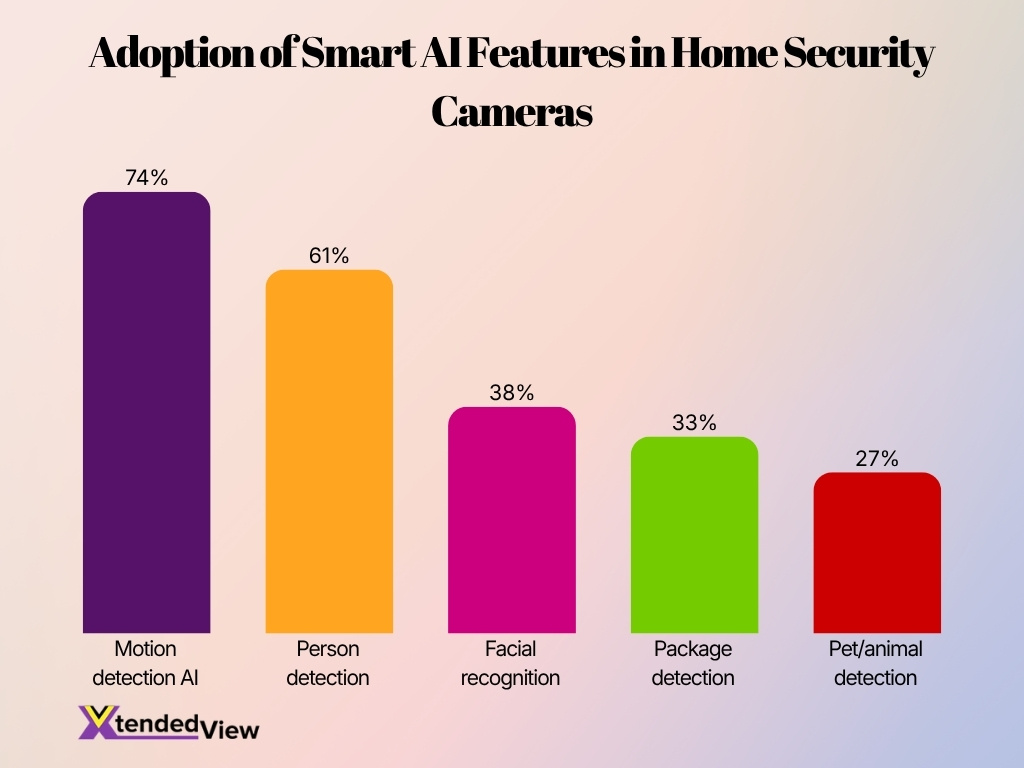
- Motion detection AI is the most widely adopted feature, used in 74% of security cameras, showing that automated activity alerts are now a core smart-camera capability.
- Person detection ranks second at 61%, highlighting strong demand for cameras that can distinguish humans from general movement.
- Facial recognition adoption stands at 38%, suggesting growing interest in identity-based security, though privacy concerns may limit wider usage.
- Package detection is used in 33% of cameras, reflecting the rising importance of doorstep monitoring and delivery protection.
- Pet/animal detection has the lowest adoption rate at 27%, making it a more niche feature compared with human- and motion-focused AI tools.
- The gap between motion detection AI (74%) and pet/animal detection (27%) shows that security-focused AI features are adopted more widely than convenience-based features.
- Overall, the data shows that AI in security cameras is mainly centered around motion alerts, human detection, and smarter home monitoring.
AI-Powered Home Security Camera Statistics
- The global smart surveillance cameras market is projected to reach 161.2 billion USD by 2032, growing at a CAGR of 10.7%.
- The global AI‑powered home security camera market reached 6.2 billion USD in 2024 and is expected to grow at around 17.4% CAGR through 2033.
- AI‑enabled analytics reduce false alerts by up to 90% compared with traditional motion‑based detection in home security cameras.
- Over 38% of U.S. households already own at least one connected security camera, with AI features becoming standard in 2025‑style models.
- More than half of the new smart camera models launched in 2025 include built‑in AI analytics and human or face detection capabilities.
- Edge AI processing is now present in over 60% of premium AI home cameras, reducing reliance on cloud‑only analysis and cutting latency.
- AI‑powered facial recognition is integrated into roughly 40–50% of high‑end home camera lines sold in North America and Asia‑Pacific.
- AI‑assisted cloud video search using keywords and object labels is used in over 70% of AI‑enabled smart camera apps launched since 2025.
- Homeowners using AI‑based anomaly detection report an average 30–40% improvement in real‑time intrusion visibility versus basic recording.
- Smart camera vendors now embed on‑device AI privacy controls in roughly 65% of new AI‑enabled models to limit external server data sharing.
Cloud Storage and Video Recording Usage
- The cloud camera market reached $20.1 million in 2026, growing at 14.5% CAGR to $52 million by 2033.
- 68% adoption of subscription-based cloud camera models among users in 2025.
- 38% of U.S. households owned at least one connected smart camera in 2025.
- Monthly cloud storage subscriptions cost $3–$15 per camera for brands like Eufy and Blink.
- H.265 compression reduced cloud bandwidth needs by 40–50% in smart cameras.The
- The VSaaS market hit $5.08 billion in 2025 with 19% CAGR through 2029.
- Cloud video retention typically 7–60 days based on subscription tiers.
- 4K cameras accounted for 45% of new smart camera deployments in 2025.
- AI analytics cuts false alerts by up to 90% in cloud-connected systems.
- Hybrid cloud-local setups led adoption trends for smart camera storage in 2026.
Most Commonly Stolen Items in Residential Burglaries
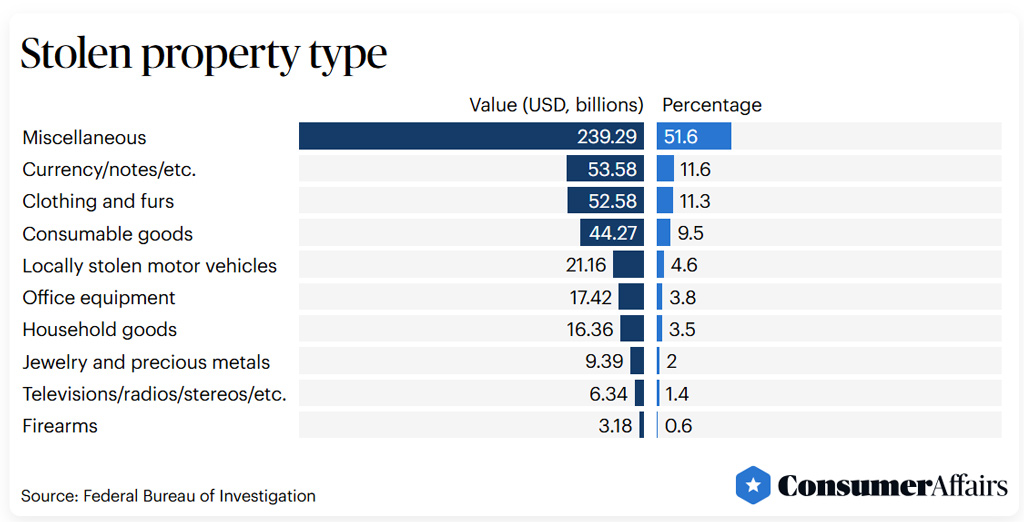
- Miscellaneous items dominate residential burglary losses, accounting for $239.29 billion in value and 51.6% of the total stolen property share.
- Currency, notes, and similar valuables are the second most commonly stolen category, representing $53.58 billion and 11.6% of stolen property.
- Clothing and furs make up a nearly equal share, with $52.58 billion in stolen value and 11.3% of the total.
- Consumable goods are another major burglary target, contributing $44.27 billion and 9.5% of stolen property value.
- Locally stolen motor vehicles account for $21.16 billion, representing 4.6% of total stolen property.
- Office equipment makes up 3.8% of stolen property, with losses valued at $17.42 billion.
- Household goods represent $16.36 billion in stolen value, equal to 3.5% of the total.
- Jewelry and precious metals, often considered high-risk burglary targets, account for $9.39 billion and 2.0% of stolen property.
- Televisions, radios, stereos, and similar electronics make up a smaller share, totaling $6.34 billion and 1.4%.
- Firearms have the lowest share among listed categories, valued at $3.18 billion and representing only 0.6% of stolen property.
- The top four categories, miscellaneous items, currency/notes, clothing and furs, and consumable goods, together account for 84.0% of stolen property, showing that burglary losses are highly concentrated in a few major item groups.
Home Security Camera Effectiveness and Crime Reduction
- Homes without security systems are 300% more likely to be burglarized.
- 50% of burglars avoid homes with visible outdoor cameras.
- 60% of convicted burglars skip properties with visible cameras or alarms.
- Neighborhoods with dense burglar alarms see fewer residential burglaries.
- 68% of homeowners feel safer with security cameras installed.
- Insurers offer up to 20% discounts for homes with monitored cameras.
- AI security cameras reduce false alarms by up to 90%.
- 34% of people use doorbell cameras to prevent package theft.
- CCTV in parking lots cuts crime by 51%.
- 61% of U.S. households now own at least one security camera in 2026.
Privacy and Data Security Concerns With Home Cameras
- Privacy concerns rank among the top barriers to smart camera adoption for U.S. consumers, with 37% worrying about footage access.
- 43% of security camera owners fear they’ve been hacked.
- 820,000+ IoT attacks targeted devices like IP cameras daily in 2025.
- 68.4% of cameras run outdated firmware vulnerable to exploits.
- 30% of users fail to change default passwords on IP cameras.
- 19% of camera users prefer local storage only for enhanced privacy.
- 49% opt for hybrid cloud-local storage amid data security worries.
- IP cameras and NVRs faced 19% of all exploits on IoT devices in 2025.
Leading Home Security Camera Brands and Market Share
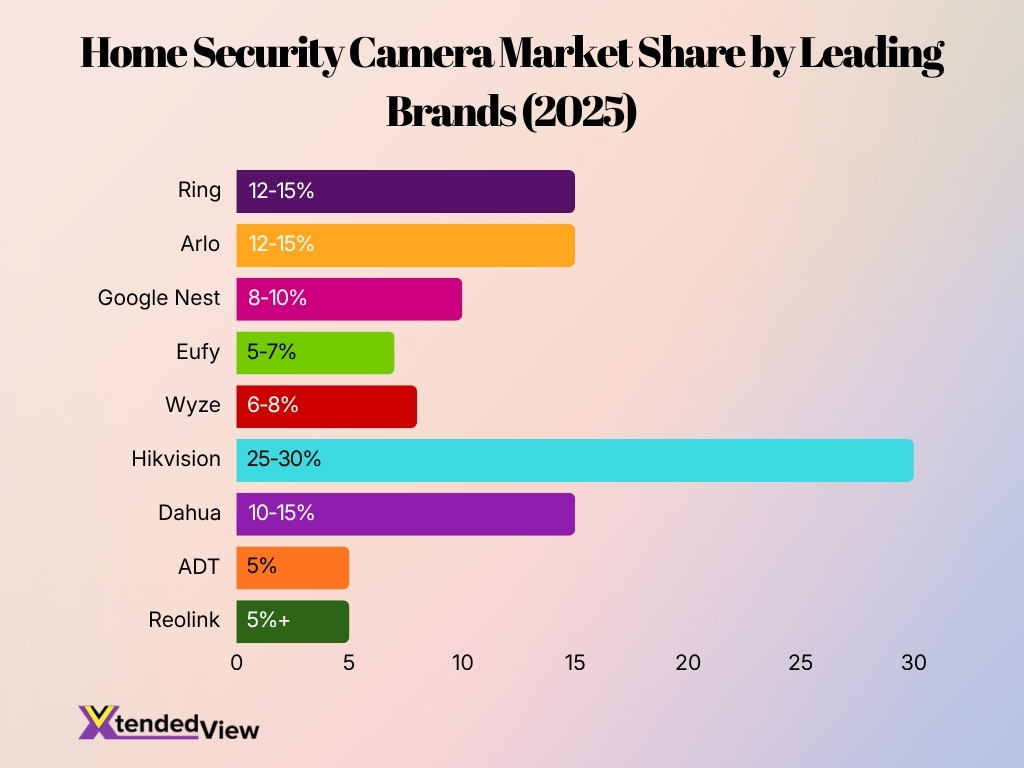
- Ring held roughly 12%–15% of the U.S. smart home camera market in 2025, ranking among the top consumer camera brands.
- Arlo captured an estimated 12%–15% share of the North American premium wireless camera segment in 2025.
- Google Nest accounted for about 8%–10% of global smart home camera shipments in 2025, driven by Google Home ecosystem adoption.
- Eufy represented roughly 5%–7% of North American smart camera sales in 2025, boosted by subscription‑free local‑storage demand.
- Wyze commanded approximately 6%–8% of the low‑cost smart camera market in North America during 2025.
- Hikvision held around 25%–30% of the global professional surveillance hardware market in 2025, especially in Asia and emerging economies.
- Dahua carried roughly 10%–15% of the global surveillance hardware market in 2025, trailing closely behind Hikvision.
- ADT’s smart camera‑linked security systems represented about 5% of total U.S. professionally monitored home security packages in 2025.
- Reolink secured over 5% of the U.S. solar‑powered and DIY outdoor security camera segment in 2025, driven by 4K solar models.
- Subscription‑free camera brands collectively grew to nearly 15% of 2025–2026 global smart home camera sales, up from under 10% in 2024.
Frequently Asked Questions (FAQs)
The global home security camera market is expected to reach $27.37 billion in 2026.
The smart home security camera market is projected to grow at a 19.22% CAGR from 2025 to 2034.
North America accounted for 41% of the global smart home security camera market share in 2024.
There are approximately 770 million surveillance cameras in use worldwide.
The smart home cameras market is forecast to grow at a 20.6% CAGR between 2024 and 2029.
Conclusion
Home security cameras have evolved from simple monitoring devices into connected smart home systems powered by AI, cloud computing, and mobile integration. Rising concerns around package theft, burglary prevention, and remote home management continue driving adoption across the U.S. and global markets. At the same time, advances in wireless technology, edge AI processing, and subscription-based ecosystems are reshaping how consumers interact with home surveillance products.
The statistics throughout this report show that demand for smart cameras, video doorbells, and AI-enabled monitoring tools will continue expanding. However, privacy concerns, cybersecurity risks, and cloud storage costs are also becoming more important purchasing considerations. As competition intensifies among leading brands, companies that combine security, privacy, affordability, and smart home compatibility are likely to lead the next phase of market growth.
