



Meetings play a central role in how modern organizations operate, shaping collaboration, decision-making, and execution across teams. Whether it’s a quick sync between remote colleagues, a client strategy session, or a cross-functional planning call, meetings directly influence how efficiently work gets done. However, as workplaces shift toward hybrid and remote models, the volume and complexity of meetings have increased significantly, often raising concerns about time management and productivity.
In the U.S. alone, professionals now spend a substantial portion of their workweek in meetings, making them one of the most resource-intensive business activities. From rising costs to growing employee fatigue, organizations are re-evaluating how meetings are structured and conducted. Understanding the latest meeting statistics helps uncover patterns, identify inefficiencies, and highlight opportunities for improvement. Let’s explore the most relevant meeting statistics and see what they reveal about the future of work.
Editor’s Choice
- Employees spend an average of 11.3 hours per week in meetings, accounting for nearly 28% of their workweek.
- Around 78% of U.S. workers attend at least 3+ hours of meetings weekly.
- The average employee spends 392 hours annually in meetings, equal to over 16 workdays.
- 71% of senior executives consider meetings unproductive or inefficient.
- Meetings cost the U.S. economy approximately $532 billion per year.
- Nearly 46% of workers attend 3 or more meetings daily.
- Knowledge workers spend 88% of their workweek on communication, including meetings and emails.
Recent Developments
- The average meeting duration dropped to 47 minutes in 2025, down from 51 minutes in 2023.
- Meetings scheduled after 8 PM increased by 16% year over year, reflecting global work patterns.
- About 57% of meetings are now spontaneous or ad hoc, without prior scheduling.
- The video conferencing market surpassed $10 billion in revenue in 2023 and continues growing.
- Meeting time has tripled since 2020, driven by remote and hybrid work.
- Employees lose an average of 6.5 minutes per meeting due to tech issues.
- Around 86% of remote workers use video conferencing weekly.
- 37% of meetings now exceed one hour, though this share is declining.
Time Spent in Meetings
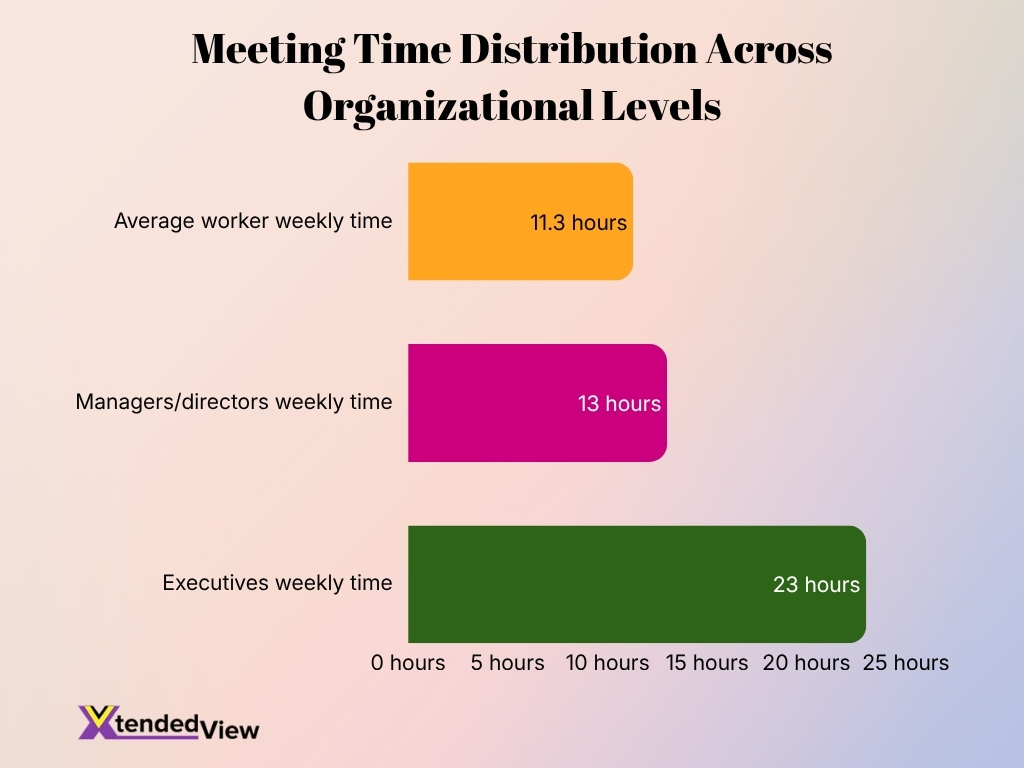
- The average worker spends 11.3 hours per week in meetings, a consistent 2024–2025 benchmark.
- Managers and directors spend 13+ hours weekly in meetings.
- Executives can spend up to 23 hours per week in meetings.
- 18% of employees spend more than 10 hours weekly in meetings.
- Nearly 1 in 10 workers exceeds 15 hours of meetings weekly.
- Employees spend an average of 35 hours per month in meetings.
- Organizations allocate about 15% of total time to meetings.
- Some workers report spending up to 23 hours per week in meetings in extreme cases.
Meetings Per Week
- Employees attend an average of 10.1 meetings per week.
- Workers in small companies average 12 meetings per week.
- Employees in large enterprises attend up to 18 meetings weekly.
- Around 59% of enterprise employees log 5+ meeting hours weekly.
- 90% of employees have fewer than 10 hours of meetings weekly, showing wide variation.
- Only 2% of workers exceed 20 hours of meetings per week.
- Distributed teams often have more frequent meetings than co-located teams.
- Meeting frequency has increased steadily since 2020 due to remote work adoption.
Daily Meeting Frequency
- 46% of employees attend three or more meetings daily.
- About 91% of managers attend between 1–5 meetings per day.
- Around 7% of managers attend more than five meetings daily.
- Approximately 60% of general staff attend one meeting or fewer per day.
- Sales professionals spend over 5 hours daily in meetings in many cases.
- Leaders are 3x more likely to spend 3+ hours daily in meetings compared to employees.
- Workers experience interruptions every 1.75 minutes, often tied to meeting-related communication.
- Roughly 10% of meetings are scheduled last-minute, increasing daily meeting density.
Meeting Length Breakdown Statistics
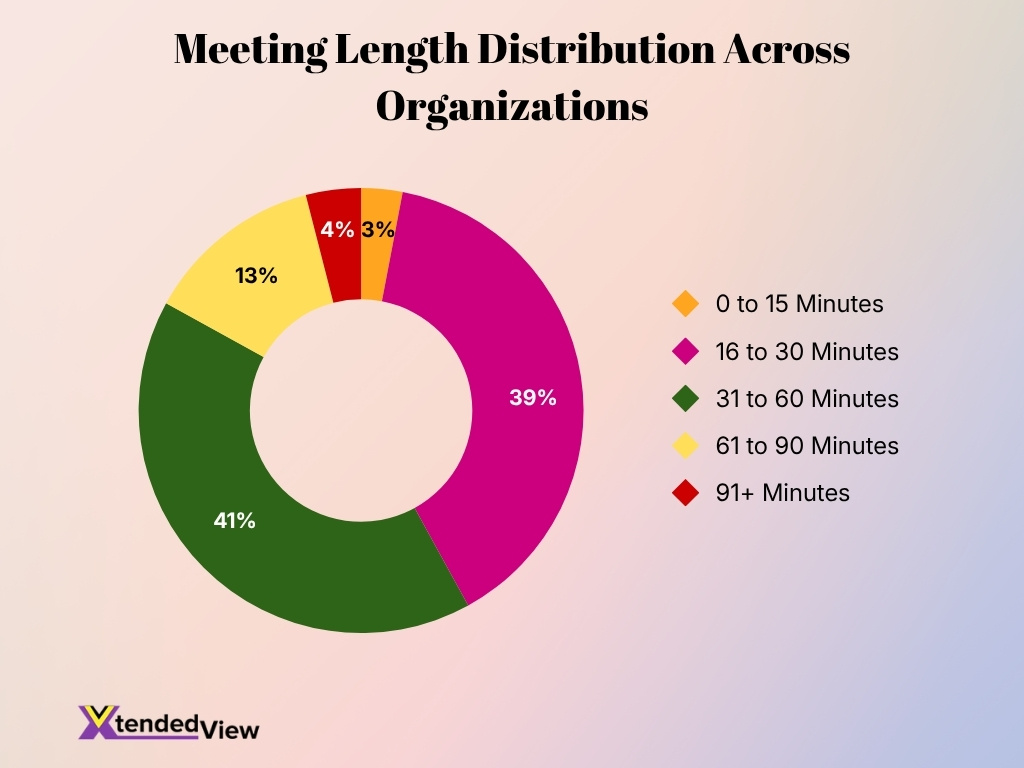
- The majority of meetings fall within the 31 to 60 minutes range (41%), making it the most common meeting duration across organizations.
- Shorter meetings of 16 to 30 minutes account for 39%, indicating a strong preference for concise and time-efficient discussions.
- Very short meetings (0 to 15 minutes) represent only 3%, suggesting that quick syncs or stand-ups are less commonly scheduled.
- Longer meetings lasting 61 to 90 minutes make up 13%, showing that a smaller portion of meetings require extended collaboration or deep discussions.
- Meetings exceeding 91+ minutes are rare (4%), highlighting that very long meetings are generally avoided in modern workflows.
- Overall, a significant 80% of meetings are under 60 minutes, emphasizing a clear trend toward shorter, more productive meeting formats.
- The data suggests organizations are prioritizing efficiency and time management, with most meetings clustered in the 30–60 minute window.
Meeting Scheduling Patterns
- 64% of meetings are scheduled within 24 hours, showing a shift toward reactive planning.
- Around 57% of meetings are ad hoc, often created without formal agendas.
- Nearly 70% of employees say unclear agendas reduce meeting value.
- Meetings booked back-to-back increased by 22% since 2020, contributing to burnout.
- About 35% of meetings are rescheduled at least once, impacting productivity.
- The average employee checks their calendar 8 times per hour due to scheduling pressure.
- 48% of professionals prefer scheduling tools like Calendly to reduce friction.
- Only 37% of meetings include a clear agenda, highlighting planning gaps.
- Early morning meetings (before 9 AM) increased by 13% year over year.
Virtual Meeting Statistics
- Over 86% of employees attend virtual meetings weekly, making them a standard practice.
- The global video conferencing market is projected to exceed $14 billion by 2027.
- Zoom accounts for over 55% of video conferencing usage in businesses.
- Around 67% of workers prefer video meetings over audio-only calls.
- Virtual meetings increased by over 300% since 2020, driven by remote work adoption.
- 42% of employees feel more comfortable speaking up in virtual meetings compared to in-person.
- However, 49% report video fatigue, especially in back-to-back sessions.
- The average virtual meeting includes 5–7 participants, slightly fewer than in-person meetings.
- Screen sharing is used in 78% of virtual meetings, indicating high collaboration levels.
Virtual Meeting Challenges
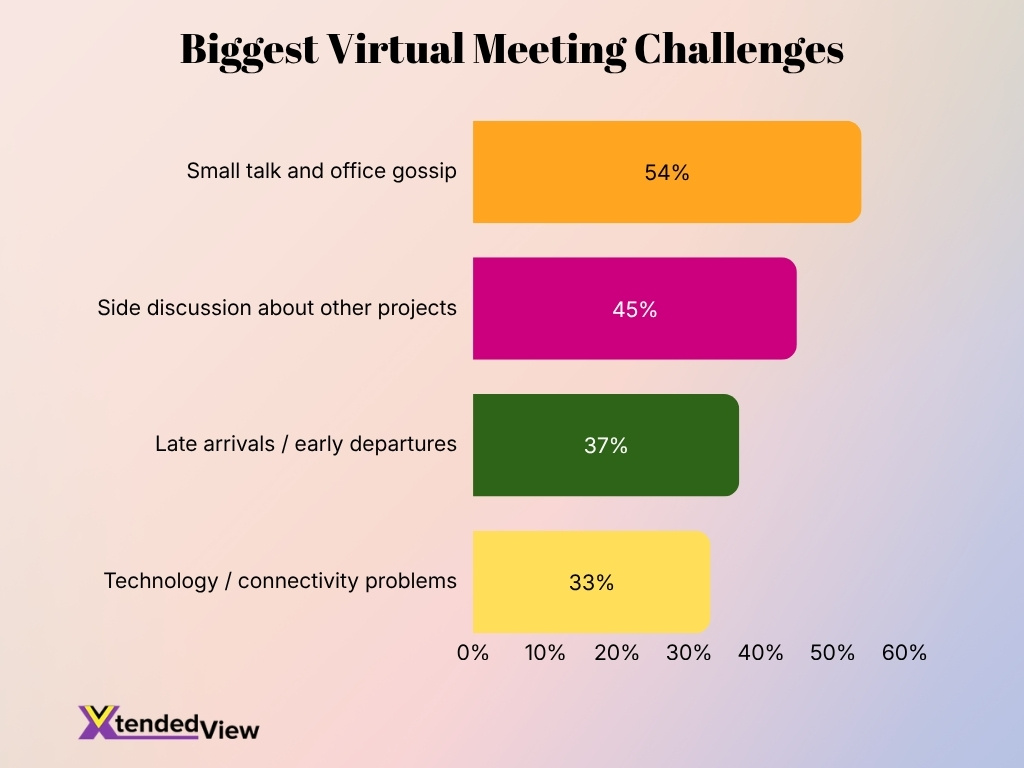
- Informal conversations dominate disruptions, with 54% of respondents citing small talk and office gossip as the biggest challenge.
- Nearly 45% of participants report side discussions about unrelated projects, indicating a lack of focus during meetings.
- Time discipline remains an issue, as 37% of respondents highlight late arrivals and early departures impacting meeting efficiency.
- Technical barriers still persist, with 33% experiencing technology or connectivity problems, affecting smooth communication.
- Overall, the data shows that behavioral distractions (54% + 45%) outweigh technical issues (33%), making human factors the primary concern in virtual meetings.
- These insights suggest that better moderation, structured agendas, and stricter meeting etiquette could significantly improve virtual meeting productivity.
Hybrid and Remote Meetings
- 58% of U.S. workers now operate in hybrid environments, blending remote and in-office work.
- Hybrid workers attend 12% more meetings than fully in-office employees.
- Remote teams rely on meetings for 32% more collaboration time than co-located teams.
- About 74% of companies plan to maintain hybrid work models long term.
- 61% of remote workers report more meetings than before the pandemic.
- Hybrid meetings often include 30% more participants due to distributed teams.
- Only 27% of hybrid meetings run without technical disruptions, highlighting setup challenges.
- Remote employees are 2x more likely to join meetings outside working hours.
- Companies using hybrid meeting tools report a 19% improvement in collaboration efficiency.
In-Person vs Virtual Preferences
- 72% of employees prefer hybrid meetings that combine in-person and virtual elements.
- Around 65% of executives prefer in-person meetings for decision-making.
- 59% of employees say virtual meetings save time, especially on commuting.
- In-person meetings are considered 34% more effective for relationship building.
- 48% of workers prefer virtual meetings for routine updates, citing convenience.
- Nearly 70% of teams use a mix of both formats, depending on meeting type.
- Employees report higher engagement in face-to-face meetings, especially for brainstorming.
- However, 52% say virtual meetings reduce unnecessary discussions.
- Travel-related meetings dropped by 40% compared to pre-2020 levels, reinforcing virtual adoption.
Factors Driving Unproductive Meetings
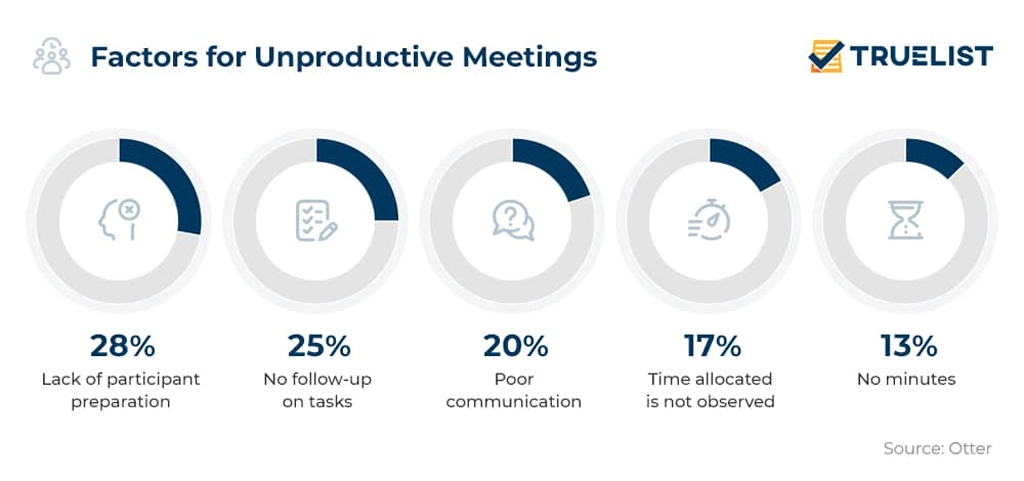
- The top reason for ineffective meetings is lack of participant preparation (28%), highlighting a major gap in pre-meeting readiness.
- No follow-up on tasks (25%) ranks second, showing that meetings often fail to translate into actionable outcomes.
- Poor communication (20%) affects 1 in 5 meetings, indicating issues with clarity, alignment, or engagement during discussions.
- 17% of meetings suffer because the allocated time is not properly observed, leading to inefficiency and wasted schedules.
- A notable 13% of meetings lack documented minutes, making it harder to track decisions and accountability.
- Overall, the data suggests that execution issues (preparation, follow-up, and documentation) are more impactful than structural ones.
- Combined, the top two factors (28% + 25% = 53%) show that over half of meeting inefficiency stems from poor preparation and lack of follow-through.
- These insights emphasize the need for better planning, clear communication, and structured post-meeting processes to improve productivity.
Meeting Productivity Rates
- Only 50% of meetings are considered productive by participants.
- 71% of executives say meetings are inefficient, signaling leadership concerns.
- Employees lose up to 31 hours per month in unproductive meetings.
- Meetings with clear agendas are 2x more likely to be productive.
- 67% of professionals say that too many attendees reduce effectiveness.
- Shorter meetings (under 30 minutes) improve productivity by 24%.
- Teams using structured meeting tools see a 20% productivity boost.
- 45% of employees leave meetings without clear action items, reducing impact.
- High-performing teams spend 30% less time in meetings than average teams.
Multitasking in Meetings
- 92% of employees multitask during meetings, including checking emails or messaging.
- Around 73% of professionals admit to doing unrelated work during meetings.
- Employees who multitask retain 40% less information from meetings.
- 69% of remote workers check emails during virtual meetings, reflecting divided attention.
- Multitasking increases when meetings exceed 45 minutes, reducing engagement.
- 58% of employees send messages during meetings, especially in hybrid settings.
- Workers who multitask report lower satisfaction with meetings overall.
- Multitasking contributes to missed action items in 35% of meetings.
- Teams with strict meeting rules reduce multitasking by 27%, improving outcomes.
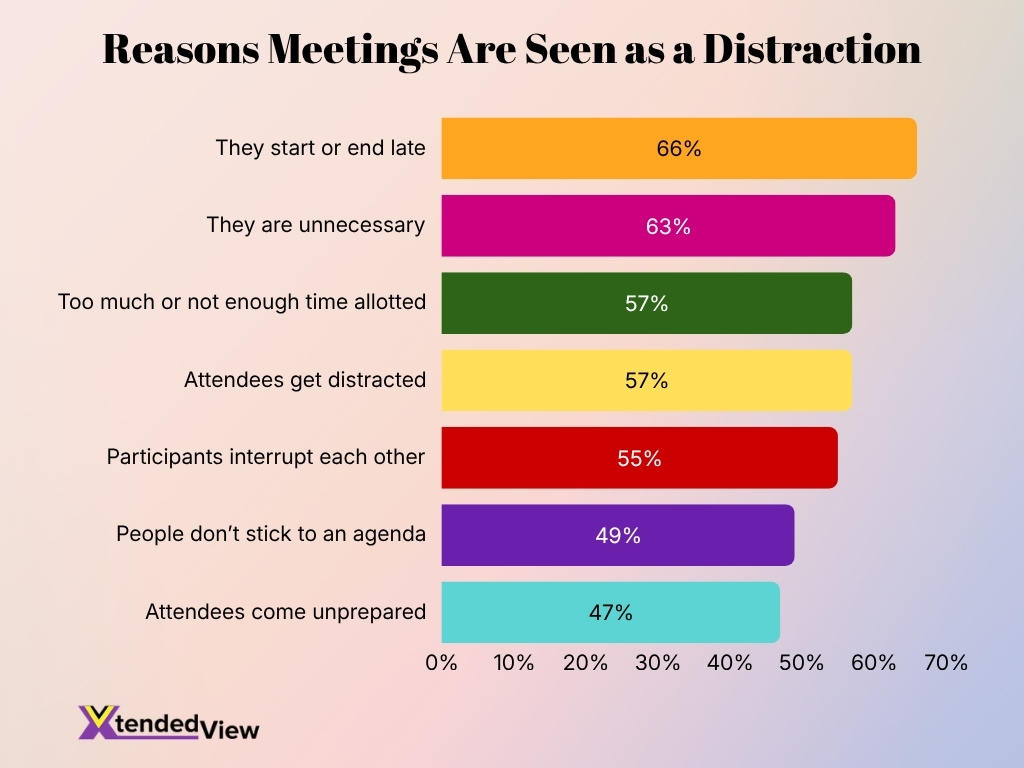
Why Meetings Are Considered a Distraction
- Poor time management is the biggest issue, with 66% of workers saying meetings start or end late, making them inefficient and disruptive.
- A significant 63% of employees believe meetings are simply unnecessary, highlighting a major gap in decision-making and meeting purpose.
- Time allocation problems affect 57% of workers, indicating meetings are either too long or too short, leading to reduced productivity.
- Another 57% report distraction during meetings, showing that engagement levels are low and focus is often lost.
- Interruptions are a common concern, with 55% of participants saying people talk over each other, disrupting communication flow.
- Nearly 49% of employees point out that a lack of adherence to an agenda makes meetings less structured and less effective.
- Unprepared attendees impact 47% of meetings, suggesting that insufficient preparation reduces the overall value and outcomes.
Meeting Effectiveness Metrics
- Only 37% of meetings achieve their intended goals, indicating widespread inefficiency.
- Meetings with a defined agenda are 2.5x more likely to deliver outcomes.
- Teams that assign clear action items see a 23% improvement in follow-through rates.
- 68% of employees say meeting effectiveness depends on leadership quality.
- Meetings that include fewer than 8 participants are 35% more effective than larger ones.
- Structured meeting formats reduce wasted time by 29%, especially in project teams.
- Only 41% of employees feel meetings are a good use of time, reflecting engagement gaps.
- Teams using collaborative tools improve meeting outcomes by 19%, particularly in hybrid setups.
- Regular feedback loops improve meeting effectiveness scores by 18% year over year.
Regional Meeting Differences
- U.S. professionals average an impressive 11.3 hours weekly in meetings, nearly a third of their workweek.
- European workers average around 9–10 hours weekly in meetings, aligned with shorter workweeks like the EU’s 36-hour average.
- Asia-Pacific employees lose 4.5 hours weekly due to ineffective meeting tech, indicating high meeting demands from coordination.
- Remote work adoption in North America reaches 32.5% of workdays at home, boosting virtual meeting frequency.
- In the U.K., 91% of workers say a third of each meeting wastes company time, higher than global norms.
- U.S. businesses view meetings as the biggest waste of time, deemed pointless 75% of the time, according to surveys.
- Nordic countries excel with 37–38-hour workweeks focused on efficiency, outpacing longer U.S. and Asian hours.
- Emerging markets like Asia-Pacific drive 29.3% CAGR in virtual meeting software, reflecting rapid digital adoption.
- Cross-time-zone meetings are 2.6 times more likely at odd hours than single-zone ones, complicating global schedules.
Financial Cost of Meetings
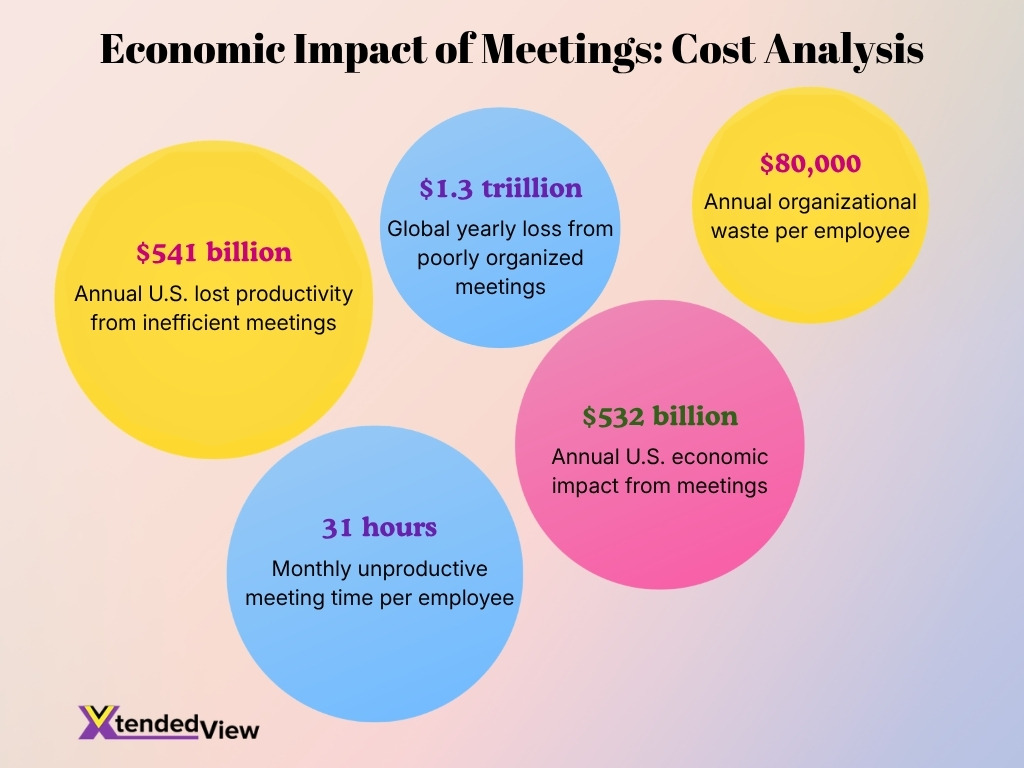
- Inefficient meetings cost U.S. businesses $541 billion annually in lost productivity.
- The global economy loses $1.3 trillion yearly due to poorly organized meetings.
- U.S. companies face a total $532 billion economic impact from meetings each year.
- Average employees lose 31 hours monthly to unproductive meetings, equating to massive costs.
- Organizations waste $80,000 per employee annually, factoring in all meeting-related expenses.
- Large enterprises lose up to $100 million yearly on unnecessary meetings.
- Knowledge workers spend 18 hours weekly in meetings, totaling $33,752 direct costs per person annually.
- 72% of meetings prove ineffective, costing businesses $400 billion yearly in the U.S.
- Gallup estimates $35 billion annual U.S. losses from time wasted in ineffective meetings.
Generational Meeting Preferences
- Gen Z employees prefer shorter meetings under 30 minutes, with 72% favoring concise formats.
- Millennials attend the highest number of meetings weekly, averaging 12–14 sessions.
- 65% of Gen Z workers prefer asynchronous communication over meetings.
- Baby Boomers show the highest preference for in-person meetings, at 58%.
- 54% of Millennials prefer hybrid meetings, balancing flexibility and collaboration.
- Gen X professionals report the highest dissatisfaction with meeting overload, at 49%.
- Younger employees are 2x more likely to multitask during meetings than older generations.
- 61% of Gen Z feel meetings lack purpose, compared to 45% of older workers.
- Cross-generational teams report 18% higher meeting friction, often due to communication style differences.
Future Meeting Trends
- AI-powered meeting tools are expected to grow at a CAGR of 14% through 2030.
- 75% of organizations plan to adopt AI meeting assistants by 2027.
- Automated note-taking tools reduce meeting admin time by 30%.
- Virtual reality meetings are projected to reach a $4.3 billion market value by 2028.
- Companies reducing meetings report 20–30% productivity gains, shaping future strategies.
- 68% of leaders plan to cut unnecessary meetings over the next two years.
- Hybrid-first policies will dominate, with over 70% of companies adopting flexible models.
- Asynchronous communication tools are expected to replace 25% of recurring meetings.
- Data-driven meeting analytics adoption is rising, improving outcomes by 22%.
Frequently Asked Questions (FAQs)
Employees spend an average of 392 hours per year in meetings, equivalent to about 10 full workweeks.
Around 60.3% of professionals report that meetings negatively impact their productivity.
Meetings cost the U.S. economy approximately $532 billion per year.
About 72% of meetings are deemed ineffective by participants.
Employees spend roughly 15% of their total work time in meetings.
Conclusion
Meeting culture continues to evolve as organizations strive to balance collaboration with efficiency in an increasingly digital workplace. While meetings remain essential for alignment, innovation, and decision-making, the data clearly shows that excessive or poorly structured meetings can drain time, reduce focus, and create unnecessary costs. This shift has pushed companies to rethink not just how often meetings occur, but also how they are designed and executed.
Forward-thinking organizations are already adopting smarter strategies, such as reducing meeting frequency, implementing clear agendas, leveraging AI-powered tools, and embracing asynchronous communication where possible. These changes not only improve productivity but also enhance employee satisfaction and engagement. As we move further and beyond, the companies that treat meetings as a strategic resource, rather than a default habit, will gain a measurable advantage in performance and efficiency.
