

Slack remains one of the most widely adopted workplace communication and collaboration platforms, serving 200,000+ paid customers and organizations across more than 150 countries. Its reach extends deep into the enterprise market, with 77 of the Fortune 100 using Slack to connect employees, coordinate projects and manage business communication. However, Slack now plays a much broader role than workplace messaging. Companies increasingly use the platform to connect business applications, automate repetitive processes, search organizational knowledge and bring AI agents directly into everyday workflows. Sales teams can work with CRM information inside conversations, while IT, customer service and operations teams can use workflows and integrations to move tasks forward without constantly switching applications.
With billions of messages and actions flowing through the platform each week, Slack has become an important layer of the modern digital workplace. These Slack statistics examine its users, revenue ecosystem, market share, engagement, enterprise adoption, integrations and competitive position.
Editor’s Choice
- Slack serves 200,000+ paying organizations, making paid-customer scale one of its clearest publicly disclosed adoption metrics in 2026.
- 77% of Fortune 100 companies use Slack, highlighting its continued relevance in large-enterprise collaboration.
- Slack users generate around 5.2 billion messages per week, a workload that illustrates the platform’s role in everyday business communication.
- Slack supports daily active users in more than 150 countries, giving it a global user footprint even though the company no longer publishes a current total daily active user figure.
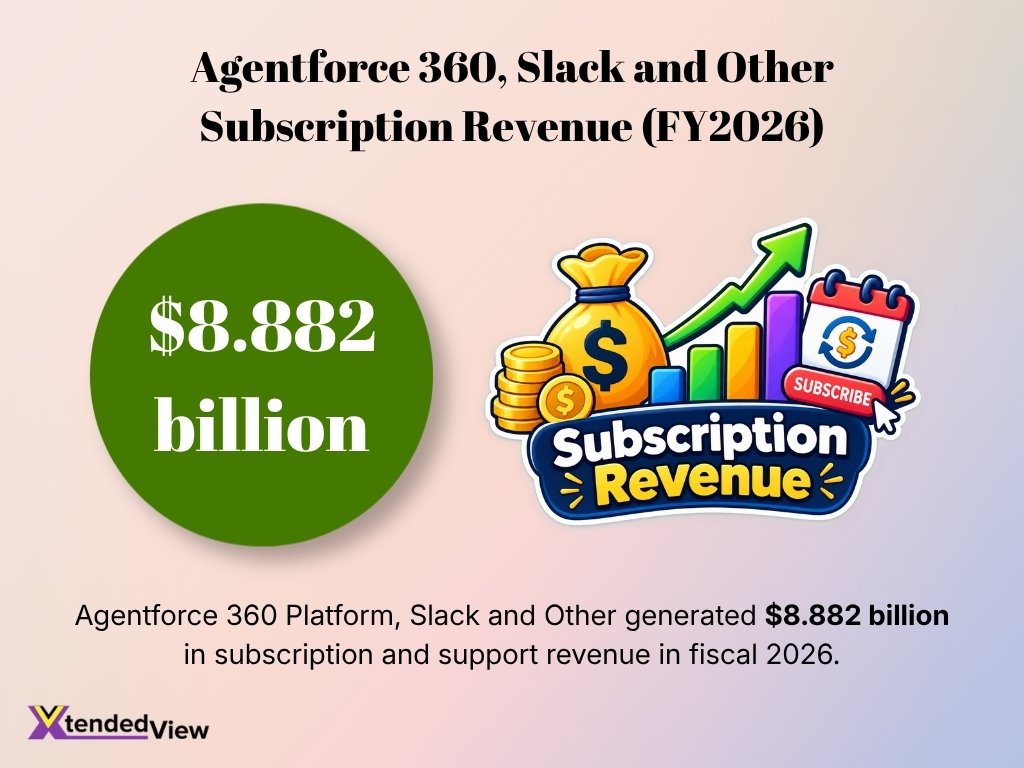
- The Agentforce 360 Platform, Slack and Other reporting category produced $8.882 billion in subscription and support revenue in fiscal 2026, compared with $7.247 billion in fiscal 2025. Importantly, this figure includes products other than Slack and should not be treated as Slack-only revenue.
- That reporting category increased by approximately 22.6% year over year on a reported-dollar basis in fiscal 2026, although $388 million of the fiscal 2026 total came from Informatica after its November 2025 acquisition.
- In Q1 fiscal 2027, the former Agentforce 360 Platform, Slack and Other category recorded 43% constant-currency growth, compared with 14% in Q1 fiscal 2026.
- Slack Model Context Protocol passed 1 million active users in six weeks, one of the clearest new Slack adoption metrics reported in 2026.
- By July 2026, Slack held a 1.06% popularity share and 1.39% spend share in one dataset tracking 769 collaboration and productivity products.
Recent Developments
- In January 2026, Slack introduced a rebuilt Slackbot positioned as a personal work agent that can draw on workspace and connected information to help users find information and complete tasks.
- By March 2026, Slackbot could use Salesforce data alongside conversations, files, connected apps and other authorized information to answer natural-language questions.
- Slack introduced a Salesforce Activity Timeline experience in 2026 that brings emails, calls, meetings and tasks into the Slack view of a customer record.
- The April 2026 feature cycle added or announced Slackbot actions for creating and updating Salesforce records, extending the agent from information retrieval to work execution.
- Slack also expanded Slackbot through Model Context Protocol, allowing the agent to take actions across compatible third-party applications. The MCP capability surpassed 1 million active users within six weeks.
- Slack’s 2026 roadmap added document, spreadsheet and presentation generation through Slackbot, reducing the need to move between separate productivity interfaces for some tasks.
- Voice commands and web search joined the announced Slackbot capabilities in 2026, broadening the ways employees can interact with the agent.
- Slack CRM expanded the product’s role for small businesses by allowing teams to create and update contacts, track leads and deals, and log customer activity from Slack conversations. In one 2026 rollout, Slack CRM came with the Business+ subscription at no additional cost.
- In India, a July 2026 small-business offering combined Slack, Agentforce Sales and Tableau with a stated implementation target of four to six weeks, showing how Slack is increasingly packaged within broader business software deployments.
Slack Revenue Statistics
- Agentforce 360 Platform, Slack and Other generated $8.882 billion in subscription and support revenue in fiscal 2026.
- The same category generated $7.247 billion in fiscal 2025, creating a year-over-year reported increase of about $1.635 billion.
- On a reported basis, category revenue therefore grew approximately 22.6% between fiscal 2025 and fiscal 2026.
- However, fiscal 2026 category revenue included $388 million from Informatica, so the reported growth rate overstates the organic comparison for the preexisting portfolio.
- Excluding that $388 million contribution for a rough like-for-like calculation, fiscal 2026 category revenue would have been approximately $8.494 billion, about 17.2% above fiscal 2025. This is a derived figure, not a separately reported Slack result.
- In the quarter ended Jan. 31, 2026, the category generated $2.655 billion, compared with $1.918 billion in the corresponding quarter a year earlier.
- For the first nine months of fiscal 2026, Agentforce 360 Platform, Slack and Other produced $6.227 billion, up from $5.329 billion during the comparable fiscal 2025 period.
- The reporting category recorded 37% constant-currency growth in Q4 fiscal 2026, up sharply from 19% in Q3 fiscal 2026.
- In Q1 fiscal 2027, the former reporting structure showed 43% constant-currency growth for Agentforce 360 Platform, Slack and Other. Because the category includes several products, that percentage should not be interpreted as Slack’s standalone revenue growth.
Slack User Statistics
- The clearest current customer measure is 200,000+ paid customers. This metric refers to paying organizations rather than individual users.
- Slack has daily active users in 150+ countries, indicating that its usage extends across North America, Europe, Asia-Pacific and other markets.
- 77 Fortune 100 companies use Slack, equivalent to more than three-quarters of the largest U.S. companies on the list.
- Current public materials do not provide a new exact platformwide daily active user total for 2026. The most reliable current disclosures instead emphasize paid customers, geographic reach, enterprise penetration and activity volume.
- Users collectively send 5.2 billion messages per week, demonstrating the scale of active communication occurring across Slack workspaces.
- At the current weekly rate, Slack handles an average of about 743 million messages per day. This is a calculated daily average, not a separately reported platform metric.
- Slack processes more than 300,000 messages per second at infrastructure scale, according to technical recruiting information describing the platform’s backend workload.
- Cumulative message volume has reached approximately 1.79 trillion messages, illustrating how much communication has passed through the service over its lifetime.
- Users perform approximately 2.65 billion actions per day in Slack, extending usage beyond message sending to reactions, workflows and other product interactions.
- Users collectively spend about 243 million minutes per week in Slack Huddles, equivalent to roughly 4.05 million hours of weekly audio and video collaboration.
Slack Growth Statistics
- Slack now has 200,000+ paid customers, providing a substantial installed base for expanding AI, automation, CRM and enterprise features.
- Slack Model Context Protocol surpassed 1 million active users within six weeks of launch in 2026, signaling rapid early adoption of its AI connectivity layer.
- Across Agentforce and Slack, 3.8 billion Agentic Work Units had been delivered by Q1 fiscal 2027, representing 111% quarter-over-quarter growth.
- The former Agentforce 360 Platform, Slack and Other category posted 43% constant-currency growth in Q1 fiscal 2027, compared with 14% in Q1 fiscal 2026.
- In fiscal 2026, the same category recorded 22% constant-currency growth for the full year, compared with progressively faster quarterly rates of 14%, 16%, 19% and 37%.
- The category’s reported subscription and support revenue rose from $7.247 billion to $8.882 billion between fiscal 2025 and fiscal 2026, although the latter figure includes a partial-year Informatica contribution.
- Slack’s AI ecosystem has reached approximately 38,000 launched AI apps, expanding the number of AI-enabled tools employees can bring into their Slack workflows.
- AI workflow activity has reached about 148 million uses per month, providing a usage-based indicator of Slack’s transition from messaging toward automated work.
- In an internal enterprise deployment that began in February 2025, Agentforce in Slack reached 86% employee adoption after six months of testing and refinement and was projected to save more than 500,000 employee hours annually.
- More broadly, a 2025 survey of over 5,000 desk workers found workplace AI use increased from 36% in November 2024 to 60% in April 2025. This trend provides context for Slack’s 2026 push toward AI agents and AI-driven workflows rather than serving as a direct Slack user-growth measure.
Slack Market Share Statistics
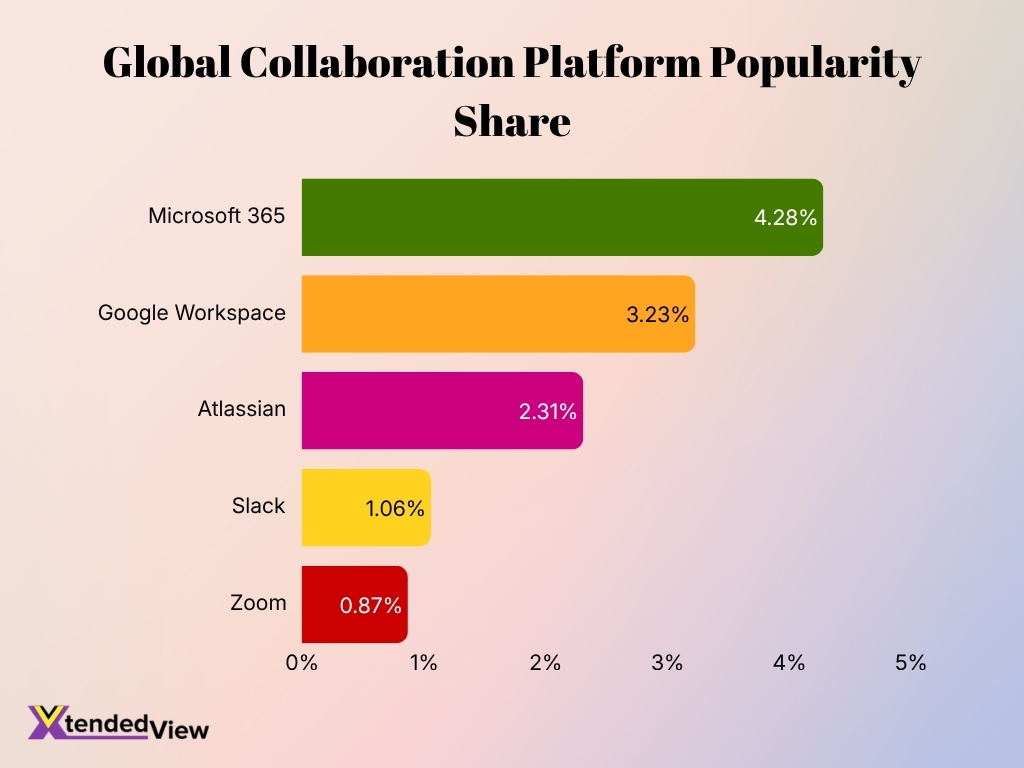
- As of July 31, 2026, Slack held approximately 1.06% of popularity share across a dataset covering 769 collaboration and productivity products.
- Slack’s share of spending in the same dataset reached 1.39%, exceeding its popularity share by 0.33 percentage points.
- Slack ranked No. 11 by popularity across the tracked collaboration and productivity products.
- It also ranked No. 11 by spending, indicating similar relative placement for customer presence and software expenditure in the dataset.
- Microsoft 365 held a 4.28% popularity share in the same dataset, roughly four times Slack’s 1.06% share.
- Google Workspace held a 3.23% popularity share, about three times Slack’s measured share.
- Atlassian held 2.31% of popularity share, approximately 2.2 times Slack’s 1.06% share.
- Slack nevertheless ranked ahead of Zoom by this popularity measure: Zoom accounted for 0.87%, compared with Slack’s 1.06%.
- Slack’s 1.39% spending share also exceeded Zoom’s 1.02% spend share, a difference of 0.37 percentage points.
- Enterprise penetration offers a different view of Slack’s competitive position: 77 of the Fortune 100 use the platform, showing that broad enterprise adoption can coexist with a smaller share across a very large, fragmented productivity-software category.
Slack Engagement Statistics
- Slack users generate more than 5 billion messages every week, showing that the platform remains deeply embedded in day-to-day workplace communication.
- Users perform roughly 15 billion actions per week, including sending messages, creating channels, sharing files, starting huddles and reacting to posts.
- Slack reports around 1.7 million apps actively used each week, showing that engagement extends well beyond messaging into connected business workflows.
- Employees using AI features in Slack save an average of 97 minutes per week, according to current customer productivity measurements.
- A survey of 1,456 weekly users found teams worked 35% faster after adopting Slack. The survey covered users in the U.S., U.K., Australia and Canada.
- The same research found Slack teams exchanged 60% fewer emails, indicating that channels and direct messages can replace a meaningful portion of internal email traffic.
- Respondents also reported 39% fewer meetings, suggesting asynchronous conversations and huddles can reduce dependence on scheduled calls.
- Slack users historically spent more than 90 active minutes per workday in the platform. While this measure predates 2026, it remains one of the latest publicly disclosed companywide active-time benchmarks.
- Current customer benchmarking reports that 85% say Slack improves communication, while 47% report feeling more productive.
Slack Mobile Usage Statistics
- A recent deployment found more than 60% of pilot users accessed Slack on mobile devices.
- During that same rollout, nearly 90% of employees utilized the desktop application.
- Historical benchmarks show more than 1 billion actions occurring weekly on mobile platforms.
- Total weekly platform activity during that historical baseline stood at 5 billion actions.
- Mobile interactions historically accounted for more than 20% of all weekly platform actions.
- The supported Slack Android application currently requires Android 11 or later.
- Slack reports active daily usage spanning across 150+ countries globally.
- Current companywide platform activity reaches approximately 15 billion actions each week.
Slack Adoption by Company Size
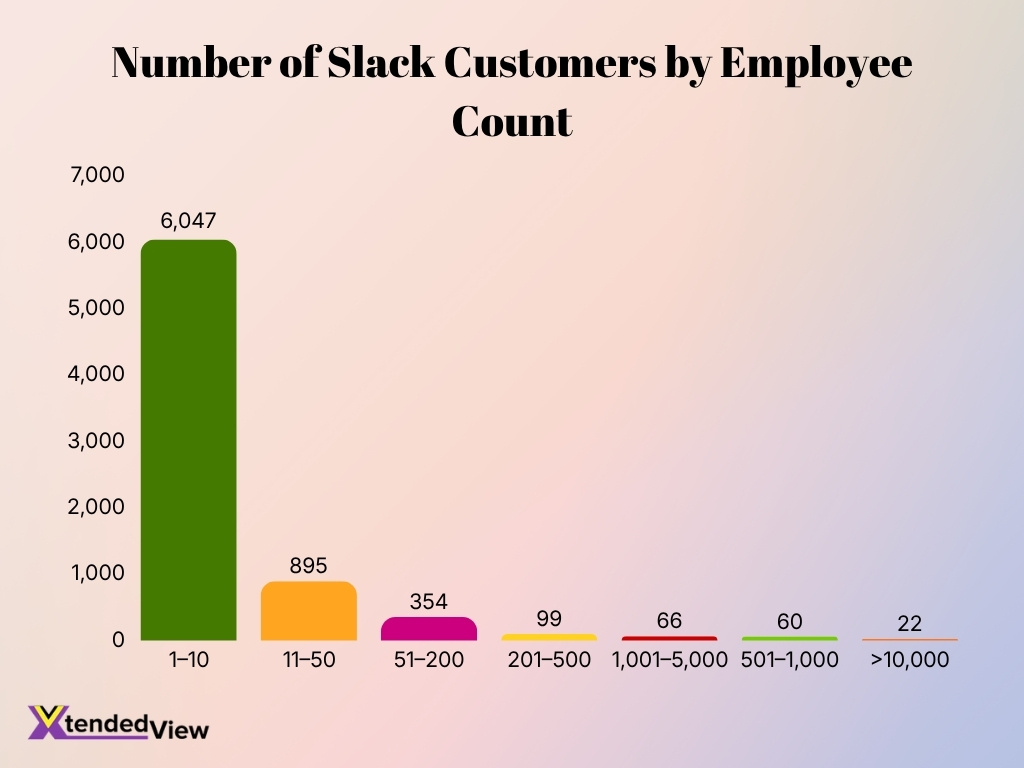
- Businesses with 1–10 employees represent 80.1% of companies in one 2026 enriched web-detection sample covering 7,598 Slack-using organizations.
- The dataset identifies 6,047 companies with 1–10 employees, making microbusinesses its largest segment by a wide margin.
- Companies with 11–50 employees account for 895 customers, or about 11.85% of the analyzed organizations.
- Businesses employing 51–200 people account for 354 detected customers, equal to about 4.69% of the enriched sample.
- The same dataset identifies 99 companies with 201–500 employees, 60 with 501–1,000 employees and 66 with 1,001–5,000 employees.
- At the upper end, the dataset includes 22 organizations with more than 10,000 employees, confirming that Slack usage spans both microbusiness and enterprise environments.
- A roughly 50-employee manufacturing company moved nearly all asynchronous communication, operational updates and business decisions into Slack within months of its September 2025 companywide rollout.
- A small-business customer facing rapid expansion hired 100 people in 100 days with 1.5 recruiters while coordinating much of the hiring workflow through Slack and AI automation.
- A medium-size technology company began its implementation with a 100-user proof of concept, and about 80% of its executive team participated in the four-week pilot.
- At enterprise scale, one automotive company expanded from 16,000 Slack users to 96,000 in nine months, showing that adoption can scale rapidly after an initial deployment.
Slack Enterprise Statistics
- 77 of the Fortune 100 currently use Slack, giving the platform adoption across more than three-quarters of the largest U.S. corporations.
- Slack reports 200,000+ paid customers, which provides a broad commercial base that includes startups, midsize businesses and major enterprises.
- Current enterprise customer metrics indicate 94% achieve a positive ROI from Slack.
- Enterprise customer measurements also show a 33% reduction in time spent in meetings, highlighting the role of channels, huddles and asynchronous collaboration in reducing scheduled calls.
- Customers report an 82% improvement in cross-functional collaboration, an important enterprise metric for organizations with multiple business units and geographically distributed teams.
- One 250,000-plus-employee enterprise generates an average of 9.2 million Slack messages each day and operates more than 10,000 Slack workflows and applications.
- One global automotive enterprise expanded its Slack population by 500%, from 16,000 to 96,000 users in nine months, while employees sent more than 2 million Slack messages on an average workday.
- In a medium-size enterprise pilot, 83% of users said Slack made it easier to find people and information, while 72% reported better access to companywide information.
- That same organization already operates more than 200 integrations inside Slack, showing how enterprise deployments often use the platform as a connective layer across existing software rather than as a stand-alone messaging system.
- Enterprise AI adoption is accelerating as well: the number of agents deployed in Slack grew 800% during 2025, while users had added almost 100,000 agents to the platform by the time the figure was disclosed.
Slack Free vs Paid Users Statistics
- Slack reports over 200,000 paid customers globally in 2026, representing organizations rather than individual seats.
- The Free plan costs $0 and restricts users to only the most recent 90 days of searchable message history.
- Data older than 1 year is permanently deleted in a Free workspace, creating a massive retention gap versus paid tiers.
- Free workspacesare capped at a maximum of 10 app integrations, whereas paid plans offer extensive app connectivity.
- The Free tier strictly limits huddles to 1-to-1 conversations, while all paid subscriptions support larger group huddles.
- Free userscan only send 1-to-1 external messages, while paid plans extend external collaboration to group conversations.
- Upgrading to a Pro workspace allows teams to retrieve up to 12 months of older data that hasn’t reached deletion limits.
- Paid workspaces retain 100% of data for the entire lifetime of the workspace by default unless custom retention periods are set.
- Slack currently features 4 primary subscription levels, which include Free, Pro, Business+, and Enterprise+.
Slack Geographic Statistics
- Slack reports daily active users across more than 150 countries, making international adoption a core part of the platform’s customer footprint.
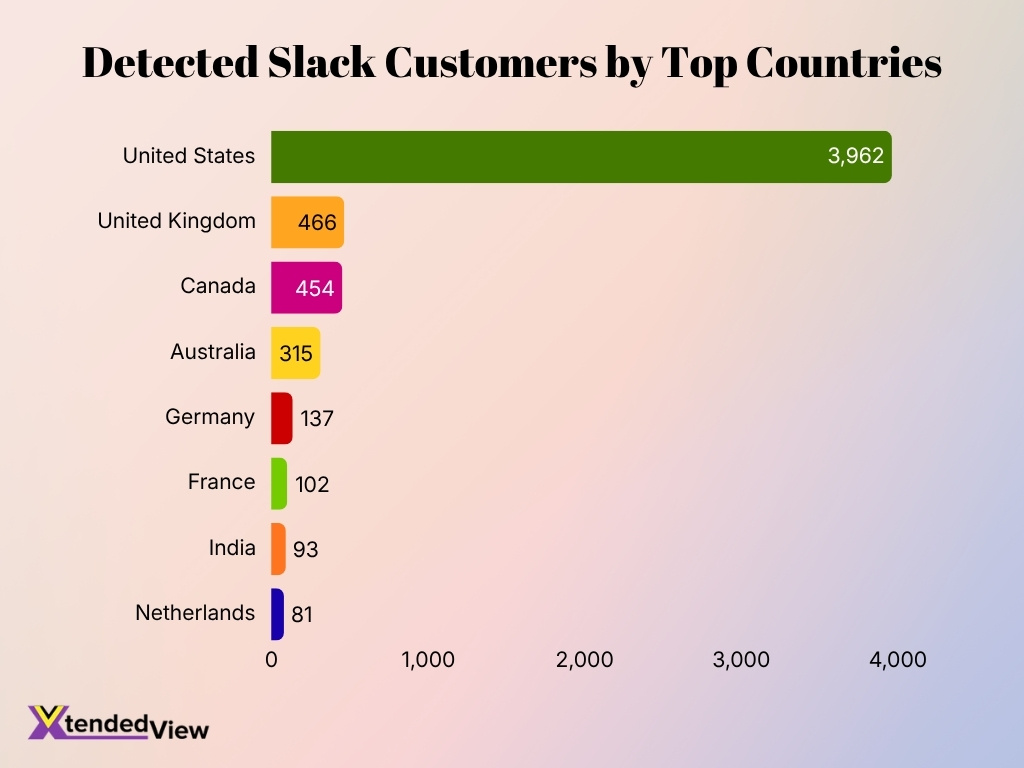
- In one 2026 enriched company sample, the United States accounted for 3,962 detected customers, the largest total among tracked countries.
- The United Kingdom ranked second with 466 detected organizations in the same geographic dataset.
- Canada followed closely with 454 companies, demonstrating a substantial North American footprint outside the U.S.
- Australia accounted for 315 detected customers, placing it fourth among the countries included in the dataset.
- Germany recorded 137 companies, while France accounted for another 102, giving Slack a measurable presence across major European economies.
- India contributed 93 detected organizations, while the Netherlands accounted for 81 in the same sample.
- English-speaking markets collectively represented more than 71% of the enriched customer sample, underscoring Slack’s particularly strong penetration in the U.S., U.K., Canada and Australia.
- Another large-scale technology-adoption dataset estimates that 66.2% of its detected Slack customers are in the United States, 8.59% are in the U.K. and 5.55% are in Canada. Different sampling methods explain why these percentages differ from other datasets.
- Slack’s geographic reach also supports major regional operators: one Southeast Asian customer with more than 10,000 employees uses Slack while serving roughly 1 in 20 of the region’s 700 million residents.
Slack App Integration Statistics
- Slack offers more than 2,600 apps and integrations through its current marketplace.
- Around 1.7 million integrated apps are used each week across the platform, demonstrating that integrations form a regular part of user activity.
- Free workspaces can install up to 10 integrations, creating a clear functional boundary between the Free tier and paid subscriptions.
- Slack supports integrations with widely used business systems including Google Drive, Microsoft 365, Jira, Salesforce and Zoom.
- Users can build custom workflows through Workflow Builder, while developers can create custom applications through the Slack API when the 2,600+ available integrations do not cover a company’s internal process.
- Slack’s AI ecosystem now includes agents and applications from companies such as Anthropic, Google, Perplexity and Writer.
- A single enterprise customer has built or deployed more than 10,000 workflows and apps, showing how integration volume can scale far beyond off-the-shelf installations in large organizations.
- One European technology company uses 193 apps and integrations inside its workspace alongside 325 workflows and thousands of daily huddles.
- In March 2026, Slack expanded its developer platform with a real-time search API and a Model Context Protocol server, giving AI applications controlled access to conversational context.
- Slack’s integration ecosystem is roughly 260 times larger than the Free plan’s 10-app allowance, which helps explain why integration-heavy companies often need paid subscriptions.
Slack Message and Activity Statistics
- Users now send more than 700 million messages each day across Slack.
- At that daily rate, users produce more than 4.9 billion messages per week. This is a calculated seven-day equivalent based on the reported daily figure.
- Maintaining a 700 million-per-day rate for a full year would equal more than 255 billion messages annually, illustrating the scale of Slack’s communication infrastructure.
- Slack users also run nearly 3 million workflows per day, moving platform activity beyond conventional chat.
- Three million daily workflows translate to roughly 21 million workflow runs per week if activity remains at a similar rate.
- At one European technology company, approximately 4,300 employees send more than 155,000 Slack messages per day, or about 36 messages per employee.
- Around 43,000 of those 155,000 daily messages appear in public channels, equal to roughly 28% of its total message activity.
- The same company’s employees use approximately 5,900 Slack huddles on a typical day, alongside 2,500 public channels.
- Its workspace also operates around 700 Slack Connect channels, demonstrating how message activity can extend beyond internal employees to customers and external partners.
- Slack’s broader platform activity spans users in more than 150 countries, meaning hundreds of millions of daily messages move across a geographically distributed user base.
Slack Customer Statistics
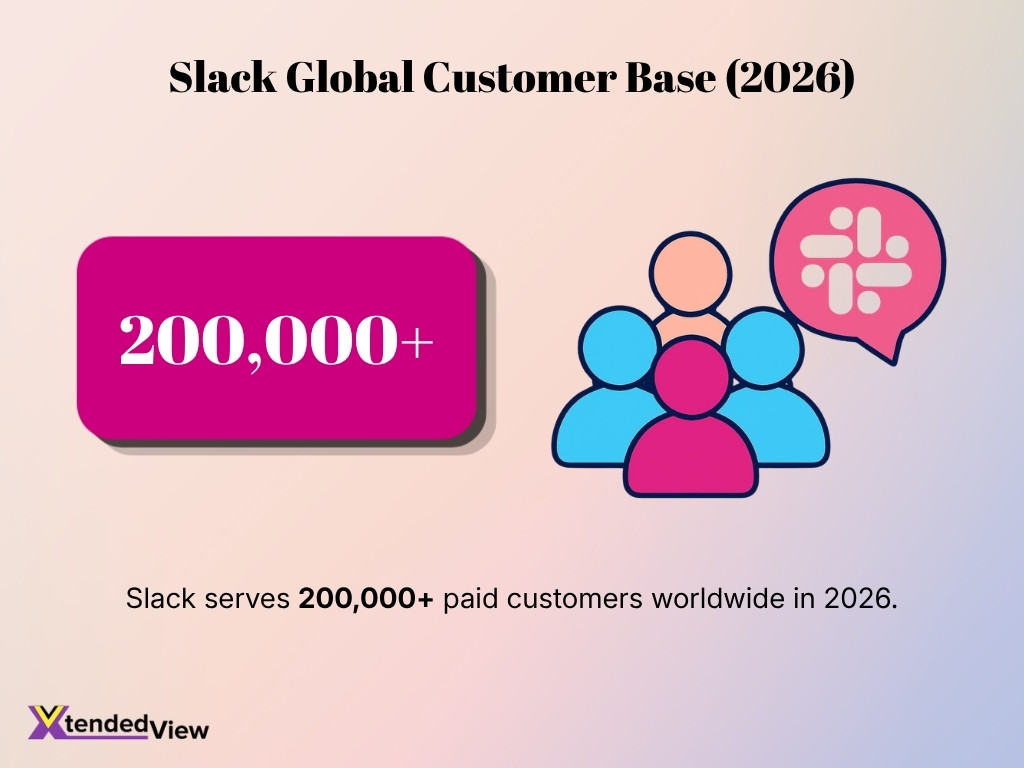
- Slack serves 200,000+ paid customers worldwide in 2026.
- 77 of the Fortune 100 use Slack, equal to 77% of the largest U.S. corporations represented on the list.
- Customer usage extends to 150+ countries with daily active users, giving Slack substantial reach outside the U.S. market.
- Current customer analysis reports that 94% achieve positive ROI from their use of Slack.
- Slack customers report a 36% improvement in project completion time, connecting adoption with faster project execution.
- Customers also report a 33% decrease in time spent in meetings, suggesting that asynchronous messaging and channels can replace some scheduled collaboration.
- A modeled customer organization in an economic-impact analysis achieved 325% ROI over three years, alongside a 16% reduction in issue-resolution time.
- The same analysis recorded a 15% increase in customer satisfaction, indicating that internal collaboration improvements can also influence external service outcomes.
- One health care organization reported 459% ROI, a 30% improvement in efficiency and patient satisfaction, and savings exceeding £1.5 million after integrating Slack into its workflows.
- An Australian retailer increased customer satisfaction from roughly 58% to more than 90% while cutting resolution time from five days to 24 hours through Slack-based customer support collaboration.
Slack Remote Work Statistics
- Fully remote U.S. job postings rose from 10% in Q1 2023 to 15% in Q4 2024, a 5-percentage-point increase heading into 2025.
- A global study found 58% of knowledge workers operating under hybrid arrangements, illustrating the scale of the workforce model that collaboration platforms support.
- Earlier Future Forum research found 72.2% of knowledge workers preferred a hybrid remote-office model, while only 11.6% wanted full-time office work.
- Another global workforce survey found 63% wanted hybrid work, 20% preferred fully remote work and only 17% wanted to return to the office full time.
- In a later survey, 34% of knowledge workers were working from an office five days per week, the highest proportion recorded since the research program began in 2020.
- Even among workers called back full time, 55% said they would prefer at least some flexibility, showing that physical office attendance does not necessarily reflect employee preference.
- Employees dissatisfied with their flexibility were three times as likely to look for another job during the following year.
- Full-time office workers recorded 28% worse work-related stress and anxiety scores in one quarter, while work-life balance scores declined 17%.
- Slack customers report spending 33% less time in meetings, a relevant outcome for remote and hybrid teams that need alternatives to continuous video calls.
- At a distributed Australian retailer, asynchronous Slack collaboration helped reduce customer-resolution times from five days to 24 hours, providing a practical example of remote teams working across time zones.
Slack Adoption by Industry
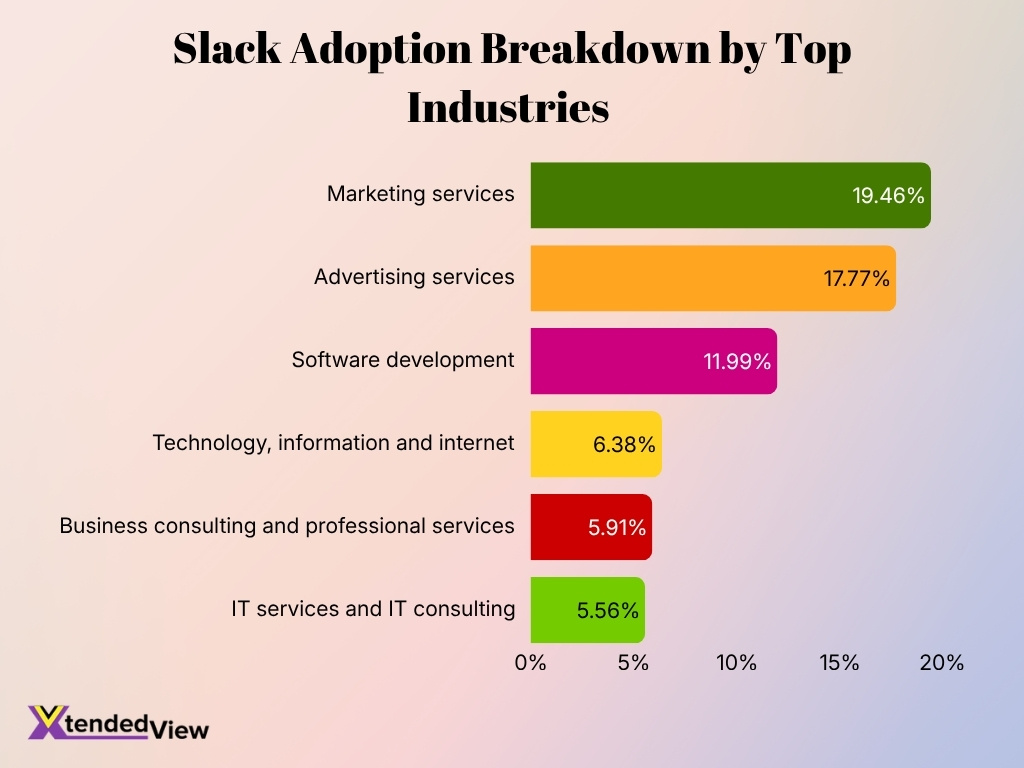
- Marketing services represent 19.46% of companies in one 2026 enriched Slack adoption dataset, making marketing the largest measured industry category.
- Advertising services account for another 17.77% of detected companies, placing advertising second in the same industry breakdown.
- Software development accounts for 11.99% of measured Slack customers, confirming strong adoption among engineering-led and software businesses.
- Technology, information and internet businesses represent 6.38% of the analyzed customer base.
- Business consulting and professional services make up 5.91% of detected Slack-using organizations.
- IT services and IT consulting account for another 5.56%, demonstrating substantial adoption among companies that manage digital infrastructure and enterprise technology projects.
- In health care, a measured customer-value study associated Slack usage with 28% faster average ticket-resolution times, showing how collaboration software can support operational workflows beyond technology companies.
- In automotive manufacturing, one major enterprise expanded Slack adoption from 16,000 to 96,000 users within nine months in 2025, a sixfold increase.
- In technology services, a 250,000-plus-employee enterprise sends roughly 9.2 million Slack messages per day and has created more than 10,000 workflows and apps.
- In manufacturing, one roughly 50-employee U.S. company rolled Slack out companywide in September 2025, illustrating adoption among smaller industrial businesses as well as large digital enterprises.
Slack vs Competitors Statistics
- Slack reports 200,000+ paid organizations, while its strongest enterprise adoption figure shows usage at 77 of the Fortune 100.
- Slack currently offers 2,600+ third-party integrations, giving it a broad ecosystem for companies that use software from multiple vendors.
- Around 1.7 million integrated apps are actively used each week, providing an activity-based measure of that ecosystem rather than simply counting available listings.
- In a comparative workplace survey, 65% of Slack users said they felt empowered to make strategic decisions, compared with 46% of Microsoft Teams users and 48% of employees primarily using email.
- The same research found 67% of Slack users felt they had the right leadership, compared with 55% among Microsoft Teams users and 54% among email users.
- 74% of Slack users said they had the tools needed to succeed at work, compared with 58% of workers relying primarily on email.
- Slack’s current customer metrics report 36% faster information retrieval, an important competitive consideration as workplace collaboration tools expand into enterprise search and AI.
- Slack customers report a 94% positive ROI rate, providing a commercial performance measure beyond raw user totals.
- Microsoft disclosed more than 30 million monthly active users for Teams Phone and over 375,000 customers in 2025. This figure applies specifically to Teams Phone, not the entire Microsoft Teams user population, so it should not be compared directly with Slack’s paid-customer count.
- In 2026, Slack and Microsoft Teams both support messaging, meetings, mobile access and AI, but their ecosystems differ: Slack emphasizes cross-vendor integrations and channels, while Teams remains closely integrated with Microsoft 365.
Frequently Asked Questions (FAQs)
Slack has more than 200,000 paid customers, while 77 of the Fortune 100 use the platform.
Users send approximately 700 million Slack messages per day, equivalent to about 4.9 billion messages per week.
Users run approximately 3 million workflows per day, reflecting Slack’s growing role in workplace automation.
Slack offers more than 2,600 apps, while approximately 1.7 million apps are actively used across Slack each week.
Slack’s Model Context Protocol surpassed 1 million active users within six weeks of its launch.
Conclusion
Slack enters the year as more than a workplace messaging application. With 200,000+ paid customers, usage across 77 of the Fortune 100 and daily active users spanning more than 150 countries, the platform maintains a substantial presence among businesses ranging from small teams to multinational enterprises. More than 700 million messages per day, millions of daily workflows and thousands of available integrations show that Slack supports both communication and increasingly complex business processes.
At the same time, Slack’s direction is shifting toward AI-assisted work, automation and connected enterprise data. Slackbot, AI agents, Model Context Protocol support and deeper Salesforce connections are designed to help employees find information and complete tasks without moving between multiple applications. That shift matters as businesses look for ways to reduce meetings, accelerate information retrieval and automate repetitive work.
Competition from Microsoft Teams and other collaboration products remains significant. Still, Slack’s 2,600+ app and integration ecosystem, enterprise penetration and emphasis on cross-platform workflows give it a distinct position in the workplace software market. The statistics ultimately point to a platform evolving from a communication tool into a broader work environment where conversations, applications, organizational knowledge, automation and AI increasingly operate together.