

Social media recruitment has moved from an optional sourcing tactic to a standard part of talent acquisition. 59% of HR professionals report using social media as a recruiting strategy, up from 55%. Employers now use social networks to source candidates, communicate their workplace culture and reach people who may not visit traditional job boards.
The impact extends beyond posting vacancies. For example, recruiters use professional networks to identify candidates by skills, while consumer-focused platforms help restaurants, retailers, health care organizations and other employers reach local and younger workers. At the same time, candidates use social profiles to research employers, demonstrate professional expertise and discover opportunities before submitting an application. The statistics below show how social recruiting is changing hiring.
Editor’s Choice
- 59% of HR professionals used social media for recruiting in 2026, making it the most frequently reported recruiting strategy. However, HR professionals ranked it ninth for effectiveness in filling vacancies.
- In comparison, 55% of organizations used social media to connect with potential candidates in 2025. The four-percentage-point increase indicates that employer adoption continued to expand entering 2026.
- 64% of recruiting executives expect their organizations to increase social media use in recruiting strategies during 2026. The same percentage expects greater emphasis on communicating organizational culture in job descriptions and advertising.
- More than 66 million job seekers visit LinkedIn Jobs each week, creating a large pool of active candidates for employers and recruiters.
- LinkedIn recorded approximately 11,000 job applications every minute in its 2025 platform data, illustrating the scale of digital competition for open positions.
- 58% of people surveyed planned to look for a new job in 2025, while 50% of job seekers said finding a job had become harder. At the same time, 64% of HR professionals said finding qualified talent had become harder.
- In a 2025 online recruiting survey, 43.5% of employers used general social media channels such as Facebook and TikTok in their recruiting mix, while another 46.1% used professional networking platforms.
- Facebook remained particularly prominent outside professional networks: 83% of surveyed employers using social channels for recruiting reported using Facebook. Instagram followed at 37%.
- Social recruiting also intersects with employer branding. A 2025 multinational survey found that 94% of hiring managers liked candidates having a social media presence related to their careers, while 88% of job seekers thought a strong professional digital brand would improve their employment prospects.
Recent Developments
- Social media recruiting adoption rose from 55% in 2025 to 59% in 2026 among the respective U.S. HR samples. This four-point change shows that social networks continue to gain a larger role in sourcing and employer outreach.
- Generative AI has become increasingly connected with social and professional-network recruiting. In 2025, 37% of recruiting organizations reported actively integrating or experimenting with generative AI, compared with 27% one year earlier.
- Talent acquisition professionals who had adopted generative AI reported saving an average of 20% of their workweek, roughly one working day. Recruiters can redirect that time toward candidate engagement, screening, and relationship building.
- AI-assisted recruiter outreach has also changed candidate engagement. AI-Assisted Messages produced a 44% higher acceptance rate and were accepted more than 11% faster than messages written without the feature, according to platform data reported in 2025.
- AI-assisted candidate searches produced an 18% higher InMail acceptance rate than sessions relying on manual search filters. This gives recruiters another reason to combine professional social networks with AI-supported sourcing.
- Skills-first recruitment has gained momentum alongside AI. Companies conducting the most skills-based searches were 12% more likely to make a quality hire, according to 2025 platform analysis.
- Recruiters increasingly face applicant volume rather than simple applicant scarcity. In 2025, 73% of HR professionals said fewer than half of the applications they received met every criterion listed for the position.
- The 2026 hiring environment remains difficult despite wider digital reach. 68% of HR professionals reported difficulty recruiting full-time employees, and 53% of those experiencing difficulty said recruitment had become harder than a year earlier.
- Recruiting leaders also expect application friction to receive more attention: 71% of executives anticipate greater emphasis on streamlining applications and making it easier for candidates to apply. This matters as social recruitment increasingly moves candidates from feeds and messages directly into application funnels.
Social Media’s Growing Role in Recruitment
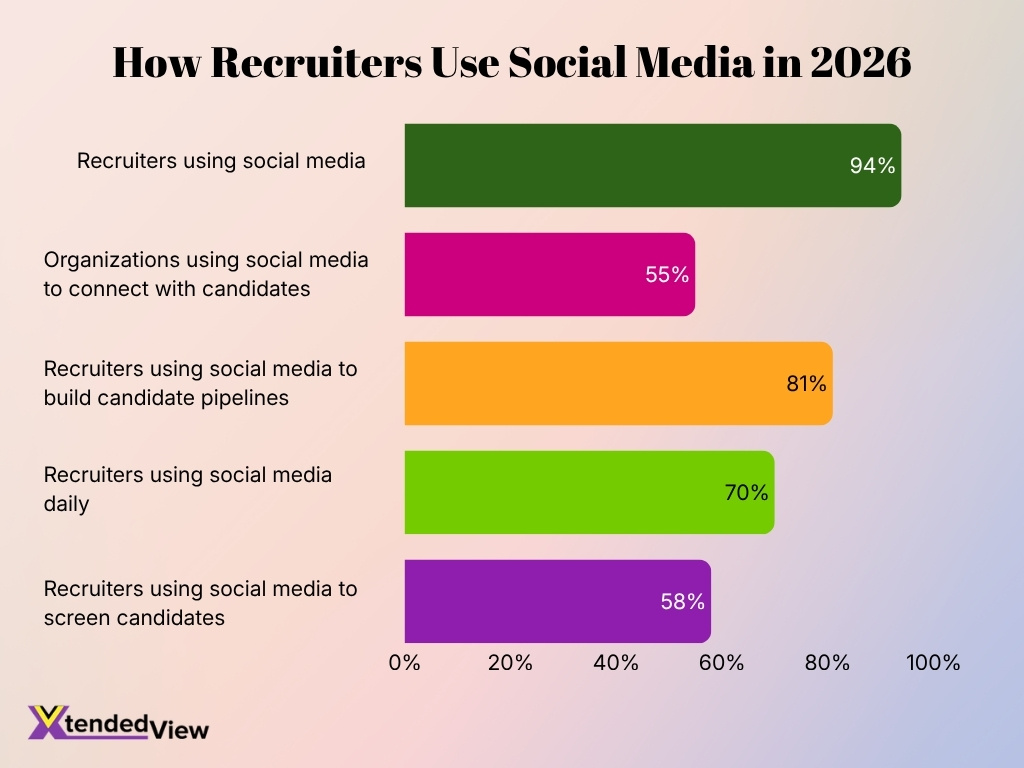
- Social media has become a core recruiting channel, with 94% of recruiters using social platforms as part of their hiring activities.
- Building a steady talent pool is a major use case, as 81% of recruiters use social media to develop candidate pipelines.
- Social recruiting is an everyday activity for many hiring professionals, with 70% of recruiters using social media daily.
- Candidate evaluation extends beyond resumes, as 58% of recruiters use social media to screen potential hires.
- More than half of organizations, 55%, use social media specifically to connect and engage with candidates.
- Overall, the figures show that social media now supports multiple stages of recruitment, from candidate discovery and engagement to screening and pipeline development.
Candidate Behavior and Job Search Trends
- Nearly 58% of people surveyed at the start of 2025 said they intended to look for a new job during the year. That level of intent created a large addressable audience for employers using professional and social platforms.
- Yet higher activity did not necessarily make searching easier. 50% of job seekers said the process of finding a job had become harder, highlighting the competition candidates face across digital hiring channels.
- Nearly 40% of job seekers reported applying to more jobs than ever while hearing back less often. Consequently, candidates have incentives to supplement applications with networking, social profiles and direct recruiter engagement.
- More than 66 million people visit LinkedIn Jobs each week, demonstrating how heavily candidates rely on professional social networks during active searches.
- Candidate activity reached roughly 11,000 applications per minute on LinkedIn in 2025. High application volume makes profile differentiation and accurate skills information more important for candidates trying to surface in recruiter searches.
- Facebook was used by 72.2% of surveyed candidates who regularly turned to the listed social platforms for employment opportunities, making it the most widely used nonprofessional social network in that survey.
- Instagram reached 24.7% of candidates looking for employment opportunities through social media, compared with 37% of employers using the platform for recruitment.
- YouTube presents a notable mismatch: 14.8% of candidates used it for employment opportunities, while only 4.8% of employers used it for recruitment. Candidate adoption was therefore more than three times employer adoption in the survey.
- Earlier Gen Z research also points toward growing social discovery. Social media use for job hunting increased from 13% among the Class of 2022 to 21% among the Class of 2023, an eight-percentage-point increase.
- Work arrangement preferences continue to shape digital searches. In 2024 platform data used for 2025 recruiting planning, 21% of full-time job searches specifically filtered for remote positions even though only 4% of full-time postings offered fully remote work.
Platform Usage by Recruiters: Key Adoption Trends
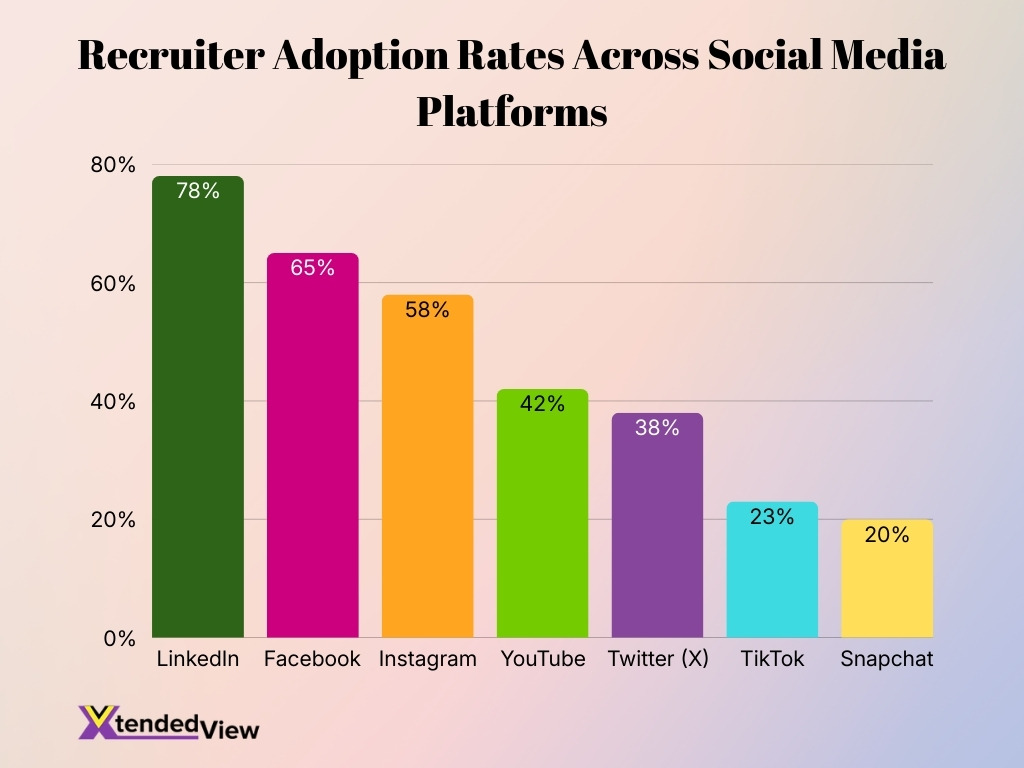
- LinkedIn dominates recruiter activity, with a leading adoption rate of 78%, making it the most trusted platform for professional hiring.
- Facebook remains a major recruitment channel, used by 65% of recruiters for job postings and employer branding.
- Instagram continues to grow in hiring relevance, with 58% adoption, driven by visual storytelling and Gen Z engagement.
- YouTube supports employer branding efforts, with 42% of recruiters leveraging video content to showcase workplace culture.
- Twitter (X) plays a secondary role in recruitment, with 38% usage, mainly for networking and real-time job updates.
- TikTok adoption is still limited, with only 23% of recruiters using it for talent acquisition and outreach.
- Snapchat ranks lowest in recruiter usage, at just 20%, reflecting minimal focus on professional recruitment.
- Professional-first platforms outperform entertainment apps, as LinkedIn, Facebook, and Instagram together account for over 200% combined adoption.
- Visual and video-based platforms show rising influence, with YouTube, Instagram, and TikTok reaching a combined 123% usage among recruiters.
- Overall, recruiters prioritize credibility and reach, favoring platforms with established professional and business-oriented audiences.
LinkedIn Recruitment Statistics
- More than 66 million job seekers visit LinkedIn Jobs each week, giving recruiters access to a large pool of people demonstrating active employment interest.
- LinkedIn’s network already exceeded 1 billion members in 2025 and was growing 19% year over year. The platform reported adding approximately seven new members every second.
- Job-seeker activity reached about 11,000 applications per minute in 2025. That equals roughly 660,000 applications an hour if activity continued at the reported average rate.
- LinkedIn Jobs recorded a 32% increase in apply clicks over the preceding year, showing that job-search engagement continued to grow even as recruiters faced high applicant volumes.
- Members had added 787 million skills to their profiles in the platform data cited in 2025, representing a 56% year-over-year increase. The growth gives recruiters more structured skills information for candidate matching.
- Recruiters using AI-Assisted Messages achieved a 44% higher acceptance rate than recruiters using messages without AI assistance. Candidates also accepted those messages more than 11% faster.
- AI-Assisted Search produced an 18% higher InMail acceptance rate compared with recruiter searches using manual filters, according to platform data.
- Organizations conducting the highest level of skills-based searches were 12% more likely to make a quality hire. Meanwhile, 93% of talent acquisition professionals said accurately assessing candidate skills plays a crucial role in improving quality of hire.
- Companies making the greatest use of AI-Assisted Messaging were 9% more likely to make a quality hire than those using it the least. The finding connects recruiter outreach technology with a measurable hiring outcome rather than message volume alone.
- Finally, organizations known for providing opportunities to work on innovative projects were 11% more likely to make a quality hire. The finding illustrates why employer branding and professional social recruitment increasingly operate as parts of the same hiring strategy.
TikTok and Emerging Platform Statistics
- TikTok reached 37% of U.S. adults in 2025, up sharply from 21% in 2021. The growth expands the potential recruitment audience for short-form career content, employee videos, and employer-brand campaigns.
- TikTok engagement runs much higher among younger Americans. Roughly half of adults ages 18 to 29 said they use the platform at least once a day, compared with just 5% of adults age 65 and older.
- Across the full U.S. adult population, 24% use TikTok daily. That recurring exposure gives employers multiple opportunities to reach potential candidates even when those users are not actively searching job boards.
- TikTok has produced measurable employment outcomes among young workers. A 2025 Gen Z study found that 46% had secured a job or internship through TikTok.
- Career advice has become a significant part of TikTok use as well. 92% of surveyed Gen Z respondents said they trusted TikTok for career information and insights.
- However, reliance on social career advice creates an accuracy problem. 55% of surveyed Gen Z respondents acknowledged that they had followed inaccurate career advice found on TikTok.
- Reddit provides another growing channel for specialized professional communities. 26% of U.S. adults used Reddit in 2025, compared with 18% in 2021. The platform can support niche recruitment through occupation-, industry- and interest-specific communities.
- Reddit usage has a strong education skew: roughly four in 10 college graduates used it in 2025, compared with 28% of adults with some college education and 15% of those with a high school education or less. That difference matters for employers seeking degree-heavy professional talent.
- Short-form workplace content continues to expand in 2026. TikTok’s #corporatelife category had accumulated more than 2 million posts, illustrating the scale of employee-generated workplace content available to prospective applicants.
Facebook vs. Instagram Recruitment Usage
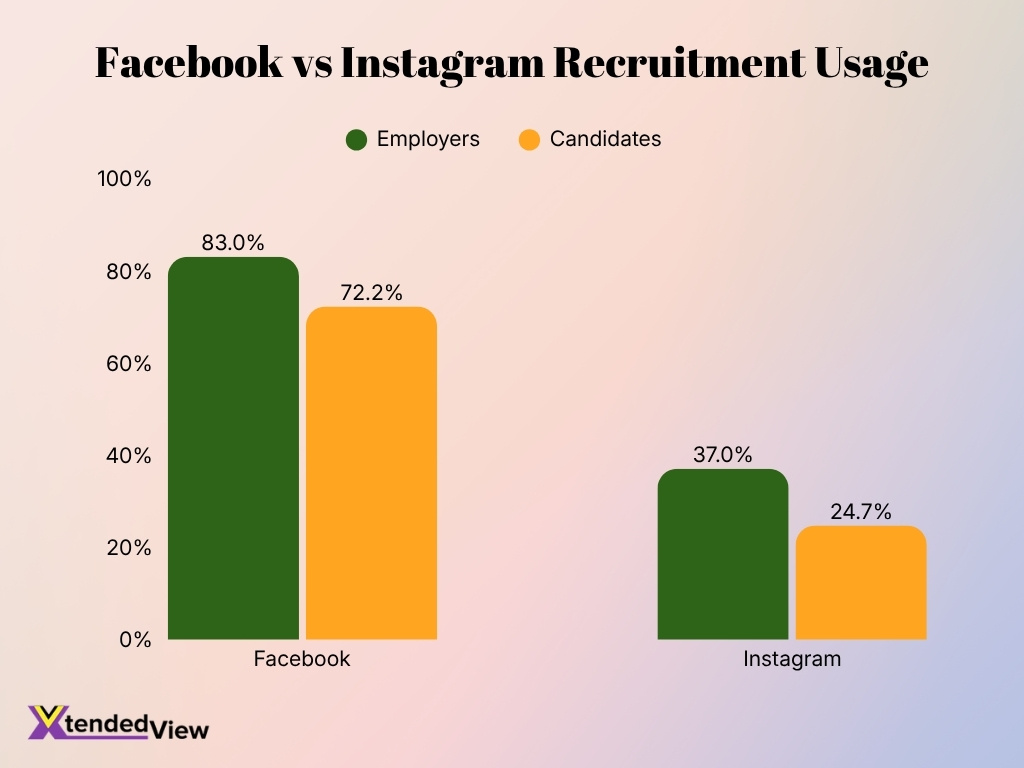
- Facebook dominates recruitment activity, with 83.0% of employers and 72.2% of candidates using the platform for recruiting and job-related purposes.
- Employer adoption of Facebook is 10.8 percentage points higher than candidate usage, showing stronger engagement from recruiters.
- Instagram has lower recruitment adoption, with 37.0% of employers and 24.7% of candidates using the platform.
- Employers are 12.3 percentage points more likely than candidates to use Instagram for recruitment-related activities.
- Facebook’s employer usage is 46 percentage points higher than Instagram’s, making it the substantially more established recruiting platform.
- Among candidates, Facebook leads Instagram by 47.5 percentage points, indicating a much broader reach among job seekers.
- Overall, the figures show that employers use both platforms more heavily than candidates, while Facebook remains the clear leader for recruitment activity.
Industry-Specific Social Media Recruitment Trends
- Targeted business students accounted for nearly 5% of employer messaging campaigns in 2025.
- Computer science students authored almost 15% of all undergraduate feed posts during 2025.
- Active business students generated approximately 25% of the total undergraduate feed posts.
- Design students represent only 5% of undergraduates but generated nearly 10% of all feed posts.
- Communications students account for close to 10% of posts despite being just 5% of the undergraduate pool.
- The retail sector boasts a median of 25 days to hire, which is 34% faster than the global median.
- Retail applications were reviewed in a median of 4 days and progressed to interviews within 11 days.
Demographic Breakdown of Social Media Job Seekers
- Age creates one of the biggest differences in potential social-recruiting reach. In 2025, 80% of Americans ages 18 to 29 used Instagram, making the platform particularly relevant to employers hiring entry-level and early-career workers.
- Facebook offers a different demographic profile. Its highest usage rate occurred among adults ages 30 to 49, where 80% reported using the platform.
- Women showed greater use of several recruiter-relevant platforms in 2025. For example, Instagram usage reached 55% among women versus 44% among men.
- Racial and ethnic differences also affect social recruitment audiences. Instagram usage among Hispanic adults reached 62%, 17 percentage points above the 45% recorded among White adults.
- Asian American adults also showed high Instagram participation at 58%, while the rate among Black adults reached 54%. Employers recruiting through a single platform may therefore reach demographic groups at different rates.
- Education changes the likely reach of emerging networks. Approximately 40% of adults with at least a college degree used Reddit, compared with only 15% among adults with a high school education or less.
- TikTok shows the opposite education pattern: Americans with some college education or less were more likely to use TikTok than college graduates in the 2025 survey. This can matter for employers recruiting hourly, skilled-trade and non-degree talent.
- Candidate media habits also vary sharply with age. 43% of Americans ages 18 to 29 regularly obtained news through TikTok in 2025, compared with 25% of those ages 30 to 49, 10% of adults ages 50 to 64 and 3% of people age 65 and older. These figures demonstrate how strongly younger audiences rely on social feeds for information discovery.
- Instagram showed a similar age pattern for information discovery: 40% of adults ages 18 to 29 regularly got news there, falling to 26% among ages 30 to 49, 11% among ages 50 to 64, and 5% among those 65 and older.
Generational Benefits of Social Media Recruitment
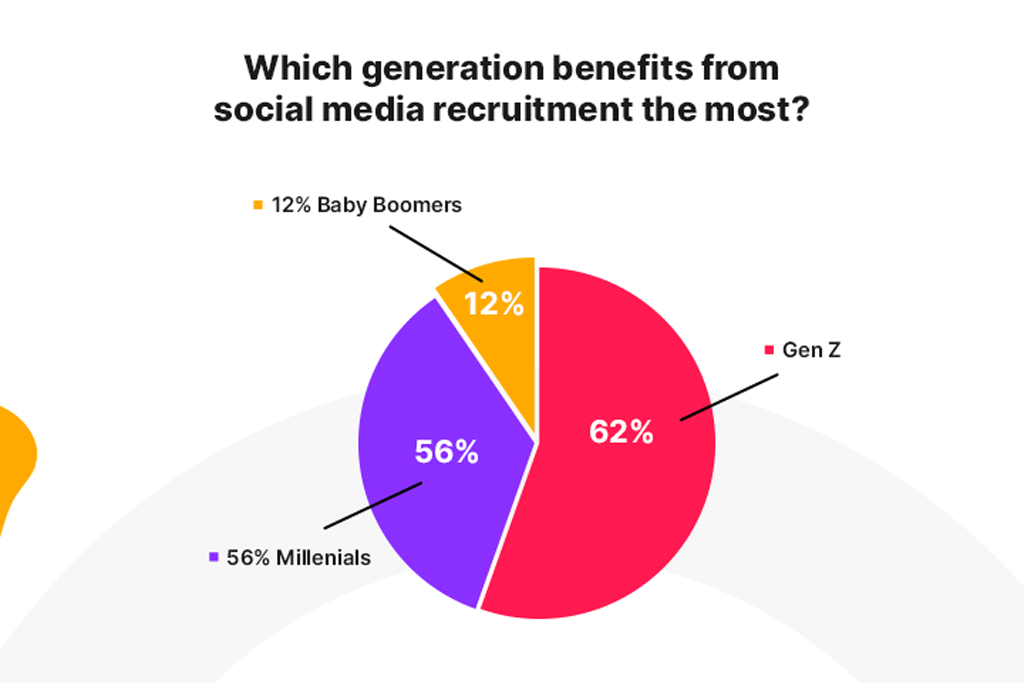
- Gen Z leads at 62%, making it the generation that benefits most from social media recruitment and highlighting the importance of digital platforms for reaching younger talent.
- Millennials follow closely at 56%, showing that social media remains a highly effective recruitment channel for this digitally experienced generation.
- The gap between Gen Z and Millennials is just 6 percentage points, indicating strong social recruitment effectiveness across both younger workforce groups.
- Only 12% of Baby Boomers benefit from social media recruitment, significantly below the figures reported for Gen Z and Millennials.
- Gen Z’s 62% rate is more than five times the 12% recorded for Baby Boomers, demonstrating a substantial generational divide in social recruitment benefits.
- Overall, the data suggests that social media recruitment delivers its strongest impact among Gen Z and Millennials, while its reach among Baby Boomers remains comparatively limited.
Cost Efficiency and ROI of Social Media Recruiting
- Viewing employer posts makes students 2.7 times more likely to click recruiting messages.
- Consistent posting drives 87% growth in employer-page followers within 30 days.
- Exposure to employer content makes qualified candidates 22% more likely to apply.
- The 2026 median cost per hire for nonexecutive roles is approximately $1,300.
- The 2026 median cost per executive hire reached $15,000, a 42% increase from 2025.
- One platform generated 11,000 employee referrals from 13,500 workers in four months.
- Those digitally shared employee referrals successfully produced more than 600 job offers.
- Employee referrals accounted for 10% of 2024 hires, with roughly half converting to hires.
- Referred applicants have a 50% chance of passing reviews versus just 12% for external candidates.
- Referred candidates represented only 5% of applicants but accounted for 30% of eventual hires.
Quality of Hires and Retention Rates
- Quality of hire has become a major recruiting priority as employers receive more applications. 93% of talent acquisition professionals said accurately assessing candidate skills plays a crucial role in improving quality of hire.
- Skills-based candidate sourcing produces measurable results. Organizations making the greatest use of skills-based searches were 12% more likely to make a quality hire than organizations using the approach less frequently.
- Social recruiting technology can also influence candidate responsiveness. Recruiter searches supported by AI generated an 18% higher InMail acceptance rate than searches relying on manual filtering, improving recruiters’ ability to start conversations with relevant prospects.
- Recruiting teams increasingly use AI alongside social and professional sourcing. 37% of recruiting organizations were actively integrating or experimenting with generative AI in 2025, up 10 percentage points from 27% a year earlier.
- Retention remains a core measure of employer-brand performance. In a 2025 employer-brand study, 45% of organizations used employee retention rates to evaluate the effectiveness of their employer brand.
- Employee engagement tied retention as a leading employer-brand measure: 45% of organizations also used employee engagement survey results to evaluate brand performance. This matters because the workplace image promoted through social media must match the post-hire employee experience.
- Early-career retention depends heavily on team culture. Nearly 90% of surveyed students said team culture influenced their interest in accepting or pursuing full-time employment. Employer social content can help candidates evaluate that culture before joining.
- Mentorship also affects whether young workers want to remain after an internship. Almost 60% of students said mentorship influenced their interest in staying with an employer after the internship period.
- Skills development contributes to both attraction and longer-term fit. 90% of surveyed students said they pursued internships to develop skills, giving employers a concrete theme to communicate through employee stories, internship videos, and career-focused social posts.
Most Popular Recruitment Channels Among Employers
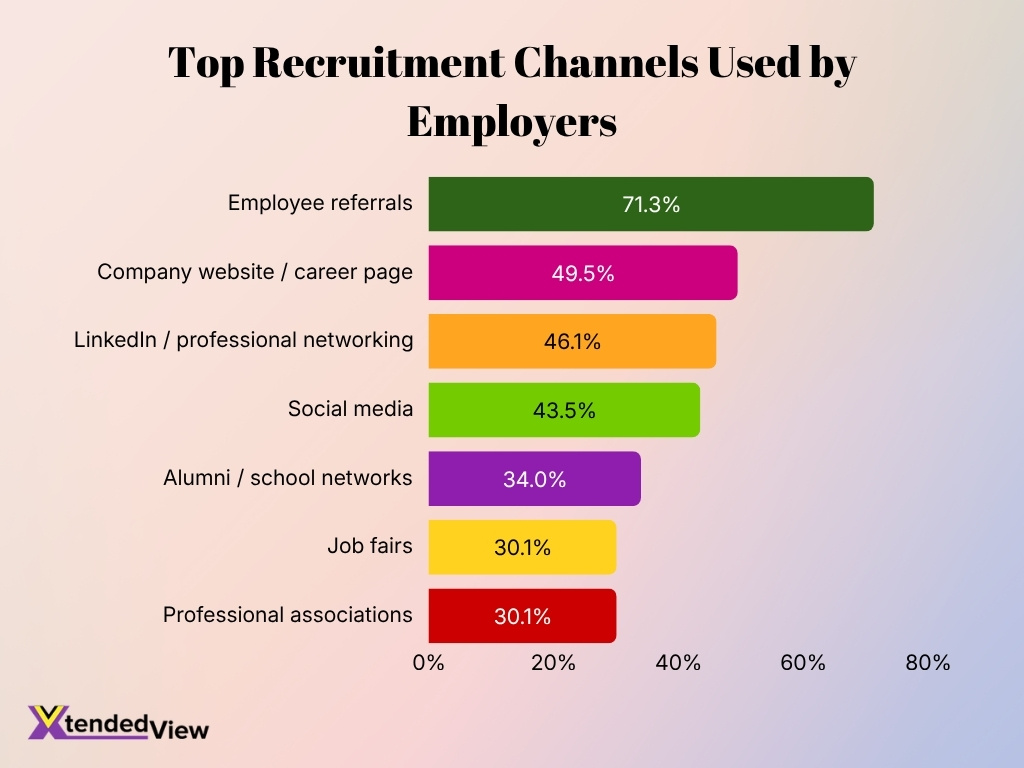
- Employee referrals are the leading recruitment channel, used by 71.3% of employers, substantially ahead of every other hiring method.
- Nearly half of employers, 49.5%, rely on their company website or career page to attract and recruit potential candidates.
- LinkedIn and professional networking platforms are used by 46.1% of employers, highlighting the importance of professional networks in talent acquisition.
- Social media serves as a recruitment channel for 43.5% of employers, demonstrating its growing role in reaching and engaging job seekers.
- Alumni and school networks are used by 34.0% of employers, making educational and former-employee connections another notable source of talent.
- Traditional recruitment methods remain relevant, with 30.1% of employers using job fairs to identify and connect with prospective candidates.
- Professional associations are also used by 30.1% of employers, matching job fairs as a recruitment channel.
- Overall, the figures show that employers use a mix of referrals, digital platforms, professional networks, and traditional channels to build diverse candidate pipelines.
Recruiter Activities and Social Media Strategies
- 64% of recruiting executives plan to increase social media use in their recruitment strategies.
- 27% of HR professionals report recruiting as the top HR area for AI tool usage in 2026.
- 34% of organizations utilize skills-first hiring approaches often or almost always.
- 55% of late-adopting organizations express strong interest in shifting to skills-first hiring.
- Two-thirds of HR professionals see more qualified applicants when using skills-first strategies.
- 49% of recruitment marketing teams plan to adopt new technology, up from 29% in 2023.
- 22% of job seekers rely on bots to submit job applications automatically.
- 31% of Gen Z applicants utilize automated tools to speed up the job application process.
- 64% of recruiting executives will emphasize organizational culture in 2026 job advertising.
Candidate Screening and Background Checks
- Social profiles remain part of candidate vetting. A survey of companies using AI in hiring found that 42% scanned social media or personal websites during their hiring processes.
- AI has made identity verification a more important screening issue. In a 2025 survey of 3,000 managers, 60% said they had uncovered a candidate who misrepresented experience or qualifications.
- Another 13% of managers suspected candidate deception but could not prove it, illustrating the difficulty of distinguishing résumé enhancement, AI assistance and outright fraud.
- Only 19% of managers said they were extremely confident that their existing hiring process would catch a fraudulent applicant. This confidence gap increases the value of layered verification rather than relying on a single social profile or résumé.
- 63% of organizations in the same 2025 research had updated their hiring protocols during the previous year specifically in response to AI or identity-fraud risks.
- Training has also become part of the screening response. 65% of HR teams had received formal instruction on identifying warning signs and AI-enabled hiring fraud.
- When managers were asked where they would invest to reduce candidate fraud, 36% selected in-person identity verification, making it the most frequently selected option.
- Another 31% favored AI-based fraud detection software, while 24% prioritized stronger background checks. These figures show that employers increasingly combine human verification with automated screening.
- Experimental evidence also shows why recruiters should avoid treating one screening signal as definitive. In a randomized study involving 37,000 applicants, candidates selected through an AI-assisted process passed the final human interview at a 54% rate, compared with 34% for candidates from a traditional résumé-screening path.
Social Media Red Flags for Recruiters
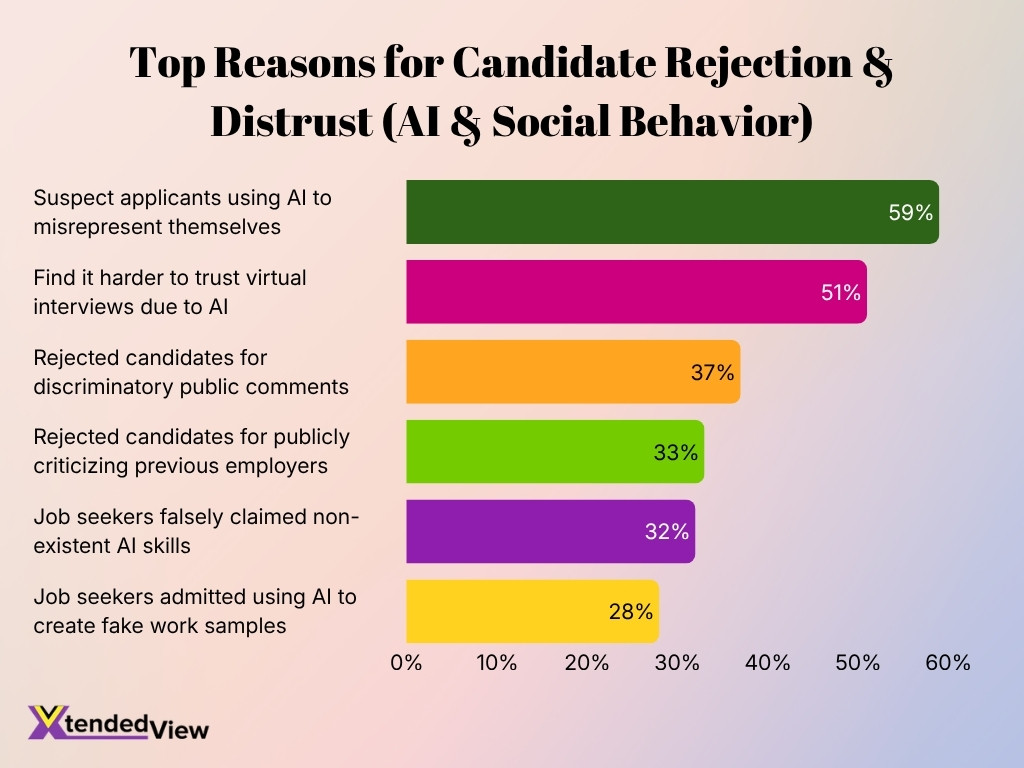
- 59% of managers suspect applicants of using AI to misrepresent themselves.
- 51% of managers find it harder to trust virtual interviews due to AI.
- 37% of employers rejected candidates for posting discriminatory public comments.
- 33% of recruiters rejected candidates for publicly criticizing previous employers.
- 32% of job seekers falsely claimed to possess non-existent AI skills.
- 28% of job seekers admitted using AI to create fake work samples.
- 27% of candidates never encountered a clear policy on AI use.
- 21% of Gen Z candidates find AI acceptable in any hiring circumstance.
- 11% of baby boomers feel AI is acceptable during the hiring process.
Benefits of Social Media Recruitment
- In 2026, 80% of HR professionals struggled to locate candidates with complex problem-solving skills.
- 37% of organizations utilizing mock work exercises successfully exceeded their financial objectives.
- Only 28% of organizations skipping mock exercises managed to exceed their financial goals.
- 46% of Gen Z professionals successfully secured a job or internship directly through TikTok.
- 92% of Gen Z respondents actively trust TikTok for valuable career information and insights.
- 66% of HR professionals using skills-first approaches reported receiving significantly more qualified candidates.
- 59% of workers receiving year-round upskilling support reported strong overall workplace engagement.
- Only 31% of workers without employer upskilling support reported feeling engaged at work.
Challenges and Drawbacks of Social Media Recruitment
- Social media is the most frequently used recruiting strategy but ranks only ninth for effectiveness.
- 53% of U.S. job seekers encountered illegal or discriminatory questions during the hiring process.
- 61% of baby boomers reported age discrimination, compared with just 11% of Gen Z.
- 57% of job seekers removed older experience from their résumés in response to perceived bias.
- 30% of underrepresented candidates changed their names to reduce bias during applications.
- Reports of job and employment-agency scams nearly tripled between 2020 and 2024.
- Reported losses from employment scams increased massively from $90 million to $501 million.
- Consumers reported $16 billion in total fraud losses in 2025, representing a 25% increase from 2024.
Frequently Asked Questions (FAQs)
59% of HR professionals report using social media as a recruiting strategy in 2026, up from 55% in 2025.
64% of recruiting executives plan to increase their use of social media in recruiting strategies during 2026.
46% of Gen Z respondents reported securing a job or internship through TikTok in 2025.
95% of Gen Z respondents said they evaluate an organization’s social media presence before applying for a job.
AI-assisted recruiting messages generated a 44% higher acceptance rate and were accepted more than 11% faster than non-AI-assisted messages.
Conclusion
Social media recruitment has become an established part of sourcing, employer branding, candidate research and skills-based hiring. Employers can use social channels to reach candidates earlier, communicate workplace culture and engage talent outside traditional job boards. However, high application volumes, AI-assisted misrepresentation, fraud, privacy concerns and potential screening bias require stronger verification and consistent hiring standards.
Organizations that combine targeted social outreach with skills-based assessment, clear candidate policies and credible employer messaging can turn social engagement into more relevant applications. As social recruiting continues to expand, success will depend less on simply being present on social platforms and more on connecting the right audiences with transparent, job-relevant hiring experiences.