



Launching a startup offers entrepreneurs the opportunity to transform innovative ideas into successful businesses, but it also comes with significant financial and operational risks. Every year, thousands of startups enter the market, yet many struggle to survive because of limited funding, weak product-market fit, intense competition, changing customer demand, and economic uncertainty. As investment trends evolve and venture capital becomes more selective, understanding startup failure rates has become increasingly important for founders, investors, accelerators, and policymakers alike.
Startup failure statistics provide valuable insights into the challenges businesses face at different growth stages, from early product validation to scaling operations. These numbers help entrepreneurs identify common pitfalls, improve decision-making, strengthen financial planning, and build more sustainable business models. They also reveal how survival rates vary across industries, regions, funding models, and economic cycles. Whether you are planning to launch a new venture, evaluating investment opportunities, or researching entrepreneurial trends, the statistics in this article offer a comprehensive overview of the latest startup failure landscape.
Editor’s Choice
- Around 20% of newly established U.S. businesses fail during their first year, while nearly half fail within five years, according to the latest federal business survival data.
- Roughly 65% of new businesses do not survive beyond 10 years in the United States.
- Among 431 VC-backed startup shutdowns analyzed in 2026, 70% ultimately ran out of capital, although cash shortages were usually the final symptom rather than the original problem.
- 43% of failed VC-backed startups cited poor product-market fit as a major cause of failure.
- The median failed VC-backed startup raised $11 million before shutting down, while the 431 companies collectively raised $17.5 billion.
- Healthcare and biotech represented the largest share (14%) of recent VC-backed startup failures by company count.
- More than 50% of failed startups in the analyzed dataset shut down within 22 months of their last funding round, highlighting the importance of capital efficiency.
Recent Developments
- During 2026, startup failure research expanded to 431 VC-backed companies that shut down after 2023, making it one of the largest recent post-mortem analyses.
- The latest research found that running out of capital ranked as the most common immediate cause of startup shutdowns, affecting 70% of analyzed companies.
- Poor product-market fit (43%) surpassed team issues and operational challenges as the leading strategic reason behind startup failures.
- Bad market timing contributed to 29% of startup failures, particularly in climate technology, food innovation, and blockchain ventures.
- Startups with available workforce data showed that about two-thirds reduced headcount during the six months before closing.
- Partnership activity among failed startups declined by 44% in the final year before shutdown compared with the previous 12-month period.
- Approximately 72% of failed startups experienced declining business health scores during the year leading to closure.
- Nearly 50,000 VC-backed startups had not raised fresh funding since early 2023, illustrating the prolonged impact of tighter capital markets.
Global Startup Failure Rate Overview
- The often-quoted “90% of startups fail” primarily applies to high-growth venture-backed startups rather than all newly registered businesses.
- Across all U.S. businesses, approximately 80% survive their first year, making early-stage survival considerably stronger than popular myths suggest.
- Around 50% of businesses remain operational after five years, indicating that long-term sustainability becomes increasingly challenging.
- Nearly 35% of businesses continue operating beyond 10 years in the United States.
- Venture-backed startups typically face higher failure risk because they pursue aggressive growth strategies and operate under investor expectations.
- Capital-intensive sectors such as biotech, climate technology, and advanced manufacturing generally report higher failure costs due to large upfront investment requirements.
- Fintech accounted for 13% of recent VC-backed startup shutdowns analyzed.
- Food and agriculture startups also represented 13% of recent venture-backed failures, reflecting weaker investment conditions after the 2021–2022 funding boom.
Startup Failure Rate Over Time
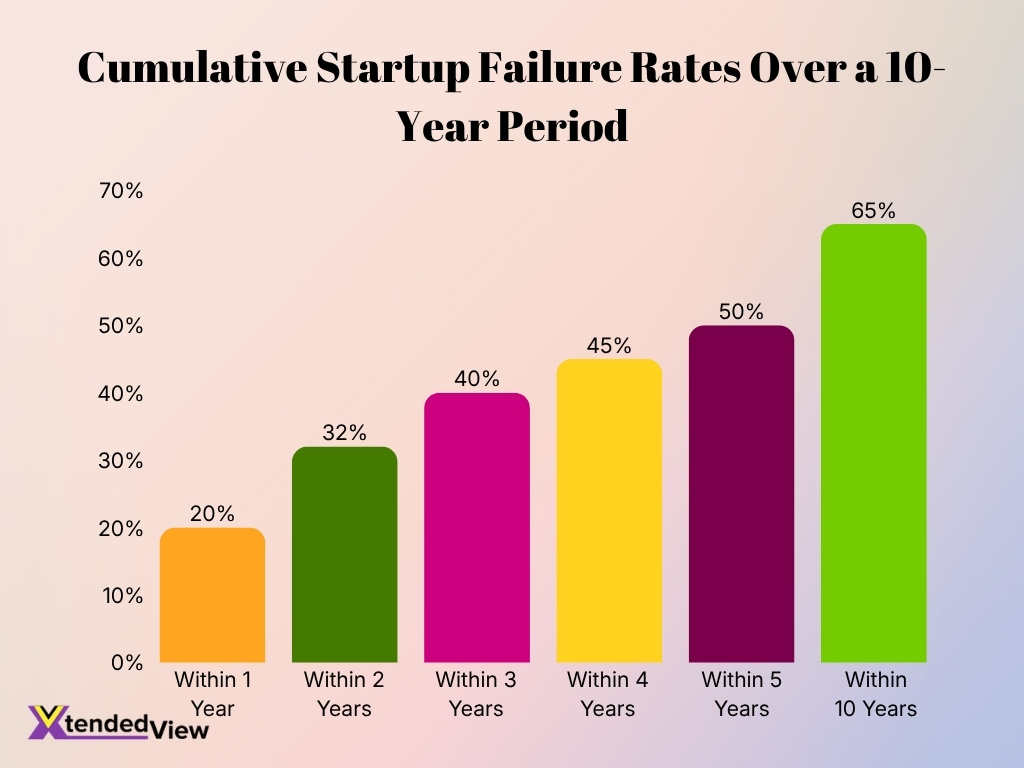
- Federal business data show that roughly 20% of startups fail within their first year.
- Business failure rates increase to approximately 32% within two years.
- About 40% of startups close before reaching their third anniversary.
- Nearly 45% of businesses fail before completing four years of operation.
- Around 49% to 50% fail before reaching five years.
- By year 10, approximately 65% of businesses have closed.
- The median failed VC-backed startup shuts down 22 months after its final funding round, demonstrating how quickly capital shortages can become existential.
- Almost one-quarter of failed VC-backed startups survived for more than three years after their last funding round before officially shutting down.
Startup Survival Rates by Age of Business
- Businesses that survive their first two years generally improve their long-term survival prospects because they establish recurring customers and operational stability.
- Approximately 80% of new businesses reach their first anniversary.
- Roughly 68% survive beyond two years.
- Around 60% remain active after three years.
- Close to 55% continue operating after four years.
- About half of all businesses remain in operation after five years.
- Approximately 35% survive beyond 10 years, demonstrating how significantly survival declines over time.
- Companies that consistently secure follow-on funding, achieve product-market fit, and maintain healthy unit economics generally outperform average survival benchmarks.
Startup Failure Rate by Stage of Growth
- 20% of all new startups fail within their first year of operation.
- Around 43% of failed VC-backed startups suffer from poor product-market fit.
- 50% of early-stage startups collapse by the end of their fifth year.
- More than 60% of Series A startups never successfully raise a Series B round.
- Nearly 75% of venture-backed startups fail to return the invested capital.
- Approximately 74% of high-growth startups fail because of premature scaling.
- Roughly 35% of Series B companies shut down before reaching a Series C round.
- Almost 20% of startup failures are directly tied to unsustainable unit economics.
- Over 70% of all tech startups completely shut down within ten years.
Top Reasons Startups Fail
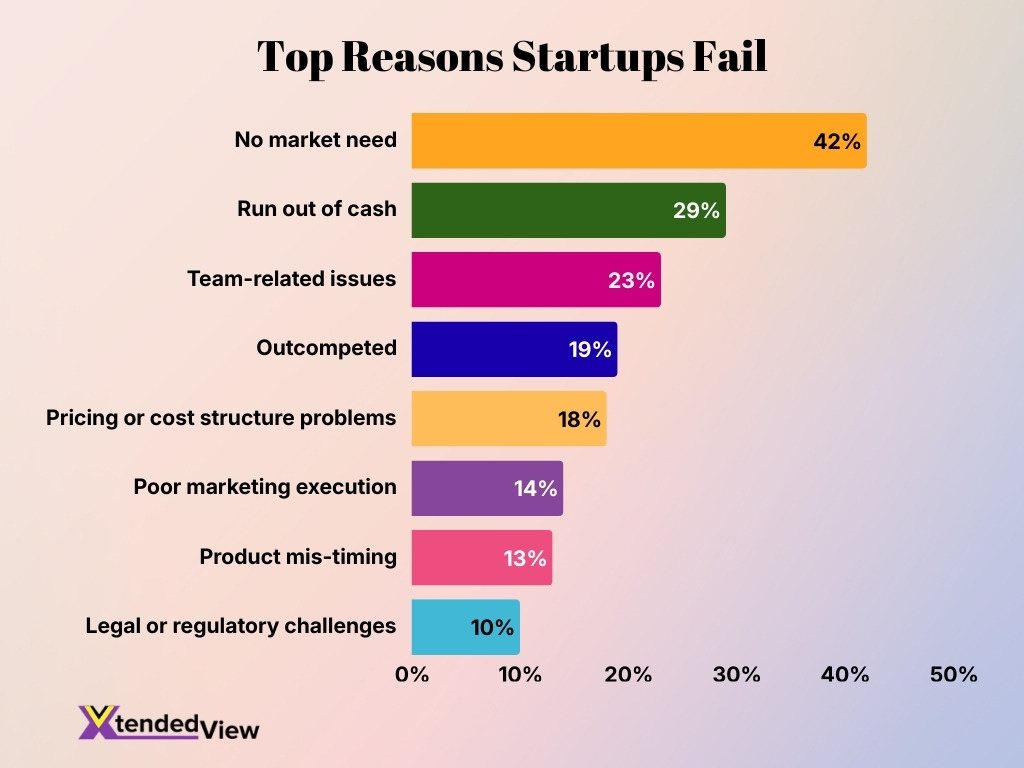
- 42% fail due to no market need for their product or service.
- 29% run out of cash before achieving profitability.
- 23% experience team-related issues, including conflict or lack of expertise.
- 19% get outcompeted, especially in saturated tech markets.
- 18% face pricing or cost structure problems.
- 14% cite poor marketing execution.
- 13% fail due to product mis-timing, entering markets too early or too late.
- 10% report legal or regulatory challenges as a core factor.
Product-Market Fit and Failure Statistics
- 43% of startup failures were directly associated with weak product-market fit.
- Around two-thirds of product-market-fit failures occurred among early-stage startups ignoring customer demand.
- At least 20 Series B or later startups failed because early traction lacked sustainable market demand.
- Over 29% of companies completely exhausted funding attempting to solve unvalidated demand problems.
- Lack of product-market fit remains the #1 failure factor across software, fintech, and climate tech.
- Nearly 74% of failed startups expanded teams or features before validating customers would consistently pay.
- Market validation outperforms aggressive scaling by over 2x as an indicator of startup success.
- Solving a genuine customer problem reduces later cash flow challenges by more than 40%.
Cash Flow, Funding, Burn Rate and Runway Failure Statistics
- 70% of failed startups completely exhausted their available capital before reaching profitability.
- The median time between a startup’s final funding round and company closure is 22 months.
- Nearly 50,000 VC-backed startups have failed to raise fresh funding since early 2023.
- Recent failed startups had collectively raised $17.5 billion before running out of operational runway.
- Flawed and unsustainable unit economics directly contributed to 19% of startup failures.
- Global venture funding rebounded to $469 billion in 2025 but remained heavily concentrated in AI.
- Overall deal activity declined, making follow-on fundraising highly competitive for non-AI companies.
- Approximately 38% of startups fail primarily because they completely ran out of cash.
- Nearly 16% of failed startups cite severe pricing and cost issues as their main reason for collapse.
Founder Stress and Burnout Statistics
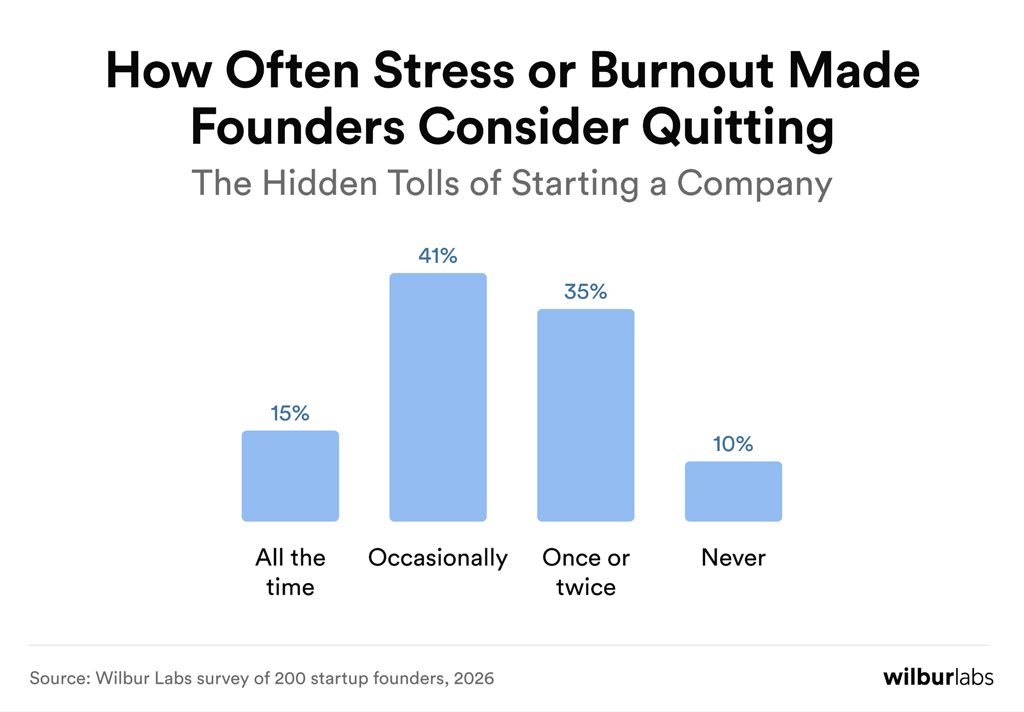
- 41% of startup founders said stress or burnout occasionally made them consider quitting, the largest share of respondents.
- Another 35% of founders reported considering quitting once or twice, showing that burnout-related doubts are common even when they are not persistent.
- 15% of founders said stress or burnout made them think about quitting all the time, highlighting the significant psychological pressure associated with running a startup.
- Only 10% of founders reported never considering quitting because of stress or burnout, the smallest group in the survey.
- Overall, about 9 in 10 founders experienced some level of stress or burnout that made them consider quitting at least once, based on the survey of 200 startup founders.
Team, Leadership and Founder Experience Statistics
- Y Combinator startups raise 21% more funding for each additional co-founder on average.
- Observable founder credentials explain less than 4% of the funding variation in large startup datasets.
- Recent unicorn founders launch companies with an average of 13.8 years of professional experience, up from 8.2 years in 2010.
- Startups with two co-founders historically raise 30% more capital than ventures started by solo founders.
- Internal team conflict is directly responsible for up to 65% of high-potential startup failures.
- Repeat experienced founders have a 30% chance of success compared to just 18% for first-time founders.
- Founding teams with prior startup experience have a two to three times higher probability of long-term success.
- Solo founders take roughly 3.6 times longer to reach the scale stage than companies with multiple founders.
- Startups with at least one female founder historically generate 63% better performance than all-male founding teams.
Competition, Pricing and Market Positioning Statistics
- Poor market timing contributed to 29% of startup failures during recent investment booms.
- Unsustainable pricing and weak unit economics drove 19% of analyzed company closures.
- Being outcompeted by established rivals is cited in 20% of all startup post-mortems.
- A lack of market need or poor positioning accounts for 42% of early-stage business failures.
- Artificial Intelligence firms captured nearly 50% of all global venture funding in 2025.
- Rising customer acquisition costs have eroded margins by over 60% for poorly positioned brands.
- Flawed revenue models and undisciplined pricing strategies cause 18% of startups to fold.
- Companies that achieve early product-market fit scale their revenues 3 times faster than competitors.
Startup Failure Rates by Industry
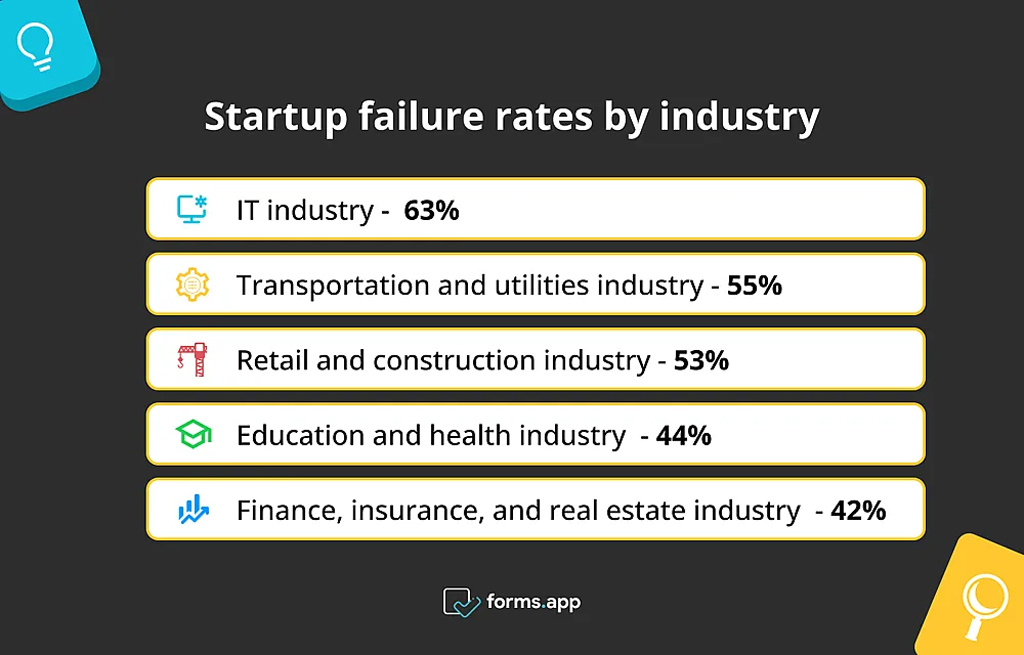
- The IT industry records the highest startup failure rate at 63%, indicating that nearly two-thirds of startups in the sector fail.
- Transportation and utilities have a startup failure rate of 55%, making them the second-highest category in the dataset.
- The retail and construction industry follows closely, with approximately 53% of startups failing.
- Startups operating in education and health have a comparatively lower failure rate of 44%.
- The finance, insurance, and real estate industry has the lowest failure rate among the listed sectors at 42%.
- Overall, the gap between the highest and lowest industry failure rates is 21 percentage points, highlighting substantial differences in startup survival across sectors.
Tech, SaaS and Software Startup Failure Statistics
- Software startups represented approximately 12% of the 431 venture-backed startup failures in recent post-mortem research.
- AI-native software companies attracted nearly 50% of global venture funding during 2025 to increase competitive pressure.
- More than 43% of failed software startups cited poor product-market fit as the primary factor behind their closure.
- Late-stage investment activity slowed dramatically during 2023–2025, causing an 18% drop in deal volume that hurt startups.
- Around 19% of startup failures involved unsustainable unit economics driven by high SaaS customer acquisition costs.
- Only 10% of SaaS startups reach the $1M annual recurring revenue milestone before pursuing aggressive enterprise expansion.
- Roughly 90% of SaaS startups fail within their first 10 years due to high burn rates and short financial runways.
- Over 50,000 new SaaS products launched in 2025 alone, making AI integration a strict requirement to survive saturation.
Fintech, E-commerce and Emerging-Tech Startup Failure Statistics
- Nearly 73% of fintech startups fail within their first three years due to preventable regulatory compliance issues.
- Enterprise SaaSbusinesses led venture-backed closures by accounting for 32% of total startup shutdowns.
- Approximately 85% of AI startups are predicted to fail within their first three years despite high investor interest.
- Fintech startupsconstituted exactly 8% of all recorded tech startup closures in recent industry shutdown data.
- Over 58.3% of retail trade and e-commerce businesses ultimately fail by their tenth year of operation.
- Proper pre-seed regulatory preparation was shown to increase fintech startup survival rates by a massive 64%.
- Approximately 92% of all SaaS startups shut down within three years primarily due to poor product-market fit.
- Early-stage tech startups face a steep 60% to 70% attrition rate before ever reaching a Series A funding round.
- Cross-border compliance challengesproved to be the primary failure point for 58% of international fintech expansion attempts.
- Roughly 75% of all fintech ventures globally will eventually crash or shut down completely within a two-decade timeframe.
Startup Failure Rate by Region and Ecosystem
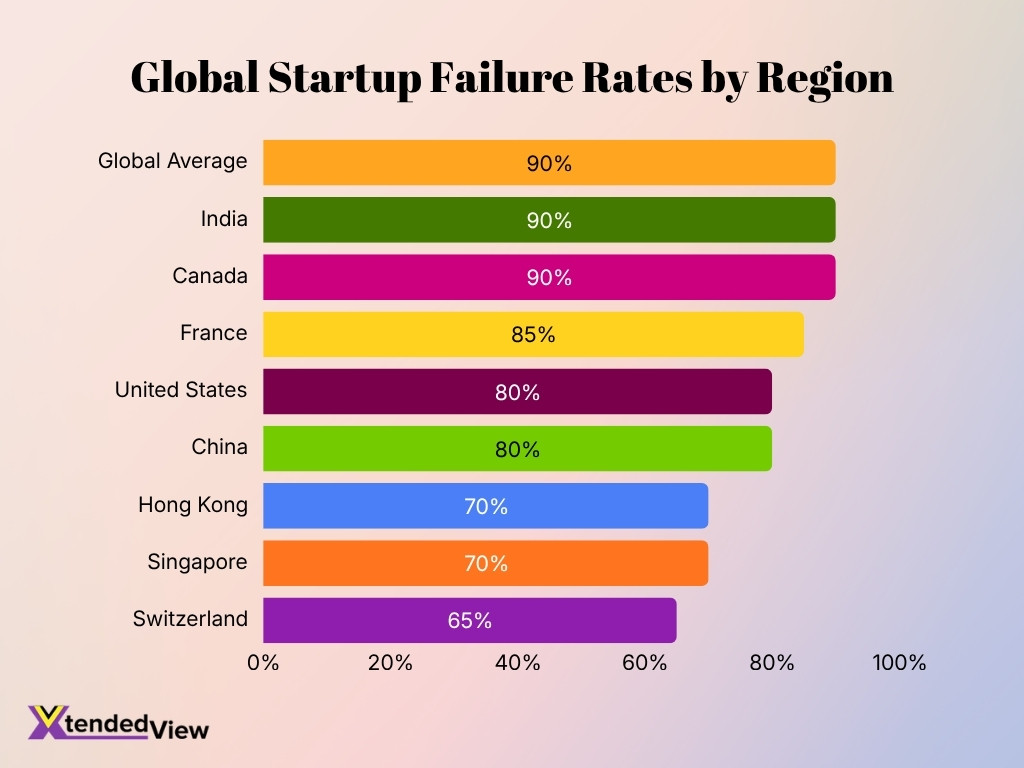
- The global startup failure rate remains at 90%, with 20% closing within their first year.
- Approximately 80% of startups in the United States eventually fail despite having a massive investment ecosystem.
- Startups in Canada experience a massive failure rate approaching 90%, particularly within tech-focused sectors.
- Francesees a high startup failure rate of 85% due to regulatory complexities and rigid labor markets.
- The United Kingdom maintains a five-year startup failure rate hovering between 60% and 70%.
- Switzerlandboasts a comparatively low startup failure rate of 65% due to a highly resourced enterprise ecosystem.
- Startup failure rates in India reached 90%, with over 11,000 business shutdowns recorded during 2025.
- Both Hong Kong and Singapore experience startup failure rates of 70% despite their mature innovation networks.
- Hyper-competitive markets in China compress profit margins and drive the regional startup failure rate to 80%.
Venture-Backed vs Bootstrapped Startup Failure Rates
- 75% of venture-backed startups ultimately fail to return any cash to their investors.
- A total of 431 failed VC-backed startups collectively lost $17.5 billion before shutting down.
- The median failed venture-backed startup secured approximately $11 million before facing complete closure.
- Premature scaling is directly responsible for destroying 74% of high-growth startups seeking rapid expansion.
- Between 30% and 40% of venture-backed startups liquidate entirely, causing investors to lose their full investment.
- Running out of cash causes 29% of startup shutdowns, highlighting the operational risk of high burn rates.
- Only 0.05% of all startups successfully raise venture capital funding during their business lifecycle.
- Around 90% of innovative startups fail entirely regardless of whether they are bootstrapped or VC-backed.
Macroeconomic and Market Cycle Impacts on Startup Failure
- Global venture funding rebounded to approximately $469 billion during 2025, heavily concentrating in AI startups.
- Overall venture deal volume remained significantly below the peak record levels seen in 2021.
- Nearly 50,000 VC-backed startups have not secured a new funding round since early 2023.
- Artificial intelligence firms captured 61% of all global venture capital, totalling $258.7 billion in 2025.
- The overall startup shutdown rate surged by 30% in 2025 as higher interest rates demanded profitability.
- Running out of cash runway caused 29% of startup failures during the 2024 and 2025 inflationary periods.
- Around 74% of recent startup closures occurred directly at the vulnerable pre-seed or seed stage.
- During this market cycle, 75% of venture-backed startups completely failed to return capital to investors.
- A massive 42% of startups collapsed specifically due to misjudging actual market demand rather than just poor growth.
Key Lessons Startup Founders Learned From Failure
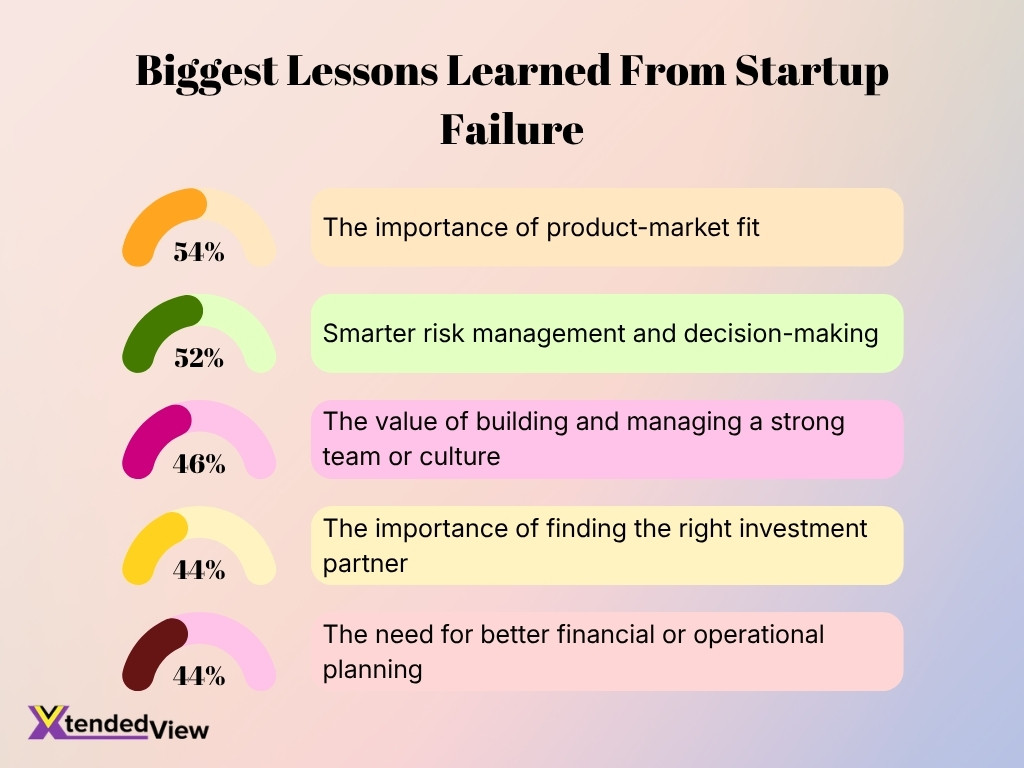
- Product-market fit was the most commonly cited lesson, with 54% of startup founders saying failure taught them the importance of ensuring strong market demand for their product.
- Smarter risk management and decision-making ranked second at 52%, highlighting how early mistakes can push founders toward more calculated business decisions.
- Building and managing a strong team or company culture was a major takeaway for 46% of founders, showing that startup success depends on people as much as products and ideas.
- Finding the right investment partner was identified as an important lesson by 44% of founders, emphasizing the value of choosing investors who align with a startup’s goals and strategy.
- Another 44% of founders learned that stronger financial or operational planning is essential, suggesting that budgeting, cash management and execution can significantly affect startup survival.
- Overall, the findings show that founders’ biggest lessons extend beyond funding, with product-market fit, risk management, team building and financial planning emerging as critical areas for avoiding repeated mistakes.
Frequently Asked Questions (FAQs)
Approximately 20% of new U.S. businesses fail within their first year of operation.
About 50% of startups remain in business after five years, while roughly 65% close within 10 years.
The most common immediate cause is running out of capital (70%), while poor product-market fit (43%) is the leading underlying business cause.
The median failed venture-backed startup raised approximately $11 million before closing.
The 431 failed VC-backed startups collectively raised approximately $17.5 billion before shutting down.
Conclusion
Startup failure remains a defining reality of entrepreneurship, but the data also reveal clear patterns behind long-term success. While roughly half of new businesses survive beyond five years, venture-backed startups continue to face additional pressure from rapid scaling, competitive markets, and changing investor expectations. Product-market fit, disciplined cash management, and sustainable unit economics consistently emerged as the strongest predictors of survival. Founders who validate customer demand early, manage burn rates carefully, and build resilient operating models are better positioned to improve their chances of long-term success.
