



Machine learning continues to reshape how organizations make decisions, automate workflows, and create new products. In the US, businesses increasingly use machine learning to improve fraud detection, personalize customer experiences, optimize supply chains, and accelerate medical research. As investment and enterprise adoption continue to rise, machine learning has become a core business capability rather than an experimental technology. Explore the statistics below to understand how the market, enterprise spending, and organizational adoption continue to evolve.
Editor’s Choice
- Worldwide AI spending is forecast to reach $2.59 trillion in 2026, representing 47% year-over-year growth from 2025.
- Global AI spending reached an estimated $1.76 trillion in 2025, creating the foundation for accelerated machine learning deployment across industries.
- AI infrastructure accounts for more than 45% of worldwide AI spending in 2026 as organizations expand compute capacity for machine learning workloads.
- Nearly two-thirds of organizations are already using AI in live production environments at the beginning of 2026, although many deployments remain limited in scale.
- Around 62% of surveyed organizations report experimenting with AI agents, highlighting the rapid evolution of machine learning applications beyond predictive analytics.
- AI is projected to generate $22.5 trillion in cumulative economic value between 2025 and 2031 under IDC’s baseline scenario.
- Enterprise AI initiatives increasingly focus on measurable productivity improvements, while organizations continue working toward enterprise-wide scaling instead of isolated pilots.
Recent Developments
- In 2026, AI software spending is projected to reach $453.2 billion, reflecting rapid enterprise demand for machine learning-powered applications.
- Spending on AI infrastructure is expected to increase to approximately $1.43 trillion during 2026, making it the largest investment category.
- AI model spending is forecast to grow by more than 110% in 2026, driven largely by agentic AI and enterprise workflow automation.
- AI-optimized servers are expected to become the largest infrastructure subsegment over the next five years as cloud providers expand capacity.
- Organizations increasingly prioritize agent-based workflows, with AI agents moving from experimentation into business operations.
- Almost two-thirds of enterprises now operate AI solutions in production, although relatively few have achieved enterprise-wide deployment.
- Nearly 50% of AI-driven digital initiatives could miss ROI targets in 2026 because of weak data foundations and unclear business outcomes.
- Enterprise CIOs continue to favor practical AI projects that improve operational efficiency instead of large-scale organizational transformation.
Machine Learning Market Growth
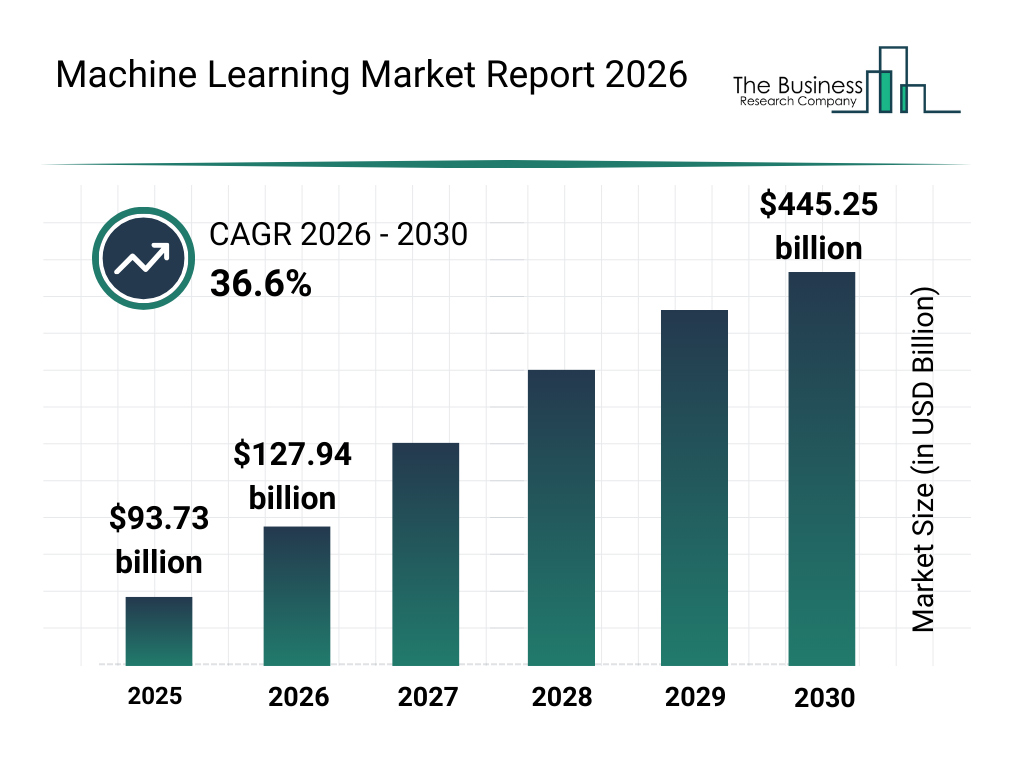
- The global machine learning market was valued at $93.73 billion in 2025.
- The market is projected to reach $127.94 billion in 2026, marking strong year-over-year expansion.
- Machine learning revenue could rise to approximately $174.77 billion by 2027.
- The market is expected to exceed $238.73 billion in 2028 as enterprise adoption accelerates.
- By 2029, the industry could generate approximately $326.11 billion in global revenue.
- The market is forecast to reach $445.25 billion by 2030, nearly 4.8 times its 2025 value.
- From 2026 to 2030, the machine learning market is expected to grow at a 36.6% CAGR.
- The projections indicate that the market could add more than $317 billion in value between 2026 and 2030.
Machine Learning Adoption Rates by Organizations
- Nearly two-thirds of organizations already use AI in live production environments as of early 2026.
- Nearly 100% of surveyed organizations report using AI in some capacity despite varying deployment maturity.
- Nearly two-thirds of organizations have not yet scaled AI across the enterprise.
- About 62% of organizations are experimenting with AI agents in business workflows.
- Around 64% of respondents say AI contributes directly to organizational innovation.
- Only 39% of organizations report a measurable enterprise-level EBIT impact from AI initiatives.
- Roughly 80% of leading organizations identify operational efficiency as a primary objective for AI deployment.
Machine Learning and AI Spending Worldwide
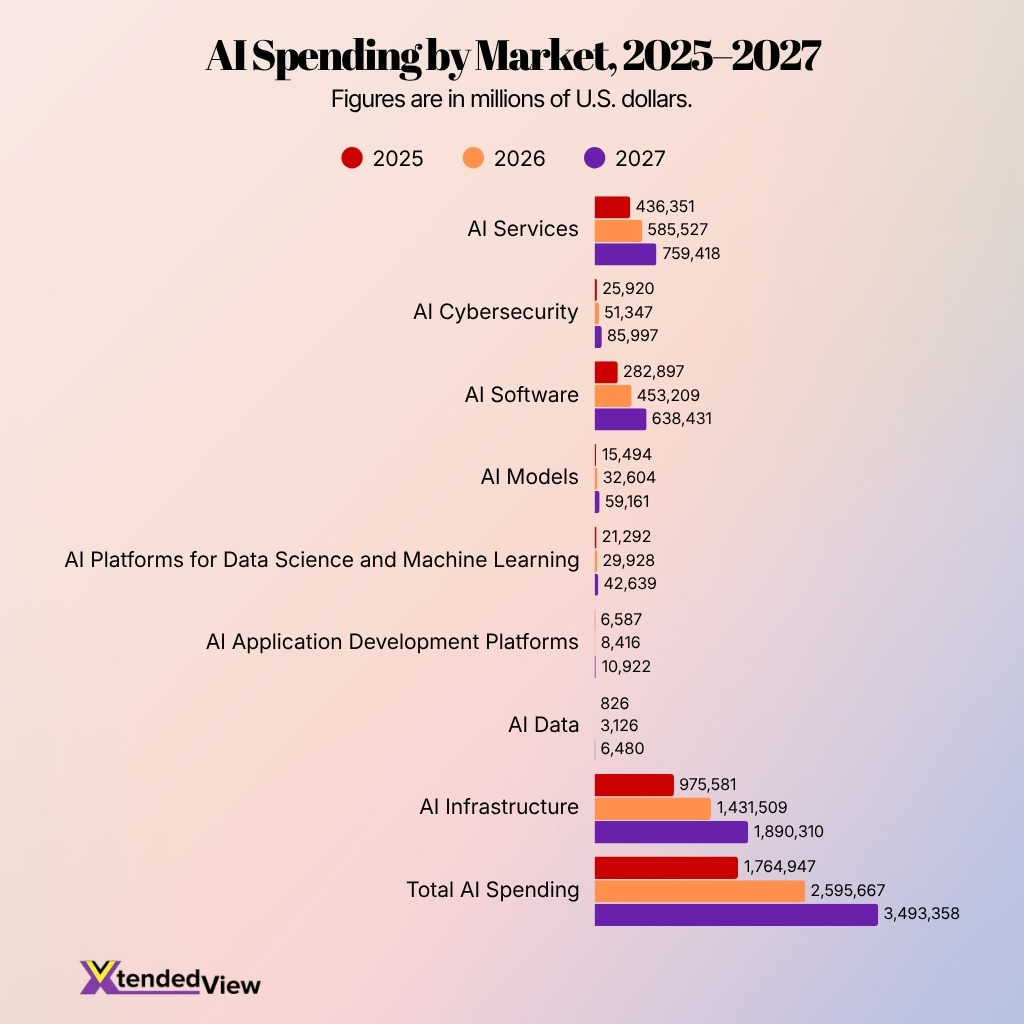
- Global AI spending is forecast to total $2.59 trillion in 2026.
- Worldwide AI spending grew from approximately $1.76 trillion in 2025, highlighting sustained enterprise investment.
- AI infrastructure represents the largest spending category at roughly $1.43 trillion in 2026.
- AI services spending is projected to exceed $585 billion worldwide in 2026.
- Organizations are expected to spend approximately $453 billion on AI software during 2026.
- AI cybersecurity spending is forecast to surpass $51 billion in 2026 as enterprises strengthen AI-enabled security capabilities.
- Worldwide IT spending is expected to reach $6.31 trillion in 2026, with AI infrastructure serving as one of the strongest growth drivers.
- Global IT spending is projected to grow 13.5% in 2026, reflecting continued investment in machine learning infrastructure and enterprise software.
AI Spending by Category
- Total worldwide AI spending is projected to rise from $1.76 trillion in 2025 to $3.49 trillion in 2027, nearly doubling within two years.
- AI infrastructure remains the largest spending category, increasing from $975.58 billion in 2025 to $1.89 trillion in 2027.
- Spending on AI services is expected to grow strongly from $436.35 billion to $759.42 billion during the forecast period.
- AI software investment is projected to more than double, climbing from $282.90 billion in 2025 to $638.43 billion in 2027.
- AI cybersecurity spending is forecast to surge from $25.92 billion to $86.00 billion, reflecting rising demand for AI-driven security tools.
- Investment in AI models is expected to expand rapidly from $15.49 billion in 2025 to $59.16 billion in 2027.
- Spending on data science and machine learning platforms is projected to reach $42.64 billion by 2027, up from $21.29 billion in 2025.
- AI application development platforms are expected to grow steadily from $6.59 billion to $10.92 billion over the three-year period.
- AI data spending records the fastest proportional increase, rising from just $826 million in 2025 to $6.48 billion in 2027.
- The figures show that businesses are prioritizing both core AI infrastructure and software capabilities as adoption accelerates worldwide.
Machine Learning Deployment and Scaling Statistics
- By 2025, 88% of organizations use AI regularly in at least one business function.
- Only 23% of companies are currently scaling agentic AI across their entire enterprise.
- Approximately 74% of companies achieve ROI in the first year, but only 39% report enterprise-level impact.
- Global AI spending is projected to reach $2.52 trillion in 2026, with infrastructure taking $1.366 trillion.
- Fewer than 10% of enterprises have successfully scaled AI agents to deliver tangible business value.
- By 2027, 85% of organizations expect a positive ROI from scaled AI initiatives focused on efficiency.
- Around 83% of AI pilots fail primarily due to change management issues rather than technology.
- Only 12% of CEOs report achieving both revenue gains and cost reductions from AI implementations.
Machine Learning in Healthcare
- 50% of US healthcare organizations surveyed reported implementing generative AI by late 2025, reflecting rapid enterprise adoption entering 2026.
- More than 80% of healthcare organizations have already deployed at least one generative AI use case to end users.
- 54% of clinical-care organizations report implementing generative AI to improve clinical productivity, making it the leading healthcare use case.
- Administrative efficiency ranks as the top opportunity for both generative AI and agent-based workflows in healthcare.
- AI adoption among US healthcare firms increased to 8.3% in 2025, up from approximately 6.5% in 2023, according to firm-level survey data.
- Outpatient and ambulatory care organizations increased AI usage from 4.6% in 2023 to 8.7% in 2025.
- Healthcare organizations increasingly view agentic AI as the next step for improving patient engagement, care delivery, and administrative workflows.
- Surveyed healthcare executives report that talent shortages, leadership support, and data quality challenges have become less significant barriers than in previous years.
Global Machine Learning Market by Industry
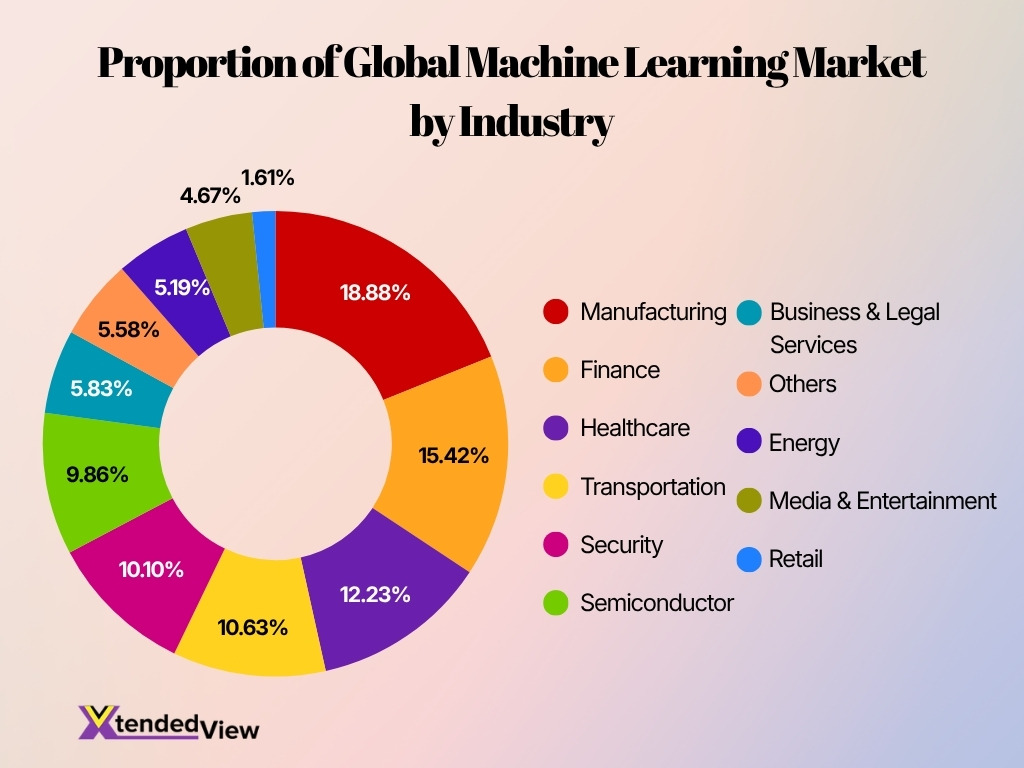
- Manufacturing holds the largest share of the global machine learning market at 18.88%, reflecting strong adoption in automation, predictive maintenance, and quality control.
- Finance ranks second with a 15.42% market share, driven by fraud detection, risk assessment, algorithmic trading, and customer analytics.
- Healthcare accounts for 12.23%, highlighting the growing use of machine learning in diagnostics, drug discovery, patient monitoring, and medical imaging.
- Transportation represents 10.63% of the market as machine learning supports route optimization, autonomous systems, and fleet management.
- Security captures a 10.10% share, supported by rising demand for threat detection, surveillance, identity verification, and cybersecurity solutions.
- Business and legal services contribute 9.86%, showing increased adoption for document analysis, compliance monitoring, and workflow automation.
- Energy holds 5.58% of the market, with machine learning used for demand forecasting, grid optimization, and predictive asset maintenance.
- Media and entertainment represent 5.19%, largely driven by recommendation systems, audience analytics, and automated content production.
- Retail accounts for 4.67%, supported by applications in demand forecasting, personalized marketing, pricing, and inventory management.
- Semiconductors have the smallest reported share at 1.61%, despite the industry’s critical role in powering machine learning infrastructure.
- The top three industries, manufacturing, finance, and healthcare, collectively account for 46.53% of the global machine learning market.
Machine Learning in Banking and Financial Services
- 77% of banks had launched or soft-launched generative AI applications by 2025, compared with 61% in 2023.
- 47% of banking organizations reported fully implementing generative AI applications in 2025, compared with just 10% in 2023.
- 61% of banking executives already report substantial business impacts from their generative AI deployments.
- 89% of surveyed banking leaders expect major transformative benefits from generative AI within the next two years.
- 77% of financial services executives report achieving positive ROI from generative AI within the first year of deployment.
- Fraud detection ranks among the leading AI agent use cases, with 64% of banks identifying it as a top deployment priority.
- As of early 2025, 54% of financial services companies had deployed AI initiatives, compared with 40% one year earlier.
- Nearly one-third of banks have started implementing agentic AI to automate customer service, risk management, and lending processes.
Machine Learning in Retail and E-commerce
- The global AI-enabled e-commerce market reached $8.65 billion in 2025 and is projected to hit $22.60 billion by 2032.
- Implementing personalized product recommendations powered by machine learning can increase e-commerce revenue by up to 300%.
- Retailers utilizing AI-powered dynamic pricing report margin improvements of 5–10% with a 6–12-month ROI payback.
- Integrating machine learning in supply chain planning reduces excess inventory by up to 20% and lowers costs by 10%.
- Proactive AI chat in conversational customer support delivers 4X higher conversion rates than non-AI shopping experiences.
- Advanced conversational AI agents successfully resolve 93% of routine customer questions entirely without human intervention.
- Approximately 89% of retail organizations have adopted AI technologies, but only 7% have fully scaled them across their enterprise.
- Shoppers arriving from generative AI traffic sources demonstrate a 27% lower bounce rate and 32% longer site visits.
- By 2028, roughly 33% of online retailers will deploy advanced AI agents to support agentic commerce and customer service.
Machine Learning Engineer Salary Insights by Country
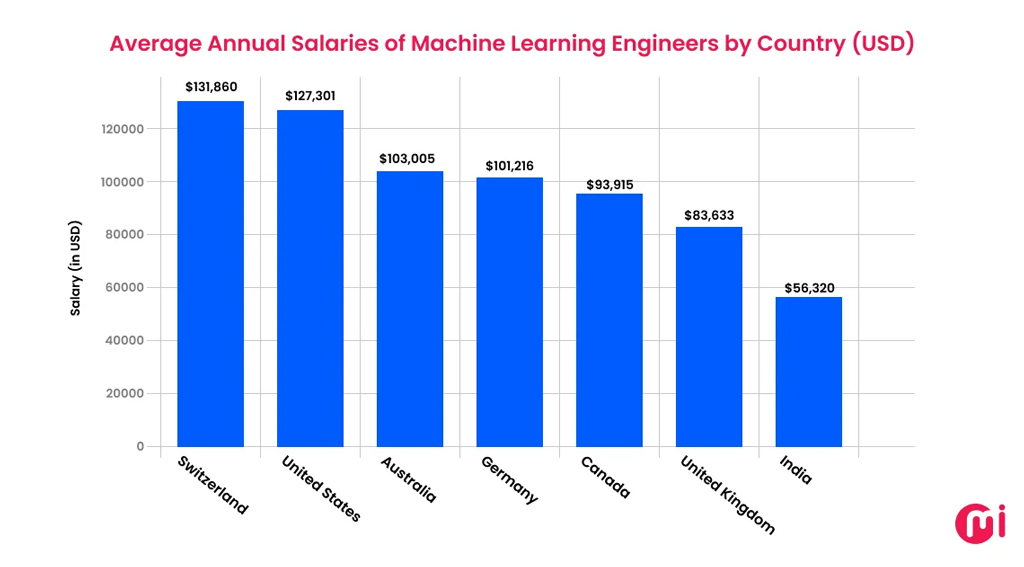
- Switzerland offers the highest average annual salary for machine learning engineers at $131,860.
- The United States ranks second, with professionals earning an average of $127,301 per year.
- Switzerland’s average salary is $4,559 higher than the figure reported for the United States.
- Australia and Germany offer similar salaries at $103,005 and $101,216, respectively.
- Canada provides an average annual salary of $93,915, placing it fifth among the listed countries.
- Machine learning engineers in the United Kingdom earn an average of $83,633 annually.
- India records the lowest salary in the comparison at $56,320 per year.
- The salary gap between Switzerland and India reaches $75,540, highlighting major geographic pay differences.
- The average salary across all seven countries is approximately $99,607 per year.
Subfields of Machine Learning: NLP, Computer Vision, MLOps, and AI Agents
- 62% of organizations report experimenting with AI agents, making them a rapidly growing ML subfield.
- Generative AI reached 53% global adoption within 3 years, outpacing the historical growth of the internet.
- The global Computer Vision market is projected to reach $46.4 billion by 2030, growing at a 15.2% CAGR.
- NLP market size is expected to surpass $112 billion by 2032, driven by enterprise chatbot integration.
- Around 80% of enterprise AI models fail to deploy without standardized MLOps platforms.
- Teams utilizing MLOps experience a 60% reduction in model deployment timelines.
- Multi-agent AI systems are expected to automate 45% of complex business workflows by 2027.
- Organizations combining LLMs with traditional ML see a 35% increase in decision-making accuracy.
- Enterprises investing in scalable MLOps report a 4x higher production deployment success rate.
Machine Learning ROI and Economic Value Creation
- Only 39% of organizations currently report measurable enterprise-level EBIT impact from AI despite widespread deployment.
- 77% of financial services executives say their organizations achieved positive AI ROI within the first year.
- 58% of banks anticipate revenue increases between 6% and 20% from generative AI deployments.
- 79% of banking executives expect additional revenue gains over the next two years as AI deployments mature.
- IDC projects AI will generate approximately $22.5 trillion in cumulative global economic impact between 2025 and 2031.
- Organizations increasingly evaluate AI success using measurable business outcomes rather than pilot completion or model accuracy alone.
- Most surveyed executives report that AI investments require two to four years to achieve satisfactory ROI, exceeding traditional technology payback expectations.
- High-performing organizations consistently align machine learning investments with strategic business objectives, governance, and workforce readiness to maximize long-term value.
Key Business Benefits of Machine Learning
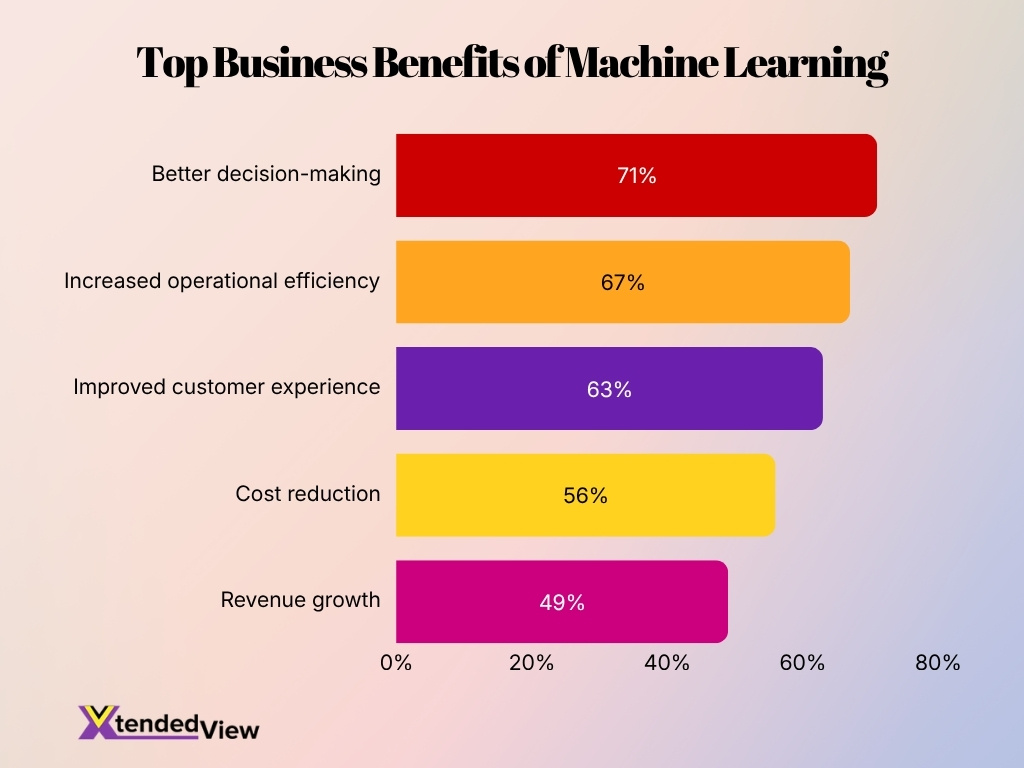
- Better decision-making ranks as the top machine learning benefit, with 71% of organizations reporting that it helps them analyze data more effectively and make faster, more informed business decisions.
- Increased operational efficiency is reported by 67% of organizations, showing that machine learning can streamline workflows, automate repetitive tasks, and improve overall productivity.
- Improved customer experience is achieved by 63% of organizations, as machine learning enables better personalization, quicker support, and more relevant product or service recommendations.
- Cost reduction is cited by 56% of organizations, highlighting how machine learning can lower expenses through automation, resource optimization, and improved process management.
- Revenue growth is reported by 49% of organizations, indicating that machine learning can support higher sales, better forecasting, stronger customer targeting, and new business opportunities.
Machine Learning Investment and Funding Trends
- Global corporate AI investment more than doubled in 2025, increasing 127.5% year over year, marking one of the strongest annual funding surges on record.
- Private investment accounted for approximately 60% of total global AI investment in 2025, reflecting continued confidence from venture capital and institutional investors.
- Generative AI funding increased by more than 200% in 2025 and captured nearly half of all private AI funding.
- Venture capital investments in AI companies reached $258.7 billion in 2025, representing 61% of all global VC investment.
- AI infrastructure startups attracted approximately $109.3 billion in VC funding during 2025, making infrastructure the largest AI investment category.
- The United States attracted roughly 75% of global AI venture capital deal value in 2025, totaling about $194 billion.
- AI funding increasingly concentrates in large investment rounds, with 73% of total AI investment value coming from mega-deals exceeding $100 million.
- Newly funded AI companies increased by 71% during 2025, highlighting continued investor confidence despite broader market uncertainty.
Machine Learning Skills Demand and Job Market
- AI and Machine Learning Specialists rank as the fastest-growing job role globally through 2030.
- Global demand for AI specialists is expected to increase by 40%, adding 1 million jobs by 2030.
- Demand for data-related occupations is projected to grow by 30% to 35%, creating roughly 1.4 million new jobs.
- Advances in AI are expected to create 11 million new jobs globally while displacing 9 million jobs.
- Job postings related to agentic AI increased by approximately 985% between 2023 and 2024.
- AI-related job postings across broader technologies increased by 35% between 2023 and 2024.
- Four major sectors, financial, retail, manufacturing, and supply chain, expect the strongest growth in AI roles over the next five years.
Key Challenges Behind Machine Learning Project Failures
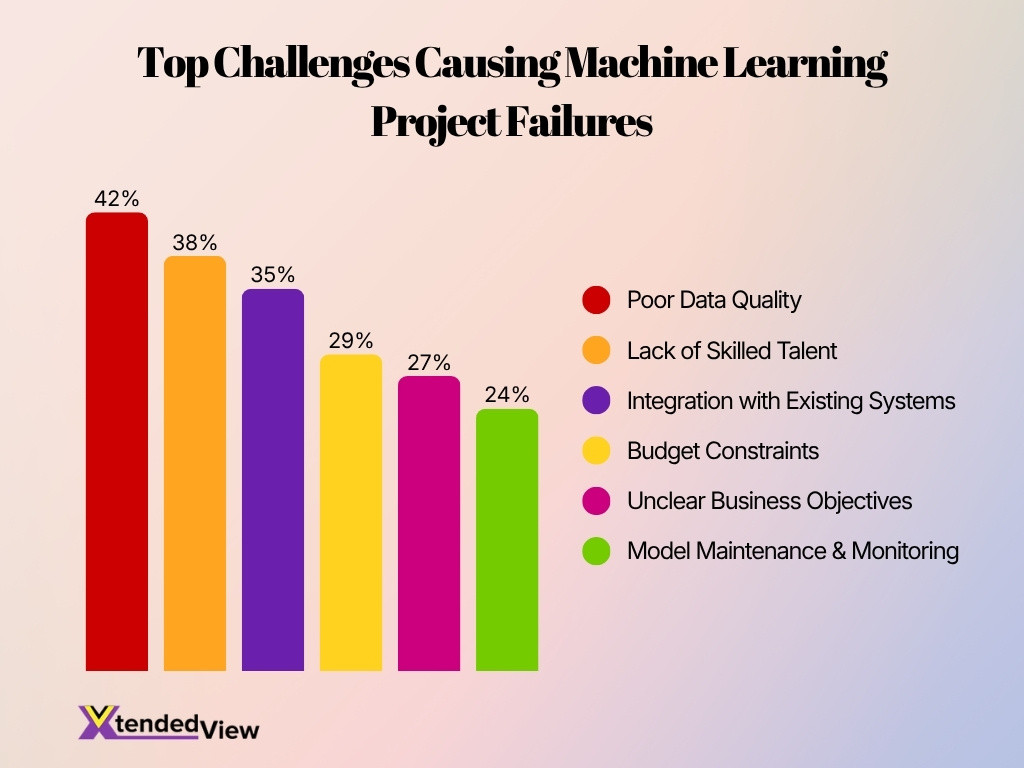
- Poor data quality is the leading challenge, reported by 42% of organizations, showing that unreliable or incomplete data remains a major barrier to successful machine learning projects.
- A lack of skilled talent affects 38% of organizations, highlighting the ongoing shortage of professionals with expertise in machine learning, data science, and model deployment.
- Integration with existing systems is a challenge for 35% of organizations, as many businesses struggle to connect new machine learning tools with legacy infrastructure and established workflows.
- Budget constraints are reported by 29% of organizations, indicating that high development, infrastructure, and staffing costs can limit machine learning implementation.
- Unclear business objectives affect 27% of organizations, suggesting that projects often fail when machine learning initiatives are not tied to measurable business outcomes.
- Model maintenance and monitoring create difficulties for 24% of organizations, emphasizing the need for continuous performance tracking, retraining, and operational support after deployment.
Geographic Trends in Machine Learning and AI Adoption
- The United States led private AI investment in 2025, spending 23 times more than China.
- The United States secured 75% of worldwide AI venture capital deal value in 2025.
- China and Europe achieved the highest year-over-year growth in organizational AI adoption during 2025.
- The Asia-Pacific region currently leads the globe in responsible AI maturity frameworks.
- Generative AI adoption reached 64% in the United Arab Emirates and 61% in Singapore.
- The United States placed 24th globally in consumer generative AI adoption at 28.3%.
- AI adoption correlates with national income levels, though several nations outperform their GDP per capita.
- North America remains the absolute largest AI investment market worldwide.
Future Machine Learning Trends and Outlook for 2030 and Beyond
- The global machine learning market is projected to surge to $1.88 trillion by 2035, reflecting massive long-term investment.
- The autonomous AI agent market is forecast to grow significantly from $8.5 billion in 2026 to $35 billion by 2030.
- Healthcare AI adoption is expected to expand rapidly, reaching between 30% and 45% by the year 2030.
- The global artificial intelligence market is anticipated to reach a massive valuation of $1.81 trillion by 2030.
- Power consumption for AI workloads is projected to roughly double to 945 TWh by 2030, reflecting immense infrastructure demands.
- The global computer vision market is expanding steadily and is projected to exceed $58 billion by 2030.
- The artificial intelligence in manufacturing sector is forecast to reach a market size of $47.9 billion by 2030.
- Generative AI could add between $400 billion and $660 billion annually to the retail sector by streamlining operations.
Frequently Asked Questions (FAQs)
Worldwide AI spending is forecast to reach $2.59 trillion in 2026, representing 47% year-over-year growth from 2025.
88% of organizations reported using AI in at least one business function in 2025, while 70% already use generative AI in at least one function.
Global corporate AI investment increased by 127.5% year over year in 2025, with private investment accounting for 60% of total AI investment.
The United States leads global private AI investment, investing approximately 23 times more than China in 2025.
AI infrastructure is projected to account for more than 45% of worldwide AI spending in 2026, making it the largest AI spending segment.
Conclusion
Machine learning has moved well beyond the experimental stage and now serves as a strategic capability for organizations across healthcare, finance, retail, manufacturing, and technology. The latest statistics show strong momentum in enterprise adoption, record investment levels, expanding workforce demand, and growing economic impact. At the same time, organizations continue to face challenges related to governance, data quality, and scaling AI across the enterprise.
As responsible AI practices mature and infrastructure investments accelerate, machine learning is expected to play an even larger role in business innovation, productivity, and economic growth through 2030 and beyond.
