


Emotional intelligence (EI) shapes how people manage emotions, build relationships, and make decisions under pressure. Companies now use EI to improve leadership development, strengthen employee engagement, and reduce workplace burnout. Healthcare organizations rely on emotionally intelligent teams to improve patient experiences, while customer-facing businesses use EI skills to increase retention and service quality. As AI automates more technical tasks, human-centered skills like empathy and self-awareness continue to gain value. Explore these statistics to understand how emotional intelligence is reshaping workplaces, careers, and organizational performance.
Editor’s Choice
- Only 36% of people worldwide demonstrate high emotional intelligence, highlighting a major opportunity for workforce development.
- Emotional intelligence accounts for about 58% of job performance across industries.
- Around 90% of top performers possess high emotional intelligence skills.
- People with high EI earn an average of $29,000 more annually than those with lower EI scores.
- Employers expect demand for emotional skills to grow by 26% by 2030, driven largely by automation and AI adoption.
- Employees with empathetic leaders report 76% higher engagement and 61% higher creativity at work.
- Companies that prioritize emotional intelligence report up to 21% higher profitability than organizations that do not.
Recent Developments
- A 2025 global study identified an ongoing “Emotional Recession,” showing declining emotional and relational capabilities among workers worldwide.
- Research published in 2025 found that 71% of employers now value emotional intelligence more than technical skills when evaluating leaders.
- Emotional intelligence skills are projected to increase sixfold over the next three to five years due to AI adoption.
- About 42% of companies worldwide currently provide emotional intelligence training for senior managers.
- Research from 2025 reported that organizations with emotionally intelligent leadership achieved 18% greater productivity.
- Glassdoor reported a 41% increase in mentions of employee fatigue in 2025, emphasizing the growing need for emotionally intelligent leadership.
- The largest workplace emotion dataset released in 2025 analyzed 733,651 emotional records collected over 30.5 months from employees in real work environments.
- A 2025 study of healthcare professionals found a strong positive relationship between emotional intelligence and workplace performance across diverse roles.
- Researchers increasingly link emotional intelligence to organizational resilience, burnout prevention, and employee retention strategies.
What Is Emotional Intelligence?
- Emotional intelligence refers to the ability to identify, understand, manage, and influence emotions in oneself and others.
- The concept gained global attention after research showed that emotional competencies often predict workplace success more accurately than IQ alone.
- Studies indicate that emotional intelligence predicts more than 75% of job success in certain professional settings.
- By 2008, at least 147 companies and consulting firms in the United States had already developed EI-based training and hiring programs.
- High emotional intelligence helps people communicate more effectively, manage conflict, and build stronger workplace relationships.
- Emotional intelligence contributes to better leadership, negotiation, and dispute resolution outcomes.
- Researchers consistently find positive correlations between emotional intelligence and both individual and team performance.
- Organizations increasingly view emotional intelligence as a core human skill that complements technological expertise and automation.
Emotional Intelligence: Key Components
- Most emotional intelligence frameworks focus on five core competencies: self-awareness, self-regulation, motivation, empathy, and social skills.
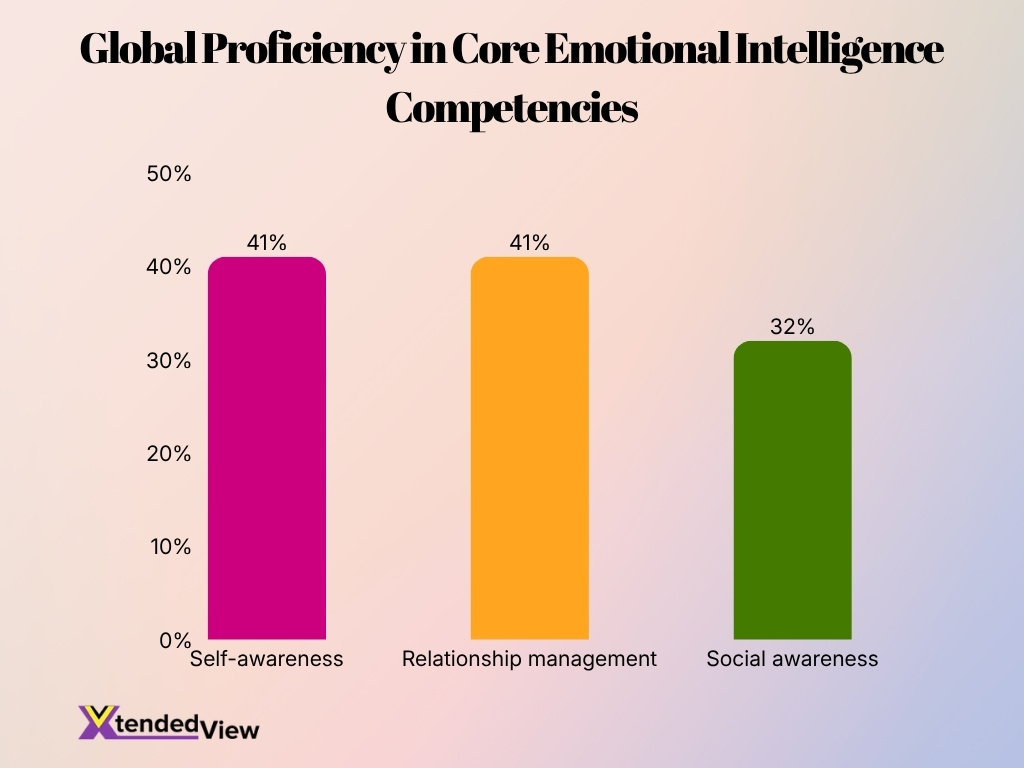
- According to the 2025 State of EQ Report, 41% of respondents scored above 80 in self-awareness.
- Relationship management also recorded 41% of respondents scoring above 80, making it one of the strongest emotional competencies globally.
- Social awareness remained comparatively weaker, with only 32% of individuals scoring above 80.
- About 23% of respondents scored below 69 in social awareness, indicating significant room for development in empathy and interpersonal understanding.
- Studies show that empathy directly improves trust and strengthens leadership effectiveness.
- Strong self-regulation skills help employees manage stress and adapt to organizational change more effectively.
- Social skills remain one of the strongest predictors of collaboration, conflict resolution, and team engagement.
- Organizations that develop these core emotional competencies often see better communication, stronger engagement, and improved workplace climates.
Global Emotional Intelligence Statistics
- Only 36% of people globally are considered emotionally intelligent according to recent assessments.
- Emotional intelligence contributes to roughly 58% of workplace success across all job categories.
- More than 80% of competencies that separate top performers from average employees involve emotional intelligence skills.
- Around 90% of top performers score high in emotional intelligence.
- Individuals with high emotional intelligence deliver performance that is approximately 127% better than employees with low EI scores.
- Companies that focus heavily on emotional intelligence are estimated to be 22 times more likely to achieve high performance.
- Approximately 60% of employees report feeling emotionally detached from their work, emphasizing the importance of emotional connection and engagement.
- Studies indicate that 75% of jobs suffer from issues linked to weak emotional skills, including poor conflict management and ineffective leadership.
- Research published in 2025 concluded that emotional intelligence remains a major predictor of resilience, employee engagement, and organizational health worldwide.
Global Trends and Demand for EI Skills
- The demand for social and emotional skills is expected to grow by 26% by 2030, making emotional intelligence one of the fastest-growing workplace competencies.
- Nearly 71% of employers say they value emotional intelligence more than technical skills when evaluating leadership potential.
- Research suggests that by 2030, two-thirds of all jobs will rely heavily on soft skills such as empathy, adaptability, and communication.
- LinkedIn’s latest workplace studies found that 92% of hiring professionals consider soft skills equally or more important than hard skills.
- About 89% of hiring failures occur because of poor soft skills rather than a lack of technical expertise.
- More than 80% of organizations now include emotional intelligence and interpersonal capabilities in leadership development programs.
- Around 63% of executives believe emotionally intelligent employees adapt to change faster than employees with lower EI.
- Surveys show that 61% of workers expect their employers to invest more in emotional and social skills training over the next few years.
- AI adoption has increased demand for uniquely human skills, and emotional intelligence now ranks among the top five skills employers seek globally.
Emotional Intelligence Statistics in the Workplace
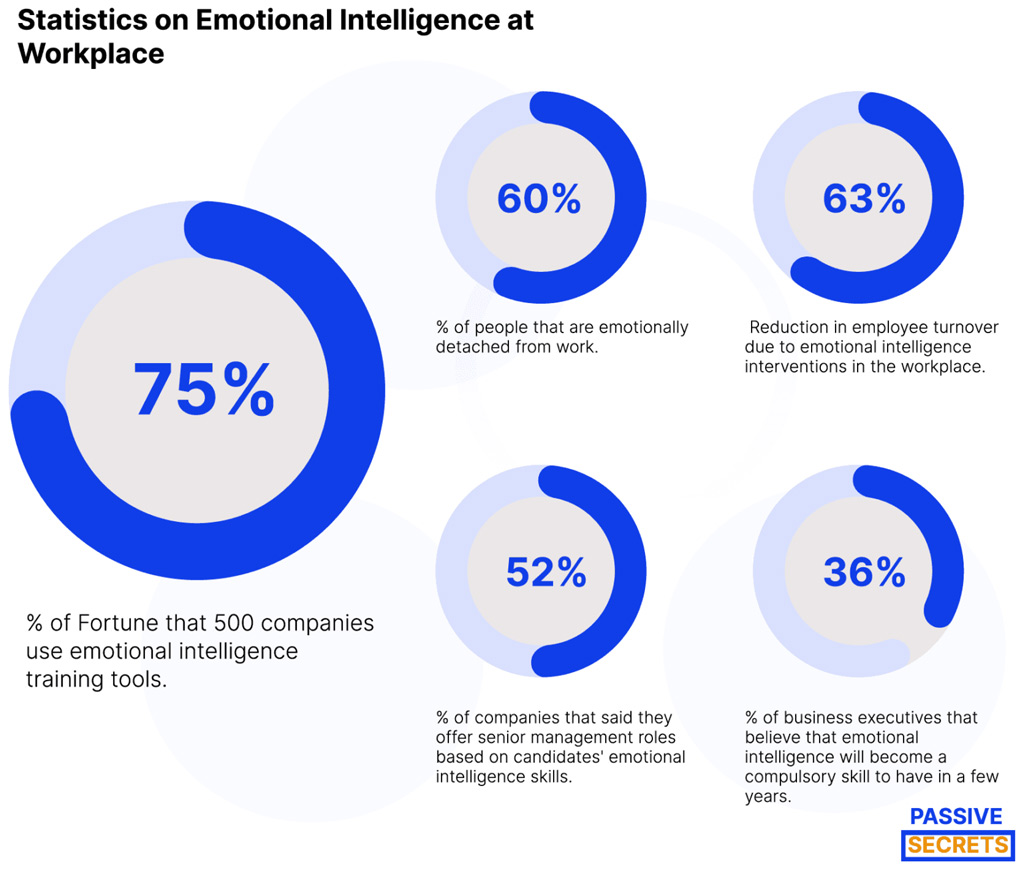
- 75% of Fortune 500 companies use emotional intelligence training tools to improve employee and leadership performance.
- 63% reduction in employee turnover can be achieved through emotional intelligence interventions in the workplace.
- 60% of employees are emotionally detached from work, highlighting the need for stronger workplace engagement strategies.
- 52% of companies consider emotional intelligence skills when offering senior management roles to candidates.
- 36% of business executives believe emotional intelligence will become a compulsory workplace skill within the next few years.
EI and Employee Performance
- Emotional intelligence accounts for 58% of workplace performance across all professional roles.
- Employees with high emotional intelligence achieve performance outcomes that are 127% better than average.
- Emotionally intelligent professionals earn an average of $29,000 more annually than lower-EI peers.
- A massive 90% of top-performing employees possess remarkably high emotional intelligence.
- In contrast, only 20% of bottom-performing workers exhibit high emotional intelligence traits.
- Emotionally intelligent staff members resolve workplace conflicts up to two times faster.
- Teams with strong emotional intelligence demonstrate a 25% increase in overall productivity.
- Companies prioritizing emotional skills report a 50% reduction in employee turnover.
EI and Career Outcomes (Salary & Promotion)
- People with high emotional intelligence earn approximately $29,000 more annually than those with lower emotional intelligence scores.
- About 75% of long-term career success depends on soft skills and emotional competencies rather than technical knowledge alone.
- A staggering 71% of employers explicitly value emotional intelligence over IQ when making hiring and promotion decisions.
- Emotional intelligence is the strongest predictor of workplace success, accounting for 58% of job performance across all types of roles.
- Every single point increase in an individual’s emotional intelligence score actively adds roughly $1,300 to their annual salary.
- Approximately 90% of the highest-performing employees in the workplace possess significantly high levels of emotional intelligence.
- An estimated 75% of managers actively use emotional intelligence to determine if employees are ready for a promotion or a salary increase.
- Employees with high emotional intelligence deliver workplace performance that is approximately 127% better than their low-EI counterparts.
- Over 59% of employers report they would entirely pass on a candidate with a high IQ if they demonstrated a low emotional intelligence score.
EI and Leadership Effectiveness
- About 90% of top-performing leaders demonstrate high emotional intelligence.
- Leaders with high emotional intelligence are 40% more effective at coaching and developing employees.
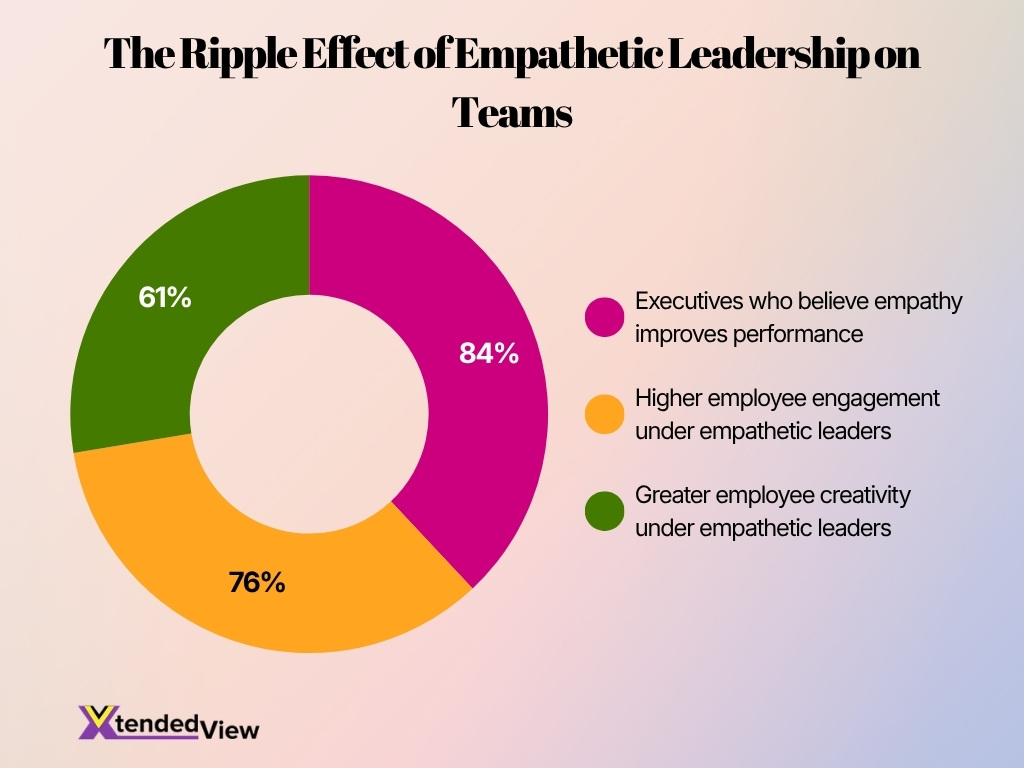
- Employees working under empathetic leaders report 76% higher engagement and 61% greater creativity.
- Teams led by emotionally intelligent managers are 50% less likely to experience high turnover.
- Approximately 84% of executives believe empathy improves leadership performance.
- Leaders who demonstrate emotional intelligence receive significantly higher trust ratings from employees than managers with low EI.
- Studies show emotionally intelligent leaders generate 20% higher team performance compared with leaders who score low in emotional competencies.
- Organizations with emotionally intelligent leadership pipelines report 22% better succession outcomes.
- Companies with highly empathetic senior leaders are more likely to outperform competitors on innovation and employee satisfaction measures.
EI and Team Performance
- Teams with high collective emotional intelligence show 20% to 30% higher productivity than teams with weaker emotional competencies.
- Research found that emotionally intelligent teams are 50% more effective at managing conflict and reaching consensus.
- Teams with strong emotional awareness report 21% higher profitability and 17% higher productivity than less-engaged teams.
- Employees working in emotionally supportive teams are three times more likely to collaborate effectively across departments.
- A 2025 workplace study showed that teams led by emotionally intelligent managers demonstrated significantly higher trust and communication scores.
- Organizations with emotionally intelligent teams report lower levels of workplace tension and fewer interpersonal disputes.
- Teams that score highly on empathy and relationship management adapt faster during organizational change initiatives.
- Emotional intelligence training has been linked to improvements in team cohesion and decision-making quality across healthcare, education, and technology sectors.
- Employees in high-EI teams report stronger psychological safety and are more willing to share new ideas and feedback.
EI and Organizational Performance
- Companies investing in emotional intelligence initiatives are 22 times more likely to achieve high business performance.
- Organizations with highly engaged employees experience 23% greater profitability than those with low engagement.
- Workplaces that foster strong emotional cultures observe an 18% increase in overall employee productivity.
- Leaders possessing high emotional intelligence account for 90% of what differentiates top organizational performers.
- Teams demonstrating high workplace empathy experience a 50% reduction in overall employee turnover rates.
- Sales professionals with strong emotional intelligence consistently generate 50% more revenue than their peers.
- Strategic investments in emotional intelligence training yield a return on investment of $5.24 per dollar.
- Organizations prioritizing emotionally intelligent leadership report a 20% improvement in customer satisfaction metrics.
EI and Employee Engagement & Retention
- Employees with high emotional intelligence are four times less likely to quit their jobs.
- Workers feeling emotionally supported by leaders are five times more likely to trust leadership.
- Staff members with empathetic managers are 3.2 times more likely to stay engaged at work.
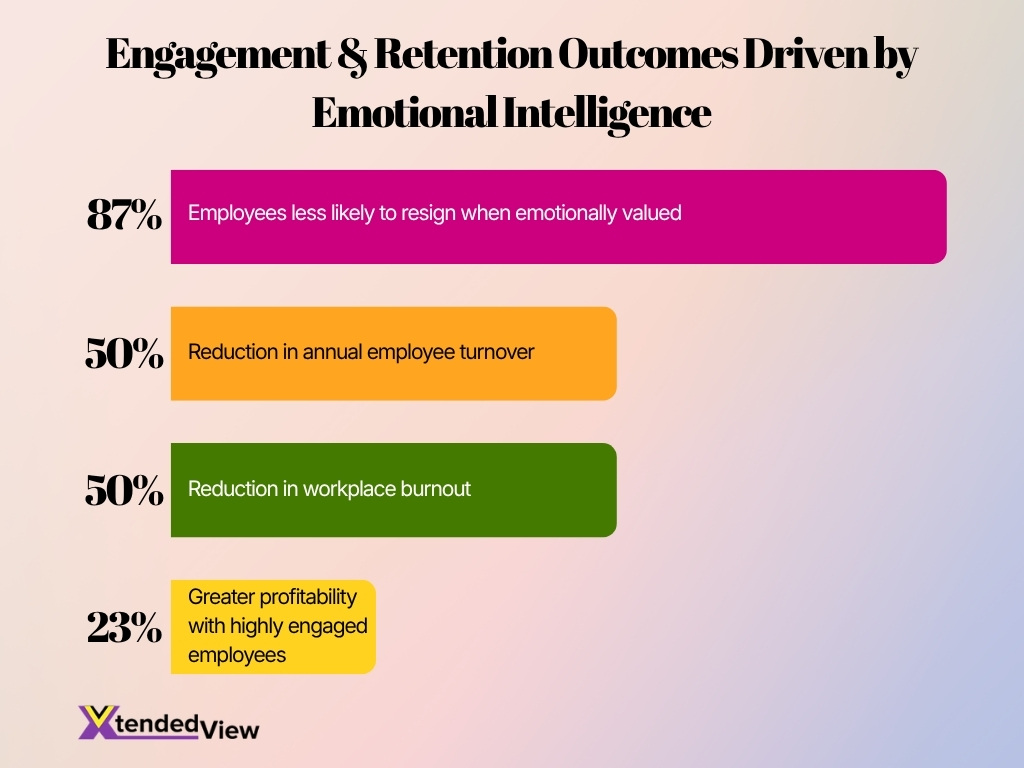
- Organizations featuring highly engaged employees report 23% greater profitability overall.
- Companies prioritizing emotional intelligence experience a 50% reduction in annual employee turnover.
- Professionals utilizing strong emotional intelligence report experiencing 50% less workplace burnout.
- Employees feeling emotionally valued and understood are 87% less likely to resign from their roles.
- Workplaces driven by empathetic leadership observe a 20% increase in long-term employee retention.
EI and Mental Health / Well-being
- Employees with high emotional intelligence report 23% lower stress levels than those with lower scores.
- Individuals possessing high EI are 50% less likely to suffer from severe workplace burnout.
- Implementing EI training programs can effectively reduce employee anxiety by up to 31%.
- Leaders displaying strong emotional intelligence manage teams with 70% fewer mental health absences.
- High emotional intelligence is directly linked to a 40% increase in overall psychological resilience.
- Workers practicing active emotional regulation demonstrate a 35% improvement in daily mental well-being.
- Organizations prioritizing emotional support observe a 25% decrease in chronic depression symptoms.
- Staff members guided by empathetic managers are 60% more satisfied with their mental health.
EI Assessment and Measurement Methods
- 71% of employers state they value emotional intelligence over cognitive ability during the hiring process.
- Studies indicate that 90% of top workplace performers possess exceptionally high emotional intelligence scores.
- Emotional intelligence accounts for approximately 58% of overall job performance across all professional industries.
- Professionals with high EI scores earn an average of $29,000 more annually than their lower-scoring peers.
- Over 75% of hiring managers utilize targeted behavioral interview questions specifically to assess emotional competencies.
- Approximately 80% of critical leadership competencies that differentiate top performers are based on emotional intelligence.
- Organizations actively integrating EI assessments into their culture experience up to 20% higher employee retention rates.
- Research indicates that only 36% of individuals can accurately identify and measure their emotions as they occur.
- Over 70% of Fortune 500 companies now utilize formal EI assessments for effective leadership development.
Gender Differences in Emotional Intelligence
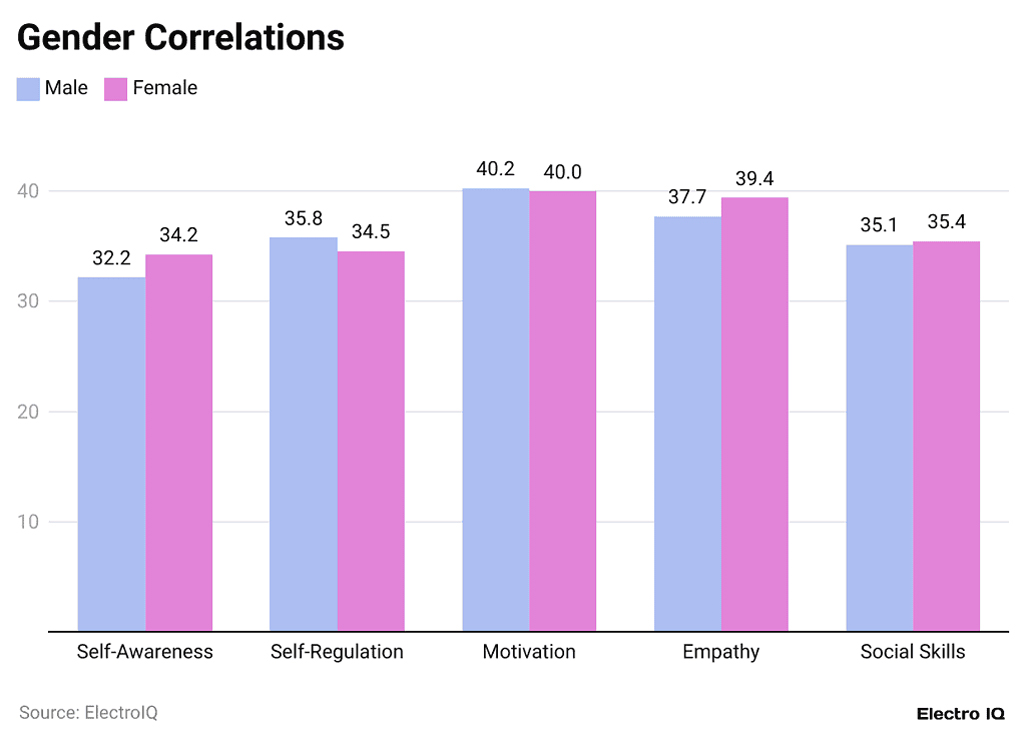
- Motivation recorded the highest scores for both genders, with 40.2 for males and 40.0 for females.
- Females scored higher in Self-Awareness, reaching 34.2 compared to 32.2 for males.
- Males slightly outperformed females in Self-Regulation, scoring 35.8 versus 34.5.
- Empathy was stronger among females, who achieved 39.4, compared to 37.7 for males.
- Social Skills scores were nearly identical, with 35.4 for females and 35.1 for males.
- The largest gender gap appeared in Self-Awareness, where females led by 2.0 points.
- Motivation showed the smallest gender difference, with only a 0.2-point gap between males and females.
- Across the five emotional intelligence competencies, females led in three categories, while males led in two.
- All emotional intelligence scores ranged between 32.2 and 40.2, indicating relatively balanced performance across genders.
- The findings suggest that gender differences in emotional intelligence are modest, with strengths varying by competency.
Use of EI Tests in Hiring and Promotion
- Nearly 60% of employers now consider emotional intelligence when making hiring decisions.
- About 71% of employers value emotional intelligence more than technical skills in leadership evaluations.
- Approximately 75% of HR managers believe emotional intelligence predicts workplace success better than IQ alone.
- Over 90% of top performers across industries possess high emotional intelligence.
- Companies report a 50% reduction in turnover when integrating EI assessments into their hiring processes.
- Candidates with high emotional intelligence are 2.5 times more likely to be selected for promotions.
- Roughly 68% of organizations currently utilize some form of emotional intelligence testing for executive roles.
- Employees with strong emotional intelligence generate up to 20% more revenue in sales-driven positions.
Training and Development for EI
- Around 42% of organizations globally provide emotional intelligence training for managers and executives.
- Organizations that invest in emotional intelligence development experience a 63% reduction in employee turnover.
- Emotional intelligence training leads to a 30% improvement in leadership effectiveness and communication.
- Companies utilizing emotional intelligence programs report a 25% decrease in workplace interpersonal friction.
- Leaders who undergo targeted EI development experience 51% less burnout and drive 56% higher performance.
- Employees participating in emotional intelligence initiatives are 4 times more likely to be highly engaged at work.
- Teams led by managers with high emotional intelligence achieve a 20% boost in customer service satisfaction.
- Integrating emotional intelligence into long-term strategies can yield an ROI exceeding 1000% for organizations.
- Over 75% of managers prioritize emotional intelligence skills when considering employees for promotions and raises.
Frequently Asked Questions (FAQs)
People with high emotional intelligence earn an average of $29,000 more per year than individuals with low emotional intelligence.
Around 90% of top performers demonstrate high emotional intelligence skills.
Emotional intelligence accounts for approximately 58% of job performance across all types of jobs.
The demand for emotional and social skills is projected to grow by 26% by 2030.
About 42% of companies worldwide provide emotional intelligence training programs for their senior managers.
Conclusion
Emotional intelligence has evolved from a soft-skill concept into a measurable driver of workplace performance, leadership success, and employee well-being. The latest data shows that organizations with emotionally intelligent cultures experience stronger engagement, higher productivity, and better retention outcomes. At the individual level, employees with high emotional intelligence often earn more, advance faster, and manage stress more effectively.
As automation and AI reshape the global economy, emotional intelligence is becoming one of the most valuable human capabilities in the workforce. Companies that invest in empathy, self-awareness, and relationship management will likely gain an advantage in attracting talent, improving collaboration, and building resilient organizations.
