



The dark web remains one of the most closely monitored areas of the internet due to its connection with cybercrime, data breaches, ransomware operations, and illicit marketplaces. At the same time, journalists, activists, and privacy-focused users continue to rely on anonymous networks for secure communication. Organizations use dark web intelligence to detect leaked credentials, while law enforcement agencies track criminal activity and underground marketplaces. Explore the latest dark web statistics to understand its scale, growth, users, and evolving global impact.
Editor’s Choice
- Approximately 3 million people access the Tor network daily as of 2025, making it the primary gateway to the dark web.
- Darknet market activity generated nearly $2.6 billion in cryptocurrency flows during 2025, highlighting the resilience of underground marketplaces.
- Global cybercrime costs are projected to reach $10.5 trillion annually in 2025, with dark web ecosystems playing a central role in facilitating attacks.
- Illicit cryptocurrency addresses received an estimated $40.9 billion in 2024, although investigators expect the final figure to increase as additional addresses are identified.
- More than 56% of dark web content is associated with illegal activities, including fraud, drugs, stolen data, and cybercrime services.
- The Tor ecosystem supports an estimated 65,000 to 100,000 active .onion services worldwide.
- Darknet markets received over $2 billion in Bitcoin inflows during 2024, despite ongoing law enforcement takedowns.
Recent Developments
- Aggregate darknet market flows climbed to nearly $2.6 billion in 2025, reflecting continued demand for illicit goods and services.
- Total ransomware payments fell by approximately 8% to $820 million in 2025, even though reported ransomware incidents increased significantly.
- The median ransomware payment surged by 368% year over year, reaching nearly $60,000 in 2025.
- Reported internet crime losses in the United States exceeded $12.5 billion, increasing by more than 20% year over year.
- Dark web-enabled cybercrime continued expanding through fraud-as-a-service, malware-as-a-service, and ransomware affiliate programs during 2025.
- Investigators reported that illicit cryptocurrency revenue remained concentrated among professional criminal organizations despite market disruptions.
- Several major darknet markets survived enforcement pressure by rapidly migrating vendors and users to replacement platforms.
- The Tor network maintained between 2.5 million and 3 million daily users throughout 2025 and early 2026.
- Cybersecurity researchers observed growing adoption of privacy-focused cryptocurrencies and anonymization services across underground marketplaces.
Dark Web Intelligence Market Growth Statistics
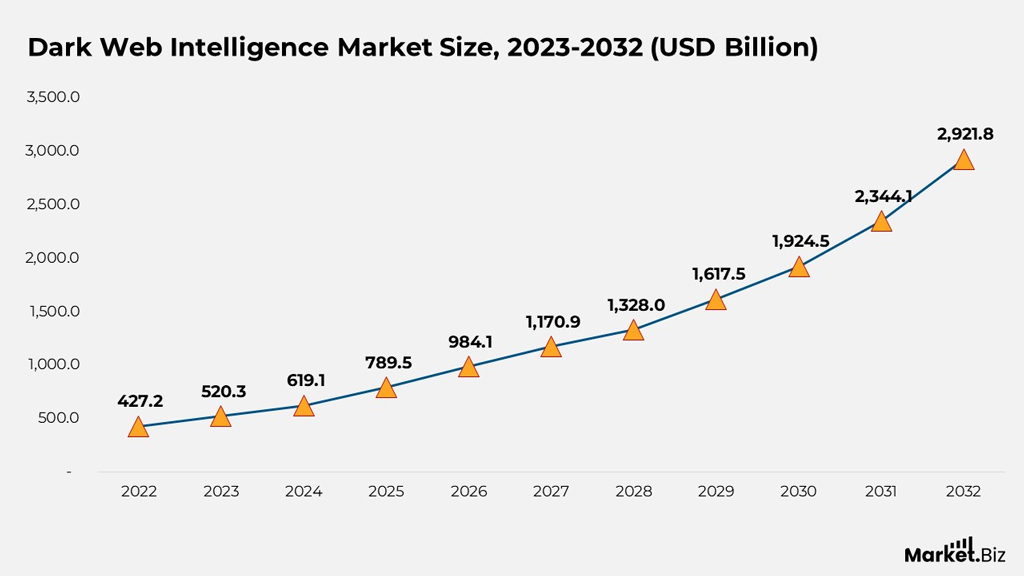
- The Dark Web Intelligence market is projected to grow from $520.3 billion in 2023 to $2,921.8 billion by 2032, highlighting rapid long-term expansion.
- Market size is expected to increase by more than 5.6 times between 2023 and 2032.
- The industry is forecast to surpass the $1 trillion mark in 2027, reaching $1,170.9 billion.
- By 2029, the market is projected to reach $1,617.5 billion, exceeding the $1.5 trillion threshold.
- The market is expected to grow from $1,924.5 billion in 2030 to $2,344.1 billion in 2031, an increase of nearly $420 billion in a single year.
- Between 2031 and 2032, the market is forecast to expand by approximately $577.7 billion, the largest annual increase in the period.
- The market is projected to cross $2 trillion in 2031, reflecting accelerating demand for cyber threat intelligence solutions.
- From 2025 to 2026, the market is expected to grow from $789.5 billion to $984.1 billion, adding nearly $195 billion.
- The industry is forecast to nearly double from $984.1 billion in 2026 to $1,924.5 billion in 2030.
- Overall market value is expected to increase by approximately $2.4 trillion between 2023 and 2032.
Dark Web Statistics: Global Usage and User Demographics
- An estimated 3 million people use Tor daily worldwide as of 2025.
- Daily dark web traffic consistently ranges between 2 million and 3 million users.
- The United States accounts for approximately 15% to 21% of global Tor users.
- Germany represents a significant portion, contributing roughly 12% to 13% of daily Tor traffic.
- India accounts for nearly 4% of the total Tor user base on a typical day.
- The Tor Browser has surpassed 200 million cumulative downloads globally.
- Approximately 75% of the dark web user demographic is estimated to be male.
- The 25 to 34 age group makes up the largest demographic segment of dark web users.
- Roughly 57% of dark web content involves illegal activity.
- Only 6% to 7% of daily users actively engage with hidden .onion services.
Dark Web Statistics: Cybercrime Marketplace Statistics
- Darknet marketplaces processed an estimated $2.6 billion in cryptocurrency transactions during 2025.
- More than 50 active darknet marketplaces operated globally with concentrated market share throughout 2025.
- Marketplace operators typically charge vendors commissions ranging from 2% to 10% per transaction.
- Cryptocurrency remains the preferred payment method, accounting for virtually 100% of marketplace settlements.
- Security researchers identified thousands of active vendors selling illicit products across major darknet markets.
- Fraud shops specializing in stolen accounts and financial data generated approximately $87.5 million in 2025.
- Exit scams continue to affect underground markets, with operators disappearing with millions of dollars in user funds.
- In 2025, dark web listings featured more than 140 million stolen credit card records for sale.
- Cybercriminals sell stolen U.S. Social Security Numbers for as little as $1 to $6 per record.
- The global dark web marketplace ecosystem experienced a 28% overall growth despite enforcement actions in 2025.
Tor User Activity by Country
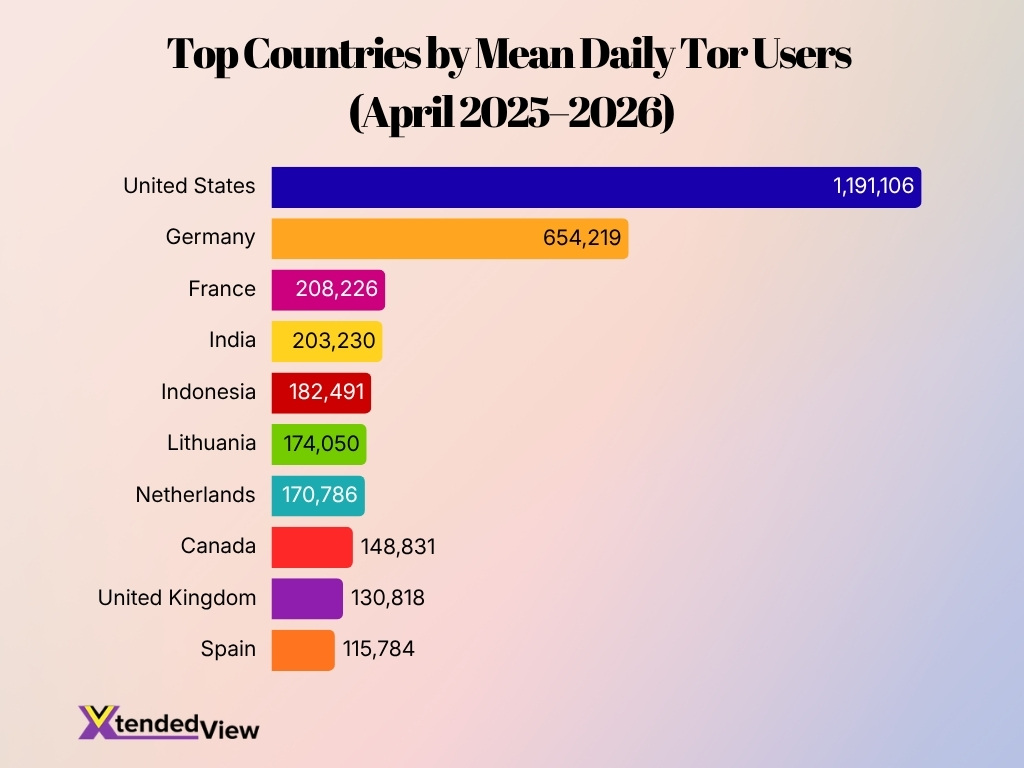
- The United States led global Tor usage with 1,191,106 mean daily users, nearly 1.8× higher than Germany.
- Germany ranked second with 654,219 daily users, highlighting strong adoption of privacy-focused browsing tools.
- France recorded 208,226 users, narrowly surpassing India with 203,230 users.
- India ranked fourth globally, demonstrating significant demand for anonymous internet access among its large online population.
- Indonesia reached 182,491 daily users, making it the highest-ranked country in Southeast Asia on the list.
- Lithuania posted 174,050 users, an impressive figure given its relatively small population size.
- The Netherlands reported 170,786 users, reflecting continued interest in digital privacy and secure communications.
- Canada averaged 148,831 daily users, placing it eighth among the top Tor-using countries.
- The United Kingdom recorded 130,818 users, maintaining a strong presence among the leading Tor markets.
- Spain rounded out the top ten with 115,784 daily users, indicating widespread use of privacy-enhancing technologies.
- The top two countries, the United States and Germany, together accounted for more than 1.84 million daily Tor users.
- Every country in the top ten recorded over 100,000 mean daily users, underscoring Tor’s broad international adoption.
Dark Web Statistics: Compromised Credentials and Password Leaks
- Over 24 billion records, including usernames and plaintext passwords, were discovered in an exposed database in 2026.
- The dark web currently hosts approximately 10 billion unique username and password combinations available for threat actors.
- Recent comprehensive leak analysis revealed over 27 billion compromised credential records across underground forums.
- Compromised credentials serve as the leading entry method for cyber intrusions, accounting for 22% of all attacks.
- On average, 43% of employees at mid-sized companies have their leaked credentials available on the dark web.
- More than 1.7 billion stolen credential records are actively shared and traded on underground Telegram channels.
- The massive “Mother of all Breaches” in 2024 alone exposed over 26 billion records containing vital login details.
- Widespread data leak analyses demonstrate a seven-time redundancy in duplicate combinations of stolen credential pairs.
Dark Web Statistics: Financial Fraud and Banking Scams
- The FBI reported that overall cybercrime losses reached a record $16.6 billion in 2024.
- Investment fraud emerged as the highest source of financial loss, totaling $8.6 billion in 2025.
- More than 140 million stolen credit card records were listed for sale on dark web marketplaces in 2025.
- Cybercriminals sell compromised online bank account logins for $200 to $2,000, depending on the available balance.
- Complete identity packages, containing a name, address, and social security number, sell for just $20 to $100.
- The exposure of full credit card numbers combined with personal names was detected in 94.2% of dark web data leaks in 2025.
- Business email compromise schemes accounted for $2.7 billion in reported financial losses in 2024.
- Dark web marketplaces experienced a 28% growth in 2025 despite aggressive law enforcement takedowns.
- Older individuals aged 60 and older reported the largest aggregate losses from online scams, totaling $4.8 billion in 2024.
- Compromised business email accounts grew by 12.7% in 2025, accounting for almost 10% of total exposed accounts.
Dark Web Statistics: Prices of Stolen Data and Identities
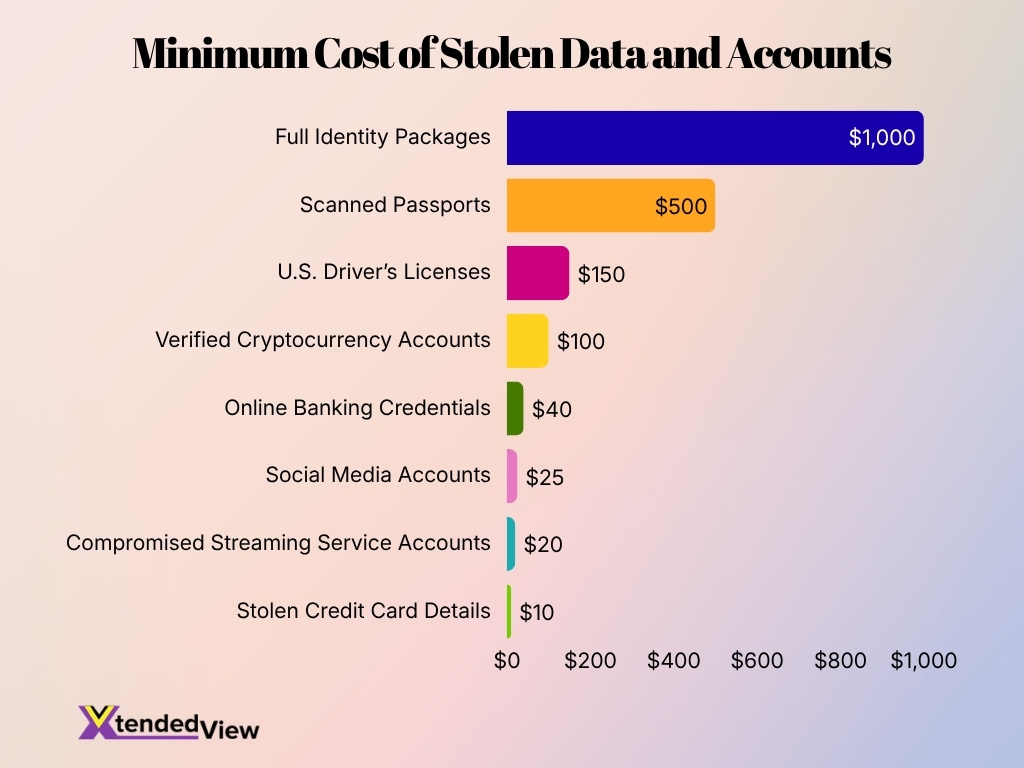
- A stolen credit card with complete cardholder information typically sells for $10 to $120, depending on balance and issuing country.
- Full identity packages containing name, address, Social Security number, and financial information often sell for $1,000 or more.
- Online banking credentials can command prices ranging from $40 to over $500, depending on account value.
- Verified cryptocurrency exchange accounts frequently sell for $100 to $410.
- Scanned passports from developed countries often sell for $500 to $4,000.
- Compromised streaming service accounts remain inexpensive, with many listings priced below $20.
- Fraudsters can purchase hacked social media accounts for as little as $25 to $60.
- Medical records continue to command higher prices than payment cards because of their long-term fraud potential.
- Driver’s licenses from the United States commonly sell for $150 to $300, depending on the state and quality.
- Synthetic identity kits combining multiple stolen data points remain one of the fastest-growing product categories in underground markets.
Dark Web Statistics: Cybercrime-as-a-Service and Hacking
- Cybercrime-as-a-Service (CaaS) has become a multi-billion-dollar underground economy supporting ransomware, phishing, malware, and credential theft operations.
- Malware kits can be rented for as little as $50 to $500 per month, lowering barriers to entry for cybercriminals.
- Ransomware affiliate programs often provide operators with 70% to 90% of ransom proceeds.
- Phishing kits are commonly sold for less than $100, making them accessible to inexperienced attackers.
- Initial access brokers generated millions in revenue by selling compromised corporate network access during 2025.
- Underground forums increasingly offer subscription-based hacking services with technical support.
- Distributed denial-of-service (DDoS) attack services can be rented for less than $20 per attack.
- Researchers observed rising demand for AI-enhanced phishing and social engineering tools during 2025.
- Cybercrime service providers often advertise success guarantees and refund policies to attract customers.
- The professionalization of underground hacking services continues to accelerate across global dark web communities.
Dark Web Statistics: Ransomware and Extortion Activities
- Ransomware victims paid approximately $820 million in cryptocurrency during 2025.
- The median ransomware payment increased by 368% year over year during 2025.
- More than 5,400 publicly disclosed ransomware victims were listed on leak sites during 2024.
- Double-extortion tactics remain the dominant ransomware model used by major groups.
- Manufacturing, healthcare, government, and professional services organizations continue to rank among the most targeted sectors.
- Ransomware operators increasingly rely on affiliates rather than conducting attacks directly.
- Data theft now accompanies the majority of high-profile ransomware incidents.
- Law enforcement disruptions have fragmented major ransomware groups, but replacement groups emerge rapidly.
- Initial access brokers play a significant role in supplying ransomware operators with network access.
- Dark web leak sites remain central to extortion strategies, allowing attackers to pressure victims through public exposure threats.
Dark Web Categories Statistics
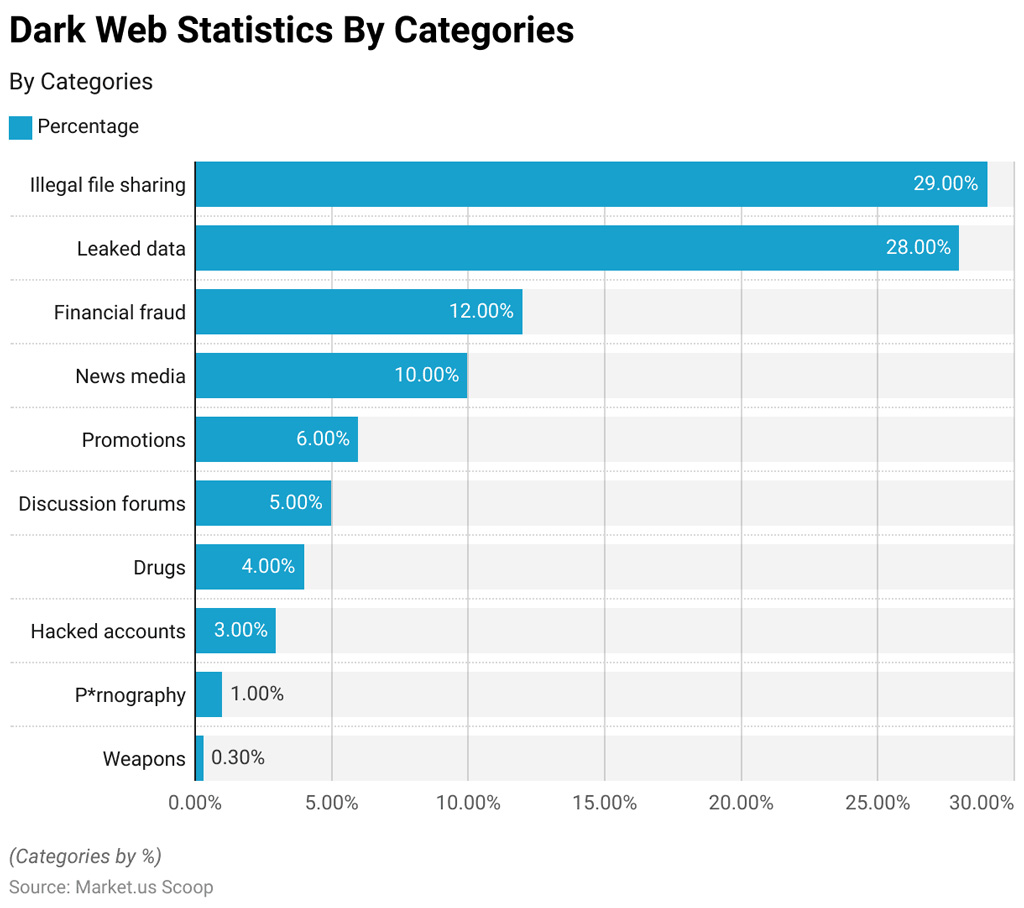
- Illegal file sharing dominates dark web activity, accounting for 29% of all tracked categories.
- Leaked data represents 28%, making stolen and exposed information one of the most common dark web commodities.
- Financial fraud contributes 12%, highlighting the significant role of scams and illicit financial activities.
- News media content accounts for 10%, showing that information sharing remains a notable use of the dark web.
- Promotions make up 6% of activity, indicating ongoing marketing and advertising efforts within hidden networks.
- Discussion forums represent 5%, serving as hubs for communication and community interaction.
- Drugs account for 4% of dark web categories, a smaller share than often perceived.
- Hacked accounts comprise 3%, reflecting continued demand for compromised credentials.
- Pornography represents only 1% of tracked activity on the dark web.
- Weapons have the smallest share at just 0.3%, making them one of the least represented categories in this dataset.
Dark Web Statistics: Cryptocurrency Usage and Transactions
- Illicit cryptocurrency addresses received an estimated $40.9 billion in 2024 and a record $154 billion in 2025.
- Darknet marketplaces and drug vendors processed over $2.5 billion in illicit cryptocurrency transactions during 2025.
- Stablecoins now dominate the illicit economy, accounting for 84% of all criminal transaction volume in 2025.
- The TRON blockchain processed the majority of illicit cryptocurrency activity in 2024, representing 58% of total volume.
- State-sponsored hackers stole $2 billion in cryptocurrency during 2025, including a single $1.5 billion exchange exploit.
- Cryptocurrency-related investment scams and fraud schemes generated a massive $23 billion in illicit inflows throughout 2025.
- Fraud shop cryptocurrency revenues declined by more than 50%, falling to roughly $225 million in 2024.
- Global law enforcement agencies have successfully seized over $34 billion in illicit funds using advanced blockchain tracing.
- Private key compromises accounted for nearly 43.8% of all stolen cryptocurrency during widespread hacking campaigns in 2024.
- Sanctioned entities and designated jurisdictions drove a massive 694% growth in illicit cryptocurrency activity throughout 2025.
Dark Web Statistics: Illicit Drug and Weapons Trade
- Drug-related products account for 48% to 62% of all active listings on major darknet marketplaces.
- Global darknet drug sales generated over $2.5 billion annually in cryptocurrency transactions.
- Cannabis products are roughly 10 times more prevalent than opiates on the darknet.
- Russian-language marketplaces drive over 97% of the total volume of illicit drug sales.
- Firearms and weapons make up only 0.3% of the total content across the dark web.
- Researchers identified over 35,000 weapon listings, with the United States making up 60% of sales.
- Europe accounts for 25% of weapon sales, representing the second-largest demand on the dark web.
- Law enforcement recently seized over $22 million in assets tied to dark web activities.
- New darknet marketplaces dropped by 42% as vendors shifted to encrypted messaging apps.
- Darknet markets facilitate nearly 20% of all global drug sales by transaction volume.
Consumer Data Most Frequently Leaked on the Dark Net
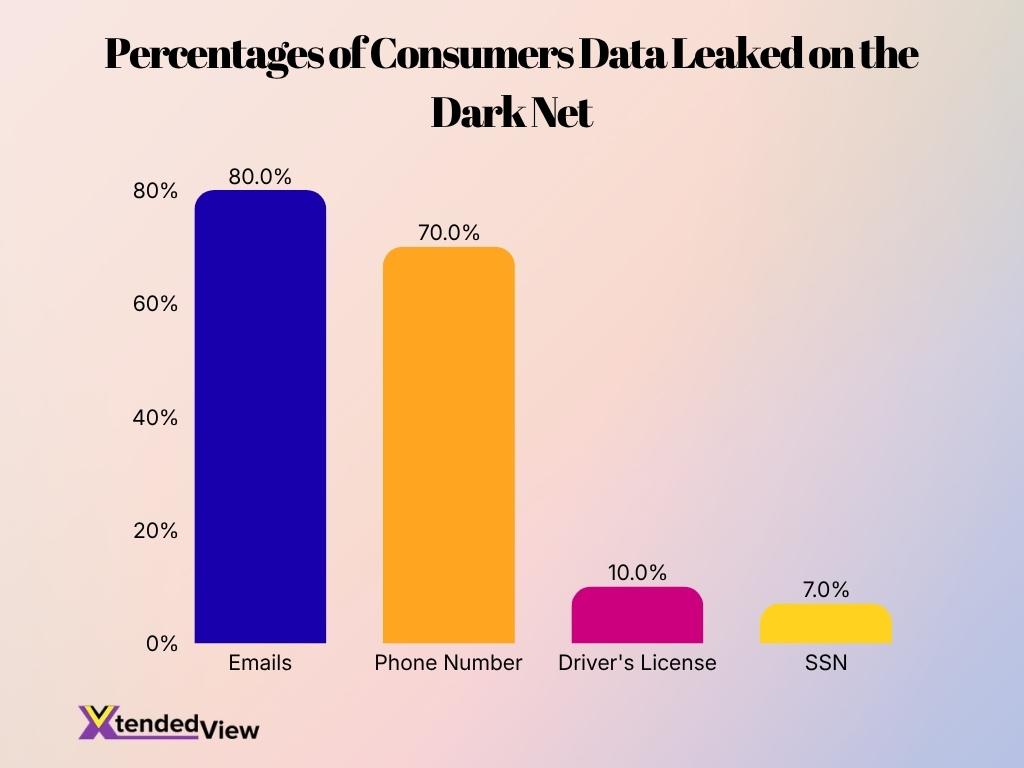
- Email addresses are the most commonly exposed data type, appearing in 80% of dark web data leaks.
- Phone numbers are the second most leaked consumer information category, accounting for 70% of exposed records.
- Driver’s license details are significantly less common but still appear in 10% of dark web data breaches.
- Social Security Numbers (SSNs) represent 7% of leaked consumer data, posing a serious identity theft risk.
- The gap between emails (80%) and driver’s licenses (10%) highlights how contact information is far more frequently compromised.
- Combined, emails and phone numbers dominate dark web leaks, making them the most vulnerable forms of consumer data.
- Despite lower exposure rates, leaked SSNs (7%) can have a greater long-term impact due to their use in financial and identity fraud.
Dark Web Statistics: Financial Impact of Corporate Breaches
- The global average cost of a data breach reached a record $4.88 million in 2024.
- Ransomware attacks involving data exfiltration cost organizations an average of $5.08 million.
- Breaches involving compromised credentials require an average of 292 days to identify and contain.
- The industrial sector faces severe financial impacts, with average data breach costs reaching $5.56 million.
- Business interruption and unplanned downtime from cyberattacks can cost organizations up to $125,000 per hour.
- Public companies experience an average immediate stock value loss of 1.12% following a data breach.
- Third-party vendor compromises represent the second costliest attack vector at $4.91 million per incident.
- Healthcare organizations consistently record the highest industry breach costs, averaging $9.77 million.
Dark Web Statistics: Law Enforcement Takedowns
- Operation SpecTor led to 288 arrests and seized $53.4 million in cash and cryptocurrencies.
- Authorities confiscated 850 kilograms of illicit drugs and 117 firearms during Operation SpecTor.
- A historic law enforcement operation seized over $3.36 billion in cryptocurrency linked to a defunct darknet marketplace.
- Operation RapTor successfully resulted in 270 arrests and recovered over $200 million in illicit funds.
- A massive 2022 international takedown disrupted a platform responsible for 80% of all darknet cryptocurrency transactions.
- Operation DisrupTor in 2020 successfully apprehended 179 individuals involved in illicit online networks.
- The 2021 Operation Dark HunTor led to the arrest of 150 suspected vendors and buyers.
- Law enforcement recently dismantled a dark web crypto laundering network responsible for moving $24 million.
Dark Web Exposure Risks Across Industries
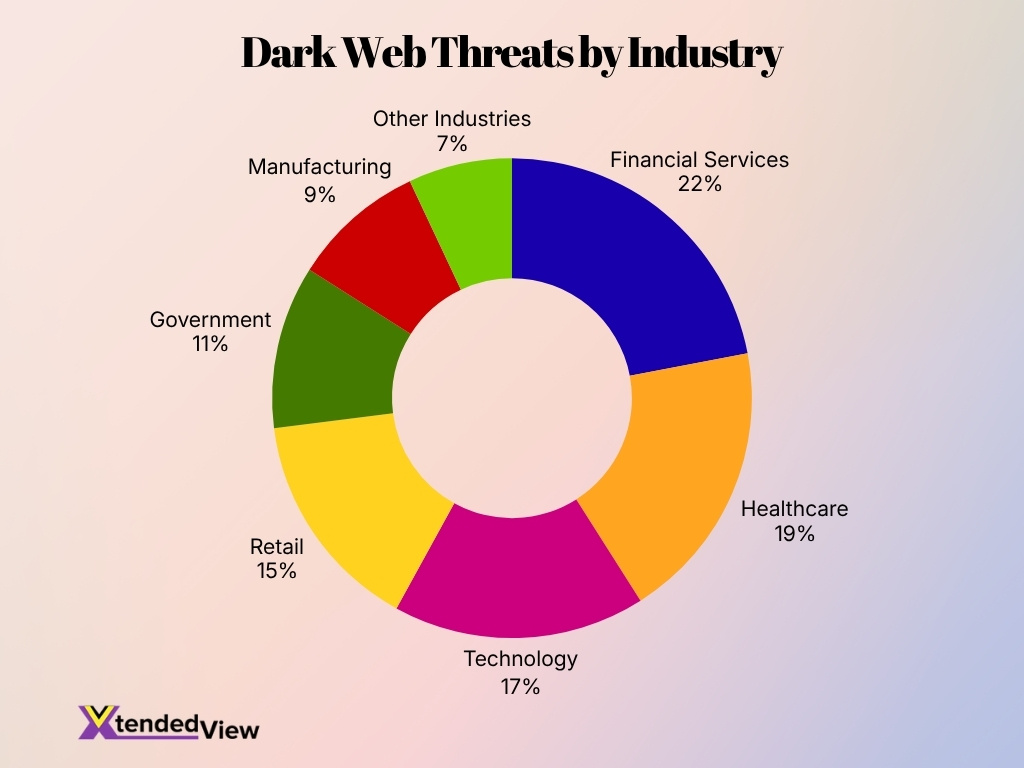
- Financial Services faces the highest dark web exposure, accounting for 22% of all exposed records across industries.
- Healthcare ranks second with 19%, highlighting the sector’s ongoing vulnerability to data breaches and patient record leaks.
- Technology companies represent 17% of exposed records, reflecting the value of intellectual property and user data to cybercriminals.
- Retail accounts for 15% of exposures, driven by attacks targeting customer payment and personal information.
- Government organizations make up 11% of exposed records, indicating persistent threats to public sector data security.
- Manufacturing contributes 9% of exposed records, showing growing cyber risks to industrial operations and supply chains.
- Other Industries collectively represent 7% of exposed records, demonstrating that dark web threats affect nearly every sector.
- The top three sectors, Financial Services, Healthcare, and Technology, account for 58% of all exposed records, making them the primary targets for cybercriminals.
Dark Web Statistics: Threat Intelligence Market Growth
- The global cyber threat intelligence market was valued at approximately $14.7 billion in 2024.
- Analysts project the market will exceed $40 billion by 2032, reflecting strong enterprise demand.
- Dark web intelligence represents one of the fastest-growing segments of cybersecurity spending.
- The dark web intelligence market alone was valued at roughly $520 million in 2023.
- Market forecasts suggest dark web intelligence solutions could surpass $2.9 billion by 2032.
- Enterprises increasingly use dark web monitoring to detect exposed credentials, leaked data, and emerging threats.
- Financial services organizations rank among the largest buyers of threat intelligence solutions.
- Artificial intelligence is accelerating the collection and analysis of dark web threat data.
- Security operations centers increasingly integrate dark web intelligence feeds into detection platforms.
- Demand for proactive threat hunting continues to drive investment in dark web monitoring services.
Dark Web Statistics: Future Trends and Outlook
- Global cybercrime damages are projected to exceed $10.5 trillion annually by 2026 and reach $15.63 trillion by 2029.
- AI-generated phishing tools circulating on the dark web are expected to increase malicious click-through rates by up to 54%.
- Global ransomware damages driven by Ransomware-as-a-Service models are forecasted to reach $74 billion in 2026.
- The global dark web intelligence market is projected to grow to $1.99 billion by 2030 at a CAGR of 21.3%.
- More than 15 billion stolen credentials are currently circulating across dark web marketplaces to fuel identity theft.
- Illicit cryptocurrency transactions facilitated through underground networks are tracked at over $154 billion annually.
- Despite coordinated law enforcement takedowns, dark web marketplaces grew by 28% in recent years.
- Selling posts on dark web forums accounts for nearly 60% of all cybercrime activity on the platform.
- The Tor network maintains a resilient base of 2.5 to 3 million daily active users accessing hidden services.
- The global average cost of a data breach stands at $4.44 million, with U.S. breaches costing over $10.22 million.
Frequently Asked Questions (FAQs)
Approximately 3 million people access the Tor network daily as of 2025, making it the primary gateway to the dark web.
Around 56.8% to 57% of dark web content is associated with illegal activities, including cybercrime, fraud, drugs, and illicit marketplaces.
Darknet markets recorded nearly $2.6 billion in cryptocurrency transaction volume during 2025.
Global cybercrime costs are projected to reach $10.5 trillion per year, with estimates suggesting they could climb to $15.63 trillion by 2029.
Researchers estimate there are between 65,000 and 100,000 active .onion services operating on the dark web at any given time.
Conclusion
The dark web remains a complex ecosystem that serves both legitimate privacy-focused users and large-scale criminal enterprises. Statistics show continued growth in darknet marketplace activity, ransomware operations, credential theft, and cryptocurrency-based crime. At the same time, law enforcement agencies and cybersecurity organizations have expanded their capabilities through blockchain analytics, threat intelligence, and international cooperation.
Looking ahead, artificial intelligence, automation, and evolving cybercrime-as-a-service models will likely reshape underground economies. Organizations that invest in dark web monitoring, credential protection, threat intelligence, and incident response will be better positioned to identify emerging threats and reduce cyber risk in an increasingly connected world.
