



Big data continues to reshape how organizations collect, analyze, and act on information. From fraud detection in banking to predictive maintenance in manufacturing, data-driven decisions now influence nearly every industry. As AI adoption accelerates and connected devices generate unprecedented volumes of information, understanding the latest big data statistics has become essential for business leaders, investors, and technology professionals. Explore the latest figures, market trends, adoption rates, and growth forecasts defining the big data landscape.
Editor’s Choice
- Global data creation is expected to reach approximately 221 zettabytes in 2026, up from about 181 zettabytes in 2025.
- The global big data analytics market was valued at approximately $495.2 billion in 2025.
- Big data analytics revenue is forecast to exceed $559.7 billion in 2026.
- Worldwide data generation is projected to nearly triple between 2025 and 2029.
- More than 41.6 billion IoT devices generated data globally in 2025.
- Cloud deployments account for roughly 58.3% of the global big data market.
- Around 402.7 million terabytes of data are created every day worldwide.
- Video content represents approximately 82% of internet data traffic globally.
- The big data market is expected to grow at a CAGR exceeding 13% through the next decade.
Recent Developments
- Databricks reached a valuation of $134 billion following a funding round exceeding $4 billion in late 2025.
- Databricks reported a revenue run rate of $4.8 billion during 2025, representing more than 55% year-over-year growth.
- Revenue from Databricks’ AI products surpassed a $1 billion annualized run rate in 2025.
- The global big data analytics market is forecast to expand from $447.7 billion in 2026 to over $1.17 trillion by 2032.
- Data analytics spending continues to rise as organizations integrate generative AI into enterprise workflows.
- Enterprises increasingly consolidate analytics, machine learning, and data engineering into unified platforms.
- Cloud-based data management remains the dominant deployment model, accounting for over half of market activity.
- AI-driven analytics adoption has become one of the strongest growth drivers in the data ecosystem.
- Organizations continue investing heavily in data infrastructure to support real-time analytics and automation initiatives.
Big Data Market Growth Highlights
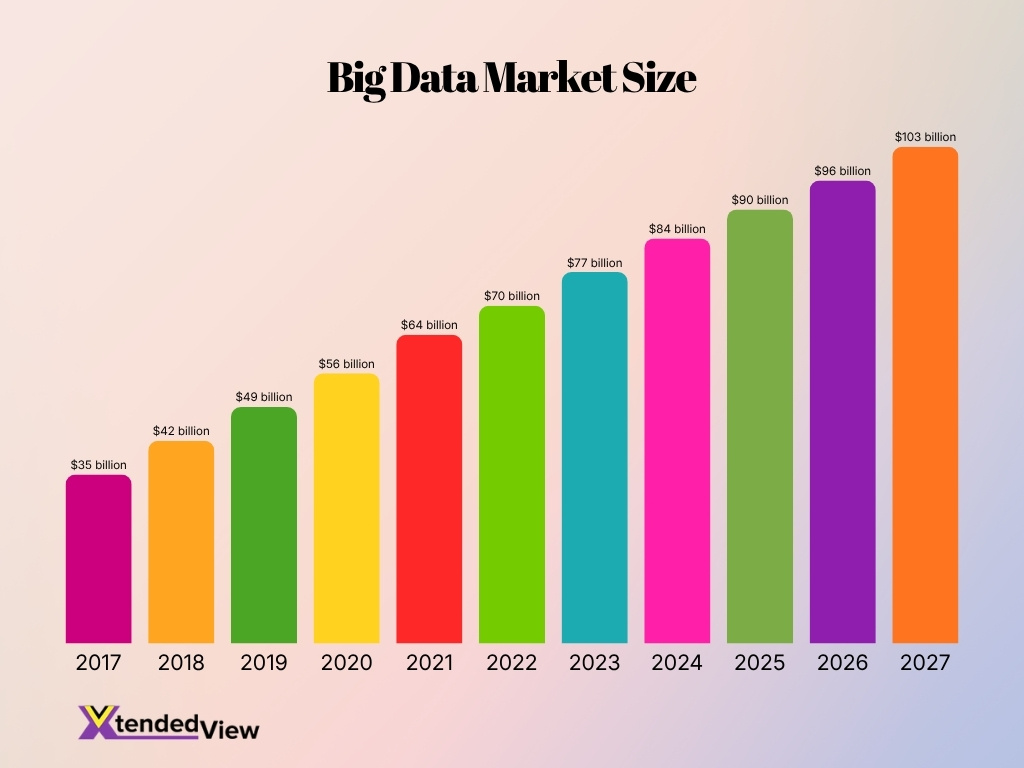
- The Big Data market size grew from $35 billion in 2017 to $103 billion in 2027, nearly tripling in value over the decade.
- Market value increased by $68 billion between 2017 and 2027, highlighting strong long-term expansion.
- The market crossed the $50 billion mark in 2020, reaching $56 billion globally.
- By 2023, the Big Data industry was valued at $77 billion, more than double its 2017 size.
- The market is projected to reach $90 billion in 2025, reflecting continued enterprise investment in data technologies.
- Big Data market size is expected to surpass $100 billion in 2027, reaching $103 billion.
- Between 2024 and 2027, the market is forecast to grow from $84 billion to $103 billion, adding $19 billion in just three years.
- Annual market growth remained steady, with gains ranging from $6 billion to $8 billion per year throughout the period.
- The largest year-over-year increase occurred between 2026 and 2027, when the market expanded by $7 billion.
- From 2017 to 2022, the Big Data market doubled from $35 billion to $70 billion, demonstrating rapid industry adoption.
General Big Data Statistics
- Global data creation exceeded 181 zettabytes in 2025.
- The world is expected to generate roughly 221 zettabytes of data in 2026.
- Data creation reached just 64.2 zettabytes in 2020, highlighting the pace of growth.
- Worldwide data generation is projected to surpass 394 zettabytes by 2028.
- More than 200 zettabytes of data storage capacity is expected globally by the mid-2020s.
- Approximately 402.74 million terabytes of data are generated daily.
- AI-generated content is emerging as a major contributor to global data growth.
- Social media platforms remain among the largest sources of unstructured data worldwide.
- IoT ecosystems contribute tens of zettabytes of new data every year.
- Global enterprises increasingly rely on data lakes and cloud-native architectures to manage growing datasets.
Global Growth and Volume Big Data Statistics
- Global data volume is expected to increase from 181 zettabytes in 2025 to approximately 394 zettabytes by 2028.
- Annual data creation is projected to reach 221 zettabytes in 2026.
- Worldwide data generation is forecast to triple between 2025 and 2029.
- IoT devices generated approximately 79.4 zettabytes of data in 2025.
- Global digital information surpassed 120 zettabytes before reaching current record levels.
- Internet video traffic remains the largest contributor to data consumption worldwide.
- Cloud computing expansion continues to accelerate data generation and storage requirements.
- AI applications significantly increase demand for high-volume data processing and storage.
- Analysts expect data growth to remain in double digits throughout the decade.
Key Drivers Behind Big Data Adoption
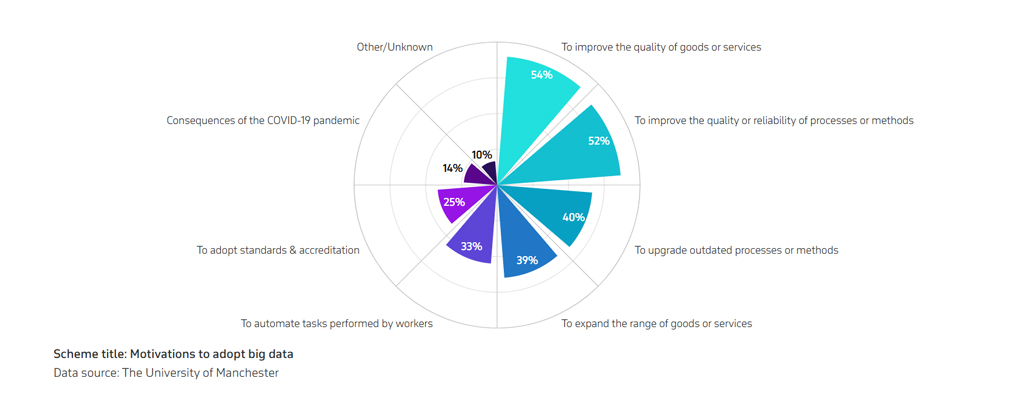
- 54% of organizations adopt big data primarily to improve the quality of goods or services.
- 52% use big data technologies to enhance the quality and reliability of processes or methods.
- 40% implement big data solutions to upgrade outdated processes and operational methods.
- 39% leverage big data to expand their range of goods or services.
- 33% adopt big data analytics to automate tasks traditionally performed by workers.
- 25% use big data initiatives to support standards adoption and accreditation requirements.
- 14% cited the COVID-19 pandemic as a motivating factor for adopting big data.
- Only 10% reported other or unknown reasons for implementing big data technologies.
Business Adoption and ROI Big Data Statistics
- The global big data analytics market is projected to reach $1,686.88 billion by 2035.
- Large enterprises demonstrate up to a 60% adoption rate for advanced big data analytics tools.
- Over 80% of organizations will have integrated AI and analytics into their core business functions by 2025.
- Cloud-based deployments currently hold a commanding revenue share of approximately 56.4% globally.
- Financial services confidently lead big data analytics adoption with a massive 91% adoption rate.
- The healthcare sector ranks as a close second, boasting an 89% adoption rate for data integration.
- Organizations leveraging mature data integration capabilities achieve an average 3.7x ROI on AI investments.
- Approximately 68% of businesses allocate roughly 30% of their IT budgets toward data governance.
- Companies maximizing their data utilization report an average 8% boost in overall revenue.
- More than 70% of new enterprise analytics systems are built natively on scalable cloud platforms.
Cloud Storage and Big Data Statistics
- Cloud-based deployments account for approximately 58.3% of the global big data market.
- Worldwide public cloud spending is expected to exceed $720 billion in 2026.
- More than 60% of corporate data is now stored in cloud environments.
- Enterprises increasingly adopt multi-cloud strategies to support large-scale analytics workloads.
- Cloud-native data warehouses continue replacing traditional on-premises storage systems.
- Approximately 90% of organizations use cloud services in some capacity for data management and analytics.
- The average enterprise manages data across multiple cloud providers and storage environments.
- Cloud storage capacity continues to expand to support AI training models and large-scale analytics.
- Data lake architectures remain one of the most common approaches for storing massive datasets in cloud environments.
- Organizations migrating analytics workloads to the cloud report lower infrastructure costs and improved scalability.
Big Data Use Cases Insights
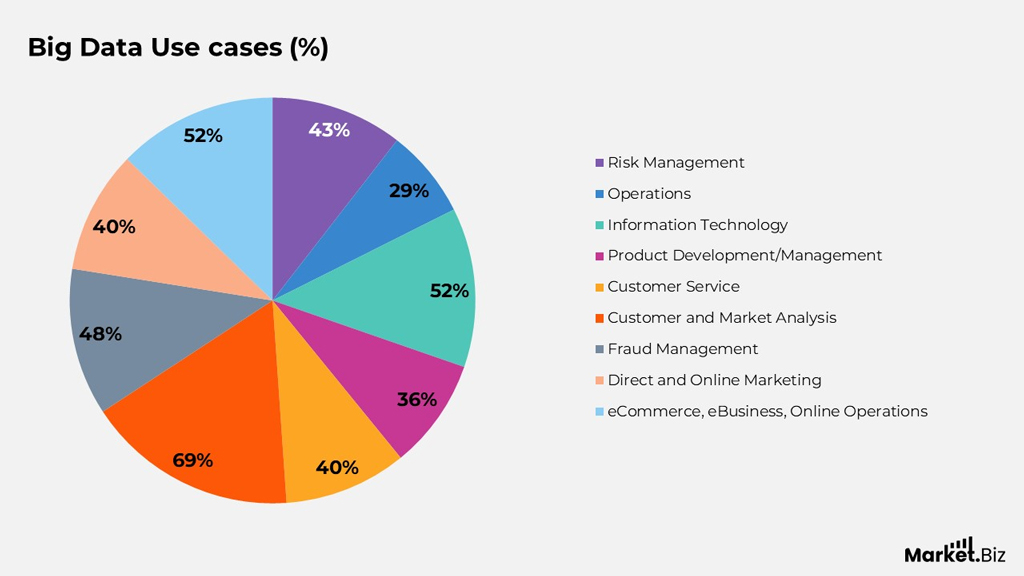
- Customer and Market Analysis leads all big data applications, with 69% of organizations using data for market intelligence and customer insights.
- Information Technology is a major use case, with 52% adoption for managing systems, infrastructure, and digital operations.
- eCommerce, eBusiness, and Online Operations also account for 52%, highlighting the importance of data in digital business growth.
- Fraud Management represents 48% of big data usage, helping organizations detect and prevent financial risks.
- Risk Management is utilized by 43% of businesses to improve forecasting and decision-making.
- Customer Service benefits from big data in 40% of organizations, enhancing support quality and customer satisfaction.
- Direct and Online Marketing accounts for 40%, enabling more targeted and data-driven campaigns.
- Product Development and Management uses big data in 36% of cases to improve innovation and product performance.
- Operations ranks lowest among listed use cases at 29%, but still plays a significant role in efficiency optimization.
Internet of Things (IoT) Big Data Statistics
- The number of connected IoT devices reached approximately 41.6 billion globally in 2025.
- IoT devices generated nearly 79.4 zettabytes of data globally in 2025.
- The global IoT market size is forecast to reach $1,055 billion in 2026.
- Cellular IoT connections in North America are estimated to reach 535 million by 2030.
- Predictive maintenance powered by IoT data reduces equipment downtime by up to 50%.
- The global IoT analytics market value is projected to reach $35.4 billion in 2026.
- Enterprise spending on IoT solutions experienced a robust 10% growth rate in 2024.
- Over 72% of manufacturers globally have implemented Industry 4.0 smart factory initiatives.
- Smart speakers are predicted to be used by 335.3 million households globally by 2027.
- The network management segment accounted for 54.10% of the IoT market share in 2025.
Social Media Big Data Statistics
- More than 5.4 billion people are actively using social media platforms worldwide in 2026.
- Users generate over 2.5 quintillion bytes of unstructured big data globally every single day.
- Over 500 million tweets and posts are created daily across major social networks.
- Video content accounts for over 82% of all social media data consumption and engagement.
- Nearly 73% of businesses utilize social listening tools to analyze brand perception and sentiment.
- More than 80% of marketing teams rely on social media analytics to optimize their audience targeting.
- AI-powered algorithms process over 60,000 social interactions every second for real-time sentiment analysis.
- Social commerce generates over $1.2 trillion in global sales and massive transactional data.
- User-generated content serves as a primary data source that influences 79% of consumer purchasing decisions.
Global Data Center Distribution Statistics
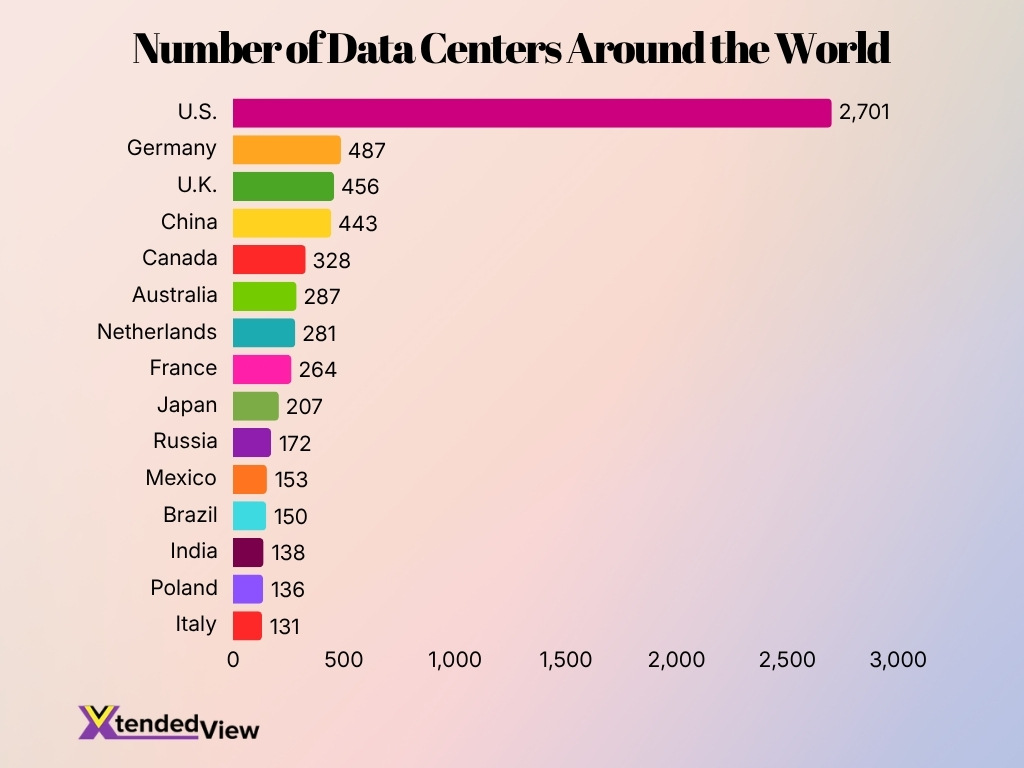
- The U.S. dominates globally with 2,701 data centers, accounting for far more facilities than any other country listed.
- Germany ranks second with 487 data centers, leading all European nations in the chart.
- The U.K. hosts 456 data centers, making it the third-largest data center market worldwide.
- China operates 443 data centers, placing it just behind the U.K. in global rankings.
- Canada maintains 328 data centers, the highest total among North American countries after the U.S.
- Australia records 287 data centers, slightly ahead of the Netherlands with 281 facilities.
- France has 264 data centers, while Japan follows with 207, showing strong infrastructure presence in both regions.
- Russia operates 172 data centers, exceeding Mexico (153) and Brazil (150).
- India hosts 138 data centers, narrowly surpassing Poland (136) and Italy (131).
- The gap between the U.S. and Germany is 2,214 data centers, highlighting the scale of U.S. digital infrastructure leadership.
AI and Big Data Statistics
- The global artificial intelligence market is projected to reach $601.93 billion in 2026 and $3,497.3 billion by 2033.
- The global big data analytics market is estimated to grow from $447.68 billion in 2026 to $1,176.57 billion by 2034.
- Approximately 88% of organizations worldwide report using AI regularly in at least one business function as of 2025.
- By late 2025, roughly 71% of enterprises will have successfully integrated generative AI into their core operational workflows.
- Nearly 16.3% of the global population frequently utilizes generative AI tools to learn or solve problems as of 2025.
- Total AI investments reached $225.8 billion in 2025, capturing roughly 48% of all venture funding across sectors.
- The total amount of data produced globally is projected to reach a staggering 181 zettabytes by the end of 2025.
- Global AI chip revenue is forecast to surpass $92.74 billion in 2026, reflecting a massive 34.58% annual increase.
- Organizations deploying AI tools report an average productivity boost of 14%, with novice workers experiencing a 34% performance jump.
Enterprise Big Data Statistics
- Over 90% of large enterprises actively maintain formal data and analytics initiatives.
- Enterprise spending on data platforms is growing by 25% annually to support AI adoption.
- Around 85% of organizations prioritize data governance programs for managing large-scale datasets.
- Nearly 70% of digital transformation projects involve significant data modernization efforts.
- Over 60% of organizations are consolidating analytics and AI functions into unified platforms.
- Approximately 75% of enterprise analytics teams cite data integration as their most common challenge.
- Real-time business intelligence adoption has increased by 40% across the finance, retail, and logistics sectors.
- Enterprises with mature analytics programs achieve up to 15% higher operational efficiency.
- Nearly 65% of enterprise data investments are directed strictly toward customer experience analytics.
- More than 80% of modern enterprise architectures now include data observability and quality tools.
Industry-Specific Big Data Statistics
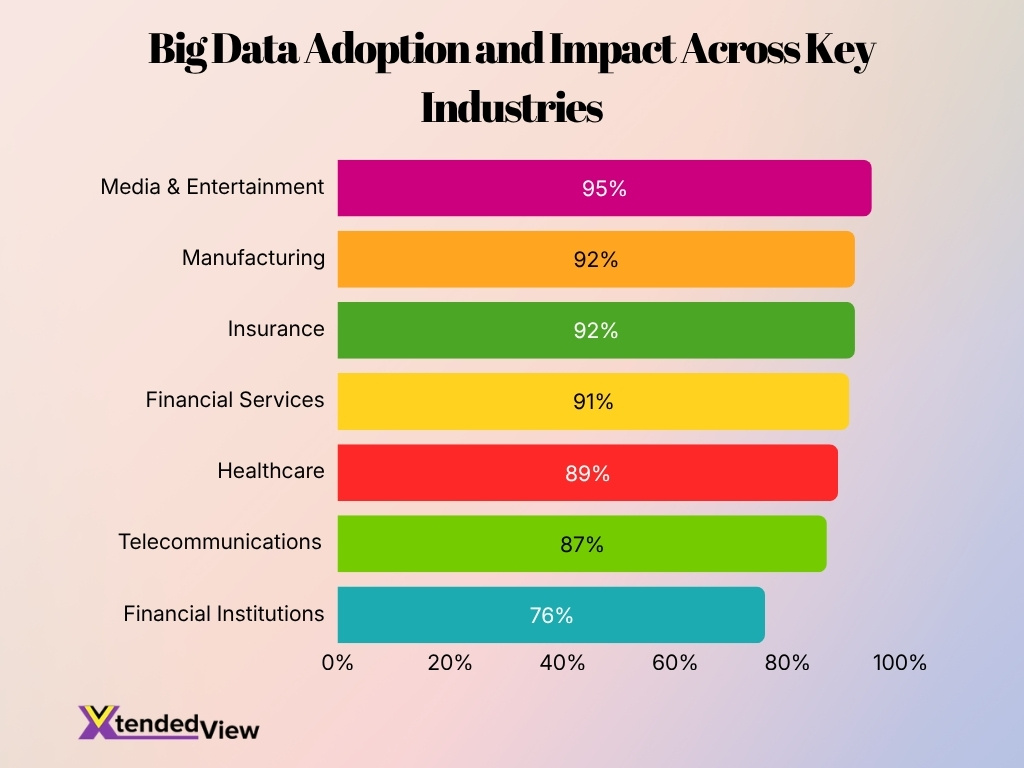
- Financial services lead big data analytics with an impressive 91% adoption rate.
- Healthcare data analytics boasts an 89% adoption rate among medical organizations.
- The global retail analytics market is projected to grow to $31.08 billion by 2032.
- 92% of manufacturing companies believe smart data utilization strongly drives competitiveness.
- 87% of telecommunications companies already actively benefit from implemented big data solutions.
- Energy utilities are investing a record $174 billion in 2026, primarily for digital grid modernization.
- 92% of insurance companies expect big data to directly improve their pricing and underwriting.
- The media and entertainment sector shows a massive 95% adoption rate for big data technologies.
- Advanced healthcare transformations yield a 124% average ROI through enhanced operational efficiency.
- 76% of financial institutions actively use big data specifically for personalized customer analytics.
Job Market and Career Big Data Statistics
- Data scientist employment is projected to grow 36% between 2023 and 2033.
- The United States currently employs hundreds of thousands of professionals in data science and AI roles.
- Data scientist positions consistently rank among the highest-paying technology jobs nationwide.
- The median annual pay for data professionals recently exceeded $112,000.
- Demand for data engineers continues to surge for building modern analytics infrastructures.
- More than 80% of employers report severe challenges in finding qualified data talent.
- Rapid AI adoption heavily drives the demand for machine learning and data governance experts.
- SQL, Python, and cloud computing consistently dominate as the most requested skills in job postings.
- Financial services, healthcare, and technology remain the largest employers of data professionals.
- Remote and hybrid work options have drastically expanded the global talent pool for analytics positions.
Regional Big Data Statistics
- North America accounts for over 36% of the global big data analytics market share.
- The United States big data market is anticipated to reach a valuation of $248.89 billion by 2032.
- The Asia-Pacific region is expected to grow at the fastest CAGR of 14.4% through the year 2030.
- China‘s extensive digital ecosystem contributes heavily to global data generation, which is expected to hit 181 zettabytes.
- India is experiencing massive data infrastructure growth, with its regional analytics market projected to expand at a 28.4% CAGR.
- Nearly 70% of European companies are currently investing in cloud-centric migrations for privacy-focused data governance.
- Germany, the UK, and France consistently command the largest share of Europe‘s multi-billion-dollar big data market.
- Latin America‘s analytics market in banking and retail is scaling rapidly, projected to hit $19.4 billion by 2030.
Key Barriers to Big Data Adoption Statistics
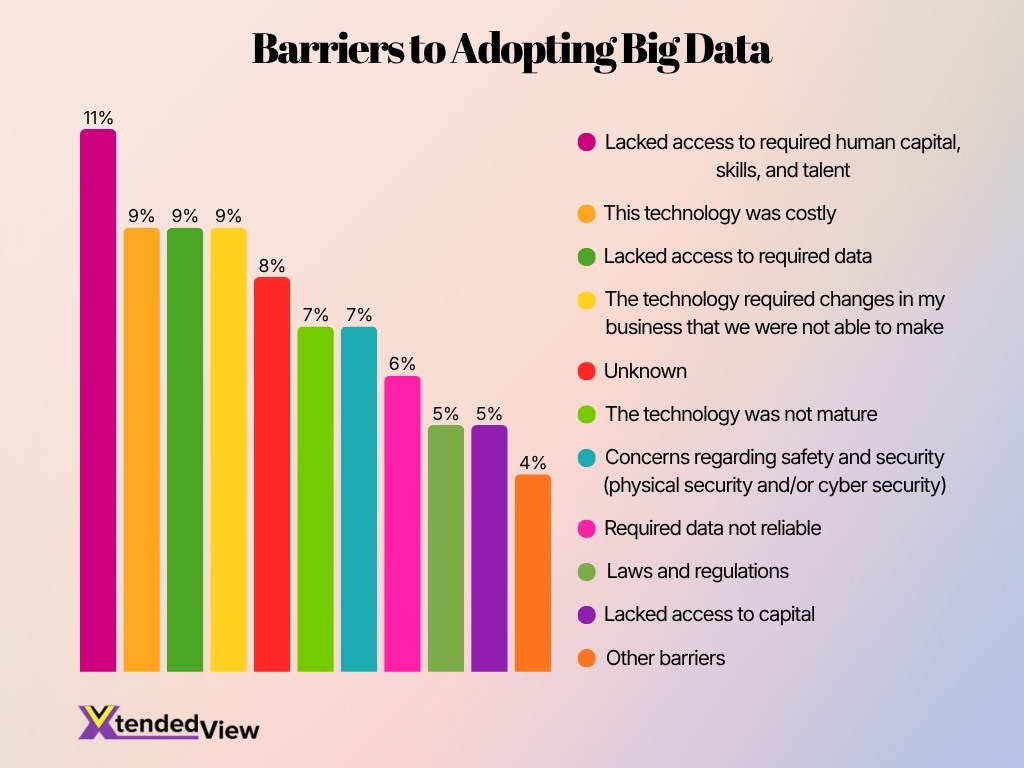
- 11% of organizations cited a lack of skilled talent, human capital, and expertise as the biggest barrier to adopting big data.
- 9% reported that high technology costs prevented them from implementing big data solutions.
- 9% said they lacked access to the required data needed for successful big data adoption.
- 9% struggled because big data required business changes they were unable to make.
- 8% of respondents selected unknown factors as their primary adoption challenge.
- 7% believed the technology was not mature enough for their needs.
- 7% identified safety and cybersecurity concerns as a major obstacle to adoption.
- 6% reported that the required data was not reliable enough for effective use.
- 5% cited laws and regulations as a barrier to implementing big data technologies.
- 5% said limited access to capital restricted their ability to invest in big data.
- 4% attributed adoption challenges to other barriers not specifically categorized.
Security and Privacy Big Data Statistics
- The average global cost of a data breach currently stands at $4.44 million, with the United States averaging $10.22 million.
- More than 82% of all reported cyber incidents involve sensitive data stored across cloud environments.
- The human element, including non-malicious errors, is a direct contributing factor in 68% of all data breaches.
- Organizations utilizing security AI and automation save an average of $1.9 million in data breach recovery costs.
- Approximately 35% of data breaches involve unmanaged shadow data, increasing the overall financial impact of an incident by 16%.
- Ransomware and extortion attacks represent 32% of breaches and remain a top threat across 92% of industries.
- The average time required for enterprises to successfully identify and contain a data breach is 241 days.
- Breaches originating from third-party vendors account for 15% of incidents, marking a 68% increase over the previous year.
- Healthcare remains the costliest sector for data breaches, averaging $7.42 million per incident.
Future Trends in Big Data Statistics
- Global data volume is projected to skyrocket from 149 zettabytes in 2024 to an estimated 394 zettabytes by 2028.
- By 2026, nearly 80% of enterprises will actively utilize Generative AI mechanisms for data processing and training.
- Approximately 76% of organizations report that real-time data analytics is now absolutely essential for business performance.
- By 2030, 50% of all enterprise AI inference workloads will be processed locally on edge computing nodes.
- The overarching big data analytics market is projected to reach $862.31 billion by 2030, growing at a 14.9% CAGR.
- The Data Discovery and Visualization segment is expected to dominate AI-assisted analytics with a 57.34% market share by 2026.
- Driven by IoT, the number of devices generating machine-created data is forecast to reach 34.7 billion globally by 2028.
- Over 70% of enterprises are actively migrating their workloads to cloud-native platforms to replace legacy systems.
- Approximately 90% of collected enterprise data remains unutilized, driving significant new investments in data governance tools.
- By 2030, autonomous analytics platforms are expected to be a primary driver of the 11.6% compound annual growth rate in big data.
Frequently Asked Questions (FAQs)
Approximately 221 zettabytes of data are expected to be generated globally in 2026.
The global big data analytics market is projected to reach $559.75 billion in 2026.
The global big data market is expected to grow at a 13.3% CAGR between 2024 and 2029.
The global big data market is forecast to grow to $516.29 billion by 2031, up from $324.59 billion in 2026.
Around 402.74 million terabytes of data are generated globally every day.
Conclusion
Big data continues to evolve from a business advantage into a business necessity. Organizations across healthcare, finance, retail, manufacturing, and government sectors increasingly depend on data-driven insights to improve efficiency, reduce risk, and identify growth opportunities. At the same time, AI adoption, cloud computing, IoT expansion, and real-time analytics are generating unprecedented amounts of information that require advanced infrastructure and governance.
Looking ahead, the global data ecosystem will continue expanding rapidly, creating new opportunities for innovation while also increasing demands around security, privacy, and talent development. Companies that invest in modern analytics capabilities, scalable data architectures, and strong governance frameworks will be better positioned to compete in the data-intensive economy.
