



Supply chains today are at a crossroads. As global disruptions and technology converge, logistics networks are no longer just back-end operations; they are strategic assets. Real-time visibility, intelligent automation, and cross-border resilience are core to supply chain design. For example, aerospace companies are absorbing more than $11 billion in supply chain-related costs, while AI-enabled inventory systems help retailers cut order cycles by nearly 30%. This article explores the statistics, trends, and performance metrics shaping supply chains in 2026 and invites readers to examine the data driving smarter decisions.
Editor’s Choice Stats
- 70% of logistics companies now use AI or machine learning, with 24% automating key supply chain decisions.
- Global supply chain management software revenue reached $16.9 billion in 2024, with strong growth continuing into 2026.
- Digital twins are expected to reduce logistics simulation and planning time by 50%, accelerating disruption response.
- Seaborne trade growth slowed to 0.5%, signaling persistent global transport constraints.
- Faster shipping options increase delivery-related emissions by 10% to 12%, reshaping sustainability priorities.
- Semiconductor supply chains are supporting a market projected to exceed $1 trillion by the end of the decade.
- Supply chain visibility platforms support more than 60% of global shipping activity today.
Recent Developments
- Manufacturing supply chains in Europe ended 2025 in contraction, with output levels at a nine-month low.
- Airlines are absorbing more than $11 billion in supply chain-driven maintenance and parts delays.
- Memory and chip shortages linked to AI demand have driven component prices up 15% to 20%.
- PC and smartphone shipments are projected to decline 5% to 9% due to constrained supply.
- Logistics technology consolidation accelerated, expanding global orchestration and control capabilities.
- Autonomous logistics systems moved from pilot programs to scaled deployment across major regions.
- Environmental compliance requirements expanded across supply networks ahead of 2026 deadlines.
- Blockchain-based logistics and traceability solutions saw rapid enterprise adoption.
AI in Logistics and Supply Chain Market Growth Statistics
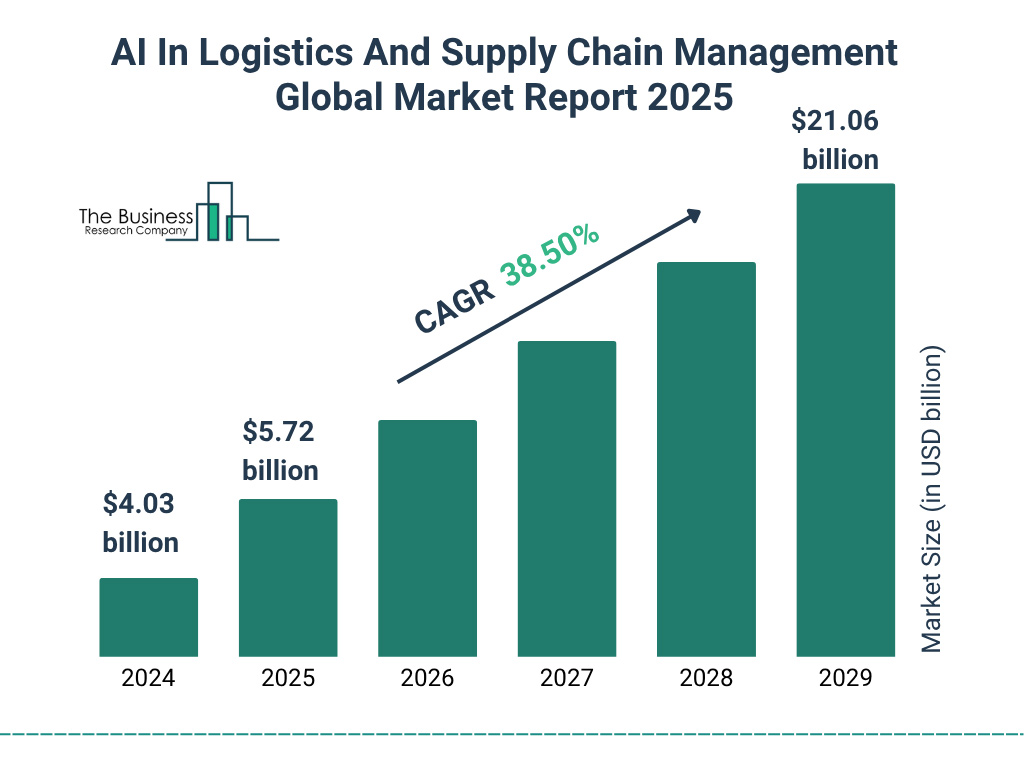
- The global AI in logistics and supply chain management market was valued at $4.03 billion in 2024, highlighting the early but rapidly scaling adoption phase.
- Market size is projected to rise to $5.72 billion in 2025, reflecting strong year-over-year growth driven by automation and data-driven decision-making.
- By 2026, the market is expected to reach approximately $7.93 billion, showing accelerating investment in AI-powered logistics solutions.
- The industry is forecast to expand to nearly $10.95 billion in 2027, crossing the $10 billion milestone.
- In 2028, the global market value is estimated at around $15.12 billion, indicating widespread enterprise-level AI deployment.
- The market is projected to surge to $21.06 billion by 2029, representing more than a 5× increase from 2024 levels.
- The forecast period reflects a robust CAGR of 38.50%, underscoring one of the fastest growth rates across enterprise AI segments.
- Rapid growth after 2026 signals increased adoption of AI-driven demand forecasting, route optimization, and warehouse automation.
- The sharp upward trend highlights AI’s expanding role in improving cost efficiency, resilience, and real-time visibility across global supply chains.
Global Overview of the Supply Chain Landscape
- Global freight activity continues a slow recovery, with growth remaining below historical averages.
- 41% of companies have shifted production or sourcing closer to end markets to reduce risk.
- Nearly 48% of firms report tariffs and trade policy changes altering sourcing strategies.
- Cyber threats targeting logistics systems increased sharply year over year.
- China’s share of global container traffic declined as supply networks diversified.
- Transit volumes through major canals dropped by nearly 18%, affecting shipping schedules.
- Latin America saw double-digit growth in nearshoring investment.
- ESG compliance now influences more than 60% of supplier selection decisions.
Software Trends in Supply Chain Management
- AI-driven inventory systems reduced stockouts by 20% to 35% in high-volume operations.
- Predictive analytics tools are now used by over 60% of large enterprises.
- Cloud-based SCM adoption grew more than 40% in two years.
- Blockchain logistics platforms attracted billions in new funding.
- Scope 3 emissions tracking tools are embedded in nearly one-third of Tier 1 suppliers.
- Digital twins reduced warehouse planning errors by up to 45%.
- Robotic process automation supports more than 50% of fulfillment workflows.
- Agentic AI tools gained traction in supplier risk modeling.
Costs and Logistics Spending Across Supply Chain Systems
- Global logistics spending is projected to reach $11.4 trillion in 2026.
- Warehousing costs rose 18%, driven by labor and real estate pressures.
- Ocean freight rates stabilized but remain higher than pre-pandemic norms.
- Last-mile delivery accounts for more than 50% of total shipping costs.
- The average cost of a failed delivery increased to nearly $18.
- Logistics wages in North America rose almost 10% year over year.
- Carbon compliance costs increased by more than 20%.
- Technology now accounts for up to 15% of supply chain budgets.
AI Impact on Retail Supply Chain and Logistics
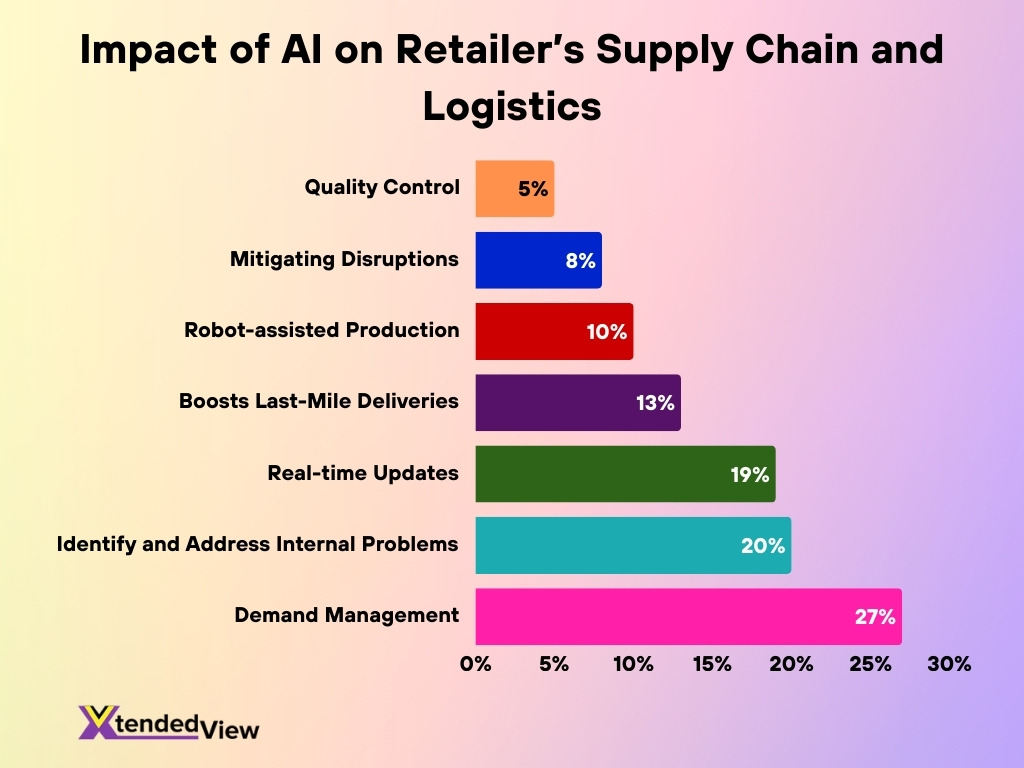
- Demand Management leads the impact, with AI delivering the greatest improvement at 27%, highlighting its critical role in forecasting and inventory optimization.
- Internal problem identification improves by 20%, showing how AI helps retailers detect inefficiencies and operational bottlenecks faster.
- Real-time supply chain visibility increases by 19%, enabling quicker decision-making through live data and predictive insights.
- Last-mile delivery performance improves by 13%, demonstrating AI’s growing influence on faster and more reliable customer fulfillment.
- Robot-assisted production contributes a 10% gain, reflecting automation’s role in boosting manufacturing speed and consistency.
- Disruption mitigation sees an 8% improvement, as AI strengthens resilience against delays, shortages, and external shocks.
- Quality control records a 5% uplift, indicating steady but emerging benefits of AI-driven inspection and defect detection.
Disruptions and Delays Affecting Supply Chain Continuity
- Supply chain disruptions cost companies roughly 8% of annual revenue on average.
- Cargo theft incidents increased by more than 25%, raising insurance and security costs.
- Nearly 90% of executives report ongoing supply chain disruptions.
- Extreme weather events continue to delay production and transportation.
- Climate risk joined cyber risk as a leading cause of disruption.
- Supplier delivery performance slowed across multiple manufacturing sectors.
- Cyber incidents increasingly cause logistics downtime.
- Demand volatility continues to strain fulfillment timelines.
Pressure and Stress Indicators in Global Supply Chains
- 63% of businesses report higher-than-expected supply chain losses.
- 82% of firms face impacts from new tariffs on supply chains.
- 76% of supply chain operations experience workforce shortages.
- Inventory carrying costs average 25% of total inventory value.
- 65% of supply chain professionals report stressful working conditions.
- Median perfect order rate stands at 90%, signaling declines.
- Software supply chain attacks averaged over 28 per month in 2025.
- 39% report rises in supplier and material costs due to disruptions.
- Global Supply Chain Pressure Index reached 0.19 in May 2025.
Risk Mitigation and Resilience in Supply Chain Models
- 73% of companies adopted dual-sourcing strategies.
- 60% regionalized parts of their supply networks.
- Cargo theft data is now factored into enterprise risk planning.
- Fewer than 10% of firms feel fully in control of supply risk.
- AI-driven risk scoring tools gained board-level attention.
- Safety stock is increasingly quantified and optimized.
- Digital twins enable faster incident response.
- Structured risk playbooks are becoming standard practice.
Educational Background of Supply Chain Managers
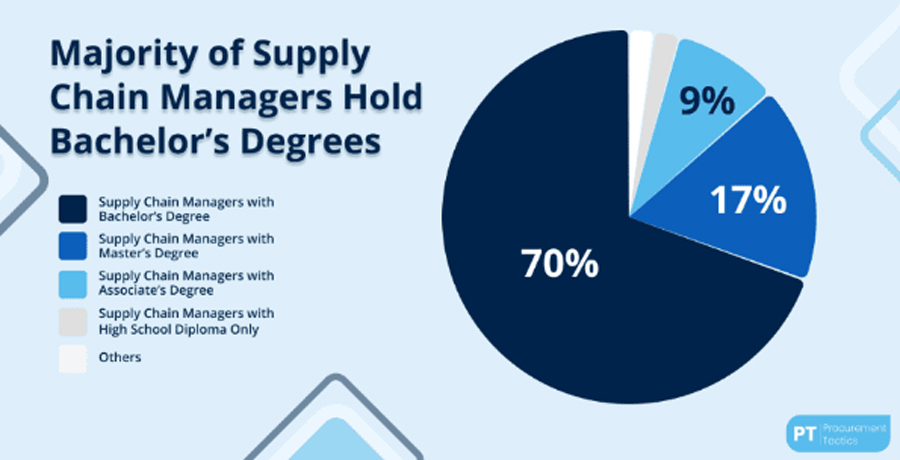
- A strong 70% of supply chain managers hold a Bachelor’s degree, highlighting undergraduate education as the industry standard.
- Advanced education is also common, with 17% of professionals having a Master’s degree, reflecting a growing emphasis on specialization and leadership skills.
- Around 9% of supply chain managers possess an Associate’s degree, indicating alternative educational pathways into the field.
- Only about 2% rely solely on a High School diploma, showing that formal higher education is typically required for managerial roles.
- Another ~2% fall under “Other” qualifications, including certifications or non-traditional academic backgrounds.
- Overall, nearly 96% of supply chain managers have post-secondary education, underscoring the sector’s high educational expectations.
- The dominance of Bachelor’s and Master’s degrees (87% combined) signals that employers prioritize structured academic training in supply chain management.
Geopolitical and Regulatory Effects on Supply Chain Networks
- Trade realignment continues to reshape sourcing and routing decisions.
- Tariffs raised project costs by 4% to 40% in some sectors.
- Geopolitical tension ranks among the top supply chain disruptors.
- Export restrictions stress access to rare earth materials.
- Governments are encouraging supplier diversification.
- Regulatory uncertainty accelerates supplier base expansion.
- Deglobalization pressures influence long-term investment decisions.
- Geopolitical risk indices correlate with supply chain volatility.
Talent Shortage and Skills Gap Within Supply Chain Roles
- 74% of employers report struggling to find the skilled talent they need to run modern supply chains.
- 90% of supply chain leaders say they lack sufficient digital talent to meet their digitization goals.
- 62% of supply chain leaders expect labor shortages to be a major short‑term challenge, accelerating automation adoption.
- Organizations with low digital maturity (average 36%) can take up to 152 days to detect and recover from disruptions, highlighting the value of ERP/WMS/AI skills.
- Workers with AI skills earn, on average, a 56% wage premium across industries, outpacing traditional supply chain roles without automation expertise.
- Only 35% of employees have received AI training in the last year, despite 75% of companies integrating AI into operations.
- 38% of manufacturers are planning large-scale reskilling/retraining initiatives to close supply chain workforce gaps.
- Manufacturing may need 3.8 million new workers by 2033, with about 1.9 million roles at risk of going unfilled without upskilling.
- Top supply chain professionals now earn over $100,000 in average total annual compensation, reflecting intense competition for advanced skills.
Supply Chain Analytics Market Share by Region (2025)
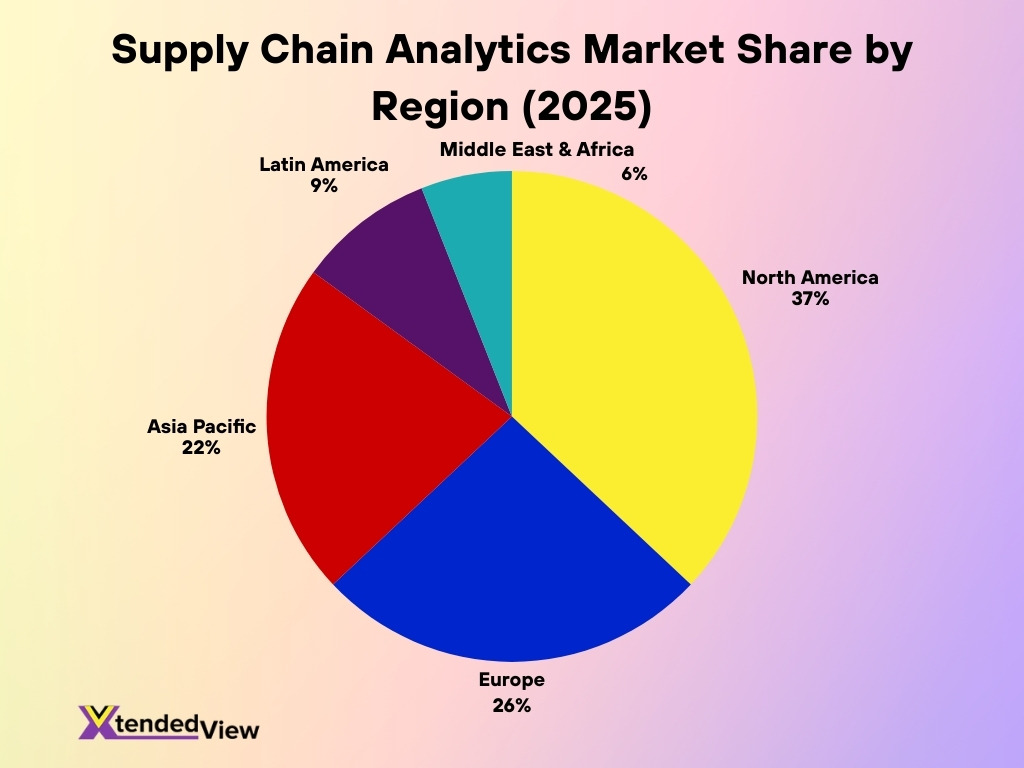
- North America leads the global market with a dominant 37% share, driven by strong adoption of AI-powered analytics, cloud platforms, and advanced logistics optimization.
- Europe holds the second-largest position at 26%, supported by digital supply chain transformation, regulatory compliance needs, and cross-border trade analytics.
- Asia Pacific captures 22% of the market, reflecting rapid industrialization, growing e-commerce volumes, and increased investments in smart supply chain technologies.
- Latin America accounts for 9%, indicating steady growth as companies gradually adopt data-driven supply chain and demand forecasting tools.
- The Middle East & Africa contribute 6%, showing early-stage adoption with rising focus on logistics modernization and infrastructure development.
- North America and Europe together control 63% of the market, highlighting their mature analytics ecosystems and early technology adoption.
- Emerging regions collectively hold 37%, signaling significant future growth opportunities as supply chain digitization accelerates globally.
- Regional disparities in market share emphasize how technology readiness and infrastructure directly impact supply chain analytics adoption.
Efficiency and Performance Metrics in Supply Chain Processes
- OTIF and lead time metrics gained prominence over pure cost KPIs.
- Inventory turnover remains central to cash flow management.
- Perfect order rate combines accuracy, completeness, and timeliness.
- Forecast accuracy directly impacts working capital efficiency.
- Delivery schedule adherence tracks supplier reliability.
- Lead time variability signals upstream risk.
- Freight cost per unit supports route benchmarking.
- Days’ sales of inventory highlight revenue conversion speed.
Inventory Turnover and Management in Supply Chain Flows
- Companies adopting digital inventory systems see up to a 25% improvement in turnover rates.
- AI-driven optimization boosts inventory turnover by 15–30% while cutting stockouts by 15–25%.
- U.S. firms using AI forecasting raised turnover rates from 3–4 to 5–6 times annually.
- Amazon’s predictive systems improved forecast accuracy by 25% and reduced stockouts by 15%.
- The inventory optimization market grows at a 27.3% CAGR from 2025 to 2032.
- eCommerce’s average turnover ratio hit 10.19 in Q4 2024.
- Ideal turnover ratios range from 5 to 10 times yearly for most industries.
- AI forecasting cuts excess inventory by 20% on average.
- Retailers with regional segmentation cut Zone D RTOs by up to 3x via closer stocking.
- Lean strategies with AI reduce inventory costs by 30%.
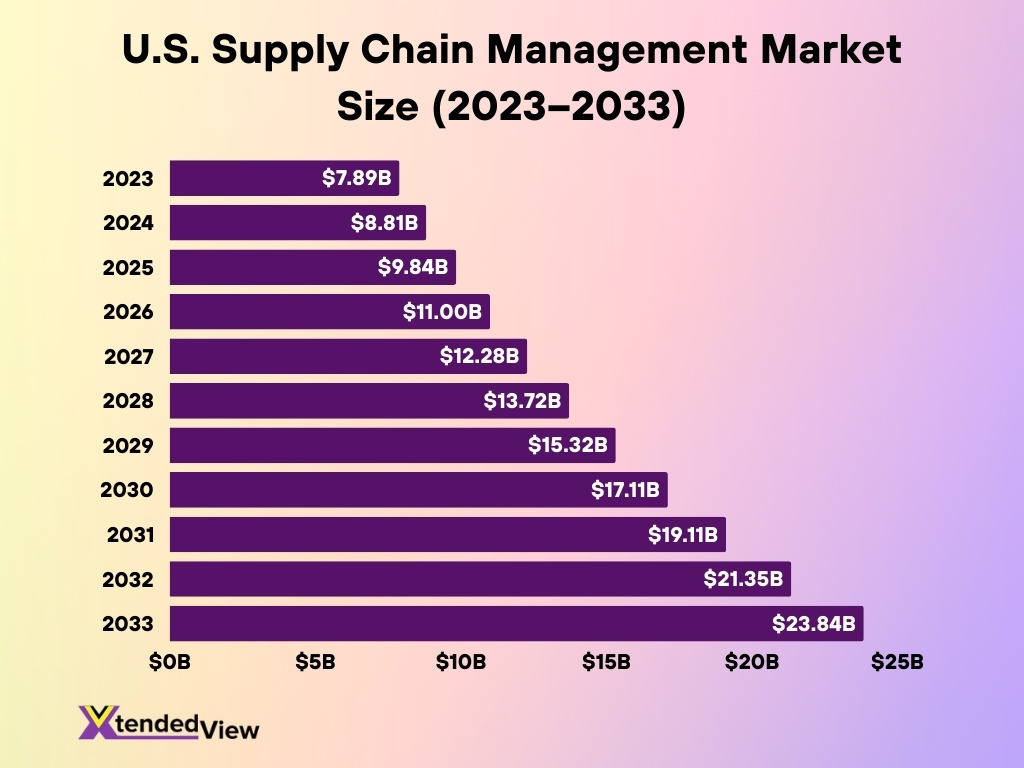
U.S. Supply Chain Management Market Growth (2023–2033)
- The U.S. supply chain management market was valued at $7.89 billion in 2023, highlighting a strong baseline for long-term expansion.
- Market size increased to $8.81 billion in 2024, showing consistent year-over-year growth.
- In 2025, the market reached $9.84 billion, reflecting the rising adoption of digital supply chain solutions.
- The market crossed the $11.00 billion milestone in 2026, signaling accelerated enterprise investment.
- By 2027, market value climbed to $12.28 billion, driven by demand for automation and analytics.
- In 2028, the market expanded further to $13.72 billion, maintaining steady upward momentum.
- The industry surpassed $15.32 billion in 2029, marking a key mid-forecast growth point.
- In 2030, the market size rose sharply to $17.11 billion, indicating stronger large-scale deployment across industries.
- The market exceeded $19.11 billion in 2031, reflecting increased focus on resilient and agile supply chains.
- By 2032, the U.S. supply chain management market crossed $21.35 billion, entering a high-growth maturity phase.
- The market is projected to reach $23.84 billion by 2033, representing nearly threefold growth compared to 2023.
Freight Capacity and Transportation Data in Supply Chain Logistics
- Global freight and logistics markets exceeded $6 trillion in value.
- Road freight remains the dominant transport mode.
- The 3PL market surpassed $1.6 trillion.
- Truckload rates are expected to rise 4% to 6% annually.
- Intermodal transport continues gaining share.
- Digital freight matching improves capacity utilization.
- Air cargo remains critical for high-value goods.
- Infrastructure differences drive regional capacity gaps.
Sustainability Performance in Green Supply Chain Strategies
- The green logistics market reached $1.39 trillion in 2025, projected to hit $2.06 trillion by 2030 at an 8.29% CAGR.
- Supply chains account for 90% of organizational carbon emissions, with transportation contributing 25% of global output.
- Scope 3 emissions from supply chains average 11.4 times higher than direct operations.
- Europe holds a 36.3% share of the green logistics market, valued at $0.47 trillion.
- The sustainable packaging market is set to grow from $313.72 billion in 2025 to $594.46 billion by 2035.
- The fleet electrification market was $93.25 billion in 2024, expected to reach $224.51 billion by 2034.
- 80% of firms report cost savings from green supply chain, reduced energy use, and efficiency.
- John Deere achieved 10% operational cost reduction via supply chain transparency over four years.
- AI optimization in supply chains cuts emissions by 10% and saves $5M annually.
Digital Transformation Driving Modern Supply Chain Ecosystems
- Supply chains operate as connected digital ecosystems with 79% of high-performing companies achieving above-average revenue growth.
- 95% of manufacturers now use AI for supply chain management, marking scaled deployment.
- Control towers deliver end-to-end visibility, reducing lead times by 25-40% for users.
- Cloud platforms hold 61% market share in SCM deployments worldwide.
- IoT data boosts supply chain transparency for 92% of adopting businesses.
- Only 8% of companies achieve digital maturity, enhancing supply chain resilience and agility.
- AI forecasting slashes stockouts by up to 65% and forecast errors by 20-50%.
- Integrated systems drive the automated supply chain market to $33.4 billion by 2037.
Frequently Asked Questions (FAQs)
The global supply chain management market is projected to reach approximately $58.42 billion by 2030, growing from about $38.51 billion in 2025.
The global supply chain management market is expected to grow at a CAGR of 8.7% from 2025 to 2030.
U.S. business logistics costs reached $2.6 trillion, equaling 8.7% of the national GDP.
Employment of logisticians is projected to increase by 19% from 2023 to 2033, adding about 26,100 jobs annually.
According to recent survey data, 82% of companies said their supply chain activity was affected by new tariffs, with 20–40% of activity impacted.
Conclusion
Supply chains are shaped by digital transformation, sustainability mandates, geopolitical pressure, and performance-driven execution. Organizations that align AI, analytics, and green logistics with resilient operating models gain a measurable advantage. As metrics such as inventory turnover, OTIF, and risk responsiveness evolve, supply chains are no longer support functions but competitive differentiators. Leaders who understand these trends are better positioned to navigate volatility and build durable, future-ready supply networks.
