



Microsoft Teams continues to serve as a central hub for communication and collaboration in businesses, education and beyond. With organisations running hybrid workflows and global teams, Teams supports chat, meetings, file sharing and integrations under one roof. In the healthcare sector, for example, clinicians use Teams to coordinate patient rounds and share diagnostics securely. In manufacturing, global engineering teams rely on Teams to manage project updates and technical documentation across time zones. Read on to explore how Teams stacks up in terms of usage, growth and market impact.
Editor’s Choice
- 320 million+ monthly active users of Teams by early 2024.
- Team Phone service within Teams reached 80 million users by May 2025.
- Revenue for Teams: over US$8 billion in 2023.
- Teams adoption by educational institutions: access across 400,000+ schools.
- The information technology sector accounts for nearly 30% of Teams usage by industry.
- US organisations: approximately 8 million companies using Teams.
- Teams recorded a >70% year‑over‑year jump in usage during the early 2020 pandemic surge.
Recent Developments
- In early 2024, Microsoft publicly reported that Teams had reached 320 million monthly active users, marking a substantial milestone.
- Teams Phone, the built‑in calling solution, had reached 80 million users by May 2025, including more than 20 million PSTN users (those making external calls) within Teams.
- The shift from Skype to Teams as Microsoft’s unified communications platform began in 2025.
- The integration of Teams into the broader Microsoft 365 suite continues to deepen, making Teams the collaboration front‑end for many productivity workflows.
- Teams usage is seeing increased activity in mobile and remote‑work contexts as hybrid arrangements become the norm.
- The analytics tools within Teams (e.g., usage reports) have been enhanced to give enterprise admins more insight into engagement and feature adoption.
- Continued investment by Microsoft in Teams features, such as meeting enhancements, security controls and ecosystem integrations, signals an emphasis on long‑term enterprise deployment rather than short‑term adoption spikes.
Microsoft Teams Overview
- Teams was launched in March 2017 as part of Microsoft’s push into enterprise collaboration.
- Headquarters: Microsoft Corporation, Redmond, Washington.
- The platform offers chat, video conferencing, file sharing, collaboration and integration with other Microsoft 365 apps.
- Teams forms a central node in modern workspaces, enabling remote, hybrid and in‑office collaboration under a unified interface.
- The platform is offered in free, business and enterprise tiers, as well as integrated within Microsoft 365 subscriptions.
- Teams also includes features like Teams Phone (cloud calling), Teams Rooms (meeting room systems), and advanced management/analytics for large organisations.
- Given its deep integration with the Microsoft ecosystem, Teams often acts as the default communications hub in enterprises already using Microsoft 365.
Microsoft Teams Users by Fiscal Year
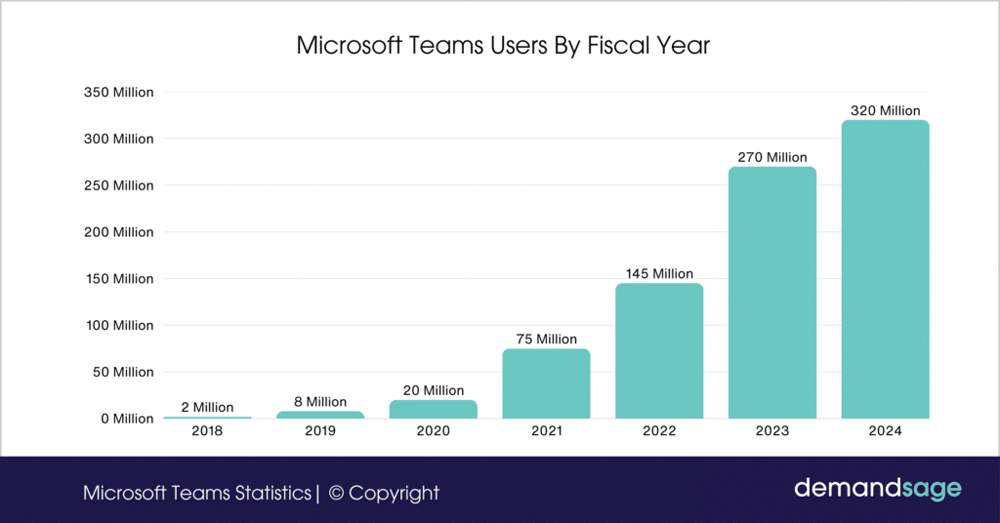
- Rapid growth from 2 million (2018) to 320 million (2024).
- User count increased 4× between 2020 and 2021, jumping from 20 million to 75 million.
- Strong continued adoption during and after the pandemic, with 145 million users in 2022.
- Growth remained significant in later years:
- 270 million users in 2023
- 320 million users in 2024
- Overall increase of 318 million users over a 6-year period.
- Represents one of the fastest-growing enterprise communication platforms.
- Clear evidence of sustained business and organisational reliance on collaboration tools.
Daily and Monthly Active Users
- One data set shows Teams moving from 270 million MAU in 2022 to 320 million in 2024.
- In a 2024 estimation, Teams reportedly had around 320 million daily active users, though independent verification is limited.
- Teams’ daily usage surged during the 2020 pandemic period, for example, between March and June 202,0, the platform grew by an estimated 894% in users.
- Mobile active users (for Teams app) are reported at 75 million+ daily in some aggregated statistics.
- The ratio of daily to monthly active users suggests that a large proportion of monthly users engage regularly on Teams.
- Engagement in meetings and chat on Teams suggests frequent active use, elevating it above tools with lower stickiness.
- The sustained growth from 2022 to 2024 indicates that Teams is moving beyond crisis‑driven adoption into mainstream business use.
Microsoft Teams Adoption Trends
- From 2022 to early 2024, Microsoft Teams users grew from approximately 270 million monthly active users (MAU) to 320 million MAU.
- Between March and June 2020, Teams recorded an estimated 894% growth in users amid the pandemic workplace shift.
- Over 1 million organisations worldwide are now reported to be using Teams.
- Teams holds about 32.29% of the global video‑conferencing and collaboration market as of 2024.
- Adoption drivers: 53.3% of enterprises cited Microsoft application integration as a key reason for choosing Teams.
- Increased mobile and hybrid work usage has contributed to higher adoption of chat, meetings and file collaboration features.
- Enterprises are moving beyond basic chat to richer collaboration workflows within Teams, indicating the maturity of usage.
- Regions previously slower to adopt are showing acceleration in hybrid/hybrid‑first work models, supporting further uptake of Teams.
Microsoft Teams Revenue and Financial Statistics
- In 2023, Microsoft Teams generated an estimated US$8 billion in revenue.
- Revenue grew from under US$1 billion in 2017 to US$8 billion in 2023, a roughly eight‑fold increase in six years.
- The broader Microsoft 365 productivity & business processes segment (which includes Teams) reported about US$77 billion in FY 2024.
- Microsoft’s cloud and productivity segments, driving Teams’ ecosystem, helped deliver a company‑wide revenue of around US$245 billion in 2024.
- The rapid growth trajectory suggests Teams has moved from a complementary tool to a key contributor in Microsoft’s enterprise communications portfolio.
- Despite high user numbers, Microsoft does not publish standalone financials for Teams, so all figures are estimates derived from segment disclosures.
- Given the estimated base and growth, Teams is contributing heavily to Microsoft’s recurring‑service revenue streams.
- Looking ahead, as hybrid work becomes the norm, further monetisation via advanced features and integrations may push revenue beyond the US$8 billion baseline.
Microsoft Teams Market Share
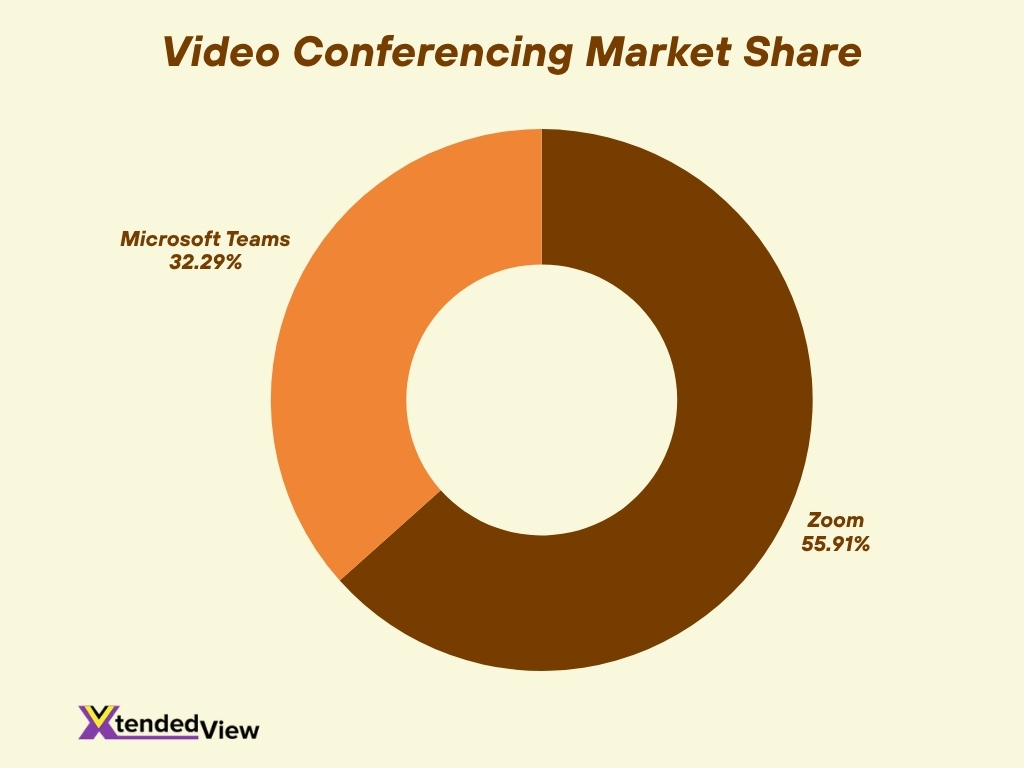
- Teams holds approximately 32.29% of the video‑conferencing software market, according to recent estimates.
- The leader in that category, Zoom, is estimated at 55.91% share.
- In the broader “collaboration platform” space, one source estimated Teams’ share at roughly 8.9%, though that appears lower than the video‑conferencing slice.
- Among large enterprises, over 93% of the Fortune 100 companies reportedly use Teams.
- The strong market presence of Teams is tied to its integration with Microsoft 365, giving it a bundled‑advantage in the enterprise.
- However, its market share is not uniform; in education, SMBs, and non‑Microsoft ecosystems, other tools still have sizeable penetration.
- Analysts caution that bundling and integration give Teams an edge, but also expose it to regulatory scrutiny.
- The near‑one‑third share in video conferencing underscores Teams’ positioning, but also leaves significant headroom for competitors.
Microsoft Teams App Downloads
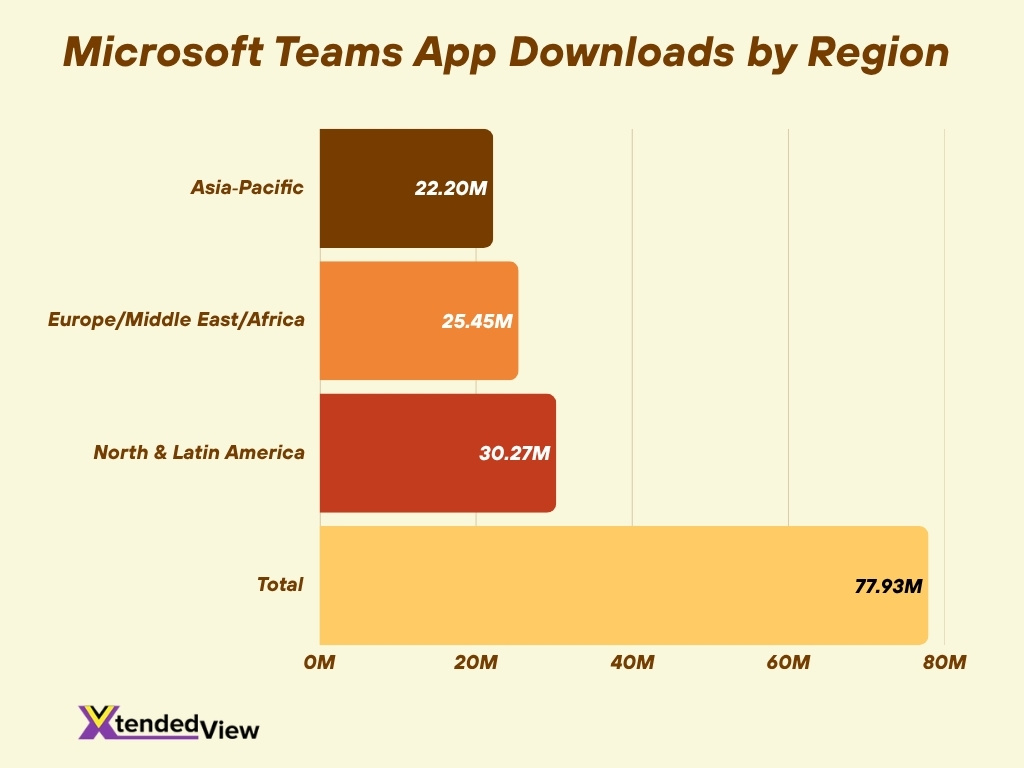
- In the first three quarters of 2024, Teams recorded 77.93 million global downloads.
- Breakdown by region for those downloads: ~22.2 million in Asia‑Pacific, ~25.45 million in Europe/Middle East/Africa, ~30.27 million in North & Latin America.
- In 2023, total downloads reached around 109.04 million.
- The mobile presence underscores that Teams isn’t just used at desks; mobile collaboration is a growing vector.
- While download numbers are high, they don’t directly reflect active usage, installation ≠ , or regular use.
- Download growth signals interest in newer deployments, especially among smaller organisations and hybrid teams.
- App‑store metrics for Teams indicate heavy regional variation; emerging markets may show slower growth but represent future upside.
- Monitoring downloads alongside active‑user metrics gives a fuller view of latent vs. engaged adoption.
Geographic Distribution of Teams Users
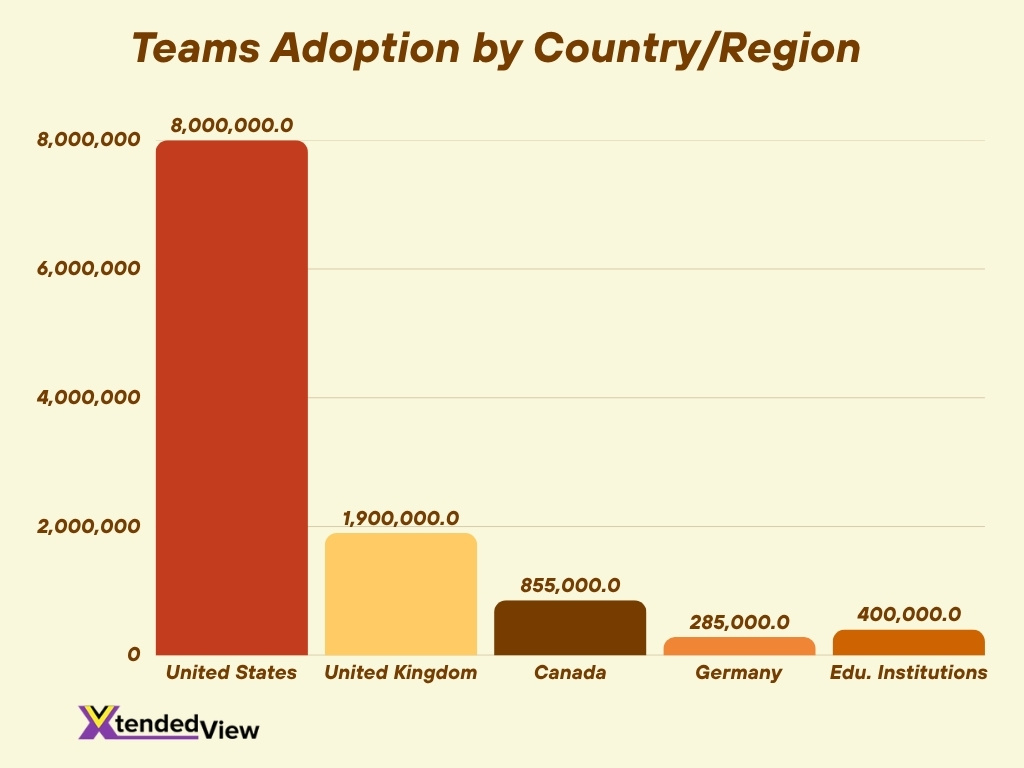
- In the United States alone, about 8 million companies reportedly use Teams.
- In the United Kingdom, roughly 1.9 million organisations use Teams, in Canada, about 855,000, Germany, around 285,000.
- More than 400,000 educational institutions worldwide use Teams for learning and hybrid collaboration.
- The growth of Teams in Asia‑Pacific reflects rising remote‑work adoption and Microsoft’s cloud expansion in that region.
- Teams’ global user base of approximately 320 million MAU underscores a broad geographic footprint.
- Regional growth rates are stabilising in mature markets (US, UK) and accelerating in developing markets, presenting further upside.
- Differences in adoption across geographies often align with enterprise‑licensing models, regulatory environment, and local collaboration tool preferences.
- Firms considering global deployments should pay attention to regional compliance, latency, data‑residency and integration maturity when rolling out Teams.
Industry‑Wise Adoption of Microsoft Teams
- In the IT/technology sector, Teams adoption accounts for nearly 30% of reported usage by industry in some datasets.
- Large enterprises across finance, healthcare, manufacturing and consulting have made Teams a core communications platform, especially post‑pandemic.
- In education, more than 400,000 schools and universities use Teams, showing its strength beyond pure enterprise.
- Small and medium‑sized businesses (SMBs) account for 21% of Teams users, medium firms ~47%, large enterprises ~32%.
- Organisations in regulated industries (e.g., healthcare, financial services) favour Teams for its compliance and integration with Microsoft 365.
- Manufacturing and engineering firms use Teams for cross‑site collaboration across global operations and field teams.
- Service industries (consulting, professional services) adopt Teams to streamline client‑worker interaction, document workflow, and hybrid meeting patterns.
- As hybrid and remote work models evolve, cross‑industry usage of Teams continues to broaden, raising its role from simply chat/meetings to a full workflow platform.
Microsoft Teams Usage By Organisation Size
- Among companies using Teams, approximately 26% are small organisations (< 50 employees).
- Around 47% of Teams users are in medium‑sized companies (50‑999 employees).
- Approximately 27% are large organisations (> 1,000 employees).
- In terms of company revenue segmentation, ~47% of Teams customers are small (< US$50 million revenue), ~20% medium, ~28% large (>$1 billion revenue).
- Over 93% of the Fortune 100 companies reportedly use Teams, showing strong enterprise penetration.
- Smaller organisations benefit from easier deployment of Teams via Microsoft 365 bundles, supporting high small‑company adoption.
- Larger organisations use Teams for global roll‑outs, standardised workflows, and compliance‑driven features, underscoring scalability across size segments.
- Usage patterns: large enterprises emphasise meetings, chat channels and governance features; small/medium firms focus on chat and document sharing, showing differentiated usage by size.
Demographic Profile of Teams Users
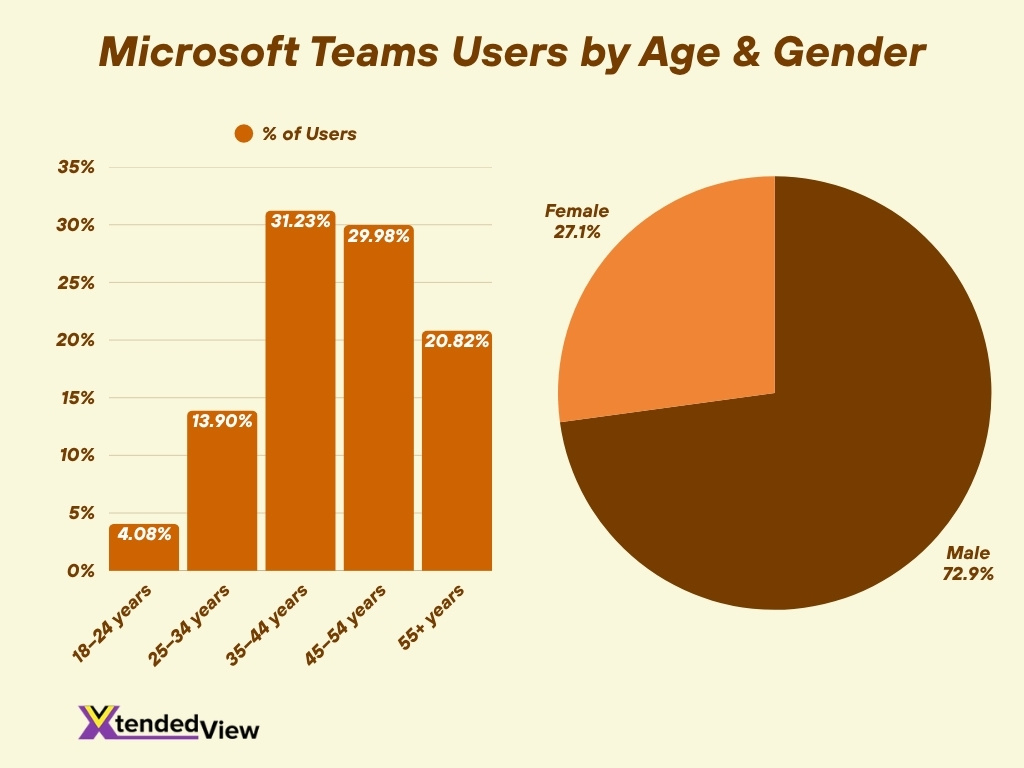
- The largest age group of Microsoft Teams users are 35‑44 years old, accounting for approximately 31.23% of the user base.
- The next largest group is 45‑54 years, making up about 29.98% of users.
- Those aged 25‑34 years represent around 13.90% of users.
- The 55 years and above cohort accounts for roughly 20.82% of users.
- Only around 4.08% of users are aged 18‑24 years, indicating relatively low usage among very young professionals.
- Gender breakdown reports suggest that, in a 2024 estimate, around 72.86% of users are male, and 27.14% female.
- These demographics suggest that Teams is heavily adopted by mid‑career professionals rather than entry‑level younger workers.
- For U.S.‑targeted organisations, this means Teams user messaging and meeting behaviours will likely reflect adult professionals (35‑54) rather than students or very young staff.
Teams Integration With Microsoft 365
- Teams is packaged as part of the broader Microsoft 365 ecosystem, making it the communication and collaboration hub for many businesses already using Microsoft services.
- Because of this integration, many organisations gain access to Teams when they subscribe to Microsoft 365 rather than selecting a standalone collaboration tool.
- This bundling supports rapid adoption, when a company deploys Microsoft 365 apps (Word, Excel, Outlook, etc.), Teams becomes the default chat/meetings interface.
- The integrated model increases stickiness; organisations using Teams are more likely to continue due to dependencies (files, chats, meetings, all embedded).
- Admin analytics reflect this; the user‑activity reports cover Teams usage across Microsoft 365 tenant data.
- Integration opportunities keep growing, e.g., announcement of new features in June 2025 for Teams Rooms Pro and expanded Chat/Channels experience.
- For U.S. organisations already using Microsoft 365, the incremental cost of deploying Teams is often low, which supports wider adoption across enterprise sizes.
- The deeper the integration with Microsoft 365, the more likely Teams is to be utilised not just for chat/meetings, but for workflows, file collaboration, and business process automation.
Popular Microsoft Teams Features
- Teams offers chat (1‑to‑1, group), channels, file sharing, video & voice meetings, and third‑party app integrations.
- The platform supports more than 1,400 third‑party apps, enabling extensive customisation.
- The file‑sharing activity on Teams has grown significantly; one source reports a 76% increase in file collaboration/interactions.
- Mobile usage is strong; one estimate puts mobile daily active users at over 75 million.
- Teams Rooms (meeting‑room hardware integration) and Teams Phone (cloud calling) are increasingly adopted, reflecting feature expansion beyond basic chat.
- In June 2025, new features, such as enhanced spell‑check and unified chat/channel experience, were rolled out, showing Microsoft’s investment in usability.
- For organisations in the U.S., the implication is that deploying Teams gives access not just to meetings and messaging, but a growing feature ecosystem, useful for collaboration, workflow, and communication tasks.
Microsoft Teams Meeting Statistics
- Teams users generated over 5 billion meeting minutes in a single day, according to one reported estimate.
- A breakdown from older data, about 2.7 billion meeting minutes in one day and 81 billion minutes in one month (early 2020), has also been reported.
- As of 2024/2025 estimates, Teams averages around 320 million monthly active users, which supports very high aggregate meeting‑minute volumes.
- Teams holds about 32.29% share of the global video‑conferencing market.
- Given this scale, U.S. enterprises using Teams are likely participating in billions of meeting minutes monthly, reflecting remote/hybrid workplace norms.
- The surge in meeting usage continues even post‑pandemic, reflecting sustained reliance on virtual collaboration.
- For admins and decision‑makers, the scale of meetings means attention to network bandwidth, meeting culture, and usage analytics becomes important.
Chat and Messaging Statistics
- According to a June 2025 report by Microsoft, the average employee receives 117 emails and 153 Teams messages daily.
- In analytics, Teams exposes metrics such as the number of posts, replies, mentions and reactions per team or channel.
- For organisational admins, the Teams user‑activity report enables insights into messaging trends across teams over 7/30/90/180-day windows.
- Heavy daily message volumes suggest that chat/messaging is central to user activity, potentially more frequent than meetings in some workflows.
- The 153 messages/day average suggests substantial internal communication load; for U.S. firms, this can influence collaboration strategy and notification policies.
- With messaging driving much of the Teams engagement, features like scheduled messages, threads (coming mid‑2025), and improved filtering (announced June 2025) will matter.
- Organisations should consider user behaviour, message overload, and governance of chat channels, given these message volume figures.
Video Conferencing Statistics (Teams Only)
- Teams recorded more than 320 million daily active users, and holds ~32% of the video‑conferencing market, suggesting very high video meeting volumes.
- Institutions and enterprises report meeting‑minute totals in the billions per day, reflecting video conferencing usage intensity.
- The average U.S. professional now meets on Tuesday most frequently (~23% of weekly meetings) according to Microsoft’s “Infinite Workday” study.
- Video conferencing via Teams consumes significant bandwidth. One estimate, 8 hours of HD video/conferencing uses ~3.6 GB of data per day.
- For large organisations, the data consumption and meeting frequency of Teams mean that IT infrastructure and network planning are critical.
- As hybrid work continues, Teams’ video usage is not just meetings but also large‑scale webinars and events; its capacity and integrations matter in hosting these.
- Administrators planning U.S. deployments should monitor video usage patterns, data usage, meeting scheduling, and functional usage (webinars, rooms, large events) of Teams.
Frequently Asked Questions (FAQs)
Approximately 320 million monthly active users as of 2024.
An estimated US$8 billion in revenue for 2023.
Roughly 32.29% of the video‑conferencing software market.
About 77.93 million downloads globally in the first three quarters of 2024.
Approximately 31% of users fall into the 35‑44 years age group.
Conclusion
Microsoft Teams has firmly established itself as a central platform for collaboration across age groups, features and workload types. The demographic data shows that its users are predominantly mid‑career professionals aged 35‑54, and its integration with Microsoft 365 ensures that this tool is embedded in business workflows. Teams’ extensive feature‑set, from chat and channels through to large video meetings, supports the high‑volume messaging and meeting usage we see today.
For U.S. organisations, this means Teams is much more than a video‑call tool; it’s a unified hub for communications, collaboration and process automation. As you evaluate Teams in your enterprise or team, these statistics offer strong evidence of scale, maturity and impact.
