


The landscape of online search remains dominated by Google, but subtle shifts in volume, device usage, and market share hint at evolving user behaviours and competitive pressure. From global search volume surging into the trillions to mobile devices firmly claiming the lead in how people access information, the scale and dynamics matter for marketers, businesses, and technologists. For instance, a global e‑commerce brand uses Google’s daily query volume to align its product launches, while a software company tailors its SEO for mobile‑first users based on detailed device‑type distribution. Explore the key statistics below to understand how search is changing in real‑time.
Editor’s Choice
Here are seven standout stats for quick insight:
- 90.4% of Google’s global search engine market share as of September 2025.
- > 5 trillion estimated number of Google searches per year in 2025.
- 13.6 billion Google searches per day in 2025.
- 64.35% share of global internet traffic coming from mobile devices by mid‑2025.
- 89.54% reported Google’s global search share in 2025.
- 71% proportion of Google searches on mobile devices, reflecting mobile‑first behaviour.
- 15%+ estimated proportion of daily Google queries that are brand‑new as of April 2025.
Recent Developments
- Google introduced an experimental “AI Mode” in March 2025 that replaces the traditional 10‑blue‑links layout with AI‑generated summaries.
- Click‑through rates (CTRs) in Google Search have fallen 30% year‑over‑year as users rely more on instant answers from AI overviews.
- Search behaviour is shifting, more queries begin in social or conversational tools rather than search engines exclusively, signalling fragmentation of the search journey.
- Google’s global share slipped below 90% for the first time since 2015, averaging 89.6% in late 2024 and early 2025.
- Mobile traffic share continues to rise globally, showing the mobile‑first paradigm is fully entrenched.
- A greater portion of daily queries are brand‑new, indicating rapidly evolving user interests and content gaps.
- Google expanded its Shopping Graph and visual search features, pushing more product queries into the platform’s own ecosystem.
Google’s Global Search Market Share
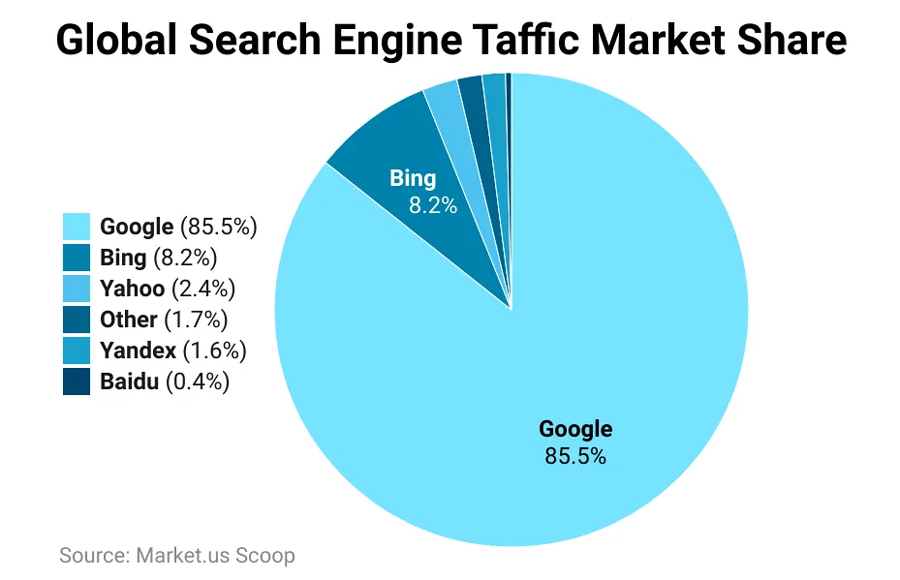
- Google dominates the search engine market with a massive 85.5% share, reaffirming its position as the global leader in search.
- Bing holds the second-largest share at 8.2%, showing steady but relatively small traction compared to Google.
- Yahoo maintains a 2.4% share, continuing its gradual decline in the market.
- Yandex, a major player in Russia and surrounding regions, has 1.6% market share.
- Baidu, China’s primary search engine, accounts for 0.4%, indicating limited global traffic despite a strong local presence.
- Other search engines collectively represent 1.7%, demonstrating minimal impact compared to the top providers.
- Key insight: The search landscape remains highly concentrated, with Google holding more than four-fifths of global search traffic.
Daily and Annual Google Search Volume
- Google handles over 5 trillion searches per year globally.
- Daily volume estimates range from 9.1 billion to 13.6 billion or higher in 2025.
- One source lists 16.4 billion searches per day in 2025, equating to 5.9 trillion per year.
- That suggests 189,800 searches per second at the high end.
- Another report 6.3 million searches per minute (9.5 million per minute) translates to 14 billion per day.
- Globally, average internet users perform 3‑4 searches per day, though professional users may conduct 20+ queries daily.
- In the U.S., earlier figures placed search volume at 8.5 billion daily (3.1 trillion annually), but newer updates suggest higher levels.
Mobile vs. Desktop Search Distribution
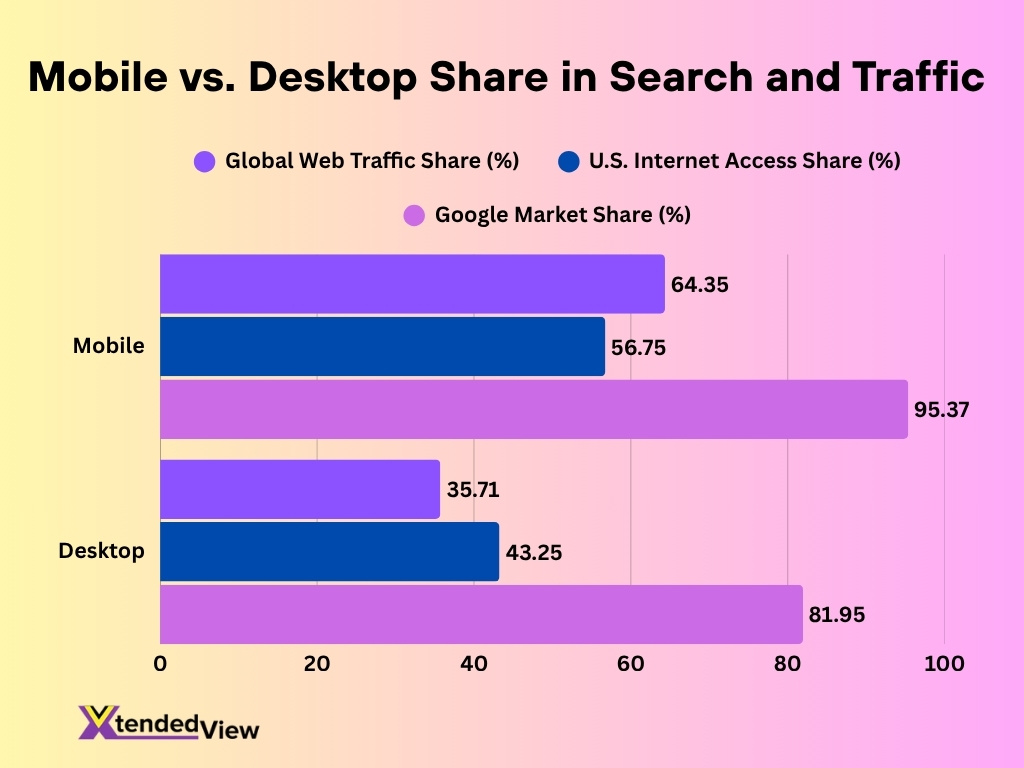
- As of May 2025, mobile devices accounted for 64.35% of global web traffic, and desktops 35.71%.
- In the U.S., mobile usage for internet access stood at 56.75% vs desktop 43.25%.
- For search engine market share specifically, Google had 95.37% on mobile and 81.95% on desktop globally.
- These figures underline the continuing shift towards mobile‑first search behaviour.
- Bounce rates tend to be higher for mobile (50‑60%) than desktop (30‑40%).
- For marketers, mobile-optimised search experiences are no longer optional; they are central.
- Desktop remains important for detail‑rich tasks, but initial queries and casual searches largely happen on mobile devices.
Most Popular Google Search Queries
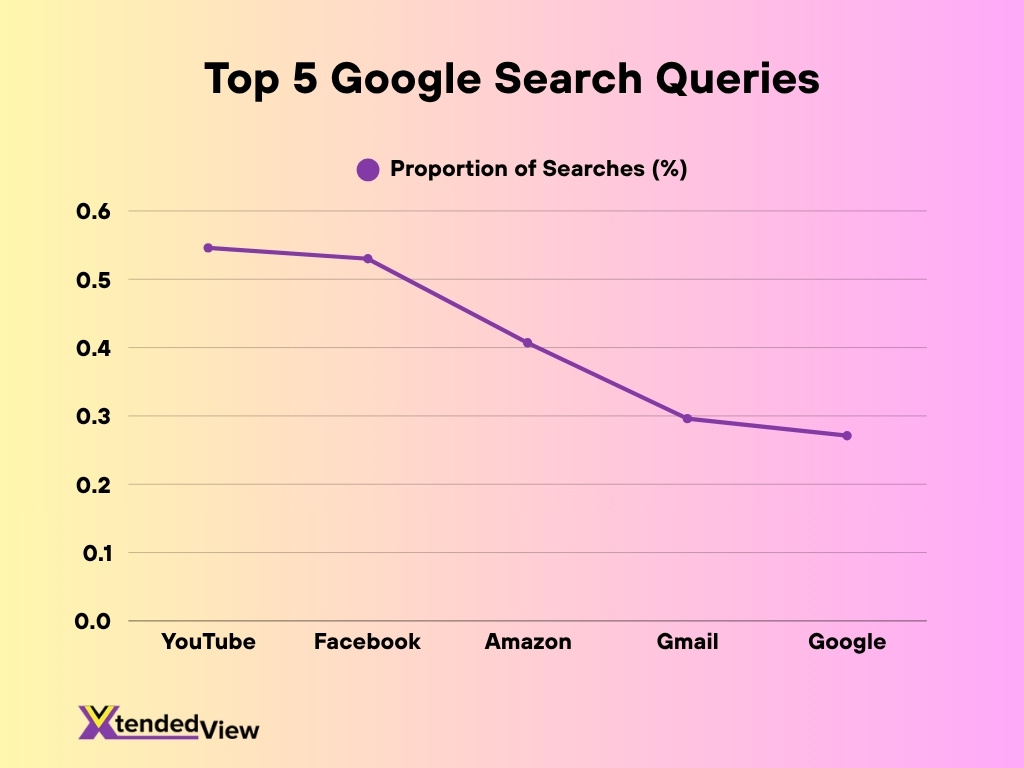
- The top‑100 Google search queries are dominated by large‑volume, brand‑related terms (YouTube, Facebook, Amazon).
- “YouTube” (0.546%), “Facebook” (0.530%), “Amazon” (0.407%), “Gmail” (0.296%), and “Google” (0.271%) are among the top five query terms.
- In 2025, 15% of Google’s daily queries are brand‑new.
- Question‑based searches (who, what, how) remain strongly represented, reflecting informational intent.
- In the U.S., mobile queries accounted for over 60% of search volume, influencing query types.
- With visual and voice search rising, keywords are becoming more conversational.
- For SEO, ranking for high‑frequency brand terms is highly competitive; opportunity exists in less saturated, long‑tail queries.
Trends in Keyword Length and Search Intent
- In the U.S., the average search query length on Google in 2025 is 3.4 words.
- On desktop, 31.6% of searches use just 1–2 words, and on mobile, the figure is 31%.
- About 39.9% of mobile searches in the U.S. consist of 3‑4 words, and desktop is at 38.2%.
- Roughly 15% of daily Google queries are entirely new.
- Informational intent remains dominant, and such queries trend toward being longer and conversational.
- Queries associated with voice or visual search tend to be longer and more natural‑language in structure.
- Short‑tail queries still appear in 30% of searches but convert less effectively than longer‑tail phrases.
- As search intent shifts toward tasks, marketers must match content with granular intent.
- Content optimised for conversational, question‑style queries is increasingly critical.
Zero‑Click and Click‑Through Rate (CTR) Statistics
- In 2025, studies estimate that 65% of searches on Google end with no click.
- On mobile, zero‑click rates are higher than on desktop.
- Featured snippets now appear in approximately 12–20% of queried searches.
- For organic search results, the average time to click is 14.6 seconds from page load.
- Only 0.44% of users go beyond the first page of results on Google.
- CTR for ads across industries averages around 3.17% in 2025.
- Around 96.55% of all web pages receive zero traffic from Google Search.
- These patterns drive a shift in strategy, focusing less on clicks and more on visibility in SERP features.
Google Search Usage by Country and Region
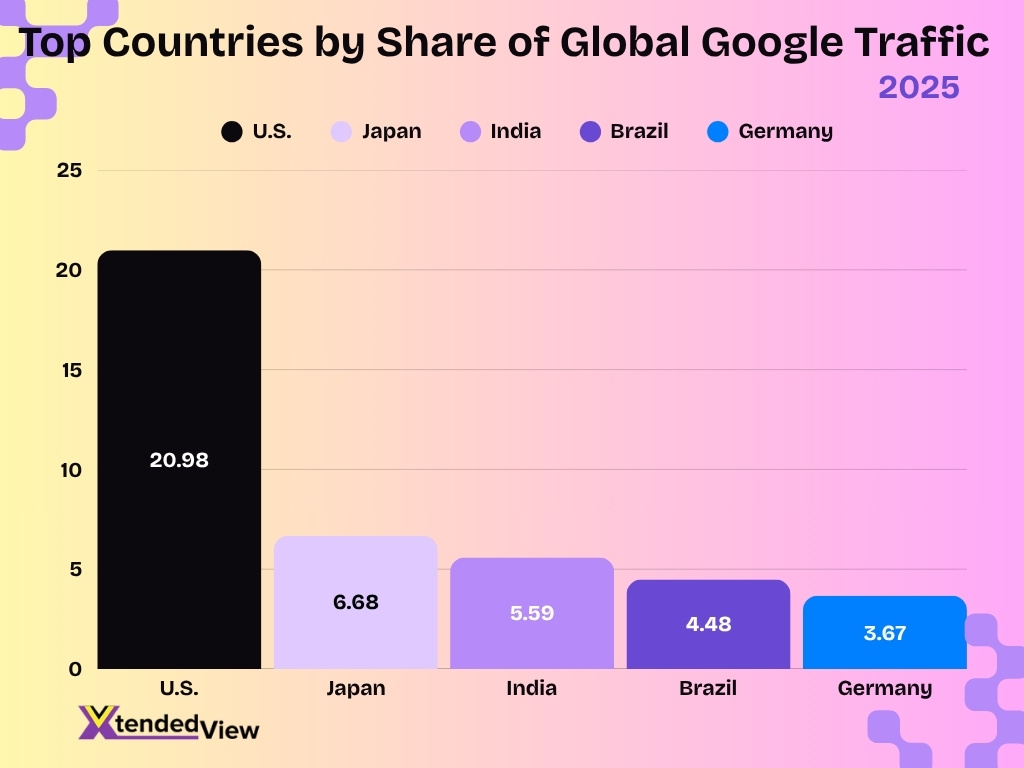
- The U.S. accounts for 20.98% of global Google traffic.
- Japan 6.68%, India 5.59%, Brazil 4.48%, and Germany 3.67%.
- In regions such as Nigeria, Israel, and Hungary, Google’s search dominance reaches 97–98%.
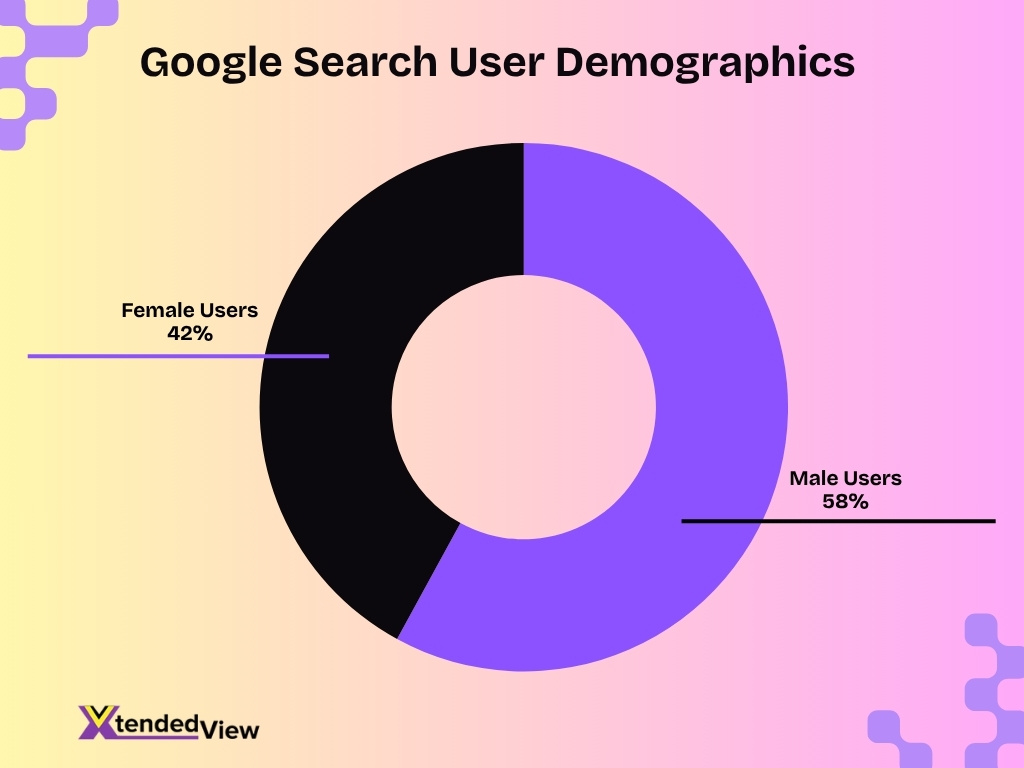
- The U.S. Google user base shows 57.96% male and 42.04% female distribution.
- 50% of Google’s users globally fall in the 18‑34 age group.
- Users aged 55+ represent 16.13% of the user base.
- For voice search, 58% of consumers ages 25‑34 report daily use.
- These differences spotlight the varying behaviours and opportunities for localisation.
Google Search Demographics (Age, Gender, etc.)
- Globally, 57.96% of Google users are male, 42.04% female.
- Half of the platform’s users fall in the 18‑34 age band.
- Users aged 55+ make up approximately. 16.13% of the user population.
- Within the 25‑34 age group, about 58% use voice search daily.
- Usage intensity: an average persons perform 3‑4 searches per day.
- Geographic‑demographic variations matter; younger users favour mobile/voice, older users tilt toward desktop/typed queries.
- For marketers, tailoring content by age group and query type improves reach and relevance.
Google Search User Behaviour Insights
- The average user conducts 3 to 4 searches daily, though power users may perform 20+ queries.
- New queries make up roughly 15% of all daily Google searches.
- On mobile, users change or refine their query 29.3% of the time, on desktop 17.9%.
- Around 51% of smartphone users discover new companies or products via search.
- Keyword length trends, mobile searches lean toward conversational phrasing.
- Bounce rates differ by device, mobile bounce higher (50‑60%) vs desktop (30‑40%).
- Search peak times in the U.S. are roughly 8‑10 AM and 6‑9 PM local time.
- With more answers displayed directly in SERPs, users may complete searches without visiting other sites.
Voice, Image, and Visual Search Statistics
- About 20.5% of people actively use voice search in 2025.
- In the U.S., roughly 27% of mobile users rely on voice search.
- Visual search via tools like Google Lens sees 12 billion+ queries/month globally.
- Users aged 25‑34, 58% report daily voice search use.
- For “near me” queries using voice, 76% of users employ voice search.
- Visual search is increasingly important for e‑commerce.
- Optimising for voice and image search means focusing on natural language, rich media, and schema markup.
- As interfaces shift, these modalities grow in relevance.
Google Shopping, E‑commerce & Product Searches
- About 36% of product search journeys start on Google Shopping.
- 65% of clicks on paid Google search results originate from mobile devices.
- 70% of smartphone users report they searched online first before making an in‑store purchase.
- Google Shopping ad units account for approximately 76% of the budget and capture about 85% of clicks.
- The global online e‑commerce market is expected to reach $6.8 trillion, with mobile commerce at 59%.
- 52% of online shoppers look for products internationally.
- “Cropped trench coat” searches rose more than 140% in one month.
- 92% of leading e‑commerce firms now use AI‑driven personalisation tools.
Seasonal and Trending Search Behaviour
- “Butter yellow” reached an all‑time high search interest in Spring 2025.
- “How to style a bandana” searches rose by 250% over one month.
- Trending queries can spike by 300% in just a few hours.
- Mobile commerce share will reach $4.01 trillion in 2025.
- Online sales are projected to reach 20.5% of total retail in 2025.
- Google Trends signals demand 4‑6 weeks ahead of seasonal peaks.
- Trending apparel items move rapidly across markets.
- Longer‑tail queries rise in trending windows.
Local Search and Google Maps Usage
- 46% of all Google searches now have local intent.
- 1.5 billion “near me” searches occur monthly.
- Users who search locally on mobile are 76% likely to visit a business within 24 hours.
- 42% of users click results in the Map Pack.
- 63.6% of consumers check Google business reviews before visiting.
- Local‑search query conversion rates can hit 80%.
- 58% of local searches happen on smartphones.
- Updated Google Business Profiles boost clicks nearly 2x.
Google Search Advertising and Revenue Statistics
- Over $71 billion in ad revenue was reported by Alphabet in Q2 2025.
- Google Ads show a 6.66% click‑through rate (CTR) and 7.52% conversion rate.
- Average cost‑per‑click (CPC) is approximately $2.69.
- 50%+ of all ad clicks are from mobile.
- Businesses gain $8 in revenue for every $1 spent on Google Ads.
- Google Search revenue is projected at $144 billion in 2024.
- U.S. search‑ad market share is around 51.9%.
- Retail ad budgets favour Google Shopping ad formats.
Impact of AI and AI‑Driven Search on Google
- AI search ad spend in the U.S. will rise from $1 billion in 2025 to $26 billion by 2029.
- 1,300% jump in retail referrals from AI search during the 2024 holiday season.
- AI search users spend 8% more time, browse 12% more pages, and show 23% lower bounce rates.
- “AI Mode” and multimodal search features replace the traditional search layout.
- AI Overviews appear in 13% of U.S. desktop searches.
- “Generative Engine Optimisation (GEO)” is rising.
- Visibility in AI answers is key for modern SEO.
Privacy and Data Usage in Google Search
- Google was ordered to pay $425 million for privacy violations in May 2025.
- A $1.4 billion settlement was paid over geolocation and biometric data usage.
- U.S. investigations continue into Google consent practices.
- 96% of mobile search results are on Google.
- Google’s warning banners appear in only 1% of sessions, despite many more risky queries.
- Data centralisation within Google’s services is growing.
- Companies must ensure regulatory compliance and transparent data use.
Frequently Asked Questions (FAQs)
Google holds approximately 89.54% of the global search engine market share in 2025.
Google processes approximately 13.7 billion searches per day in 2025.
Google commands about 95.32% of the mobile search engine market share and 81.95% of the desktop search engine market share.
Google handled over 5 trillion searches annually in 2025.
Around 58.5% of Google searches in the U.S. result in zero clicks (i.e., no site visited) in 2025.
Conclusion
Google Search extends far beyond simple query‑and‑click behaviour. From dominating e‑commerce product discovery, enabling highly localised business searches, and capturing intelligence via AI‑driven modalities, Google remains a cornerstone of digital strategy across industries. At the same time, privacy regulations and changing user interaction patterns demand that marketers adopt more nuanced and forward‑looking approaches.
Understanding these statistics is no longer optional; it is essential. Keep exploring the data and watch how these trends unfold over the coming months.
