


Cyberbullying has emerged as a digital‑age threat that affects schools, workplaces, and online social spaces alike. In business settings, companies find that employees who face harassment through company messaging apps see decreased productivity and higher turnover. In education, districts report increased absenteeism and mental‑health referrals linked to online victimisation. This article digs into the numbers behind cyberbullying, showing you what the data reveals and why it matters.
Editor’s Choice
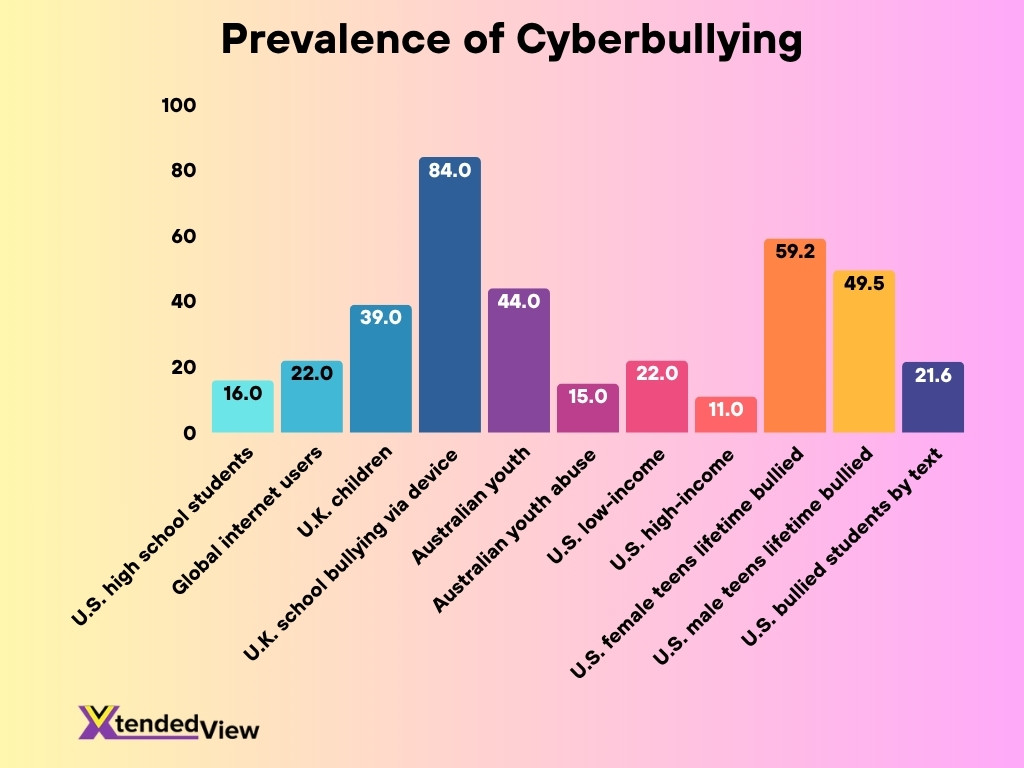
- In the U.S., 16% of high school students reported being electronically bullied in the past year, up slightly from 15.9% in 2021.
- Globally, 22% of internet users aged 12‑17 experienced cyberbullying in 2025.
- Among U.S. teens aged 13‑17, 59.2% of female teens and 49.5% of male teens said they had experienced cyberbullying at some point.
- Around 44% of Australian young people reported a negative online experience in the last 6 months, and about 15% received threats or abuse.
- Children from households with incomes under US $75,000 were twice as likely (22% vs. 11%) to be cyberbullied compared to higher‑income peers.
- In the U.K., 39% of children aged 8‑17 reported having experienced bullying (online or offline), of those, 84% say it occurred on a device.
- In the U.S., among students aged 12‑18 who reported being bullied, 21.6% cited online or text harassment.
Recent Developments
- A 2025 study found that more than half of U.S. adolescents who reported cyberbullying also reported symptoms akin to PTSD, challenging assumptions that online harassment is less serious.
- In Australia, reports of cyber‑harassment to the national regulator rose by 455% over five years by 2025, and children aged 12‑13 constituted 35% of reported victims in one year.
- New research highlights that generative AI and large‑language models are now being applied to detect cyberbullying in real time with accuracy nearing 90% in controlled experiments.
- More schools in the U.S. are partnering with platforms like Instagram to allow educators to report incidents directly to the platform, pointing to a shift in how policy and tech intersect in prevention.
- The growth of new social media and gaming platforms means cyberbullying is now less about traditional text messages and more about group chats, live‑streams and anonymous accounts. For instance, one global source found 34% of online harassment links to anonymous accounts in 2025.
- Policymakers in several countries are exploring minimum age limits for social media, mandatory reporting channels and digital‑citizenship education as part of anti‑cyberbullying frameworks.
- The shift to hybrid and online learning environments continues to embed digital spaces into students’ social lives, giving new vectors for cyberbullying outside traditional school hours.
What is Cyberbullying?
- Cyberbullying refers to intentional and repeated harm delivered via electronic means, text, social media, chats or gaming platforms, and includes harassment, threats, spreading false rumours, or sharing private images without consent.
- Unlike traditional bullying, cyberbullying can occur 24/7, reach a wider audience instantly, and allow anonymity for perpetrators.
- Forms of cyberbullying may include exclusion online, impersonation of victims’ accounts, sextortion, rumour-spreading, and targeted harassment in group or chat apps.
- Victimisation is not limited to youth; adults also experience harassment and online threats in professional contexts, though data is more limited.
- Cyberbullying often intersects with other issues, hate speech, discrimination based on identity, and digital privacy breaches.
- Because it happens online, documentation (screenshots, logs) matters more, and the impact can spill into offline life, social isolation, anxiety, and school avoidance.
- Prevention efforts often emphasise digital citizenship education, platform moderation, and safe‑reporting channels, but research shows many victims still don’t report incidents.
Prevalence of Cyberbullying
- In the U.S., recent data show 16% of high school students reported electronic bullying in the past year (2023).
- Globally, about 22% of internet users aged 12‑17 said they experienced cyberbullying in 2025.
- A U.K. study found 39% of children aged 8‑17 experienced bullying (online or offline), of those, 84% reported it happened via a device.
- In Australia, 44% of young people reported a negative online experience in the last six months, 15% said it included threats or abuse.
- In lower‑income U.S. households (under US$75k annual income), children had a 22% chance of being cyberbullied vs. 11% in higher‑income groups.
- According to the U.S. survey of teens aged 13‑17, 59.2% of female teens and 49.5% of male teens have experienced cyberbullying at some point.
- According to the U.S. federal survey, 21.6% of bullied students ages 12‑18 reported online/text bullying among those bullied.
- Earlier meta‑analysis shows adolescent cyberbullying victimisation rates vary widely, from 20% to 40% on average, depending on region, definition and method.
Cyberbullying Statistics by Country
- In the U.S., about 46% of teens reported experiencing cyberbullying in 2022.
- In Australia, 44% of young people reported a negative online experience in the last six months, including 15% receiving threats or abuse.
- A global poll of young people in 30 countries found that around one in three reported being victims of online bullying.
- In the U.K., 39% of children aged 8‑17 experienced bullying (online or offline), and among those, 84% said it happened via a device.
- In India, about 19.2% of children reported being bullied through social networks and online programmes, and 7.9% via electronic video games.
- Children from households earning under US $75,000 were twice as likely to be cyberbullied (22%) compared with higher‑income peers (11%).
- Global prevalence estimates show a wide range by country—from about 19% up to 57%—depending on region and definitions.
Cyberbullying Statistics by Age Group
- In 2023, 26.5% of U.S. teens aged 13–17 reported being cyberbullied in the past 30 days, up from 23.2% in 2021.
- Among the same age group, lifetime exposure reaches approximately 59.2% for girls and 49.5% for boys.
- For teens aged 15–17, 54% of girls said they experienced some form of cyberbullying, compared with 44% of boys in that age range.
- Teens aged 13–14 reported lower rates; 41% of boys and girls in that bracket said they had experienced at least one online harassment behaviour.
- Tweens (ages roughly 9–12) show online bullying exposure; about 14.5% of children in that pre‑teen range reported cyberbullying in certain international studies.
- A global study via the World Health Organisation found that one in six school‑aged children (≈ 16.7%) across several European countries reported cyberbullying victimisation.
- Age correlates with risk; one dataset observed that as children aged from 10 to 18, the likelihood of cyberbullying increased by about 2 % for every two‑year interval.
- Among students in grades 6‑12 who reported being bullied at school, 21.6% said the bullying happened online or by text.
- Younger adolescents under age 16 accounted for more than three‑quarters of reported serious cyberbullying complaints in a 2023 report from an Australian regulator.
Cyberbullying Statistics by Gender
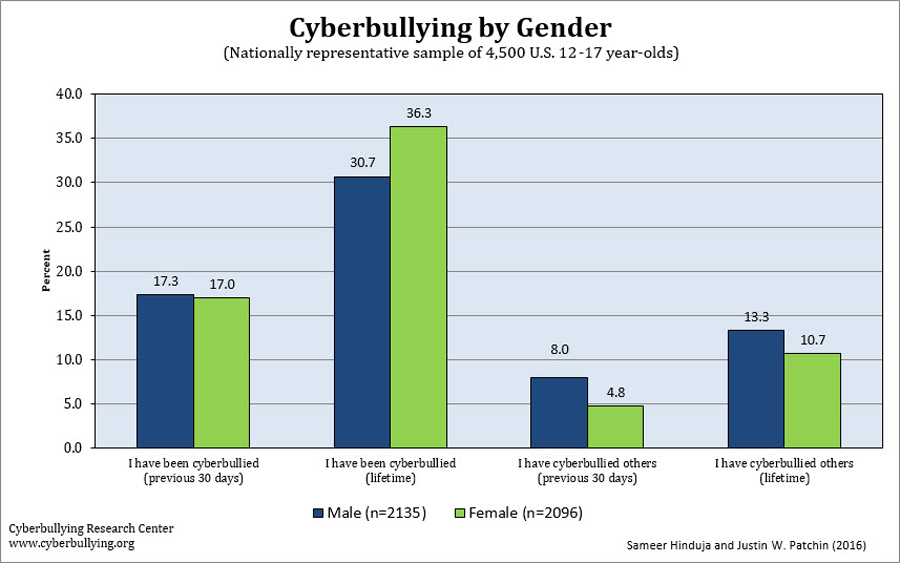
- A U.S. survey found female teens (aged 13–17) had a lifetime cyberbullying victimisation rate of 59.2%, compared to 49.5% for male teens.
- Over the past 30 days, 28.6% of girls and 24.2% of boys in the 13‑17 age range reported being cyberbullied.
- Among older teens (15–17), 38% of girls experienced two or more types of online harassment, whereas about 26% of boys reported multiple types.
- One recent source states that girls are about 1.3 times more likely to experience online harassment than boys.
- In adult populations (U.S.), 44% of men and 37% of women reported some cyberbullying experience.
- While female adolescents report higher victimisation rates, research notes that males may engage in cyberbullying perpetration at somewhat higher rates.
- Female‑victim rates in specific areas show much higher numbers, e.g., among girls aged 14‑19 in Australia, 98% reported appearance‑related cyberbullying in one study.
Cyberbullying Among LGBTQ Youth
- A 2021 survey found that LGBTQ+ students experienced cyberbullying at roughly 27%, compared to about 13% of their heterosexual peers.
- Another report noted that 73% of LGBTQ+ people reported being personally attacked or harassed online.
- LGBTQ youth who were bullied were reported to be three times more likely to attempt suicide than peers who were not bullied.
- Transgender youth (ages 13–17) reported cyberbullying victimisation rates up to 35% in one dataset.
- A U.S. federal survey indicated that of teens who experienced online harassment, about 12% cited their sexual orientation as the reason.
- Online harassment for LGBTQ youth often includes identity‑based attacks, such as misgendering, outing, or shaming of orientation/identity.
- Studies of Indian queer students found elevated rates of cyber sexual harassment versus non-LBGTQ counterparts.
Cyberbullying and Minority Groups
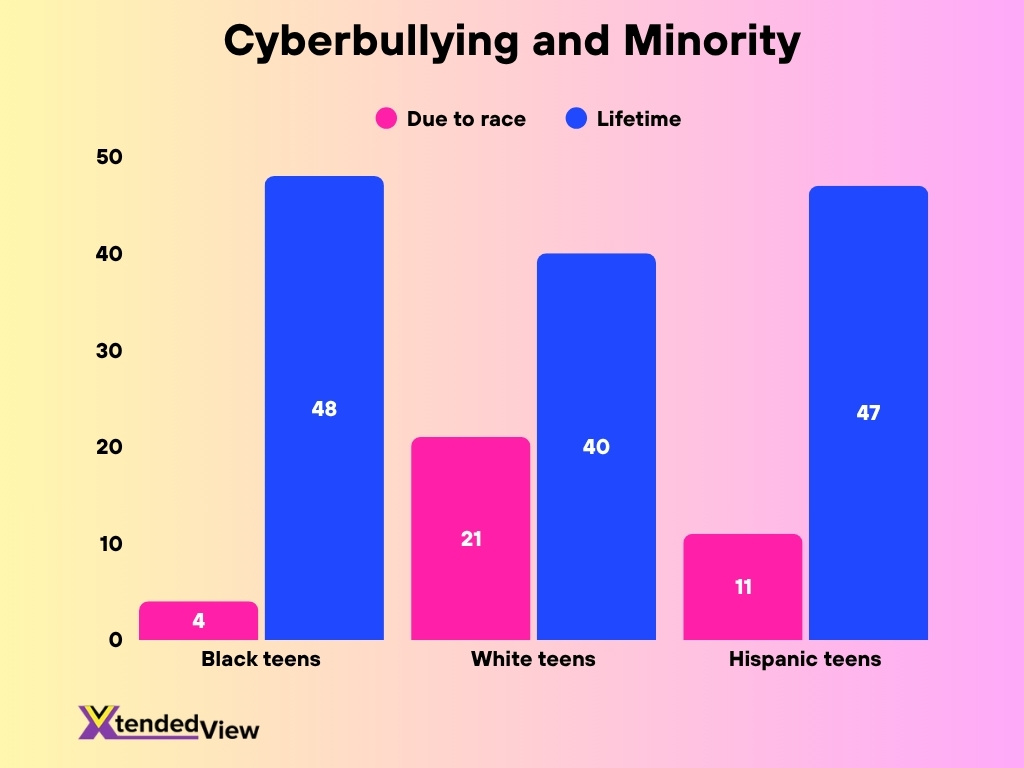
- According to a U.S. survey, 21% of Black teens said they were cyberbullied due to their race, a much higher share than White (4%) or Hispanic (11%) teens.
- Lifetime victimisation among White teens (48%) slightly exceeded Black teens (40%) and Hispanic teens (47%) in one dataset.
- Teens from households with incomes under US$30,000 were twice as likely to report being physically threatened online as those from households earning $75,000+.
- Globally, children from lower‑income backgrounds are shown to experience higher odds of cyberbullying; one dataset found that kids in households earning under $75k had a 22% likelihood vs. 11% for higher income.
- Research shows that racial and ethnic minority youth often face multiple reasons for cyber‐targeting, appearance, race/ethnicity, religion or language.
- The academic literature notes victimisation rates in minority groups vary widely (from 9% to 80%) depending on region and definition.
- Many minority students report lower rates of reporting cyberbullying to adults, due to mistrust of systems or lower perception of response efficacy.
Most Common Forms of Cyberbullying
- Around 77.5% of U.S. teens who were cyberbullied in 2023 said the most common form was having mean or hurtful comments posted online.
- Spreading rumours or false information was reported by approximately 70.4% of cyberbullying victims.
- Intentional exclusion from group chats or online groups affected about 66.4% of victimised teens.
- Repeated unwanted contact (texts or messages after being asked to stop) occurred in about 55.5% of cases.
- In Australia, 44% of young people reported a negative online experience in the last six months, which included 15% receiving threats or abuse.
- Social-media-specific data show, for example, that 67% of U.S. teenagers experienced some form of cyberbullying on social platforms in 2025.
- Appearance‑based harassment is rising; female‑identifying teens are about 1.8 × more likely than males to report appearance‑related insults via social apps.
- Across platforms, on YouTube, up to 79% of kids reported being cyberbullied, Snapchat 69%, TikTok 64%, and Facebook 49%.
- Less common but harmful, non‑consensual image sharing, fake accounts or impersonation, and social media “pile-ons” are increasingly reported.
- Bystander behaviour, many young people witness cyberbullying rather than being direct victims, helping raise the prominence of exclusion, rumour-spreading and witnessing roles.
Cyberbullying Trends Over Time
- According to the World Health Organisation Europe region study, reports of being cyberbullied rose from 12% to 15% for boys and 13% to 16% for girls between 2018 and 2022.
- Global reviews found victimisation rates ranged widely (≈ 14% up to ≈ 58%) over the past decade, showing a clear upward trend.
- Data show that as a child’s age increases (from 10 to 18), their likelihood of cyberbullying rises by about 2% for every two‑year interval.
- In U.S. teens aged 13‑17, those reporting cyberbullying in the past 30 days rose from 23.2% in 2021 to 26.5% in 2023.
- Social‑media platform shifts, newer platforms such as TikTok, Discord and anonymous apps are contributing to the rise; online harassment is moving beyond text to live streams and group chats.
- Income‑associated disparity persists; children in households earning under US $75,000 still show ~22% exposure vs ~11% in higher‑income homes.
- Awareness is rising globally; one source reports that “global cyberbullying awareness” is at 75%, up from earlier years.
- School‑reporting policies and online safety initiatives have grown, but incidents continue to rise, suggesting that the shift to digital is creating new vectors rather than eliminating old ones.
- The recent surge in AI‑driven harassment and anonymity tools suggests future years may see higher rates unless countermeasures scale.
- Many regions still lack consistent tracking, so while trends point upward, actual figures may under‑represent the full scope.
Risk Factors for Cyberbullying Victimisation
- Meta‑analysis shows that unfavourable family environments, such as frequent arguments or single‑parent households, are associated with higher victimisation (median r ≈ 0.20).
- Higher internet use, internet addiction and risky online behaviour are linked to increased victimisation (median r ≈ 0.19).
- Being a victim of traditional (offline) bullying significantly raises the risk of cyberbullying victimisation.
- Females, school‑aged youths and frequent internet users emerged consistently as higher risk groups.
- Unsupportive parental relationships and poor parental monitoring increase the odds of being targeted online.
- Negative school climate or lack of school safety are contextual predictors of higher cyberbullying risk (median r ≈ 0.11).
- Early substance use and poor academic engagement were found to correlate with higher cyberbullying victimisation in adolescents.
- Protective factors include higher emotional intelligence, self‑esteem, empathy and social‐skills (median r ≈ ‑0.06, indicating lower risk).
- Youth from lower‑income households, or where home digital supervision is weak, show elevated risk, echoing earlier income disparity trends.
- Emerging research suggests that children with siblings show differential patterns of risk for both victimisation and perpetration.
Risk Factors for Cyberbullying Perpetration
- Meta‑analyses show externalising behaviour (anger, hostility, substance use) is positively related to cyberbullying perpetration (median r ≈ 0.16).
- Previous victimisation (online or offline) increases odds of becoming a perpetrator, “bully‑victim” overlap is common.
- Dark personality traits (e.g., dominance, antisocial traits) correlate with higher perpetration risk (median r ≈ 0.15).
- Frequent or unmonitored internet use and high engagement in gaming or social media platforms may elevate perpetration risk.
- Poor parental monitoring, low family cohesion and negative peer influences are contextual risk factors for perpetration.
- Youth who see bullying as normative online behaviour (peer modelling) are more likely to engage in perpetration.
- School environments with weak anti‑bullying culture or inadequate supervision show higher rates of perpetration.
- Lower empathy, poor social skills and impulsivity are psychological traits associated with being a perpetrator.
- Identity and minority stress may also play a role in some perpetration contexts, but data is still emerging.
- Very few longitudinal studies isolate causality, so many of these correlations carry caveats about directionality.
Impact of Cyberbullying on Mental Health
- Victims of cyberbullying report higher levels of anxiety, depression, loneliness, and somatic symptoms than non‑victims.
- Meta‑analysis found cybervictimisation is associated with self‑harm and suicidal behaviour (median r ≈ 0.29).
- In the U.S., students ages 12‑18 who reported bullying online or by text reported being electronically bullied at ~21.6%.
- School attendance drops, for example, 19.2% of U.S. teens in 2023 missed school days because of cyberbullying (up from ~10.3% in 2016).
- Academic performance and peer relationships suffer, victims report lower satisfaction with school, reduced achievement and increased absenteeism.
- In Australia, 15% of youngsters reported threats or abuse online in the last six months, such experiences are linked to mental‑health complaints.
- Some studies suggest the severity of trauma from cyberbullying rivals offline bullying, research published in May 2025 found that 53.9% of U.S. teens had been cyberbullied and that more frequent incidents corresponded to higher PTSD symptoms.
- Victim identity matters; LGBTQ youth, minority students and females show elevated mental‑health impacts from cyberbullying exposure (though full statistics vary).
- Long‑term consequences can include chronic depression, social withdrawal, and increased risk for substance use and aggression.
- Reporting and prior support play a protective role, victims who seek help early show better mental‑health outcomes.
Reporting and Prevention of Cyberbullying
- Only 38% of U.S. teenagers who experienced cyberbullying on social media in 2025 said they reported the abuse to a trusted adult or authority.
- Among U.S. students ages 12‑18 who were bullied, about 44.2% told an adult at school.
- According to research, school‑based intervention programmes are associated with lower cyberbullying levels (median r ≈ ‑0.07).
- Digital literacy and parental monitoring remain under‑utilised; many families lack clear rules around device use, platforms or online behaviour.
- Governments and regulators in several countries are tightening platform obligations and age‑verification policies (e.g., Australia’s upcoming social media age limit).
- Peer‑intervention programmes (bystander‑training) show promise, e.g., ~80% of young people say they would intervene if anonymous.
- Platforms such as Instagram, TikTok and YouTube are increasingly offering in‑app reporting and AI‑moderation tools, but victims still report dissatisfaction with the effectiveness.
- Schools are increasingly integrating digital‑citizenship curricula, focusing not just on behaviour but emotional resilience and coping.
- Holistic prevention involves family, school, platform and policy collaboration; singular actions rarely suffice.
- Monitoring and evaluation remain weak in many jurisdictions; better data, tracking and standardised definitions would support more effective prevention.
Frequently Asked Questions (FAQs)
About 26.5% of U.S. teens (ages 13‑17) reported being cyberbullied in the last 30 days.
Approximately 59.2% of girls and 49.5% of boys (ages 13‑17) have experienced cyberbullying in their lifetime.
On YouTube, kids report the highest incidence of cyberbullying at 79%.
Reports show 12% to 15% of boys and 13% to 16% of girls experienced cyberbullying during 2018–2022 in Europe.
About 21.6% of students ages 12–18 (grades 6‑12) who reported being bullied at school said the bullying happened online or by text.
Conclusion
The data for 2025 underline a clear and urgent reality: cyberbullying remains pervasive, evolving and deeply harmful. From the most common forms of hurtful comments and exclusion, through rising trends over time, to identifiable risk factors and serious mental‑health impacts, the numbers tell a consistent story. Effective mitigation demands coordinated efforts across families, schools, platforms and policymakers. As we move deeper into the digital age, staying informed, vigilant and proactive is essential.
