



Cyberbullying in the workplace has become a growing concern as organizations increasingly depend on email, instant messaging, video conferencing, and collaborative digital platforms to communicate. While these technologies improve efficiency and flexibility, they also create new opportunities for repeated online harassment, intimidation, exclusion, and abusive behavior among employees. The rise of remote and hybrid work has further expanded the digital spaces where workplace interactions take place, making cyberbullying more difficult to detect and address.
The impact extends far beyond individual employees. Workplace cyberbullying contributes to lower productivity, declining employee engagement, higher absenteeism, increased turnover, and greater legal and compliance risks for employers. Industries such as healthcare, education, technology, finance, and public services have all reported growing concerns about digital harassment as online collaboration becomes a permanent part of daily operations. Understanding the latest workplace cyberbullying statistics helps organizations develop stronger prevention strategies, protect employee well-being, and foster healthier workplace cultures. Explore the latest data and trends below to understand how workplace cyberbullying is evolving.
Editor’s Choice
- 32.3% of working American adults report experiencing workplace bullying, representing an estimated 52.2 million workers.
- Around 72% of U.S. adults are aware of workplace bullying either through direct or indirect experience.
- More than one in five employed people worldwide have experienced violence or harassment at work during their careers.
- Digital communication tools have expanded opportunities for technology-enabled harassment, making cyberbullying a growing workplace risk in both remote and hybrid settings.
- Among U.S. workers, hybrid employees recorded the highest bullying prevalence at 51%, exceeding fully remote and fully on-site workers.
- Psychosocial risks at work contribute to approximately 840,000 deaths annually, highlighting the growing health burden associated with harmful work environments.
- Violence, harassment, and bullying are among the leading workplace psychosocial risks affecting employee mental health.
Recent Developments
- During 2025, international labor organizations emphasized that technology-facilitated violence and harassment are pushing many women out of leadership positions and digital workplaces.
- International efforts continue promoting Convention No. 190 as the first treaty covering workplace violence and harassment, including abuse occurring through work-related digital communications.
- In 2026, new findings estimated 840,000 annual deaths linked to workplace psychosocial risks, reinforcing the importance of preventing digital harassment.
- The latest national workplace bullying survey found that workplace bullying directly affects over 52 million U.S. workers, demonstrating that the issue remains widespread.
- Hybrid work arrangements emerged as the highest-risk work model for bullying in the latest national survey, with prevalence exceeding half of surveyed hybrid employees.
- International organizations increasingly classify digital harassment as an occupational safety and health issue rather than solely an HR concern.
- Global health authorities continue recommending that employers address bullying alongside workload, discrimination, and organizational culture when improving workplace mental health.
- Academic research published during 2024 focused on AI-assisted cyberbullying detection, reflecting growing interest in automated workplace moderation tools.
- Researchers also reported rapid progress in machine learning models capable of identifying cyberbullying language across digital communication platforms.
What Is Cyberbullying in the Workplace
- Workplace cyberbullying refers to repeated harmful behavior conducted through digital communication tools such as email, messaging apps, collaboration platforms, video meetings, and workplace social networks.
- Workplace cyberbullying is recognized as violence or harassment occurring through work-related communications enabled by information and communication technologies (ICTs).
- Workplace cyberbullying may include threatening emails, repeated public humiliation, hostile chat messages, exclusion from digital meetings, or abusive comments during virtual collaboration.
- Unlike isolated disagreements, workplace cyberbullying typically involves persistent and repeated behavior intended to intimidate, isolate, or undermine another employee.
- Researchers note that cyberbullying has become more difficult to identify because digital interactions often occur across multiple platforms simultaneously.
- Remote and hybrid work have expanded opportunities for digital harassment because employees communicate through more online channels than ever before.
- International guidance now encourages employers to include digital communication policies within workplace anti-harassment programs.
- Workplace bullying is classified as a psychosocial hazard that can negatively affect both mental and physical health when organizations fail to intervene.
General Cyberbullying in the Workplace Statistics
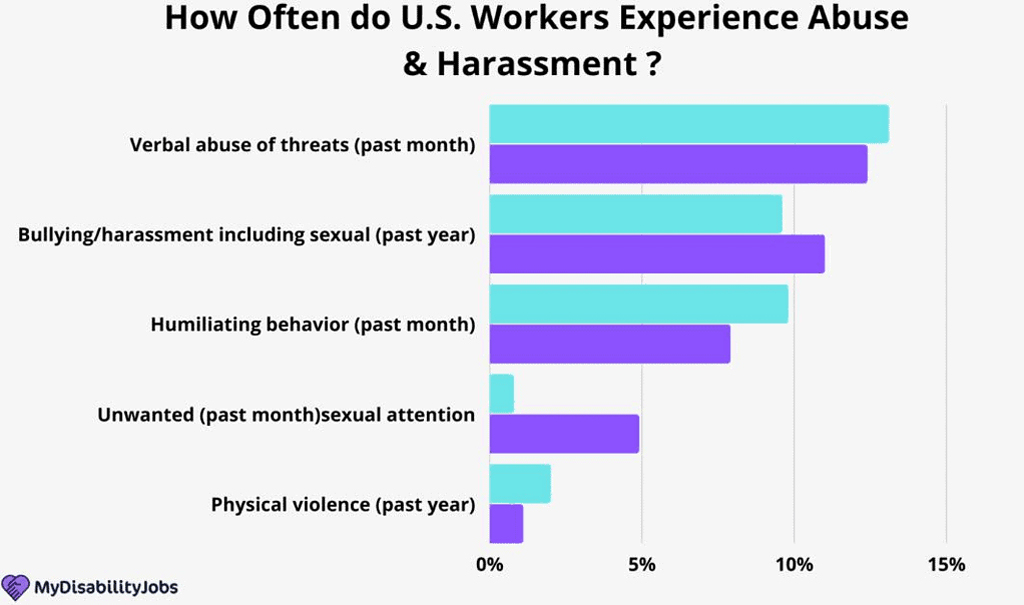
- Verbal abuse or threats were the most common issue, affecting 13.1% of men and 12.4% of women in the past month.
- Bullying or harassment affected 11.0% of women, compared with 9.6% of men over the past year.
- Humiliating behavior was reported by 9.8% of men and 7.9% of women in the past month.
- Unwanted sexual attention showed the widest gender gap, affecting 4.9% of women versus just 0.8% of men.
- Physical violence was less common overall, but affected 2.0% of men compared with 1.1% of women.
- Women recorded higher rates in bullying, harassment, and unwanted sexual attention, while men reported more verbal abuse, humiliation, and physical violence.
Key Cyberbullying in the Workplace Statistics
- 32.3% of working U.S. adults report being directly bullied at work.
- An estimated 52.2 million U.S. workers currently experience workplace bullying.
- Approximately 22.6 million workers report witnessing workplace bullying without being direct targets.
- Combined, nearly 74.8 million U.S. workers are affected either directly or indirectly by workplace bullying.
- 72% of Americans report awareness of workplace bullying through personal experience or observation.
- More than 20% of workers globally have experienced workplace violence or harassment during their careers.
- Workplace bullying is among the primary workplace factors contributing to poor mental health outcomes.
- Digitalization, AI, remote work, and new employment models continue increasing exposure to psychosocial risks if organizations lack effective safeguards.
- Technology-enabled harassment is an increasingly important workplace safety issue requiring legal, organizational, and policy responses.
Workplace Cyberbullying by Industry and Sector
- The healthcare industry experiences 50% higher rates of workplace bullying than any other sector.
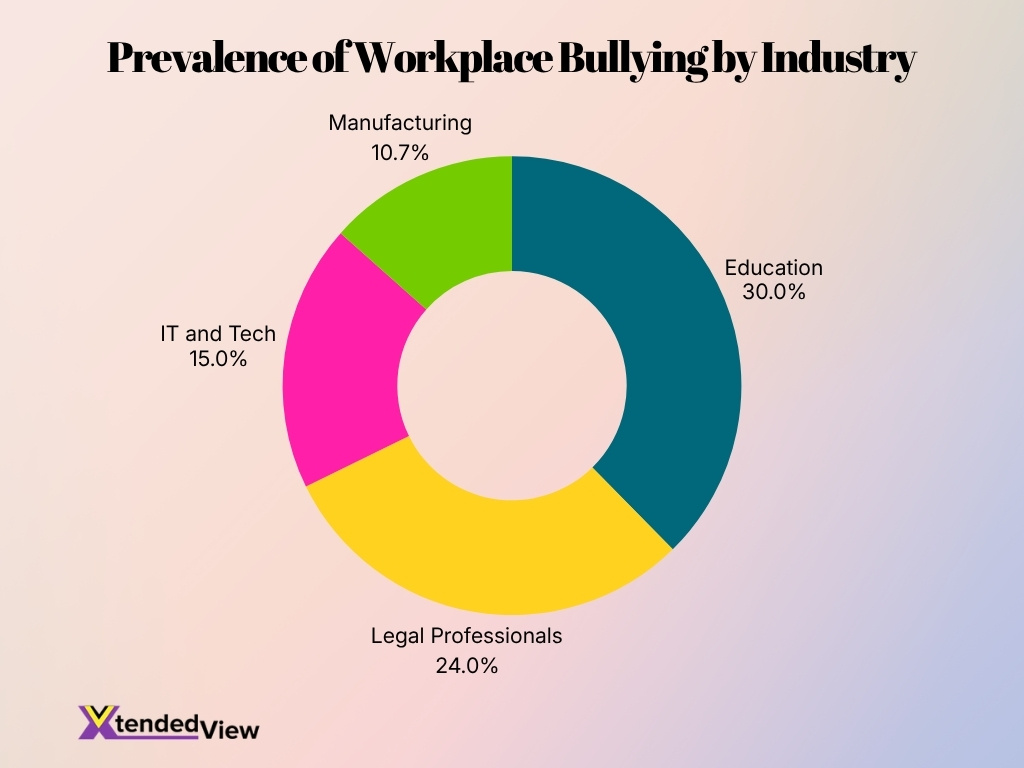
- In the education sector, 30% of employees report being victims of workplace bullying.
- Approximately 15% of IT and tech employees become victims of workplace bullying.
- Nearly 24% of legal professionals have reported being bullied or harassed at work.
- Roughly 61.5% of remote employees across various sectors have experienced or witnessed bullying.
- Studies indicate that 10.7% of manufacturing workers have reported experiencing workplace cyberbullying.
- Across all industries, 50% of workplace cyberbullying incidents occur during online company meetings.
- About 46% of professionals report experiencing cyberbullying through emails at work.
- Research shows 70% of younger employees aged 18-34 have faced cyberbullying in the workplace.
Cyberbullying in Remote and Hybrid Workplaces
- 51% of hybrid employees reported experiencing workplace bullying in a recent survey.
- Fully remote workers experience a bullying prevalence of 32%, matching the national average.
- Exclusively on-site employees report a lower bullying rate of approximately 26%.
- 66% of hybrid workers are affected by bullying, compared to the 46% national average.
- A study of 373 IT employees found cyberbullying significantly reduces well-being and retention.
- Remote work extends harassment opportunities through digital channels beyond normal hours.
- Hybrid employees face overlapping risks from both traditional bullying and online harassment.
- 2025 studies identify remote work as a major factor reshaping workplace cyberbullying patterns.
- Employers are increasingly urged to monitor digital workplace culture to identify emerging cyberbullying risks.
Digital Channels Used for Workplace Cyberbullying
- Over 50% of remote workers reported experiencing cyberbullying through technology-induced interactions.
- Approximately 70% of workplace mistreatment happens publicly, including during virtual team meetings.
- Data reveals that bosses make up 47% of cyberbullies across digital workplace platforms.
- Incidents of mistreatment via group emails account for 6% of cases, while private emails represent 3%.
- A staggering 80% of employees have dealt with some form of cyberbullying on professional communication apps.
- Nearly 1 in 5 employees face digital cyber-abuse on enterprise messaging platforms at least once a week.
- Around 65% of perpetrators using collaborative platforms for harassment hold a higher rank than their targets.
- Online workplace bullying prevalence rates across various digital sectors range from 2% to 40%.
Types of Workplace Bullying and Cyberbullying Behaviors
- 32.3% of employees reported that they were cyberbullied in the U.S. during 2024.
- 43.2% of remote workers report experiencing some form of cyberbullying in their virtual workplace.
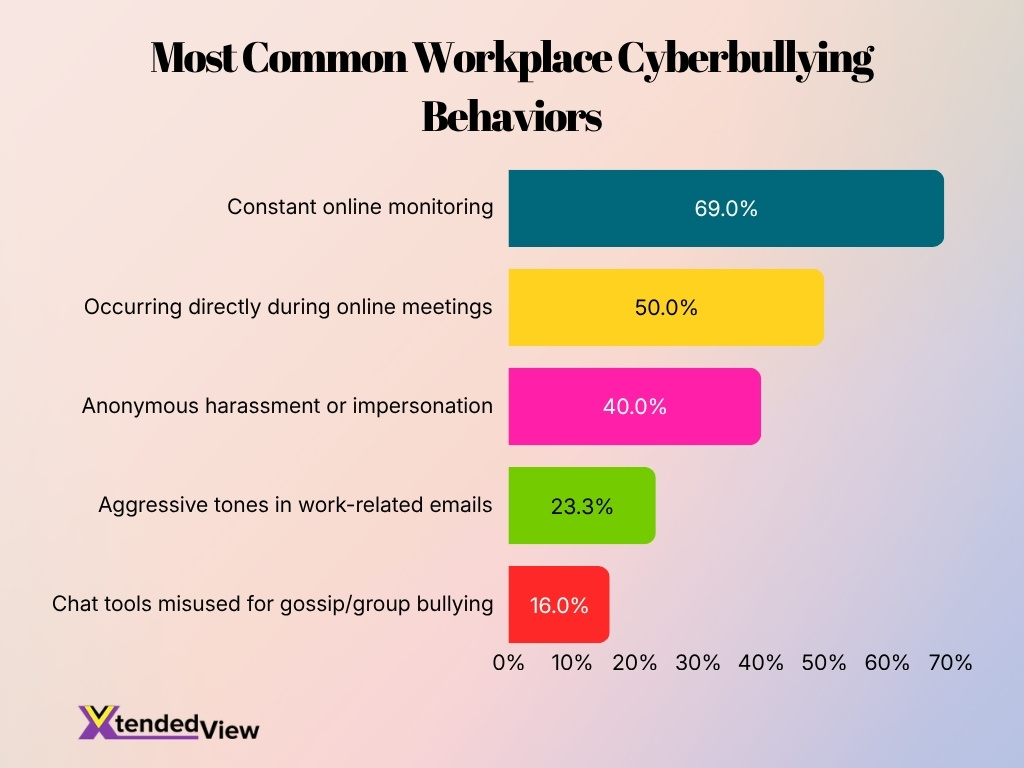
- 50% of all workplace cyberbullying incidents occur directly during online meetings.
- 23.3% of employees have received aggressive tones in work-related emails from their co-workers.
- 16% of employees noted that internal chat tools were actively misused for gossip or group bullying in 2025.
- 69% of workplace bullying targets experienced harassment through constant online monitoring.
- 40% of digital bullying incidents in professional settings involved anonymous harassment or impersonation in 2025.
- 31% of professionals who experienced workplace cyberbullying ultimately changed jobs as a result.
Demographics of Workplace Cyberbullying Victims
- 51% of workplace bullying targets in recent surveys were women.
- 30% of female respondents reported experiencing workplace bullying.
- 34% of male respondents reported experiencing workplace bullying.
- African American employees reported the highest overall rate of bullying exposure.
- Hispanic workers experienced bullying at rates above the national average.
- White employees reported bullying rates below the national average.
- Asian employees reported lower direct victimization but equal awareness.
- 6% of reported workplace bullying targets identified as non-binary.
- Demographic differences often intersect with organizational hierarchy and remote work.
Mental Health Impact of Cyberbullying at Work
- Approximately 15% of working-age adults live with a mental disorder partly driven by workplace bullying.
- Workplace hazards like bullying and harassment significantly increase the risk of anxiety, depression, and burnout.
- Psychosocial workplace risks contribute to more than 840,000 deaths annually across the globe.
- Poor psychosocial working environments account for nearly 45 million disability-adjusted life years (DALYs) lost every year.
- Psychosocial risks cause an annual economic loss equal to 1.37% of global GDP due to health-related productivity declines.
- Repeated workplace cyberbullying significantly increases the likelihood of chronic stress and sleep disorders.
- Digital harassment often extends beyond working hours, severely hindering psychological recovery.
- Poor management and workplace bullying must be addressed to actively improve employee mental health.
- Cyberbullying is a major contributor to declining digital well-being among highly connected employees.
Roles of Perpetrators and Power Imbalance at Work
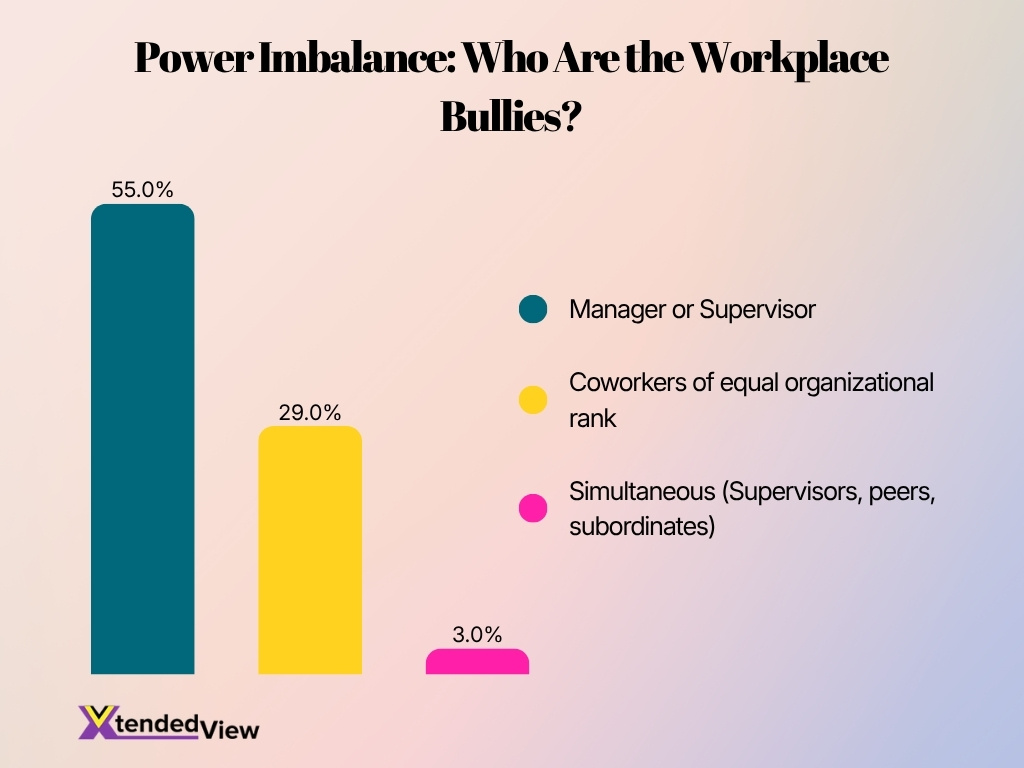
- 55% of workplace bullying cases involved a manager or supervisor, making “bully bosses” the most common perpetrators.
- 29% of reported perpetrators were coworkers of equal organizational rank, the highest peer-to-peer level recorded across recent workplace bullying surveys.
- 75% of victims reported that the perpetrator acted alone rather than as part of a coordinated group.
- Only 3% of incidents involved bullying simultaneously from supervisors, peers, and subordinates.
- 36% of all reported bullying cases involved a male perpetrator targeting a male employee, making it the most common gender pairing.
- 59% of workplace bullying incidents occurred between individuals of the same gender.
- Researchers consistently identify organizational power imbalance as one of the defining characteristics distinguishing workplace cyberbullying from ordinary interpersonal conflict.
- Digital technologies allow perpetrators to extend power beyond traditional office settings through after-hours messaging, online exclusion, and continuous monitoring.
- Recent workplace cyberbullying research recommends leadership accountability, transparent reporting systems, and AI-supported monitoring to reduce abuse associated with organizational power differences.
Impact of Cyberbullying on Job Performance and Productivity
- 34% of workers witness an increase in absenteeism as a direct result of workplace cyberbullying.
- Approximately 45% of targeted employees experience productivity-killing depression and anxiety.
- Nearly 67% of cyberbullying targets ultimately leave their jobs, severely disrupting team output.
- About 50% of workplace cyberbullying incidents happen during online meetings, halting collaborative momentum.
- Victims are 64% more prone to quit their roles, leading to high turnover and lost organizational knowledge.
- Around 62% of severe workplace cyberbullying cases end in the resignation or termination of the target.
- Over 61% of remote workers have experienced or witnessed digital bullying, hindering virtual work efficiency.
- Roughly 48% of workplace bullying sufferers witness lowered confidence and self-respect, which damages work quality.
Impact of Cyberbullying on Turnover and Retention
- 60% of employees experiencing bullying consider leaving, while 15% actually resign.
- Unresolved workplace cyberbullying causes roughly 29% of targeted victims to quit their jobs.
- Companies with high rates of online harassment experience a 20% increase in voluntary turnover.
- Victims of workplace cyberbullying take an average of 7 extra sick days annually.
- Approximately 71% of cyberbullying victims experience severe burnout leading to resignation.
- Replacing an employee lost to cyberbullying can cost up to 200% of their annual salary.
- Nearly 40% of employees who simply witness cyberbullying express a strong desire to leave.
- Ongoing digital harassment contributes to a 34% overall drop in employee retention rates.
Legal and Compliance Risks Related to Workplace Cyberbullying
- 70% of professionals aged 18 to 34 have experienced cyberbullying in their work environment.
- Over 50% of modern workplace cyberbullying incidents occur specifically during remote online meetings.
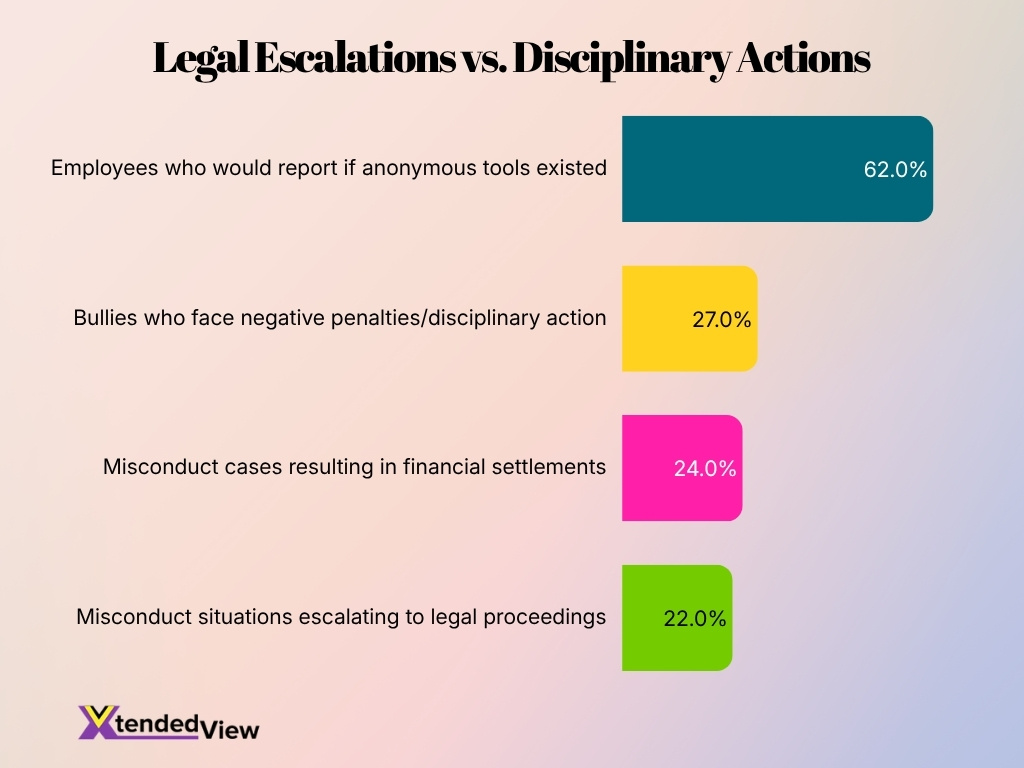
- Approximately 22% of unaddressed workplace misconduct situations escalate into formal legal proceedings.
- Around 24% of severe workplace misconduct cases eventually result in expensive financial settlements.
- Toxic behavior and workplace bullying cost UK employers roughly £18 billion annually in legal and productivity losses.
- Nearly 32.3% of employees report facing digital harassment, exposing employers to severe compliance liabilities.
- Unresolved workplace bullying claims drain up to $36 billion annually in hidden costs and legal fees in Australia.
- Fully 62% of employees would report workplace harassment if companies provided secure, anonymous compliance reporting tools.
- Only 27% of workplace bullies ever face negative penalties or formal disciplinary action from their employers.
- Over 46% of employees have experienced forms of cyberbullying directly through work-related emails.
Financial and Economic Costs of Workplace Cyberbullying
- Poor psychosocial work environments reduce global economic output by approximately 1.37% of global GDP each year.
- Canada has estimated annual workplace bullying-related absenteeism costs at approximately CA$19 billion.
- Depression and anxiety alone contribute to global productivity losses of approximately $1 trillion annually.
- Toxic workplace behavior and bullying cost UK employers approximately £18 billion per year due to sickness and low productivity.
- Workplace misconduct caused an estimated $8.54 billion loss for the US economy due to missed workdays.
- The annual economic cost of workplace bullying to New Zealand employers is estimated at $1.34 billion.
- Around 42% of the total cost of workplace bullying is driven by the turnover and replacement of affected workers.
- Approximately 66% of employees who experience or witness workplace misconduct report a significant drop in productivity.
- The productivity cost of workplace bullying ranges from 13.9% to 17.4% for victims with chronic medical conditions.
- Replacing an employee who resigns due to cyberbullying can cost an organization more than 50% of that employee’s annual salary.
Organizational Responses to Cyberbullying Complaints
- 32.3% of U.S. employees reported experiencing cyberbullying at their workplace.
- Only 27% of reported cyberbullying cases resulted in the culprits being negatively penalized.
- 50% of workplace cyberbullying incidents occur during online company meetings.
- About 47% of workplace bullies are individuals in supervisory roles or boss positions.
- Nearly 31% of employees who faced digital harassment ended up changing jobs as a result.
- 45% of victims reported severe symptoms of stress, anxiety, or depression requiring mental health support.
- In 62% of unresolved bullying cases, the victims ultimately lost their jobs rather than the perpetrators.
- Around 69% of targets experienced harassment due to being constantly monitored online by their organizations.
- 46% of workers have experienced cyberbullying through company email channels.
- Approximately 61.5% of remote employees have either been bullied or witnessed bullying behavior virtually.
Key Workplace Anti-Cyberbullying Practices
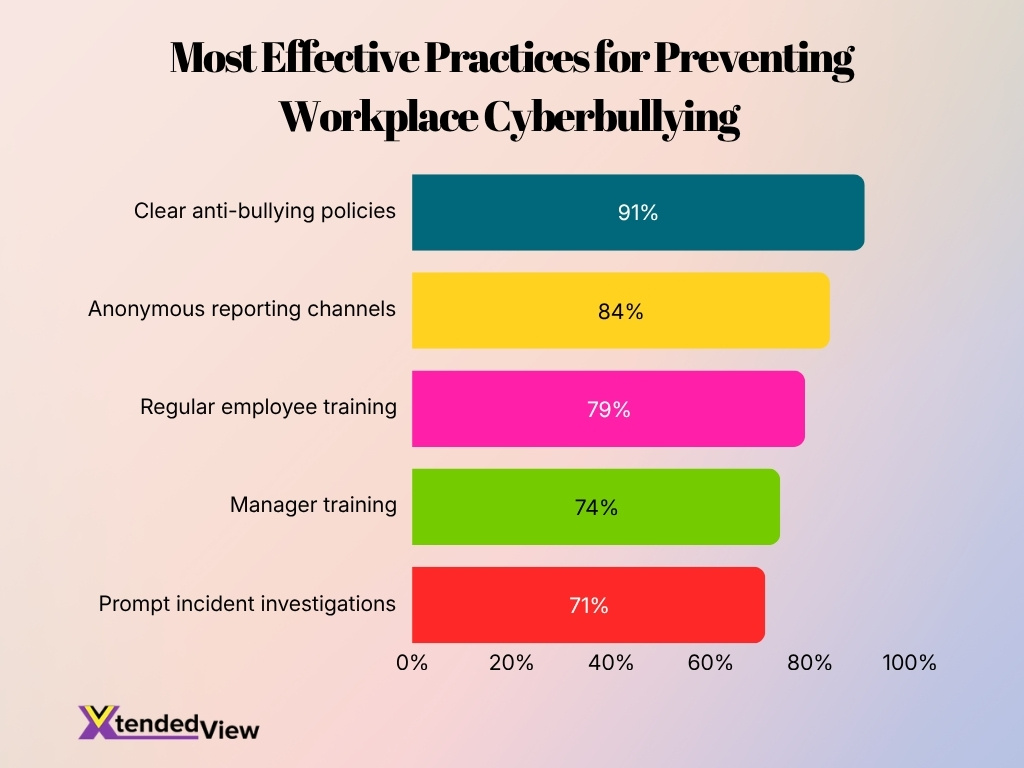
- Clear anti-bullying policies are the most widely implemented practice, adopted by 91% of organizations.
- Anonymous reporting channels rank second, with 84% of organizations using them to encourage safer incident reporting.
- Regular employee training is implemented by 79% of organizations to improve awareness and prevention.
- Manager training is used by 74% of organizations, highlighting the importance of leadership in handling cyberbullying cases.
- Prompt incident investigations are carried out by 71% of organizations, making them the least adopted practice in the dataset.
Frequently Asked Questions (FAQs)
32.3% of adult American workers report experiencing workplace bullying, representing an estimated 52.2 million employees.
Approximately 74.8 million U.S. workers are affected by workplace bullying, including 52.2 million direct victims and 22.6 million witnesses.
Hybrid employees report the highest bullying prevalence at 51%, significantly higher than fully remote or fully on-site workers.
About 55% of workplace bullying incidents involve a manager or supervisor as the perpetrator, while 29% involve coworkers at the same organizational level.
87% of Americans support legislation that would require employers to protect workers from repeated workplace bullying and allow employees to seek legal remedies.
Conclusion
Workplace cyberbullying has evolved into a significant organizational challenge that affects employees across virtually every industry. As businesses continue adopting remote work, hybrid teams, AI-powered collaboration tools, and digital communication platforms, opportunities for technology-enabled harassment have increased alongside the benefits of greater workplace flexibility. The latest statistics demonstrate that cyberbullying not only harms employee mental health but also reduces productivity, increases absenteeism, drives higher turnover, creates financial losses, and exposes organizations to legal and reputational risks.
The data also show that organizations can significantly reduce these risks by implementing clear anti-bullying policies, strengthening reporting systems, providing leadership training, promoting respectful digital communication, and offering accessible mental health support. Employers that proactively monitor workplace culture and respond quickly to complaints are better positioned to build trust, improve employee retention, and maintain a productive workforce. As digital workplaces continue to evolve, investing in prevention and fostering psychologically safe work environments will remain essential for long-term organizational success.
