



Blockchain has evolved from a niche technology powering cryptocurrencies into a core infrastructure layer for finance, supply chains, healthcare, and digital identity systems. Organizations now use blockchain to improve transparency, automate transactions, and strengthen data security across global operations. From cross-border payments to product traceability, its impact continues to expand across industries. Explore the latest blockchain statistics to understand market growth, adoption trends, investment patterns, and the forces shaping the future of decentralized technology.
Editor’s Choice
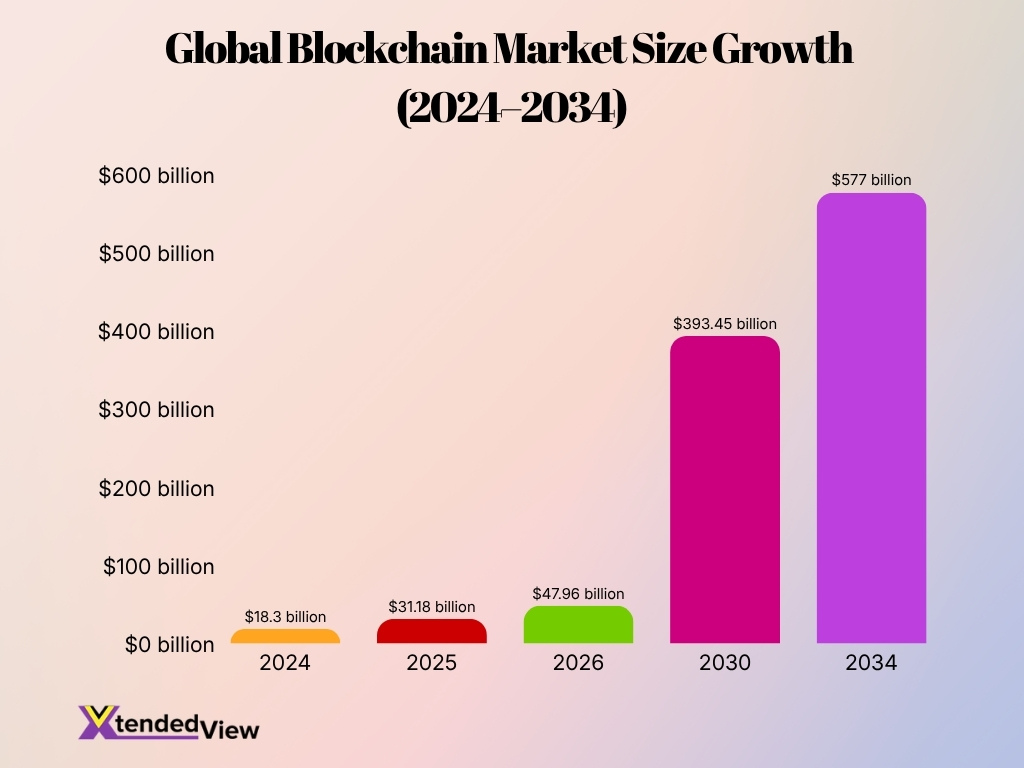
- The global blockchain technology market is projected to reach $47.96 billion in 2026, up from $31.18 billion in 2025.
- Another industry forecast estimates the blockchain market will grow from $32.99 billion in 2025 to $393.45 billion by 2030, representing a 64.2% CAGR.
- Global blockchain users are expected to exceed 283 million in 2026, reflecting continued mainstream adoption.
- Worldwide cryptocurrency ownership reached approximately 741 million people in 2025, representing one of the largest blockchain user bases ever recorded.
- The blockchain technology market was valued at $31.28 billion in 2024 and is forecast to surpass $1.43 trillion by 2030.
- India and the United States ranked among the leading countries for crypto and blockchain adoption in 2025.
- North America accounted for 43.8% of the global blockchain market revenue in 2025, maintaining its leadership position.
Recent Developments
- Several major financial institutions expanded blockchain-based asset tokenization initiatives throughout 2025 and into 2026.
- Institutional investors increased participation through exchange-traded crypto products, a trend expected to accelerate in 2026.
- Stablecoin adoption continued to rise as regulatory clarity improved in key markets.
- Real-world asset (RWA) tokenization emerged as one of the fastest-growing blockchain sectors entering 2026.
- Interest-bearing stablecoins recorded approximately 300% annual growth during 2025.
- Traditional financial institutions are increasingly integrating blockchain infrastructure into settlement and payment systems.
- Blockchain-based lender Figure reported a 22.4% increase in revenue during the first half of 2025.
- Bullish announced a $4.2 billion acquisition aimed at expanding blockchain-based capital market services.
- Regulatory developments in the United States encouraged broader institutional blockchain participation during 2025 and 2026.
- AI and blockchain convergence emerged as a major investment theme heading into 2026.
General Blockchain Statistics
- More than 741 million people globally owned cryptocurrency by the end of 2025.
- Global crypto ownership increased significantly from approximately 562 million holders in 2024.
- Blockchain adoption continues to expand beyond finance into healthcare, logistics, gaming, and identity management.
- Public blockchain networks process millions of transactions daily across multiple ecosystems.
- The Asia-Pacific region remains one of the fastest-growing blockchain adoption markets worldwide.
- Enterprise demand for transparent and tamper-resistant recordkeeping continues to fuel blockchain implementation.
- Decentralized finance applications remain among the most active blockchain use cases globally.
- Tokenization of real-world assets has become a key growth driver for blockchain adoption.
- Financial services remain the largest commercial blockchain application segment.
- Governments worldwide continue exploring blockchain-powered digital identity and CBDC initiatives.
Blockchain Market Size and Revenue Growth
- The blockchain market was valued at $31.18 billion in 2025.
- Market revenue is forecast to reach $47.96 billion in 2026.
- Long-term projections indicate market value could exceed $577 billion by 2034.
- One forecast predicts blockchain technology revenue will reach $393.45 billion by 2030.
- The market is expected to grow at a 64.2% CAGR between 2025 and 2030.
- Another industry estimate places the 2025 blockchain market at $41.14 billion.
- Some forecasts anticipate the industry surpassing $2.37 trillion by 2035.
- The blockchain technology sector grew from $18.3 billion in 2024 and continues expanding rapidly.
- Market analysts project blockchain spending growth across banking, supply chain, healthcare, and government sectors.
- Increasing demand for secure digital transactions remains the primary growth catalyst.
Global Blockchain Adoption and Usage Rates
- Global cryptocurrency ownership reached approximately 741 million users in 2025.
- Earlier estimates showed around 560 million crypto owners globally in 2024.
- Global digital asset ownership represented roughly 6.8% to 6.9% of the world’s population in 2024.
- Several estimates indicate that global digital asset ownership surpassed 800 million people during 2025.
- Bitcoin ownership increased from 337 million holders in 2024 to 365 million in 2025.
- Ethereum ownership grew by 22.6% year over year in 2025.
- APAC recorded approximately 69% growth in on-chain activity value received during the 12 months ending June 2025.
- The global crypto adoption rate increased by 38.1% between 2023 and 2024.
- India and the United States led worldwide cryptocurrency adoption rankings in 2025.
- Institutional participation became one of the strongest drivers of blockchain adoption in 2026.
Blockchain User Demographics
- Approximately 61% of global cryptocurrency owners are under the age of 35, highlighting blockchain’s strong appeal among younger users.
- Around 34% of crypto holders worldwide are between 25 and 34 years old, making this the largest age segment.
- Men account for roughly 61% to 63% of global crypto ownership, while women represent about 37% to 39%.
- In the United States, nearly 40% of adults under 30 report having invested in, traded, or used cryptocurrency.
- More than 70% of crypto users possess at least a bachelor’s degree, indicating above-average educational attainment among blockchain participants.
- Millennials remain the most active demographic group in decentralized finance (DeFi) applications.
- Gen Z users continue to adopt blockchain-based gaming, NFT platforms, and Web3 social applications at higher rates than older demographics.
- Emerging markets account for a growing share of blockchain users due to demand for alternative financial services and remittance solutions.
- Mobile-first users represent the majority of new blockchain participants across Africa, Southeast Asia, and Latin America.
- Surveys conducted during 2025 found that younger investors were significantly more likely to hold digital assets than traditional securities alone.
Blockchain Adoption by Region
- North America generated approximately 43.8% of global blockchain revenue in 2025.
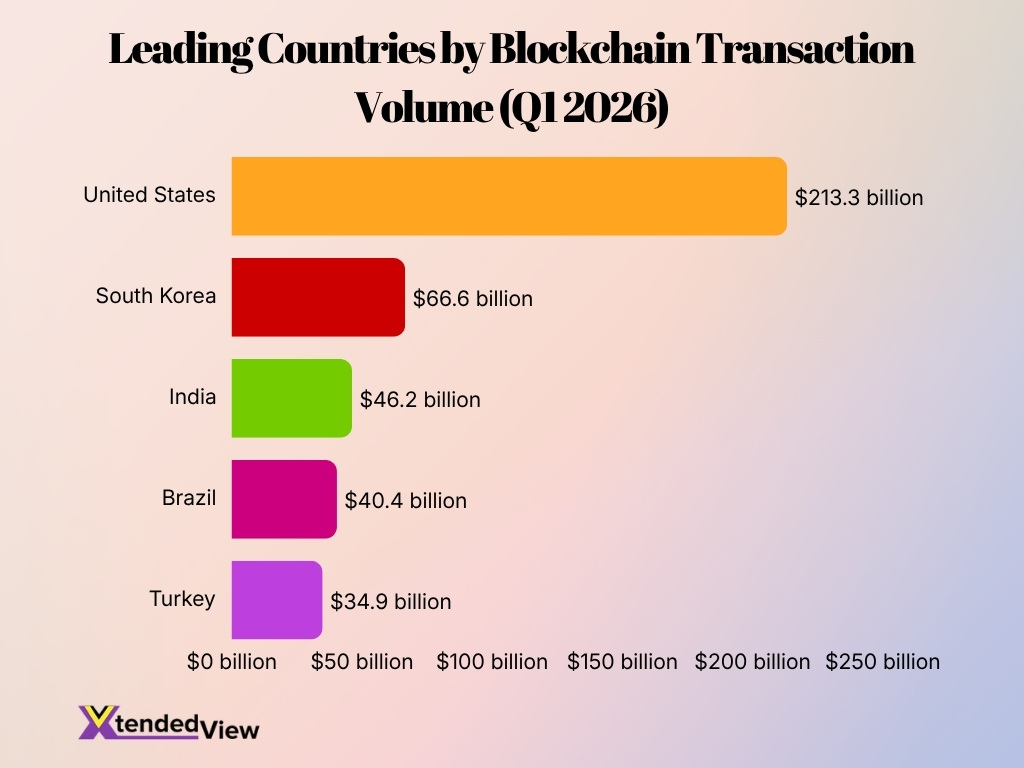
- The United States retained the top spot globally with $213.3 billion in transaction volume in early 2026.
- South Korea remained a key Asia-Pacific hub by processing $66.6 billion in blockchain transactions in Q1 2026.
- India ranked fourth globally with a strong $46.2 billion cryptocurrency transaction volume in early 2026.
- Brazil led Latin American blockchain adoption by recording $40.4 billion in transaction volume during Q1 2026.
- Turkey spearheaded regional growth with $34.9 billion in blockchain transactions in the first quarter of 2026.
- European EUR-denominated stablecoin volumes experienced a massive 12-fold growth from 2025 to early 2026.
- The Asia-Pacific region is projected to be the fastest-growing global market with a 63.4% CAGR through 2031.
Worldwide Blockchain Spending and Investment
- Global blockchain spending is projected to reach $18.9 billion by the end of 2025.
- The asset tokenization market is expected to skyrocket from $3.00 trillion in 2025 to $130.67 trillion by 2035.
- Venture capitalists poured more than $8 billion into private crypto and blockchain startups during Q4 2025.
- The total value of tokenized U.S. Treasuries and money market funds surpassed the $7.4 billion mark in 2025.
- Approximately 38% of Fortune 500 retailers now deploy production-grade blockchain supply chain solutions.
- The BFSI sector accounts for the largest market share in blockchain, growing at an estimated 45.1% CAGR.
- Annual capital allocated to crypto-focused venture funds reached a multi-year high of $8.75 billion in 2025.
- The U.S. implemented government-backed initiatives, including national crypto reserves worth $21 billion by March 2025.
Enterprise Blockchain Statistics
- More than 80% of global executives report active exploration, deployment, or experimentation with blockchain technologies.
- Nearly 60% of large enterprises identify blockchain as a strategic priority for digital transformation initiatives.
- Financial services account for 39% of enterprise blockchain adoption, growing faster than the supply chain and healthcare sectors.
- Over 50% of surveyed executives expect blockchain to become critical to their future business operations.
- Private and permissioned blockchains are projected to command a 42.47% market share by 2026 for security and compliance requirements.
- Businesses implementing blockchain report up to 40% of process steps streamlined, improving auditability and operational transparency.
- Enterprise tokenization initiatives expanded significantly in 2025, driving capital markets toward a projected $16 trillion by 2030.
- Supply chain and payment projects represent 45% of the total revenue share of enterprise blockchain deployments worldwide.
- The large enterprise segment dominates blockchain adoption rates, holding a 68.5% revenue share as technology maturity improves.
Blockchain Market Distribution By Sector
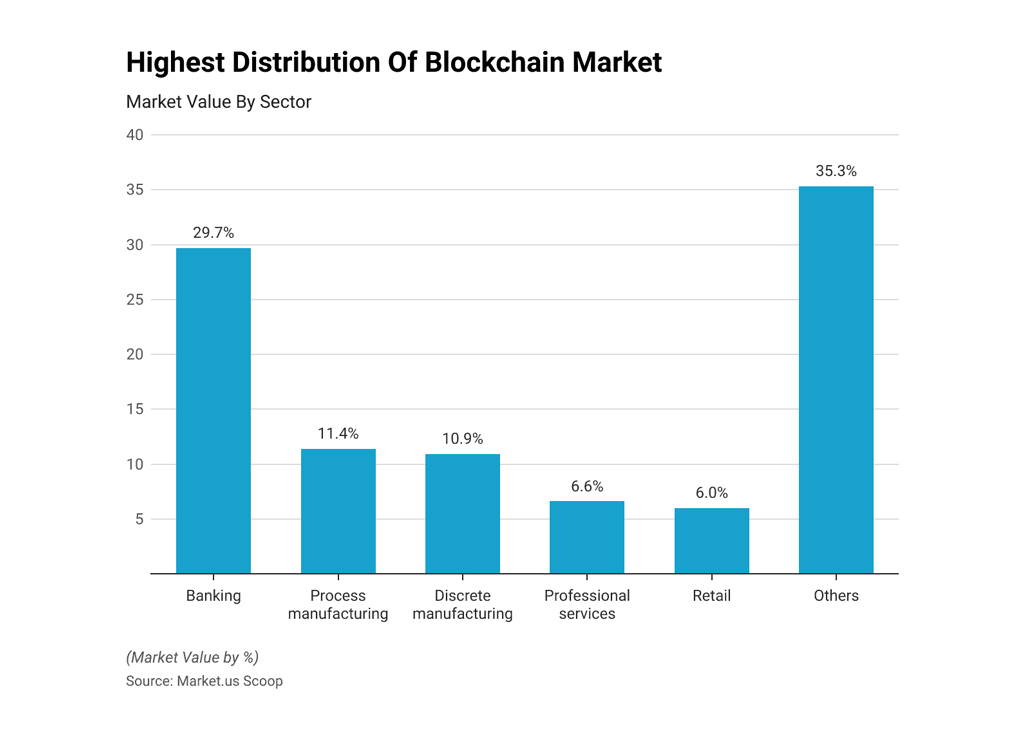
- Others hold the largest share of the blockchain market, accounting for 35.3% of the total market value.
- Banking is the leading sector, representing 29.7% of the blockchain market distribution.
- Others and Banking together make up 65.0% of the total blockchain market value.
- Process manufacturing contributes 11.4%, showing notable blockchain use in industrial operations.
- Discrete manufacturing follows closely with 10.9%, reflecting growing adoption across production workflows.
- Professional services account for 6.6%, indicating moderate blockchain integration in service-based industries.
- Retail has the smallest share at 6.0%, suggesting slower blockchain penetration compared with other sectors.
Blockchain in Healthcare
- Nearly 80% of healthcare organizations report improved data security after adopting blockchain technology.
- The global healthcare blockchain market is projected to reach $45.37 billion by the year 2030.
- Blockchain implementation aims to reduce the $650 billion annual loss caused by counterfeit pharmaceutical drugs.
- Enhancing supply chain traceability with blockchain can improve pharmaceutical delivery efficiency by 40%.
- With breaches costing $10.9 million, 70% of health systems will integrate blockchain for cybersecurity by 2030.
- Blockchain-driven interoperability could save the fragmented healthcare industry up to $30 billion annually.
- Over 60% of hospitals are actively exploring decentralized digital identity management to secure patient access.
- Blockchain-based consent management platforms can reduce unauthorized medical record access by up to 90%.
- Implementing blockchain for clinical trial auditing reduces data verification and processing time by nearly 50%.
- Blockchain claims processing reduces health insurance fraud by 75%, saving an estimated $25 billion annually.
Blockchain in Banking and Financial Services
- The global blockchain in banking market is projected to reach $220.43 billion by 2033 at a 47.2% CAGR.
- Cross-border payments command a dominant 34% share of all banking blockchain deployments in 2026.
- The tokenized real-world asset market surpassed $43 billion in 2026 and is projected to hit $2.7 trillion by 2030.
- Exactly 137 countries are actively researching central bank digital currencies, with 49 nations conducting pilot programs.
- Individual tokenized US Treasury funds from major asset managers have surpassed $2.5 billion in total value during 2026.
- Blockchain technology successfully reduces cross-border settlement times from several days to a few minutes.
- The software infrastructure segment accounts for approximately 43% of the global banking blockchain ecosystem.
- North America leads global enterprise adoption by capturing 38% of the overall blockchain in banking market share.
Top Bank Initial Use Cases for Blockchain
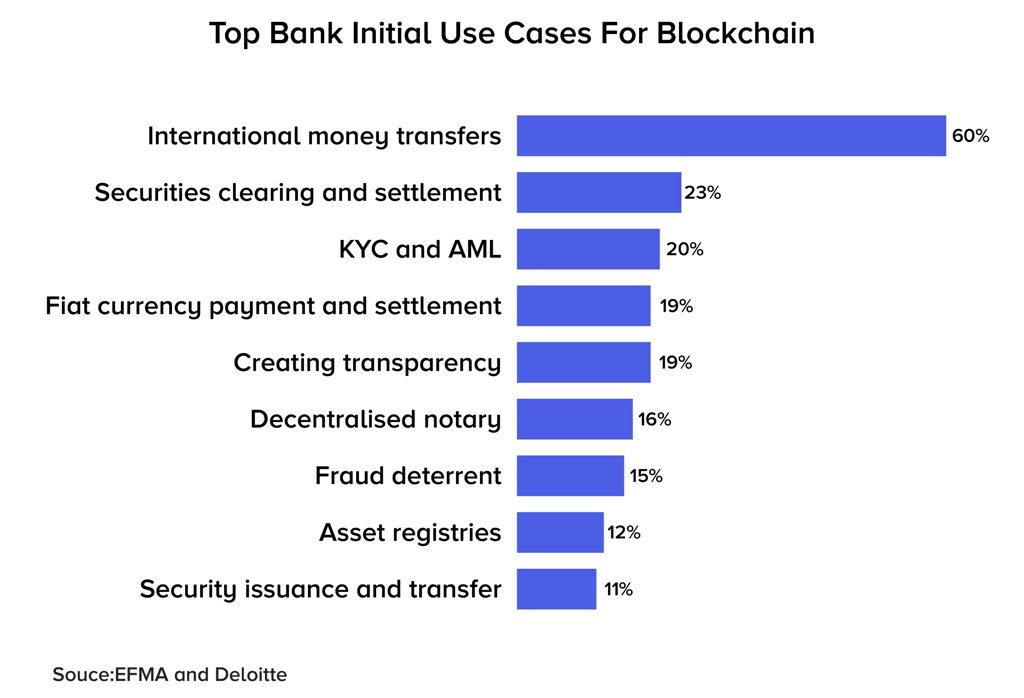
- International money transfers lead bank blockchain use cases with the highest share at 60%.
- Securities clearing and settlement ranks second, used by 23% of banks for blockchain initiatives.
- KYC and AML are a major blockchain use case, accounting for 20% of initial bank adoption.
- Fiat currency payment and settlement represents 19% of blockchain use cases in banking.
- Creating transparency also stands at 19%, showing blockchain’s role in improving trust and visibility.
- Decentralised notary use cases account for 16% of initial blockchain applications among banks.
- Fraud deterrent is used by 15% of banks, highlighting blockchain’s security value.
- Asset registries make up 12% of blockchain banking use cases.
- Security issuance and transfer have the lowest share in the chart at 11%.
Blockchain in Supply Chain and Logistics
- More than 54% of supply chain leaders report active investment in blockchain-based traceability solutions.
- Blockchain adoption can reduce documentation processing times by up to 81% in trade finance workflows.
- The global blockchain supply chain market is projected to reach $12.41 billion by the year 2031.
- Integrating smart contracts lowers administrative costs by up to 42% for invoicing and settlement tasks.
- Businesses using blockchain report revenue growth of 15% to 25% due to enhanced operational efficiency.
- Blockchain-enabled cold chain monitoring reduces temperature-related pharmaceutical product spoilage by 28%.
- Utilizing blockchain networks improves compliance documentation efficiency by up to 49% across global supply chains.
- The blockchain supply chain market is expected to expand at a massive 44.5% CAGR through the year 2034.
Cryptocurrency and Wallet Ownership Statistics
- Global cryptocurrency ownership reached approximately 741 million people in 2025, up from around 580 million a year earlier.
- Worldwide crypto ownership now represents roughly 8% to 9% of the global population.
- Bitcoin remains the most widely held digital asset, with approximately 365 million owners globally.
- Ethereum ownership surpassed 142 million holders in 2025.
- Mobile crypto wallet adoption continues to grow rapidly across emerging markets.
- The number of blockchain wallet addresses worldwide exceeds hundreds of millions, reflecting continued ecosystem expansion.
- Self-custody wallet adoption increased as users sought greater control over digital assets.
- Stablecoin wallets experienced strong growth due to payment and remittance use cases.
- Asia-Pacific accounts for one of the largest concentrations of crypto wallet users globally.
- The United States remains among the world’s largest cryptocurrency ownership markets by total users.
Most Popular Cryptocurrencies by Year
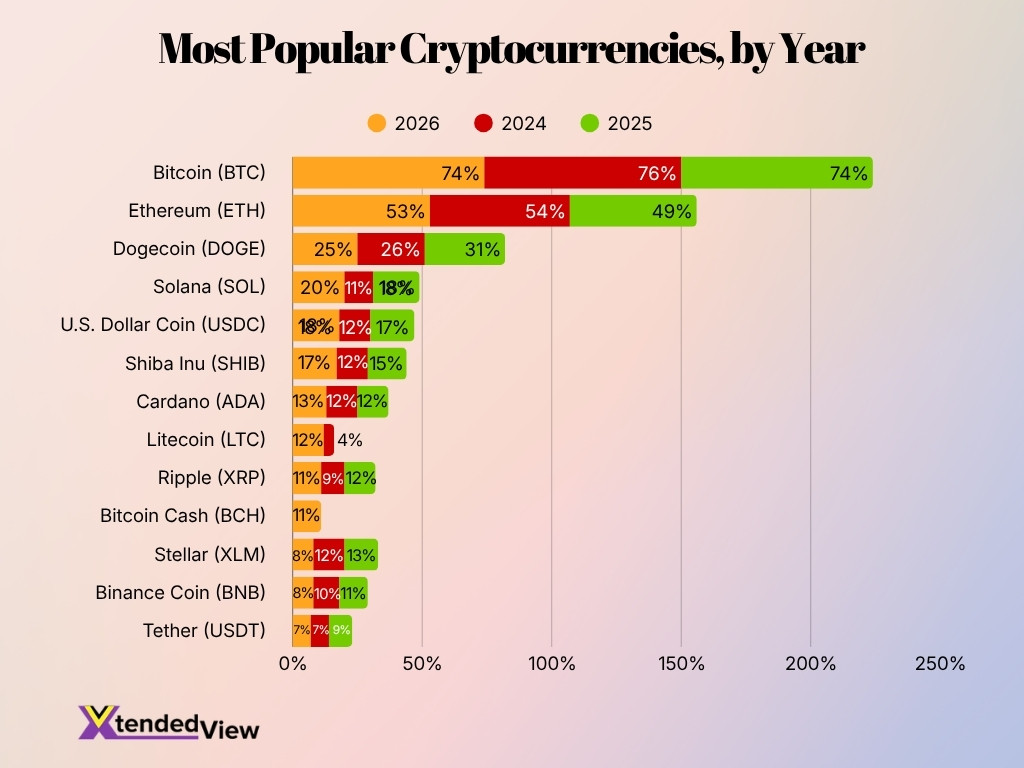
- Bitcoin (BTC) remained the most owned cryptocurrency, holding 74% ownership in both 2025 and 2026.
- Ethereum (ETH) stayed in second place, rising from 49% in 2025 to 53% in 2026.
- Dogecoin (DOGE) dropped from 31% in 2025 to 25% in 2026, showing a decline in ownership.
- Solana (SOL) showed steady growth, increasing from 11% in 2024 to 20% in 2026.
- U.S. Dollar Coin (USDC) grew consistently, moving from 12% in 2024 to 18% in 2026.
- Shiba Inu (SHIB) also gained popularity, increasing from 12% in 2024 to 17% in 2026.
- Litecoin (LTC) saw a major jump, rising from 4% in 2024 to 12% in 2026.
- Ripple (XRP) remained relatively stable, moving from 9% in 2024 to 11% in 2026.
- Bitcoin Cash (BCH) appeared in the 2026 data with 11% ownership.
- Stellar (XLM) declined sharply, falling from 13% in 2025 to 8% in 2026.
- Binance Coin (BNB) decreased from 11% in 2025 to 8% in 2026.
- Tether (USDT) stayed among the least owned listed cryptocurrencies, falling from 9% in 2025 to 7% in 2026.
Bitcoin Network Statistics
- Bitcoin’s market capitalization is projected to reach $6.16 trillion globally in 2026.
- The circulating supply reached over 20.05 million BTC out of the 21 million limit.
- Bitcoin accounted for 43.38% of the global cryptocurrency market activity in 2025.
- The Bitcoin block reward is currently set at 3.125 BTC following the latest halving.
- The Lightning Network capacity reached a historic peak of over 5,600 BTC recently.
- The Bitcoin network generates and securely processes a new block every 10 minutes.
- The Lightning Network operates with more than 21,000 active payment channels.
- Over 14,940 active nodes currently secure and validate Lightning Network transactions.
- Institutional users dominated the market by holding 63.24% of the cryptocurrency share.
Web3 and DeFi Statistics
- Total value locked (TVL) in DeFi protocols rebounded to a peak of $171.9 billion in late 2025.
- Ethereum maintained its market dominance by commanding 68% of the total cross-chain DeFi TVL.
- Decentralized exchanges processed an unprecedented $6.7 trillion in perpetual trading volume throughout 2025.
- Web3 and crypto venture funding saw VCs deploy over $8 billion into infrastructure and projects in Q4 2025.
- Layer-2 blockchain networks recorded strong activity, combining to hold over $15 billion in locked value.
- Decentralized lending platforms reached a massive milestone with their TVL peaking above $91 billion in October 2025.
- Tokenized real-world assets (RWAs) crossed $17 billion in on-chain value to become the fifth-largest DeFi category.
- Stablecoin market capitalization grew by 50%, driving DeFi liquidity to reach $305 billion by the end of 2025.
- The broader asset tokenization market is projected to rapidly expand to an estimated $3.01 trillion in 2026.
- Unique user wallets actively interacting with decentralized finance applications globally reached 41.7 million.
NFT Market Statistics
- The global NFT market size reached an estimated valuation of $34.1 billion in 2025.
- Ethereum maintained market dominance by powering nearly 62% of all global NFT transactions.
- Gaming NFTs represented exactly 38% of the total transaction volume throughout the year.
- More than 12 million NFTs are minted each quarter for enterprise loyalty and brand engagement programs.
- The United States, China, and South Korea collectively drove over 68% of the global NFT trading volume.
- Sports NFT trading activity experienced a massive 337% surge, hitting $71.1 million in Q3 2025.
- Over 85 million distinct NFTs were successfully minted globally during the first half of 2025.
- Utility-focused NFTs saw a 63% growth rate as consumer interest shifted away from speculative digital art.
- Music NFTs generated more than $520 million in direct sales revenue across various platforms in 2025.
Blockchain Security and Fraud Statistics
- Cryptocurrency-related losses from hacks and exploits exceeded $3.4 billion during 2025.
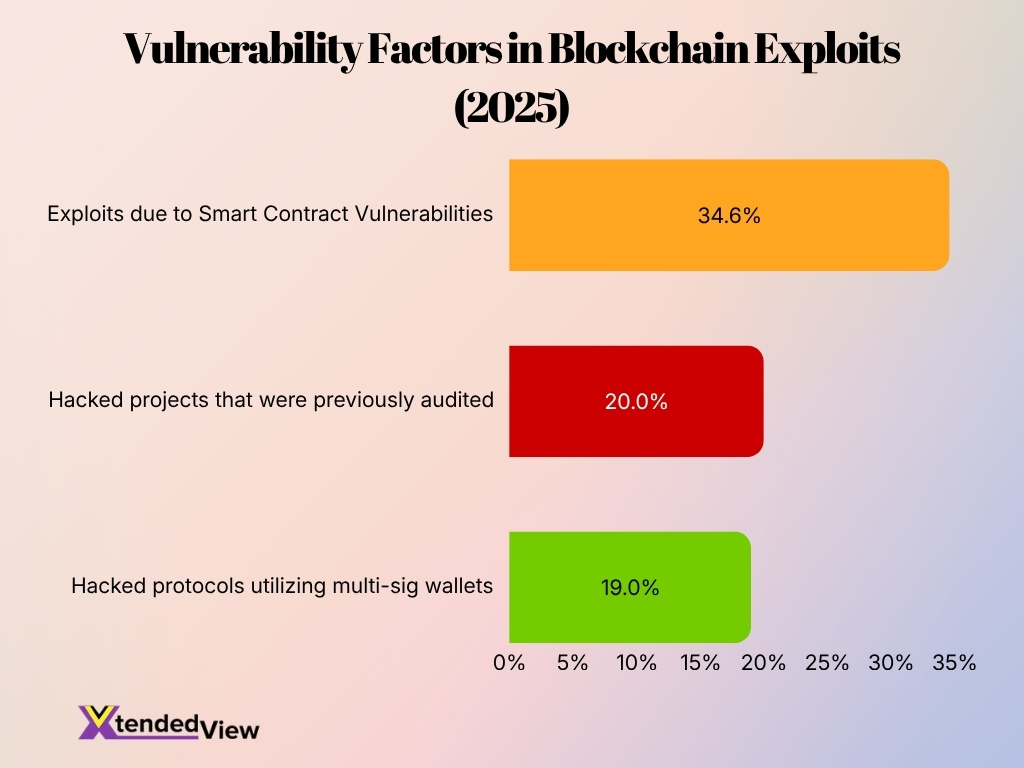
- Smart contract vulnerabilities remain a leading cause of incidents, accounting for 34.6% of direct protocol exploits.
- DeFi protocols account for a significant share of breaches, suffering over $600 million in losses in just one month in 2025.
- While security audits are standard practice, statistics show that only 20% of hacked blockchain projects were actually audited.
- Phishing attacks remain the most common threat, driving $410.7 million in losses across 132 incidents for crypto users.
- Blockchain analytics tools help law enforcement trace illicit transactions, resulting in hundreds of millions of dollars frozen in 2025.
- Ransomware groups operating 161 active variants face challenges as monitoring tracks their structured 45-day laundering pathways.
- Multi-signature wallets remain highly effective security measures, as data shows only 19% of hacked protocols utilized them.
- Institutional adoption demands enterprise-grade cybersecurity as individual wallet compromises alone surged to $1.71 billion in losses.
Future Blockchain Projections and Trends
- The global blockchain market is projected to reach between $393.45 billion and $1.43 trillion by 2030, with a CAGR of up to 90.1%.
- Asset tokenization is forecasted to grow exponentially to a $5.5 trillion base market value by 2030.
- Regulated stablecoins are projected to hit a market value of $1.9 trillion by 2030 as global payment adoption scales.
- Integrating artificial intelligence with blockchain is expected to save businesses up to $1 trillion annually by 2030.
- Government and enterprise pilot programs are accelerating, with over 60% of new applications being built on public networks.
- The value of real-world asset tokenization within decentralized finance is estimated to surge 37-fold to $2.7 trillion by 2030.
- Enterprise public cloud blockchain deployment continues to dominate the industry by capturing over 61.5% of total global revenue.
- Decentralized finance (DeFi) infrastructure growth is exploding, with its total value locked historically surging by over 1,200%.
- North America leads the industry with a 37.4% revenue share, while Asia-Pacific remains the fastest-growing global market.
- The financial services sector dominates blockchain application usage by contributing to over 35% of total market revenue.
Frequently Asked Questions (FAQs)
The global blockchain technology market is projected to reach $47.96 billion in 2026, up from $31.18 billion in 2025.
The global blockchain market is forecast to grow at a 64.2% CAGR between 2025 and 2030.
Industry forecasts estimate the blockchain market will reach $393.45 billion by 2030.
North America accounted for 43.8% of the global blockchain market revenue in 2025.
The global blockchain technology market is projected to reach approximately $577.36 billion by 2034.
Conclusion
Blockchain technology entered the year with stronger institutional support, broader enterprise adoption, and increasing integration into mainstream financial systems. Market forecasts continue to point toward substantial long-term growth, driven by tokenization, decentralized finance, digital identity, and cross-border payment innovation.
While challenges around regulation, scalability, and security remain, adoption trends show that blockchain is moving beyond experimentation into real-world implementation. From banking and healthcare to logistics and digital assets, organizations continue to invest in blockchain infrastructure to improve transparency, efficiency, and trust. As investment accelerates and new use cases emerge, blockchain is positioned to remain one of the most influential technologies shaping the digital economy over the next decade.