


Online pharmacies have become a mainstream part of healthcare, giving patients faster access to prescription and over-the-counter medicines without visiting a physical store. They now play a key role in chronic disease management, medication refills, telehealth consultations, and home delivery, especially for older adults, rural communities, and people with limited mobility. As digital healthcare continues to expand, understanding the latest online pharmacy usage statistics helps patients, providers, insurers, and policymakers make informed decisions. Explore the data below to see how consumer behavior, technology, and regulations are shaping the future of online pharmacies.
Editor’s Choice
- 38% of U.S. adults have purchased prescription medications online, and 55% of those buyers now obtain all or most of their prescriptions through online pharmacies.
- The U.S. government extended telemedicine prescribing flexibilities through December 31, 2026, supporting uninterrupted access to medications prescribed remotely.
- Total U.S. prescription drug expenditures reached $915.2 billion in 2025, increasing 12.7% year over year.
- Mail-order pharmacies accounted for $257 billion, representing 28.1% of all U.S. prescription drug spending in 2025.
- 66% of U.S. adults believe purchasing medicines online carries health risks, up 22 percentage points from 2023.
- NABP reports that 96% of illegal online pharmacies reviewed failed to require a valid prescription before dispensing prescription medicines.
- More than 40,000 websites identified by NABP fail to comply with pharmacy practice standards or applicable laws, highlighting the continuing challenge of rogue online pharmacies.
Recent Developments
- In January 2026, HHS and the DEA extended telemedicine prescribing flexibilities for controlled medications through the end of 2026.
- Federal data show that more than 7 million controlled-substance prescriptions were issued through telemedicine in 2024 without a prior in-person visit.
- Following the expiration of certain Medicare telehealth flexibilities in 2025, fee-for-service telemedicine visits dropped by 24%, demonstrating continued dependence on virtual care.
- The FDA continued enforcement against illegal internet pharmacies by issuing warning letters throughout 2025 and 2026 to websites selling unapproved or prescription medicines unlawfully.
- NABP expanded its Pulse Product Verification Service in 2026, allowing regulators to verify pharmaceutical products more efficiently across the supply chain.
- More than 150 regulators now use Pulse by NABP to identify counterfeit or illegitimate medications before they reach patients.
- The expanded verification platform supports pharmacies preparing for the Drug Supply Chain Security Act (DSCSA) compliance deadline in November 2026.
- Regulators have already scanned thousands of pharmaceutical units using the verification platform to detect unsafe products.
- Federal agencies continue promoting verified digital pharmacies as part of broader medication safety initiatives in response to rising online prescription purchases.
Global Online Pharmacy Usage Overview
- Global adoption of online pharmacies continues to grow as consumers increasingly combine digital consultations with home medicine delivery.
- In the United States, 38% of adults have already purchased prescription medicines online.
- Among online prescription buyers, 73% started purchasing medicines online within the past three years, reflecting rapid post-pandemic adoption.
- 55% of U.S. online pharmacy customers now receive all or most of their prescriptions digitally instead of visiting local pharmacies.
- Mail-order pharmacies represented 28.1% of national prescription drug spending during 2025, underscoring their growing role in healthcare delivery.
- Retail pharmacies remained the largest distribution channel with 41.3% of U.S. prescription expenditures, although digital pharmacy channels continue expanding rapidly.
- The continued integration of e-prescriptions, digital health records, and telemedicine has accelerated online pharmacy utilization across developed healthcare systems.
- Online pharmacy demand remains strongest for chronic disease medications, maintenance prescriptions, and repeat refills supported by recurring digital prescribing.
- Consumer demand increasingly favors licensed digital pharmacies offering pharmacist consultation, prescription verification, and secure home delivery.
Key E-Pharmacy Market Growth Insights
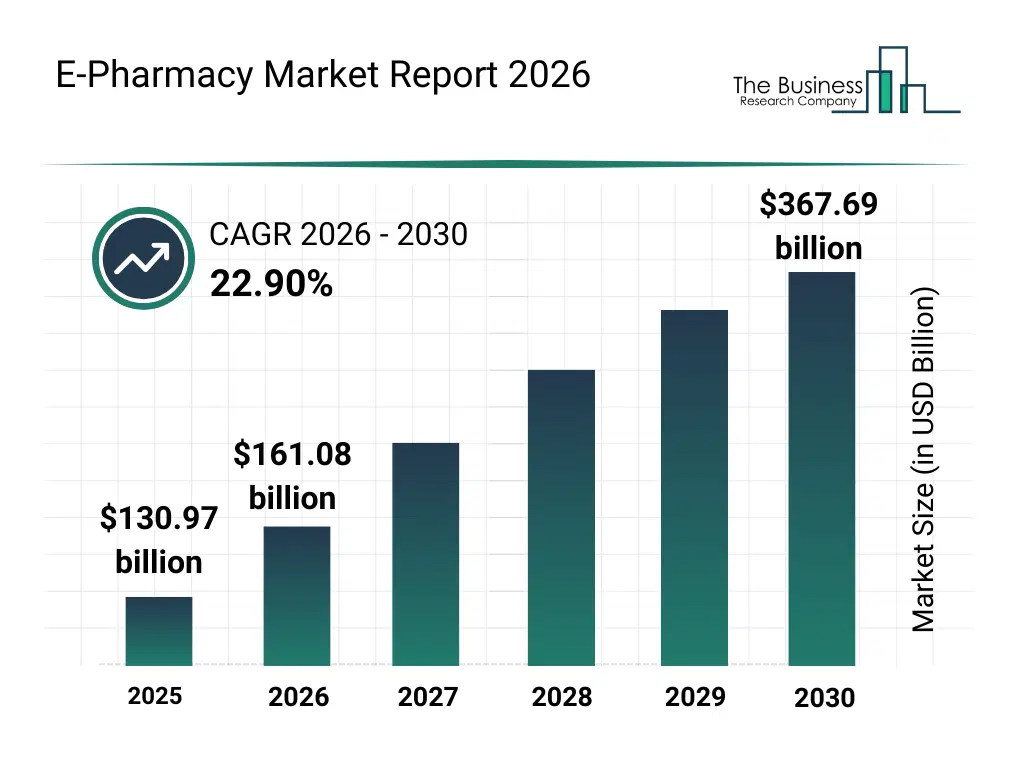
- The global e-pharmacy market was valued at $130.97 billion in 2025.
- Market size increased to $161.08 billion in 2026, reflecting strong annual growth.
- The market is projected to reach approximately $197.97 billion by 2027.
- E-pharmacy revenue could rise further to around $243.30 billion in 2028.
- By 2029, the global market is expected to approach $299.02 billion.
- The e-pharmacy market is forecast to reach $367.69 billion by 2030.
- Between 2026 and 2030, the market is expected to grow at a 22.90% CAGR.
- Overall, the market is projected to expand by more than 128% from 2026 to 2030.
Demographic Profile of Online Pharmacy Users
- 73% of prescription buyers adopted online pharmacies within the last three years.
- Older adults and patients with chronic conditions are the most frequent users.
- Seniors, rural residents, and disabled individuals are key beneficiaries of telemedicine.
- 79% of GLP-1 consumers consider buying from a licensed U.S. pharmacy very important.
- 73% of all online buyers prioritize purchasing from a U.S.-licensed pharmacy.
- 91% of buyers check pharmacy licensure at least occasionally before making a purchase.
- Only 39% actually verify pharmacy credentials through official verification resources.
- Consumers with chronic illnesses drive repeat purchases for delivery convenience.
- Younger adults are drawn into online pharmacy ecosystems through mobile-first experiences.
Online Pharmacy Medicine Shopping Frequency After COVID-19
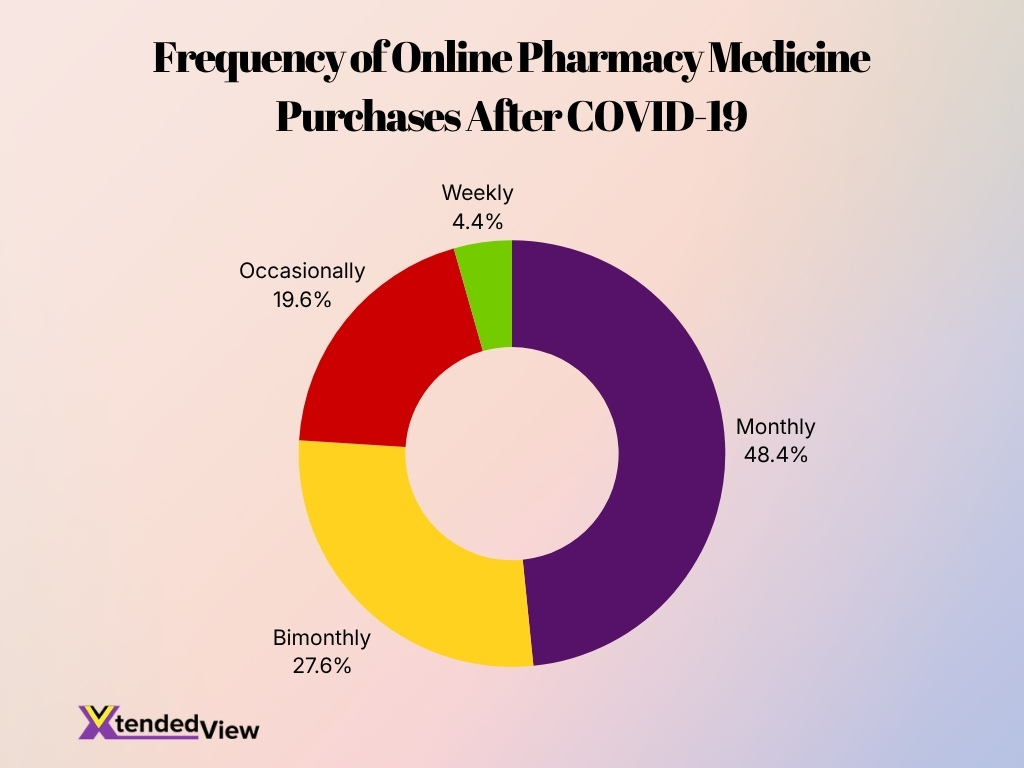
- Monthly purchases are the most common shopping pattern, with 48.4% of respondents buying medicines from online pharmacies once a month.
- Bimonthly purchases account for 27.6%, showing that more than one-quarter of consumers shop for medicines online every two months.
- Around 19.6% of respondents use online pharmacies occasionally, suggesting that many consumers still purchase medicines only when needed.
- Weekly purchases are the least common, representing just 4.4% of respondents and indicating limited frequent use.
- Combined, 76% of respondents purchase medicines either monthly or bimonthly, highlighting the strong role of online pharmacies in routine medicine shopping.
Types of Medications Bought from Online Pharmacies
- Specialty medicines represented 53% of total U.S. prescription drug expenditures in 2025.
- Mail-order pharmacies handled 44.9% of specialty drug spending as the leading distribution channel for high-cost medications.
- 79% of GLP-1 medication buyers state that purchasing from a licensed U.S. pharmacy is very important.
- Prescription medicines are expected to hold the largest share of the global online pharmacy market at 76.3% in 2026.
- Generic drugs lead the global online pharmacy market by capturing a significant share of 65.5% in 2026.
- The global Rx medicines segment generated an online revenue of $51 billion in 2025.
- Over-the-counter products dominated the Indian online pharmacy market with a 56% market share in 2025.
- The global GLP-1 receptor agonist market was highly valued at $66.4 billion in 2025.
Consumer Perceptions of Safety and Trust in Online Pharmacies
- 66% of U.S. adults believe purchasing medicines online involves health risks, up 22 percentage points compared with 2023.
- 87% believe counterfeit or substandard medicines purchased online could have serious health consequences.
- 73% of online prescription buyers trust only U.S.-licensed online pharmacies.
- 76% trust medicines intended specifically for the U.S. market.
- 47% of online medicine buyers admit they have taken an online-purchased medication despite not being fully confident about its safety.
- 27% report receiving counterfeit or substandard medicine or experiencing harm from medicine purchased online.
- Consumers increasingly verify pharmacy credentials before ordering because of rising awareness of counterfeit medicines.
- Federal safety campaigns continue encouraging consumers to purchase medicines only from licensed pharmacies that require valid prescriptions.
- Trust remains highest for pharmacies offering licensed pharmacists, verified business addresses, and transparent prescription verification procedures.
Reasons for Using Online Pharmacies
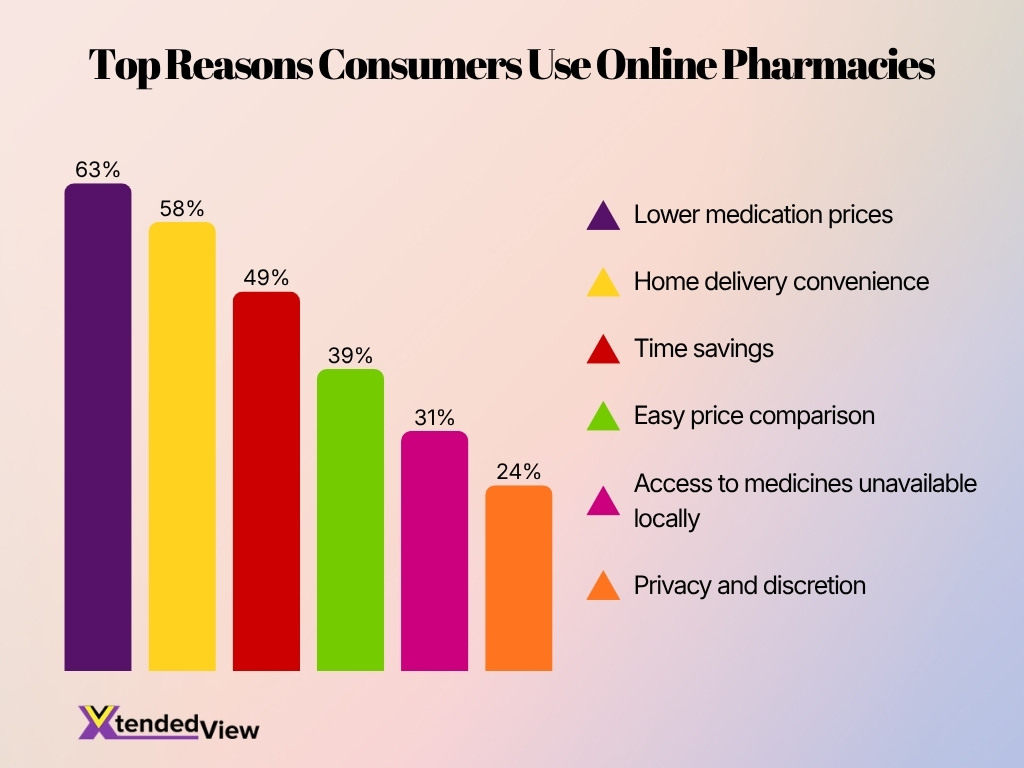
- Lower medication prices are the leading reason for using online pharmacies, cited by 63% of consumers.
- Home delivery convenience ranks second, influencing 58% of users to purchase medicines online.
- Nearly half of consumers, or 49%, use online pharmacies because they offer meaningful time savings.
- Easy price comparison motivates 39% of consumers, allowing them to review costs across multiple platforms.
- Around 31% of users rely on online pharmacies to access medicines unavailable locally.
- Privacy and discretion remain important for 24% of consumers, especially when purchasing sensitive health products.
Prescription Requirements and Verification Practices
- 95% of websites selling prescription-only drugs online operate illegally.
- 42% of consumers have purchased medications online for convenience and cost savings.
- 45% of individuals mistakenly believe all online pharmacies are approved by regulators.
- Only 20% of assessed online pharmacies actually require a valid prescription for medications.
- Approximately 96.61% of reviewed internet drug outlets are non-compliant with pharmacy laws.
- Prescription medicines are projected to account for 76.3% of the global online pharmacy market by 2026.
- Around 20 new illegal online pharmacy websites are launched globally every single day.
- Generic drugs represent a significant 65.5% share of all online pharmacy sales.
- Consumer adoption of digital pharmacies and telehealth increased from 11% to 46% in recent years.
Prevalence of Unsafe or Illegitimate Online Pharmacy Use
- Out of 35,000 active online pharmacies worldwide, a staggering 95% to 96% operate illegally in violation of pharmacy laws.
- Approximately 20 new illegal online pharmacy websites are created and launched every single day globally.
- Medications purchased from websites concealing their physical address are found to be counterfeit in over 50% of cases.
- A recent survey revealed that 42% of consumers have purchased medications online for perceived convenience and cost benefits.
- In a comprehensive review of over 10,000 pharmacy websites, exactly 96.2% operated out of compliance with safety standards.
- Nearly 50% of illegitimate online pharmacies offer medications that are either foreign or unapproved for safety.
- Alarmingly, 88.4% of non-compliant sites illegally sell prescription medications without requiring a valid medical prescription.
- Around 62% of unrecognized pharmacy websites fail to provide consumers with a valid physical location or address.
- A national survey indicated that 71% of online consumers remain completely unaware of the severe health risks involved.
- Nearly 25% of individuals using online pharmacies reported encountering substandard, fake, or harmful medications.
Price Comparison Behavior and Discount Usage
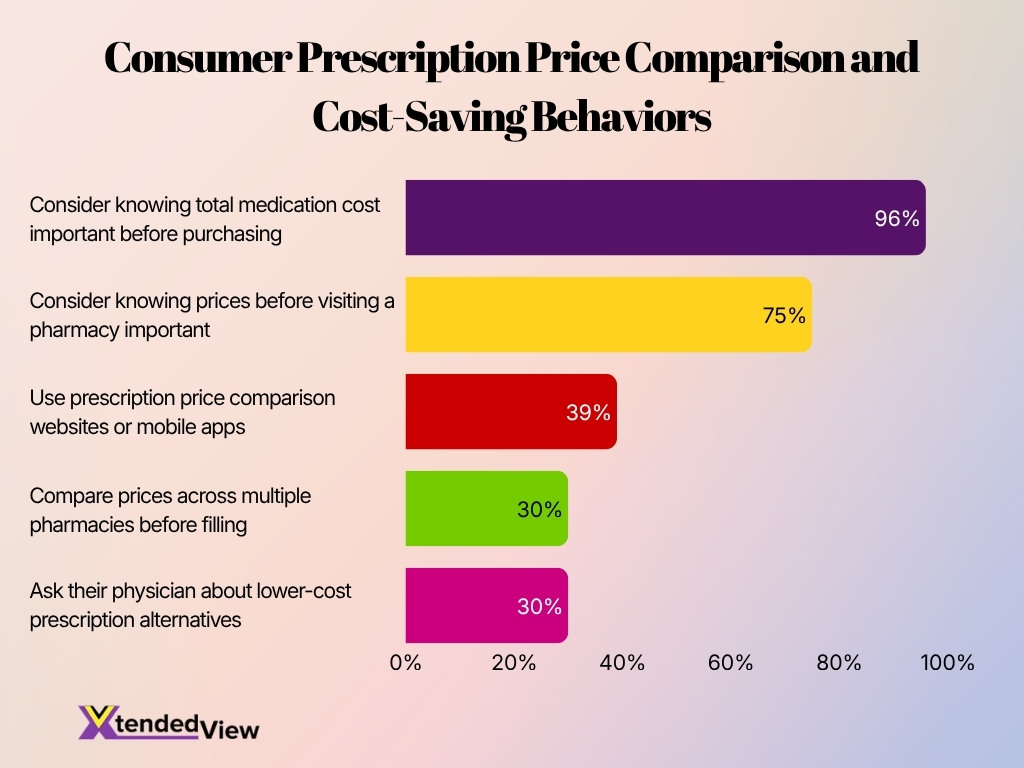
- 96% of U.S. patients say it is important to know the total medication cost, including insurance coverage and eligible discounts, before completing a prescription purchase.
- 75% of consumers consider knowing prescription prices before visiting a pharmacy somewhat or very important.
- More than three-quarters of consumers compare medication prices before purchasing prescriptions.
- 39% of consumers use prescription price comparison websites or mobile apps to identify the lowest medication prices.
- 30% compare prices across multiple pharmacies before filling a prescription.
- Another 30% ask their physician about lower-cost prescription alternatives before purchasing medication.
- Lower prices rank as the leading reason consumers choose direct-to-patient or online prescription services.
- Discount coupons, promotional offers, and digital payment incentives continue to influence online pharmacy purchasing decisions in many markets.
- Government-supported medicine price comparison tools continue expanding to improve pricing transparency and help consumers identify approved retail prices.
Role of Telehealth and E-Prescriptions in Online Pharmacy Usage
- Over 90% of all medical prescriptions are now routed electronically to pharmacies.
- E-prescribing systems reduce prescription error rates by up to 85%.
- Telehealth consultations improve first-fill medication adherence by nearly 10%.
- More than 7 million controlled-substance prescriptions were issued via telemedicine in 2024.
- Approximately 60% of patients prefer using online pharmacies following a virtual doctor visit.
- Virtual prescribing flexibilities support medication access for over 30 million rural residents.
- A reduction in telehealth flexibilities previously caused a 24% decline in virtual visits.
- The global online pharmacy market is projected to exceed $150 billion by 2026.
Regulatory and Policy Developments
- Federal telemedicine prescribing flexibilities have been extended through December 31, 2026.
- 1.39 million prescribers actively used e-prescribing networks during 2025, marking a 4% increase over 2024.
- 84.4% of e-prescribers were enabled to electronically prescribe controlled substances in 2025.
- 98.3% of pharmacies on the national network supported electronic prescribing for controlled substances.
- 94% of electronic prescriptions processed in 2025 contained standardized quantity unit of measure information.
- Over 900,000 prescribers utilized Real-Time Prescription Benefit tools 1 billion times in 2025.
- The use of real-time coverage insights helped patients save $55.1 million collectively on specialty prescriptions.
- Automated prior authorization technology successfully returned medication approvals in just 18 seconds.
- Nearly 25% of retail pharmacy locations were enabled for RxTransfer transactions during 2025.
- The national network maintained 99.998% average uptime while processing 2.64 billion e-prescriptions.
User Concerns About Data Privacy and Cybersecurity
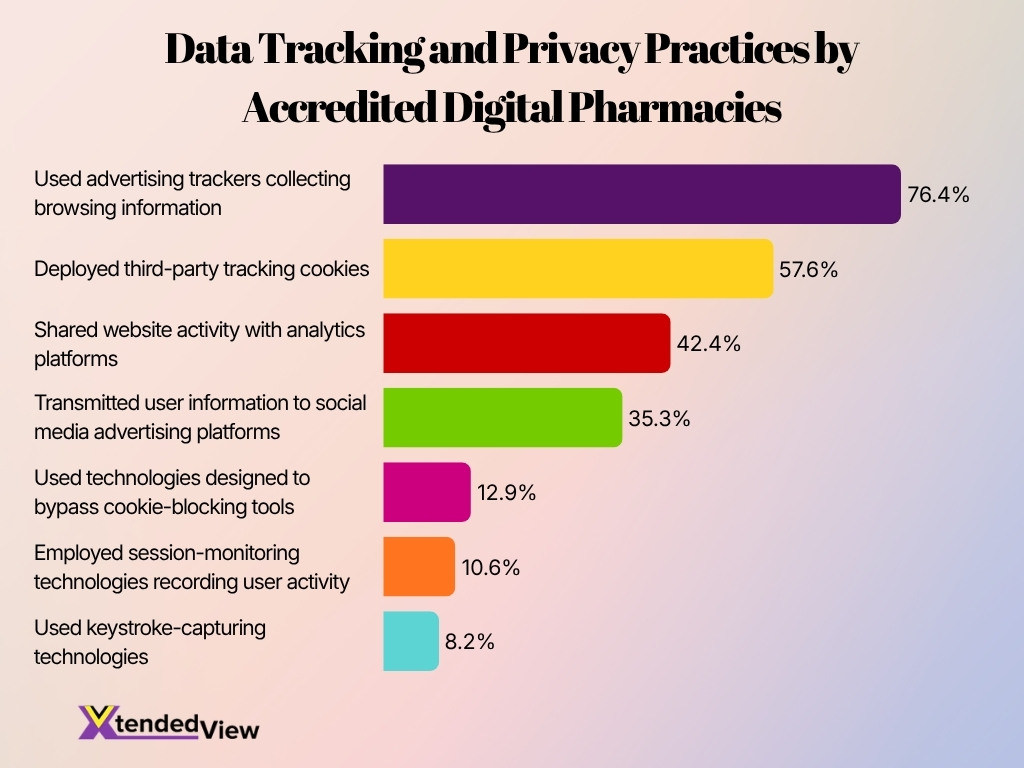
- Researchers found that 76.4% of accredited digital pharmacy websites used advertising trackers that collect browsing information.
- 57.6% of accredited online pharmacies deployed third-party tracking cookies.
- 42.4% shared website activity with analytics platforms for performance measurement.
- 35.3% transmitted user information to social media advertising platforms.
- 12.9% of accredited digital pharmacies used technologies designed to bypass cookie-blocking tools.
- 10.6% employed session-monitoring technologies capable of recording user activity.
- 8.2% used keystroke-capturing technologies that may collect information entered by website visitors.
- More than two-thirds of accredited digital pharmacies used at least two forms of user data tracking, highlighting ongoing privacy concerns.
- Privacy experts continue recommending that consumers review privacy policies, verify encryption, and purchase medicines only from licensed pharmacies that follow healthcare privacy requirements.
Patient Satisfaction with Online Pharmacy Services
- Customer satisfaction with mail-order pharmacies increased by 7 points in 2025 compared with the previous year.
- A significant 63% of customers are interested in using a fully digital pharmacy to fill their prescriptions.
- Research shows 69% of respondents view the ability to order prescription medicines online anytime as highly beneficial.
- Direct home delivery of prescription medications is considered beneficial by 67% of surveyed patients.
- Overall satisfaction with mail-order pharmacies rose by 6 points on a 1,000-point scale during 2024.
- Approximately 58.9% of users are willing to recommend home delivery pharmacy services to other patients.
- A notable 89% of respondents expressed willingness to use online pharmacies in the future for convenience.
- Growing awareness shows that 52% of customers are now familiar with digital pharmacies, reflecting increased trust.
- Nearly 45.5% of participants reported being highly satisfied with the overall quality of home delivery services.
Regional Distribution of the Online Pharmacy Market
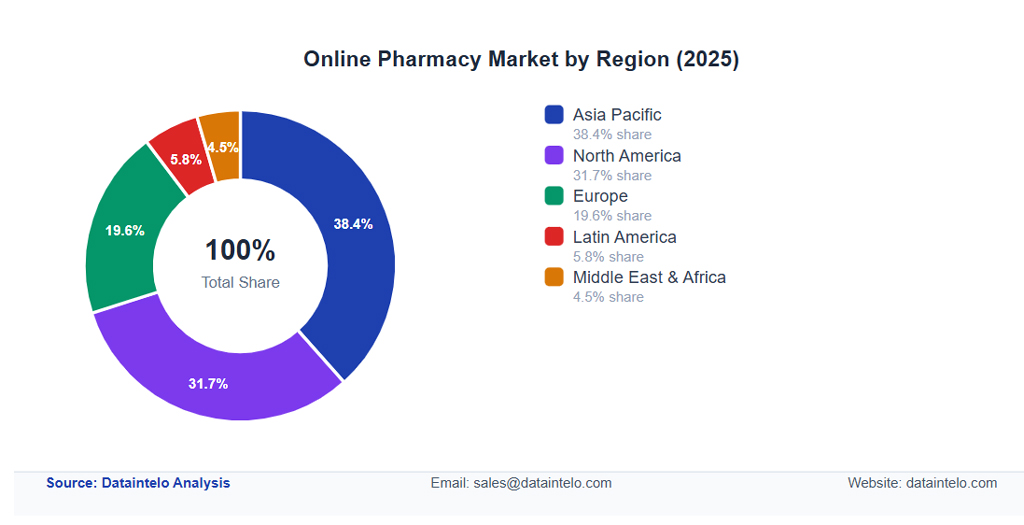
- Asia Pacific dominates the global online pharmacy market, holding the largest regional share of 38.4% in 2025.
- North America follows closely with a strong 31.7% market share, making it the second-largest regional market.
- Combined, Asia Pacific and North America account for 70.1% of the worldwide online pharmacy market.
- Europe represents a significant 19.6% share, securing its position as the third-largest regional contributor.
- Latin America holds a comparatively smaller 5.8% share of the global online pharmacy market.
- The Middle East & Africa records the lowest regional market share at 4.5% in 2025.
- The three leading regions, Asia Pacific, North America, and Europe, collectively control 89.7% of the market.
Future Adoption Intentions
- 72% of consumers are likely to buy prescription medicines online if pricing meets expectations.
- 63% of mail-order customers want to use fully digital pharmacies for future prescriptions.
- Around one-third of U.S. patients prefer a hybrid or fully online prescription experience.
- Nearly 80% of consumers report interest in branded online prescription experiences.
- Approximately 60% indicate greater trust in platforms with visible manufacturer branding.
- Research from 2026 shows consumer trust influences e-pharmacy adoption more than price.
- Behavioral intention produces a large effect size of f² = 0.422 on online medicine purchases.
Frequently Asked Questions (FAQs)
38% of U.S. adults have purchased prescription medicines online, and 55% of those buyers now obtain all or most of their prescriptions through online pharmacies.
The global digital pharmacy market is projected to grow at a 17.28% CAGR between 2026 and 2034, increasing from $185.17 billion in 2026 to $662.58 billion by 2034.
91% of online prescription buyers say they verify pharmacy licensure at least some of the time, but only 39% use official verification sources.
8% of U.S. consumers reported that they most often fill prescriptions through an online-only pharmacy in 2026, up from 6% in 2024.
Customer satisfaction with mail-order pharmacies increased by 7 points, reaching a score of 697 out of 1,000 in the 2025 U.S. Pharmacy Study.
Conclusion
Online pharmacies continue to reshape how patients access prescription medications, with adoption accelerating through improved telehealth integration, electronic prescribing, and home delivery services. Recent statistics show that consumers increasingly value transparent pricing, digital convenience, and trusted pharmacy verification while remaining cautious about counterfeit medicines and data privacy. At the same time, regulators are strengthening supply chain security and expanding oversight to improve patient safety across digital healthcare channels.
Looking ahead, continued investment in secure technology, regulatory compliance, and patient-centered digital experiences is expected to support sustained growth in online pharmacy usage.
