


Sustainable packaging has moved from a niche initiative to a mainstream business strategy. Brands across food, retail, and e-commerce now use recyclable, compostable, and reusable packaging to reduce waste and meet changing consumer expectations. Companies also rely on sustainable packaging to comply with environmental regulations and strengthen brand loyalty among eco-conscious shoppers. As investment and innovation accelerate, the statistics below reveal how sustainable packaging is reshaping global supply chains and consumer behavior.
Editor’s Choice
- The global sustainable packaging market is expected to reach $399.97 billion in 2026, up from $374.86 billion in 2025.
- The industry is projected to grow at a 6.7% CAGR between 2026 and 2034.
- Another forecast estimates the market at $339.35 billion in 2026, with revenue surpassing $719 billion by 2036.
- North America accounted for 32.65% of the global sustainable packaging market in 2025, making it one of the largest regional markets.
- Europe represented 32.08% of the green packaging market in 2025, supported by strict environmental regulations.
- Paper and paperboard are expected to hold 35% to 38% of the market share in 2026, remaining the leading sustainable packaging material.
- The U.S. sustainable packaging market is forecast to expand at a 4.7% CAGR through 2036.
- The green packaging market is expected to grow from $389.75 billion in 2026 to $732.33 billion by 2034.
- Asia-Pacific remains one of the fastest-growing regions due to rising e-commerce activity and increasing consumer demand for environmentally friendly products.
Recent Developments
- In 2026, the sustainable packaging market is estimated to be worth $325.94 billion, compared with $303.80 billion in 2025.
- More than 63 countries have introduced or expanded Extended Producer Responsibility regulations that directly affect packaging manufacturers and retailers.
- The market is expected to create an additional $379.83 billion opportunity by 2036 as companies replace conventional plastics.
- Sustainable packaging innovations increasingly focus on mono-material packaging that improves recyclability and reduces sorting costs.
- Paper-based alternatives continue to replace plastic packaging in food service and retail applications.
- Governments in Europe and North America continue implementing restrictions on single-use plastics and minimum recycled content requirements.
- Investments in biodegradable materials and compostable packaging technologies accelerated in 2025 and continued into 2026.
- Retailers increasingly require suppliers to meet sustainability standards before products reach store shelves.
- Brands are incorporating sustainable packaging targets into Environmental, Social, and Governance strategies to attract investors and consumers.
Sustainable Packaging Market Size Statistics
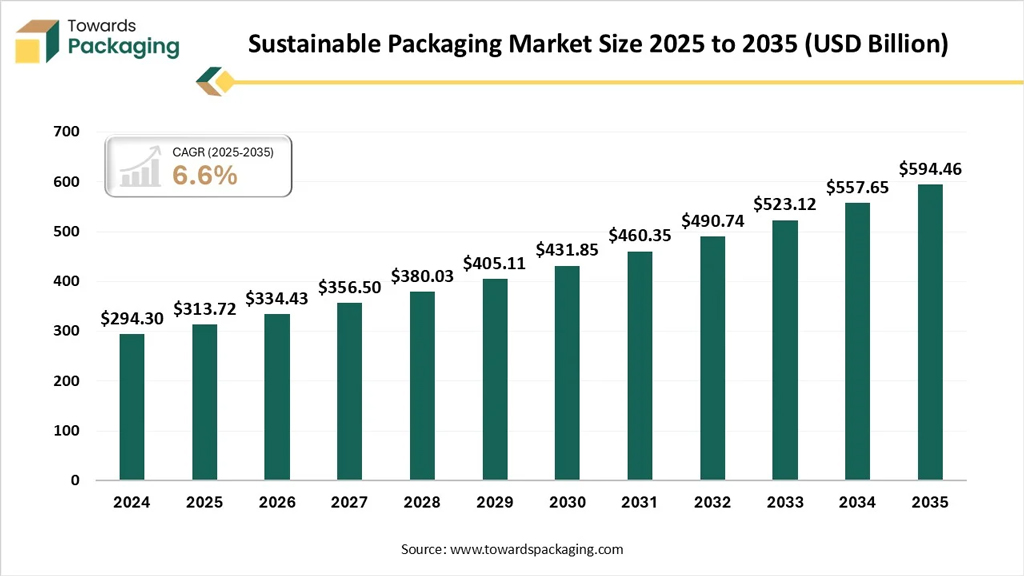
- The global sustainable packaging market is projected to grow from $313.72 billion in 2025 to $594.46 billion by 2035.
- The market is expected to expand at a compound annual growth rate (CAGR) of 6.6% from 2025 to 2035.
- The market is forecast to add $280.74 billion in value between 2025 and 2035.
- Market size is projected to reach $334.43 billion in 2026, up from $313.72 billion in 2025.
- The industry is expected to surpass $400 billion in 2029, reaching $405.11 billion.
- The sustainable packaging market is forecast to exceed $431.85 billion by 2030.
- Global market value is expected to climb to $460.35 billion in 2031.
- The market is projected to cross $490.74 billion in 2032, nearing the $500 billion milestone.
- Sustainable packaging market revenue is expected to exceed $523.12 billion in 2033.
- The industry is forecast to reach $557.65 billion in 2034, reflecting continued annual growth.
- By 2035, the sustainable packaging market is projected to approach $600 billion, totaling $594.46 billion.
- Compared with 2024 ($294.30 billion), the market is expected to grow by more than $300 billion by 2035.
Sustainable Packaging Market Growth Rate
- The global sustainable packaging market is forecast to grow at a 6.7% CAGR from 2026 to 2034.
- Another market assessment projects a 7.8% CAGR through 2036.
- Grand View Research estimates annual growth at 7.6% between 2024 and 2030.
- The green packaging market is expected to expand at an 8.2% CAGR through 2034.
- Future Market Insights projects the sector to grow at 5.8% annually from 2026 to 2036.
- Research Nester estimates growth above 8.5% through 2035, reflecting strong investor confidence.
- The U.S. market is projected to register a 4.7% CAGR through 2036.
- India is expected to post one of the fastest growth rates at 6.9% through 2036.
- Europe is forecast to achieve a 7.83% CAGR, driven by regulatory support and circular economy policies.
Regional Distribution of Sustainable Packaging Adoption
- North America held a 32.65% share of the global sustainable packaging market in 2025.
- The North American green packaging market generated $90.14 billion in 2025.
- The U.S. market alone reached $73.37 billion in 2025, accounting for more than one-fifth of global sales.
- Europe generated $116.13 billion in green packaging revenue in 2025, the highest among all regions.
- Europe represented 32.08% of global market revenue in 2025.
- Asia-Pacific recorded $76.71 billion in market value during 2025.
- China’s sustainable packaging market reached $23.76 billion in 2025.
- India’s market generated $19.78 billion in 2025 and is among the fastest-growing globally.
- The United Kingdom’s green packaging market reached $20.56 billion in 2025, supported by packaging taxes and recycling mandates.
- Germany accounted for $29.16 billion in market value in 2025, reflecting strong manufacturing and recycling infrastructure.
Industry-Wise Usage of Sustainable Packaging
- The food and beverage sector accounts for more than 45% of global sustainable packaging demand, making it the largest end-use industry.
- The personal care and cosmetics industry represents approximately 18% of sustainable packaging consumption worldwide.
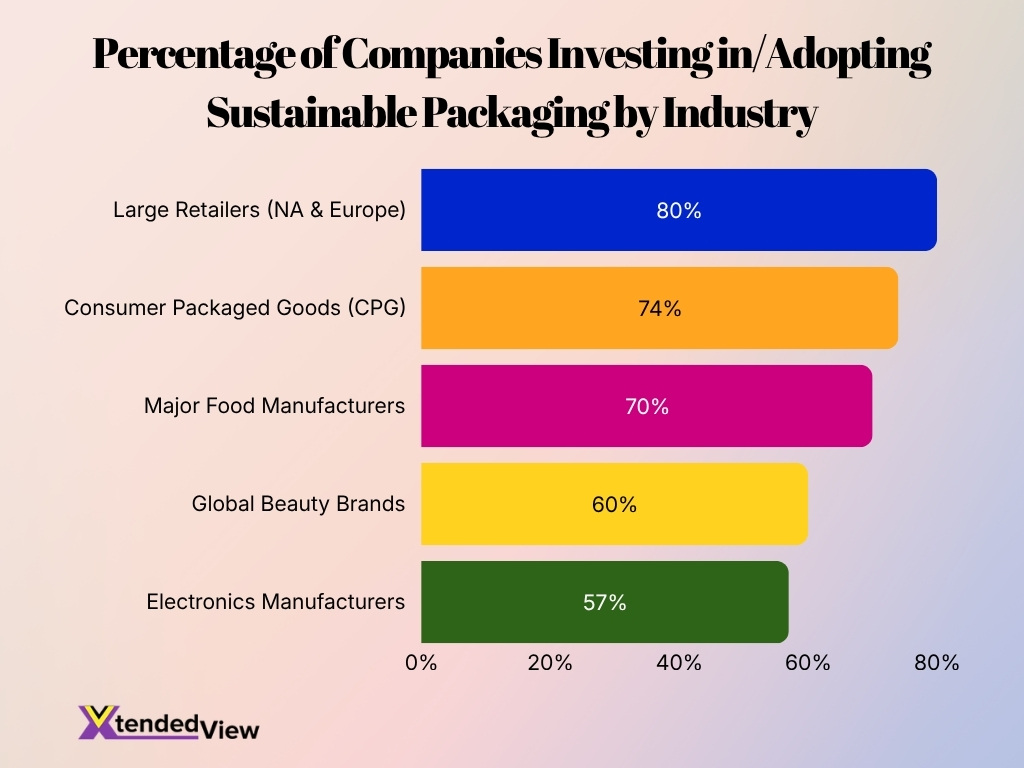
- Nearly 74% of consumer packaged goods companies have increased investments in sustainable packaging initiatives since 2023.
- Around 60% of global beauty brands now offer products in recyclable, refillable, or reusable packaging formats.
- More than 70% of major food manufacturers have established targets to make their packaging recyclable, reusable, or compostable by 2030.
- The pharmaceutical sector’s demand for sustainable packaging is projected to grow at a 6% CAGR through 2030 due to rising environmental regulations.
- Approximately 57% of electronics manufacturers now include sustainable packaging requirements in supplier contracts.
- The apparel and fashion industry generates nearly 92 million tons of textile waste annually, driving brands toward recyclable and biodegradable packaging alternatives.
- More than 80% of large retailers in North America and Europe have implemented sustainable packaging guidelines for suppliers.
Material Types Used in Sustainable Packaging
- Paper and paperboard packaging account for roughly 38% of the global sustainable packaging market, the largest share among materials.
- Recycled paper packaging demand increased by approximately 7% year over year in 2025.
- Bioplastics currently represent nearly 1% of total global plastic production, but demand continues to grow rapidly.
- Global bioplastics production capacity is expected to exceed 7.4 million metric tons by 2028, up from around 2.5 million tons in 2024.
- Recycled plastic packaging accounts for approximately 23% of sustainable packaging materials used globally.
- Metal packaging maintains one of the highest recycling values, with aluminum capable of being recycled indefinitely without quality loss.
- Glass packaging represents nearly 12% of sustainable packaging applications because of its recyclability and chemical stability.
- Fiber-based packaging solutions are expected to record a 7% CAGR through 2030, driven by e-commerce and food delivery demand.
- More than 70% of new packaging innovations introduced in 2025 incorporated recycled or renewable materials.
Usage of Biodegradable and Compostable Packaging
- The global biodegradable packaging market is projected to exceed $170 billion by 2030, reflecting rapid adoption across industries.
- More than 60% of consumers worldwide say they prefer biodegradable packaging over conventional plastic alternatives.
- Compostable packaging demand in North America increased by approximately 17% between 2024 and 2025.
- The food-service industry accounts for nearly 40% of biodegradable packaging usage globally.
- Biodegradable plastic production capacity is expected to grow by more than 300% by 2029.
- Nearly 55% of packaging manufacturers are investing in compostable materials research and development.
- The market for starch-based biodegradable packaging is forecast to grow at a 7.5% CAGR through 2032.
- Around 35% of new packaging patents filed in 2025 focused on compostable or biodegradable materials.
- Industrial composting infrastructure now serves more than 170 million people worldwide, increasing the viability of compostable packaging solutions.
Consumer Willingness to Pay More for Sustainable Packaging
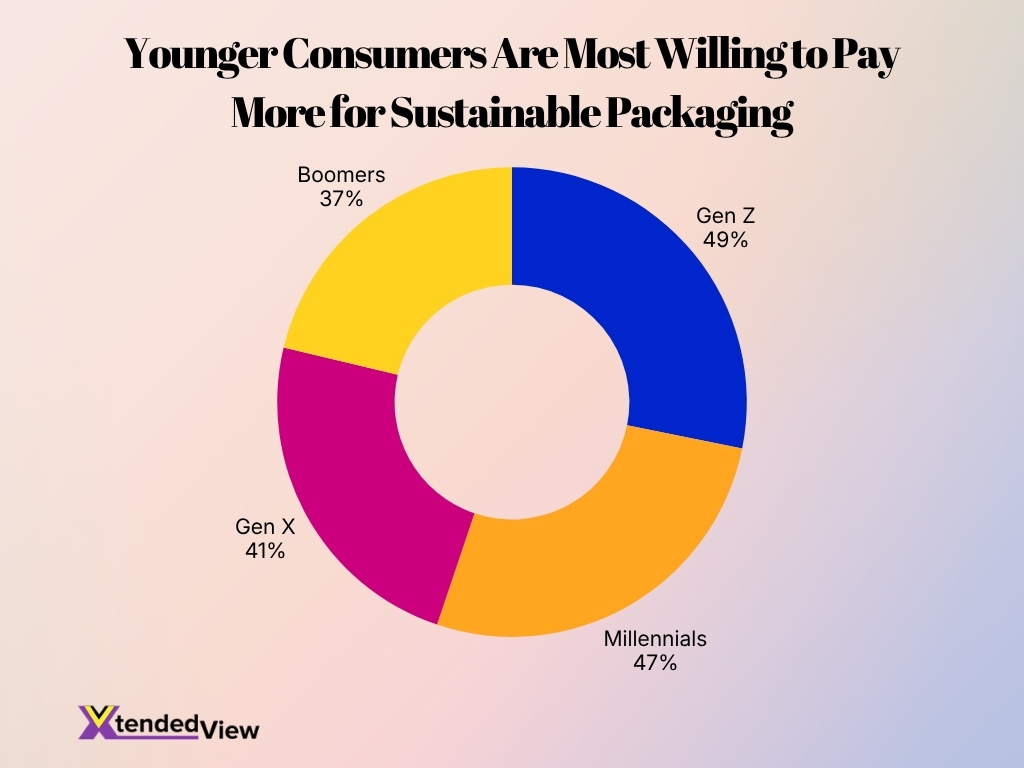
- Gen Z is the most willing to pay more for sustainable packaging, with 49% expressing support.
- Millennials closely follow, with 47% willing to spend extra on eco-friendly packaging.
- Gen X shows moderate support, with 41% saying they would pay more for sustainable packaging.
- Boomers are the least likely to pay a premium, with 37% willing to do so.
- The gap between Gen Z (49%) and Boomers (37%) is 12 percentage points, highlighting a clear generational difference.
- Nearly 1 in 2 Gen Z consumers are willing to pay extra for environmentally friendly packaging.
- Younger generations, especially Gen Z and Millennials, demonstrate the strongest demand for sustainable packaging.
- All four generations recorded willingness levels of 37% or higher, indicating broad consumer interest in sustainable packaging.
- The data suggests that brands targeting younger consumers may benefit more from investing in sustainable packaging solutions.
- Consumer willingness to pay more declines with age, from 49% among Gen Z to 37% among Boomers.
Sustainable Packaging Usage in E-Commerce and Retail
- Global e-commerce packaging demand is expected to surpass $98 billion in 2026, with sustainability becoming a major purchasing factor.
- Approximately 72% of online shoppers prefer retailers that use environmentally friendly packaging.
- More than 50% of e-commerce companies have committed to reducing virgin plastic use in packaging by 2030.
- Around 67% of consumers consider sustainable packaging important when ordering products online.
- The retail industry generates nearly 30% of global packaging waste, encouraging adoption of recyclable and reusable materials.
- Nearly 80% of major retailers have introduced packaging reduction strategies in their supply chains.
- E-commerce companies adopting right-sized packaging have reported shipping material reductions of up to 25%.
- The reusable packaging segment in retail is forecast to grow at a 9% CAGR through 2030.
- More than 40% of consumers have abandoned an online purchase because of concerns about excessive packaging waste.
Consumer Demand for Sustainable Packaging
- Around 82% of consumers are willing to pay more for products packaged sustainably.
- Nearly 74% of consumers say they would switch brands to reduce environmental impact.
- About 71% of Americans consider environmentally friendly packaging important when making purchasing decisions.
- More than 60% of global consumers actively seek products with sustainable packaging labels.
- Approximately 54% of shoppers intentionally purchased products with sustainable packaging during the past year.
- Around 44% of consumers rank sustainable packaging among the top factors influencing brand perception.
- Nearly 35% of Gen Z consumers consider packaging sustainability more important than product branding.
- More than 50% of consumers globally have reduced purchases from brands they perceive as environmentally irresponsible.
- About 65% of shoppers believe companies should eliminate unnecessary packaging materials entirely.
The Importance of Eco-Friendly Packaging in Asia
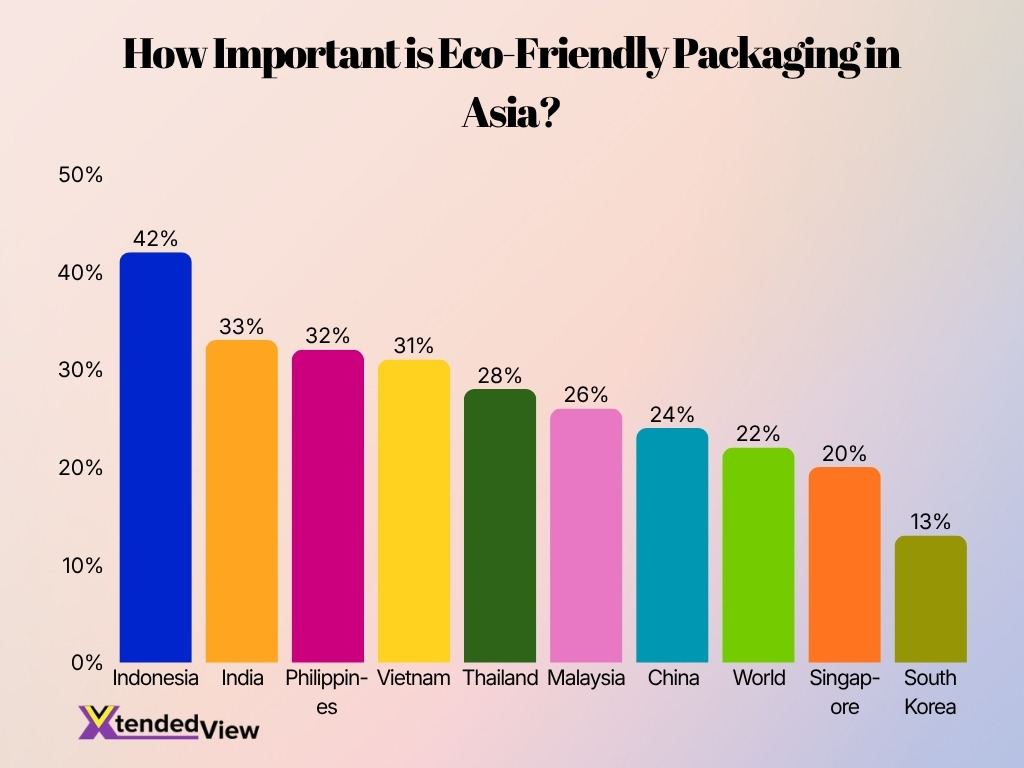
- Indonesia ranks first, with 42% of grocery shoppers saying eco-friendly packaging is important when choosing food.
- India secures second place at 33%, highlighting strong consumer demand for sustainable packaging.
- The Philippines follows closely with 32%, just 1 percentage point behind India.
- Vietnam records 31%, showing that nearly one-third of consumers value environmentally friendly packaging.
- Thailand stands at 28%, placing it in the top five among the surveyed countries.
- Malaysia reports 26%, indicating that over one in four shoppers prioritize sustainable packaging.
- China reaches 24%, remaining 2 percentage points above the global average.
- The global average is 22%, providing a benchmark for comparing regional consumer preferences.
- Singapore records 20%, falling 2 percentage points below the global average.
- South Korea ranks last with 13%, the lowest share among all countries in the survey.
- The gap between Indonesia (42%) and South Korea (13%) is 29 percentage points, highlighting significant regional differences in consumer attitudes.
- Seven of the nine Asian countries surveyed score above the global average of 22%, demonstrating strong regional interest in eco-friendly packaging.
Impact of Sustainable Packaging on Brand Preference and Loyalty
- Around 82% of consumers say they are more likely to purchase from brands that use sustainable packaging.
- Approximately 71% of U.S. consumers believe environmentally friendly packaging positively influences their perception of a brand.
- Nearly 63% of shoppers have switched to brands with stronger sustainability credentials in the past five years.
- About 44% of consumers consider sustainable packaging a key factor in determining brand trust.
- Products marketed with sustainability claims grew 28% cumulatively over the past five years, outperforming conventionally marketed products.
- Nearly 50% of Gen Z consumers say sustainable packaging directly affects their loyalty to a brand.
- Around 57% of global consumers are willing to recommend brands that reduce packaging waste.
- Approximately 68% of consumers believe companies should communicate packaging sustainability information more clearly.
- Brands with visible sustainability commitments tend to achieve higher customer retention rates than brands without such initiatives.
Business Adoption Rates of Sustainable Packaging
- More than 74% of consumer packaged goods companies have increased spending on sustainable packaging since 2023.
- Around 81% of large companies globally now consider sustainable packaging a strategic business priority.
- Approximately 62% of manufacturers have already adopted recyclable or reusable packaging solutions.
- Nearly 70% of retail companies have established formal packaging sustainability targets.
- Around 58% of organizations plan to accelerate sustainable packaging investments over the next three years.
- More than 50% of businesses have implemented packaging redesign initiatives to reduce material usage.
- Approximately 46% of packaging companies are actively developing refill and reuse systems.
- Around 90% of Fortune 500 consumer brands now publish sustainability goals that include packaging commitments.
- Nearly 67% of executives believe sustainable packaging creates a competitive advantage in their markets.
Sustainable Packaging Adoption: Key Drivers and Obstacles
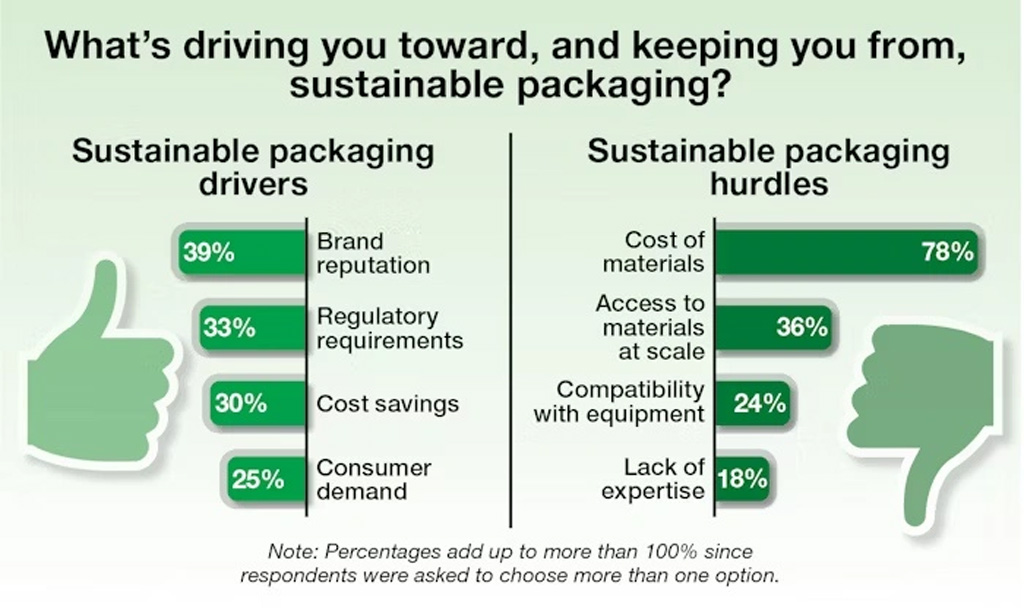
- Brand reputation is the leading driver, influencing 39% of organizations to adopt sustainable packaging.
- Regulatory requirements encourage 33% of businesses to implement sustainable packaging solutions.
- Cost savings motivate 30% of companies to invest in more sustainable packaging practices.
- Consumer demand drives 25% of organizations toward adopting sustainable packaging.
- Cost of materials is the biggest hurdle, cited by 78% of respondents.
- Access to materials at scale remains a challenge for 36% of businesses.
- Compatibility with existing equipment is a barrier for 24% of organizations.
- Lack of expertise prevents 18% of companies from adopting sustainable packaging more effectively.
- Brand reputation (39%) is the strongest adoption driver, while material costs (78%) are the most significant obstacle.
- The survey allowed multiple responses, so the combined percentages exceed 100%.
Regulatory Impact on Sustainable Packaging Usage
- The European Union regulation requires 100% of packaging to be fully recyclable by 2030.
- More than 90 countries have introduced restrictions or taxes targeting single-use plastics.
- Five U.S. states now enforce Extended Producer Responsibility laws for packaging waste.
- California legislation requires a 25% reduction in single-use plastic packaging by 2032.
- The United Kingdom imposes a tax on plastic packaging containing less than 30% recycled plastic.
- Canada aims to achieve zero plastic waste by 2030 through strict recycling mandates.
- Two major Asian economies, India and South Korea, expanded regulations mandating increased recycled packaging content.
- More than 1,000 companies worldwide support stronger regulations through voluntary sustainability commitments.
- Governments worldwide spent billions of dollars on circular economy initiatives over the past 5 years.
Recycling Rates of Packaging Materials
- Global municipal waste generation exceeds 2.3 billion metric tons annually, and packaging represents a significant share of that volume.
- The global recycling rate for paper and cardboard packaging exceeds 68%, making it one of the most recycled packaging materials.
- Aluminum beverage containers achieve recycling rates above 70% in several European countries.
- Approximately 9% of plastic waste globally is recycled into new products.
- The United States recycled approximately 32% of municipal solid waste in recent years.
- Glass packaging recycling rates exceed 75% in parts of Europe, supported by deposit-return systems.
- Around 50 billion beverage containers are recovered annually through deposit systems worldwide.
- Recycled materials can reduce greenhouse gas emissions by up to 70% compared with virgin material production.
- Global investments in advanced recycling technologies continue to rise as governments seek to improve packaging recovery rates.
Barriers to Wider Sustainable Packaging Usage
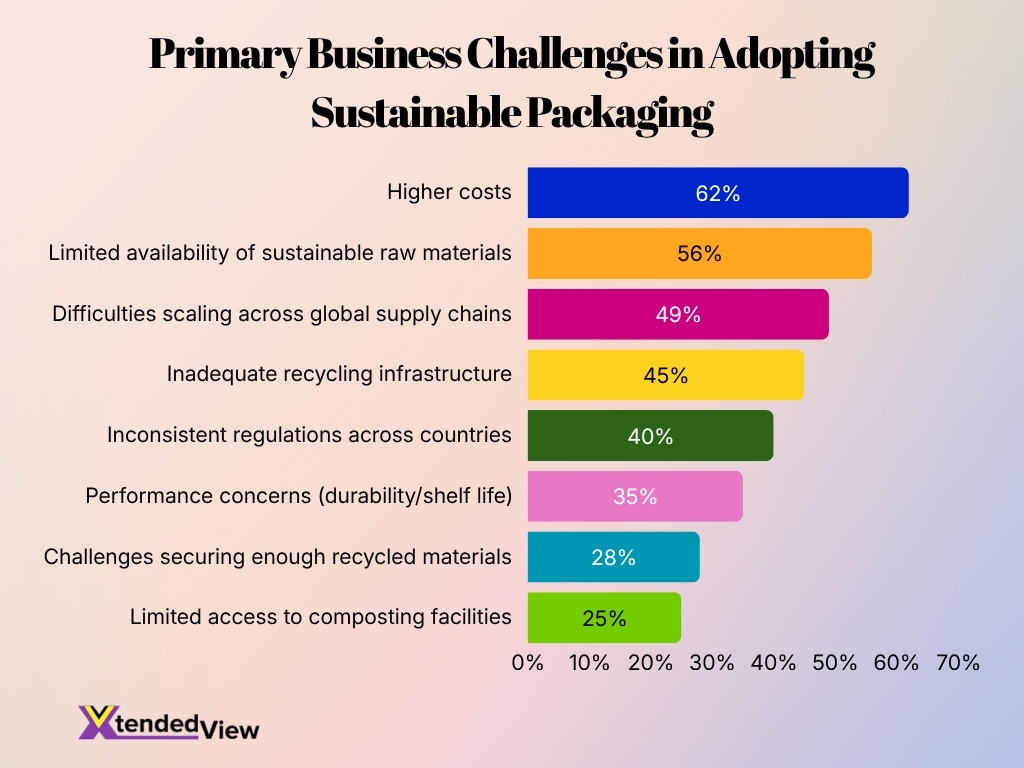
- Around 62% of companies cite higher costs as the biggest challenge to adopting sustainable packaging.
- Approximately 56% of businesses struggle with limited availability of sustainable raw materials.
- Nearly 49% of organizations report difficulties in scaling sustainable packaging across global supply chains.
- About 45% of executives say inadequate recycling infrastructure limits the effectiveness of sustainable packaging initiatives.
- Around 40% of companies identify inconsistent regulations across countries as a major barrier.
- More than 35% of businesses cite performance concerns, such as durability and shelf life, when replacing conventional packaging materials.
- Approximately 30% of consumers remain confused by sustainability labels and packaging claims.
- Around 28% of packaging producers report challenges in securing enough recycled materials to meet demand.
- Nearly 25% of businesses indicate that limited access to composting facilities slows investment in compostable packaging.
Circular Economy Initiatives in Packaging
- More than 1,000 organizations have joined international initiatives promoting circular packaging systems.
- Approximately 65% of global packaging executives plan to increase investment in circular economy solutions by 2027.
- The reusable packaging market is projected to grow at a 9% CAGR through 2030.
- Around 20% of companies already operate refill or return packaging programs.
- The circular economy could unlock $4.5 trillion in global economic benefits by 2030.
- More than 400 companies have committed to increasing reusable, recyclable, or compostable packaging through global sustainability initiatives.
- Approximately 50% of major consumer brands now incorporate recycled content targets into packaging strategies.
- Circular packaging models can reduce packaging-related emissions by up to 45% in certain sectors.
- Governments and private companies have committed billions of dollars to develop recycling infrastructure and closed-loop packaging systems.
Frequently Asked Questions (FAQs)
The global sustainable packaging market is estimated to be worth $339.35 billion in 2026 and is projected to reach $719.19 billion by 2036.
The global sustainable packaging market is forecast to grow at a 5.8% to 7.8% CAGR between 2026 and 2036, depending on the market assessment.
Europe accounted for 32.08% of the global green packaging market in 2025, making it the largest regional market.
About 43% of consumers say they are willing to pay more for products packaged sustainably.
Around 90% of consumers say they are more likely to purchase from brands that prioritize sustainable packaging.
Conclusion
Sustainable packaging has become a central part of global business strategy rather than a niche environmental initiative. Market value continues to climb, consumers increasingly reward brands that reduce packaging waste, and governments are introducing regulations that accelerate adoption. At the same time, challenges such as higher costs, limited recycling infrastructure, and supply chain constraints remain significant barriers.
Despite these obstacles, the long-term outlook remains strong. Companies across food, retail, beauty, and e-commerce are investing in recyclable, reusable, and compostable materials to meet consumer expectations and regulatory requirements. As circular economy models mature and packaging technologies improve, sustainable packaging will likely play an even greater role in reducing waste and reshaping global supply chains.
