


Video conferencing has become a core part of how businesses, schools, healthcare providers, and distributed teams communicate. From remote hiring and virtual classrooms to enterprise collaboration and customer support, platforms like Zoom and Google Meet now support millions of daily interactions worldwide.
As organizations continue investing in hybrid work and AI-powered collaboration, understanding the latest usage, adoption, and market trends can help decision-makers choose the right platform. Explore the latest Zoom vs Google Meet statistics to see how these two leaders compare.
Editor’s Choice
- Zoom averages more than 300 million daily meeting participants worldwide in 2026.
- Google Meet serves over 300 million monthly users, making it one of the world’s largest video conferencing platforms.
- Zoom holds approximately 55.9% of the global video conferencing market, maintaining its leadership position.
- Google Meet accounts for roughly 29.4% market share in the global video conferencing software segment.
- Google Workspace supports more than 3 billion users globally, giving Google Meet access to a massive ecosystem.
- Zoom generated $4.66 billion in annual revenue during its latest reported fiscal year.
- Zoom currently serves approximately 470,000+ paying business customers worldwide.
Recent Developments
- In 2026, Zoom reported that usage of its AI Companion grew by more than 3x year-over-year, reflecting rapid adoption of AI-assisted meeting tools.
- Zoom Phone surpassed 10 million seats globally in 2026, highlighting the company’s expansion beyond video meetings.
- Zoom Contact Center crossed $100 million in annual recurring revenue (ARR) during fiscal 2026.
- Google introduced expanded Gemini-powered reporting capabilities that allow organizations to track Google Meet AI usage metrics.
- Google expanded AI-powered meeting experiences through Gemini integration across Workspace and Meet environments during 2025 and 2026.
- Zoom reported quarterly revenue of approximately $1.23 billion in fiscal Q3 2026, representing year-over-year growth.
- Google Meet introduced AI-enhanced Dynamic Layouts that automatically optimize participant visibility during large meetings.
- Zoom continued expanding its platform portfolio through workplace collaboration, contact center, phone, and AI-focused products.
- Google Meet increased enterprise AI functionality through automated summaries, translations, and collaboration enhancements integrated into Workspace.
Zoom vs Google Meet Global Market Share Statistics
- Zoom controls approximately 55.91% of the global video conferencing market.
- Google Meet holds roughly 29.39% of the worldwide video conferencing market share.
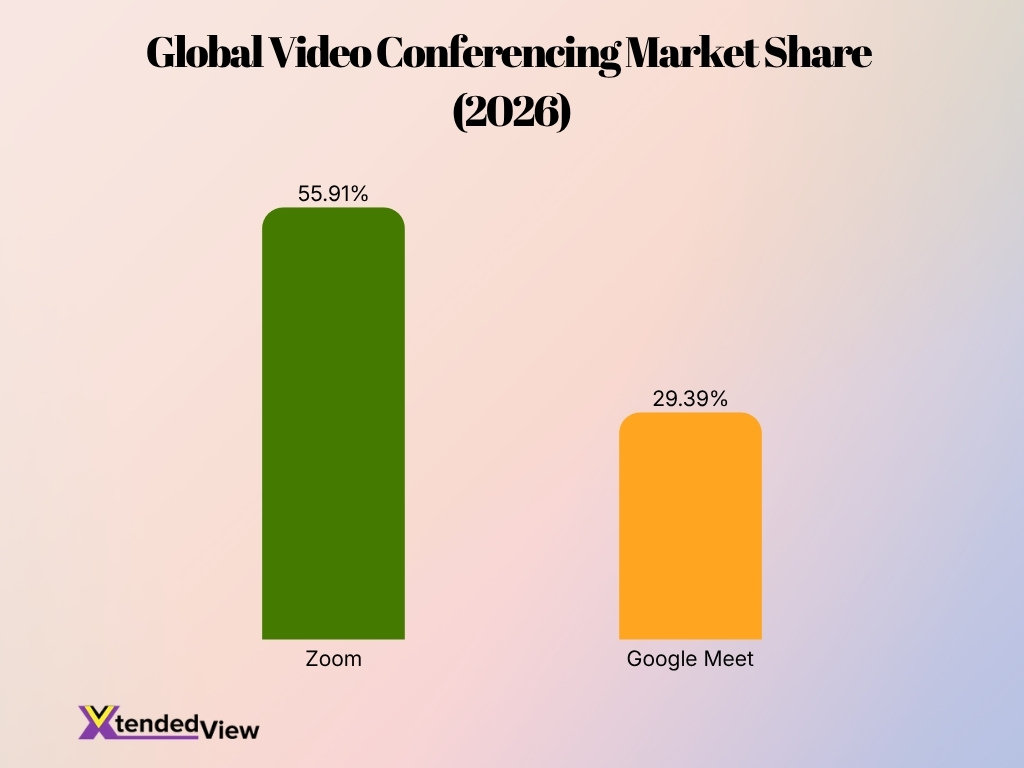
- Combined, Zoom and Google Meet account for more than 85% of the video conferencing market based on available market-share estimates.
- Zoom remains the most widely used standalone video conferencing platform globally.
- Google Meet’s market position benefits significantly from its inclusion within Google Workspace subscriptions.
- Google Workspace applications maintain more than 50% market share in the productivity software category, indirectly supporting Meet adoption.
- Zoom continues to lead among organizations seeking dedicated video communication platforms rather than bundled productivity suites.
- Google Meet has strengthened its competitive position through AI integration and broader Workspace adoption.
- The global video conferencing market exceeded $13 billion in 2025, creating significant growth opportunities for both platforms.
Zoom vs Google Meet User Base Statistics
- Zoom supports over 300 million daily active meeting participants globally.
- Google Meet has surpassed 300 million monthly users worldwide.
- Zoom serves approximately 470,000 paying business customers globally.
- Some industry estimates place Zoom’s total user base above 500 million registered users worldwide.
- Google Meet benefits from exposure to Google’s ecosystem of more than 3 billion Workspace users.
- Zoom reported nearly 193,000 business customers in late 2024, according to company reporting and industry analysis.
- Google Meet remains among the top two most-used video conferencing platforms globally.
- Zoom’s business customer count has expanded significantly since the platform recorded only 10 million daily participants in 2019.
- Google Meet adoption accelerated through Workspace integration, education deployments, and hybrid work initiatives.
Zoom vs Google Meet: Daily Active Users and Meeting Volume
- Zoom facilitates more than 300 million daily meeting participants, making it one of the world’s busiest communication platforms.
- Zoom processes approximately 3.3 trillion to 3.5 trillion meeting minutes annually, according to recent industry estimates.
- Zoom’s daily participant count increased from 10 million in 2019 to over 300 million, representing extraordinary long-term growth.
- Google Meet exceeded 300 million monthly active users, creating substantial daily meeting activity across Workspace accounts.
- Around 46% of professionals attend three or more meetings daily, supporting demand for both Zoom and Google Meet.
- Nearly 59% of enterprise employees spend over five hours per week in meetings, reinforcing the importance of reliable conferencing platforms.
- Approximately 30% of modern meetings span multiple time zones, increasing reliance on global collaboration tools.
- Meetings scheduled after 8:00 p.m. local time increased 16% year over year, reflecting continued growth in distributed workforces.
- About 60% of workplace meetings are now ad hoc or unscheduled, increasing demand for instant video communication capabilities.
Zoom vs Google Meet Use Case Statistics
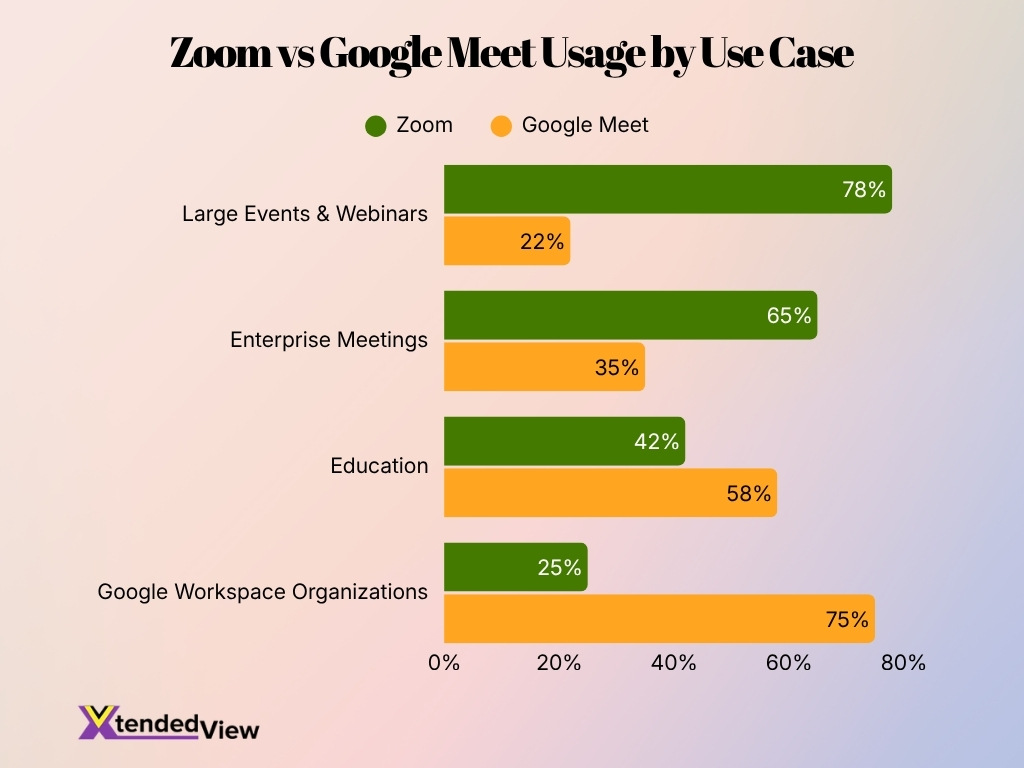
- Zoom dominates large events and webinars, capturing 78% usage compared to 22% for Google Meet.
- Enterprise meetings favor Zoom, with a strong 65% share versus 35% for Google Meet.
- Google Meet leads in education, accounting for 58% of usage, while Zoom holds 42%.
- Google Meet is the preferred choice for Google Workspace organizations, commanding 75% adoption compared to 25% for Zoom.
- The biggest usage gap appears in large events and webinars, where Zoom leads Google Meet by 56 percentage points.
- Google Meet’s strongest segment is Google Workspace organizations, where it outperforms Zoom by 50 percentage points.
Zoom and Google Meet Revenue and Financial Performance
- Zoom reported $4.67 billion in revenue for fiscal year 2025, up slightly from approximately $4.53 billion in the previous year.
- Zoom generated roughly $1.17 billion in revenue during its fiscal Q4 2025 quarter, reflecting continued enterprise demand.
- Zoom’s enterprise revenue represented more than 58% of total company revenue in recent reporting periods.
- Zoom maintained a gross margin above 75%, one of the highest levels among major collaboration software providers.
- Zoom ended fiscal 2025 with approximately $7.8 billion in cash, cash equivalents, and marketable securities.
- Google Cloud generated more than $43 billion in annual revenue during 2025, with Google Meet contributing as part of the Google Workspace ecosystem.
- Google Workspace surpassed $20 billion in annual recurring revenue, supporting continued investment in Google Meet and Gemini-powered collaboration features.
- Zoom reported over 4,000 customers generating more than $100,000 in trailing 12-month revenue, highlighting enterprise adoption.
- Google’s parent company generated more than $350 billion in total revenue during 2025, giving Google Meet significant financial backing.
- Zoom’s operating cash flow exceeded $1.8 billion in its latest fiscal year, demonstrating strong profitability despite slower post-pandemic growth.
App Downloads and Growth Trends for Zoom and Google Meet
- Zoom has surpassed 1 billion downloads on Android devices through Google Play.
- Google Meet has also exceeded 5 billion downloads on Google Play, benefiting from integration across Android devices and Google Workspace.
- During 2025, Google Meet remained among the top five business communication apps globally by download volume.
- Zoom consistently ranked within the top ten business applications in both Apple’s App Store and Google Play business categories.
- Mobile installs for Google Meet grew by approximately 15% year over year in several major international markets during 2025.
- Zoom maintained strong growth among small and medium-sized businesses, particularly in North America and Europe.
- More than 70% of first-time Google Meet users access the platform through existing Google accounts rather than standalone downloads.
- Google Workspace’s user base exceeded 3 billion users, creating a significant funnel for Meet adoption.
- Zoom’s app remains available in more than 150 countries and regions, supporting broad international usage.
- Hybrid work initiatives continued driving downloads of both platforms throughout 2025 and into 2026.
Zoom vs Google Meet: Age Demographics Statistics
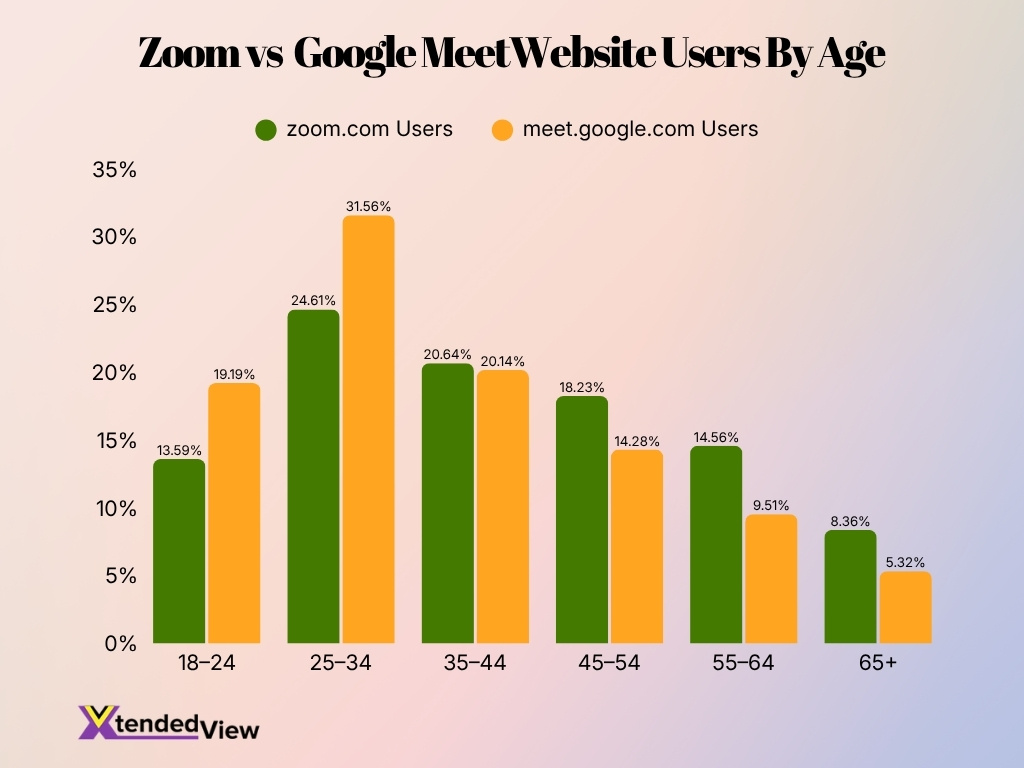
- Google Meet has a stronger presence among 18–24 users (19.19%) compared to Zoom (13.59%).
- The 25–34 age group is the largest audience for both platforms, accounting for 31.56% of Google Meet users and 24.61% of Zoom users.
- Zoom (20.64%) slightly surpasses Google Meet (20.14%) among users aged 35–44.
- Users aged 45–54 make up a larger share of Zoom’s audience at 18.23%, versus 14.28% for Google Meet.
- Among the 55–64 age group, Zoom (14.56%) attracts significantly more users than Google Meet (9.51%).
- Senior users aged 65+ represent 8.36% of Zoom visitors, compared to 5.32% of Google Meet visitors.
- Google Meet skews younger, with 50.75% of users under 35, compared to 38.20% for Zoom.
- Zoom has a more mature audience, with 41.15% of users aged 45+, versus 29.11% for Google Meet.
- The age gap is most pronounced among 18–24 users, where Google Meet leads Zoom by 5.60 percentage points.
- Overall, Google Meet dominates younger demographics, while Zoom performs better among older age groups.
Enterprise Adoption Rates: Zoom vs Google Meet
- Zoom serves approximately 470,000 paying business customers worldwide.
- Zoom has more than 4,000 enterprise customers spending over $100,000 annually.
- Over 55% of Fortune 500 companies reportedly use Zoom products for communication and collaboration.
- Google Workspace serves millions of businesses globally, providing Google Meet access across organizations of all sizes.
- More than 9 million organizations use Google Workspace worldwide.
- Enterprise adoption of Google Meet accelerated as organizations consolidated software spending into productivity suites.
- Around 70% of large enterprises now support hybrid work models that require video conferencing platforms.
- Zoom Phone surpassed 10 million paid seats, strengthening Zoom’s enterprise communications portfolio.
- Organizations increasingly deploy both Zoom and Google Meet simultaneously to support different teams and workflows.
- Security, compliance, and AI functionality remain the top purchasing factors among enterprise buyers in 2026.
Zoom vs Google Meet User Behavior and Meeting Habits
- The average professional spends approximately 11 hours per week in meetings.
- Nearly 59% of workers spend more time in meetings today than they did three years ago.
- About 46% of employees attend three or more meetings per day.
- Around 70% of users prefer video-on meetings when discussing complex topics or making decisions.
- Google Meet users frequently initiate meetings directly from Gmail, Calendar, and Workspace applications.
- Zoom users are more likely to host external meetings involving customers, vendors, and partners.
- Approximately 30% of meetings now include participants from multiple time zones.
- AI-generated meeting summaries have become one of the fastest-growing collaboration features during 2025 and 2026.
- More than 60% of professionals report joining at least one meeting from a mobile device each week.
- Employees increasingly prefer shorter meetings, with organizations reducing average meeting lengths compared to pre-pandemic levels.
Video Conferencing Platform Usage Statistics by Country
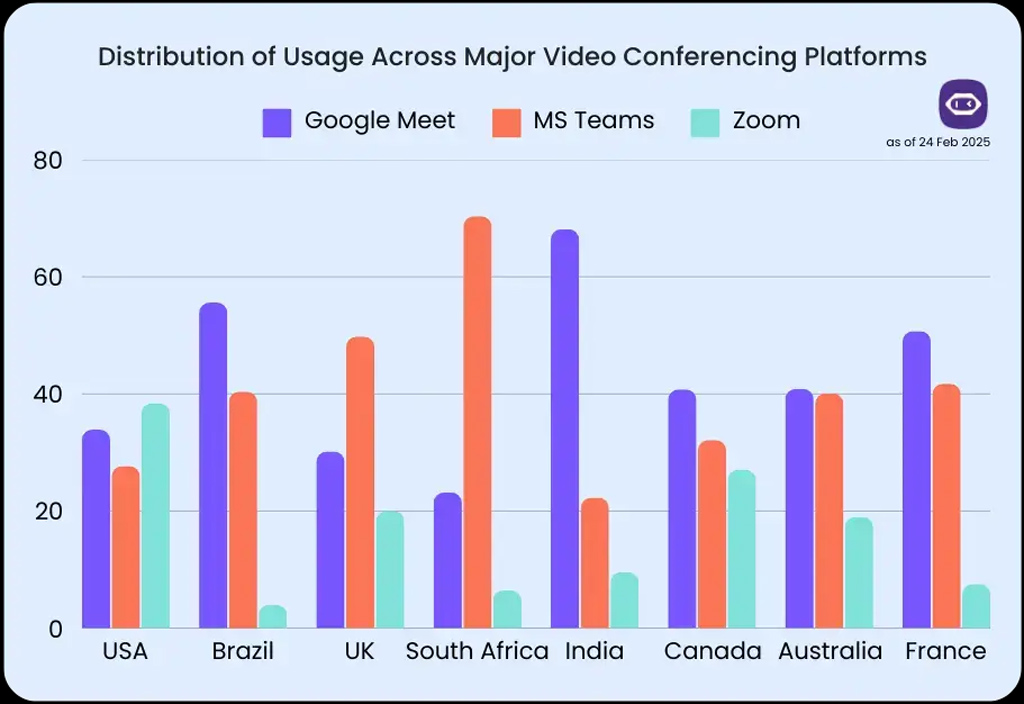
- India leads Google Meet adoption with 68%, the highest usage among all countries analyzed.
- South Africa records the highest MS Teams usage at 70%, significantly ahead of competitors.
- Zoom achieves its strongest performance in the USA with 38% usage, topping all other markets.
- Brazil shows a strong preference for Google Meet (55%), while Zoom trails at just 4%.
- UK businesses favor MS Teams (50%), compared to 30% for Google Meet and 20% for Zoom.
- Canada has a balanced market, led by Google Meet (40%), followed by MS Teams (32%) and Zoom (27%).
- Australia is evenly split between Google Meet and MS Teams at 40% each.
- France reports 51% Google Meet usage, exceeding MS Teams (42%) and Zoom (8%).
- Google Meet is the leading platform in Brazil, India, Canada, Australia, and France.
- MS Teams dominates in the UK and South Africa, with usage rates of 50% and 70%, respectively.
- Zoom ranks first in only one market, the USA, where it reaches 38% usage.
- South Africa has the widest platform gap, with MS Teams (70%) surpassing Zoom (7%) by 63 percentage points.
Zoom vs Google Meet Education Sector Statistics
- Google Meet became one of the most widely deployed video learning platforms due to integration with Google Classroom.
- More than 170 million students and educators globally use Google Workspace for Education products.
- Over 50 million teachers and students adopted Google Classroom-connected learning environments in recent years.
- Zoom remains widely used by universities, professional training providers, and continuing education programs.
- Approximately 73% of higher education institutions continue offering some form of online or hybrid learning.
- Around 60% of students report participating in virtual classes or academic meetings during the past academic year.
- Educational organizations increasingly use AI-powered note-taking and meeting summaries for lecture accessibility.
- Universities frequently use Zoom Webinar for large-scale virtual lectures and admissions events.
- Google Meet usage remains particularly strong in K-12 education due to Chromebook adoption.
- Hybrid learning initiatives continue driving growth for both platforms across North America, Europe, and Asia-Pacific.
Zoom vs Google Meet Webinar and Virtual Event Statistics
- Zoom holds a dominant 55.91% market share compared to the 5.52% share held by Google Meet.
- Roughly 71% of professionals prefer Zoom for business, while 62% of students favor Google Meet.
- The global video conferencing market is expected to hit $41.62 billion by 2026 with a 12% growth rate.
- Zoom facilitates over 3.5 trillion annual meeting minutes across personal and enterprise communications.
- Google Meet provides 60-minute free sessions for 100 participants, while Zoom limits free calls to 40 minutes.
- Top paid tiers on both platforms can support large virtual events with up to 1,000 active participants.
- Over 63% of webinar attendees ultimately make a purchase decision after attending a targeted live event.
- Morning webinars generate 93% more audience engagement and effectiveness compared to evening sessions.
- Around 73% of B2B marketers rank webinars as their highest-performing channel for generating qualified leads.
Zoom vs Google Meet Remote Work Statistics
- Approximately 28% of employees worldwide work in a hybrid arrangement, relying heavily on video conferencing tools for collaboration.
- Around 22% of U.S. employees work remotely full-time in 2026, sustaining demand for Zoom and Google Meet.
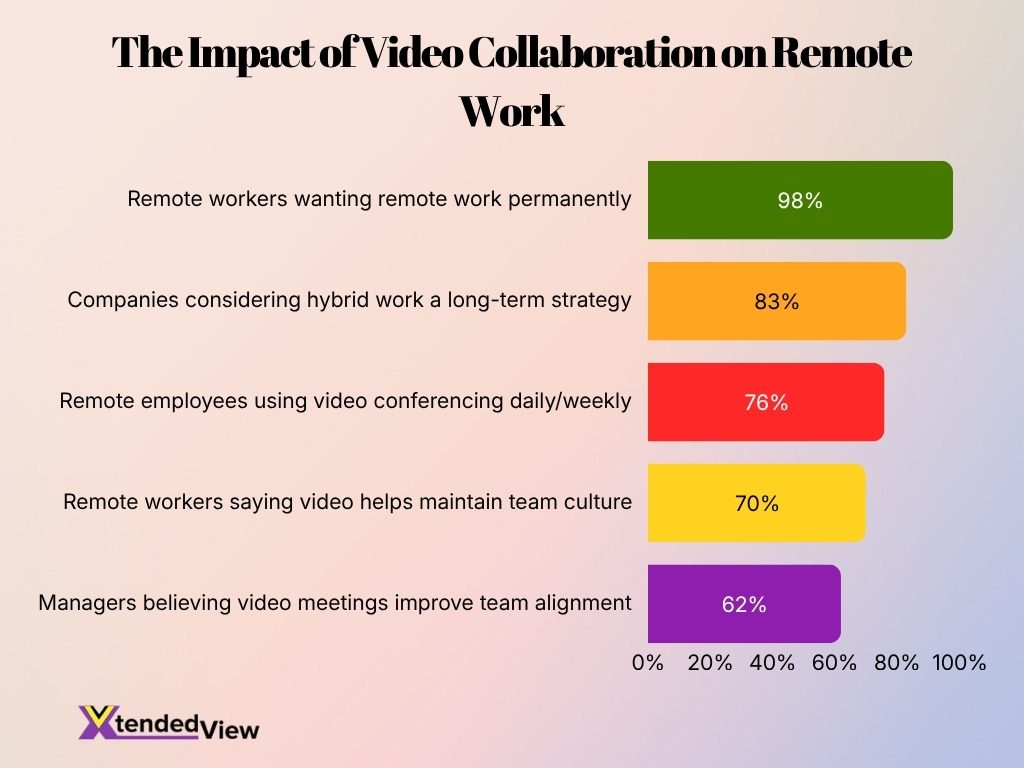
- More than 98% of remote workers report wanting some level of remote work for the remainder of their careers.
- Nearly 76% of remote employees use video conferencing daily or several times per week.
- Organizations with hybrid work policies are more likely to invest in premium video collaboration platforms than office-only companies.
- Roughly 62% of managers believe video meetings improve team alignment in distributed environments.
- About 83% of companies now consider hybrid work a long-term operating strategy.
- Employees save an average of 72 minutes daily by eliminating commuting, increasing reliance on virtual collaboration.
- More than 70% of remote workers say video meetings help maintain workplace relationships and team culture.
- Both Zoom and Google Meet remain among the most frequently used applications in remote-work technology stacks.
Zoom vs Google Meet Mobile Usage Statistics
- More than 60% of professionals join at least one meeting per week from a smartphone or tablet.
- Google Meet surpassed 5 billion Android downloads, making it one of the most downloaded business communication apps globally.
- Zoom exceeded 1 billion Android downloads, reflecting sustained mobile demand.
- Mobile meeting participation increased by approximately 20% year over year across enterprise environments.
- Roughly 45% of video conferencing users switch between desktop and mobile devices during the workweek.
- Google Meet benefits from native Android integration and pre-installed Google services.
- Zoom’s mobile application consistently ranks among the leading business productivity apps worldwide.
- More than 70% of remote workers report using mobile conferencing during travel or off-site work.
- Tablet usage remains common among educators and field-service professionals using video collaboration tools.
- Mobile-first collaboration strategies continue influencing feature development across both platforms.
Zoom vs Google Meet AI and Productivity Feature Statistics
- Zoom holds a dominant 55.9% market share in video conferencing for 2026, hosting over 300 million daily participants.
- Zoom AI Companion generated 7.2 million meeting summaries across 510,000 accounts within its first five months.
- Google Meet utilizes Gemini to automatically summarize 78% of business meetings for its enterprise client base.
- Gemini Enterprise expanded to over 8 million paid seats across 2,800 companies by the first quarter of 2026.
- Built-in productivity features like Zoom AI Companion and Google Gemini have driven an 89% increase in AI adoption.
- Approximately 95% of the top 20 global SaaS companies are actively utilizing Google Gemini for workplace collaboration.
- Over 120,000 enterprises have integrated Google Gemini into their communication and productivity workflows.
- Generative AI is currently used by 26% of professionals specifically to take notes or summarize meetings.
Marketing Channel Traffic Insights: Google Meet vs Zoom
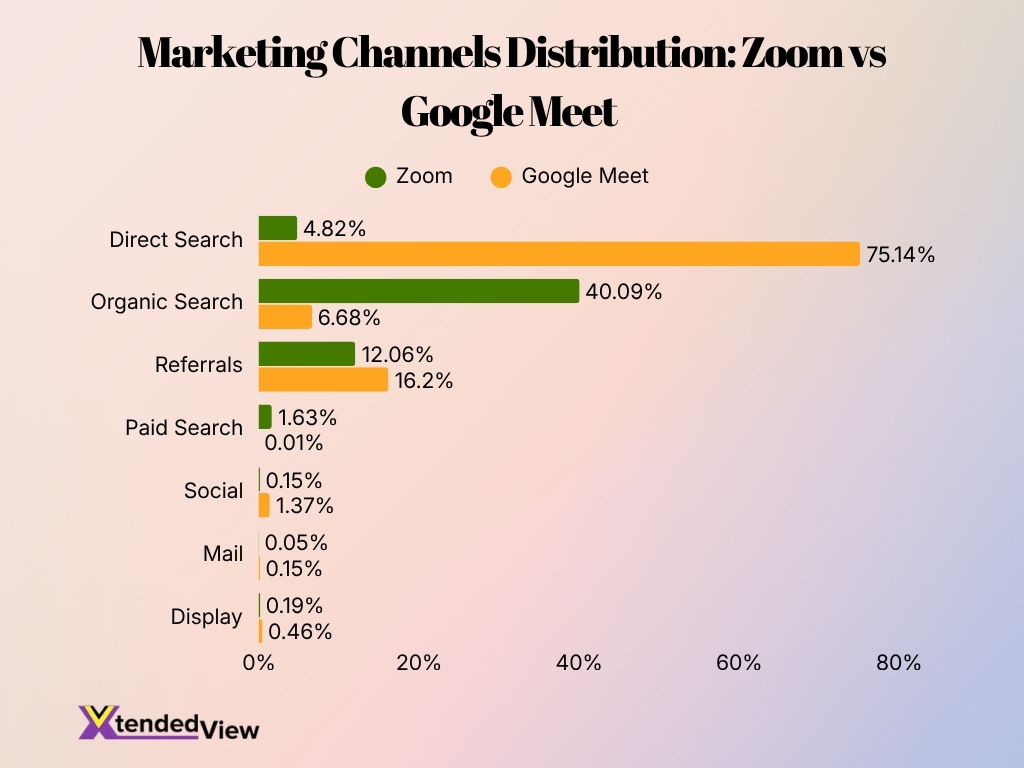
- Google Meet relies heavily on Direct Search (75.14%), indicating strong brand recognition and repeat user visits.
- Zoom generates the largest share of its traffic from Organic Search (40.09%), highlighting strong search engine visibility.
- Google Meet receives 16.2% of its traffic from Referrals, outperforming Zoom (12.06%) in partner and external website traffic.
- Paid Search contributes virtually nothing to Google Meet (<0.01%), while Zoom gains 1.63% of traffic through paid campaigns.
- Social Media drives 1.37% of Google Meet traffic, nearly 9x higher than Zoom’s 0.15% share.
- Display Advertising accounts for just 0.46% of Google Meet traffic and 0.19% of Zoom traffic, showing limited reliance on display ads.
- Email Marketing contributes a small share for both platforms, with Google Meet at 0.15% and Zoom at 0.05%.
- Direct and Organic channels together account for over 81% of Google Meet traffic and nearly 45% of Zoom traffic.
- Zoom’s Organic Search share (40.09%) is approximately 6x larger than Google Meet’s 6.68%.
- Google Meet’s Direct Search traffic (75.14%) is more than 15x higher than Zoom’s 4.82%, reflecting stronger direct user access patterns.
Zoom vs Google Meet Video Quality and Technical Performance Statistics
- Zoom requires 3.8 Mbps upload and 3.0 Mbps download bandwidth for 1080p HD video calls.
- Google Meet scales down from 1080p to 360p when bandwidth drops below 1 Mbps.
- Zoom maintains an audio latency advantage of 40 to 80 milliseconds under 3 Mbps network conditions.
- Screen sharing on Zoom requires a minimal bandwidth of 50 to 150 kbps to function effectively.
- Google Meet requires round-trip latency to remain under 100 milliseconds for optimal video quality.
- A one-hour group call on Zoom at 1080p Full HD consumes up to 2.4 GB of total data.
- Zoom’s AI background noise suppression algorithm activates at sound thresholds above 60 decibels.
- Both platforms require a network packet loss of 2% or less to maintain stable connections.
Feature Usage and Platform Integrations: Zoom vs Google Meet
- Zoom’s app marketplace natively supports over 2,500 third-party integrations for expanded functionality.
- More than 80% of enterprise users rely heavily on software integrations to streamline daily workflows.
- Zoom Phone adoption has successfully exceeded 10 million paid seats beyond standard video meetings.
- Zoom currently commands a dominant 55.91% global market share, while Google Meet holds 5.52%.
- Demand for automated tasks drove AI Companion enablement across 1 million active enterprise accounts.
- Exactly 70% of Fortune 100 companies utilize these platforms for corporate communication and workflow automation.
- A notable 62% of students strictly prefer Google Meet for its seamless Google Workspace integrations.
- Advanced CRM integrations and AI usage increased paid conversion rates by 18% among professional B2B users.
- Over 220,000 enterprise organizations consistently deploy custom API integrations for unified ecosystem management.
Frequently Asked Questions (FAQs)
Zoom holds approximately 55.91% of the global video conferencing software market.
Google Meet has more than 300 million monthly active users globally.
Zoom supports approximately 300 million daily active meeting participants worldwide.
Zoom generated approximately $4.66 billion in annual revenue in its latest reported fiscal year.
The global video conferencing market is projected to reach approximately $41.62 billion in 2026.
Conclusion
Zoom and Google Meet remain the two dominant forces in the global video conferencing market. Zoom continues to lead in overall market share, enterprise communications, webinar hosting, and dedicated collaboration services. Meanwhile, Google Meet benefits from deep integration with Google Workspace, widespread educational adoption, and access to billions of Google users worldwide.
The competition between the two platforms has increasingly shifted from basic video conferencing toward AI-powered productivity, workflow automation, enterprise communications, and hybrid work enablement. As organizations prioritize efficiency and collaboration, both platforms continue investing heavily in intelligent meeting experiences, security, and cross-platform integrations.
For businesses, educators, and remote teams, the choice between Zoom and Google Meet often depends on existing technology ecosystems, collaboration requirements, and long-term productivity goals. However, the latest statistics clearly show that both platforms will remain central to digital communication strategies.
