



Webinars have evolved from simple online presentations into a core channel for marketing, training, product education, and customer engagement. Companies now use webinars to generate qualified leads, onboard remote teams, and build thought leadership at scale. At the same time, universities, healthcare providers, and financial firms rely on webinars to deliver virtual learning and compliance training across distributed audiences.
The rise of hybrid work, AI-powered engagement tools, and on-demand content continues to reshape how businesses run digital events. From B2B demand generation to virtual certification programs, webinars now influence revenue, retention, and customer experience across industries. Explore the latest webinar statistics, benchmarks, and market trends shaping the industry this year.
Editor’s Choice
- The global webinar software market reached $7.2 billion in 2025 and is projected to hit $18.6 billion by 2034, growing at an 11.1% CAGR.
- Around 87% of businesses now use webinars as part of their marketing strategy in 2026.
- Webinar attendance increased across every quarter of 2025 compared to 2024, with Q4 averaging 254 attendees per webinar.
- The median registration-to-attendance rate across B2B webinars sits at 41.6% in 2026.
- Roughly 50% of webinar attendees now consume content on-demand instead of live sessions.
- Webinars generate leads at an average cost of about $72 per lead, lower than many paid acquisition channels.
- About 91% of B2B professionals rank webinars as their preferred content format for learning and research.
- Webinar audiences that actively engage with polls, CTAs, and downloads are 30% more likely to convert into customers.
- Personalized webinar experiences increased on-demand attendance by 62% in benchmark studies published in 2025.
- The average webinar now attracts approximately 300 registrations globally.
Recent Developments
- AI-driven webinar features such as automated summaries, transcription, and engagement scoring became standard across enterprise platforms in 2025 and 2026.
- Businesses using personalization in webinar campaigns achieved 3X higher registrations from landing pages during 2025.
- Webinar engagement time increased by 7% year over year, with average viewing sessions reaching 51 minutes.
- AI adoption in webinar and virtual event marketing reached 87% among B2B marketers in 2026.
- Webinar replay viewing continued to rise, with 42% to 63% of all webinar views now happening on-demand.
- Hybrid webinar strategies that promoted replays within two hours of event completion achieved 89% combined viewership within 72 hours.
- North America accounted for 40.4% of webinar software revenue in 2025, maintaining its lead in enterprise adoption.
- Asia-Pacific emerged as the fastest-growing webinar software market with a projected 14.2% CAGR through 2034.
- Healthcare organizations accelerated webinar adoption as the global continuing medical education market expanded to $9.41 billion in 2025.
- Companies increasingly shifted budgets from trade shows to webinars because webinars delivered 200% to 1,200% ROI potential.
Global Webinar Market Overview
- The global webinar and webcast market was valued at approximately $1.3 billion in 2025.
- The webinar software market alone generated $7.2 billion in revenue in 2025.
- Analysts project the webinar software industry to surpass $18.6 billion by 2034.
- Cloud-based webinar deployment models represented 79.3% of total market revenue in 2025.
- Large enterprises controlled 61.8% of webinar software spending globally in 2025.
- Corporate webinar applications accounted for 32.1% of the market share worldwide.
- The software segment contributed 68.4% of webinar platform revenue in 2025.
- Hybrid work remained a major growth driver, with around 58% of knowledge workers operating under hybrid schedules in early 2026.
- The virtual events industry is expected to exceed $100 billion in value between 2023 and 2032.
- Educational institutions and professional certification programs accelerated webinar investments as online learning demand continued to expand globally.
Webinar Adoption and Usage Statistics
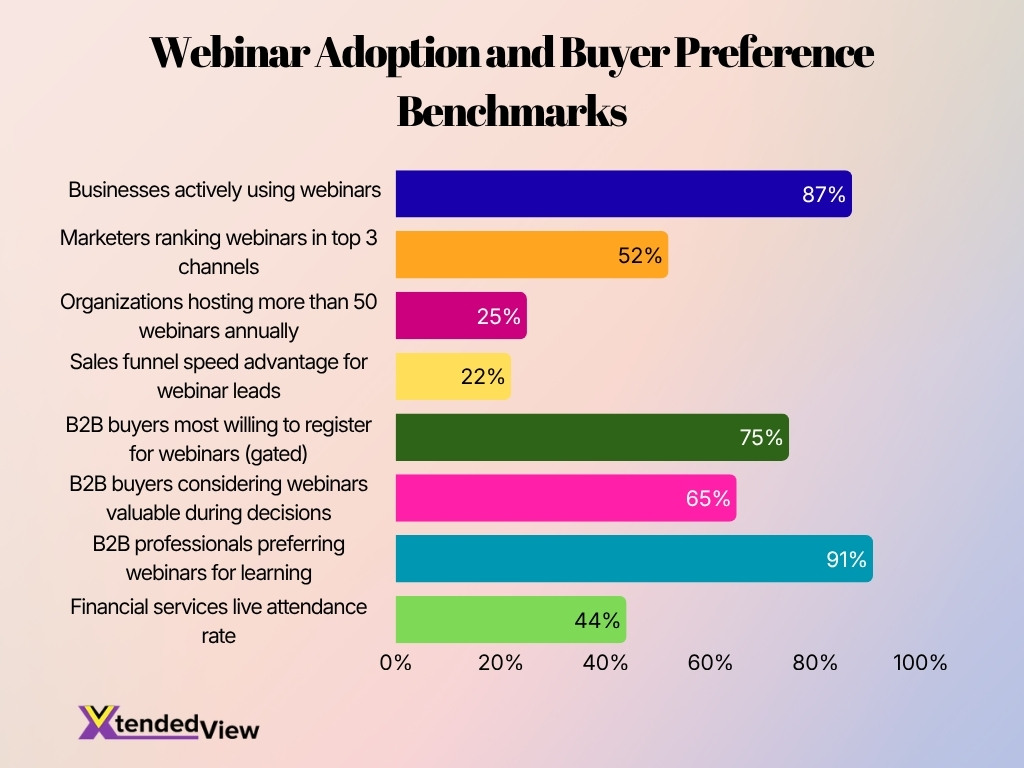
- About 87% of businesses actively use webinars in their marketing or communication strategies.
- Roughly 52% of marketers rank webinars among their top three highest-performing channels.
- Around 25% of organizations now host more than 50 webinars annually.
- Webinar-generated leads move through the sales funnel 22% faster than leads from other channels.
- Nearly 75% of B2B buyers say webinars are the gated content format they are most willing to register for.
- About 65% of B2B buyers consider webinars one of the most valuable content formats during purchasing decisions.
- Approximately 91% of B2B professionals prefer webinars over other content formats for professional learning.
- Financial services webinars achieved average live attendance rates of 44% in recent benchmark studies.
- Webinars remain heavily adopted in healthcare due to the rapid expansion of continuing medical education programs.
- Technology firms continue to dominate webinar usage because of product demos, customer onboarding, and remote training requirements.
Webinar Demand and Search Trends
- Searches related to webinar statistics, webinar ROI, and webinar attendance benchmarks increased sharply throughout 2025 as businesses optimized virtual event strategies.
- Around 49% of webinar registrations happen within seven days of the live event.
- Nearly 23% of webinar sign-ups occur within 48 hours before the webinar starts.
- About 14% of webinar registrations happen on the same day as the event.
- Tuesday generates roughly 24% of total webinar registrations, making it the strongest day for sign-ups.
- Thursday contributes approximately 22% of webinar registrations globally.
- Businesses increasingly searched for AI-powered webinar tools as automation adoption surged across digital marketing teams in 2026.
- On-demand webinar demand continued to grow as replay content accounted for up to 63% of webinar views in some studies.
- Educational webinar formats gained traction because educational sessions generated 53% higher ROI than product demo webinars.
- Businesses increasingly prioritized shorter sales cycles, which boosted demand for webinar-led lead-nurturing programs.
Webinar Marketing and Lead Generation Statistics
- Around 73% of B2B marketers say webinars generate higher-quality leads than most other top-of-funnel channels.
- Webinar campaigns deliver conversion rates between 20% and 40%, depending on audience targeting and industry.
- Businesses report webinar lead acquisition costs averaging $72 per lead, significantly lower than paid search campaigns in competitive industries.
- About 61% of marketers use webinars specifically for lead nurturing and mid-funnel engagement.
- Educational webinars generate 2X more engagement than direct sales-focused webinars.
- Nearly 95% of marketers repurpose webinars into blog posts, clips, and downloadable assets after live sessions end.
- Companies using webinar funnels report up to 451% more qualified leads compared to brands that do not use webinars.
- Around 67% of webinar registrations come directly from email marketing campaigns.
- Businesses that add video snippets to webinar promotions improve registration rates by approximately 34%.
- Webinar attendees who interact with polls or Q&A features are 30% more likely to become sales-qualified leads.
Webinar Adoption by Industry
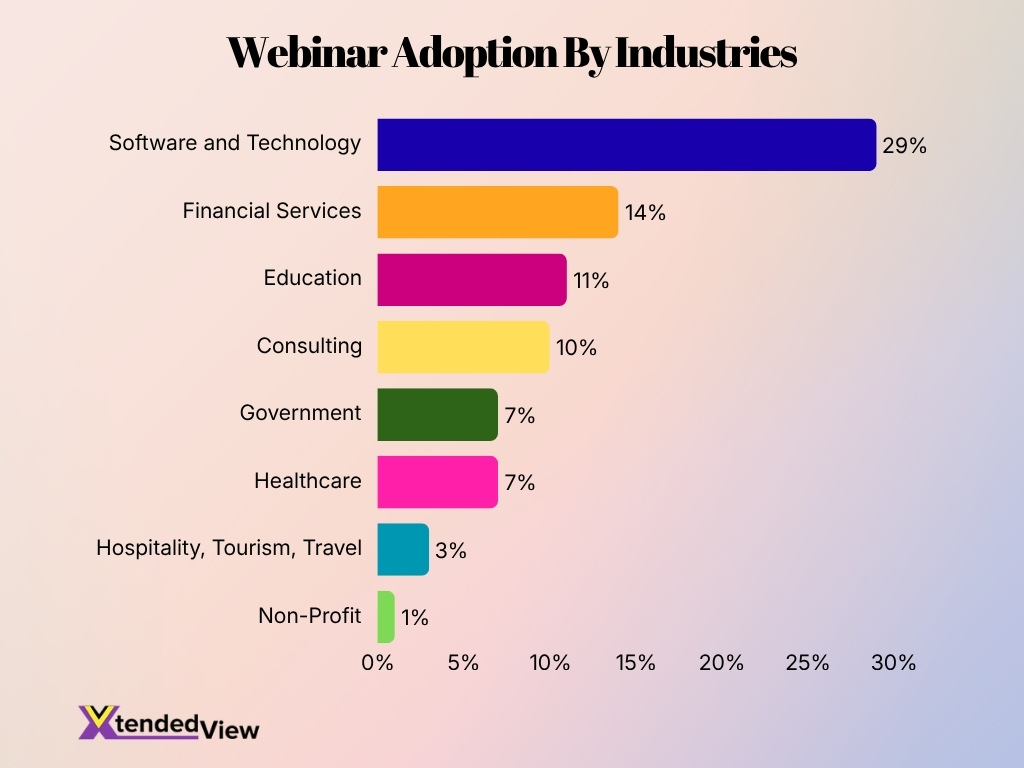
- Software and Technology leads webinar adoption with the highest share at 29%, showing that tech-focused businesses rely heavily on webinars for product demos, education, and lead generation.
- Financial Services ranks second with 14%, indicating strong webinar use for client education, market updates, compliance discussions, and financial product awareness.
- Education accounts for 11% of webinar adoption, reflecting the continued role of online sessions in learning, training, and academic engagement.
- Consulting represents 10% of webinar usage, suggesting that consultants use webinars to share expertise, build authority, and attract potential clients.
- Government and Healthcare both hold 7% adoption, showing moderate webinar usage for public communication, professional training, awareness programs, and stakeholder engagement.
- Hospitality, Tourism, and Travel has a smaller share at 3%, likely because the industry depends more on visual campaigns, direct booking platforms, and seasonal promotions.
- Non-Profit organizations show the lowest webinar adoption at just 1%, which may reflect limited budgets, smaller teams, or lower investment in webinar-based outreach.
- Overall, the data shows that webinar adoption is strongest in knowledge-driven and service-based industries, especially Software and Technology, Financial Services, Education, and Consulting.
B2B Webinar Statistics
- Around 91% of B2B professionals consider webinars their preferred format for learning and professional development.
- Nearly 73% of B2B marketers and sales leaders rank webinars as one of the best lead generation channels.
- About 75% of B2B buyers are willing to exchange contact information to access webinar content.
- Roughly 65% of B2B buyers say webinars directly influence purchasing decisions.
- B2B webinars focused on thought leadership attract 40% more registrants than purely promotional webinars.
- The average B2B webinar generates approximately 300 registrations and 120 live attendees.
- Around 58% of B2B webinar attendees watch webinar replays after the live session.
- Enterprise B2B webinars achieve average engagement times exceeding 50 minutes.
- Approximately 49% of B2B webinar marketers host webinars at least twice per month.
- Webinar-based B2B sales funnels can shorten sales cycles by up to 22% through better lead education and qualification.
Webinar Audience Demographics
- Professionals aged 25 to 44 years account for the largest share of webinar attendees globally.
- About 54% of webinar viewers attend from desktop devices, while mobile participation continues to grow yearly.
- Millennials represent nearly 48% of all webinar participants in B2B sectors.
- Roughly 73% of webinar attendees join sessions from home offices or hybrid workspaces.
- Women now account for approximately 46% of webinar registrations across professional industries.
- About 62% of webinar audiences prefer educational and skill-based content over product-centric presentations.
- Senior managers and executives represent nearly 38% of webinar attendees in B2B technology sectors.
- Around 27% of webinar participants consume webinars entirely on demand rather than attending live events.
- Global webinar participation continues expanding in Asia-Pacific, where digital learning adoption accelerated sharply after 2024.
- Accessibility features such as captions and multilingual subtitles increased average watch duration by 23% in multinational webinars.
Popular Webinar Hosting Days
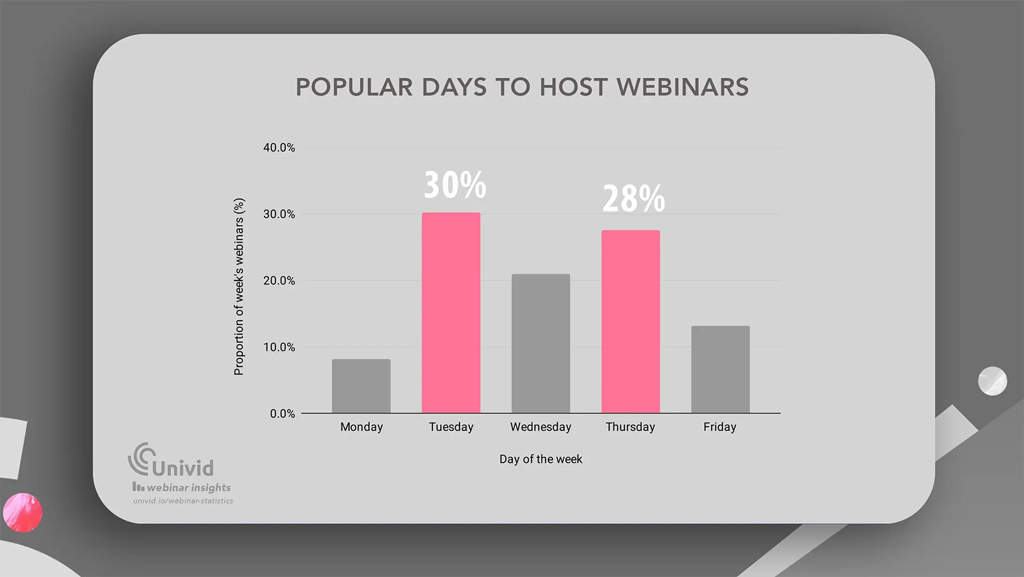
- Tuesday is the most popular day to host webinars, accounting for 30% of the week’s webinars.
- Thursday ranks second, with 28% of webinars hosted on this day, making it another strong midweek option.
- Together, Tuesday and Thursday account for 58% of all webinar hosting activity, showing that businesses strongly prefer midweek webinar scheduling.
- Wednesday captures 21% of webinar hosting, placing it in the middle range and suggesting it is still a reliable day for webinar engagement.
- Friday sees only 13% of webinar activity, indicating that webinar hosting drops as the workweek ends.
- Monday has the lowest share, with just 8% of webinars hosted, suggesting that businesses may avoid scheduling webinars at the start of the week.
- The data shows a clear preference for Tuesday, Wednesday, and Thursday, which together represent 79% of webinar hosting activity.
- For marketers and event planners, scheduling webinars on Tuesday or Thursday may improve visibility, attendance potential, and audience availability.
Webinar Attendance and No-Show Rates
- The average webinar attendance rate in 2026 stands at approximately 41.6% of registrants.
- Typical webinar no-show rates range between 35% and 45%, depending on audience intent and promotion timing.
- Reminder email sequences can improve attendance rates by 20% or more.
- Financial services webinars achieve some of the highest live attendance rates at around 44%.
- About 14% of webinar registrants sign up on the same day as the event and often show higher attendance intent.
- Webinar sessions held midweek typically produce higher attendance than Monday or Friday sessions.
- On-demand replay availability reduces the negative impact of no-shows by extending audience reach after live events.
- Around 50% of webinar engagement now happens after the live event through replay views and downloadable assets.
- Companies using SMS reminders alongside email reminders report attendance increases of approximately 7% to 12%.
- Webinar attendance rates tend to increase when sessions stay below 60 minutes and include interactive elements.
Live vs On-Demand Webinar Attendance
- Around 50% of webinar viewers now prefer on-demand rather than live sessions.
- On-demand content accounts for 42%–63% of total webinar views.
- Live webinars generate higher engagement rates, especially during Q&A and polling.
- Combining live + replay campaigns increases audience reach by up to 89% in 3 days.
- On-demand viewers consume shorter segments, averaging 20–30 minutes per session.
- Live attendees are more likely to convert into sales-qualified leads vs replay-only viewers.
- Replays published within 2 hours of event completion produce the highest post-event engagement.
- About 58% of B2B audiences watch webinar recordings after the original broadcast.
- AI-generated summaries and chapter markers boosted replay consumption in 2025–2026.
- Companies increasingly treat webinars as long-term content assets instead of one-time live events.
Webinar Attendance Rate Increases With Longer Sessions
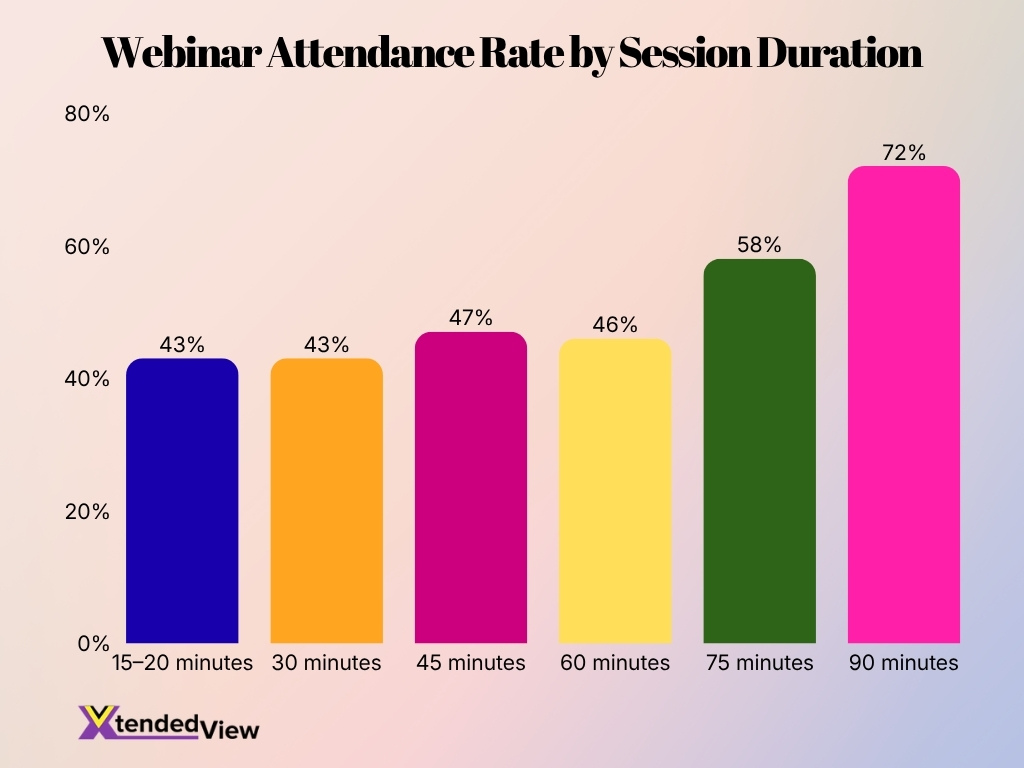
- 90-minute webinars recorded the highest attendance rate at 72%, making them the strongest-performing duration in the dataset.
- 75-minute webinars also performed well, with an attendance rate of 58%, showing a clear jump compared with shorter sessions.
- Shorter webinars of 15–20 minutes and 30 minutes had the same attendance rate of 43%, suggesting brief sessions may not always drive stronger attendance.
- 45-minute webinars achieved a 47% attendance rate, slightly higher than 30-minute webinars.
- 60-minute webinars had a 46% attendance rate, nearly the same as 45-minute sessions but lower than 75- and 90-minute webinars.
- The data suggests that long-form webinars attract better attendance, especially when sessions are 75 minutes or longer.
- Attendance rose by 29 percentage points from 43% for 15–20 minute webinars to 72% for 90-minute webinars.
- For article insight, you can mention that audiences may prefer more detailed, in-depth webinar sessions when the topic provides enough value to justify a longer time commitment.
Webinar Engagement and Interaction Statistics
- Interactive webinars that include polls, surveys, or Q&A sessions achieve up to 30% higher engagement rates than presentation-only webinars.
- The average attendee engagement time during webinars reached 51 minutes in the 2025 benchmark reports.
- Around 81% of webinar attendees say they prefer webinars that allow live audience participation.
- Webinars that include downloadable resources generate 23% more post-event interactions.
- Chat activity during live webinars increased by approximately 18% year over year between 2024 and 2025.
- About 70% of webinar attendees stay until the end when sessions include interactive features every 10 to 15 minutes.
- AI-powered personalization tools improved webinar engagement scores by up to 22% in enterprise campaigns during 2026.
- Webinars with multiple speakers achieve higher engagement than single-presenter sessions, especially in B2B industries.
- Approximately 64% of webinar attendees engage with at least one interactive element during live sessions.
- Audience engagement increases significantly when webinars include case studies, live demos, or customer success examples.
Conversion Rates From Registrants to Attendees
- The median webinar registrant-to-attendee conversion rate reached 41.6% in 2026 benchmark studies.
- Reminder email sequences can improve attendee conversion rates by up to 20%.
- Webinars scheduled midweek consistently outperform Monday and Friday events in attendee conversion rates.
- Educational webinars achieve higher attendance conversion rates than product-focused webinars.
- Around 23% of webinar registrations occur within 48 hours before the event and often convert at higher attendance rates.
- SMS reminders improve registrant attendance by approximately 7% to 12% when paired with email reminders.
- Personalized webinar landing pages improve attendance conversion rates by nearly 15%.
- Webinars shorter than 60 minutes generally achieve stronger attendance retention and attendee completion rates.
- On-demand replay access reduces overall attendee drop-off because registrants can watch sessions later.
- Registrants who engage with pre-event content are significantly more likely to attend live webinars.
Platforms Used to Drive Webinar Registrations
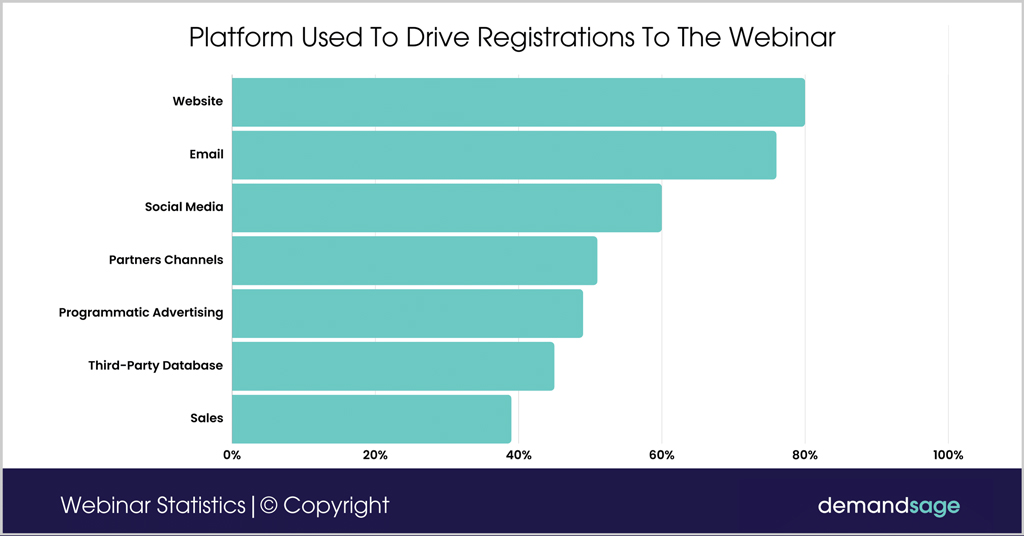
- Websites are the leading platform for driving webinar registrations, used by 80% of businesses, making them the strongest registration channel.
- Email marketing ranks second, with 76% of businesses using email to attract webinar sign-ups, showing that email remains a highly effective webinar promotion tool.
- Social media is used by 60% of businesses, making it a major channel for increasing webinar visibility and audience reach.
- Partner channels contribute to webinar registrations for 51% of businesses, highlighting the value of collaborations, co-marketing, and affiliate promotion.
- Programmatic advertising is used by 49% of businesses, showing that nearly half of companies rely on paid digital ads to promote webinars.
- Third-party databases support registrations for 45% of businesses, suggesting that external audience lists and lead databases still play a role in webinar marketing.
- Sales teams are used by 39% of businesses to drive webinar registrations, making sales outreach the least-used channel in this dataset.
- The data shows that owned channels, such as websites and email, are more widely used than paid or external channels for webinar registrations.
- Businesses appear to prefer multi-channel promotion, combining websites, email, social media, partner channels, and paid advertising to maximize webinar sign-ups.
- The gap between the top and bottom channels is significant, with websites at 80% and sales outreach at 39%, showing a 41 percentage-point difference in platform usage.
Conversion Rates From Attendees to Customers
- Webinar attendees convert into customers at rates between 5% and 20%, depending on industry and funnel structure.
- Businesses using webinars for SaaS product demos report attendee-to-customer conversion rates exceeding 20% in high-intent campaigns.
- Webinar attendees who participate in polls or Q&A sessions are 30% more likely to convert into paying customers.
- About 73% of B2B marketers believe webinars generate higher-quality sales opportunities than most inbound channels.
- Educational webinars focused on problem-solving produce higher conversion rates than purely promotional sessions.
- Webinar funnels that include post-event follow-up emails improve customer conversion rates by approximately 25%.
- Around 61% of webinar marketers use webinars primarily to nurture leads before sales outreach.
- Webinar attendees who consume replay content remain highly valuable because they often engage later in the buying cycle.
- Multi-session webinar series convert more effectively than one-off webinars because they build stronger audience trust.
- AI-driven lead scoring tools increasingly help sales teams identify webinar attendees with the highest purchase intent.
Webinar ROI and Cost-Per-Lead Statistics
- Webinar campaigns generate 200%–1,200% ROI, especially in B2B technology and SaaS sectors.
- The average webinar lead costs approximately $72, lower than many paid acquisition channels.
- Around 73% of marketers say webinars are among the most cost-effective lead generation channels.
- Content repurposing boosts webinar ROI by reusing sessions for blogs, clips, and gated assets.
- Automating webinar follow-ups increases pipeline efficiency while reducing operational costs.
- Webinar-generated leads move 22% faster through sales pipelines than traditional inbound channels.
- On-demand webinars keep generating leads long after live broadcasts, improving long-term ROI.
- Companies swapping some in-person events for webinars cut event costs significantly in 2025–2026.
- Educational webinar series drives stronger retention and higher customer lifetime value.
- Businesses use webinar analytics dashboards to track engagement, conversion, and ROI in real time.
Webinar Registrations Peak in the Final Week
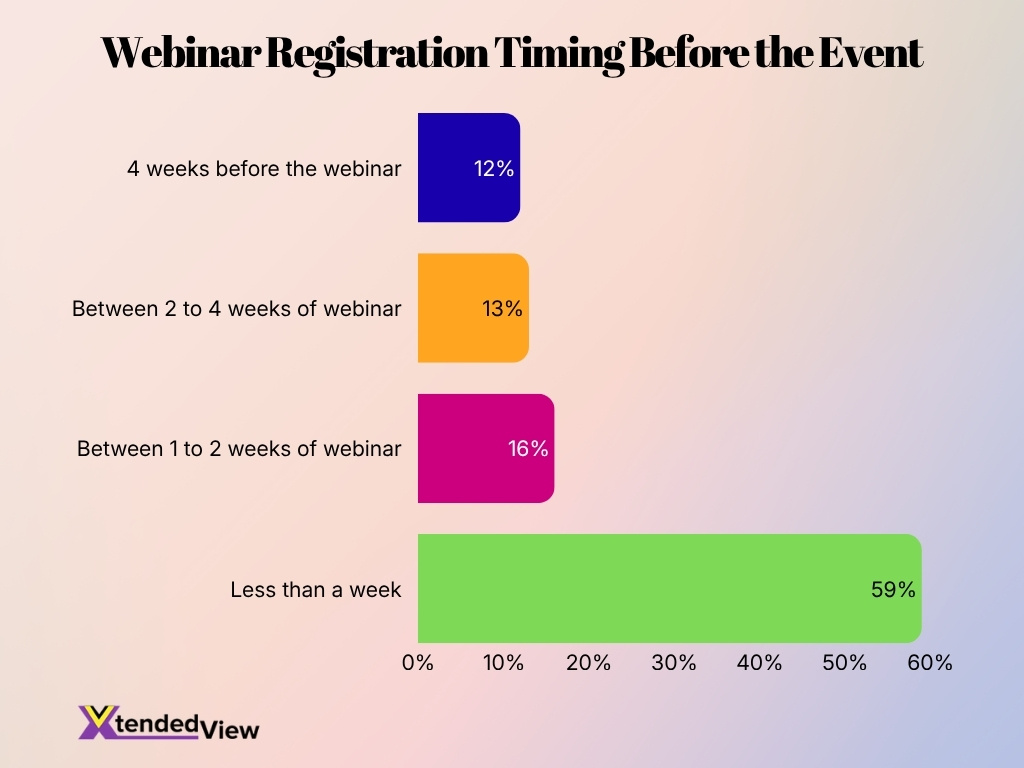
- The majority of webinar registrations happen less than a week before the webinar, accounting for 59% of total registrations.
- Early registrations remain relatively low, with only 12% of participants registering 4 weeks before the webinar.
- Registrations between 2 to 4 weeks before the webinar make up 13%, showing only a slight increase from the earliest stage.
- Around 16% of registrations occur 1 to 2 weeks before the webinar, indicating that interest starts building closer to the event date.
- The data shows that last-minute registrations dominate, with the final week generating nearly 6 in 10 webinar sign-ups.
- Marketers should focus heavily on last week’s promotional campaigns, as this period delivers the highest registration volume.
- Email reminders, retargeting ads, social media posts, and urgency-based messaging can be most effective during the final 7 days before the webinar.
- Since only 41% of registrations happen before the final week, webinar promotion should continue consistently until the event date rather than slowing down early.
Future Trends and Predictions for Webinars
- 98% of marketers plan to enhance webinars with AI in 2025, making automation a standard enterprise feature.
- The webinar software market is growing at a 12.68% CAGR, projected to more than triple over the next decade.
- Personalized webinar experiences drive 30% higher conversion rates for engaged attendees.
- 80% of attendees prefer hybrid webinar formats combining live events with on-demand access.
- Asia-Pacific holds 20% of the global webinar share and is the fastest-growing region through 2035.
- AI-generated transcription usage grew 8x among B2B webinar teams in 2025, improving accessibility.
- 73% of B2B marketers say webinars deliver the highest-quality leads, driving CRM integration.
- Interactive formats with breakout rooms and polls increase engagement by up to 140% in enterprise settings.
Frequently Asked Questions (FAQs)
The average live webinar attendance rate in 2026 ranges between 44% and 50% of total registrants.
The global webinar market is projected to reach $134.2 billion by 2032, growing at a 13.9% CAGR.
The average webinar cost per lead is approximately $72.
Email marketing drives around 57% to 76% of webinar registrations globally.
More than 60 million webinars are expected to be hosted worldwide in 2026.
Conclusion
Webinars continue to evolve into one of the most effective digital communication and lead generation channels. Businesses across technology, healthcare, finance, education, and professional services increasingly rely on webinars to educate audiences, generate qualified leads, and strengthen customer relationships. At the same time, AI-powered automation, personalized experiences, and hybrid viewing options continue to reshape how organizations deliver virtual events.
The latest webinar statistics show that engagement, accessibility, and replay consumption now play a major role in webinar success. Companies that combine interactive content, strong promotion strategies, and data-driven follow-up workflows consistently achieve stronger attendance, conversion, and ROI results. As webinar platforms continue expanding their AI and analytics capabilities, webinars are expected to remain a core component of modern digital marketing and online learning strategies for years ahead.
