


Smart glasses have moved beyond niche tech experiments and into mainstream consumer and enterprise markets. Companies now use them in healthcare, warehouse logistics, remote collaboration, and manufacturing, while consumers increasingly adopt AI-powered glasses for navigation, translation, entertainment, and fitness tracking. The rapid rise of augmented reality, AI assistants, and wearable computing continues to reshape how users interact with digital content in real time.
This article explores the latest smart glasses statistics, covering market growth, revenue trends, adoption patterns, and emerging developments shaping the industry.
Editor’s Choice
- The global smart glasses market reached $2.46 billion in 2025 and is projected to hit $3.16 billion in 2026.
- Smart glasses revenue is forecast to grow at a 24.2% CAGR between 2026 and 2033.
- North America accounted for more than 36% of global smart glasses revenue in 2025.
- Global AR glasses revenue stood at $1.84 billion in 2025 and could surpass $35.1 billion by 2033.
- Unit shipments of smart glasses jumped from 230,000 in 2017 to 32.7 million in 2022.
- AI smart glasses generated approximately $540 million in global revenue in 2025.
- India’s smart glasses market is expected to grow at a 29.3% CAGR through 2033, making it one of the fastest-growing regions globally.
- The audio smart glasses segment captured more than 28% of total market revenue in 2025.
- Bluetooth-enabled smart glasses represented over 52% of the total connectivity market share in 2025.
- Nearly 49% of surgeons believe smart glasses can reduce operating-room complications caused by human error.
Recent Developments
- In 2025, Meta expanded its AI-powered Ray-Ban smart glasses lineup with enhanced voice assistance and live translation capabilities.
- Google renewed its investment in wearable AR platforms after increasing partnerships tied to Android XR ecosystems in 2025.
- Several enterprise manufacturers integrated AI vision systems into smart glasses for warehouse picking and industrial inspection in 2025.
- The immersive smart glasses category became the fastest-growing segment in India entering 2026.
- Lightweight waveguide optics and MicroOLED displays improved battery efficiency and visual clarity across new smart glasses releases in 2025.
- AI-enabled real-time translation became one of the most requested consumer features in premium smart eyewear products during 2025.
- Enterprise demand for hands-free collaboration tools accelerated due to remote maintenance and hybrid work environments.
- Healthcare providers increasingly adopted AR glasses for surgery visualization and patient imaging access during procedures.
- China and the broader Asia-Pacific region recorded some of the fastest smart glasses manufacturing expansion rates entering 2026.
- AI processors and computer vision chips became critical hardware differentiators among premium smart glasses brands in 2025.
Overview of Smart Glasses and Key Statistics
- Smart glasses combine wearable computing with AR, AI, sensors, microphones, and display technologies to provide real-time digital overlays.
- The industry spans consumer, industrial, healthcare, logistics, military, and education applications.
- Android-powered smart glasses held more than 48% market share among operating systems in 2025.
- Industrial applications represented over 27% of smart glasses revenue in 2025.
- Bluetooth remained the dominant connectivity standard with more than 52% market share in 2025.
- The U.S. represented more than 88% of North American smart glasses revenue in 2025.
- Smart glasses increasingly support AI-based contextual awareness, voice assistants, and object recognition features.
- AR-enabled smart eyewear has become a key component of broader spatial computing ecosystems.
- Audio smart glasses emerged as the largest product category due to strong consumer demand for hands-free communication and entertainment.
- The smart glasses market now overlaps heavily with the XR and wearable technology sectors, including AR, VR, and mixed reality devices.
Global Smart Glasses Market Size and Growth
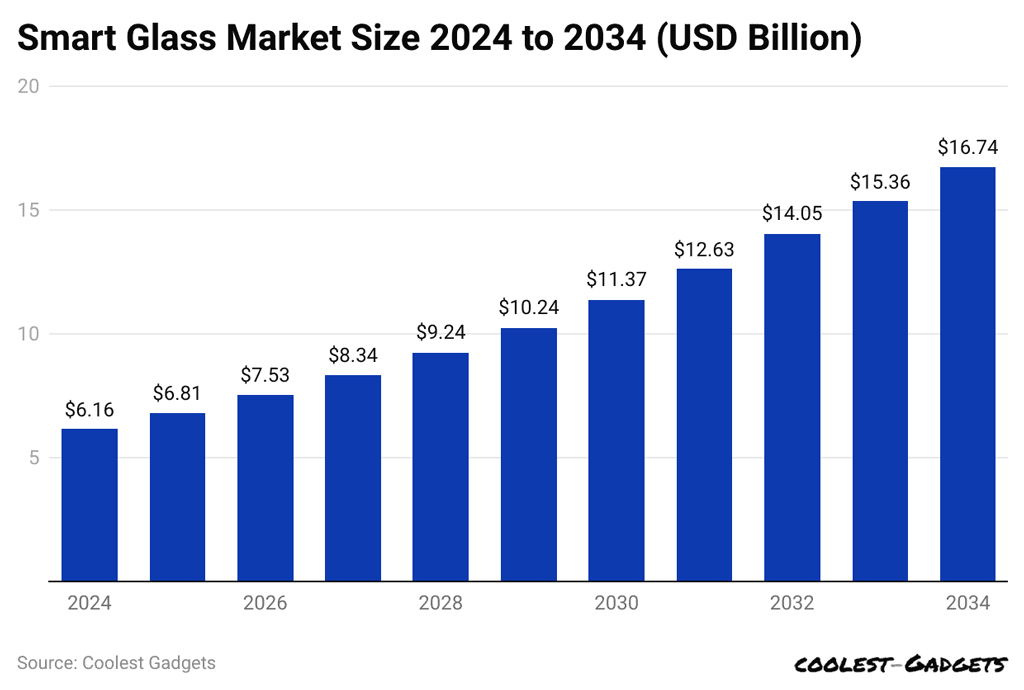
- The global smart glass market is projected to grow from $6.16 billion in 2024 to $16.74 billion by 2034.
- Between 2024 and 2034, the market is expected to add around $10.58 billion in value.
- The market size is forecast to be nearly 2.7 times larger by 2034 compared with 2024.
- Smart glass market revenue is expected to cross the $10 billion mark in 2029, reaching $10.24 billion.
- The market shows consistent year-over-year growth, rising from $6.81 billion in 2025 to $7.53 billion in 2026.
- By 2030, the smart glass market is projected to reach $11.37 billion, showing strong mid-decade momentum.
- The market is expected to surpass $14 billion in 2032, reaching $14.05 billion.
- From 2032 to 2034, the market is forecast to increase from $14.05 billion to $16.74 billion, adding $2.69 billion in just two years.
- The steady rise suggests growing adoption of smart glass across sectors such as construction, automotive, healthcare, retail, and energy-efficient buildings.
- The data indicates that smart glass demand will continue expanding as businesses and consumers increasingly prioritize energy savings, privacy control, and modern building technologies.
Smart Glasses Revenue Growth by Year
- Smart glasses revenue surpassed $1 billion globally in 2025, according to multiple industry trackers.
- Revenue is expected to climb by nearly 28% year over year between 2025 and 2026.
- The AR glasses segment alone is forecast to grow from $1.84 billion in 2025 to $2.49 billion in 2026.
- AI smart glasses revenue could increase from $540 million in 2025 to $720 million in 2026.
- Industry analysts project AI smart glasses revenue could exceed $3.4 billion by 2034.
- Smart glasses shipments and recurring software ecosystems increasingly contribute to long-term revenue streams.
- Subscription-based AI assistant services are expected to become a growing monetization channel after 2026.
- Enterprise software integration remains one of the highest-margin revenue segments for smart glasses vendors.
- Consumer entertainment, navigation, and fitness applications continue expanding recurring revenue opportunities.
- Hardware improvements in displays and battery systems contributed to higher average selling prices during 2025.
Smart Glasses Share Within the XR and Wearables Market
- Smart glasses accounted for roughly 11% of the global XR hardware market in 2025.
- Wearable technology revenue surpassed $186 billion globally in 2025, with smart glasses emerging as one of the fastest-growing categories.
- AR smart glasses represented more than 35% of enterprise XR deployments in 2025.
- Audio-enabled smart glasses held approximately 28% share of the broader smart eyewear market.
- Smart glasses adoption within industrial wearable ecosystems increased by nearly 31% year over year during 2025.
- The XR industry generated over $45 billion in total hardware and software revenue in 2025, with smart glasses contributing a growing percentage.
- Enterprise AR glasses deployments expanded rapidly in logistics, field services, and manufacturing sectors.
- Smart eyewear captured a larger share of wearable AI device launches than smart rings or AI pins during 2025.
- Bluetooth-enabled smart glasses represented more than 52% of wearable smart eyewear connectivity share in 2025.
- Analysts project smart glasses could account for nearly 20% of XR hardware shipments by 2030.
Smart Glasses Shipments and Unit Sales Over Time
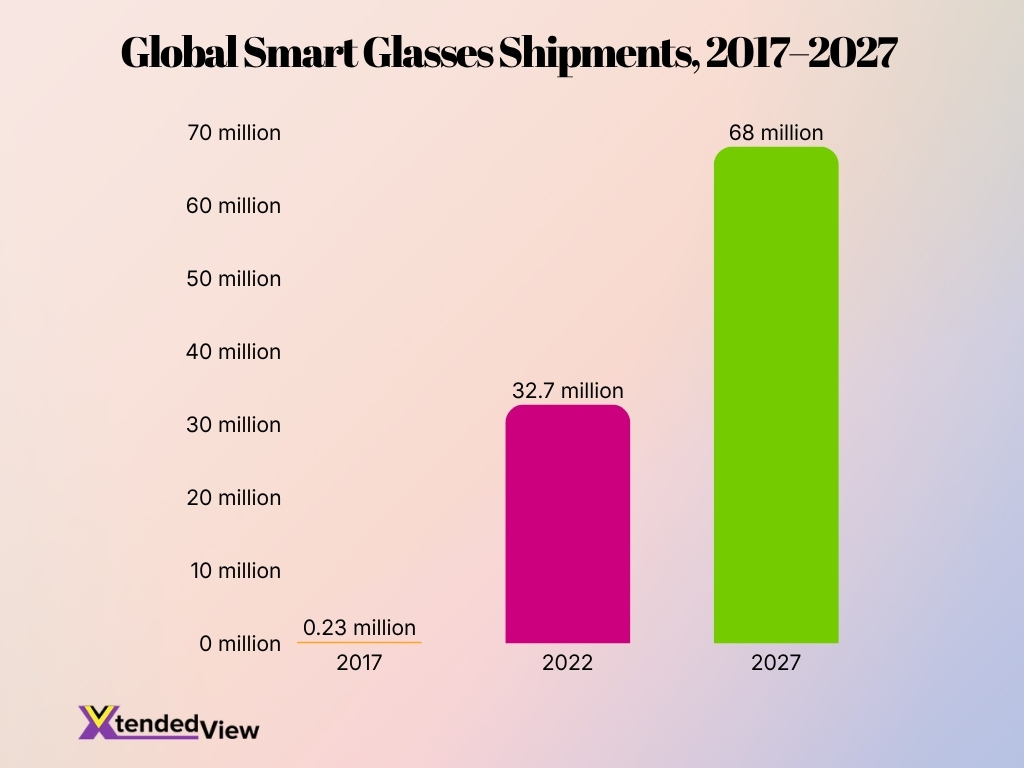
- Global smart glasses shipments increased from 230,000 units in 2017 to 32.7 million units by 2022.
- Industry forecasts suggest annual smart glasses shipments could exceed 68 million units by 2027.
- Consumer smart glasses represented more than 60% of total shipments in 2025.
- Meta’s Ray-Ban smart glasses reportedly surpassed 2 million cumulative unit sales entering 2026.
- Enterprise-focused smart glasses shipments grew by approximately 39% year over year in 2025.
- Asia-Pacific contributed nearly 44% of global smart glasses manufacturing volume during 2025.
- Smart glasses with AI-enabled voice assistants recorded the fastest shipment growth rate in 2025.
- North America remained the largest consumer market for premium smart eyewear devices in 2025.
- Prescription-compatible smart glasses shipments rose significantly as brands partnered with eyewear retailers and optical chains.
- Analysts expect mixed reality smart glasses shipments to expand rapidly after 2026 as spatial computing adoption increases.
Adoption Rates and User Penetration of Smart Glasses
- Approximately 14% of U.S. consumers expressed interest in purchasing smart glasses during 2025.
- Smart glasses penetration among enterprise users increased by nearly 27% globally in 2025.
- Around 39% of surveyed consumers viewed AI functionality as the primary reason to purchase smart glasses.
- Younger consumers between the ages of 18 and 34 represented the highest smart glasses adoption segment in 2025.
- Enterprise adoption in logistics and warehousing increased due to hands-free workflow optimization tools.
- Nearly 48% of technology professionals believe AR smart glasses will become mainstream within five years.
- Smart glasses usage among healthcare organizations increased substantially for remote consultation and surgery support.
- Consumer adoption remained strongest in urban regions with high wearable technology usage rates.
- AI-powered translation and navigation features drove higher adoption among international travelers in 2025.
- Smart glasses penetration remains lower than smartwatches, but growth rates continue to outpace most wearable categories.
Smart Glasses User Demographics
- Consumers aged 18 to 34 accounted for more than 46% of smart glasses buyers in 2025.
- Male consumers represented approximately 58% of smart glasses users globally in 2025.
- Millennials and Gen Z users showed the strongest interest in AI-enabled wearable devices.
- More than 41% of smart glasses users reported using the devices primarily for entertainment and media consumption.
- Enterprise smart glasses users largely came from the manufacturing, logistics, and healthcare industries.
- Consumers with annual household incomes above $75,000 demonstrated significantly higher adoption rates.
- Urban consumers adopted smart glasses faster than suburban and rural populations due to stronger tech infrastructure and retail access.
- Students and education professionals increasingly adopted AR smart glasses for immersive learning applications during 2025.
- Prescription lens compatibility became an important purchasing factor among users older than 35.
- Consumer surveys showed privacy concerns remained higher among older demographics compared to younger users.
Smart Glasses Market Share by Region
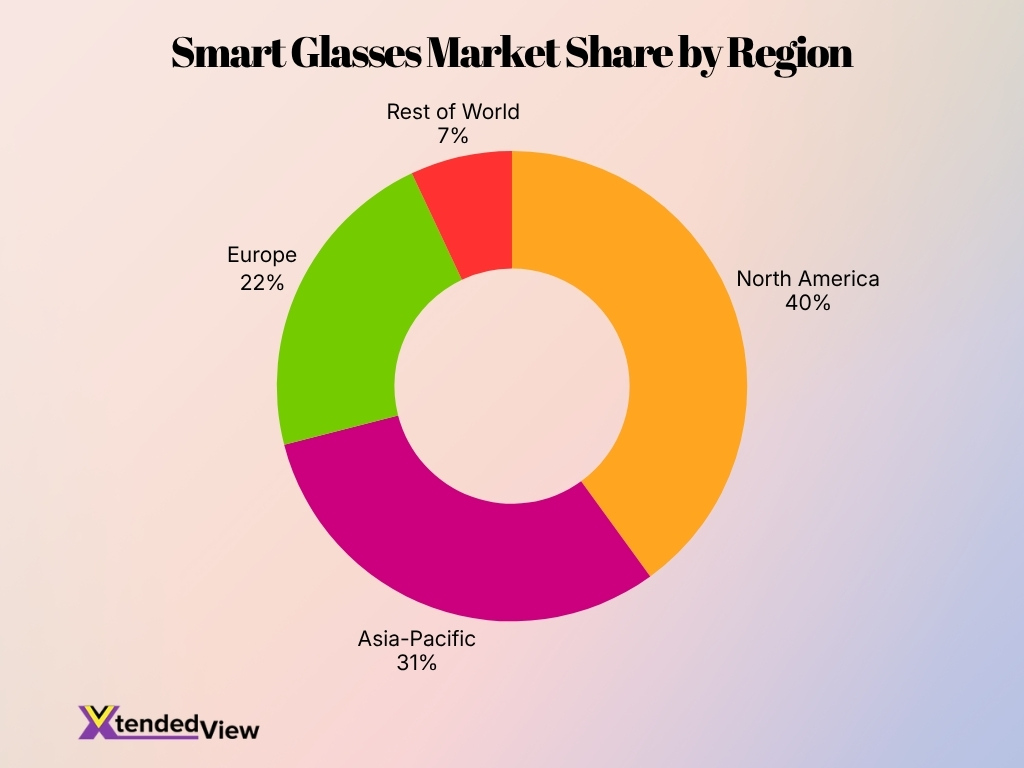
- North America leads the smart glasses market with the highest regional share of 40%, showing strong demand for wearable technology and AR-enabled devices.
- Asia-Pacific holds the second-largest share at 31%, driven by rapid technology adoption, consumer electronics growth, and expanding smart device ecosystems.
- Europe accounts for 22% of the market, reflecting steady adoption across enterprise, healthcare, manufacturing, and consumer use cases.
- The Rest of the World represents 7% of the market, indicating an emerging but smaller adoption base compared to major developed regions.
- Together, North America and Asia-Pacific make up 71% of the global smart glasses market, highlighting these two regions as the key growth centers.
- The data shows that the smart glasses market is currently concentrated in technologically advanced and high-consumption regions.
- The lower share of 7% for the Rest of the World suggests significant future growth potential as affordability, connectivity, and awareness improve.
AR Smart Glasses Market Size and Adoption Statistics
- The global AR smart glasses market reached approximately $1.84 billion in 2025.
- AR smart glasses revenue is expected to rise to $2.49 billion in 2026.
- Analysts project the AR smart glasses market could exceed $35.1 billion by 2033.
- Enterprise AR applications represented more than 60% of AR smart glasses deployments during 2025.
- Manufacturing and logistics remained the largest AR smart glasses adoption sectors globally.
- More than 42% of enterprise organizations using AR wearables reported measurable productivity improvements.
- Healthcare providers increasingly adopted AR glasses for surgical assistance and real-time diagnostics visualization.
- AR smart glasses equipped with AI assistants became one of the fastest-growing wearable categories entering 2026.
- North America led global AR smart glasses revenue generation in 2025.
- Asia-Pacific recorded the fastest AR adoption growth due to manufacturing expansion and consumer demand.
VR and Mixed Reality Smart Glasses Statistics
- The global mixed reality market exceeded $8 billion in 2025, supported by smart glasses and immersive headset adoption.
- VR and mixed reality smart glasses shipments increased by approximately 29% year over year during 2025.
- Enterprise training applications represented nearly 34% of mixed reality deployments globally.
- Gaming remained one of the top consumer use cases for VR smart eyewear products.
- Mixed reality smart glasses adoption in healthcare expanded rapidly for simulation and surgical training.
- More than 50% of XR developers focused on mixed reality software compatibility in 2025.
- Lightweight mixed reality smart glasses became increasingly popular in industrial maintenance and remote collaboration tasks.
- Consumer demand for immersive entertainment applications helped drive higher VR smart glasses sales entering 2026.
- Educational institutions expanded VR and MR pilot programs for immersive learning environments in 2025.
- Analysts expect mixed reality smart eyewear to become a central category in spatial computing ecosystems by 2030.
Smart Glasses Revenue by Technology Highlights
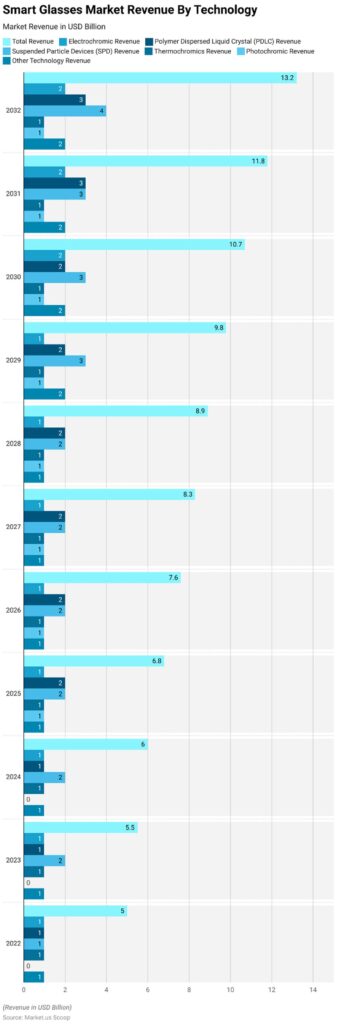
- The global smart glasses market revenue is projected to rise from $5.0 billion in 2022 to $13.2 billion by 2032.
- Total market revenue is expected to more than double over the forecast period, showing strong long-term demand for smart glasses technologies.
- Suspended Particle Devices (SPD) show one of the strongest technology-level gains, increasing from $1 billion in 2022 to $4 billion by 2032.
- Polymer Dispersed Liquid Crystal (PDLC) revenue is expected to grow from $1 billion in 2022 to $3 billion by 2032.
- Electrochromic technology maintains steady growth, reaching $2 billion by 2030 and remaining at that level through 2032.
- Photochromic revenue remains comparatively smaller, staying at $0 billion from 2022 to 2024 before rising to $1 billion from 2025 onward.
- Thermochromics’ revenue stays stable at around $1 billion throughout the entire period from 2022 to 2032.
- Other technology revenue gradually increases from $1 billion in 2022 to $2 billion by 2029, remaining steady through 2032.
- The market shows consistent year-over-year expansion, with total revenue rising from $6.0 billion in 2024 to $8.9 billion in 2028.
- By 2032, SPD and PDLC technologies are expected to be the largest individual technology contributors after total market revenue, with $4 billion and $3 billion, respectively.
Consumer vs Enterprise Smart Glasses Adoption Statistics
- Enterprise applications represented 52%+ of the smart glasses market revenue in 2025.
- Consumer smart glasses shipments outpaced enterprise unit sales in H1 2025, with AI-enabled models making up 78% of total shipments.
- In 2025, the global smart glasses market was valued at $2.46 billion, showing strong demand across both segments.
- Healthcare smart glasses applications were projected at $171.6 million in 2025, driven by surgery, diagnostics, and telemedicine.
- Logistics use cases improved picking speed by 25% in DHL pilots and by 40% in AR warehouse systems.
- Consumer smart glasses prices fell 32% between 2023 and 2025, pushing more products into the sub-$500 range.
- Analysts forecast smart glasses shipments to reach 112 million by 2030, with revenue climbing toward $40 billion.
- Consumer AR smart glasses shipments are forecast to rise from 850,000 units in 2024 to about 32 million by 2030.
- Enterprise deployments remain the main growth engine, with manufacturing, logistics, healthcare, and field service leading adoption in 2025.
AI Smart Glasses Market Size and Growth Statistics
- The AI smart glasses market generated around $540 million in global revenue during 2025.
- Industry forecasts suggest AI smart glasses revenue could reach $720 million in 2026.
- AI-powered smart eyewear is projected to exceed $3.4 billion by 2034.
- Real-time translation and voice assistance became the most requested AI smart glasses features in 2025.
- More than 39% of consumers interested in smart glasses cited AI functionality as the main purchase driver.
- AI-enhanced image recognition systems improved enterprise productivity across logistics and warehousing operations.
- Smart glasses integrated with generative AI assistants experienced significantly higher engagement rates during pilot testing.
- AI chips optimized for wearable devices improved battery performance and response speeds in 2025 smart glasses models.
- AI-powered contextual awareness became a key competitive differentiator among premium wearable brands.
- Enterprise investment in AI-enabled wearable computing accelerated due to automation and workflow optimization trends.
AI Features in Smart Glasses
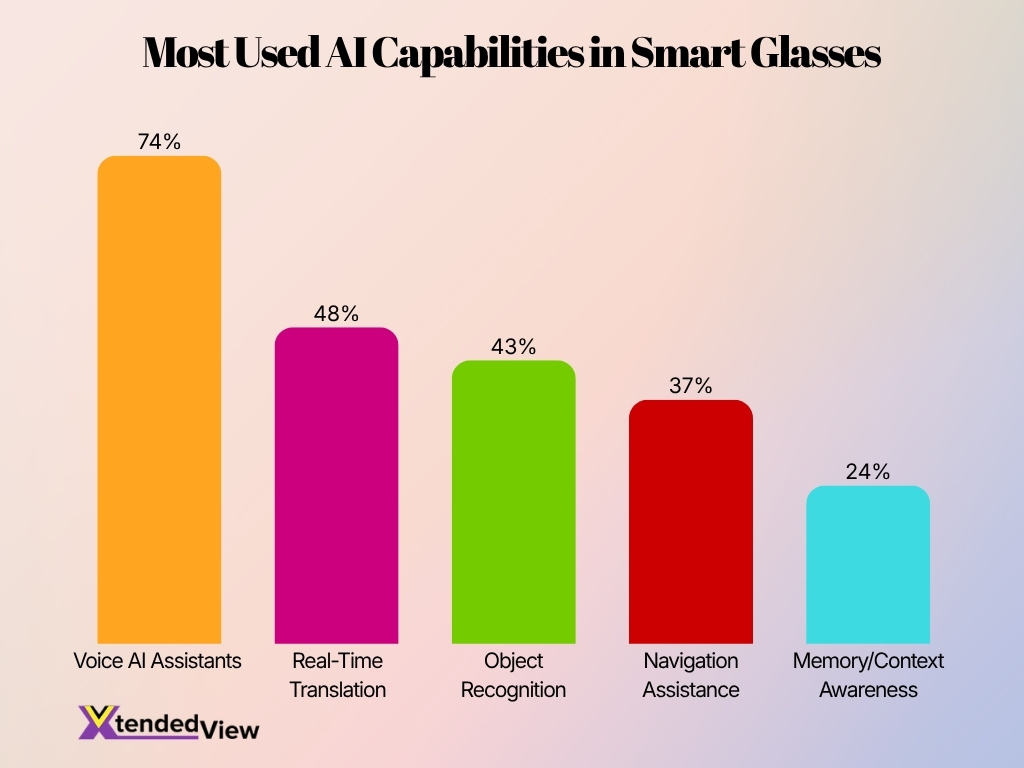
- Voice AI Assistants are the most widely adopted AI feature in smart glasses, with 74% adoption, showing that hands-free interaction is the strongest use case.
- Real-Time Translation ranks second at 48%, highlighting strong demand for smart glasses as travel, business, and communication tools.
- Object Recognition has 43% adoption, making it an important feature for visual assistance, accessibility, retail, logistics, and daily object identification.
- Navigation Assistance is used by 37% of adopters, showing that smart glasses are increasingly being positioned as wearable guidance devices.
- Memory/Context Awareness has the lowest adoption at 24%, suggesting that advanced personalized AI features are still emerging.
- The gap between Voice AI Assistants at 74% and Memory/Context Awareness at 24% shows a 50 percentage-point difference, indicating that basic AI interaction features are much more mature than context-aware intelligence.
- Overall, the data shows that smart glasses adoption is currently driven more by practical, everyday AI features such as voice control, translation, and object recognition.
- The strong adoption of AI assistants and translation tools suggests that smart glasses are moving beyond display-based wearables and becoming AI-powered personal productivity devices.
Smart Glasses Statistics by Technology and Features
- Bluetooth‑enabled smart glasses captured over 52% of the global connectivity‑technology market share in 2025.
- Audio smart glasses contributed approximately 28% of total global smart glasses revenue in 2025.
- MicroOLED‑based displays accounted for roughly 15–18% of the smart glasses microdisplay market by 2025.
- Waveguide‑based optics were integrated into over 30% of new enterprise‑grade smart glasses models launched in 2025.
- More than 45% of premium consumer smart glasses shipped in 2025 included on‑device AI voice assistants.
- Gesture control and eye‑tracking features were present in nearly 25% of enterprise AR smart glasses systems in 2025.
- Smart glasses with prescription‑lens compatibility outsold non‑compatible models by more than 35% in consumer‑focused markets in 2025.
- Battery life in mainstream smart glasses averaged around 4–6 hours under continuous connected use in 2025.
- Cloud‑connected smart glasses represented over 40% of deployments in enterprise field‑service and logistics environments by 2025.
- AI‑powered object recognition and live translation features were included in about 30% of new AI‑enabled smart glasses launched in 2025.
Healthcare and Medical Smart Glasses Adoption Statistics
- Nearly 49% of surgeons believe AR smart glasses can reduce surgical complications caused by human error.
- Healthcare became one of the fastest‑growing enterprise smart glasses segments, capturing over 30% of global enterprise XR pilots in 2025.
- The global medical smart glasses market was valued at about $2.2 billion in 2025 and is projected to exceed $9.7 billion by 2035, growing at a CAGR of around 15.8%.
- Around 40% of hospitals in North America are expected to integrate smart glasses for surgical guidance and remote monitoring by 2025.
- Use of AR‑assisted smart glasses in surgery has been linked to up to 27% higher precision and up to 29% shorter procedure times in AI‑augmented trials.
- More than 30% of healthcare XR pilots globally involved wearable smart glasses systems in 2025, mainly in telemedicine, surgical training, and remote consultations.
- Approximately 34% of hospitals in the U.S. and Europe piloted AI‑powered smart glasses for telemedicine and patient monitoring in 2024.
- Medical training programs using mixed‑reality smart glasses reported up to 48% improvement in trainees’ procedure accuracy versus traditional methods.
- Emergency‑response teams using smart eyewear recorded roughly 35% faster communication cycles among healthcare professionals during critical incidents.
- Analysts forecast that healthcare smart glasses deployments will grow at over 15% CAGR through 2030, driven by telehealth expansion and AI‑augmented surgery tools.
Leading Smart Glasses Brands and Market Share Statistics
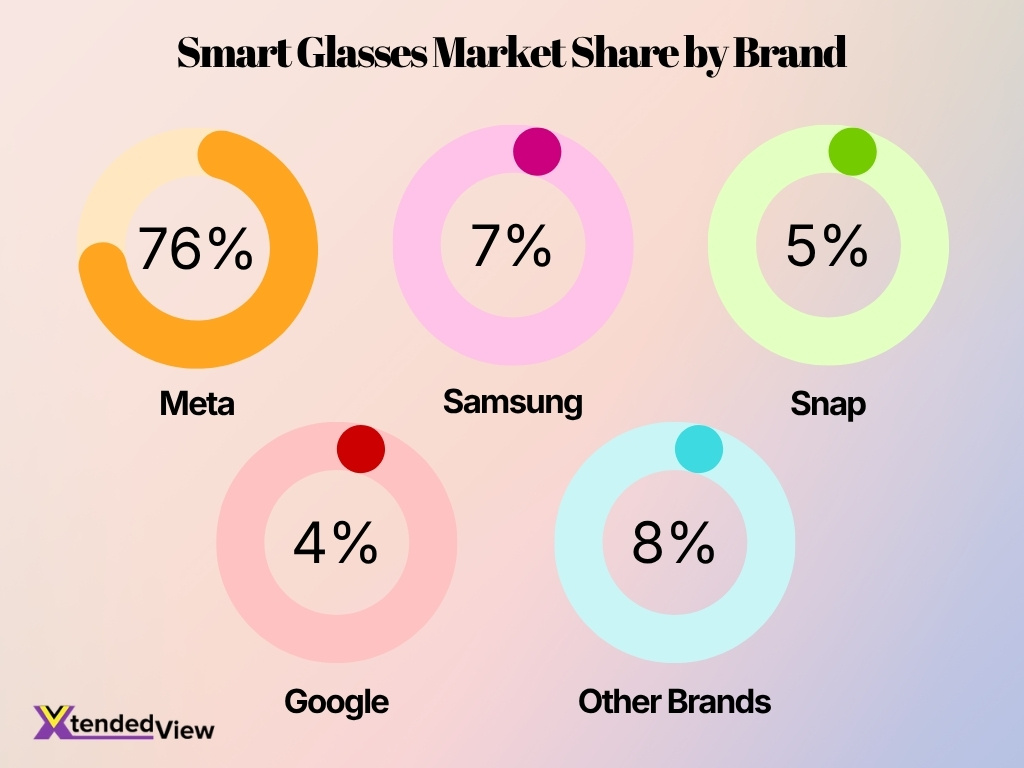
- Meta dominates the smart glasses market with an estimated 76% share, making it the clear leader among all listed brands.
- Samsung holds the second-largest share at 7%, but it remains far behind Meta’s market position.
- Other Brands collectively account for 8%, showing that smaller players still have a minor but visible presence in the smart glasses market.
- Snap captures 5% of the market, reflecting its niche position in the smart glasses segment.
- Google accounts for 4%, the lowest share among the named brands in this dataset.
- The data shows a highly concentrated market, where one brand, Meta, controls more than three-fourths of the total estimated share.
- Combined, Samsung, Snap, and Google hold only 16%, highlighting how difficult it is for competitors to challenge Meta’s lead.
- The gap between Meta at 76% and Samsung at 7% is 69 percentage points, showing a major imbalance in brand-level market share.
Safety, Privacy, and User Concern Statistics for Smart Glasses
- Privacy concerns represent the primary barrier for 70% of potential adopters regarding mainstream smart glasses usage.
- Approximately 47% of surveyed consumers identified always-on cameras as their top data privacy fear.
- Over 7 million pairs of AI-powered smart glasses were sold in 2025 despite ongoing surveillance anxieties.
- Roughly 44% of wearable users actively track sensitive heart rate data, intensifying demands for stricter privacy policies.
- Enterprises increased cybersecurity spending by 25% in 2025 to mitigate data breach risks from wearable devices.
- Nearly 35% of potential buyers would accelerate adoption rates if manufacturers guaranteed on-device data processing.
- Legal scrutiny surrounding biometric data under GDPR and CCPA reached record levels globally throughout 2025.
- Over 60% of consumers stated they prioritize transparent data storage when selecting wearable brands.
Frequently Asked Questions (FAQs)
The global smart glasses market was valued at approximately $2.46 billion in 2025.
The smart glasses market is projected to grow at a 24.2% CAGR from 2026 to 2033.
Worldwide smart glasses and XR-related device shipments are forecast to reach around 14.3 million units in 2025.
Meta captured approximately 73% of global smart glasses sales in the first half of 2025.
The AI smart glasses market is projected to reach around $4.59 billion by 2035.
Conclusion
Smart glasses have evolved from experimental gadgets into a rapidly growing category within the global wearable and XR markets. Enterprise adoption continues to accelerate across manufacturing, healthcare, logistics, and remote collaboration, while consumer demand increasingly centers on AI-powered features such as live translation, voice assistance, navigation, and immersive entertainment. At the same time, advances in MicroOLED displays, waveguide optics, and lightweight battery systems are improving usability and driving broader adoption.
Looking ahead, the smart glasses market appears positioned for sustained expansion through 2030 and beyond. AI integration, spatial computing ecosystems, and enterprise productivity applications will likely remain the primary growth drivers. However, privacy concerns, device affordability, and battery limitations still present challenges that manufacturers must address to achieve mainstream adoption at scale.
