



Gaming monitors have evolved from a specialist PC accessory into one of the most important segments of the desktop display market. Competitive gamers increasingly rely on high-refresh-rate monitors for smoother motion, faster visual feedback, and more responsive gameplay, while mainstream and enthusiast users are moving toward QHD, 4K, and OLED displays for sharper images, stronger contrast, and better HDR performance. This shift is also influencing product development, panel manufacturing, pricing, and retail strategies across the wider display industry. The following Gaming Monitor Statistics highlight how shipment growth, resolution preferences, refresh rates, panel technologies, pricing, and regional demand are reshaping the market.
Editor’s Choice
- Gaming monitor manufacturers shipped 41 million units worldwide in 2025, a 50.2% jump from 2024, making gaming one of the fastest-growing parts of the desktop monitor business.
- Gaming models represented 31.1% of worldwide desktop monitor shipments in 2025. In other words, nearly one in three monitors shipped during the year fell into the gaming category under the tracking methodology used.
- By Q4 2025, gaming monitor shipments had increased for 11 consecutive quarters, and quarterly volume reached the highest point recorded since category tracking began.
- One 2026 industry estimate valued the gaming monitor market at $8.54 billion in 2025 and projects it to reach $12.79 billion by 2032, equivalent to a 5.79% compound annual growth rate.
- Under that same estimate, the five largest vendors generated about 64% of gaming monitor revenue in 2025, pointing to a relatively concentrated competitive market.
- OLED monitor shipments reached 2.735 million units in 2025, rising 92% year over year as gaming brands widened their product ranges and promotions accelerated demand.
- OLED penetration across the overall monitor market reached 2.1% in 2025 and is forecast to reach 5.4% by 2028, showing substantial headroom for premium gaming-display adoption.
Recent Developments
- Global OLED monitor shipments increased 26.1% quarter over quarter in Q2 2026 and rose 98% from Q2 2025, making OLED one of the clearest growth areas in the gaming-display ecosystem.
- ASUS held 23.1% of global OLED monitor shipments in Q2 2026, keeping the top position as demand from China’s midyear retail promotions and gaming cafés supported sales.
- Samsung ranked second in Q2 2026 with 13.1%, while MSI followed at 12.8%. Only 0.3 percentage points separated the two brands.
- AOC captured 8.6% of Q2 2026 OLED monitor shipments, helped by an expanded lineup focused particularly on 27-inch QHD products.
- LG Electronics held 8.4% of Q2 2026 OLED shipments, with increased volume from its 39-inch WUHD product contributing to quarterly growth.
- OLED monitor panel shipments are forecast at 4.7 million units in 2026, representing 38.7% year-over-year growth after another strong expansion year in 2025.
- Samsung Display shipped about 2.6 million OLED monitor panels in 2025, up 82.4%, and set a 2026 shipment target of approximately 4.2 million panels.
- LG Display shipped approximately 800,000 OLED monitor panels in 2025 and set a 1.5 million-unit target for 2026, highlighting growing panel-supply competition.
- QD-OLED represented an estimated 73% of OLED monitor shipments in 2025, up from 68% in 2024, while its penetration within 27-inch OLED products was expected to reach 47%.
Global Gaming Monitor Market Size and Growth
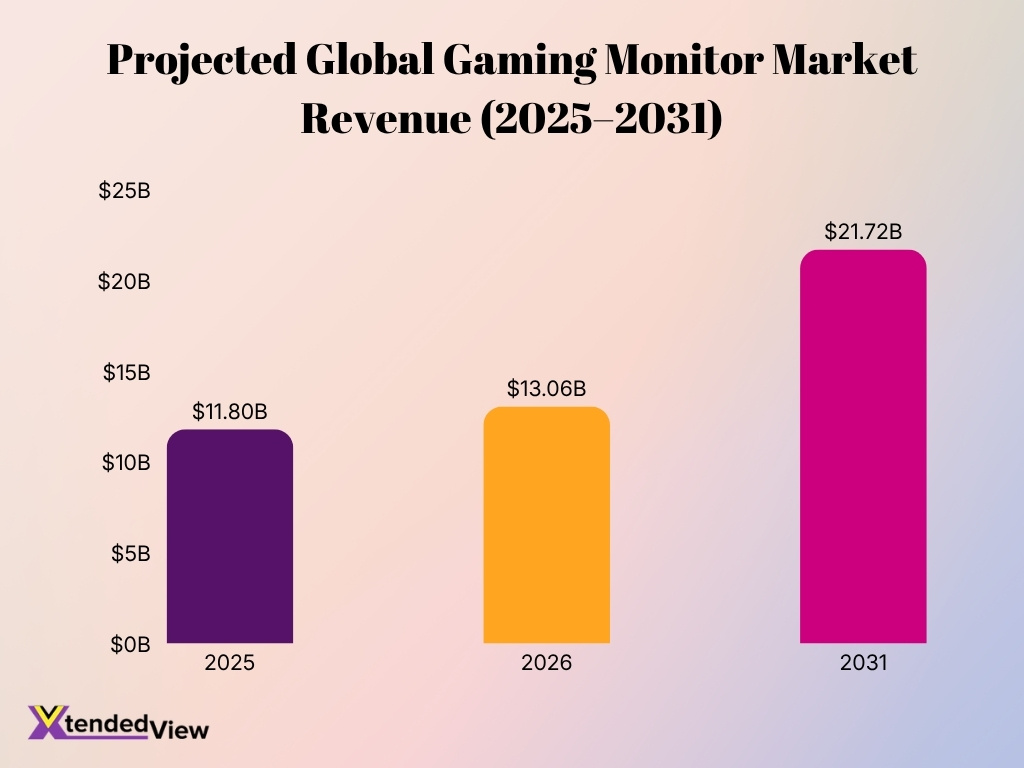
- One current estimate places the global gaming monitor market at $11.8 billion in 2025 and approximately $13.06 billion in 2026.
- Under that forecast, global revenue could reach $21.72 billion by 2031, representing a 10.7% CAGR from 2026 through 2031.
- Another 2026 market assessment puts global gaming monitor revenue at $12.09 billion in 2025 and forecasts $18.54 billion by 2031.
- That second forecast implies a 7.39% compound annual growth rate, illustrating how assumptions about pricing, product classification and regional demand can materially alter long-term estimates.
- A separate market model estimates $13.84 billion in 2025 revenue and projects the category to reach $29.24 billion by 2035.
- The corresponding long-range growth rate in that model is 7.8% annually between 2025 and 2035, supported by OLED adoption and demand for high-refresh-rate gaming displays.
- A more conservative assessment estimates the market at $8.4 billion in 2025, rising to $12.35 billion by 2032.
- That conservative outlook represents a 5.6% CAGR for 2026-2032. Taken together, current forecasts place long-term gaming monitor growth roughly in the mid-single-digit to low-double-digit range, depending on methodology.
Gaming Monitor Market Share by Region
- Asia-Pacific accounted for approximately 41% of the overall gaming monitor market in 2025 under one current global market estimate, giving it the leading regional position.
- North America represented 44% of worldwide OLED monitor shipments in 2024, making it the technology’s largest regional market before shipment strategies shifted in 2025.
- North America’s OLED monitor shipment share was expected to fall to 33% in 2025, partly as manufacturers diversified inventory toward other major regions.
- Europe’s OLED monitor share increased from 28% in 2024 to roughly 33% in 2025, putting the region approximately level with North America.
- China’s portion of global OLED monitor shipments expanded from 14% in 2024 to about 21% in 2025, supported partly by demand from gaming cafés and the broader domestic gaming market.
- Combined, North America, Europe and China accounted for more than 80% of global OLED monitor shipments, concentrating premium OLED demand in three major consumer markets.
- Within the 1080p gaming monitor submarket, Asia-Pacific represented an estimated 41.60% of 2025 revenue, compared with 24.75% for North America.
- Europe generated an estimated 21.72% of 1080p gaming monitor revenue in 2025, while Latin America represented 7.89% and the Middle East and Africa accounted for 4.03%.
- The 27-inch gaming monitor segment showed a similar geographic pattern in 2025: Asia-Pacific held an estimated 43.06%, followed by North America at 24.67% and Europe at 22.28%.
Gaming Monitor Revenue and Shipment Statistics
- Global LCD gaming monitor panel shipments above 144 Hz reached 32.42 million units in 2024, an increase of 12% year over year.
- LCD gaming monitor panel shipments were forecast to reach approximately 34 million units in 2025, representing about 5% annual growth as the mature LCD category expanded more slowly.
- OLED gaming monitor panel shipments grew 132% in 2024, following the wider rollout of 27-inch and 31.5-inch OLED gaming displays.
- A later assessment calculated 3.3 million OLED monitor panels shipped in 2025, representing 72.2% year-over-year growth.
- Global finished OLED monitor shipments reached approximately 507,000 units in Q1 2025, up 175% year over year as new product launches expanded availability.
- Q3 2025 OLED monitor shipments reached 644,000 units, increasing 12% sequentially and 65% year over year.
- China-based LCD gaming panel suppliers recorded particularly strong 2024 gains: HKC increased shipments by nearly 50%, CSOT by about 40%, and BOE by more than 20%.
- Global trade records tracked 2,933 gaming monitor export shipments from June 2024 through May 2025, involving 494 verified exporters and 972 buyers, with shipment activity changing by 49% year over year in that dataset.
- China alone accounted for 1,617 tracked gaming monitor export shipments over that June 2024-May 2025 window, with recorded shipment activity increasing 72% year over year.
Gaming Monitor Adoption Rate Among Gamers
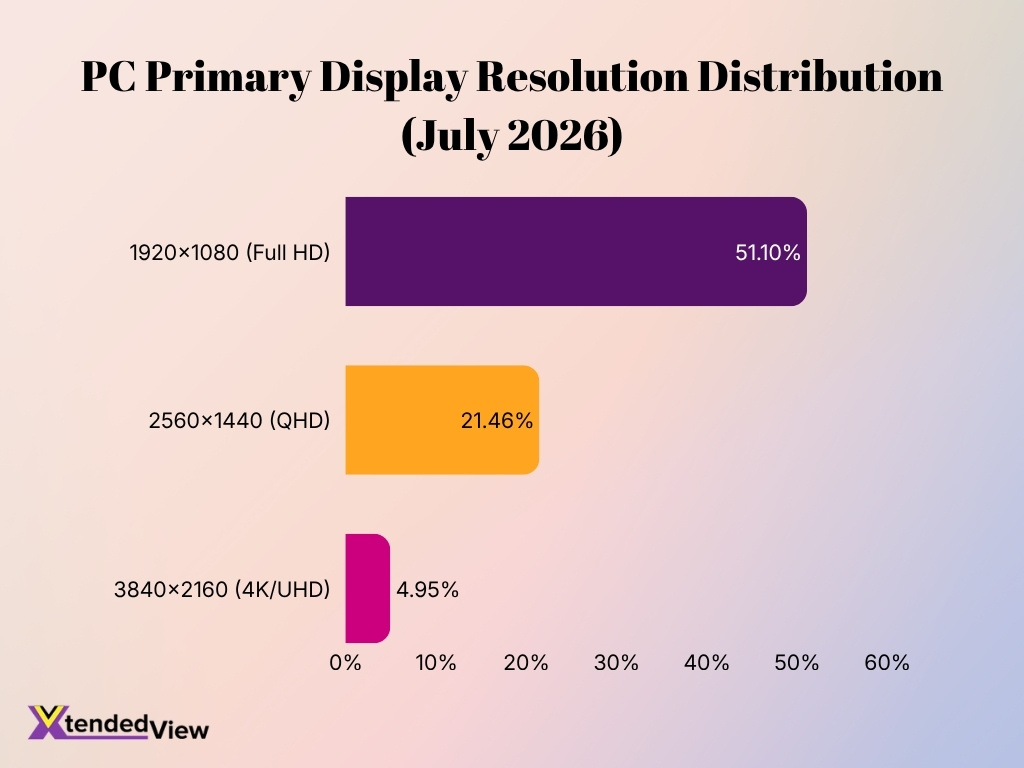
- In July 2026, 51.10% of surveyed PC systems used 1920×1080 as their primary display resolution, showing that Full HD remains the largest installed-base resolution despite rapid growth in higher-resolution gaming screens.
- 2560×1440 accounted for 21.46% of primary displays in the same 2026 survey, making QHD the clear No. 2 resolution and an important target for gaming monitor vendors.
- Native 3840×2160 represented 4.95% of primary displays, indicating that 4K PC gaming remains a smaller installed-base segment despite its strong presence in premium monitor lineups.
- Looking specifically at Windows systems in July 2026, Full HD represented 52.87% of primary displays, confirming that 1080p remains particularly entrenched within the dominant PC gaming operating-system ecosystem.
- In the same Windows dataset, QHD reached 22.08%, while native 4K accounted for 5.01%, highlighting the large gap that still exists between mainstream QHD adoption and 4K.
- A separate 2026 enthusiast poll of 6,476 respondents found that 36% preferred 2560×1440 for gaming, making QHD the most popular resolution among the poll’s participants.
- In that enthusiast sample, 1080p and 4K each captured about 22% of preferences. The near tie differs sharply from the broader installed-base data, suggesting enthusiasts upgrade displays faster than the general PC population.
- Ultrawide 3440×1440 attracted about 14% of respondents in the same poll, giving ultrawide gaming a meaningful niche despite its much smaller presence than standard 16:9 QHD.
- A 2025 PC-gaming setup poll with 717 respondents found 41.8% used dual monitors, compared with 33.9% using one conventional display, 11.7% using a single ultrawide and 12.6% using more than two monitors. This smaller community sample should be treated as directional rather than representative of all gamers.
Gaming Monitor Resolution Usage Statistics
- The worldwide 1080p gaming monitor segment generated an estimated $8.45 billion in 2025. It could reach $11.31 billion by 2032, indicating that Full HD still has a large commercial base even as buyers move toward sharper displays.
- The 1080p gaming monitor segment carries a projected 4.25% CAGR from 2025 to 2032, substantially slower than the growth forecast for higher-resolution gaming screens.
- The worldwide 1440p gaming monitor market reached about $5.07 billion in 2025, up 9.43% from the prior year in one current market estimate.
- QHD gaming monitor revenue is projected to rise to $5.47 billion in 2026, an increase of approximately 7.75% from 2025.
- By 2032, the 1440p gaming monitor segment could reach $9.42 billion, representing a 9.24% CAGR from its 2025 base.
- Within the 27-inch gaming monitor segment, QHD generated approximately 64.97% of 2025 revenue, compared with 21.87% for Full HD and 13.15% for UHD. This makes 2560×1440 particularly important in the most widely adopted desktop size class.
- The worldwide UHD gaming monitor market reached about $3.55 billion in 2025 and is projected to climb to $10.18 billion by 2032.
- UHD gaming monitors carry a projected 16.24% CAGR through 2032, making 4K one of the faster-growing resolution segments despite its smaller current installed base.
Gaming Monitor Refresh Rate Preferences
- Among 1440p gaming monitors, the 144 Hz to 180 Hz range generated about $2.56 billion in 2025 and held 50.48% of segment revenue.
- The 181 Hz to 240 Hz QHD segment generated approximately $1.75 billion in 2025, equal to 34.44% of revenue.
- QHD gaming monitors above 240 Hz captured 15.08% of 2025 segment revenue, or about $764.7 million. This smaller tier primarily serves competitive players and enthusiasts.
- Combined, QHD monitors operating at 181 Hz or faster represented 49.52% of 2025 QHD gaming monitor revenue, nearly matching the 144 Hz to 180 Hz category.
- Within the 1080p gaming monitor market, 144 Hz to 165 Hz held 65.18% of 2025 revenue, maintaining its position as the dominant Full HD refresh-rate range.
- Full HD monitors running at 240 Hz or faster accounted for 24.77% of 2025 revenue, illustrating the continuing role of lower-resolution screens in esports-oriented setups.
- The slower 75 Hz to 120 Hz Full HD segment represented only 10.05% of 2025 gaming-monitor revenue, showing how strongly the category has shifted toward high-refresh displays.
- Competitive display development reached 500 Hz QHD OLED products during the 2025-2026 product cycle, while some dual-resolution gaming designs have demonstrated operating modes reaching as high as 1,000 Hz at lower resolutions.
Gaming Monitor Panel Type Market Share
- IPS is expected to account for approximately 46% of the global gaming monitor market in 2026, giving it the largest share among panel technologies.
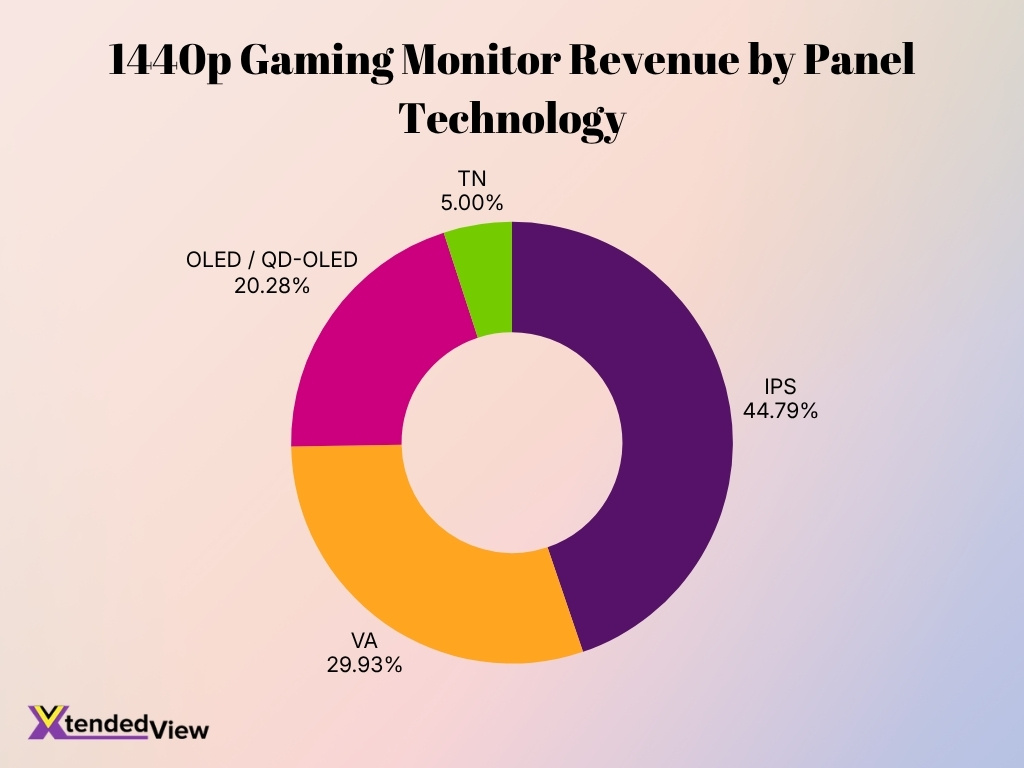
- In the 1440p gaming monitor segment, IPS generated $2.27 billion in 2025, representing 44.79% of revenue.
- VA panels accounted for approximately 29.93% of QHD gaming monitor revenue in 2025, equal to about $1.52 billion.
- OLED and QD-OLED captured 20.28% of 1440p gaming monitor revenue in 2025, already giving self-emissive displays roughly one-fifth of this higher-value resolution segment.
- TN represented only 5% of QHD gaming monitor revenue in 2025, reflecting its shrinking role outside highly competitive gaming applications.
- IPS had an even larger position in the 1080p segment, accounting for 53.94% of 2025 Full HD gaming monitor revenue.
- VA captured 33.25% of 1080p gaming monitor revenue in 2025, retaining a sizeable market among users who prioritize stronger native contrast at mainstream prices.
- TN held 12.81% of Full HD gaming monitor revenue in 2025. Its share was more than twice its QHD share, reflecting stronger use in lower-resolution, high-frame-rate esports displays.
Gaming Monitor Size Preferences and Trends
- The 27-inch to 32-inch category is expected to capture about 41% of the overall gaming monitor market in 2026, making it the leading screen-size segment.
- A separate 2025 segmentation estimate placed 24-inch to 27-inch monitors at approximately 38% of global gaming monitor demand, reflecting their continued popularity in mainstream and esports setups.
- The worldwide 27-inch gaming monitor market generated approximately $4.24 billion in 2025.
- The 27-inch segment is projected to grow to $4.83 billion in 2026, representing an estimated 13.88% year-over-year increase.
- By 2032, worldwide 27-inch gaming monitor revenue could reach $8.23 billion, nearly double the 2025 level.
- Within UHD gaming monitors, screens measuring 27 to 32 inches captured 68.65% of 2025 revenue, equivalent to about $2.44 billion.
- UHD gaming monitors larger than 32 inches represented 31.35% of 2025 revenue, or approximately $1.11 billion, showing meaningful demand for large-format premium gaming screens.
- One current size-segmentation estimate divides the broader market into 42.5% for 24-27 inches, 31.2% for 28-32 inches, 15.3% below 24 inches and 11% above 32 inches, further illustrating the concentration around desktop-friendly mid-size panels.
Gaming Monitor Price Range Distribution
- Entry-level gaming monitors in major Asia-Pacific markets generally occupy the $150 to $300 range, typically pairing Full HD resolution with lower or mainstream high-refresh-rate specifications.
- Mainstream gaming monitors commonly fall between $300 and $600, where buyers can find 1080p or 1440p IPS displays offering refresh rates from roughly 144 Hz to 240 Hz.
- Premium gaming monitors typically range from $600 to $1,200, with common features including 1440p or 4K resolution, 240-360 Hz refresh rates, HDR and curved or ultrawide panels.
- Flagship OLED and Mini-LED configurations can exceed $1,200, particularly when screen sizes, ultrawide formats and high-end HDR specifications increase.
- The display panel itself can represent approximately 50% to 65% of a gaming monitor’s bill of materials, making panel technology one of the largest influences on final retail price.
- In China, mainstream 27-inch QHD 165-180 Hz Fast IPS gaming monitors were commonly priced around $170 to $250 in 2026, reflecting intense panel competition and large domestic manufacturing capacity.
- Prices for comparable mainstream Chinese gaming monitor specifications have fallen approximately 5% to 8% per year over the past three years, helping bring QHD and faster refresh rates into lower price tiers.
- By August 2026, promotional pricing had pushed several 27-inch 1440p QD-OLED monitors to roughly $299-$350, compared with launch or list prices often around $450-$500, showing how quickly OLED pricing has moved toward the mainstream.
Gaming Monitor Brand Market Share
- Samsung held 18.9% of global gaming monitor revenue in the latest full-year measurement reported in 2026, retaining the No. 1 overall position.
- Samsung also controlled approximately 26% of the OLED gaming monitor segment under the corresponding gaming-specific market-share measurement.
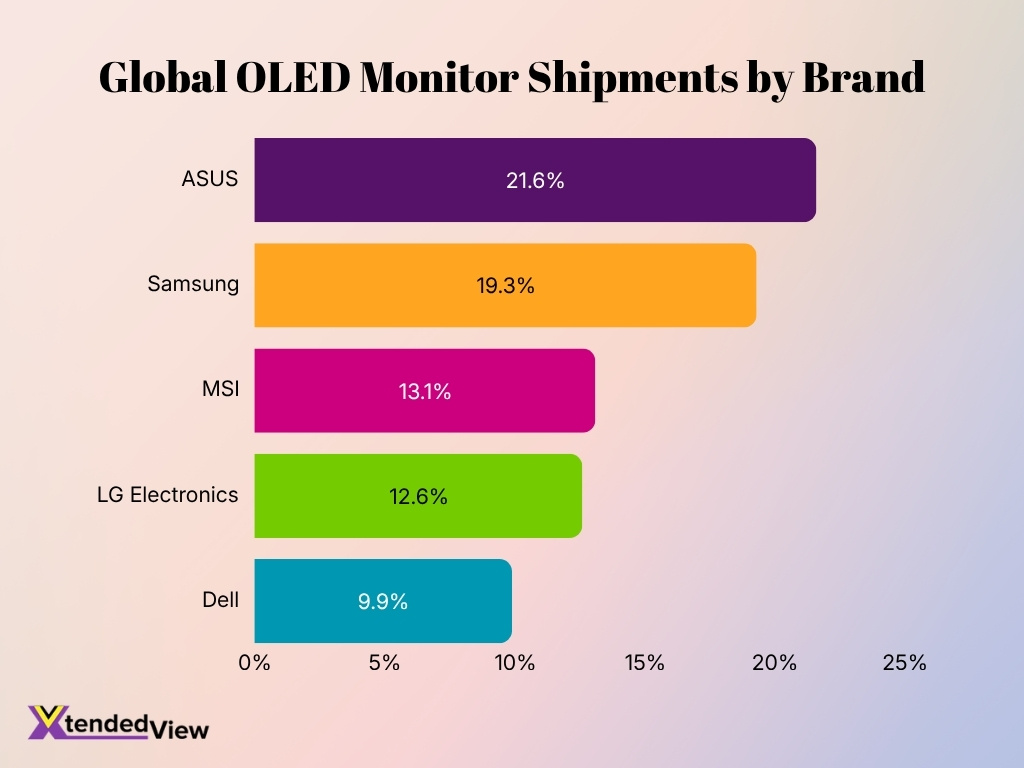
- In a separate unit-shipment measure covering all OLED monitors, ASUS finished 2025 with a 21.6% share, ranking first globally.
- Samsung followed with 19.3% of 2025 OLED monitor shipments, leaving only a 2.3-percentage-point gap between the top two brands.
- MSI captured 13.1% of global OLED monitor shipments in 2025, placing it third in that market.
- LG Electronics held approximately 12.6% of 2025 OLED monitor shipments, ranking fourth while maintaining a strong position in larger OLED screen formats.
- Dell accounted for 9.9% of global OLED monitor shipments in 2025, placing it fifth in the annual ranking.
- Competition shifted further in early 2026: ASUS increased its OLED monitor shipment share to 24% in Q1 2026, while Samsung held 16.4%, MSI 12.2% and AOC/Philips 12.1%.
OLED Gaming Monitor Market Growth
- Global finished OLED monitor shipments reached 2.735 million units in 2025, representing a 92% increase year over year.
- OLED monitor shipments are forecast to grow another 51% in 2026, which would put annual finished-product shipments at roughly 4.13 million units if the forecast is achieved.
- Despite normal seasonal weakness, Q1 2026 OLED monitor shipments were 78% higher than Q1 2025, underscoring how quickly the category continues to expand.
- Sequentially, Q1 2026 OLED shipments declined 11% from Q4 2025, partly because strong year-end promotions had pulled some purchases forward into the previous quarter.
- OLED monitor panel shipments reached approximately 3.3 million units in 2025, an increase of 72.2% from the previous year. Panel shipments measure upstream display components rather than finished monitor sales.
- OLED monitor panel shipments are forecast to rise to 4.7 million units in 2026, representing another 38.7% annual increase.
- QD-OLED represented approximately 73% of OLED monitor shipments in 2025, up from 68% in 2024, showing how strongly the technology has established itself within desktop OLED products.
- By 2030, OLED monitor panel shipments are projected to reach approximately 10.1 million units annually. Forecast annual growth from 2027 onward is expected to settle into a 25% to 32% range as the category moves beyond its early high-growth phase.
Gaming Monitor Sales by Distribution Channel
- Online channels accounted for an estimated 55% of global gaming monitor sales in 2025, giving e-commerce the largest distribution-channel share.
- A separate 2026 market assessment puts online gaming monitor sales at 54.7% of the 2025 market, closely supporting the roughly 55% estimate.
- Another current estimate places the online channel somewhat higher at 58.3% of 2025 sales, showing that estimates vary according to the products, retailers, and markets included.
- Under the 58.3% estimate, offline channels accounted for the remaining 41.7% of gaming monitor sales in 2025.
- Major e-commerce marketplaces and manufacturer websites represented approximately 64% of online gaming monitor sales in one 2025 channel analysis.
- Specialized gaming and manufacturer-direct stores generated an estimated 18% to 22% of online sales, illustrating the growing role of direct-to-consumer distribution.
- Affiliate marketing and partnerships with gaming creators were estimated to influence approximately 15% to 18% of online gaming monitor sales, linking hardware purchasing with esports and gaming content.
- Looking at the broader gaming PC and monitor category, online retail represented 52.78% of 2025 revenue, while physical and specialty retail generated 47.22%. The split supports the wider trend toward online purchasing without eliminating the role of physical stores.
Gaming Monitor User Demographics
- Approximately 212.3 million Americans ages 5 to 90 play video games for at least one hour per week in 2026, up 7.2 million from 2025.
- That total represents 67% of Americans ages 5 to 90, compared with 64% in 2025 and 61% in 2024. Gaming monitor manufacturers therefore operate within a growing U.S. gaming population.
- The average U.S. video game player reached 37 years old in 2026, one year older than the average of 36 reported in 2025.
- Men represent 53% of U.S. players, while women account for 46%. The near-even split shows that the broader addressable gaming hardware market extends well beyond the traditional young-male stereotype.
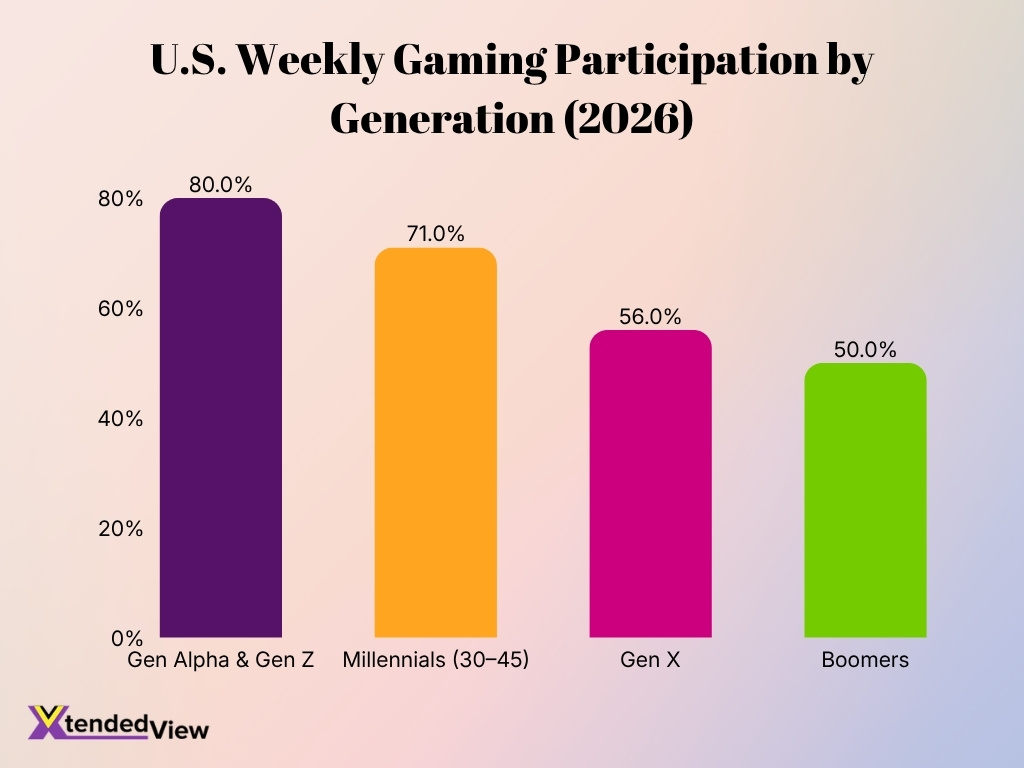
- More than 80% of both Gen Alpha and Gen Z in the U.S. play video games weekly in 2026, creating a substantial future audience for entry-level and performance gaming displays.
- Among Millennials ages 30 to 45, 71% play video games weekly, showing that gaming hardware demand extends well into working-age households with purchasing power.
- Gaming remains common among older consumers as well: 56% of Gen X and 50% of Boomers report weekly play in 2026.
- PCs were used for gaming in 52% of U.S. households that played on at least one video game device in the latest 2026 data, compared with 44% for consoles and 10% for VR. That PC footprint provides a large potential base for dedicated monitor demand.
- U.S. video game consumer spending reached $60.7 billion in 2025, including $5.4 billion on hardware and $2.95 billion on accessories. This spending environment supports demand for displays alongside PCs, consoles and peripherals.
Gaming Monitor Upgrade Cycle Statistics
- Current market estimates put the typical gaming monitor replacement cycle at approximately 4 to 5 years in 2026, compared with an estimated two to three years during the 2015-2020 period.
- In mature markets, gaming monitor upgrade cycles also average roughly 4 to 5 years, while some faster-growing markets show shorter cycles as gamers move from basic displays to 144 Hz-and-faster products.
- India’s gaming monitor upgrade cadence is estimated at three to four years, roughly one year shorter than the typical mature-market range.
- Across Asia, the average gaming monitor replacement cycle is forecast at approximately 4.2 years in 2026.
- That Asian replacement interval could extend to approximately 4.8 to 5 years by 2035 as display technologies mature and year-to-year improvements become less dramatic.
- The shift to faster displays remains an upgrade catalyst: LCD gaming monitor panels above 144 Hz reached 32.42 million shipments in 2024, up 12% year over year.
- Shipments of those high-refresh LCD gaming panels were forecast to reach approximately 34 million units in 2025, showing that refresh-rate upgrades continued even as LCD gaming panel growth slowed.
- OLED creates another replacement trigger. OLED monitor panel shipments increased 72.2% in 2025, reaching 3.3 million units, as more gamers gained access to high-refresh self-emissive displays.
- Gaming monitor shipments themselves jumped 50.2% in 2025, reaching 41 million units. That growth greatly exceeded the 4.3% increase in total desktop monitor shipments and indicates that gaming-specific upgrades contributed disproportionately to market expansion.
Gaming Monitor vs TV Usage for Gaming
- In 2026, 52% of U.S. gaming households played on PCs, while 44% played on consoles. Because households can use multiple platforms, these percentages overlap rather than representing exclusive groups.
- Among individual U.S. players, platform crossover is substantial: only 15% were PC-only gamers in the 2026 survey, while another 13% combined PC and console gaming without mobile, and additional players used all three major platforms.
- Globally, a 2025 survey across 21 countries found 21% of active players named a computer or laptop as their favorite gaming device, equal to the combined console/handheld share of 21%. Mobile led at 55%.
- Gaming monitor shipments reached 41 million units in 2025, demonstrating that dedicated desktop gaming displays maintain significant demand despite widespread access to gaming-capable TVs.
- Gaming monitors represented 31.1% of all desktop monitor shipments in 2025, making performance displays nearly one-third of the monitor market.
- Modern gaming TVs can support 4K at 120 Hz through HDMI 2.1, narrowing the historical refresh-rate gap between televisions and monitors for console and living-room PC gaming.
- TV latency remains an important differentiator: display processing on unsuitable TVs can introduce 50 to 100 milliseconds of delay, although gaming modes on newer televisions can reduce the problem substantially.
- For desk-based TV use, a latency target below 30 milliseconds is recommended for gaming, while competitive gaming monitors increasingly prioritize much lower response latency and refresh rates well beyond 120 Hz.
- Dedicated gaming monitors are forecast to reach 43 million shipments in 2026, up about 4.9% from 2025. The continued expansion suggests TVs are complementing rather than replacing gaming monitors in performance-focused PC setups.
Gaming Monitor Market Forecast and Projections
- Worldwide gaming monitor shipments are forecast to reach 43 million units in 2026, compared with 41 million in 2025.
- That shipment forecast represents approximately 4.9% year-over-year growth in 2026 after the unusually strong 50.2% expansion recorded in 2025.
- One current revenue forecast values the global gaming monitor market at $8.7 billion in 2025 and projects it to reach $12.9 billion in 2032, equivalent to a 5.8% CAGR.
- Under that forecast, the U.S. gaming monitor market was worth an estimated $2.7 billion in 2025, while China’s market could reach $3 billion by 2032 with a 9% CAGR.
- High-frame-rate gaming monitors form a faster-growing submarket, with estimated revenue rising from $6.29 billion in 2025 to $6.92 billion in 2026 and a projected $12.05 billion by 2032.
- The 27-inch gaming monitor segment is projected to grow from $4.24 billion in 2025 to $8.23 billion in 2032, representing a 9.94% CAGR.
- QHD gaming monitor revenue is projected to increase from $5.07 billion in 2025 to $9.42 billion by 2032, representing a 9.24% CAGR.
- UHD gaming monitors have a faster projected trajectory, rising from $3.55 billion in 2025 to $10.18 billion in 2032, equivalent to a 16.24% CAGR under one current forecast.
- OLED monitor panel shipments are forecast to climb from 4.7 million units in 2026 to 10.1 million by 2030. From 2027 onward, annual OLED panel shipment growth is expected to remain within roughly 25% to 32%.
Frequently Asked Questions (FAQs)
Global gaming monitor shipments are forecast to reach 43 million units in 2026, following 41 million units in 2025.
Worldwide gaming monitor shipments increased 50.2% year over year in 2025, reaching 41 million units and representing 31.1% of all desktop monitor shipments.
The No. 1 gaming monitor brand held 18.9% of global market revenue in the latest 2025 measurement, maintaining the top ranking for a seventh consecutive year.
Global OLED monitor shipments are forecast to increase 51% year over year in 2026, after reaching 2.735 million units and growing 92% in 2025.
The leading OLED monitor brand captured 21.6% of global shipments in 2025, followed by the second-ranked brand at 19.3% and the third-ranked brand at 13.1%.
Conclusion
Gaming Monitor Statistics show a market that is expanding not only in shipment volume, but also in technological sophistication. Global gaming monitor shipments reached 41 million units in 2025 and are forecast to rise to approximately 43 million in 2026, while gaming models already account for 31.1% of worldwide desktop monitor shipments. QHD remains a major performance sweet spot for PC gamers, while 4K adoption continues to rise as graphics hardware improves and premium display prices gradually decline.
At the same time, OLED is becoming one of the industry’s strongest growth drivers, supported by faster refresh rates, improved panel availability, and wider competition among monitor brands. High-refresh LCD displays still dominate much of the mainstream market, but OLED, QD-OLED and advanced 4K products are increasingly shaping premium demand. Overall, the data suggests that gaming monitors will continue moving toward higher resolutions, faster refresh rates, larger screen sizes, and more advanced panel technologies as both competitive and immersive gaming experiences become more demanding.
